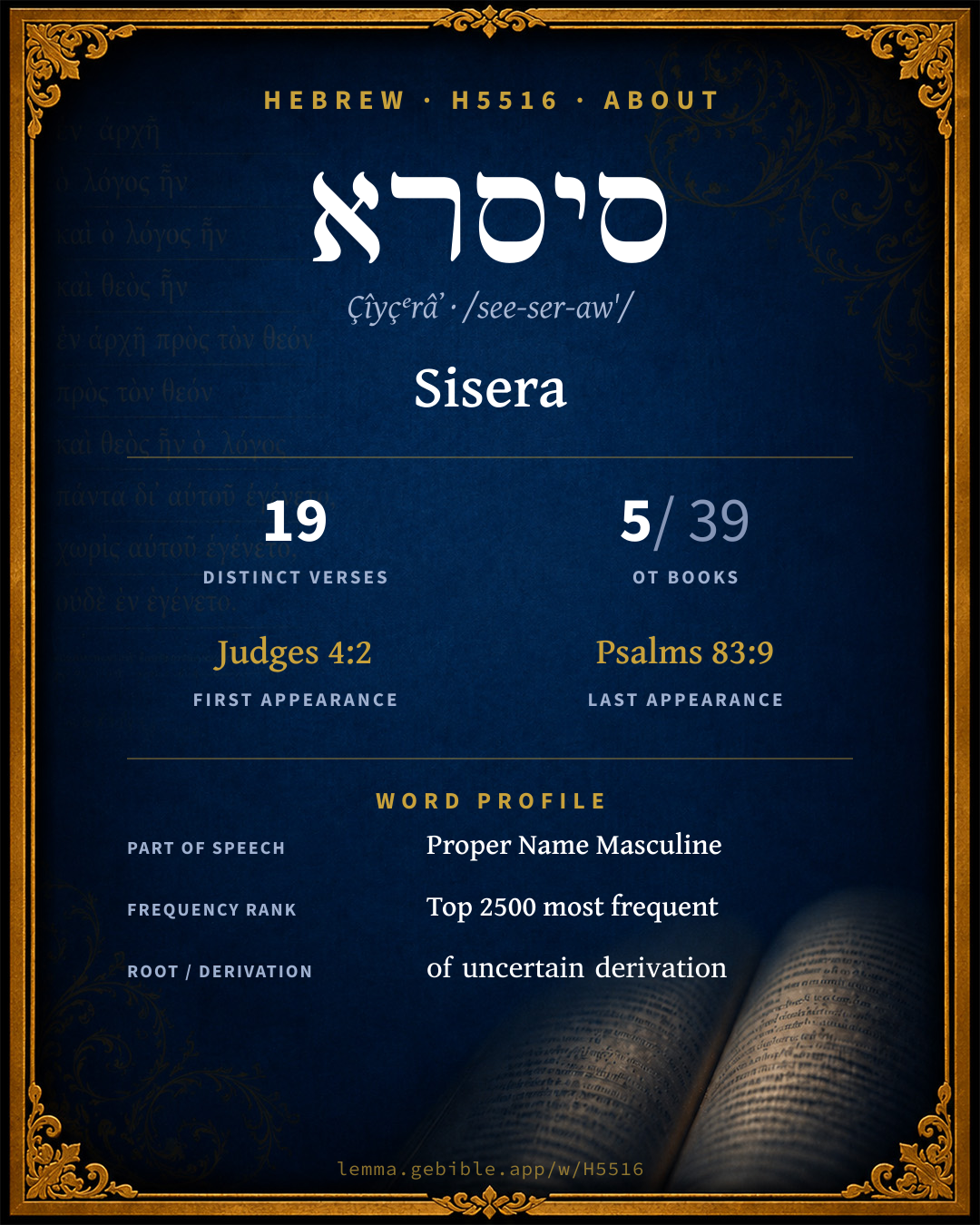
סִיסְרָא
Sisera
BDB lists 3 entries for ‘Sisera’ fuller range ↓
Full lexicon entry — Brown-Driver-Briggs (BDB)
From Brown-Driver-Briggs (BDB)
Where this word appears
Grammar key — what these labels mean
Part of speech
- Noun
- A naming word — a person, place, thing, or idea.
Noun type
- Proper
- A name of a specific person, place, or people (e.g. Abraham, Zion, Israel).
Every verse where H5516 appears in the Book of Judges — 15 distinct verses. Click any verse to open its interlinear word-by-word view. Verse text shown in the World English Bible for context — . Each verse’s Hebrew form is shown with its reference; the English is not keyword-highlighted, since the data carries no word-level English alignment. Use “Compare translations” on any verse to read it across multiple English versions. This concordance covers the Hebrew Bible; Septuagint (Greek Old Testament) occurrences are not indexed here.
Judges
- Judges 4:2 סִֽיסְרָ֔א n Proper Yahweh sold them into the hand of Jabin king of Canaan, who reigned in Hazor; the captain of whose host was Sisera, who lived in Harosheth of the Gentiles.
- Judges 4:7 סִֽיסְרָא֙ n Proper I will draw to you, to the river Kishon, Sisera, the captain of Jabin's army, with his chariots and his multitude; and I will deliver him into your hand.
- Judges 4:9 סִֽיסְרָ֑א n Proper She said, I will surely go with you: notwithstanding, the journey that you take shall not be for your honor; for Yahweh will sell Sisera into the hand of a woman. Deborah arose, and went with Barak to Kedesh.
- Judges 4:12 לְ/סִֽיסְרָ֑א prep + n Proper They told Sisera that Barak the son of Abinoam was gone up to Mount Tabor.
- Judges 4:13 סִֽיסְרָ֜א n Proper Sisera gathered together all his chariots, even nine hundred chariots of iron, and all the people who were with him, from Harosheth of the Gentiles, to the river Kishon.
- Judges 4:14 סִֽיסְרָא֙ n Proper Deborah said to Barak, Up; for this is the day in which Yahweh has delivered Sisera into your hand; hasn't Yahweh gone out before you? So Barak went down from Mount Tabor, and ten thousand men after him.
- Judges 4:15 סִֽיסְרָ֨א סִֽיסְרָ֛א n Proper n Proper Yahweh confused Sisera, and all his chariots, and all his host, with the edge of the sword before Barak; and Sisera alighted from his chariot, and fled away on his feet.
- Judges 4:16 סִֽיסְרָא֙ n Proper But Barak pursued after the chariots, and after the host, to Harosheth of the Gentiles: and all the host of Sisera fell by the edge of the sword; there was not a man left.
- Judges 4:17 וְ/סִֽיסְרָא֙ conj + n Proper However Sisera fled away on his feet to the tent of Jael the wife of Heber the Kenite; for there was peace between Jabin the king of Hazor and the house of Heber the Kenite.
- Judges 4:18 סִֽיסְרָא֒ n Proper Jael went out to meet Sisera, and said to him, Turn in, my lord, turn in to me; don't be afraid. He came in to her into the tent, and she covered him with a rug.
- Judges 4:22 סִֽיסְרָא֒ סִֽיסְרָא֙ n Proper n Proper Behold, as Barak pursued Sisera, Jael came out to meet him, and said to him, Come, and I will show you the man whom you seek. He came to her; and, behold, Sisera lay dead, and the tent-pin was in his temples.
- Judges 5:20 סִיסְרָֽא n Proper From the sky the stars fought, From their courses they fought against Sisera.
- Judges 5:26 סִֽיסְרָא֙ n Proper She put her hand to the tent-pin, Her right hand to the workmen's hammer; With the hammer she struck Sisera, she struck through his head; Yes, she pierced and struck through his temples.
- Judges 5:28 סִֽיסְרָ֖א n Proper Through the window she looked forth, and cried, The mother of Sisera [cried] through the lattice, Why is his chariot so long in coming? Why do the wheels of his chariots wait?
- Judges 5:30 לְ/סִ֣יסְרָ֔א prep + n Proper Have they not found, have they not divided the spoil? A lady, two ladies to every man; To Sisera a spoil of dyed garments, A spoil of dyed garments embroidered, Of dyed garments embroidered on both sides, on the necks of the spoil?
About this entry
At a glance — auto-summarized from this page’s data, not written by a person. Every figure links to its source below. This summary describes the numbers; it doesn’t interpret them.
At its core, סיסרא (Çîyçᵉrâʼ) means “Sisera.” Its uses cluster heavily in Judges (79% of all occurrences). With 19 verses in 5 books, it is an uncommon word in the Hebrew Bible. First canonically at Judges 4:2, it enters the text early. Dig into 19-verse concordance and the renderings breakdown below.
Gloss history
Strong's 1890 vs modern scholarship
About this word
Strong's H5516 catalogs a Hebrew word from the Hebrew Old Testament.
These counts are not copied from any lexicon or concordance. They are computed here, from the morphology-tagged Hebrew Old Testament. What Lemma adds →
- 19
- distinct verses
- The word appears in 19 distinct verses.
- 5 / 39
- OT books
- The word appears in 5 of 39 Old Testament books.
- #1,462
- by frequency
- Top 2500 most frequent Hebrew words (rank 1,462 of 8,640 Hebrew words by occurrence).
View all 19 occurrences in the concordance →
By section of the Old Testament
By traditional corpus
Conventional, traditional groupings — biblical authorship is debated, so this is a traditional corpus grouping, not an authorship claim. Each share is this word’s portion of its verses in that division of the Hebrew canon. Each figure is a share of the word’s 19 distinct verses.
- Prophets (Nevi'im) 16 verses · 84%
- Writings (Ketuvim) 3 verses · 16%
How translations render this word
Counts come from each version’s own published word-to-Strong’s tagging or interlinear alignment — an approximate guide to how each version renders this word, not a word-level alignment the data otherwise carries. Because each total is that version’s own tagged count, the per-version totals vary from one another and need not match the appearance or distinct-verse counts above. These counts may also differ from a printed concordance because Lemma counts each distinctly tagged rendering and does not collapse phrase taggings into a single head-word total. This is a fixed set of word-tagged versions (KJV, ASV, BSB, ULT) and does not change with the reading translation you choose elsewhere. Each version’s license is shown beside its name below (and on Sources).
- King James Version: Sisera 17×
- American Standard Version: Sisera 17×
- Berean Standard Bible: Sisera 17×
- unfoldingWord Literal Text: Sisera 20×
King James Version Public Domain
Renders H5516 across 21 tagged occurrences — most commonly:
Plus 4 renderings that appear only once — usually multi-word phrases or single function words the recovered tagging swept in, not distinct renderings.
American Standard Version Public Domain
Renders H5516 across 20 tagged occurrences — most commonly:
Plus 3 renderings that appear only once — usually multi-word phrases or single function words the recovered tagging swept in, not distinct renderings.
Berean Standard Bible Public Domain
Renders H5516 across 20 tagged occurrences — most commonly:
Plus 3 renderings that appear only once — usually multi-word phrases or single function words the recovered tagging swept in, not distinct renderings. Not rendered by a distinct English word in 1 further occurrence.
unfoldingWord Literal Text CC BY-SA 4.0
Renders H5516 across 22 tagged occurrences — most commonly:
Plus 2 renderings that appear only once — usually multi-word phrases or single function words the recovered tagging swept in, not distinct renderings.
Senses in the full BDB
What do BDB’s symbols mean?
BDB uses these scholarly abbreviations:
| Symbol | Meaning |
|---|---|
| 𝔊 | the Septuagint (the ancient Greek translation, LXX) |
| 𝔙 | the Vulgate (the Latin translation) |
| 𝔖 | the Syriac version (the Peshitta) |
| 𝔗 | the Targum (the Aramaic translation) |
| ψ | the Psalms |
| √ | root (the underlying root or stem) |
| ‖ | parallel passage (a synonymous or contrasted parallel) |
| † | the dagger: every passage where the word occurs is cited |
The 2 senses and sub-senses the full Brown-Driver-Briggs lexicon distinguishes for this word, in lexicon order (not ranked by frequency), with BDB’s own verbatim wording and sub-sense lettering. Shown in Hebrew script with BDB’s own scholarly abbreviations. The condensed entry is in the Lexicon Entry tab. See also the Forms in the corpus table below.
- 1. general of Jabin, king of Hazor Ju 4:2 + 12 times Ju 4; appar. himself king 5:20, 26, 28, 30; cf. 1 S 12:9 ψ 83:10;—on ס׳ v. GFM Ju, 107 ff.; PAOS l.c.; 𝔊 Σ(ε)ισαρα. e.g. Judges 4:2
- 2. בְּנֵי־סִיסְרָא, returned exiles, Ezr 2:53 = Ne 7:55; 𝔊 Σεισαραθ, Σισαρα, etc. e.g. Ezra 2:53
Senses from the full Brown-Driver-Briggs lexicon (Brown, Driver, Briggs; Oxford 1906 — public domain), digitized via Sefaria, supplemented by the OpenScriptures HebrewLexicon (CC BY 4.0). Full attribution on Sources.
Word origin
n.pr.m. (GFM Ju 4:2; PAOS xix (1898), 160 cp. Hittite names in -sira);—
— Brown-Driver-Briggs (Oxford 1906, public domain), digitized via Sefaria, supplemented by the OpenScriptures HebrewLexicon (CC BY 4.0). See Sources.
Origin: of uncertain derivation
Jastrow Dictionary
A second Hebrew/Aramaic lexicon for comparison, covering Aramaic and post-biblical (Talmudic, Targumic, Midrashic) usage that the biblical-Hebrew BDB does not. Matched by lemma rather than by Strong’s number, so a lemma may carry more than one Jastrow headword (shown separately below), and the entries cover usage well beyond the Bible.
סִיסְרָא
- (b. h.) pr. n. m. Sisera,
- 1. captain of the army of Jabin king of Canaan. Ber. 58ᵃ (ref. to I Chr. XXIX, 11, a. Jud. V, 20) זו מלחמת ס׳ this refers to the warfare against S.—Num. R. s. 9; a. fr. e.g. 1 Chronicles 29:11
- 2. name of a gentile gardener. Y. Dem. II, 22ᶜ bot.
A Dictionary of the Targumim, the Talmud Babli and Yerushalmi, and the Midrashic Literature (Marcus Jastrow; London, Luzac, 1903) — Public Domain. Digitized via Sefaria. Digitized via Sefaria. Full attribution on Sources.
Forms in the corpus
The 14 distinct written forms H5516 takes in the Hebrew Bible, most frequent first — each parse links to that state’s occurrences in the concordance. Hebrew forms include their vowel points and cantillation, so a single lemma takes many written forms.
| Form | Parsing | Example | Uses |
|---|---|---|---|
| סִֽיסְרָא֙ | Noun, Proper | Judges 4:7 | 5 |
| סִֽיסְרָ֖א | Noun, Proper | Ezra 2:53 | 3 |
| סִֽיסְרָא֒ | Noun, Proper | Judges 4:18 | 2 |
| וְ/סִֽיסְרָא֙ | Noun, Proper | Judges 4:17 | 1 |
| כְּֽ/סִֽיסְרָ֥א | Noun, Proper | Psalms 83:9 | 1 |
| לְ/סִ֣יסְרָ֔א | Noun, Proper | Judges 5:30 | 1 |
| לְ/סִֽיסְרָ֑א | Noun, Proper | Judges 4:12 | 1 |
| סִֽיסְרָ֑א | Noun, Proper | Judges 4:9 | 1 |
| סִֽיסְרָ֔א | Noun, Proper | Judges 4:2 | 1 |
| סִֽיסְרָ֛א | Noun, Proper | Judges 4:15 | 1 |
| סִֽיסְרָ֜א | Noun, Proper | Judges 4:13 | 1 |
| סִֽיסְרָ֨א | Noun, Proper | Judges 4:15 | 1 |
| סִֽיסְרָא֩ | Noun, Proper | 1 Samuel 12:9 | 1 |
| סִיסְרָֽא | Noun, Proper | Judges 5:20 | 1 |
Bible dictionary
Public-domain dictionary articles matched to this entry by name (Sisera). A biblical name can be shared by more than one person or place, so an article may treat several.
Easton's Bible Dictionary · M. G. Easton, 1897
(Egypt. Ses-Ra, "servant of Ra"). (1.) The captain of Jabin's army (Judg. 4:2), which was routed and destroyed by the army of Barak on the plain of Esdraelon. After all was lost he fled to the settlement of Heber the Kenite in the plain of Zaanaim. Jael, Heber's wife, received him into her tent with apparent hospitality, and "gave him butter" (i.e., lebben, or curdled milk) "in a lordly dish." Having drunk the refreshing beverage, he lay down, and soon sank into the sleep of the weary. While he lay asleep Jael crept stealthily up to him, and taking in her hand one of the tent pegs, with a mallet she drove it with such force through his temples that it entered into the ground where he lay, and "at her feet he bowed, he fell; where he bowed, there he fell down dead." The part of Deborah's song (Judg. 5:24-27) referring to the death of Sisera (which is a "mere patriotic outburst," and "is no proof that purer eyes would have failed to see gross sin mingling with Jael's service to Israel") is thus rendered by Professor Roberts (Old Testament Revision):
"Extolled above women be Jael, The wife of Heber the Kenite, Extolled above women in the tent. He asked for water, she gave him milk; She brought him cream in a lordly dish. She stretched forth her hand to the nail, Her right hand to the workman's hammer, And she smote Sisera; she crushed his head, She crashed through and transfixed his temples. At her feet he curled himself, he fell, he lay still; At her feet he curled himself, he fell; And where he curled himself, there he fell dead."
(2.) The ancestor of some of the Nethinim who returned with Zerubbabel (Ezra 2:53; Neh. 7:55).
Smith's Bible Dictionary · William Smith, 1863
(battle array).
+ Captain of the army of Jabin king of Canaan, who reigned in Hazor. He himself resided in Harosheth of the Gentiles. The particulars of the rout of Megiddo and of Sisera's flight and death are drawn out under the heads of Barak, Deborah, Jael, Kishon. (B.C. 1296.) + After a long interval the name appears in the lists of Nethinim who returned from the captivity with Zerubbabel. (Ezra 2:53; Nehemiah 7:55) It doubtless tells of Canaanite captives devoted to the lowest offices of the temple. (B.C. before 536.)
Hitchcock's Bible Names Dictionary · Roswell D. Hitchcock, 1869
that sees a horse or a swallow
Classic public-domain reference works; full attribution on Sources.
Septuagint verse parallels
This word appears in 18 verses that also exist in the Greek Old Testament (Septuagint), out of the 19 Hebrew verses it occurs in. You can read those verses in Greek by switching the Old Testament edition to the Septuagint.
Read these verses in the Septuagint
This is a verse-level parallel only — the same verses exist in both the Hebrew and Greek Old Testaments. No word-level Hebrew↔Greek correspondence is claimed: the data carries no such alignment, so no Greek word is shown as this Hebrew word’s translation. Coverage is not total — the Septuagint omits the deuterocanon and renumbers the Psalms, so some Hebrew verses have no direct Greek parallel.