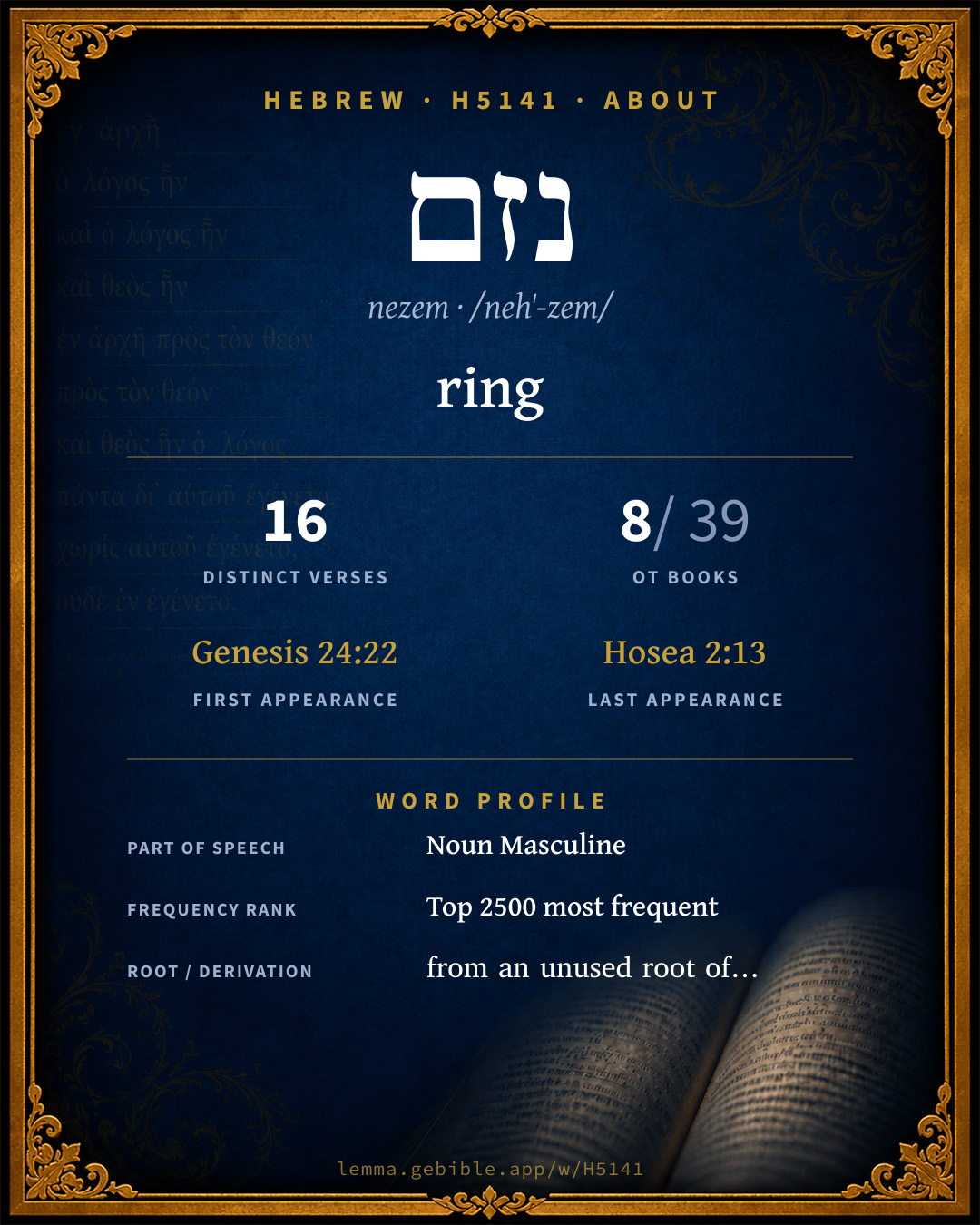
נֶ֫זֶם
ring
also: nose ring, earring fuller range ↓
Full lexicon entry — Brown-Driver-Briggs (BDB)
From Brown-Driver-Briggs (BDB)
Where this word appears
See every Construct-state word in the Hebrew Bible →
Grammar key — what these labels mean
Part of speech
- Noun
- A naming word — a person, place, thing, or idea.
Noun type
- Common
- A common noun — a general class of person, place, or thing (“king,” “city,” “water”), not a specific name.
State
- Construct
- A noun bound to a following noun in a possessive / “of” relationship (the construct chain).
- Absolute
- The independent form of a noun, not bound to a following word.
Gender
- Masculine
- Grammatically masculine.
Number
- Singular
- One.
- Plural
- More than one (in Hebrew, generally three or more).
Grammatical forms
- Noun, Common, Masculine, Singular, Construct 7 times (41%)
- Noun, Common, Masculine, Plural, Construct 5 times (29%)
- Noun, Common, Masculine, Singular, Absolute 4 times (24%)
- Noun, Common, Masculine, Plural, Absolute 1 time (6%)
Parsed forms decoded from the imported morphology (morphhb / Westminster Leningrad Codex — WLC text public domain, morphhb tagging CC BY 4.0), counted across 17 parsed occurrences — not distinct verses.
Every verse where H5141 appears — 16 distinct verses across 8 books. Click any verse to open its interlinear word-by-word view. Verse text shown in the World English Bible for context — . Each verse’s Hebrew form is shown with its reference; the English is not keyword-highlighted, since the data carries no word-level English alignment. Use “Compare translations” on any verse to read it across multiple English versions. This concordance covers the Hebrew Bible; Septuagint (Greek Old Testament) occurrences are not indexed here.
Genesis 4 verses
- Genesis 24:22 נֶ֣זֶם n c ms cs It happened, as the camels had done drinking, that the man took a golden ring of half a shekel weight, and two bracelets for her hands of ten shekels weight of gold,
- Genesis 24:30 הַ/נֶּ֗זֶם ptcl def.art + n c ms It happened, when he saw the ring, and the bracelets on his sister's hands, and when he heard the words of Rebekah his sister, saying, "This is what the man said to me," that he came to the man. Behold, he was standing by the camels at the spring.
- Genesis 24:47 הַ/נֶּ֨זֶם֙ ptcl def.art + n c ms I asked her, and said, 'Whose daughter are you?' She said, 'The daughter of Bethuel, Nahor's son, whom Milcah bare to him.' I put the ring on her nose, and the bracelets on her hands.
- Genesis 35:4 הַ/נְּזָמִ֖ים ptcl def.art + n c mp They gave to Jacob all the foreign gods which were in their hands, and the rings which were in their ears; and Jacob hid them under the oak which was by Shechem.
Exodus 3 verses
- Exodus 32:2 נִזְמֵ֣י n c mp cs Aaron said to them, "Take off the golden rings, which are in the ears of your wives, of your sons, and of your daughters, and bring them to me."
- Exodus 32:3 נִזְמֵ֥י n c mp cs All the people took off the golden rings which were in their ears, and brought them to Aaron.
- Exodus 35:22 וָ/נֶ֜זֶם conj + n c ms They came, both men and women, as many as were willing-hearted, and brought brooches, ear-rings, signet-rings, and armlets, all jewels of gold; even every man who offered an offering of gold to Yahweh.
Judges 3 verses
- Judges 8:24 נֶ֣זֶם נִזְמֵ֤י n c ms cs n c mp cs Gideon said to them, I would make a request of you, that you would give me every man the ear-rings of his spoil. (For they had golden ear-rings, because they were Ishmaelites.)
- Judges 8:25 נֶ֥זֶם n c ms cs They answered, We will willingly give them. They spread a garment, and did cast therein every man the ear-rings of his spoil.
- Judges 8:26 נִזְמֵ֤י n c mp cs The weight of the golden ear-rings that he requested was one thousand and seven hundred [shekels] of gold, besides the crescents, and the pendants, and the purple clothing that was on the kings of Midian, and besides the chains that were about their camels' necks.
Job 1 verse
Proverbs 2 verses
Isaiah 1 verse
Ezekiel 1 verse
Hosea 1 verse
About this entry
At a glance — auto-summarized from this page’s data, not written by a person. Every figure links to its source below. This summary describes the numbers; it doesn’t interpret them.
נזם — transliterated nezem — is a Hebrew noun carrying the sense “ring.” Debuting at Genesis 24:22, it then recurs through the corpus. The Hebrew Bible uses it across 16 verses — uncommon. More than a quarter of its appearances fall in Genesis. Alongside “ring” the lexicon also lists “nose ring” and “earring” — part of its full sense range. Each statement above links to its evidence; the full detail follows below.
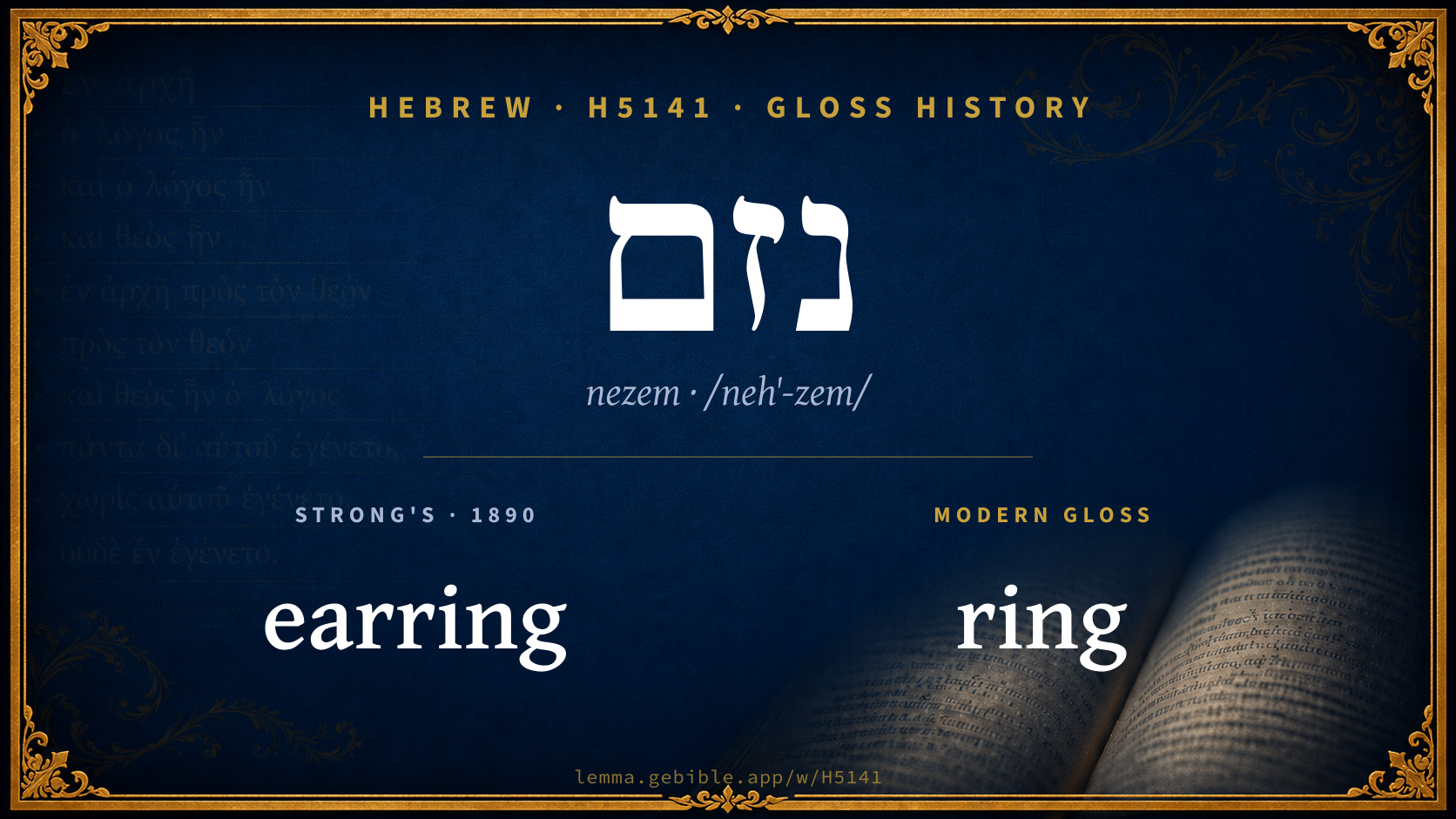
Gloss history
Strong's 1890 vs modern scholarship
About this word
Strong's H5141 catalogs a Hebrew word from the Hebrew Old Testament.
These counts are not copied from any lexicon or concordance. They are computed here, from the morphology-tagged Hebrew Old Testament. What Lemma adds →
- 16
- distinct verses
- The word appears in 16 distinct verses.
- 8 / 39
- OT books
- The word appears in 8 of 39 Old Testament books.
- #1,671
- by frequency
- Top 2500 most frequent Hebrew words (rank 1,671 of 8,640 Hebrew words by occurrence).
View all 16 occurrences in the concordance →
By section of the Old Testament
By traditional corpus
Conventional, traditional groupings — biblical authorship is debated, so this is a traditional corpus grouping, not an authorship claim. Each share is this word’s portion of its verses in that division of the Hebrew canon. Each figure is a share of the word’s 16 distinct verses.
- Torah (Pentateuch) 7 verses · 44%
- Prophets (Nevi'im) 6 verses · 38%
- Writings (Ketuvim) 3 verses · 19%
How translations render this word
Counts come from each version’s own published word-to-Strong’s tagging or interlinear alignment — an approximate guide to how each version renders this word, not a word-level alignment the data otherwise carries. Because each total is that version’s own tagged count, the per-version totals vary from one another and need not match the appearance or distinct-verse counts above. These counts may also differ from a printed concordance because Lemma counts each distinctly tagged rendering and does not collapse phrase taggings into a single head-word total. This is a fixed set of word-tagged versions (KJV, ASV, BSB, ULT) and does not change with the reading translation you choose elsewhere. Each version’s license is shown beside its name below (and on Sources).
- King James Version: Earrings 7×, Earring 5×, Jewel 2×
- American Standard Version: Ear-rings 5×, Ring 3×, Rings 3×
- Berean Standard Bible: Earrings 6×, Ring 6×, Earring 3×
- unfoldingWord Literal Text: Earring of 3×, Nose ring 3×, Rings of 3×
King James Version Public Domain
Renders H5141 across 17 tagged occurrences — most commonly:
Plus 3 renderings that appear only once — usually multi-word phrases or single function words the recovered tagging swept in, not distinct renderings.
American Standard Version Public Domain
Renders H5141 across 16 tagged occurrences — most commonly:
Plus 5 renderings that appear only once — usually multi-word phrases or single function words the recovered tagging swept in, not distinct renderings.
Berean Standard Bible Public Domain
Renders H5141 across 17 tagged occurrences — most commonly:
unfoldingWord Literal Text CC BY-SA 4.0
Renders H5141 across 18 tagged occurrences — most commonly:
Plus 3 renderings that appear only once — usually multi-word phrases or single function words the recovered tagging swept in, not distinct renderings.
Senses in the full BDB
What do BDB’s symbols mean?
BDB uses these scholarly abbreviations:
| Symbol | Meaning |
|---|---|
| 𝔊 | the Septuagint (the ancient Greek translation, LXX) |
| 𝔙 | the Vulgate (the Latin translation) |
| 𝔖 | the Syriac version (the Peshitta) |
| 𝔗 | the Targum (the Aramaic translation) |
| ψ | the Psalms |
| √ | root (the underlying root or stem) |
| ‖ | parallel passage (a synonymous or contrasted parallel) |
| † | the dagger: every passage where the word occurs is cited |
The 2 senses and sub-senses the full Brown-Driver-Briggs lexicon distinguishes for this word, in lexicon order (not ranked by frequency), with BDB’s own verbatim wording and sub-sense lettering. Shown in Hebrew script with BDB’s own scholarly abbreviations. The condensed entry is in the Lexicon Entry tab. See also the Forms in the corpus table below.
- 1. nose-ring (Syriac ܙܡܳܡܳܐ) woman’s ornament, נ׳ עַל־אַפָּהּ Gn 24:47 cf. v 22, 30 (J); נִזְמֵי הָאָף Is 3:21 (‖ טַבַּ֫עַת seal-ring); perhaps also Ho 2:15; Ez 16:12 fig. of י׳’s adoring Jerus. (‖ עֲגִילִים עַל־אָזְנַיִךְ); cf. נ׳ בְּאַף חֲזִיר Pr 11:22. e.g. Genesis 24:47
- 2. earring, ornament of men and women, Gn 35:4, נ׳ אֲשֶׁר בְּאָזְנֵיהֶם so Ex 32:2, 3 (all E); cf. Pr 25:12 (in sim. of wise reprover), and perhaps Ex 35:22 (P; ‖ טַבַּ֫עַת); prob. also Ju 8:24(×2), 25, 26 (of men, cf. GFM), Jb 42:11.—Cf. further GeiJüd. Zeitschr. x (1872), 45 ff. RSSem i. 434, 2d ed. 453; also ref. sub נזר. e.g. Genesis 35:4
Senses from the full Brown-Driver-Briggs lexicon (Brown, Driver, Briggs; Oxford 1906 — public domain), digitized via Sefaria, supplemented by the OpenScriptures HebrewLexicon (CC BY 4.0). Full attribution on Sources.
Word origin
n.m. Jb 42:11 ring, always of gold when material mentioned;—נ׳ abs. Gn 24:30 +; cstr. v 22 +; sf. נִזְמָהּ Ho 2:15; pl. נְזָמִים Gn 35:4; cstr. נִזְמֵי Ex 32:2 +;—
— Brown-Driver-Briggs (Oxford 1906, public domain), digitized via Sefaria, supplemented by the OpenScriptures HebrewLexicon (CC BY 4.0). See Sources.
Origin: from an unused root of uncertain meaning
Jastrow Dictionary
A second Hebrew/Aramaic lexicon for comparison, covering Aramaic and post-biblical (Talmudic, Targumic, Midrashic) usage that the biblical-Hebrew BDB does not. Matched by lemma rather than by Strong’s number, so a lemma may carry more than one Jastrow headword (shown separately below), and the entries cover usage well beyond the Bible.
נֶזֶם
- nose-ring, earring. Kel. XI, 9; a. e.—Pl. נְזָמִים. Ib. 8 נ׳ earrings; נִזְמֵי האף nose-rings. Sabb. VI, 1 בנ׳, expl. ib. 54ᵇ נזמי האף. Ex. R. s. 48, end; a. fr.
A Dictionary of the Targumim, the Talmud Babli and Yerushalmi, and the Midrashic Literature (Marcus Jastrow; London, Luzac, 1903) — Public Domain. Digitized via Sefaria. Digitized via Sefaria. Full attribution on Sources.
Forms in the corpus
The 12 distinct written forms H5141 takes in the Hebrew Bible, most frequent first — each parse links to that state’s occurrences in the concordance. Hebrew forms include their vowel points and cantillation, so a single lemma takes many written forms.
| Form | Parsing | Example | Uses |
|---|---|---|---|
| נֶ֣זֶם | Noun, Common, Masculine, Singular, Construct | Genesis 24:22 | 4 |
| נִזְמֵ֤י | Noun, Common, Masculine, Plural, Construct | Judges 8:24 | 2 |
| נֶ֥זֶם | Noun, Common, Masculine, Singular, Construct | Job 42:11 | 2 |
| הַ/נְּזָמִ֖ים | Noun, Common, Masculine, Plural, Absolute | Genesis 35:4 | 1 |
| הַ/נֶּ֗זֶם | Noun, Common, Masculine, Singular, Absolute | Genesis 24:30 | 1 |
| הַ/נֶּ֨זֶם֙ | Noun, Common, Masculine, Singular, Absolute | Genesis 24:47 | 1 |
| וְ/נִזְמֵ֥י | Noun, Common, Masculine, Plural, Construct | Isaiah 3:21 | 1 |
| וָ/נֶ֜זֶם | Noun, Common, Masculine, Singular, Absolute | Exodus 35:22 | 1 |
| נִזְמֵ֣י | Noun, Common, Masculine, Plural, Construct | Exodus 32:2 | 1 |
| נִזְמֵ֥י | Noun, Common, Masculine, Plural, Construct | Exodus 32:3 | 1 |
| נִזְמָ/הּ֙ | Noun, Common, Masculine, Singular, Construct | Hosea 2:13 | 1 |
| נֶ֨זֶם֙ | Noun, Common, Masculine, Singular, Absolute | Ezekiel 16:12 | 1 |
Septuagint verse parallels
This word appears in 16 verses that also exist in the Greek Old Testament (Septuagint), out of the 16 Hebrew verses it occurs in. You can read those verses in Greek by switching the Old Testament edition to the Septuagint.
Read these verses in the Septuagint
This is a verse-level parallel only — the same verses exist in both the Hebrew and Greek Old Testaments. No word-level Hebrew↔Greek correspondence is claimed: the data carries no such alignment, so no Greek word is shown as this Hebrew word’s translation. Coverage is not total — the Septuagint omits the deuterocanon and renumbers the Psalms, so some Hebrew verses have no direct Greek parallel.