
Nehemiah 11:7

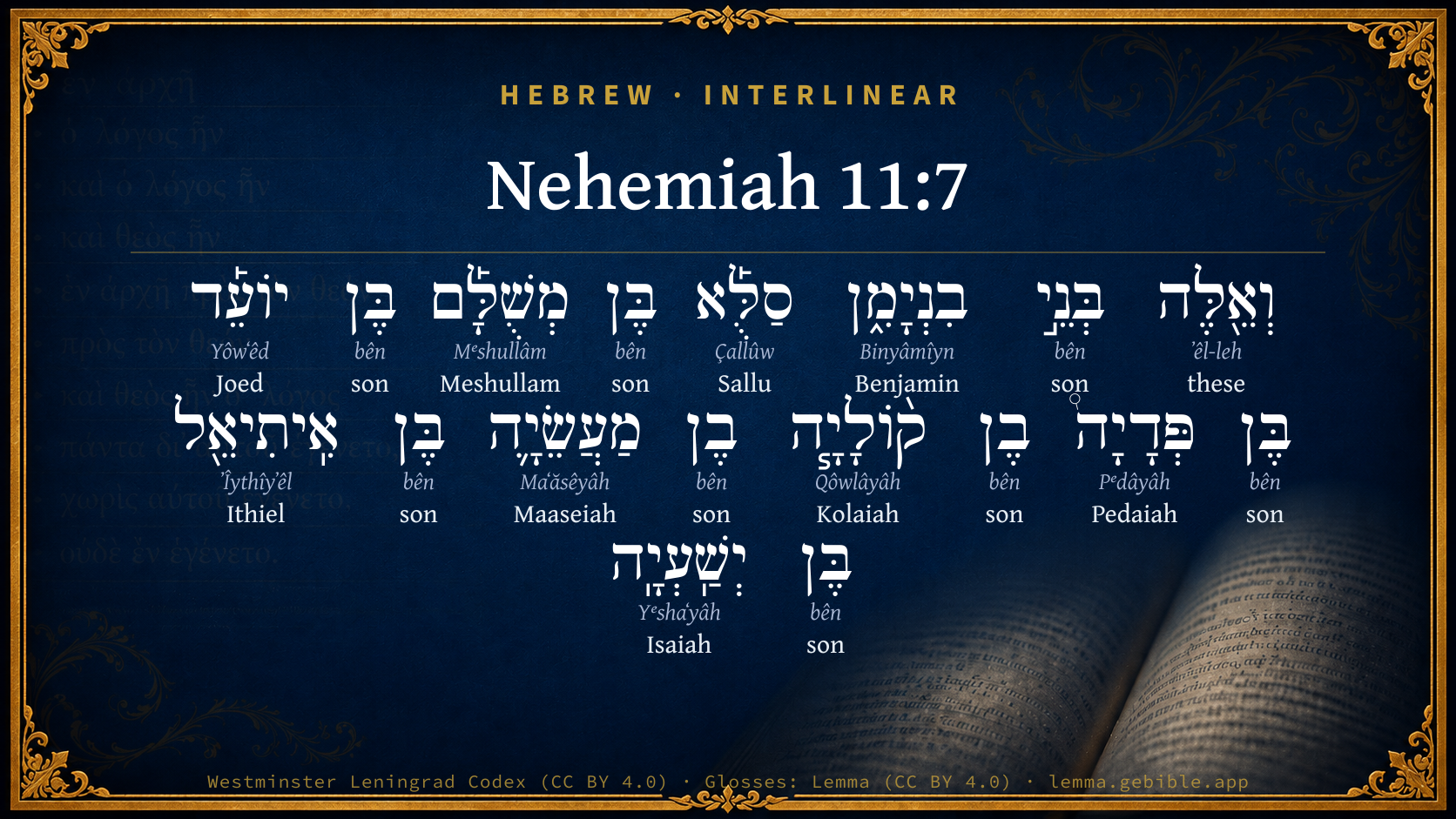
Hebrew (Westminster Leningrad Codex) Nehemiah 11:7 appears in the Hebrew Old Testament. The text above is from the Westminster Leningrad Codex. Each word links to its Strong’s number, a concise gloss, and parsing drawn from the Open Scriptures Hebrew Bible morphology. Click any word for its full Brown-Driver-Briggs (BDB) entry.
Download image
Cite this verse

Nehemiah 11:7 (World English Bible). Public Domain. Lemma interlinear Bible study tool, https://lemma.gebible.app/v/nehemiah/11/7.

Show BibTeX & RIS
BibTeX
RIS
English Translation
These are the sons of Benjamin: Sallu the son of Meshullam, the son of Joed, the son of Pedaiah, the son of Kolaiah, the son of Maaseiah, the son of Ithiel, the son of Jeshaiah.
World English Bible · Public Domain
Highlights
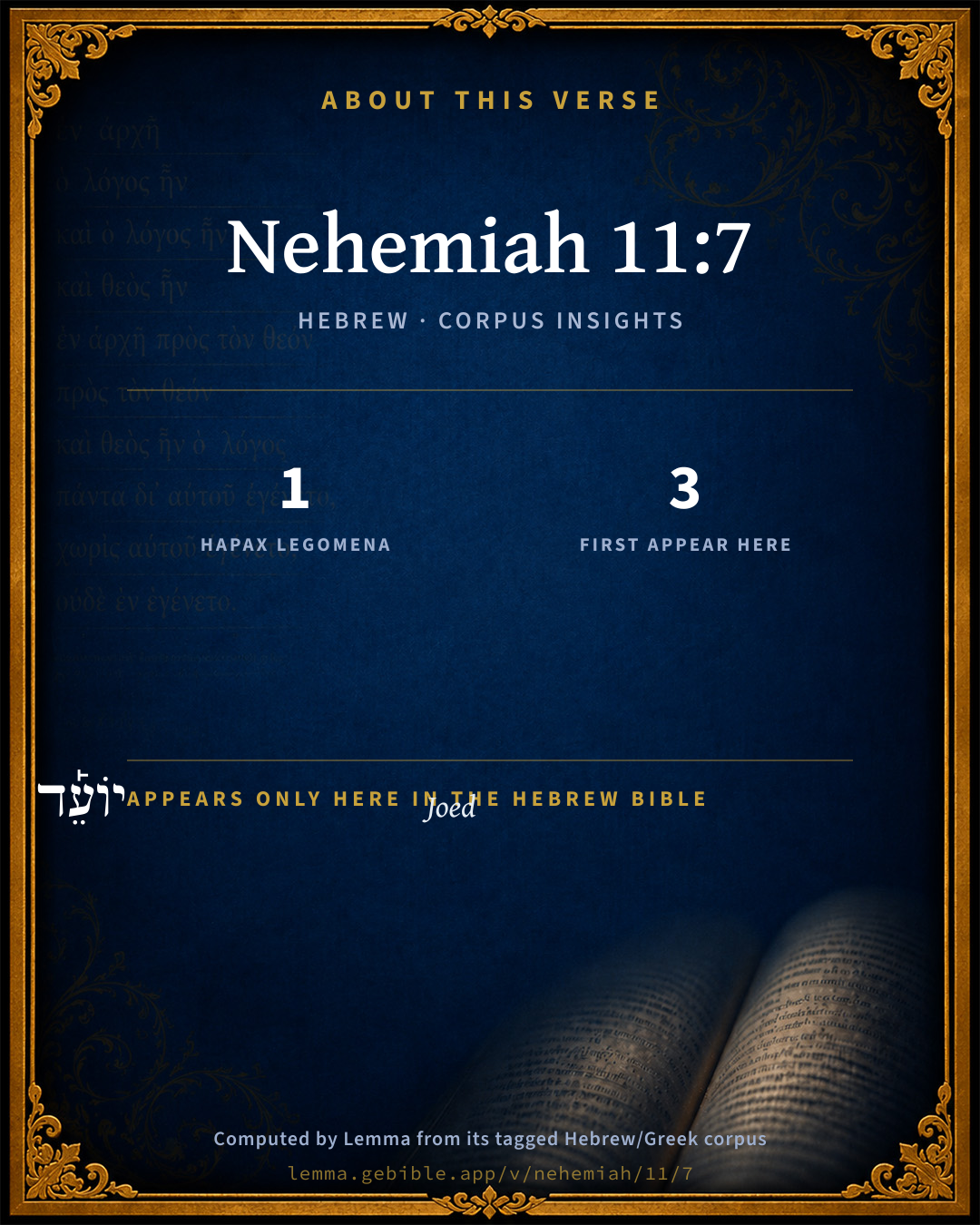
  • 1 hapax legomenon — only here in the Hebrew Bible
  • 3 first appearances in the Hebrew Bible
Full analysis ↓
Download a study sheet

One document with this verse’s original text, its word-by-word gloss line, the meaning frame, cross-references with their text, attributed commentary, and full source and license credits — printable, and it pastes into notes with its structure intact.

This verse Autodidact and up

Study sheet (.html) Plain text (.txt)

A passage Seminary Student

Up to 50 verses in one chapter. A passage sheet keeps up to 6 commentary sources and 12 cross-references per verse, in the order this page ranks them, and says so on the sheet whenever that leaves anything out. Ask for a single verse and you get the Autodidact verse sheet above.

Everything on this page stays free to read, with no account — the sheet is a download of what is already on screen, not access to it.

Want to remove ads? Support Godless Engineer
Compare translations 3

The same verse in 3 English versions, stacked beneath the original-language interlinear above. Click any original word for its lexicon entry.

Each is an independent rendering of the whole verse — the interlinear is not word-aligned to these translations.

Highlighted words mark where these versions differ — a whole-verse word diff, not a word-by-word alignment.

  • World English Bible Public Domain
    These are the sons of Benjamin: Sallu the son of Meshullam, the son of Joed, the son of Pedaiah, the son of Kolaiah, the son of Maaseiah, the son of Ithiel, the son of Jeshaiah.
  • King James Version Public Domain
    And these are the sons of Benjamin; Sallu the son of Meshullam, the son of Joed, the son of Pedaiah, the son of Kolaiah, the son of Maaseiah, the son of Ithiel, the son of Jesaiah.
  • unfoldingWord Literal Text CC BY-SA 4.0
    And these are the sons of Benjamin: Sallu, the son of Meshullam, the son of Joed, the son of Pedaiah, the son of Kolaiah, the son of Maaseiah, the son of Ithiel, the son of Jeshaiah;

unfoldingWord Literal Text — © unfoldingWord, licensed CC BY-SA 4.0. Word-aligned USFM3 via Door43 (git.door43.org/unfoldingWord/en_ult).

Versions to compare (up to 4)

3 of 4 selected

Show all 18 translations

Every available English version of this verse, each an independent rendering of the whole verse.

  • World English Bible Public Domain
    These are the sons of Benjamin: Sallu the son of Meshullam, the son of Joed, the son of Pedaiah, the son of Kolaiah, the son of Maaseiah, the son of Ithiel, the son of Jeshaiah.
  • Berean Standard Bible Public Domain
    From the descendants of Benjamin: Sallu son of Meshullam, the son of Joed, the son of Pedaiah, the son of Kolaiah, the son of Maaseiah, the son of Ithiel, the son of Jeshaiah;
  • Majority Standard Bible Public Domain
    From the descendants of Benjamin: Sallu son of Meshullam, the son of Joed, the son of Pedaiah, the son of Kolaiah, the son of Maaseiah, the son of Ithiel, the son of Jeshaiah;
  • King James Version Public Domain
    And these are the sons of Benjamin; Sallu the son of Meshullam, the son of Joed, the son of Pedaiah, the son of Kolaiah, the son of Maaseiah, the son of Ithiel, the son of Jesaiah.
  • American Standard Version (1901) Public Domain
    And these are the sons of Benjamin: Sallu the son of Meshullam, the son of Joed, the son of Pedaiah, the son of Kolaiah, the son of Maaseiah, the son of Ithiel, the son of Jeshaiah.
  • Revised Version (1885) Public Domain
    And these are the sons of Benjamin: Sallu the son of Meshullam, the son of Joed, the son of Pedaiah, the son of Kolaiah, the son of Maaseiah, the son of Ithiel, the son of Jeshaiah.
  • Geneva Bible (1599) Public Domain
    These also are the sonnes of Beniamin, Sallu, the sonne of Meshullam, the sonne of Ioed, the sonne of Pedaiah, the sonne of Kolaiah, the sonne of Maaseiah, the sonne of Ithiel, the sonne of Ieshaiah.
  • Douay-Rheims (1899) Public Domain
    And these are the children of Benjamin: Sellum the son of Mosollam, the son of Joed, the son of Phadaia, the son of Colaia, the son of Masia, the son of Etheel, the son of Isaia.
  • Young's Literal Translation Public Domain
    And these `are' sons of Benjamin: Sallu son of Meshullam, son of Joed, son of Pedaiah, son of Kolaiah, son of Maaseiah, son of Ithiel, son of Jesaiah;
  • Literal Standard Version CC BY-SA 4.0
    And these [are] sons of Benjamin: Sallu son of Meshullam, son of Joed, son of Pedaiah, son of Kolaiah, son of Maaseiah, son of Ithiel, son of Jesaiah;
  • Unlocked Literal Bible CC BY-SA 4.0
    These are the descendants of Benjamin: Sallu son of Meshullam son of Joed son of Pedaiah son of Kolaiah son of Maaseiah son of Ithiel son of Jeshaiah,
  • unfoldingWord Literal Text CC BY-SA 4.0
    And these are the sons of Benjamin: Sallu, the son of Meshullam, the son of Joed, the son of Pedaiah, the son of Kolaiah, the son of Maaseiah, the son of Ithiel, the son of Jeshaiah;
  • Darby Bible Public Domain
    And these are the children of Benjamin: Sallu the son of Meshullam, the son of Joed, the son of Pedaiah, the son of Kolaiah, the son of Maaseiah, the son of Ithiel, the son of Isaiah;
  • World Messianic Bible Public Domain
    These are the sons of Benjamin: Sallu the son of Meshullam, the son of Joed, the son of Pedaiah, the son of Kolaiah, the son of Maaseiah, the son of Ithiel, the son of Jeshaiah.
  • Webster's Bible Public Domain
    And these are the sons of Benjamin; Sallu the son of Meshullam, the son of Joed, the son of Pedaiah, the son of Kolaiah, the son of Maaseiah, the son of Ithiel, the son of Jesaiah.
  • Free Bible Version CC BY-SA 4.0
    From the tribe of Benjamin: Sallu, son of Meshullam, son of Joed, son of Pedaiah, son of Kolaiah, son of Maaseiah, son of Ithiel, son of Jeshaiah,
  • Bible in Basic English Public Domain
    And these are the sons of Benjamin: Sallu, the son of Meshullam, the son of Joed, the son of Pedaiah, the son of Kolaiah, the son of Maaseiah, the son of Ithiel, the son of Jeshaiah.
  • JPS Tanakh (1917) Public Domain
    And these are the sons of Benjamin: Sallu the son of Meshullam, the son of Joed, the son of Pedaiah, the son of Kolaiah, the son of Maaseiah, the son of Ithiel, the son of Jeshaiah.

Literal Standard Version (2020), Covenant Press — licensed CC BY-SA 4.0. Text via the HelloAO Bible API (eBible.org). Unlocked Literal Bible (unfoldingWord) — licensed CC BY-SA 4.0. Text via the HelloAO Bible API (eBible.org). unfoldingWord Literal Text — © unfoldingWord, licensed CC BY-SA 4.0. Word-aligned USFM3 via Door43 (git.door43.org/unfoldingWord/en_ult). Free Bible Version, Dr. Jonathan Gallagher — licensed CC BY-SA 4.0. Text via the HelloAO Bible API (eBible.org).

Word by word

More ways to search: Search by grammar → Find every occurrence → Compare this word →

Practice this passage: Drill this verse → Learn its vocabulary →

יוֹעֵ֡ד
Yôwʻêd
H3133
“Joed”
Noun, Proper
Part of Speech
Noun
Type
Proper
Full BDB Definition

Origin: apparently the active participle of H3259

TWOT: None

Joed = "Jehovah is witness" - a Benjamite, son of Pedaiah
  1. וְאֵ֖לֶּה ʼêl-leh H428 “and · these” Conjunction + Pronoun, Demonstrative, Common, Plural
  2. בְּנֵ֣י bên H1121 “sons of” Noun, Common, Masculine, Plural, Construct
  3. בִנְיָמִ֑ן Binyâmîyn H1144 “Benjamin” Noun, Proper
  4. סַלֻּ֡א Çallûw H5543 “Sallu” Noun, Proper
  5. בֶּן bên H1121 “son of” Noun, Common, Masculine, Singular, Construct
  6. מְשֻׁלָּ֡ם Mᵉshullâm H4918 “Meshullam” Noun, Proper
  7. בֶּן bên H1121 “son of” Noun, Common, Masculine, Singular, Construct
  8. בֶּן bên H1121 “son of” Noun, Common, Masculine, Singular, Construct
  9. פְּדָיָה֩ Pᵉdâyâh H6305 “Pedaiah” Noun, Proper
  10. בֶן bên H1121 “son of” Noun, Common, Masculine, Singular, Construct
  11. ק֨וֹלָיָ֧ה Qôwlâyâh H6964 “Kolaiah” Noun, Proper
  12. בֶן bên H1121 “son of” Noun, Common, Masculine, Singular, Construct
  13. מַעֲשֵׂיָ֛ה Maʻăsêyâh H4641 “Maaseiah” Noun, Proper
  14. בֶּן bên H1121 “son of” Noun, Common, Masculine, Singular, Construct
  15. אִֽיתִיאֵ֖ל ʼÎythîyʼêl H384 “Ithiel” Noun, Proper
  16. בֶּן bên H1121 “son of” Noun, Common, Masculine, Singular, Construct
  17. יְשַֽׁעְיָֽה Yᵉshaʻyâh H3470 “Isaiah” Noun, Proper

About this verse

These counts appear in no published source. They are computed here, from the morphology-tagged text and Lemma’s own curated glosses. What Lemma adds →

18
words
11
distinct lemmas
Historical
section

Notable vocabulary

1 hapax legomenon — a word that appears only here in the entire Hebrew Bible:

  • יוֹעֵ֡ד Joed H3133

First appearance in Scripture

These words make their first canonical appearance in the Hebrew Bible here:

  • יוֹעֵ֡ד Joed H3133
  • ק֨וֹלָיָ֧ה Kolaiah H6964
  • אִֽיתִיאֵ֖ל Ithiel H384

Shared distinctive vocabulary

ק֨וֹלָיָ֧ה Kolaiah H6964 occurs in 2 verses of the Hebrew Bible. Also found in:

Grammatical profile

  • 17 nouns
  • 1 pronoun

Repetition

A word recurs within this verse — often emphatic in Hebrew:

  • בְּנֵ֣י son H1121 ×8

Cross-references

1

Topical passages linked to Nehemiah 11:7 in the Treasury of Scripture Knowledge — connected by theme and wording, ordered by reader-vote popularity; previews shown in the World English Bible.

  • 1 Chronicles 9:7–9 Of the sons of Benjamin: Sallu the son of Meshullam, the son of Hodaviah, the son of Hassenuah,

Cross-references courtesy of OpenBible.info (CC BY 4.0).

Hebrew and Greek witnesses Masoretic Hebrew ↔ Greek Septuagint

The same verse in the two great witnesses to the Old Testament, shown verse-for-verse.

These are two independent witnesses, not word-aligned to each other, and the Septuagint is shown in lemma (dictionary) form.

Hebrew Nehemiah 11:7 Masoretic · Westminster Leningrad Codex

וְאֵ֖לֶּה בְּנֵ֣י בִנְיָמִ֑ן סַלֻּ֡א בֶּן מְשֻׁלָּ֡ם בֶּן יוֹעֵ֡ד בֶּן פְּדָיָה֩ בֶן ק֨וֹלָיָ֧ה בֶן מַעֲשֵׂיָ֛ה בֶּן אִֽיתִיאֵ֖ל בֶּן יְשַֽׁעְיָֽה

These are the sons of Benjamin: Sallu the son of Meshullam, the son of Joed, the son of Pedaiah, the son of Kolaiah, the son of Maaseiah, the son of Ithiel, the son of Jeshaiah.

World English Bible · Public Domain

Greek LXX Structure differs

The Septuagint has no separate book of Nehemiah. Its Greek text is the second half of Esdras B (2 Esdras), chapters 11–23; Ezra is the first half (1–10).

A verse-for-verse comparison isn’t shown here because the chapters and verses don’t line up. Switch to the LXX edition with the MT / LXX toggle above to read the Greek directly.

Hebrew: Westminster Leningrad Codex (CC BY 4.0). Greek: Septuagint (public domain); English from a public-domain English Septuagint. How the Septuagint differs from the Hebrew →

Commentary

Notes on Nehemiah 11:7 from classic Christian and Jewish commentators (each source and its license shown beneath its notes). The classic Christian expositions comment on the surrounding passage and are grouped to its opening verse, so a note may address several verses; the Jewish commentaries on the Tanakh (Rashi and others) are per-verse, so they appear only where the commentator wrote on this verse.

Lemma curates 59 commentaries, every one of them public domain or Creative Commons licensed, each selected and text-cleaned for this edition rather than reprinted as found. About our sources →

Trapp's Complete Commentary

John Trapp

Neh 11:7 And these [are] the sons of Benjamin; Sallu the son of Meshullam, the son of Joed, the son of Pedaiah, the son of Kolaiah, the son of Maaseiah, the son of Ithiel, the son of Jesaiah.

Neh 11:8 And after him Gabbai, Sallai, nine hundred twenty and eight.

Ver. 7,8. Little Benjamin, the smallest of the tribes of Israel, 1Sa 9:21, yields more by half than Judah. Jerusalem stood in both these tribes.

John Trapp, A Commentary or Exposition upon All the Books of the Old and New Testament (1647–1656) — public domain. Text from a community e-Sword module.

Ellicott's Commentary for English Readers

(7) The Benjamites were represented by two families, and gave the city two prefects (Neh_11:9).

A Bible Commentary for English Readers, edited by Charles John Ellicott (1878–1897) — public domain. Text from a community e-Sword module.

The Cambridge Bible for Schools and Colleges

gen. ed. J. J. S. Perowne

7. Sallu the son of Meshullam] This name stands at the head of the Benjamites in 1Ch_9:7-9. But otherwise the lists here vary from one another.

8 Gabbai, Sallai] The occurrence of these names, not separated by the copula, is peculiar. No connexion can be traced between the ‘Gabbai, Sallai, … Joel, … Judah,’ of our list with the ‘Ibneiah, Elah and Meshullam’ in 1Ch_9:8. But there are certain peculiarities in the two lists at this point which make us suspect that the text of the original document was here at fault. Thus in our text we may remark on (1) the abruptness of ‘after him Gabbai, Sallai,’ (2) the number 928 differing from, but yet sufficiently close to, that of 956 in 1 Chron. Sallai, it has been conjectured, is the name Sallu repeated, which has crept into the text from a gloss on the word ‘after him.’ In 1 Chronicles we remark upon Meshullam occurring twice, and Ibneiah by the side of Ibnijah. The number 928, if we may argue from the analogy of Neh_11:6, relates only to the house of Sallai or Gabbai Sallai. In 1Ch_9:9, the number 956 represents the sons of Benjamin.

The Cambridge Bible for Schools and Colleges (gen. ed. J. J. S. Perowne; Cambridge University Press, 1878–1918) — public domain. Text from a community e-Sword module.

John Gill's Exposition

Who dwelt in Jerusalem, of whom the same account is given in these two verses as in Ch1 9:10, only Seraiah here is called Azariah there.

, only Seraiah here is called Azariah there.

Nehemiah 11:11

neh 11:11

neh 11:11

neh 11:11And their brethren that did the work of the house were eight hundred twenty and two,.... That offered the sacrifices, burnt incense, set on the shewbread, lighted the lamps, &c.

and Adaiah the son of Jeroham; see Ch1 9:12 whose genealogy is traced here through Pelaliah, Amzi, Zechariah, Pashur, to Malchiah.

John Gill's Exposition of the Whole Bible (1746–1763) — public domain (CC PDM 1.0). Text via the HelloAO Bible API.

The Pulpit Commentary

And these are the sons of Benjamin. A verse equivalent to 1Ch_9:6 would seem to have fallen out here. Nehemiah cannot have intended to leave out the descendants of Zerah, who formed more than one-half of the Jewish element in the population of Jerusalem, and furnished 690 fighting men. Sallu the son of Meshullam. Compare 1Ch_9:7. The other names in the genealogy are different, the two writers singling out for mention different ancestors.

The Pulpit Commentary (1880–1919), ed. H.D.M. Spence-Jones & Joseph S. Exell — public domain. Text from a community e-Sword module.

Keil & Delitzsch

C. F. Keil & F. Delitzsch

Of the Benjamites there were two heads of houses: Sallu, and after him Gabbai-Sallai, with nine hundred and twenty-eight fathers of families. Their chief was Joel the son of Zichri, and Jehuda the son of Sennah over the city as second (prefect).

Keil & Delitzsch — Biblical Commentary on the Old Testament (1861–1891) — public domain (CC PDM 1.0). Text via the HelloAO Bible API. (Old Testament only.)

unfoldingWord translationNotes

Door43 World Missions Community

Connecting Statement:

In these verses, Nehemiah continues to list the provincial officers who lived in Jerusalem.

These are the descendants

"These are some of the descendants." Your language may need to specify that this is not a list of every descendant.

Benjamin ... Sallu ... Meshullam ... Joed ... Pedaiah ... Kolaiah ... Maaseiah ... Ithiel ... Jeshaiah ... Gabbai ... Sallai ... Joel ... Zichri ... Judah ... Hassenuah

These are the names of men. (See: How to Translate Names)

928 men

"nine hundred and twenty-eight men." (See: Numbers)

translationWords

descend

Benjamin

son

oversee

command

unfoldingWord translationNotes — © Distant Shores Media and the Door43 World Missions Community, licensed CC BY-SA 4.0. Source: git.door43.org/Door43/en_tn.

Lesson kit

Teaching starters — assembled from the data on this page, not authored interpretation. Every prompt links to the verse data it draws on. Edit before teaching.

Nehemiah, in the Historical, opens this verse with 18 words (11 distinct Hebrew lemmas). Its most distinctive word is Yôwʻêd (“Joed”). A historical commentator’s framing appears above. Read the whole chapter for the surrounding context.

Discussion questions

  1. What does “Joed” (Yôwʻêd) contribute to the verse as a whole?
  2. This verse holds 1 word here found nowhere else in the Hebrew Bible. What might the rare word draw attention to?
  3. 3 words here appear for the first time in Scripture. What is being introduced at this debut?
  4. Jeremiah 29:21 shares the word «Kolaiah» with this verse. How do the two illuminate each other?
  5. “son” occurs 8× in this one verse. What is the effect of the repetition?
  6. These translations render this verse differently; the difference is in the English rendering, not the original. What questions does that raise?
  7. Reading how Trapp's Complete Commentary and Ellicott's Commentary for English Readers read this verse, where do the two commentators agree and where do they part?

Things to notice

  • 1 word in this verse appears nowhere else in the Hebrew Bible.
  • 3 words make their first canonical appearance in Scripture here.
  • These translations choose different wording for 2 words in this verse.
  • “son” occurs 8× in this single verse.
  • 11 distinct Hebrew lemmas span 18 words in this verse.

Reading settings

Reading text

Shown beneath each verse's original-language words.

Old Testament
Old Testament edition

Read the OT as the Masoretic Hebrew (MT) or the Greek Septuagint (LXX).

English shown for the Greek Septuagint (in the Hebrew ↔ Greek comparison).

Comparing translations? Open the Compare panel on any verse page to stack up to four side by side.