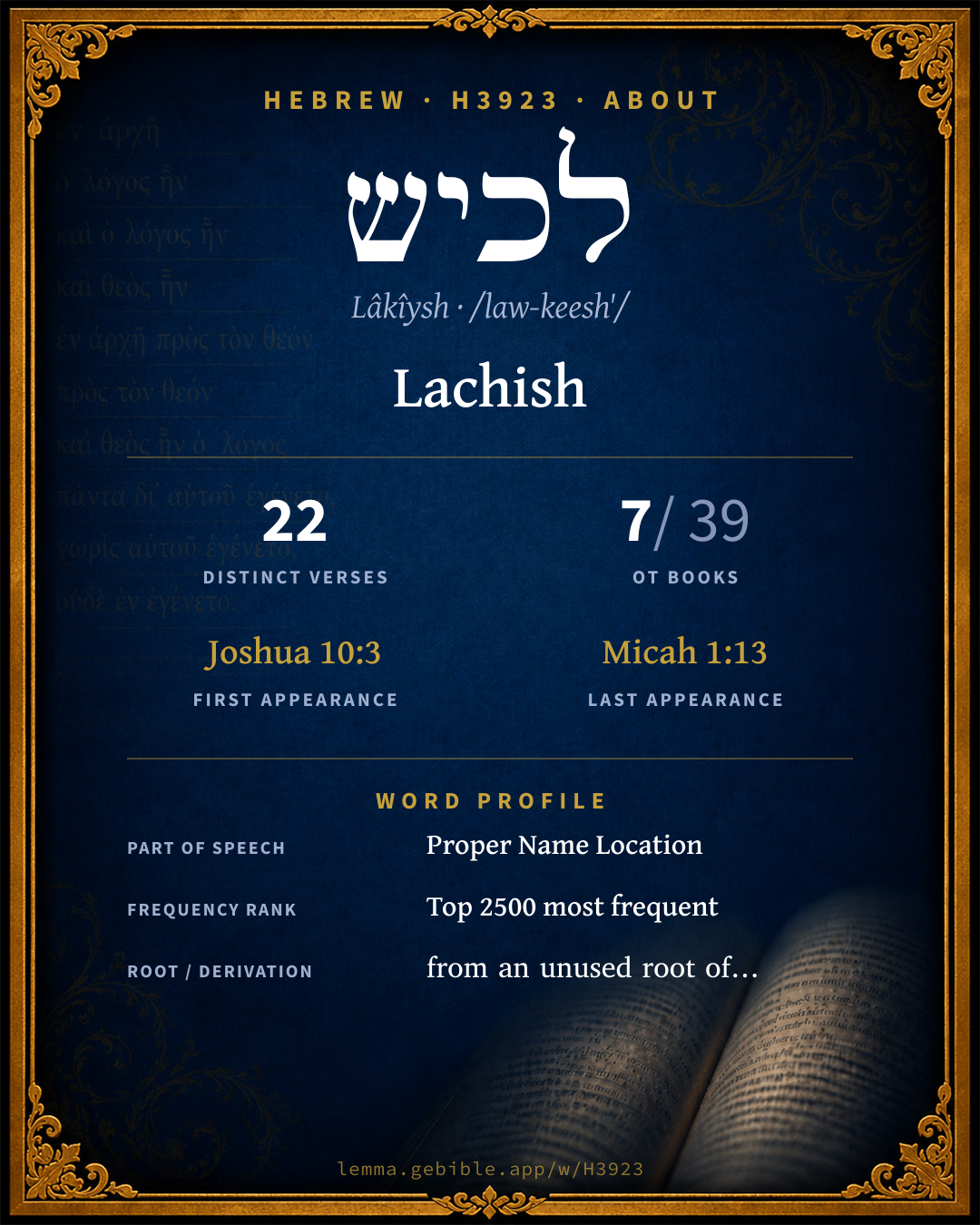
לָכִישׁ
Lachish
BDB lists 2 entries for ‘Lachish’ fuller range ↓
Full lexicon entry — Brown-Driver-Briggs (BDB)
From Brown-Driver-Briggs (BDB)
Where this word appears
Grammar key — what these labels mean
Part of speech
- Noun
- A naming word — a person, place, thing, or idea.
Noun type
- Proper
- A name of a specific person, place, or people (e.g. Abraham, Zion, Israel).
Every verse where H3923 appears — 22 distinct verses across 7 books. Click any verse to open its interlinear word-by-word view. Verse text shown in the World English Bible for context — . Each verse’s Hebrew form is shown with its reference; the English is not keyword-highlighted, since the data carries no word-level English alignment. Use “Compare translations” on any verse to read it across multiple English versions. This concordance covers the Hebrew Bible; Septuagint (Greek Old Testament) occurrences are not indexed here.
Joshua 10 verses
- Joshua 10:3 לָכִ֛ישׁ n Proper Therefore Adoni-zedek king of Jerusalem sent to Hoham king of Hebron, and to Piram king of Jarmuth, and to Japhia king of Lachish, and to Debir king of Eglon, saying,
- Joshua 10:5 לָכִ֣ישׁ n Proper Therefore the five kings of the Amorites, the king of Jerusalem, the king of Hebron, the king of Jarmuth, the king of Lachish, the king of Eglon, gathered themselves together, and went up, they and all their hosts, and encamped against Gibeon, and made war against it.
- Joshua 10:23 לָכִ֖ישׁ n Proper They did so, and brought forth those five kings to him out of the cave, the king of Jerusalem, the king of Hebron, the king of Jarmuth, the king of Lachish, the king of Eglon.
- Joshua 10:31 לָכִ֑ישָׁ/ה n Proper + sfx dem Joshua passed from Libnah, and all Israel with him, to Lachish, and encamped against it, and fought against it:
- Joshua 10:32 לָכִ֜ישׁ n Proper and Yahweh delivered Lachish into the hand of Israel; and he took it on the second day, and struck it with the edge of the sword, and all the souls who were therein, according to all that he had done to Libnah.
- Joshua 10:33 לָכִ֑ישׁ n Proper Then Horam king of Gezer came up to help Lachish; and Joshua struck him and his people, until he had left him none remaining.
- Joshua 10:34 מִ/לָּכִ֖ישׁ prep + n Proper Joshua passed from Lachish, and all Israel with him, to Eglon; and they encamped against it, and fought against it;
- Joshua 10:35 לְ/לָכִֽישׁ prep + n Proper and they took it on that day, and struck it with the edge of the sword; and all the souls who were therein he utterly destroyed that day, according to all that he had done to Lachish.
- Joshua 12:11 לָכִ֖ישׁ n Proper the king of Jarmuth, one; the king of Lachish, one;
- Joshua 15:39 לָכִ֥ישׁ n Proper Lachish, and Bozkath, and Eglon,
2 Kings 4 verses
- 2 Kings 14:19 לָכִ֑ישָׁ/ה לָכִ֔ישָׁ/ה n Proper + sfx dem n Proper + sfx dem They made a conspiracy against him in Jerusalem; and he fled to Lachish: but they sent after him to Lachish, and killed him there.
- 2 Kings 18:14 לָכִ֨ישָׁ/ה n Proper + sfx dem Hezekiah king of Judah sent to the king of Assyria to Lachish, saying, I have offended; return from me: that which you put on me will I bear. The king of Assyria appointed to Hezekiah king of Judah three hundred talents of silver and thirty talents of gold.
- 2 Kings 18:17 לָכִ֜ישׁ n Proper The king of Assyria sent Tartan and Rabsaris and Rabshakeh from Lachish to king Hezekiah with a great army to Jerusalem. They went up and came to Jerusalem. When they were come up, they came and stood by the conduit of the upper pool, which is in the highway of the fuller's field.
- 2 Kings 19:8 מִ/לָּכִֽישׁ prep + n Proper So Rabshakeh returned, and found the king of Assyria warring against Libnah; for he had heard that he was departed from Lachish.
2 Chronicles 3 verses
- 2 Chronicles 11:9 לָכִ֖ישׁ n Proper and Adoraim, and Lachish, and Azekah,
- 2 Chronicles 25:27 לָכִ֑ישָׁ/ה לָכִ֔ישָׁ/ה n Proper + sfx dem n Proper + sfx dem Now from the time that Amaziah did turn away from following Yahweh they made a conspiracy against him in Jerusalem; and he fled to Lachish: but they sent after him to Lachish, and killed him there.
- 2 Chronicles 32:9 לָכִ֔ישׁ n Proper After this did Sennacherib king of Assyria send his servants to Jerusalem, (now he was before Lachish, and all his power with him), to Hezekiah king of Judah, and to all Judah who were at Jerusalem, saying,
Nehemiah 1 verse
Isaiah 2 verses
- Isaiah 36:2 מִ/לָּכִ֧ישׁ prep + n Proper The king of Assyria sent Rabshakeh from Lachish to Jerusalem to king Hezekiah with a great army. He stood by the conduit of the upper pool in the highway of the fuller's field.
- Isaiah 37:8 מִ/לָּכִֽישׁ prep + n Proper So Rabshakeh returned, and found the king of Assyria warring against Libnah; for he had heard that he was departed from Lachish.
Jeremiah 1 verse
Micah 1 verse
About this entry
At a glance — auto-summarized from this page’s data, not written by a person. Every figure links to its source below. This summary describes the numbers; it doesn’t interpret them.
לכיש — transliterated Lâkîysh — is a Hebrew name carrying the sense “Lachish.” It first appears in Joshua 10:3. With 22 verses in 7 books, it is an uncommon word in the Hebrew Bible. Its uses concentrate in Joshua (45% of all occurrences). Each statement above links to its evidence; the full detail follows below.
Gloss history
Strong's 1890 vs modern scholarship

About this word
Strong's H3923 catalogs a Hebrew word from the Hebrew Old Testament.
These counts are not copied from any lexicon or concordance. They are computed here, from the morphology-tagged Hebrew Old Testament. What Lemma adds →
- 22
- distinct verses
- The word appears in 22 distinct verses.
- 7 / 39
- OT books
- The word appears in 7 of 39 Old Testament books.
- #1,327
- by frequency
- Top 2500 most frequent Hebrew words (rank 1,327 of 8,640 Hebrew words by occurrence).
View all 22 occurrences in the concordance →
Most concentrated in
- Joshua 10 verses 45%
- 2 Kings 4 verses 18%
- 2 Chronicles 3 verses 14%
By section of the Old Testament
By traditional corpus
Conventional, traditional groupings — biblical authorship is debated, so this is a traditional corpus grouping, not an authorship claim. Each share is this word’s portion of its verses in that division of the Hebrew canon. Each figure is a share of the word’s 22 distinct verses.
- Prophets (Nevi'im) 18 verses · 82%
- Writings (Ketuvim) 4 verses · 18%
How translations render this word
Counts come from each version’s own published word-to-Strong’s tagging or interlinear alignment — an approximate guide to how each version renders this word, not a word-level alignment the data otherwise carries. Because each total is that version’s own tagged count, the per-version totals vary from one another and need not match the appearance or distinct-verse counts above. These counts may also differ from a printed concordance because Lemma counts each distinctly tagged rendering and does not collapse phrase taggings into a single head-word total. This is a fixed set of word-tagged versions (KJV, ASV, BSB, ULT) and does not change with the reading translation you choose elsewhere. Each version’s license is shown beside its name below (and on Sources).
- King James Version: Lachish 22×
- American Standard Version: Lachish 21×
- Berean Standard Bible: Lachish 24×
- unfoldingWord Literal Text: Lachish 23×
King James Version Public Domain
Renders H3923 across 24 tagged occurrences — most commonly:
Plus 2 renderings that appear only once — usually multi-word phrases or single function words the recovered tagging swept in, not distinct renderings.
American Standard Version Public Domain
Renders H3923 across 24 tagged occurrences — most commonly:
Plus 3 renderings that appear only once — usually multi-word phrases or single function words the recovered tagging swept in, not distinct renderings.
Berean Standard Bible Public Domain
Renders H3923 across 24 tagged occurrences — most commonly:
unfoldingWord Literal Text CC BY-SA 4.0
Renders H3923 across 23 tagged occurrences — most commonly:
Senses in BDB
The 2 senses BDB distinguishes for this word, in lexicon order (not ranked by frequency or importance). The full entry — with sub-senses — is in the Lexicon Entry tab.
- Lachish = "invincible"
- a city lying south of Jerusalem on the borders of Simeon and which belonged to the Amorites until conquered by Joshua…
Word origin
n.pr.loc.—so Jos 10:3 +; c. ה loc. לָכִ֫ישָׁה Jos 10:31 + 5 times;—Canaanitish (Amorit.) city, with king, Jos 10:3, 5, 23 (all JE), v 31; 12:11 (both D); (= Tel el-Amarna Lakiša, Lakisi WklTA Tablets, Nos. 217, 218, 180, 181); captured by Jos 10:32, 33, 34, 35 (all D); reckoned to Judah Mi 1:13 Je 34:7 Jos 15:39 (P), cf. 2 K 14:19(×2) = 2 Ch 25:27(×2), 2 Ch 11:9 Ne 11:30; base of Assyrian operations 2 K 18:14, cf. 2 Ch 32:9, also 2 K 18:17; 19:8 = Is 36:2; 37:8 (= Assyrian Lakisi SchrCOT 2 K 18:13); prob. = mod. Tell el-Ḥesy, c. 33 miles SW. from Jerusalem FJBMound of Many Cities, 1893 BuhlGeogr. § 103 GASmGeogr. 234; > Umm el-Lâḳis vdVeldeMem. 320 Guérin Judeé ii. 299 ff.; Um Lâḳis opp. by RobBR ii. 47.—𝔊 Λαχεις.
— Brown-Driver-Briggs (Oxford 1906, public domain), digitized via Sefaria, supplemented by the OpenScriptures HebrewLexicon (CC BY 4.0). See Sources.
Origin: from an unused root of uncertain meaning
Forms in the corpus
The 15 distinct written forms H3923 takes in the Hebrew Bible, most frequent first — each parse links to that state’s occurrences in the concordance. Hebrew forms include their vowel points and cantillation, so a single lemma takes many written forms.
| Form | Parsing | Example | Uses |
|---|---|---|---|
| לָכִ֑ישָׁ/ה | Noun, Proper | 2 Chronicles 25:27 | 3 |
| לָכִ֖ישׁ | Noun, Proper | 2 Chronicles 11:9 | 3 |
| לָכִ֑ישׁ | Noun, Proper | Joshua 10:33 | 2 |
| לָכִ֔ישָׁ/ה | Noun, Proper | 2 Chronicles 25:27 | 2 |
| לָכִ֜ישׁ | Noun, Proper | 2 Kings 18:17 | 2 |
| לָכִישׁ֙ | Noun, Proper | Jeremiah 34:7 | 2 |
| מִ/לָּכִֽישׁ | Noun, Proper | 2 Kings 19:8 | 2 |
| לְ/לָכִֽישׁ | Noun, Proper | Joshua 10:35 | 1 |
| לָכִ֔ישׁ | Noun, Proper | 2 Chronicles 32:9 | 1 |
| לָכִ֛ישׁ | Noun, Proper | Joshua 10:3 | 1 |
| לָכִ֣ישׁ | Noun, Proper | Joshua 10:5 | 1 |
| לָכִ֥ישׁ | Noun, Proper | Joshua 15:39 | 1 |
| לָכִ֨ישָׁ/ה | Noun, Proper | 2 Kings 18:14 | 1 |
| מִ/לָּכִ֖ישׁ | Noun, Proper | Joshua 10:34 | 1 |
| מִ/לָּכִ֧ישׁ | Noun, Proper | Isaiah 36:2 | 1 |
Bible dictionary
Public-domain dictionary articles matched to this entry by name (Lachish). A biblical name can be shared by more than one person or place, so an article may treat several.
Easton's Bible Dictionary · M. G. Easton, 1897
Impregnable, a royal Canaanitish city in the Shephelah, or maritime plain of Palestine (Josh. 10:3, 5; 12:11). It was taken and destroyed by the Israelites (Josh. 10:31-33). It afterwards became, under Rehoboam, one of the strongest fortresses of Judah (2 Chr. 10:9). It was assaulted and probably taken by Sennacherib (2 Kings 18:14, 17; 19:8; Isa. 36:2). An account of this siege is given on some slabs found in the chambers of the palace of Koyunjik, and now in the British Museum. The inscription has been deciphered as follows:, "Sennacherib, the mighty king, king of the country of Assyria, sitting on the throne of judgment before the city of Lachish: I gave permission for its slaughter." (See NINEVEH.)
Lachish has been identified with Tell-el-Hesy, where a cuneiform tablet has been found, containing a letter supposed to be from Amenophis at Amarna in reply to one of the Amarna tablets sent by Zimrida from Lachish. This letter is from the chief of Atim (=Etam, 1 Chr. 4:32) to the chief of Lachish, in which the writer expresses great alarm at the approach of marauders from the Hebron hills. "They have entered the land," he says, "to lay waste...strong is he who has come down. He lays waste." This letter shows that "the communication by tablets in cuneiform script was not only usual in writing to Egypt, but in the internal correspondence of the country. The letter, though not so important in some ways as the Moabite stone and the Siloam text, is one of the most valuable discoveries ever made in Palestine" (Conder's Tell Amarna Tablets, p. 134).
Excavations at Lachish are still going on, and among other discoveries is that of an iron blast-furnace, with slag and ashes, which is supposed to have existed B.C. 1500. If the theories of experts are correct, the use of the hot-air blast instead of cold air (an improvement in iron manufacture patented by Neilson in 1828) was known fifteen hundred years before Christ. (See FURNACE.)
Smith's Bible Dictionary · William Smith, 1863
(invincible), a city lying south of Jerusalem, on the borders of Simeon, and belonging to the Amorites, the king of which joined with four others, at the invitation of Adonizedek king of Jerusalem, to chastise the Gibeonites for their league with Israel. (Joshua 10:3,5) They were routed by Joshua at Beth-horon, and the king of Lachish fell a victim with the others under the trees at Makkedah. ver. (Joshua 10:26) The destruction of the town shortly followed the death of the king. vs. (Joshua 10:31-33) In the special statement that the attack lasted two days, in contradistinction to the other cities which were taken in one (see ver. 35), we gain our first glimpse of that strength of position for which Lachish was afterward remarkable. Lachish was one of the cities fortified and garrisoned by Rehoboam after the revolt of the northern kingdom. (2 Chronicles 11:9) In the reign of Hezekiah it was one of the cities taken by Sennacherib. This siege is considered by Layard and Hincks to be depicted on the slabs found by the former in one of the chambers of the palace at Kouyunjik. After the return from captivity, Lachish with its surrounding "fields" was reoccupied by the Jews. (Nehemiah 11:30)
Hitchcock's Bible Names Dictionary · Roswell D. Hitchcock, 1869
who walks, or exists, of himself
Classic public-domain reference works; full attribution on Sources.
Septuagint verse parallels
This word appears in 20 verses that also exist in the Greek Old Testament (Septuagint), out of the 22 Hebrew verses it occurs in. You can read those verses in Greek by switching the Old Testament edition to the Septuagint.
Read these verses in the Septuagint
This is a verse-level parallel only — the same verses exist in both the Hebrew and Greek Old Testaments. No word-level Hebrew↔Greek correspondence is claimed: the data carries no such alignment, so no Greek word is shown as this Hebrew word’s translation. Coverage is not total — the Septuagint omits the deuterocanon and renumbers the Psalms, so some Hebrew verses have no direct Greek parallel.