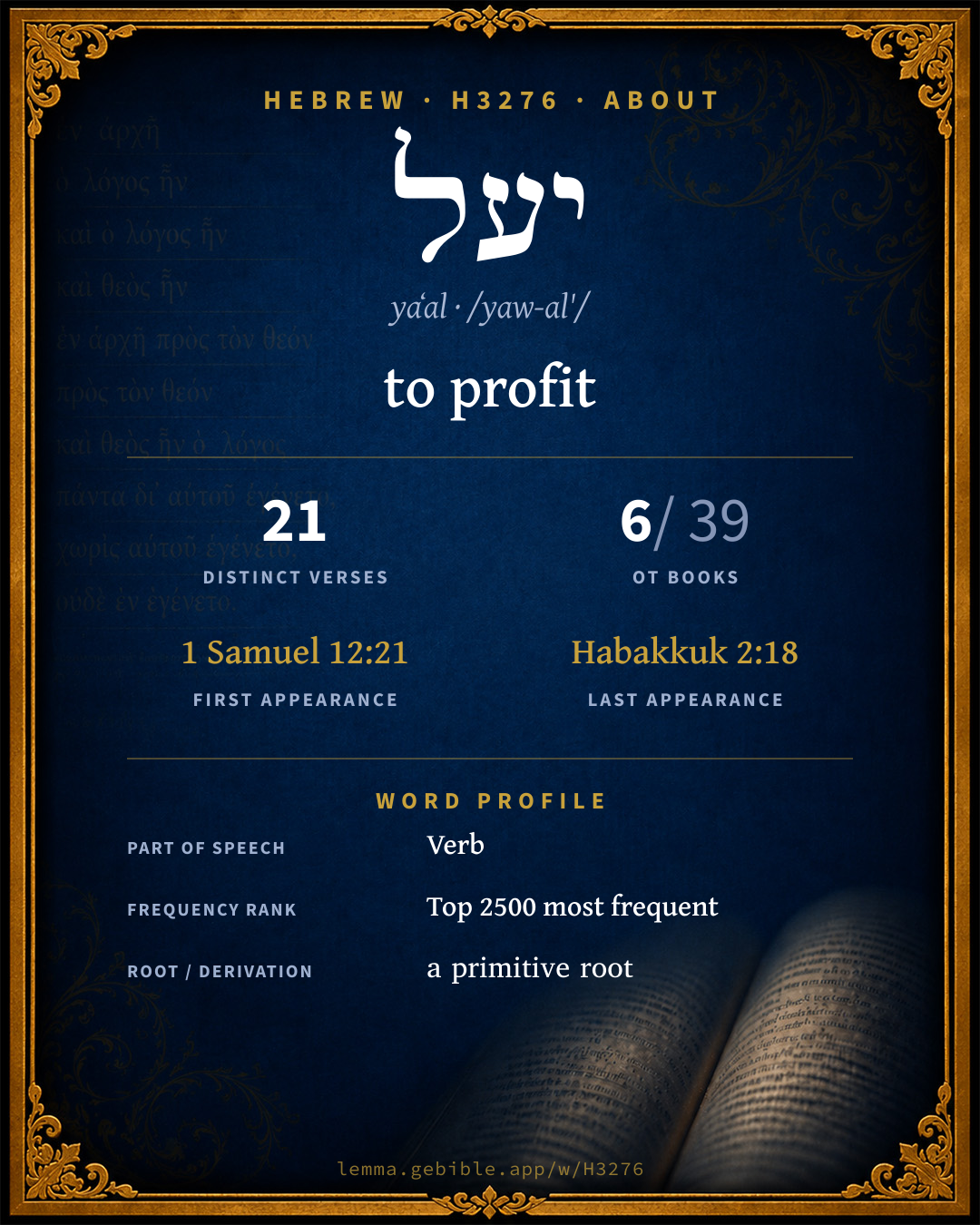
יָעַל
to profit
Full lexicon entry — Brown-Driver-Briggs (BDB)
From Brown-Driver-Briggs (BDB)
Where this word appears
Grammar key — what these labels mean
Part of speech
- Verb
- An action or state-of-being word.
Stem
- Hiphil
- The causative active stem (“he caused / brought about”).
Form
- Imperfect
- An incomplete, ongoing, or future action (“he will / would write”).
- Infinitive Construct
- A bound verbal noun, frequently with prepositions (“to write / in writing”).
- Infinitive Absolute
- An unbound verbal noun, often intensifying or standing in for a finite verb.
- Perfect
- A completed action or state — Hebrew marks aspect (completeness) more than strict tense (“he wrote”).
- Participle Active
- A verbal adjective expressing ongoing or characteristic action (“writing / one who writes”).
State
- Absolute
- The independent form of a noun, not bound to a following word.
Person
- 3rd Person
- The one spoken about (“he / she / it / they”).
- 1st Person
- The speaker (“I / we”).
Gender
- Masculine
- Grammatically masculine.
- Common
- Either gender — not distinguished for this form.
Number
- Plural
- More than one (in Hebrew, generally three or more).
- Singular
- One.
Every verse where H3276 appears in the Book of Jeremiah — 6 distinct verses. Click any verse to open its interlinear word-by-word view. Verse text shown in the World English Bible for context — . Each verse’s Hebrew form is shown with its reference; the English is not keyword-highlighted, since the data carries no word-level English alignment. Use “Compare translations” on any verse to read it across multiple English versions. This concordance covers the Hebrew Bible; Septuagint (Greek Old Testament) occurrences are not indexed here.
Jeremiah
- Jeremiah 2:8 יוֹעִ֖לוּ Hiphil impf 3mp The priests didn't say, Where is Yahweh? and those who handle the law didn't know me: the rulers also transgressed against me, and the prophets prophesied by Baal, and walked after things that do not profit.
- Jeremiah 2:11 יוֹעִֽיל Hiphil impf 3ms Has a nation changed [its] gods, which yet are no gods? but my people have changed their glory for that which does not profit.
- Jeremiah 7:8 הוֹעִֽיל Hiphil inf.cs Behold, you trust in lying words, that can't profit.
- Jeremiah 12:13 יוֹעִ֑לוּ Hiphil impf 3mp They have sown wheat, and have reaped thorns; they have put themselves to pain, and profit nothing: and you shall be ashamed of your fruits, because of the fierce anger of Yahweh.
- Jeremiah 16:19 מוֹעִֽיל Hiphil ptcp.act ms Yahweh, my strength, and my stronghold, and my refuge in the day of affliction, to you shall the nations come from the ends of the earth, and shall say, Our fathers have inherited nothing but lies, [even] vanity and things in which there is no profit.
- Jeremiah 23:32 וְ/הוֹעֵ֛יל יוֹעִ֥ילוּ conj + Hiphil inf.abs Hiphil impf 3mp Behold, I am against those who prophesy lying dreams, says Yahweh, and do tell them, and cause my people to err by their lies, and by their vain boasting: yet I didn't send them, nor commanded them; neither do they profit this people at all, says Yahweh.
About this entry
At a glance — auto-summarized from this page’s data, not written by a person. Every figure links to its source below. This summary describes the numbers; it doesn’t interpret them.
At its core, יעל (yaʻal) means “to profit.” Older and newer Bibles part ways — “profit” in the King James Version, “benefit” (unfoldingWord Literal Text) in modern versions. See the renderings breakdown. It turns up in 21 verses across 6 books, an uncommon footprint. The word gravitates to Isaiah (33%), then Jeremiah and Job. Scripture first uses it in 1 Samuel 12:21. Each statement above links to its evidence; the full detail follows below.
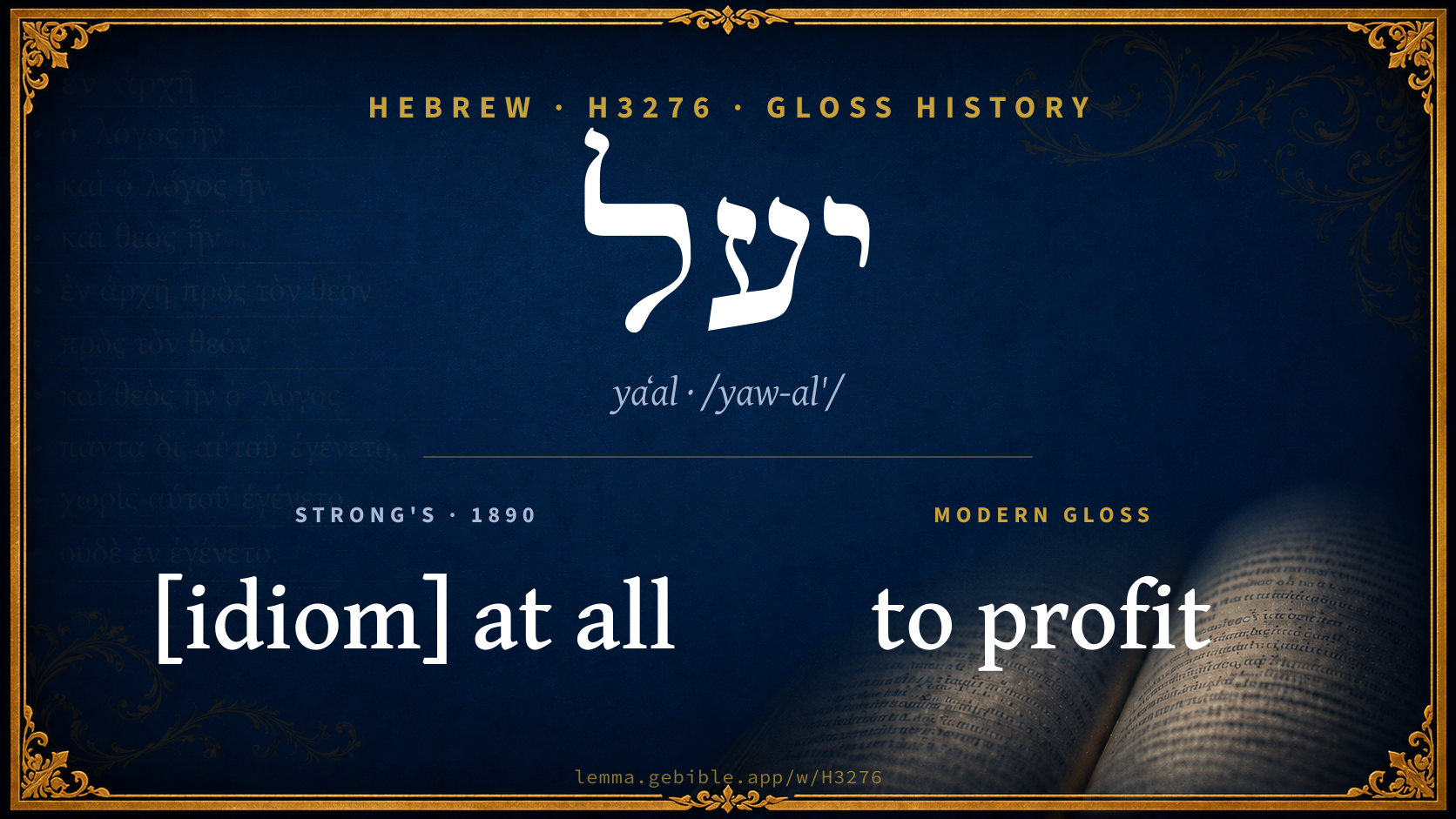
Gloss history
Strong's 1890 vs modern scholarship
About this word
Strong's H3276 catalogs a Hebrew word from the Hebrew Old Testament.
These counts are not copied from any lexicon or concordance. They are computed here, from the morphology-tagged Hebrew Old Testament. What Lemma adds →
- 21
- distinct verses
- The word appears in 21 distinct verses.
- 6 / 39
- OT books
- The word appears in 6 of 39 Old Testament books.
- #1,368
- by frequency
- Top 2500 most frequent Hebrew words (rank 1,368 of 8,640 Hebrew words by occurrence).
View all 21 occurrences in the concordance →
By section of the Old Testament
By traditional corpus
Conventional, traditional groupings — biblical authorship is debated, so this is a traditional corpus grouping, not an authorship claim. Each share is this word’s portion of its verses in that division of the Hebrew canon. Each figure is a share of the word’s 21 distinct verses.
- Prophets (Nevi'im) 15 verses · 71%
- Writings (Ketuvim) 6 verses · 29%
How translations render this word
Counts come from each version’s own published word-to-Strong’s tagging or interlinear alignment — an approximate guide to how each version renders this word, not a word-level alignment the data otherwise carries. Because each total is that version’s own tagged count, the per-version totals vary from one another and need not match the appearance or distinct-verse counts above. These counts may also differ from a printed concordance because Lemma counts each distinctly tagged rendering and does not collapse phrase taggings into a single head-word total. This is a fixed set of word-tagged versions (KJV, ASV, BSB, ULT) and does not change with the reading translation you choose elsewhere. Each version’s license is shown beside its name below (and on Sources).
- King James Version: Profit 5×, Shall not profit 3×
- American Standard Version: Profit 4×, Cannot profit 2×
- Berean Standard Bible: Are worthless 2×, Avail 2×, Benefit 2×
- unfoldingWord Literal Text: Benefit 8×, Profit 7×, Do 5×
King James Version Public Domain
Renders H3276 across 23 tagged occurrences — most commonly:
Plus 15 renderings that appear only once — usually multi-word phrases or single function words the recovered tagging swept in, not distinct renderings.
American Standard Version Public Domain
Renders H3276 across 23 tagged occurrences — most commonly:
Plus 17 renderings that appear only once — usually multi-word phrases or single function words the recovered tagging swept in, not distinct renderings.
Berean Standard Bible Public Domain
Renders H3276 across 23 tagged occurrences — most commonly:
Plus 13 renderings that appear only once — usually multi-word phrases or single function words the recovered tagging swept in, not distinct renderings.
unfoldingWord Literal Text CC BY-SA 4.0
Renders H3276 across 37 tagged occurrences — most commonly:
Plus 10 renderings that appear only once — usually multi-word phrases or single function words the recovered tagging swept in, not distinct renderings.
Senses in BDB
The 1 sense BDB distinguishes for this word, in lexicon order (not ranked by frequency or importance). The full entry — with sub-senses — is in the Lexicon Entry tab.
- (Hiphil) to gain, profit, benefit, avail
Word origin
[ יָעַל ] vb. only Hiph. profit, avail, benefit
— Brown-Driver-Briggs (Oxford 1906, public domain), digitized via Sefaria, supplemented by the OpenScriptures HebrewLexicon (CC BY 4.0). See Sources.
Origin: a primitive root
Jastrow Dictionary
A second Hebrew/Aramaic lexicon for comparison, covering Aramaic and post-biblical (Talmudic, Targumic, Midrashic) usage that the biblical-Hebrew BDB does not. Matched by lemma rather than by Strong’s number, so a lemma may carry more than one Jastrow headword (shown separately below), and the entries cover usage well beyond the Bible.
יָאַל
- , v. הוֹאִיל
*יָעַל
- to go up.
- to bring up, effect; to profit, accomplish. Y. Sot. VIII, 21ᶜ ולא הוֹעַלְתֶּם לעצמיכם כלום and you have profited nothing for yourselves; (Snh. 90ᵇ העליתם בידכם); v. זוּף I. Erub. 24ᵇ לחי מוֹעִיל וכ׳ a post helps (has the effect of making the moving about on the Sabbath permitted) for all vineyard paths. Ib. 25ᵃ ה׳ it does good (it serves its purpose). Yoma 47ᵃ ולא הוֹעִילוּ and did not succeed (in obtaining distinction). Meg. 6ᵃ אינו מועילוכ׳ will not succeed in business. Keth. 10ᵃ מה הועילו חכמים וכ׳ what have the scholars accomplished with their measure?; Gitt. 17ᵇ, sq. Ib. 32ᵇ (if one said) גט זה לא יועיל this letter of divorce shall have no effect, contrad. to אינו מועיל has no effect. Ib. 57ᵇ תפלה שמוֹעֶלֶת a prayer which was efficacious. Ib. 65ᵇ (if he said, Write ye a letter of divorce and) הוֹעִילוּ לה make it of avail to her. B. Bath. 100ᵃ אין הילוך מוֹעִיל walking through the field (as a symbol of possession) has no legal effect. Ḥull. 70ᵇ; a. fr.
יָעֵל I
- v. next w.) pr. n. f. Jael, the wife of Heber the Kenite. Meg. 15ᵃ, v. זָנָה. Lev. R. s. 23; a. e.
יָעֵל II
- v. יָעַל, mountain-goat, wild goat. R. Hash. III, 3.—Pl. יְעֵלִים. Ib. 5 (26ᵇ). Kil. I, 6. Gen. R. s. 12.—V. יְעֵלָה.
A Dictionary of the Targumim, the Talmud Babli and Yerushalmi, and the Midrashic Literature (Marcus Jastrow; London, Luzac, 1903) — Public Domain. Digitized via Sefaria. Digitized via Sefaria. Full attribution on Sources.
Forms in the corpus
The 21 distinct written forms H3276 takes in the Hebrew Bible, most frequent first — each parse links to that stem’s occurrences in the concordance. Hebrew forms include their vowel points and cantillation, so a single lemma takes many written forms.
| Form | Parsing | Example | Uses |
|---|---|---|---|
| הוֹעִֽיל | Verb, Hiphil, Infinitive Construct | Isaiah 44:10 | 2 |
| לְ/הוֹעִ֔יל | Verb, Hiphil, Infinitive Construct | Isaiah 30:5 | 2 |
| אֹ֝עִ֗יל | Verb, Hiphil, Imperfect, 1st Person, Common, Singular | Job 35:3 | 1 |
| הוֹעִ֖יל | Verb, Hiphil, Infinitive Construct | Isaiah 47:12 | 1 |
| הוֹעִ֣יל | Verb, Hiphil, Perfect, 3rd Person, Masculine, Singular | Habakkuk 2:18 | 1 |
| וְ/הוֹעֵ֛יל | Verb, Hiphil, Infinitive Absolute | Jeremiah 23:32 | 1 |
| י֭וֹעִילוּ | Verb, Hiphil, Imperfect, 3rd Person, Masculine, Plural | Proverbs 10:2 | 1 |
| יֹעִ֑ילוּ | Verb, Hiphil, Imperfect, 3rd Person, Masculine, Plural | Job 30:13 | 1 |
| יוֹעִ֑ילוּ | Verb, Hiphil, Imperfect, 3rd Person, Masculine, Plural | Isaiah 44:9 | 1 |
| יוֹעִ֑לוּ | Verb, Hiphil, Imperfect, 3rd Person, Masculine, Plural | Jeremiah 12:13 | 1 |
| יוֹעִ֖לוּ | Verb, Hiphil, Imperfect, 3rd Person, Masculine, Plural | Jeremiah 2:8 | 1 |
| יוֹעִ֛ילוּ | Verb, Hiphil, Imperfect, 3rd Person, Masculine, Plural | 1 Samuel 12:21 | 1 |
| יוֹעִ֣יל | Verb, Hiphil, Imperfect, 3rd Person, Masculine, Singular | Proverbs 11:4 | 1 |
| יוֹעִ֣ילוּ | Verb, Hiphil, Imperfect, 3rd Person, Masculine, Plural | Isaiah 30:5 | 1 |
| יוֹעִ֥יל | Verb, Hiphil, Imperfect, 3rd Person, Masculine, Singular | Job 15:3 | 1 |
| יוֹעִ֥ילוּ | Verb, Hiphil, Imperfect, 3rd Person, Masculine, Plural | Jeremiah 23:32 | 1 |
| יוֹעִֽיל | Verb, Hiphil, Imperfect, 3rd Person, Masculine, Singular | Jeremiah 2:11 | 1 |
| יוֹעִֽילוּ | Verb, Hiphil, Imperfect, 3rd Person, Masculine, Plural | Isaiah 30:6 | 1 |
| יוֹעִילֽוּ/ךְ | Verb, Hiphil, Imperfect, 3rd Person, Masculine, Plural | Isaiah 57:12 | 1 |
| מוֹעִֽיל | Verb, Hiphil, Participle Active, Masculine, Singular, Absolute | Jeremiah 16:19 | 1 |
| נּ֝וֹעִ֗יל | Verb, Hiphil, Imperfect, 1st Person, Common, Plural | Job 21:15 | 1 |
Same root — word family
Other BDB entries built from the same root as H3276, grouped by Strong’s listed origin. These share a root / origin per the lexicon — not necessarily a shared meaning. Each links to that word’s own entry.
Derived from this word
Proper names from this root
People and places named from this root — a name, not an additional meaning of the word.
Compare all same-root words → 1 of the same-root words is a proper name (a person or place). They share a root, not necessarily a meaning.
Septuagint verse parallels
This word appears in 20 verses that also exist in the Greek Old Testament (Septuagint), out of the 21 Hebrew verses it occurs in. You can read those verses in Greek by switching the Old Testament edition to the Septuagint.
Read these verses in the Septuagint
This is a verse-level parallel only — the same verses exist in both the Hebrew and Greek Old Testaments. No word-level Hebrew↔Greek correspondence is claimed: the data carries no such alignment, so no Greek word is shown as this Hebrew word’s translation. Coverage is not total — the Septuagint omits the deuterocanon and renumbers the Psalms, so some Hebrew verses have no direct Greek parallel.