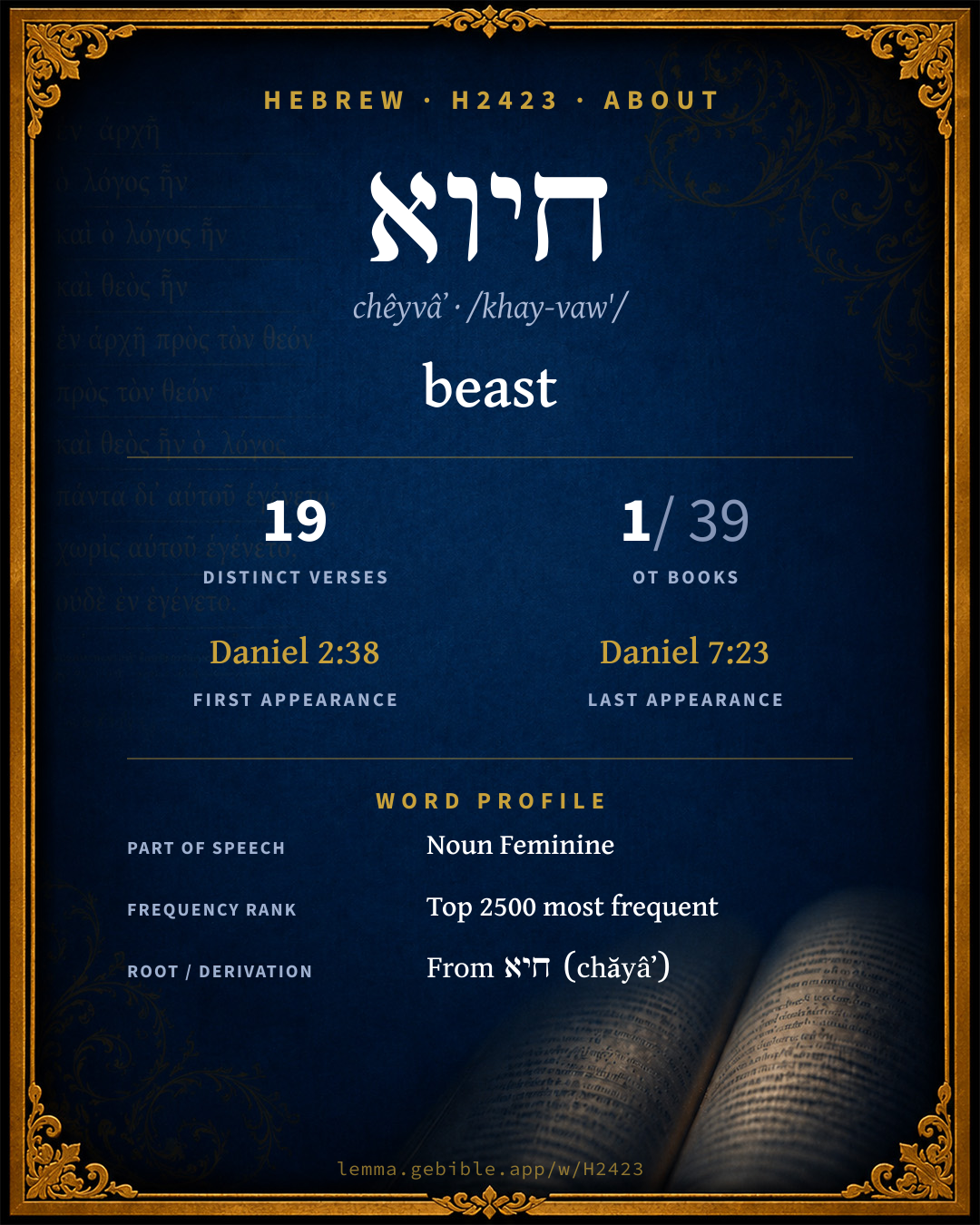
חֵיוָא
beast
Full lexicon entry — Brown-Driver-Briggs (BDB)
From Brown-Driver-Briggs (BDB)
Where this word appears
See every Construct-state word in the Hebrew Bible →
Grammar key — what these labels mean
Part of speech
- Noun
- A naming word — a person, place, thing, or idea.
Noun type
- Common
- A common noun — a general class of person, place, or thing (“king,” “city,” “water”), not a specific name.
State
- Construct
- A noun bound to a following noun in a possessive / “of” relationship (the construct chain).
- Absolute
- The independent form of a noun, not bound to a following word.
Gender
- Feminine
- Grammatically feminine.
Number
- Singular
- One.
- Plural
- More than one (in Hebrew, generally three or more).
Grammatical forms
- Particle, Definite Article 10 times (50%)
- Noun, Common, Feminine, Singular, Construct 6 times (30%)
- Noun, Common, Feminine, Singular, Absolute 3 times (15%)
- Noun, Common, Feminine, Plural, Absolute 1 time (5%)
Parsed forms decoded from the imported morphology (morphhb / Westminster Leningrad Codex — WLC text public domain, morphhb tagging CC BY 4.0), counted across 20 parsed occurrences — not distinct verses.
Every verse where H2423 appears — 19 distinct verses across 1 book. Click any verse to open its interlinear word-by-word view. Verse text shown in the World English Bible for context — . Each verse’s Hebrew form is shown with its reference; the English is not keyword-highlighted, since the data carries no word-level English alignment. Use “Compare translations” on any verse to read it across multiple English versions. This concordance covers the Hebrew Bible; Septuagint (Greek Old Testament) occurrences are not indexed here.
Daniel 19 verses
- Daniel 2:38 חֵיוַ֨ת n c fs cs and wherever the children of men dwell, the animals of the field and the birds of the sky has he given into your hand, and has made you to rule over them all: you are the head of gold.
- Daniel 4:12 חֵיוַ֣ת n c fs cs The leaves of it were beautiful, and the fruit of it much, and in it was food for all: the animals of the field had shadow under it, and the birds of the sky lived in the branches of it, and all flesh was fed from it.
- Daniel 4:14 חֵֽיוְתָ/א֙ n c fs det + ptcl def.art He cried aloud, and said thus, Hew down the tree, and cut off its branches, shake off its leaves, and scatter its fruit: let the animals get away from under it, and the fowls from its branches.
- Daniel 4:15 חֵיוְתָ֥/א n c fs det + ptcl def.art Nevertheless leave the stump of its roots in the earth, even with a band of iron and brass, in the tender grass of the field; and let it be wet with the dew of the sky: and let his portion be with the animals in the grass of the earth:
- Daniel 4:16 חֵיוָ֖ה n c fs let his heart be changed from man's, and let a animal's heart be given to him; and let seven times pass over him.
- Daniel 4:21 חֵיוַ֣ת n c fs cs whose leaves were beautiful, and the fruit of it much, and in it was food for all; under which the animals of the field lived, and on whose branches the birds of the sky had their habitation:
- Daniel 4:23 חֵיוַ֤ת n c fs cs Whereas the king saw a watcher and a holy one coming down from the sky, and saying, Hew down the tree, and destroy it; nevertheless leave the stump of the roots of it in the earth, even with a band of iron and brass, in the tender grass of the field, and let it be wet with the dew of the sky: and let his portion be with the animals of the field, until seven times pass over him;
- Daniel 4:25 חֵיוַ֣ת n c fs cs that you shall be driven from men, and your dwelling shall be with the animals of the field, and you shall be made to eat grass as oxen, and shall be wet with the dew of the sky, and seven times shall pass over you; until you know that the Most High rules in the kingdom of men, and gives it to whoever he will.
- Daniel 4:32 חֵיוַ֧ת n c fs cs and you shall be driven from men; and they dwelling shall be with the animals of the field; you shall be made to eat grass as oxen; and seven times shall pass over you; until you know that the Most High rules in the kingdom of men, and gives it to whoever he will.
- Daniel 5:21 חֵיוְתָ֣/א n c fs det + ptcl def.art and he was driven from the sons of men, and his heart was made like the animals', and his dwelling was with the wild donkeys; he was fed with grass like oxen, and his body was wet with the dew of the sky; until he knew that the Most High God rules in the kingdom of men, and that he sets up over it whoever he will.
- Daniel 7:3 חֵיוָן֙ n c fp Four great animals came up from the sea, diverse one from another.
- Daniel 7:5 חֵיוָה֩ n c fs Behold, another animal, a second, like a bear; and it was raised up on one side, and three ribs were in its mouth between its teeth: and they said thus to it, Arise, devour much flesh.
- Daniel 7:6 לְ/חֵ֣יוְתָ֔/א prep + n c fs det + ptcl def.art After this I saw, and, behold, another, like a leopard, which had on its back four wings of a bird; the animal had also four heads; and dominion was given to it.
- Daniel 7:7 חֵיוָ֣ה חֵֽיוָתָ/א֙ n c fs n c fs det + ptcl def.art After this I saw in the night-visions, and, behold, a fourth animal, awesome and powerful, and strong exceedingly; and it had great iron teeth; it devoured and broke in pieces, and stamped the residue with its feet: and it was diverse from all the animals that were before it; and it had ten horns.
- Daniel 7:11 חֵֽיוְתָ/א֙ n c fs det + ptcl def.art I saw at that time because of the voice of the great words which the horn spoke; I saw even until the animal was slain, and its body destroyed, and it was given to be burned with fire.
- Daniel 7:12 חֵֽיוָתָ֔/א n c fp det + ptcl def.art As for the rest of the animals, their dominion was taken away: yet their lives were prolonged for a season and a time.
- Daniel 7:17 חֵיוָתָ֣/א n c fp det + ptcl def.art These great animals, which are four, are four kings, who shall arise out of the earth.
- Daniel 7:19 חֵֽיוְתָ/א֙ n c fs det + ptcl def.art Then I desired to know the truth concerning the fourth animal, which was diverse from all of them, exceedingly terrible, whose teeth were of iron, and its nails of brass; which devoured, broke in pieces, and stamped the residue with its feet;
- Daniel 7:23 חֵֽיוְתָ/א֙ n c fs det + ptcl def.art Thus he said, The fourth animal shall be a fourth kingdom on earth, which shall be diverse from all the kingdoms, and shall devour the whole earth, and shall tread it down, and break it in pieces.
About this entry
At a glance — auto-summarized from this page’s data, not written by a person. Every figure links to its source below. This summary describes the numbers; it doesn’t interpret them.
“beast” is the headline sense of the Hebrew noun חיוא (chêyvâʼ). It clusters heavily in Daniel, which alone accounts for 100% of its uses. It turns up in 19 verses across 1 book, an uncommon footprint. First canonically at Daniel 2:38, it enters the text early. Translators differ — “beasts” in the King James Version, then “animals of” (unfoldingWord Literal Text), as the renderings breakdown shows. The sections below give every sense, occurrence, and version rendering.
Gloss history
Strong's 1890 vs modern scholarship
About this word
Strong's H2423 catalogs a Hebrew word from the Hebrew Old Testament.
These counts are not copied from any lexicon or concordance. They are computed here, from the morphology-tagged Hebrew Old Testament. What Lemma adds →
- 19
- distinct verses
- The word appears in 19 distinct verses.
- 1 / 39
- OT books
- The word appears in 1 of 39 Old Testament books.
- #1,513
- by frequency
- Top 2500 most frequent Hebrew words (rank 1,513 of 8,640 Hebrew words by occurrence).
View all 19 occurrences in the concordance →
Most concentrated in
- Daniel 19 verses 100%
By section of the Old Testament
By traditional corpus
Conventional, traditional groupings — biblical authorship is debated, so this is a traditional corpus grouping, not an authorship claim. Each share is this word’s portion of its verses in that division of the Hebrew canon. Each figure is a share of the word’s 19 distinct verses.
- Writings (Ketuvim) 19 verses · 100%
How translations render this word
Counts come from each version’s own published word-to-Strong’s tagging or interlinear alignment — an approximate guide to how each version renders this word, not a word-level alignment the data otherwise carries. Because each total is that version’s own tagged count, the per-version totals vary from one another and need not match the appearance or distinct-verse counts above. These counts may also differ from a printed concordance because Lemma counts each distinctly tagged rendering and does not collapse phrase taggings into a single head-word total. This is a fixed set of word-tagged versions (KJV, ASV, BSB, ULT) and does not change with the reading translation you choose elsewhere. Each version’s license is shown beside its name below (and on Sources).
- King James Version: Beasts 12×, Beast 6×
- American Standard Version: Beasts 12×, Beast 6×
- Berean Standard Bible: Beasts 10×, Beast 4×, Beast appeared 2×
- unfoldingWord Literal Text: Animals of 6×, Beast 5×, Beasts 4×
King James Version Public Domain
Renders H2423 across 20 tagged occurrences — most commonly:
Plus 2 renderings that appear only once — usually multi-word phrases or single function words the recovered tagging swept in, not distinct renderings.
American Standard Version Public Domain
Renders H2423 across 20 tagged occurrences — most commonly:
Plus 2 renderings that appear only once — usually multi-word phrases or single function words the recovered tagging swept in, not distinct renderings.
Berean Standard Bible Public Domain
Renders H2423 across 20 tagged occurrences — most commonly:
Plus 4 renderings that appear only once — usually multi-word phrases or single function words the recovered tagging swept in, not distinct renderings.
unfoldingWord Literal Text CC BY-SA 4.0
Renders H2423 across 22 tagged occurrences — most commonly:
Plus 3 renderings that appear only once — usually multi-word phrases or single function words the recovered tagging swept in, not distinct renderings.
Senses in BDB
The 1 sense BDB distinguishes for this word, in lexicon order (not ranked by frequency or importance). The full entry — with sub-senses — is in the Lexicon Entry tab.
- beast, animal
Word origin
Derived from חיא (chăyâʼ) (H2418) — to live.
Jastrow Dictionary
A second Hebrew/Aramaic lexicon for comparison, covering Aramaic and post-biblical (Talmudic, Targumic, Midrashic) usage that the biblical-Hebrew BDB does not. Matched by lemma rather than by Strong’s number, so a lemma may carry more than one Jastrow headword (shown separately below), and the entries cover usage well beyond the Bible.
חֵיוָא
- = h. חַיָּה I, animal, mostly collect. beasts. Targ. Y. Gen. XXXVII, 2. Targ. Gen. I, 25; a. fr.—Yeb. 121ᵇ ושדי לחֵיוָאִי and cast it before my cattle; Snh. 74ᵇ לחֵיוְתָא (ed. Sonc. לחֵיוְתָאִי); a. fr.—Pl. חֵיוָון, חֵיוָאן. Targ. Y. Gen. XXV, 27.—Koh. R. to XI, 2 תרין ח׳ דנור two animals of fire (M. K. חִוְיָן serpents). Ib. חֵיוָן.—(Masc. pl.) חֵיוֵי. Ḥull. 43ᵇ, a. e. ח׳ ברייתא, v. בָּרָאָה.—V. חֵיוְתָא
A Dictionary of the Targumim, the Talmud Babli and Yerushalmi, and the Midrashic Literature (Marcus Jastrow; London, Luzac, 1903) — Public Domain. Digitized via Sefaria. Digitized via Sefaria. Full attribution on Sources.
Forms in the corpus
The 15 distinct written forms H2423 takes in the Hebrew Bible, most frequent first — each parse links to that state’s occurrences in the concordance. Hebrew forms include their vowel points and cantillation, so a single lemma takes many written forms.
| Form | Parsing | Example | Uses |
|---|---|---|---|
| חֵֽיוְתָ/א֙ | Particle, Definite Article | Daniel 4:14 | 4 |
| חֵיוַ֣ת | Noun, Common, Feminine, Singular, Construct | Daniel 4:12 | 3 |
| חֵֽיוָתָ/א֙ | Particle, Definite Article | Daniel 7:7 | 1 |
| חֵֽיוָתָ֔/א | Particle, Definite Article | Daniel 7:12 | 1 |
| חֵיוְתָ֣/א | Particle, Definite Article | Daniel 5:21 | 1 |
| חֵיוְתָ֥/א | Particle, Definite Article | Daniel 4:15 | 1 |
| חֵיוַ֤ת | Noun, Common, Feminine, Singular, Construct | Daniel 4:23 | 1 |
| חֵיוַ֧ת | Noun, Common, Feminine, Singular, Construct | Daniel 4:32 | 1 |
| חֵיוַ֨ת | Noun, Common, Feminine, Singular, Construct | Daniel 2:38 | 1 |
| חֵיוָ֖ה | Noun, Common, Feminine, Singular, Absolute | Daniel 4:16 | 1 |
| חֵיוָ֣ה | Noun, Common, Feminine, Singular, Absolute | Daniel 7:7 | 1 |
| חֵיוָה֩ | Noun, Common, Feminine, Singular, Absolute | Daniel 7:5 | 1 |
| חֵיוָן֙ | Noun, Common, Feminine, Plural, Absolute | Daniel 7:3 | 1 |
| חֵיוָתָ֣/א | Particle, Definite Article | Daniel 7:17 | 1 |
| לְ/חֵ֣יוְתָ֔/א | Particle, Definite Article | Daniel 7:6 | 1 |
Same root — word family
Other BDB entries built from the same root as H2423, grouped by Strong’s listed origin. These share a root / origin per the lexicon — not necessarily a shared meaning. Each links to that word’s own entry.
Derives from
Shares the same root
Compare all same-root words → They share a root, not necessarily a meaning.
Septuagint verse parallels
This word appears in 17 verses that also exist in the Greek Old Testament (Septuagint), out of the 19 Hebrew verses it occurs in. You can read those verses in Greek by switching the Old Testament edition to the Septuagint.
Read these verses in the Septuagint
This is a verse-level parallel only — the same verses exist in both the Hebrew and Greek Old Testaments. No word-level Hebrew↔Greek correspondence is claimed: the data carries no such alignment, so no Greek word is shown as this Hebrew word’s translation. Coverage is not total — the Septuagint omits the deuterocanon and renumbers the Psalms, so some Hebrew verses have no direct Greek parallel.