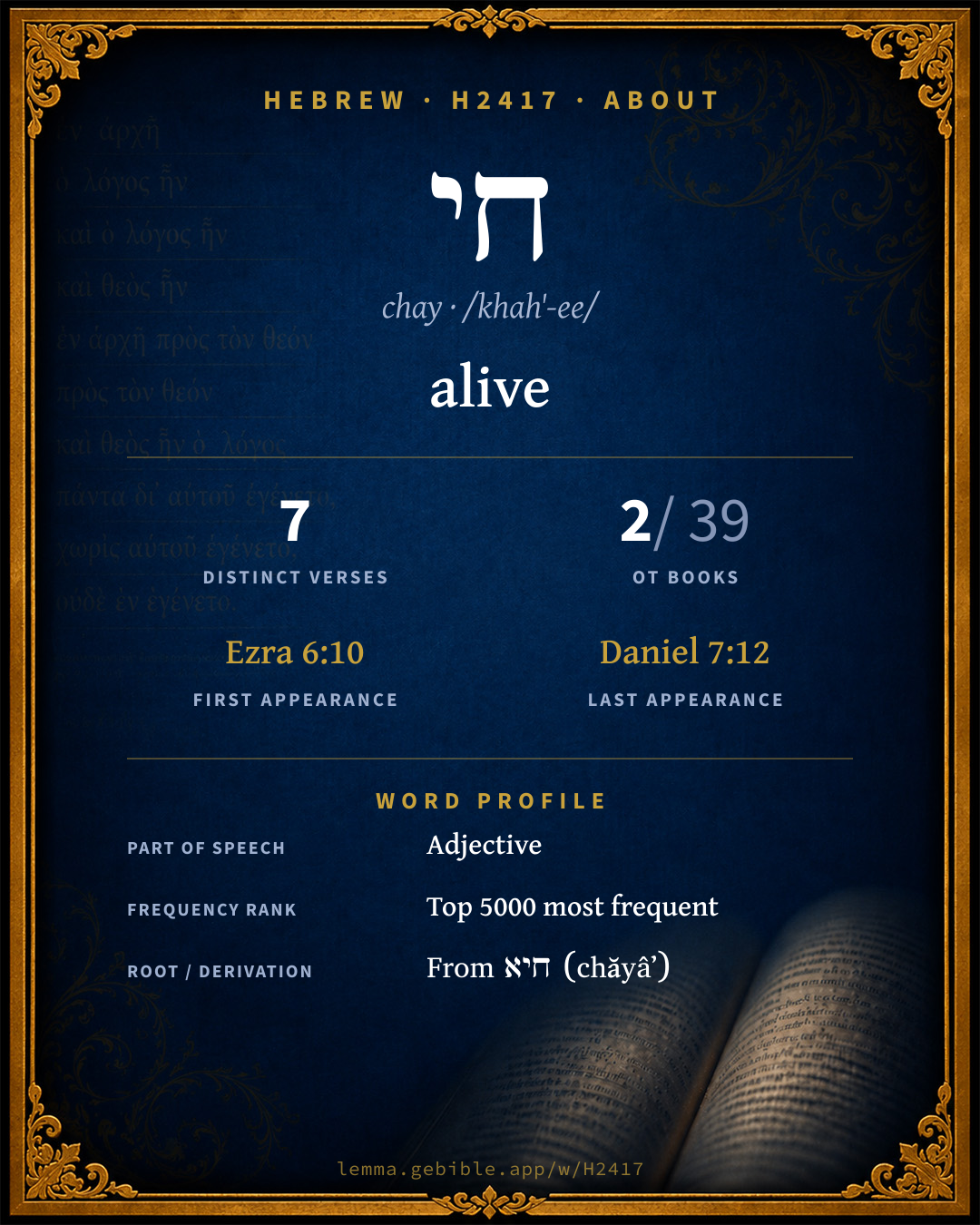
חַי
alive
Full lexicon entry — Brown-Driver-Briggs (BDB)
From Brown-Driver-Briggs (BDB)
Where this word appears
See every Construct-state word in the Hebrew Bible →
Grammar key — what these labels mean
Noun type
- Common
- A common noun — a general class of person, place, or thing (“king,” “city,” “water”), not a specific name.
State
- Construct
- A noun bound to a following noun in a possessive / “of” relationship (the construct chain).
- Absolute
- The independent form of a noun, not bound to a following word.
Gender
- Masculine
- Grammatically masculine.
Number
- Singular
- One.
- Plural
- More than one (in Hebrew, generally three or more).
Grammatical forms
- Particle, Definite Article 4 times (57%)
- Adjective, Adjective, Masculine, Singular, Construct 1 time (14%)
- Noun, Common, Masculine, Plural, Absolute 1 time (14%)
- Noun, Common, Masculine, Plural, Construct 1 time (14%)
Parsed forms decoded from the imported morphology (morphhb / Westminster Leningrad Codex — WLC text public domain, morphhb tagging CC BY 4.0), counted across 7 parsed occurrences — not distinct verses.
Every verse where H2417 appears — 7 distinct verses across 2 books. Click any verse to open its interlinear word-by-word view. Verse text shown in the World English Bible for context — . Each verse’s Hebrew form is shown with its reference; the English is not keyword-highlighted, since the data carries no word-level English alignment. Use “Compare translations” on any verse to read it across multiple English versions. This concordance covers the Hebrew Bible; Septuagint (Greek Old Testament) occurrences are not indexed here.
Ezra 1 verse
Daniel 6 verses
- Daniel 2:30 חַיַּיָּ֔/א adj Adjective mp det + ptcl def.art But as for me, this secret is not revealed to me for any wisdom that I have more than any living, but to the intent that the interpretation may be made known to the king, and that you may know the thoughts of your heart.
- Daniel 4:17 חַ֠יַּיָּ/א adj Adjective mp det + ptcl def.art The sentence is by the decree of the watchers, and the demand by the word of the holy ones; to the intent that the living may know that the Most High rules in the kingdom of men, and gives it to whoever he will, and sets up over it the lowest of men.
- Daniel 4:34 וּ/לְ/חַ֥י conj + ptcl do + Adjective Adjective ms cs At the end of the days I, Nebuchadnezzar, lifted up my eyes to heaven, and my understanding returned to me, and I blessed the Most High, and I praised and honored him who lives forever; for his dominion is an everlasting dominion, and his kingdom from generation to generation.
- Daniel 6:20 חַיָּ֔/א adj Adjective ms det + ptcl def.art When he came near to the den to Daniel, he cried with a lamentable voice; the king spoke and said to Daniel, Daniel, servant of the living God, is your God, whom you serve continually, able to deliver you from the lions?
- Daniel 6:26 חַיָּ֗/א adj Adjective ms det + ptcl def.art I make a decree, that in all the dominion of my kingdom men tremble and fear before the God of Daniel; for he is the living God, and steadfast forever, His kingdom that which shall not be destroyed; and his dominion shall be even to the end.
- Daniel 7:12 בְ/חַיִּ֛ין prep + n c mp As for the rest of the animals, their dominion was taken away: yet their lives were prolonged for a season and a time.
About this entry
At a glance — auto-summarized from this page’s data, not written by a person. Every figure links to its source below. This summary describes the numbers; it doesn’t interpret them.
חי — transliterated chay — is a Hebrew adjective carrying the sense “alive.” More than three-quarters of its appearances fall in Daniel. It appears 7 verses across 2 books of the Hebrew Bible, among its uncommon vocabulary. Its earliest occurrence is Ezra 6:10. It shares a root with חיא and חיוא. See the sense tree, 7-verse concordance, and the renderings breakdown below.
Gloss history
Strong's 1890 vs modern scholarship
About this word
Strong's H2417 catalogs a Hebrew word from the Hebrew Old Testament.
These counts are not copied from any lexicon or concordance. They are computed here, from the morphology-tagged Hebrew Old Testament. What Lemma adds →
- 7
- distinct verses
- The word appears in 7 distinct verses.
- 2 / 39
- OT books
- The word appears in 2 of 39 Old Testament books.
- #2,835
- by frequency
- Top 5000 most frequent Hebrew words (rank 2,835 of 8,640 Hebrew words by occurrence).
View all 7 occurrences in the concordance →
By traditional corpus
Conventional, traditional groupings — biblical authorship is debated, so this is a traditional corpus grouping, not an authorship claim. Each share is this word’s portion of its verses in that division of the Hebrew canon. Each figure is a share of the word’s 7 distinct verses.
- Writings (Ketuvim) 7 verses · 100%
How translations render this word
Counts come from each version’s own published word-to-Strong’s tagging or interlinear alignment — an approximate guide to how each version renders this word, not a word-level alignment the data otherwise carries. Because each total is that version’s own tagged count, the per-version totals vary from one another and need not match the appearance or distinct-verse counts above. These counts may also differ from a printed concordance because Lemma counts each distinctly tagged rendering and does not collapse phrase taggings into a single head-word total. This is a fixed set of word-tagged versions (KJV, ASV, BSB, ULT) and does not change with the reading translation you choose elsewhere. Each version’s license is shown beside its name below (and on Sources).
BDB lists this Strong’s number as 3 distinct words (homographs). Each count above pools all of them and is not split by sense — see the Senses section below. A low-frequency rendering may belong to a different one of those words, not the primary meaning.
- King James Version†: Living 3×
- American Standard Version†: Living 3×
- Berean Standard Bible†: Lives 2×, Living 2×
- unfoldingWord Literal Text†: Living 4×
King James Version Public Domain
Renders H2417 across 7† tagged occurrences — most commonly:
Plus 4 renderings that appear only once — usually multi-word phrases or single function words the recovered tagging swept in, not distinct renderings.
American Standard Version Public Domain
Renders H2417 across 7† tagged occurrences — most commonly:
Plus 4 renderings that appear only once — usually multi-word phrases or single function words the recovered tagging swept in, not distinct renderings.
Berean Standard Bible Public Domain
Renders H2417 across 7† tagged occurrences — most commonly:
Plus 3 renderings that appear only once — usually multi-word phrases or single function words the recovered tagging swept in, not distinct renderings.
unfoldingWord Literal Text CC BY-SA 4.0
Renders H2417 across 8† tagged occurrences — most commonly:
Plus 4 renderings that appear only once — usually multi-word phrases or single function words the recovered tagging swept in, not distinct renderings.
8 senses and sub-senses in the full BDB
What do BDB’s symbols mean?
BDB uses these scholarly abbreviations:
| Symbol | Meaning |
|---|---|
| 𝔊 | the Septuagint (the ancient Greek translation, LXX) |
| 𝔙 | the Vulgate (the Latin translation) |
| 𝔖 | the Syriac version (the Peshitta) |
| 𝔗 | the Targum (the Aramaic translation) |
| ψ | the Psalms |
| √ | root (the underlying root or stem) |
| ‖ | parallel passage (a synonymous or contrasted parallel) |
| † | the dagger: every passage where the word occurs is cited |
The 8 senses and sub-senses the full Brown-Driver-Briggs lexicon distinguishes for this word, in lexicon order (not ranked by frequency), with BDB’s own verbatim wording and sub-sense lettering. Shown in Hebrew script with BDB’s own scholarly abbreviations. The condensed entry is in the Lexicon Entry tab. See also the Forms in the corpus table below.
חי I alive, living
- 1.
- a. of God, as the living one, the fountain of life אֵל חַי Jos 3:10 (J), Ho 2:1 ψ 42:3; 84:3; אלהים חי 2 K 19:4, 16 = Is 37:4, 17; אלהים חיים Dt 5:23 1 S 17:26, 36 Je 10:10; 23:36; חי יהוה Yahweh is living ψ 18:47 = 2 S 22:47; גאלי חי my avenger is living Jb 19:25; the formula of the oath is חַי י׳ Ju 8:19 Ru 3:13 1 S 14:39, 45; 19:6; 20:3, 21; 25:34; 26:10, 16; 28:10; 29:6 2 S 4:9; 12:5; 14:11; 15:21 1 K 1:29; 2:24; 17:1, 12; 18:10; 22:14 = 2 Ch 18:13, 2 K 5:16, 20 Ho 4:15 Je 4:2; 5:2; 12:16; 16:14, 15; 23:7, 8; 38:16; חי אל Jb 27:2; חי האלהים 2 S 2:27; חי אדני י׳ Je 44:26; חי י׳ צבאות 1 K 18:15 2 K 3:14; as used by God Himself it is חי אנכי Dt 32:40, elsewhere חי אני Nu 14:21, 28 (P) Is 49:18; Je 22:24; 46:18 Ez 5:11; 14:16, 18, 20; 16:48; 17:16, 19; 18:3; 20:3, 31, 33; 33:11, 27; 34:8; 35:6, 11 Zp 2:9, cf. also חֵי דרך באר שׁבע, חֵי אלהיך דן Am 8:14; with the exception of בְּחֵי הָעֹולָם by him who liveth for ever Dn 12:7, חֵי is always (as an artificial distinction of scribes) used of non-sacred oaths, v. b. e.g. Joshua 3:10
- b. of man; אָדָם חַי a living man La 3:39, in antith. מֵת: חי חי Is 38:19; הַחַי collective Ec 7:2; Absalom 2 S 19:7; Naboth 1 K 21:15; a son or lad 2 S 12:21 1 K 3:22(×2), 23(×2), 25, 26(×2), 27; 17:23; usually pl. חיים alive, living Nu 16:30, 33 (J), 17:13 (P), Dt 4:4; 5:3 Is 8:19 ψ 55:16; 124:3 Pr 1:12 Ec 4:2(×2), 15; 6:8; 9:4, 5 Ru 2:20; taking prisoners alive Jos 8:23 (J) 1 S 15:8 1 K 20:18(×2) 2 K 7:12; 10:14(×2) 2 Ch 25:12; living (prosperously) 1 S 25:6 (We reads לָחִי = לְאָחִי (v. Klo Dr) to my brother, after 𝔙 fratribus meis); elsewhere in phrase כל־הימים אשׁר הֵם (אַתֶּם) היים על (פני) האדמה all the days that they (ye) live upon (the face of) the land Dt 4:10; 12:1; 31:13 1 K 8:40 = 2 Ch 6:31. Note phrases: עוֹד חַי (ים) yet alive Gn 25:6; 43:7, 27, 28; 45:28; 46:30 (J), 45:3, 26 Ex 4:18 (E), Dt 31:27 1 Sa 20:14 2 S 12:22; 18:14 1 K 20:32; בהיות חי 2 S 12:18 1 K 12:6 2 Ch 10:6; אֶרֶץ (הַ)חַיִים land of the living Is 38:11; 53:8 Je 11:19 Ez 26:20; 32:23, 24, 25, 26, 27, 32 ψ 27:13; 52:7; 142:6 Jb 28:13; ארצות הח׳ ψ 116:9; ספר ח׳ ψ 69:29; צרור הח׳ bundle of the living 1 S 25:29; אור הח׳ light of the living Jb 33:30 ψ 56:14. In the oath by life of men חי is pointed always חֵי: חֵי אדני המלך as my lord the king liveth 2 S 15:21; חֵי פרעה Gn 42:15, 16 (E); חֵי נַפְשְׁךָ 1 S 1:26; 17:55 2 S 14:19; חַי י׳ וְחֵי נַפְשְׁךָ as Yahweh liveth and as thy soul (or thyself) liveth 1 S 20:3; 25:26 2 K 2:2, 4, 6; 4:30 חַיֶּךָ וְחֵי נ׳ 2 S 11:11 (but on text v. We Dr). e.g. Lamentations 3:39
- c. of animals, alive, living: ox Ex 21:35; 22:3 (E); goat Lv 16:10, 20, 21 (P); bird Lv 14:4, 6(×2), 7, 51, 53; dog, לְכֶלֶב חַי הוּא טוֹב מִן־הָאַרְיֵה הַמֵּת Ec 9:4 (comp. Arabic prov. Kalb ḥay wa-lâ maiyit, a living dog and no dead lion Wetzst Verhand. Berl. Anthrop. Ges 1878, 388); reptiles Gn 1:28 (P); animals in general Gn 9:3 (P); בשׂר חי living, raw flesh Lv 13:10, 14, 15(×2), 16 (P) 1 S 2:15. e.g. Exodus 21:35
- d. animals and man, phrases for either or both: כל חי Gn 3:20; 8:21 (J) Jb 12:10; 28:21; 30:23 ψ 143:2; 145:16; כל החי Gn 6:19 (P); נֶפֶשׁ חַיָּה Gn 1:20, 24, 30 (P) 2:7, 19 (J); כל נֶפֶשׁ חַיָּה Gn 9:12, 15, 16 (P) Ez 47:9; כל נפשׁ החיה Gn 1:21; 9:10 Lv 11:10, 46 (P). e.g. Genesis 3:20
- e. (dub.) of vegetation, as thorns, green, ψ 58:10 (Ges Ew Ol Pe, but De Ri Che Bae raw flesh, v. c supr. ad fin.) e.g. Psalms 58:10
- f. of water, flowing, fresh מים חיים Gn 26:19 (J), Lv 14:5, 6, 50, 51, 52; 15:13 Nu 19:17 (P), Je 2:13; 17:13 Zc 14:8 Ct 4:15. e.g. Genesis 26:19
- 2. (dub.) lively, active: אישׁ חַי an active man 2 S 23:20 (but Qr אישׁ חַיִל is to be preferred); איבי חיים mine enemies are lively ψ 38:20 (RV, but Houb Ol Ew Hu. Che al. read חִנָּם, ‖ שׁקר). e.g. 2 Samuel 23:20
- 3. reviving: כָּעֵת חַיָּה at the time (when it is) reviving, the spring Gn 18:10, 14 (J), 2 K 4:16, 17. e.g. Genesis 18:10
חי II [m.] kinsfolk (Arabic حَىٌّ a group of families united by vital ties RSK 36–40 DrSm 119), pl. sf. חַיַּי 1 S 18
Senses from the full Brown-Driver-Briggs lexicon (Brown, Driver, Briggs; Oxford 1906 — public domain), digitized via Sefaria, supplemented by the OpenScriptures HebrewLexicon (CC BY 4.0). Full attribution on Sources.
Word origin
I. v. sub חיה infr.
II. adj. alive, living;—ח׳ Gn 25:6 +; חָ֑י Gn 3:20 +, חֵי Am 8:14 + 15 times (Ew§ 329 explains as cstr., but Ges§ 93, R 7 n. al. as contracted abs.); f. חַיָּה Gn 1:20 +; pl. חַיִּים ψ 116:9 +;—
III. n.[m.] kinsfolk (Arabic حَىٌّ a group of families united by vital ties RSK 36–40 DrSm 119), pl. sf. חַיַּי 1 S 18:18, incorrectly pointed with the interpretation my life RV, but read חַיִּי my kinsfolk, We Ki Dr RS SS RVm VB. It is explained by the gloss משׁפחת אבי We (Klo reads אַחַי וּ).
— Brown-Driver-Briggs (Oxford 1906, public domain), digitized via Sefaria, supplemented by the OpenScriptures HebrewLexicon (CC BY 4.0). See Sources.
Derived from חיא (chăyâʼ) (H2418) — to live.
Jastrow Dictionary
A second Hebrew/Aramaic lexicon for comparison, covering Aramaic and post-biblical (Talmudic, Targumic, Midrashic) usage that the biblical-Hebrew BDB does not. Matched by lemma rather than by Strong’s number, so a lemma may carry more than one Jastrow headword (shown separately below), and the entries cover usage well beyond the Bible.
חַי
- 1. living, alive; living creature; healthy. Ber. 27ᵇ אלמלא אני חי והוא מת יכול החי וכ׳ if I were alive and he dead, the living one might give the lie to the dead. Ib. V, 5 זה חי this one is destined to live (recover). Sabb. 94ᵃ, a. e. החי נושא את עצמו a living being carries itself (the carrying of a living being on the Sabbath is not unlawful). Ib. X, 5 את החי במטה (he who carries) a living person on a couch; a. v. fr.—אבר מן החי, v. אֵבֶר.—Pl. חַיִּים, חַיִּין. Ab. IV, 22 והח׳ לידון and the living are destined to be judged. Sabb. 94ᵃ בין ח׳ ובין שחוטין whether alive or slaughtered; a. fr.—Ab. Zar. 5ᵇ (ref. to החי, Gen. VI, 19) שחיין ראשי וכ׳ the ends of whose limbs live (exist). e.g. Genesis 6:19
- 2. in natural condition, raw (opp. בשול); unmixed (opp. מָזוּג). Snh. 70ᵃ בשר חי raw meat, יין חי unmixed wine. Ab. Zar. 38ᵃ, a. fr. הנאכל כמות שהוא חי what is eatable in its natural state; a. fr.—Fem. חַיָּה. Ḥull. 42ᵃ (ref. to Lev. XI, 2) ח׳ אכול וכ׳ what is in a healthy condition (viable), you may eat, v. טְרֵפָה. [V. חַיָּה.] e.g. Leviticus 11:2
חַי ²
- Targ. Gen. IX, 3; a. fr.—Targ. Ex. XII, 9 כד חי (half-)raw; a. fr.—Sabb. 18ᵇ קרא חייא raw cabbage.—Midr. Till. to Ps. XXII, 7 [read:] חשיך חי דבעי למיתא luckless in the living one that is dependent on the dead; Yalk. ib. 686; a. fr.—Pl. חַיִּין, חַיַּיָּא, חַיֵּי. Targ. Ps. XXXVIII, 20. Targ. Num. XVII, 13; a. fr.—Snh. 98ᵇ אי מן ח׳ הוא if he is one of the living (the present age); Y. Ber. II, 5ᵃ top; a. fr.—Fem. חַיָּיא, חַיָּא, חַיְּתָא, חַיְּי׳. Targ. Gen. I, 20. Targ. Y. ib. XXXVII, 2; a. e.—Sabb. 18ᵇ קדרא ח׳ a raw dish.—Pl. חַיָּיתָא, חַיָּין. Targ. Y. Gen. I, 21; a. fr.—Targ. Y. II, Ex. I, 19 (strong).—[B. Kam. 38ᵇ דהוה חַיָּה (h. form.) that she would have lived.
A Dictionary of the Targumim, the Talmud Babli and Yerushalmi, and the Midrashic Literature (Marcus Jastrow; London, Luzac, 1903) — Public Domain. Digitized via Sefaria. Digitized via Sefaria. Full attribution on Sources.
Forms in the corpus
The 7 distinct written forms H2417 takes in the Hebrew Bible, most frequent first — each parse links to that state’s occurrences in the concordance. Hebrew forms include their vowel points and cantillation, so a single lemma takes many written forms.
| Form | Parsing | Example | Uses |
|---|---|---|---|
| בְ/חַיִּ֛ין | Noun, Common, Masculine, Plural, Absolute | Daniel 7:12 | 1 |
| וּ/לְ/חַ֥י | Adjective, Adjective, Masculine, Singular, Construct | Daniel 4:34 | 1 |
| חַ֠יַּיָּ/א | Particle, Definite Article | Daniel 4:17 | 1 |
| חַיַּיָּ֔/א | Particle, Definite Article | Daniel 2:30 | 1 |
| חַיָּ֔/א | Particle, Definite Article | Daniel 6:20 | 1 |
| חַיָּ֗/א | Particle, Definite Article | Daniel 6:26 | 1 |
| לְ/חַיֵּ֥י | Noun, Common, Masculine, Plural, Construct | Ezra 6:10 | 1 |
Same root — word family
Other BDB entries built from the same root as H2417, grouped by Strong’s listed origin. These share a root / origin per the lexicon — not necessarily a shared meaning. Each links to that word’s own entry.
Derives from
Shares the same root
Compare all same-root words → They share a root, not necessarily a meaning.
Septuagint verse parallels
This word appears in 6 verses that also exist in the Greek Old Testament (Septuagint), out of the 7 Hebrew verses it occurs in. You can read those verses in Greek by switching the Old Testament edition to the Septuagint.
Read these verses in the Septuagint
This is a verse-level parallel only — the same verses exist in both the Hebrew and Greek Old Testaments. No word-level Hebrew↔Greek correspondence is claimed: the data carries no such alignment, so no Greek word is shown as this Hebrew word’s translation. Coverage is not total — the Septuagint omits the deuterocanon and renumbers the Psalms, so some Hebrew verses have no direct Greek parallel.