
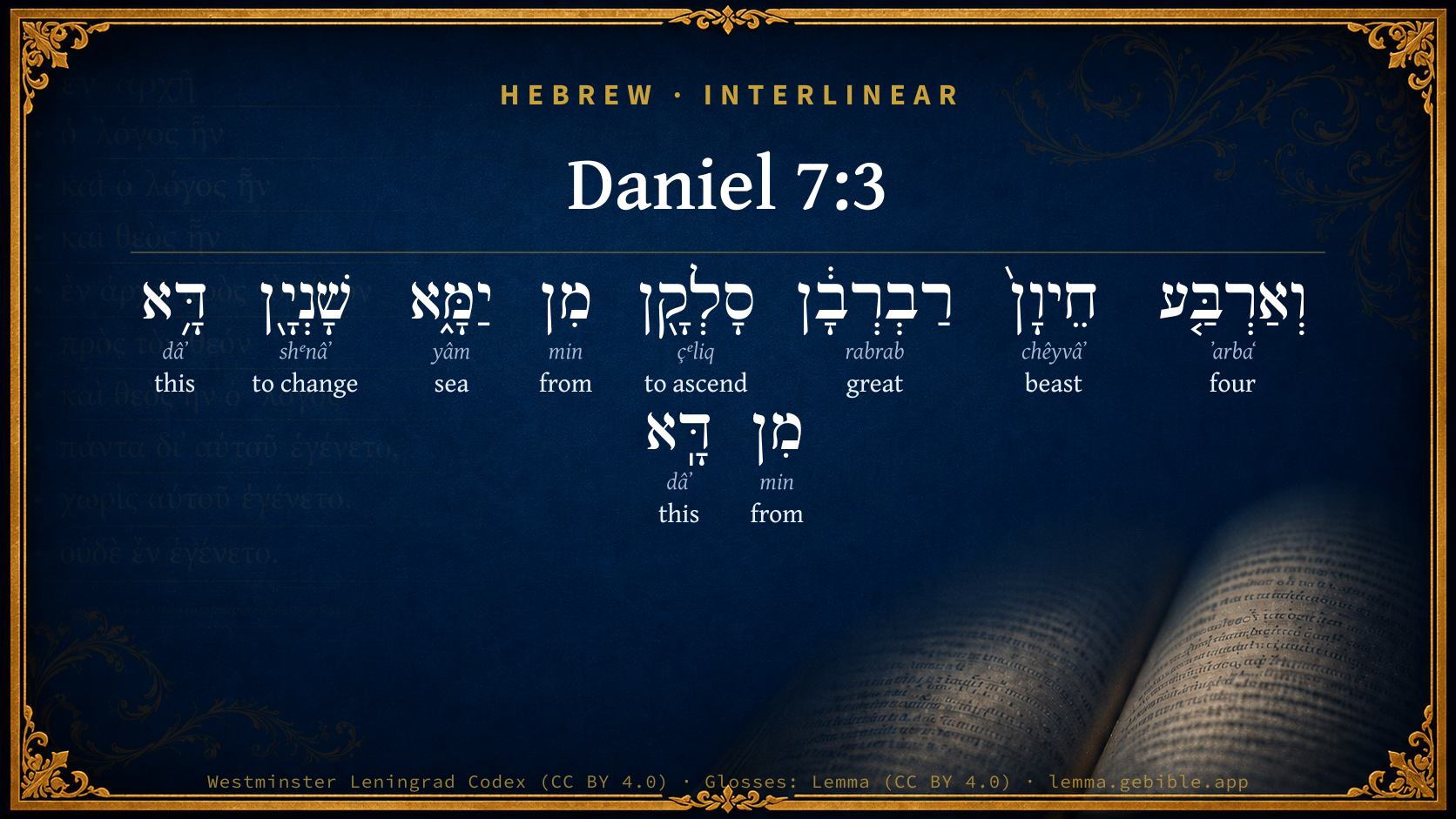
Daniel 7:3

Hebrew (Westminster Leningrad Codex) Daniel 7:3 appears in the Hebrew Old Testament. The text above is from the Westminster Leningrad Codex. Each word links to its Strong’s number, a concise gloss, and parsing drawn from the Open Scriptures Hebrew Bible morphology. Click any word for its full Brown-Driver-Briggs (BDB) entry.
Download image
Cite this verse

Daniel 7:3 (World English Bible). Public Domain. Lemma interlinear Bible study tool, https://lemma.gebible.app/v/daniel/7/3.

Show BibTeX & RIS
BibTeX
RIS
English Translation
Four great animals came up from the sea, diverse one from another.
World English Bible · Public Domain
Download a study sheet

One document with this verse’s original text, its word-by-word gloss line, the meaning frame, cross-references with their text, attributed commentary, and full source and license credits — printable, and it pastes into notes with its structure intact.

This verse Autodidact and up

Study sheet (.html) Plain text (.txt)

A passage Seminary Student

Up to 50 verses in one chapter. A passage sheet keeps up to 6 commentary sources and 12 cross-references per verse, in the order this page ranks them, and says so on the sheet whenever that leaves anything out. Ask for a single verse and you get the Autodidact verse sheet above.

Everything on this page stays free to read, with no account — the sheet is a download of what is already on screen, not access to it.

Want to remove ads? Support Godless Engineer
Compare translations 3

The same verse in 3 English versions, stacked beneath the original-language interlinear above. Click any original word for its lexicon entry.

Each is an independent rendering of the whole verse — the interlinear is not word-aligned to these translations.

Highlighted words mark where these versions differ — a whole-verse word diff, not a word-by-word alignment.

  • World English Bible Public Domain
    Four great animals came up from the sea, diverse one from another.
  • King James Version Public Domain
    And four great beasts came up from the sea, diverse one from another.
  • unfoldingWord Literal Text CC BY-SA 4.0
    And four great beasts, each one different from the other, were coming up out of the sea.

unfoldingWord Literal Text — © unfoldingWord, licensed CC BY-SA 4.0. Word-aligned USFM3 via Door43 (git.door43.org/unfoldingWord/en_ult).

Versions to compare (up to 4)

3 of 4 selected

Show all 18 translations

Every available English version of this verse, each an independent rendering of the whole verse.

  • World English Bible Public Domain
    Four great animals came up from the sea, diverse one from another.
  • Berean Standard Bible Public Domain
    Then four great beasts came up out of the sea, each one different from the others:
  • Majority Standard Bible Public Domain
    Then four great beasts came up out of the sea, each one different from the others:
  • King James Version Public Domain
    And four great beasts came up from the sea, diverse one from another.
  • American Standard Version (1901) Public Domain
    And four great beasts came up from the sea, diverse one from another.
  • Revised Version (1885) Public Domain
    And four great beasts came up from the sea, diverse one from another.
  • Geneva Bible (1599) Public Domain
    And foure great beastes came vp from the sea one diuers from another.
  • Douay-Rheims (1899) Public Domain
    And four great beasts, different one from another, came up out of the sea.
  • Young's Literal Translation Public Domain
    and four great beasts are coming up from the sea, diverse one from another.
  • Literal Standard Version CC BY-SA 4.0
    and four great beasts are coming up from the sea, diverse from one another.
  • Unlocked Literal Bible CC BY-SA 4.0
    Four large animals, each one different from the other, came up out of the sea.
  • unfoldingWord Literal Text CC BY-SA 4.0
    And four great beasts, each one different from the other, were coming up out of the sea.
  • Darby Bible Public Domain
    And four great beasts came up from the sea, different one from another.
  • World Messianic Bible Public Domain
    Four great animals came up from the sea, different from one another.
  • Webster's Bible Public Domain
    And four great beasts came up from the sea, diverse one from another.
  • Free Bible Version CC BY-SA 4.0
    Four very large beasts were coming up from the sea, every one of them different.
  • Bible in Basic English Public Domain
    And four great beasts came up from the sea, different one from another.
  • JPS Tanakh (1917) Public Domain
    And four great beasts came up from the sea, diverse one from another.

Literal Standard Version (2020), Covenant Press — licensed CC BY-SA 4.0. Text via the HelloAO Bible API (eBible.org). Unlocked Literal Bible (unfoldingWord) — licensed CC BY-SA 4.0. Text via the HelloAO Bible API (eBible.org). unfoldingWord Literal Text — © unfoldingWord, licensed CC BY-SA 4.0. Word-aligned USFM3 via Door43 (git.door43.org/unfoldingWord/en_ult). Free Bible Version, Dr. Jonathan Gallagher — licensed CC BY-SA 4.0. Text via the HelloAO Bible API (eBible.org).

Word by word

More ways to search: Search by grammar → Find every occurrence → Compare this word →

Practice this passage: Drill this verse → Learn its vocabulary →

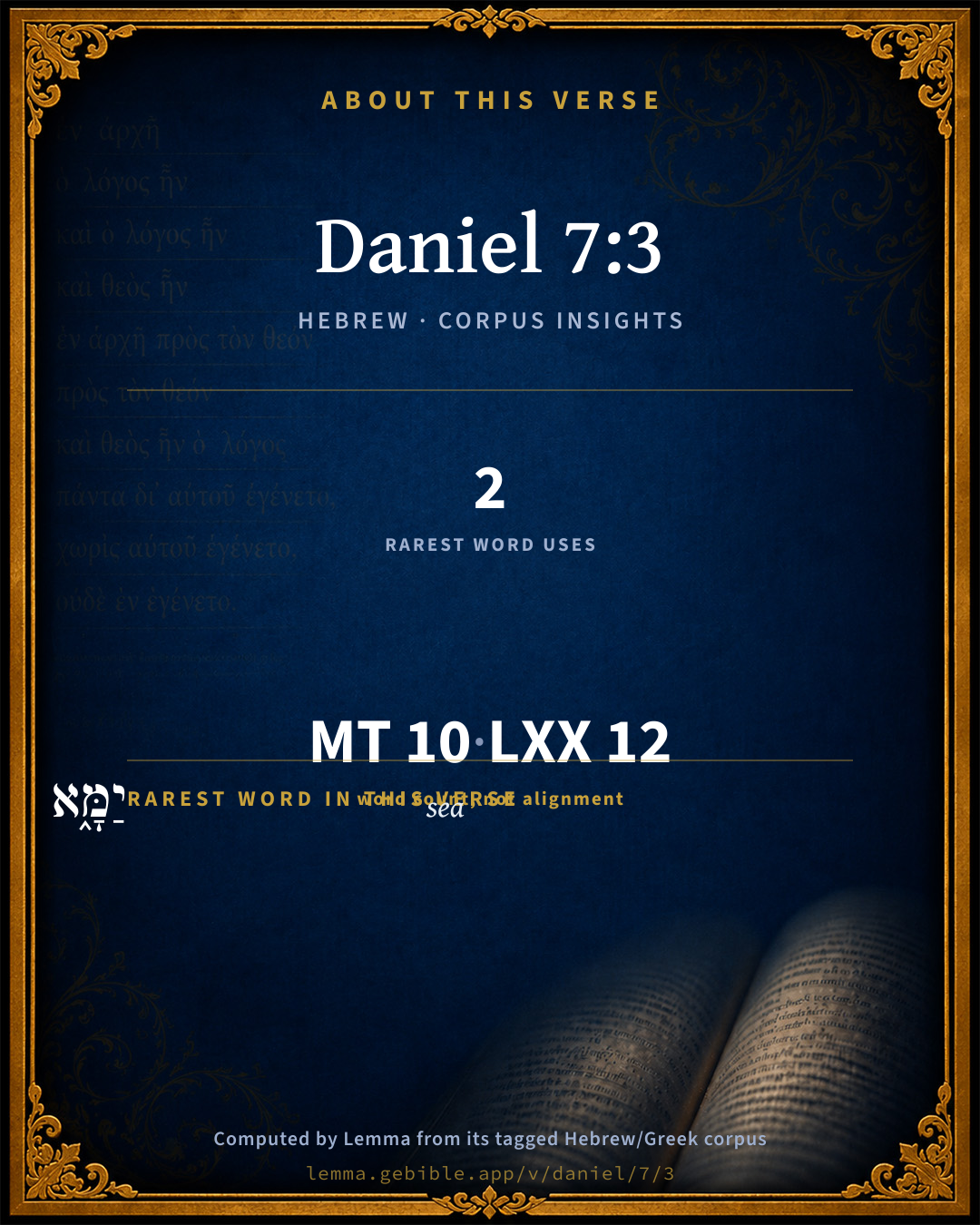
About this verse

These counts appear in no published source. They are computed here, from the morphology-tagged text and Lemma’s own curated glosses. What Lemma adds →

10
words
8
distinct lemmas
Prophets
section

Notable vocabulary

The rarest word here is יַמָּ֑א sea H3221 — appearing just 2 times in the whole Hebrew Bible.

Shared distinctive vocabulary

יַמָּ֑א sea H3221 occurs in 2 verses of the Hebrew Bible. Also found in:

Grammatical profile

  • 9 adjectives
  • 1 particle

Repetition

Words recur within this verse — often emphatic in Hebrew:

Hebrew & Septuagint length

In English translation the verse runs 12 words from the Hebrew and 15 from the Septuagint (LXX English) — closely comparable.

A rough comparison of the two English renderings, which tokenize alike — not a word-level alignment.

Word counts can differ between the Hebrew and the Greek without any difference in meaning — e.g. the Hebrew direct-object marker אֵת has no separate Greek word, and Greek often adds the article ὁ.

In the original languages it is 10 Hebrew tokens and 12 Greek tokens — but the two are counted differently (Hebrew bundles its prefixes and suffixes into one token; the Greek is in lemma form), so that isn’t a like-for-like length.

Cross-references

8

Topical passages linked to Daniel 7:3 in the Treasury of Scripture Knowledge — connected by theme and wording, ordered by reader-vote popularity; previews shown in the World English Bible.

  • Revelation 13:1 Then I stood on the sand of the sea. I saw a beast coming up out of the sea, having ten horns and seven heads. On his horns were ten crowns, and on his heads, blasphemous names.
  • Daniel 7:17 These great animals, which are four, are four kings, who shall arise out of the earth.
  • Daniel 2:32–33 As for this image, its head was of fine gold, its breast and its arms of silver, its belly and its thighs of brass,
  • Daniel 7:4–8 The first was like a lion, and had eagle's wings: I saw until the wings of it were plucked, and it was lifted up from the earth, and made to stand on two feet as a man; and a man's heart was given to it.
  • Psalms 76:4 Glorious are you, and excellent, More than mountains of game.
  • Ezekiel 19:3–8 She brought up one of her cubs: he became a young lion, and he learned to catch the prey; he devoured men.
  • Zechariah 6:1–8 Again I lifted up my eyes, and saw, and, behold, four chariots came out from between two mountains; and the mountains were mountains of brass.
  • Daniel 2:37–40 You, O king, are king of kings, to whom the God of heaven has given the kingdom, the power, and the strength, and the glory;

Cross-references courtesy of OpenBible.info (CC BY 4.0).

Hebrew and Greek witnesses Masoretic Hebrew ↔ Greek Septuagint

The same verse in the two great witnesses to the Old Testament, shown verse-for-verse.

These are two independent witnesses, not word-aligned to each other, and the Septuagint is shown in lemma (dictionary) form.

Hebrew Daniel 7:3 Masoretic · Westminster Leningrad Codex

וְאַרְבַּ֤ע חֵיוָן֙ רַבְרְבָ֔ן סָלְקָ֖ן מִן יַמָּ֑א שָׁנְיָ֖ן דָּ֥א מִן דָּֽא

Four great animals came up from the sea, diverse one from another.

World English Bible · Public Domain

Greek LXX Daniel 7:3 Septuagint · lemma form

καί τέσσαρες θηρίον ἀναβαίνω ἐκ ὁ θάλασσα διαφέρω εἷς παρά ὁ εἷς

And there came up four great beasts out of the sea, differing from one another.

LXX2012 (modern English Septuagint) · Public Domain

On this verse, The Pulpit Commentary discusses the Septuagint’s reading. Read the note in Commentary ↓

Hebrew: Westminster Leningrad Codex (CC BY 4.0). Greek: Septuagint (public domain); English from LXX2012 (modern English Septuagint) (Public Domain). How the Septuagint differs from the Hebrew →

Commentary

Notes on Daniel 7:3 from classic Christian and Jewish commentators (each source and its license shown beneath its notes). The classic Christian expositions comment on the surrounding passage and are grouped to its opening verse, so a note may address several verses; the Jewish commentaries on the Tanakh (Rashi and others) are per-verse, so they appear only where the commentator wrote on this verse.

Lemma curates 59 commentaries, every one of them public domain or Creative Commons licensed, each selected and text-cleaned for this edition rather than reprinted as found. About our sources →

Trapp's Complete Commentary

John Trapp

Dan 7:3 And four great beasts came up from the sea, diverse one from another.

Ver. 3. And four great beasts.] Regnorum feritas bestiarum nomine demonstratur, saith Jerome. The fierceness of the four kingdoms is set forth by the name of beasts. Bellum a belluis. Monarchies are mostly gotten, kept, and governed with violence and tyranny. {Psa 76:4 Son 4:8} Regna mundana parantur et retinentur bellis. Commune vitium monarchiis et tyrannis.

John Trapp, A Commentary or Exposition upon All the Books of the Old and New Testament (1647–1656) — public domain. Text from a community e-Sword module.

Tyndale Open Study Notes

Tyndale Open Resources

7:3-7 The kingdoms of the world are represented as four huge beasts (7:17; cp. Rev 13:1-2).

Tyndale Open Study Notes — © Tyndale Open Resources, licensed CC BY-SA 4.0. Text via the HelloAO Bible API.

Jamieson, Fausset & Brown

Robert Jamieson, A. R. Fausset & David Brown

beasts--not living animals, as the cherubic four in Rev 4:7 (for the original is a different word from "beasts," and ought to be there translated, living animals). The cherubic living animals represent redeemed man, combining in himself the highest forms of animal life. But the "beasts" here represent the world powers, in their beast-like, grovelling character. It is on the fundamental harmony between nature and spirit, between the three kingdoms of nature, history, and revelation, that Scripture symbolism rests. The selection of symbols is not arbitrary, but based on the essence of things.

Jamieson, Fausset & Brown — Commentary Critical and Explanatory on the Whole Bible (1871) — public domain (CC PDM 1.0). Text via the HelloAO Bible API.

Adam Clarke's Commentary

Verse 3. Four great beasts came up from the sea] The term sea, in Hebrew ים yam, from המה hamah, to be tumultuous, agitated, c., seems to be used here to point out the then known terraqueous globe, because of its generally agitated state and the four winds striving, point out those predatory wars that prevailed almost universally among men, from the days of Nimrod, the founder of the Assyrian or Babylonish monarchy, down to that time, and in the end gave birth to the four great monarchies which are the subject of this vision.

Diverse one from another.] The people were different; the laws and customs different; and the administration of each differently executed.

Adam Clarke's Commentary on the Bible (1810–1826) — public domain. Text from a community e-Sword/MySword module.

John Calvin's Commentaries

After Daniel had beheld these great commotions which were shaking the earth in different parts, another vision was offered to him. What has already been said concerning the troubled sea and the conflict of the winds, is extended to the four monarchies, concerning which we shall now treat. A certain preparation is intended when God offers to the eyes of his Prophet a turbulent sea produced by the conflict of the winds. Just as if he should say — after these troubles others shall spring up; thus men will wait for peace and tranquillity in vain, for they must suffer under fresh agitation’s. Now, the kind of trouble is expressed, by the words, four beasts proceed out of the sea. Hence that concussion, those storms, and that confused disturbance of the whole world through one kingdom succeeding to another. It can scarcely happen that any kingdom can perish without involving others in its ruin. A single edifice can scarcely fall without the crash being heard far and wide, and the earth seeming to gape at its overthrow. Then, what must happen when the most powerful monarchies so suddenly perish? Hence in this verse Daniel shows how the world is like a troubled sea, since violent changes among its empires were then at hand. The comparison of empires to beasts is easily explained. We know how God’s glory and power are resplendent in all kingdoms, if they are rightly conducted after the law of equity. But since we often see the truth of what was said to Alexander, — The greatest kingdoms are the greatest robberies, and very few absorb the whole power in a great empire, and exercise a cruel and excessive tyranny. Here the Prophet compares empires to great and savage beasts, of which he will afterwards treat. Now we understand the meaning of the words: and we may learn this lesson from what usually happens in the empires of the world; in themselves, as I have said, they are most beautiful reflections of the divine wisdom, virtue, and justice, although those who obtain supreme sway very rarely acknowledge themselves divinely created for the discharge of their office. As, therefore, kings are mostly tyrants, full of cruelty and barbarity, and forgetful of humanity, the Prophet marks this vice as springing from themselves and not from the sacred ordinance of God. Let us proceed, —

John Calvin's Commentaries (1540-1563) — public domain. Text from the Calvin Translation Society English edition (1840s-50s) via the Christian Classics Ethereal Library (ccel.org). Calvin's coverage is partial (roughly two-thirds of the Bible); uncommented books and verses are honest gaps, never fabricated. The 19th-century editor's footnotes and remarks are omitted so the notes are faithfully Calvin's own voice.

Ellicott's Commentary for English Readers

(3) Four great beasts.—The monstrous forms of the beasts are implied, rather than the hugeness of their size. Other instances of beasts being taken as emblems of kingdoms may be found in Isa_27:1; Eze_29:3; Eze_32:2. It must be observed that the beasts do not rise up simultaneously, but in succession to each other. In this way, and in the difference of their character, they form a parallel to the subject-matter of the vision recorded in Daniel 2.

A Bible Commentary for English Readers, edited by Charles John Ellicott (1878–1897) — public domain. Text from a community e-Sword module.

The Cambridge Bible for Schools and Colleges

gen. ed. J. J. S. Perowne

3. came up from the sea] Cf. Rev_13:1; 2Es_11:1; 2Es_13:3 (R.V.).

The Cambridge Bible for Schools and Colleges (gen. ed. J. J. S. Perowne; Cambridge University Press, 1878–1918) — public domain. Text from a community e-Sword module.

John Gill's Exposition

And four great beasts came up from the sea,.... Which are afterwards interpreted of four kings or kingdoms, Dan 7:17, which rose up in the world, not at once, but successively, and out of the sea or world, through the commotions and agitations of it; and these are the four monarchies, Babylonian, Persian, Grecian, and Roman; compared to "beasts", because of the rapine and violence, cruelty, oppression, and tyranny, by which they were obtained, set up, supported, and maintained; and to "great ones", being not like single separate kingdoms, as the kingdom of Israel, and the like, but consisting of many kingdoms and nations, and so like beasts of an enormous size:

diverse one from another; in their situation, language, manner, strength, and power; hence expressed by divers sorts of beasts, as the lion, bear, leopard, &c.; as in Nebuchadnezzar's dream by different metals, gold, silver, brass, and iron.

John Gill's Exposition of the Whole Bible (1746–1763) — public domain (CC PDM 1.0). Text via the HelloAO Bible API.

Albert Barnes' Notes on the Bible

And four great beasts came up from the sea - Not at once, but in succession. See the following verses. Their particular form is described in the subsequent verses. The design of mentioning them here, as coming up from, the sea, seems to have been to show that this succession of kingdoms sprang from the agitations and commotions among the nations represented by the heaving ocean. It is not uncommon for the prophets to make use of animals to represent or symbolize kingdoms and nations - usually by some animal which was in a manner peculiar to the land that was symbolized, or which abounded there. Thus in Isa 27:1, leviathan, or the dragon, or crocodile, is used to represent Babylon. See the note at that passage. In Eze 29:3-5, the dragon or the crocodile of the Nile is put for Pharaoh; in Eze 32:2, Pharaoh is compared to a young lion, and to a whale in the seas. In Psa 74:13-14, the kingdom of Egypt is compared to the dragon and the leviathan.

So on ancient coins, animals are often used as emblems of kingdoms, as it may be added, the lion and the unicorn represent Great Britain now, and the eagle the United States. It is well remarked by Lengerke (in loc.), that when the prophets design to represent kingdoms that are made up of other kingdoms, or that are combined by being brought by conquest under the power of others, they do this, not by any single animal as actually found in nature, but by monsters - fabulous beings that are compounded of others, in which the peculiar qualities of different animals are brought together - as in the case of the lion with eagle’s wings. Thus in Rev 13:1, the Romish power is represented by a beast coming out of the sea, having seven heads and ten horns, Compare it. Ezra (Apocry.) 11:1, where an eagle is represented as coming from the sea with twelve feathered wings and three heads. As an illustration of the attempts made in the apocryphal writings to imitate the prophets, the whole of chapter 11 and chapter 12 of the second book of Ezra may be referred to.

Diverse one from another - Though they all came up from the same abyss, yet they differed from each other - denoting, doubtless, that though the successive kingdoms referred to would all rise out of the nations represented by the agitated sea, yet that in important respects they would differ from each other.

Albert Barnes' Notes on the Bible (1834–1885) — public domain. Text from a community e-Sword/MySword module.

Haydock's Catholic Bible Commentary

Four great beasts; viz. the Chaldeans, Persian, Grecian, and Roman empires. But some rather choose to understand the fourth beast of the successors of Alexander the great, more especially of them that reigned in Asia and Syria, (Challoner) or in Egypt. (Chap. ii. 40.) (Haydock)

George Leo Haydock (1774–1849), Haydock's Catholic Family Bible and Commentary, 1859 edition — public domain. Excludes Psalms (Douay-Rheims chapter numbering differs from Protestant) and Deuterocanonical books (Catholic canon only).

Matthew Poole's English Annotations

That is, four great monarchies,

great in comparison of particular kingdoms that were little to them; beasts for their idolatry, and tyrannical oppressions and depredations.

Matthew Poole's English Annotations on the Holy Bible (1683–1685) — public domain. Text from a community e-Sword/MySword module.

The Pulpit Commentary

And four great beasts came up from the sea, diverse one from another. The Septuagint rendering omits "great;" otherwise it is a closely accurate representation of the Massoretic text, save that the translator seems to have had, not aDAm ad, but as in the Syriac, adjAm adj, as he renders en para to en. Theodotion has megala, but does not so slavishly follow the Aramaic construction at the end. The Peshitta is very close to the Massoretic, save that in the last clause it agrees with the LXX The number four is, in apocalyptic writings, significant of the world; "the four winds" mean the whole world. Here it is human history that is summed up in the four beasts. So in Zechariah we have "four horns" that symbolize the oppressors of the people of God. (Dan_1:18 Dan_2:1) We have "four" chariots in the sixth chapter of Zechariah, which seem to be symbols of the same thing. Beasts. Animals of one sort or another are used of nations in the prophets; thus Egypt is symbolized in Isaiah 27, as "leviathan," presumably a crocodile, (Isa_51:7) as "a dragon" in Eze_29:3 Babylonia is figured as an eagle. (Eze_17:3) Composite beings are used as symbols also, as Tyro is addressed as a cherub." In the Book of Revelation Rome is figured as a beast with seven heads and ten horns. (Rev_13:1) In the Book of Enoch (85. 90.) we find this figurative use of animals carried much further. Assyria and Babylonia and, following them, Persia made great use of composite, monstrous animal forms as symbols, not so much, however, of political as of spiritual powers. This distinction is the less important, that political events were regarded as the production of spiritual activity.

The Pulpit Commentary (1880–1919), ed. H.D.M. Spence-Jones & Joseph S. Exell — public domain. Text from a community e-Sword module.

John Wesley's Explanatory Notes

Four great beasts - That is, four great monarchies, great, in comparison of particular kingdoms; beasts for their tyrannical oppressions.

John Wesley, Explanatory Notes Upon the Whole Bible (1754–1765) — public domain. Text via the GEBible commentary corpus.

Rashi

Rabbi Shlomo Yitzchaki (Rashi)

And four beasts [as translated,] and four beasts.

each one different from the other [as translated,] each one different from the other.

Rashi on the Tanakh — English translations: “The Judaica Press complete Tanach with Rashi, translated by A. J. Rosenberg” (CC BY 4.0); “Pentateuch with Rashi's commentary by M. Rosenbaum and A.M. Silbermann, 1929-1934” (public domain); “The Metsudah Tanach series, Lakewood, N.J” (CC BY 4.0); and “The Book of Joshua, Metsudah Publications, 1997” (CC BY 4.0). Text via Sefaria.

Lesson kit

Teaching starters — assembled from the data on this page, not authored interpretation. Every prompt links to the verse data it draws on. Edit before teaching.

Daniel, in the Prophets, opens this verse with 10 words (8 distinct Hebrew lemmas). Its most distinctive word is yâm (“sea”). A historical commentator’s framing appears above. Read the whole chapter for the surrounding context.

Discussion questions

  1. What does “sea” (yâm) contribute to the verse as a whole?
  2. How does Daniel 7:2, which shares the word «sea», read alongside this verse?
  3. What does the repetition of “from” (2× in this one verse) do in this verse?
  4. These translations render this verse differently; the difference is in the English rendering, not the original. What questions does that raise?
  5. Compare how Trapp's Complete Commentary and Tyndale Open Study Notes read this verse. Where do they agree or differ?

Things to notice

Reading settings

Reading text

Shown beneath each verse's original-language words.

Old Testament
Old Testament edition

Read the OT as the Masoretic Hebrew (MT) or the Greek Septuagint (LXX).

English shown for the Greek Septuagint (in the Hebrew ↔ Greek comparison).

Comparing translations? Open the Compare panel on any verse page to stack up to four side by side.