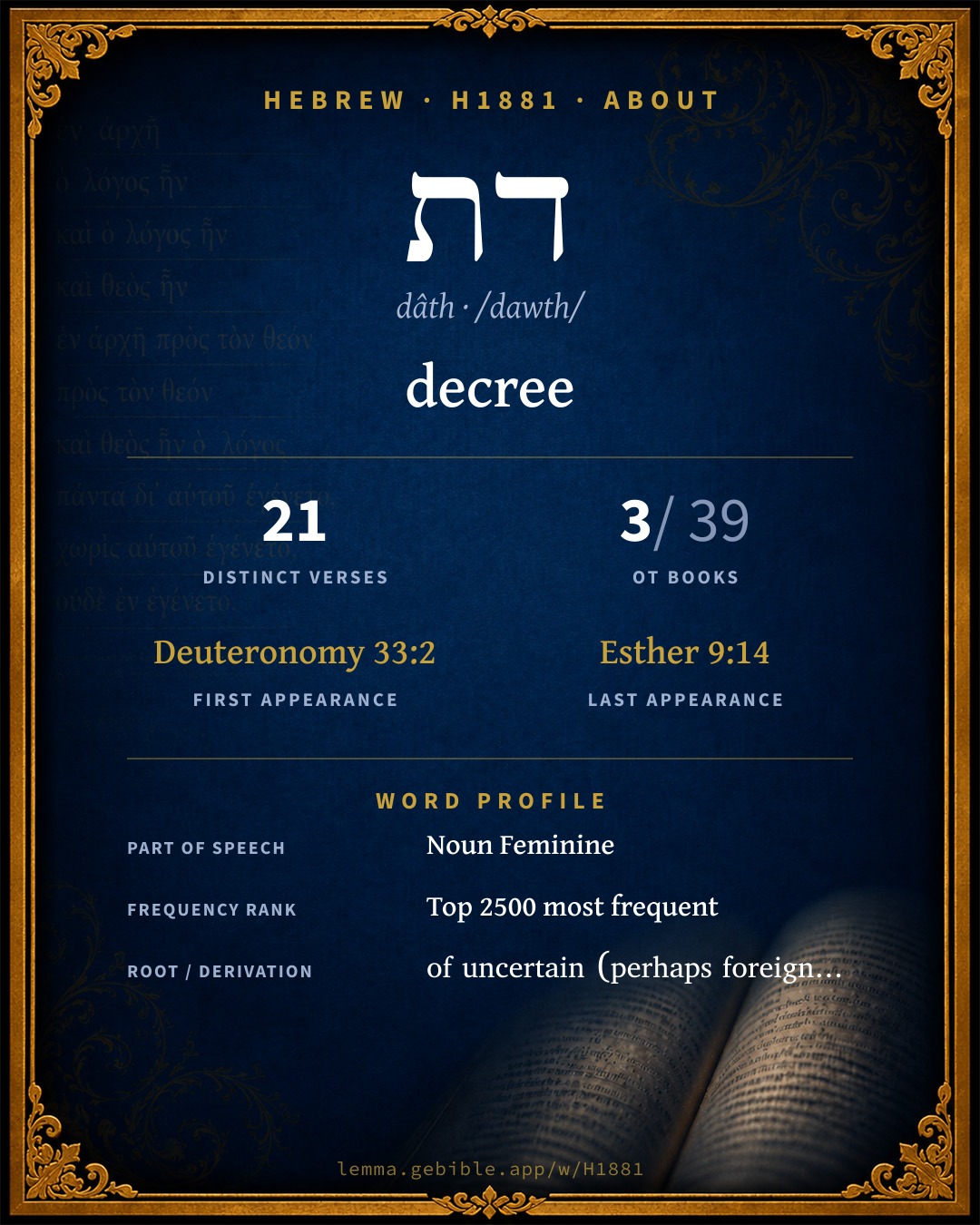
דָּת
decree
also: law, edict, regulation, usage fuller range ↓
Full lexicon entry — Brown-Driver-Briggs (BDB)
From Brown-Driver-Briggs (BDB)
Where this word appears
See every Absolute-state word in the Hebrew Bible →
Grammar key — what these labels mean
Part of speech
- Noun
- A naming word — a person, place, thing, or idea.
Noun type
- Common
- A common noun — a general class of person, place, or thing (“king,” “city,” “water”), not a specific name.
State
- Absolute
- The independent form of a noun, not bound to a following word.
- Construct
- A noun bound to a following noun in a possessive / “of” relationship (the construct chain).
Gender
- Feminine
- Grammatically feminine.
Number
- Singular
- One.
- Plural
- More than one (in Hebrew, generally three or more).
11 distinct verses where H1881 appears in the Absolute state, across 2 books. Filtered view — show all forms. Click any verse to open its interlinear word-by-word view. Verse text shown in the World English Bible for context — . Each verse’s Hebrew form is shown with its reference; the English is not keyword-highlighted, since the data carries no word-level English alignment. Use “Compare translations” on any verse to read it across multiple English versions. This concordance covers the Hebrew Bible; Septuagint (Greek Old Testament) occurrences are not indexed here.
Deuteronomy 1 verse
Esther 10 verses
- Esther 1:8 כַ/דָּ֖ת prep det + n c fs The drinking was according to the law; none could compel: for so the king had appointed to all the officers of his house, that they should do according to every man's pleasure.
- Esther 1:13 דָּ֥ת n c fs Then the king said to the wise men, who knew the times, (for so was the king's manner toward all who knew law and judgment;
- Esther 1:15 כְּ/דָת֙ prep + n c fs What shall we do to the queen Vashti according to law, because she has not done the bidding of the king Ahasuerus by the chamberlains?
- Esther 3:14 דָּת֙ n c fs A copy of the writing, that the decree should be given out in every province, was published to all the peoples, that they should be ready against that day.
- Esther 3:15 וְ/הַ/דָּ֥ת conj + ptcl def.art + n c fs The posts went forth in haste by the king's commandment, and the decree was given out in Shushan the palace. The king and Haman sat down to drink; but the city of Shushan was perplexed.
- Esther 4:8 הַ֠/דָּת ptcl def.art + n c fs Also he gave him the copy of the writing of the decree that was given out in Shushan to destroy them, to show it to Esther, and to declare it to her, and to charge her that she should go in to the king, to make supplication to him, and to make request before him, for her people.
- Esther 4:16 כַ/דָּ֔ת prep det + n c fs Go, gather together all the Jews who are present in Shushan, and fast you for me, and neither eat nor drink three days, night or day: I also and my maidens will fast in like manner; and so will I go in to the king, which is not according to the law: and if I perish, I perish.
- Esther 8:13 דָּת֙ n c fs A copy of the writing, that the decree should be given out in every province, was published to all the peoples, and that the Jews should be ready against that day to avenge themselves on their enemies.
- Esther 8:14 וְ/הַ/דָּ֥ת conj + ptcl def.art + n c fs So the posts who rode on swift steeds that were used in the king's service went out, being hurried and pressed on by the king's commandment; and the decree was given out in Shushan the palace.
- Esther 9:14 דָּ֖ת n c fs The king commanded it so to be done: and a decree was given out in Shushan; and they hanged Haman's ten sons.
About this entry
At a glance — auto-summarized from this page’s data, not written by a person. Every figure links to its source below. This summary describes the numbers; it doesn’t interpret them.
At its core, דת (dâth) means “decree.” Its uses cluster heavily in Esther (90% of all occurrences). Spanning 21 verses in 3 books, it ranks among the uncommon words of the Hebrew Bible. Not a single-sense word: its full sense range also takes in “law”, “edict”, and “regulation”. The King James Version usually renders it “decree,” while modern versions prefer “edict” (Berean Standard Bible) — see the renderings breakdown. Each statement above links to its evidence; the full detail follows below.
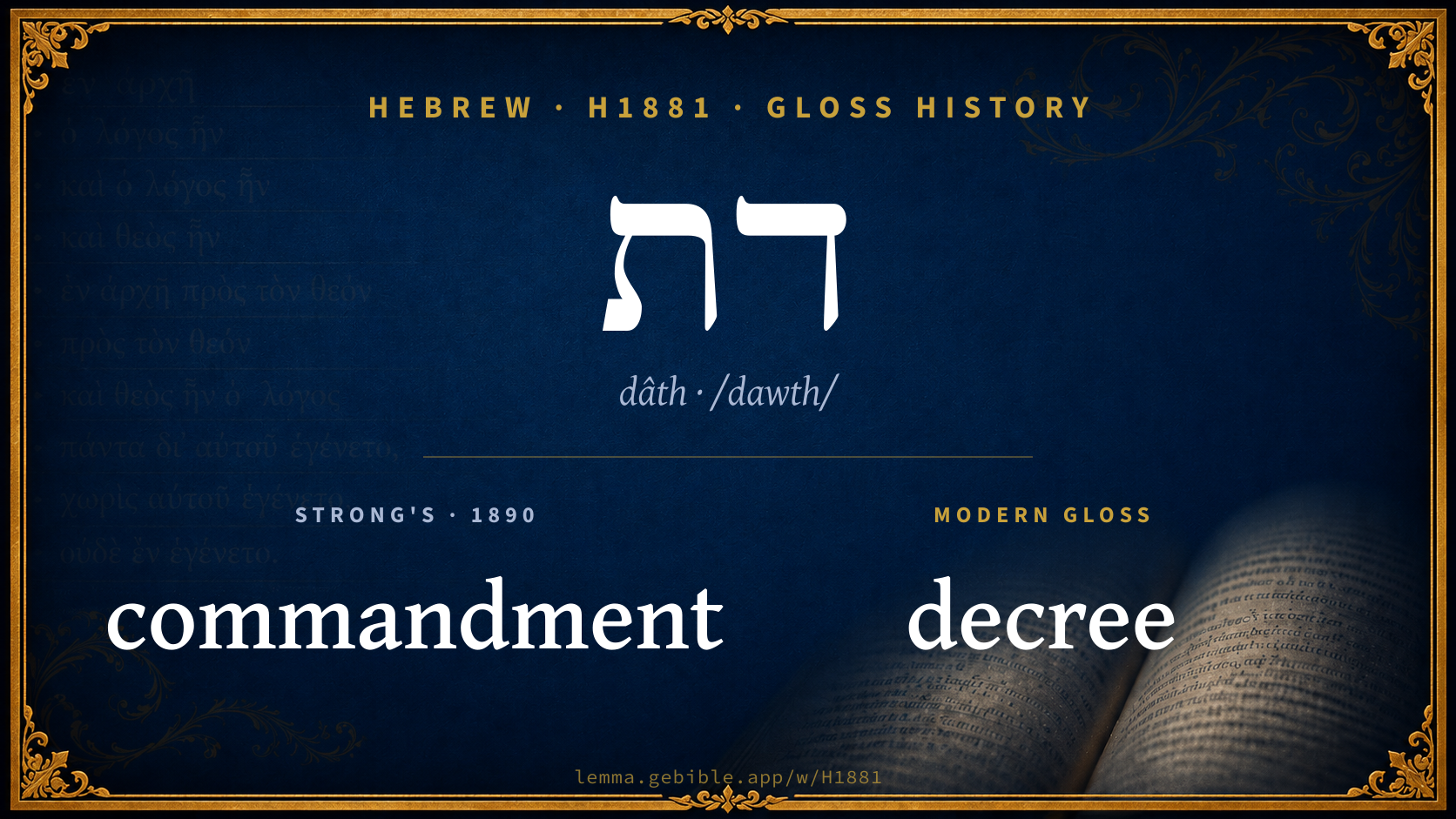
Gloss history
Strong's 1890 vs modern scholarship
About this word
Strong's H1881 catalogs a Hebrew word from the Hebrew Old Testament.
These counts are not copied from any lexicon or concordance. They are computed here, from the morphology-tagged Hebrew Old Testament. What Lemma adds →
- 21
- distinct verses
- The word appears in 21 distinct verses.
- 3 / 39
- OT books
- The word appears in 3 of 39 Old Testament books.
- #1,412
- by frequency
- Top 2500 most frequent Hebrew words (rank 1,412 of 8,640 Hebrew words by occurrence).
View all 21 occurrences in the concordance →
Most concentrated in
- Esther 19 verses 90%
- Deuteronomy 1 verse 5%
- Ezra 1 verse 5%
By section of the Old Testament
By traditional corpus
Conventional, traditional groupings — biblical authorship is debated, so this is a traditional corpus grouping, not an authorship claim. Each share is this word’s portion of its verses in that division of the Hebrew canon. Each figure is a share of the word’s 21 distinct verses.
- Writings (Ketuvim) 20 verses · 95%
- Torah (Pentateuch) 1 verse · 5%
How translations render this word
Counts come from each version’s own published word-to-Strong’s tagging or interlinear alignment — an approximate guide to how each version renders this word, not a word-level alignment the data otherwise carries. Because each total is that version’s own tagged count, the per-version totals vary from one another and need not match the appearance or distinct-verse counts above. These counts may also differ from a printed concordance because Lemma counts each distinctly tagged rendering and does not collapse phrase taggings into a single head-word total. This is a fixed set of word-tagged versions (KJV, ASV, BSB, ULT) and does not change with the reading translation you choose elsewhere. Each version’s license is shown beside its name below (and on Sources).
- King James Version: Decree 9×, Law 3×, Commandment 2×
- American Standard Version: Decree 10×, Law 2×
- Berean Standard Bible: Edict 9×, Law 3×, Laws 3×
- unfoldingWord Literal Text: Law 12×, Laws of 3×, According to the law 2×
King James Version Public Domain
Renders H1881 across 22 tagged occurrences — most commonly:
Plus 6 renderings that appear only once — usually multi-word phrases or single function words the recovered tagging swept in, not distinct renderings.
American Standard Version Public Domain
Renders H1881 across 22 tagged occurrences — most commonly:
Plus 10 renderings that appear only once — usually multi-word phrases or single function words the recovered tagging swept in, not distinct renderings.
Berean Standard Bible Public Domain
Renders H1881 across 21 tagged occurrences — most commonly:
Plus 4 renderings that appear only once — usually multi-word phrases or single function words the recovered tagging swept in, not distinct renderings.
unfoldingWord Literal Text CC BY-SA 4.0
Renders H1881 across 21 tagged occurrences — most commonly:
Plus 4 renderings that appear only once — usually multi-word phrases or single function words the recovered tagging swept in, not distinct renderings.
Senses in the full BDB
What do BDB’s symbols mean?
BDB uses these scholarly abbreviations:
| Symbol | Meaning |
|---|---|
| 𝔊 | the Septuagint (the ancient Greek translation, LXX) |
| 𝔙 | the Vulgate (the Latin translation) |
| 𝔖 | the Syriac version (the Peshitta) |
| 𝔗 | the Targum (the Aramaic translation) |
| ψ | the Psalms |
| √ | root (the underlying root or stem) |
| ‖ | parallel passage (a synonymous or contrasted parallel) |
| † | the dagger: every passage where the word occurs is cited |
The 2 senses and sub-senses the full Brown-Driver-Briggs lexicon distinguishes for this word, in lexicon order (not ranked by frequency), with BDB’s own verbatim wording and sub-sense lettering. Shown in Hebrew script with BDB’s own scholarly abbreviations. The condensed entry is in the Lexicon Entry tab. See also the Forms in the corpus table below.
- 1. decree, edict, commission of Pers. king Ezr 8:36 (word elsewhere only in Est) Est 2:8 (‖ דְּבַר הַמֶּלֶךְ), 4:3 (‖ id.) 8:17 (‖ id.) 9:1 (‖ id.; c. עשׂה execute) cf. also 9:13; c. vb. נָתַן 3:14, 15; 8:13, 14; 9:14; written כְּתָב־הַדָּת 4:8 (cf. 3:14; 8:13). e.g. Ezra 8:36
- 2. law, permanently valid and applicable, וְיִכָּתֵב בְּדָתֵי פָרַס־וּמָדַי וְלֹא יַעֲבוֹר Est 1:19 cf. v 15; 4:11, 16; יֹדְעֵי דָּת וָדִין 1:13 those that understood law and judgment; דָּתֵי הַמֶּלֶךְ 3:8; of laws of the Jews in Persia 3:8; even of rules for drinking at a feast 1:8; for purifying of women 2:12.—The distinction between 1 & 2 is not absolute. The king’s will was law, and the royal edict (דְּבַר מַלְכוּת) concerning Vashti was reckoned among the laws (דָּתֵי) of the Persians & Medes (1:19).—In Dt 33:2 MT אֵשׁ דָּת לָמוֹ fire was a law for them is corrupt; many emend. proposed, cf. Di; Di suggests אֵשׁ [לַפִּ]דֹת fire of flames, flaming fire, cf. הַלַּפִּידִם Ex 20:18 (but לַפִּדֹת pl. in ת—ֹ not in OT unless as n.pr.), or (better), אֵשׁ [יֹקֶ]דֶת a burning fire, cf. Is 65:5 (diff. sense). e.g. Esther 1:19
Senses from the full Brown-Driver-Briggs lexicon (Brown, Driver, Briggs; Oxford 1906 — public domain), digitized via Sefaria, supplemented by the OpenScriptures HebrewLexicon (CC BY 4.0). Full attribution on Sources.
Word origin
n.f. Est 3:15; 4:11; decree, law, usage, only in Persian period (Biblical Aramaic NH id., Syriac ܕܰܬܳܐ or ܕܳܬܳܐ Pers. loan-w., Old Pers. dâta, law, SpiegAPK 225)—ד׳ abs. Est 1:8 + 9 times; cstr. דַּת Est 2:12, דָּת 9:13; sf. דָּתוֹ Est 2:8 + 4 times; pl. cstr. דָּתֵי Ezr 8:36 + 2 times; sf. דָּתֵיהֶם Est 3:8;—
— Brown-Driver-Briggs (Oxford 1906, public domain), digitized via Sefaria, supplemented by the OpenScriptures HebrewLexicon (CC BY 4.0). See Sources.
Origin: of uncertain (perhaps foreign) derivation
Jastrow Dictionary
A second Hebrew/Aramaic lexicon for comparison, covering Aramaic and post-biblical (Talmudic, Targumic, Midrashic) usage that the biblical-Hebrew BDB does not. Matched by lemma rather than by Strong’s number, so a lemma may carry more than one Jastrow headword (shown separately below), and the entries cover usage well beyond the Bible.
דַּתְּ
- = דְּאַתְּ. Y. Snh. X, 27ᵈ bot., a. fr. כמה דת מר (= דתימר כמה) as thou sayest, i.e. as we read in Scriptures &c.—Y. Ab. Zar. II, 42ᵃ top הדא דת מר וכ׳ (interch. with הדא דאת אמר = הדא דתימא) that which thou sayest (hast recited), applies only &c.—Y. Snh. X, 29ᵈ top על דעתך דת מר according to thy opinion who sayest; a. fr.
דָּת
- (b. h.; = דנת,, Arab, dîn corresp. to our w.)
- 1. custom, law; judgment, punishment. Esth. R. to I, 8 כדַת כל מקום וכ׳ in accordance with the usages of &c.—Keth. VII, 6 דַּת משה Mosaic (ritual) law, ד׳ יהודית Jewish custom (chastity, decency); Tosef. ib. VII, 6 ד׳ משה וישראל. Ib. 7 שעברו על הדת who disregard the Jewish custom. Esth. R. to I, 15 כדת just dealing, v. אַכְזְרִיּוּת. Meg. 12ᵃ ד׳ של תורה the Biblical dues (sacrifices); a. fr.
- 2. religion. Succ. 56ᵇ המירה דָתָהּ (Tosef. ib. IV, 28 נשתמדה) she changed her faith, became an apostate. Yeb. 70ᵇ; Pes. 96ᵃ (ref. to Ex. XII, 43, v. דְּרָשָׁא) בו המרת דת וכ׳ to eat of it (the passover lamb) apostasy does unfit, but &c.—Pl. דָּתִין. Koh. R. to VII, 19 (play on ידותון, I Chr. XXV, 3) הנבא על הד׳ ועל הדינין וכ׳ (Asaph) who prophesied over the judgments and dispensations that passed over him; Cant. R. to IV, 4 (corr. acc.). [As to derivation of our w. from the Persian, v. Ges. H. Dict.10 s. v.] e.g. Exodus 12:43
דָּת ²
- Dan. VI, 16. Ib. II, 15; a. fr.—Pl. constr. דָּתֵי. Ezra VII, 25. e.g. Daniel 6:16
A Dictionary of the Targumim, the Talmud Babli and Yerushalmi, and the Midrashic Literature (Marcus Jastrow; London, Luzac, 1903) — Public Domain. Digitized via Sefaria. Digitized via Sefaria. Full attribution on Sources.
Forms in the corpus
The 18 distinct written forms H1881 takes in the Hebrew Bible, most frequent first — each parse links to that state’s occurrences in the concordance. Hebrew forms include their vowel points and cantillation, so a single lemma takes many written forms.
Same root — word family
Other BDB entries built from the same root as H1881, grouped by Strong’s listed origin. These share a root / origin per the lexicon — not necessarily a shared meaning. Each links to that word’s own entry.
Derived from this word
Compare all same-root words → They share a root, not necessarily a meaning.
Septuagint verse parallels
This word appears in 21 verses that also exist in the Greek Old Testament (Septuagint), out of the 21 Hebrew verses it occurs in. You can read those verses in Greek by switching the Old Testament edition to the Septuagint.
Read these verses in the Septuagint
This is a verse-level parallel only — the same verses exist in both the Hebrew and Greek Old Testaments. No word-level Hebrew↔Greek correspondence is claimed: the data carries no such alignment, so no Greek word is shown as this Hebrew word’s translation. Coverage is not total — the Septuagint omits the deuterocanon and renumbers the Psalms, so some Hebrew verses have no direct Greek parallel.