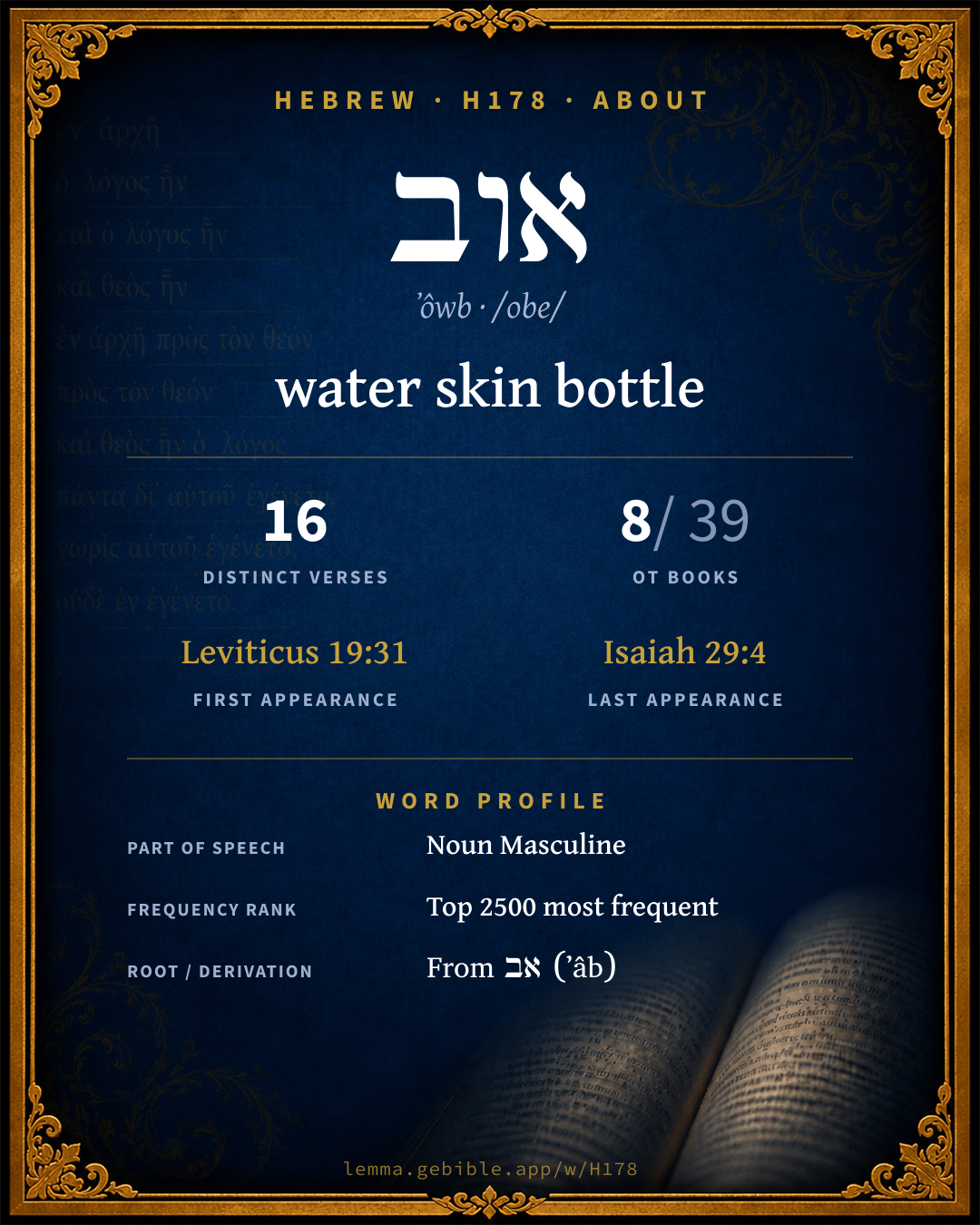
אוֹב
water skin bottle
‘water skin bottle’ is one of 3 main senses fuller range ↓
Full lexicon entry — Brown-Driver-Briggs (BDB)
From Brown-Driver-Briggs (BDB)
Where this word appears
Grammar key — what these labels mean
Part of speech
- Noun
- A naming word — a person, place, thing, or idea.
Noun type
- Common
- A common noun — a general class of person, place, or thing (“king,” “city,” “water”), not a specific name.
State
- Absolute
- The independent form of a noun, not bound to a following word.
Gender
- Masculine
- Grammatically masculine.
Number
- Plural
- More than one (in Hebrew, generally three or more).
- Singular
- One.
Every verse where H178 appears in the Book of Job — 1 distinct verse. Click any verse to open its interlinear word-by-word view. Verse text shown in the World English Bible for context — . Each verse’s Hebrew form is shown with its reference; the English is not keyword-highlighted, since the data carries no word-level English alignment. Use “Compare translations” on any verse to read it across multiple English versions. This concordance covers the Hebrew Bible; Septuagint (Greek Old Testament) occurrences are not indexed here.
Job
About this entry
At a glance — auto-summarized from this page’s data, not written by a person. Every figure links to its source below. This summary describes the numbers; it doesn’t interpret them.
The Hebrew noun אוב centers on the idea of “water skin bottle.” Translators differ — “familiar spirit” in the King James Version, then “mediums” (Berean Standard Bible) and “ritual pit” (unfoldingWord Literal Text), as the renderings breakdown shows. It turns up in 16 verses across 8 books, an uncommon footprint. The word gravitates to 1 Samuel (25%), then Leviticus and Isaiah. Its meaning spans more than one sense — see its full sense range. Dig into 16-verse concordance and the renderings breakdown below.
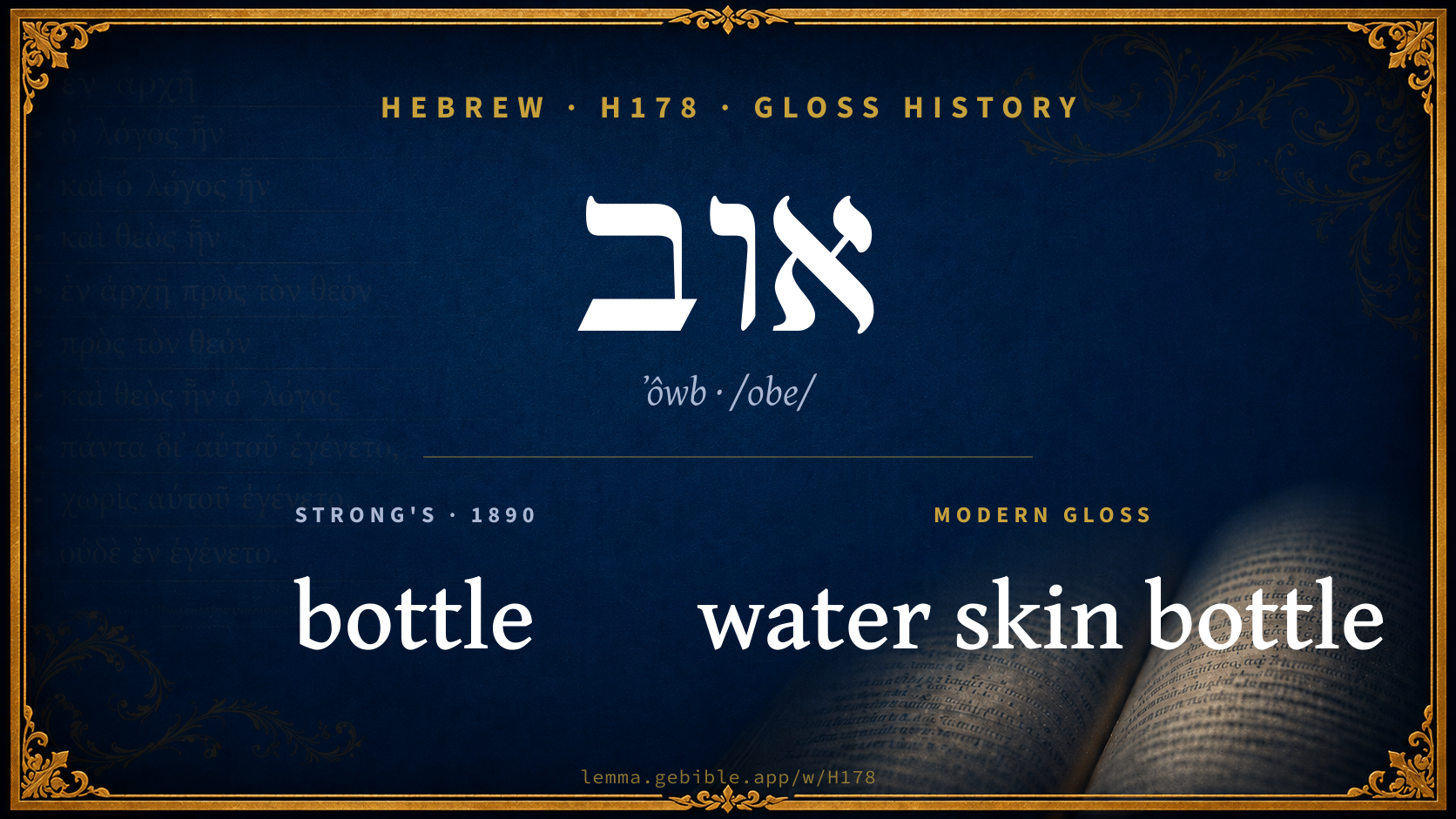
Gloss history
Strong's 1890 vs modern scholarship
About this word
Strong's H178 catalogs a Hebrew word from the Hebrew Old Testament.
These counts are not copied from any lexicon or concordance. They are computed here, from the morphology-tagged Hebrew Old Testament. What Lemma adds →
- 16
- distinct verses
- The word appears in 16 distinct verses.
- 8 / 39
- OT books
- The word appears in 8 of 39 Old Testament books.
- #1,671
- by frequency
- Top 2500 most frequent Hebrew words (rank 1,671 of 8,640 Hebrew words by occurrence).
View all 16 occurrences in the concordance →
By section of the Old Testament
By traditional corpus
Conventional, traditional groupings — biblical authorship is debated, so this is a traditional corpus grouping, not an authorship claim. Each share is this word’s portion of its verses in that division of the Hebrew canon. Each figure is a share of the word’s 16 distinct verses.
- Prophets (Nevi'im) 9 verses · 56%
- Torah (Pentateuch) 4 verses · 25%
- Writings (Ketuvim) 3 verses · 19%
How translations render this word
Counts come from each version’s own published word-to-Strong’s tagging or interlinear alignment — an approximate guide to how each version renders this word, not a word-level alignment the data otherwise carries. Because each total is that version’s own tagged count, the per-version totals vary from one another and need not match the appearance or distinct-verse counts above. These counts may also differ from a printed concordance because Lemma counts each distinctly tagged rendering and does not collapse phrase taggings into a single head-word total. This is a fixed set of word-tagged versions (KJV, ASV, BSB, ULT) and does not change with the reading translation you choose elsewhere. Each version’s license is shown beside its name below (and on Sources).
- King James Version: Familiar spirit 5×, Have familiar spirits 5×, Familiar spirits 2×
- American Standard Version: Familiar spirit 4×, Had familiar spirits 3×, Have familiar spirits 3×
- Berean Standard Bible: Mediums 9×, Medium 5×
- unfoldingWord Literal Text: Ritual pit 5×, Ritual pits 5×, Mediums 4×
King James Version Public Domain
Renders H178 across 17 tagged occurrences — most commonly:
Plus 5 renderings that appear only once — usually multi-word phrases or single function words the recovered tagging swept in, not distinct renderings.
American Standard Version Public Domain
Renders H178 across 17 tagged occurrences — most commonly:
Plus 7 renderings that appear only once — usually multi-word phrases or single function words the recovered tagging swept in, not distinct renderings.
Berean Standard Bible Public Domain
Renders H178 across 17 tagged occurrences — most commonly:
Plus 3 renderings that appear only once — usually multi-word phrases or single function words the recovered tagging swept in, not distinct renderings.
unfoldingWord Literal Text CC BY-SA 4.0
Renders H178 across 18 tagged occurrences — most commonly:
Plus 4 renderings that appear only once — usually multi-word phrases or single function words the recovered tagging swept in, not distinct renderings.
Senses in the full BDB
What do BDB’s symbols mean?
BDB uses these scholarly abbreviations:
| Symbol | Meaning |
|---|---|
| 𝔊 | the Septuagint (the ancient Greek translation, LXX) |
| 𝔙 | the Vulgate (the Latin translation) |
| 𝔖 | the Syriac version (the Peshitta) |
| 𝔗 | the Targum (the Aramaic translation) |
| ψ | the Psalms |
| √ | root (the underlying root or stem) |
| ‖ | parallel passage (a synonymous or contrasted parallel) |
| † | the dagger: every passage where the word occurs is cited |
The 4 senses and sub-senses the full Brown-Driver-Briggs lexicon distinguishes for this word, in lexicon order (not ranked by frequency), with BDB’s own verbatim wording and sub-sense lettering. Shown in Hebrew script with BDB’s own scholarly abbreviations. The condensed entry is in the Lexicon Entry tab. See also the Forms in the corpus table below.
- 1. skin-bottle, only pl. אֹבוֹת חֲדָשִׁים new (wine-) skins Jb 32:19. e.g. Job 32:19
- 2. necromancer, in phr. אוֹב אוֹיִדְּעֹנִי necrom. or wizard Lv 20:27 (H; usually tr. ‘a man also or woman that hath a familiar spirit or that is a wizard’ RV; but better a man or a woman, if there should be among them, a necromancer or wizard; no suff. reason for exceptional use of phrase here); א׳ וְיִדְּעֹנִי Dt 18:11 2 Ch 33:6 = 2 K 21:6 (where א׳ וידענים); הָאֹבוֹת וְהַיִּדְּעֹנִים Lv 19:31; 20:6 (H) 1 S 28:3, 9 2 K 23:24 Is 8:19 (where repres. as chirping & muttering, in practice of their art of seeking dead for instruction, prob. ventriloquism, & so 𝔊) 19:3. e.g. Leviticus 20:27
- 3. ghost, Is 29:4 וְהָיָה כְּאוֹב מֵאֶרֶץ קוֹלֵךְ וּמֵעָפָר אִמְרָתֵךְ תְּצַפְצֵף and thy voice shall be as a ghost from the ground and from the dust thy speech shall chirp (so Ge MV Ew De Che al., but chirping might be of necromancer, as 8:19). e.g. Isaiah 29:4
- 4. necromancy אֵשֶׁת בַּעֲלַת־אוֹב a woman who was mistress of necromancy 1 S 28:7(×2); (JPh. xiv, 127 f makes אוֹב primarily a subterranean spirit, and signif. 2 only an abbrev. of בעלתא׳ etc.); קסם בָּאוֹב divine by necromancy 1 S 28:8, which seems to be interpr. of 1 Ch 10:13 שׁאל בא׳ inquire by necromancy. (In these three exx. אוֹב is usually interpreted as ghost or familiar spirit conceived as dwelling in necromancer; but this apparently not the ancient conception.) e.g. 1 Samuel 28:7
Senses from the full Brown-Driver-Briggs lexicon (Brown, Driver, Briggs; Oxford 1906 — public domain), digitized via Sefaria, supplemented by the OpenScriptures HebrewLexicon (CC BY 4.0). Full attribution on Sources.
Word origin
n.m. Jb 32:19 skin-bottle, necromancer, etc.—abs. א׳ Lv 20:27 + 8 times; pl. אֹבוֹת Lv 19:31 + 7 times—
— Brown-Driver-Briggs (Oxford 1906, public domain), digitized via Sefaria, supplemented by the OpenScriptures HebrewLexicon (CC BY 4.0). See Sources.
Derived from אב (ʼâb) (H1) — father.
Jastrow Dictionary
A second Hebrew/Aramaic lexicon for comparison, covering Aramaic and post-biblical (Talmudic, Targumic, Midrashic) usage that the biblical-Hebrew BDB does not. Matched by lemma rather than by Strong’s number, so a lemma may carry more than one Jastrow headword (shown separately below), and the entries cover usage well beyond the Bible.
אֵב
- swelling, spreading, whence
- 1. the young shoots of a tree, opp. to the branches growing directly from the trunk. B. Kam. 81ᵃ אִיבּוֹ של אילן ed. (Ar. a. Ms. חובו, v. חוֹב II, cmp. Rashi a. l.). [Y. Erub. III, 21ᵃ top איבו; Y. Succ. II, 53ᵃ צידו.]
- 2. pl. אִבִּין, אִיבִּין state of growth, development. Ḥull. 58ᵃ cascuta which became wormy באִבֶּיהָ during its growth. Ib. 127ᵇ figs which shrunk באִבֵּיהֶן during development. Y. Sabb. VII, 10ᶜ bot. he who presses olives מאִבֵּיהֶן from where they grow (before they are ripe to be taken off). [Tosef. Maasr. I, 4 איבין אדומים, Var. אובין, read אוּגִין, v. אוֹג.] Ib. 5 they differ על האיבין concerning the plants in their growing state (between ripening [גמר] and blossoming [הנץ]; Var. אוֹנין incorr.); cmp. יָבַן. Ch. v. אִיבָּא I.
אוֹב
- shoots, v. אֵב.
אוֹב ²
- cited ghost.—בעל א׳ necromancer. Snh. 65ᵃ; a. fr.
אוֹב ³
- Targ. Is. XXIX, 4; a. e.—א׳ טמיא necromancy over bones, sculls, also for necromancer. Targ. Y. I Deut. XVIII, 11. Ber. 59ᵃ א׳ טמיא כדיב וכ׳ the necromancer is a liar (necromancy is false), and his (its) words are lies. Sabb. 152ᵇ bot. (of the woman of En-Dor, I Sam. XXVIII, 7). [Yeb. 103ᵃ בר א׳, v. אַבְיוּ.] e.g. 1 Samuel 28:7
A Dictionary of the Targumim, the Talmud Babli and Yerushalmi, and the Midrashic Literature (Marcus Jastrow; London, Luzac, 1903) — Public Domain. Digitized via Sefaria. Digitized via Sefaria. Full attribution on Sources.
Forms in the corpus
The 14 distinct written forms H178 takes in the Hebrew Bible, most frequent first — each parse links to that state’s occurrences in the concordance. Hebrew forms include their vowel points and cantillation, so a single lemma takes many written forms.
| Form | Parsing | Example | Uses |
|---|---|---|---|
| א֖וֹב | Noun, Common, Masculine, Singular, Absolute | 1 Samuel 28:7 | 3 |
| הָ/אֹב֥וֹת | Noun, Common, Masculine, Plural, Absolute | 1 Samuel 28:3 | 2 |
| א֔וֹב | Noun, Common, Masculine, Singular, Absolute | 1 Samuel 28:7 | 1 |
| א֛וֹב | Noun, Common, Masculine, Singular, Absolute | Leviticus 20:27 | 1 |
| אוֹב֙ | Noun, Common, Masculine, Singular, Absolute | Deuteronomy 18:11 | 1 |
| בָּ/א֔וֹב | Noun, Common, Masculine, Singular, Absolute | 1 Samuel 28:8 | 1 |
| בָּ/א֖וֹב | Noun, Common, Masculine, Singular, Absolute | 1 Chronicles 10:13 | 1 |
| הָ/אֹב֖וֹת | Noun, Common, Masculine, Plural, Absolute | Isaiah 19:3 | 1 |
| הָ/אֹב֣וֹת | Noun, Common, Masculine, Plural, Absolute | 2 Kings 23:24 | 1 |
| הָ/אֹבֹת֙ | Noun, Common, Masculine, Plural, Absolute | Leviticus 19:31 | 1 |
| הָ/אֹבוֹת֙ | Noun, Common, Masculine, Plural, Absolute | Isaiah 8:19 | 1 |
| הָֽ/אֹבֹת֙ | Noun, Common, Masculine, Plural, Absolute | Leviticus 20:6 | 1 |
| כְּ/א֤וֹב | Noun, Common, Masculine, Singular, Absolute | Isaiah 29:4 | 1 |
| כְּ/אֹב֥וֹת | Noun, Common, Masculine, Plural, Absolute | Job 32:19 | 1 |
Same root — word family
Other BDB entries built from the same root as H178, grouped by Strong’s listed origin. These share a root / origin per the lexicon — not necessarily a shared meaning. Each links to that word’s own entry.
Derives from
Shares the same root
Proper names from this root
People and places named from this root — a name, not an additional meaning of the word.
- אבי ʼĂbîy H21 Abi
- אביאל ʼĂbîyʼêl H22 Abiel
- אביאסף ʼĂbîyʼâçâph H23 Abiasaph
- אבי גבעון ʼĂbîy Gibʻôwn H25 father of Gibeon
- אביגיל ʼĂbîygayil H26 Abigail
- אבידן ʼĂbîydân H27 Abidan
- אבידע ʼĂbîydâʻ H28 Abida
- אביה ʼĂbîyâh H29 Abijah
- אביהוא ʼĂbîyhûwʼ H30 Abihu
- אביהוד ʼĂbîyhûwd H31 Ahihud
- אביהיל ʼĂbîyhayil H32 Abihail
- אביטוב ʼĂbîyṭûwb H36 Abitub
- אביטל ʼĂbîyṭâl H37 Abital
- אבים ʼĂbîyâm H38 Abijam
- אבימאל ʼĂbîymâʼêl H39 Abimael
- אבימלך ʼĂbîymelek H40 Abimelech
- אבינדב ʼĂbîynâdâb H41 Abinadab
- אבינעם ʼĂbîynôʻam H42 Abinoam
- אביעזר ʼĂbîyʻezer H44 Abiezer
- אביעלבון ʼĂbîy-ʻalbôwn H45 Abialbon
- אבירם ʼĂbîyrâm H48 Abiram
- אבישג ʼĂbîyshag H49 Abishag
- אבישוע ʼĂbîyshûwaʻ H50 Abishua
- אבישור ʼĂbîyshûwr H51 Abishur
- אבת ʼôbôth H88 Oboth
+7 more proper names from this root (not shown).
Compare all same-root words → Showing 4 of 35 — not the complete family. 32 of the same-root words are proper names (people or places). They share a root, not necessarily a meaning.
Septuagint verse parallels
This word appears in 16 verses that also exist in the Greek Old Testament (Septuagint), out of the 16 Hebrew verses it occurs in. You can read those verses in Greek by switching the Old Testament edition to the Septuagint.
Read these verses in the Septuagint
- Leviticus 19:31
- Deuteronomy 18:11
- 1 Samuel 28:3
- 2 Kings 21:6
- 1 Chronicles 10:13
- 2 Chronicles 33:6
- Job 32:19
- Isaiah 8:19
This is a verse-level parallel only — the same verses exist in both the Hebrew and Greek Old Testaments. No word-level Hebrew↔Greek correspondence is claimed: the data carries no such alignment, so no Greek word is shown as this Hebrew word’s translation. Coverage is not total — the Septuagint omits the deuterocanon and renumbers the Psalms, so some Hebrew verses have no direct Greek parallel.