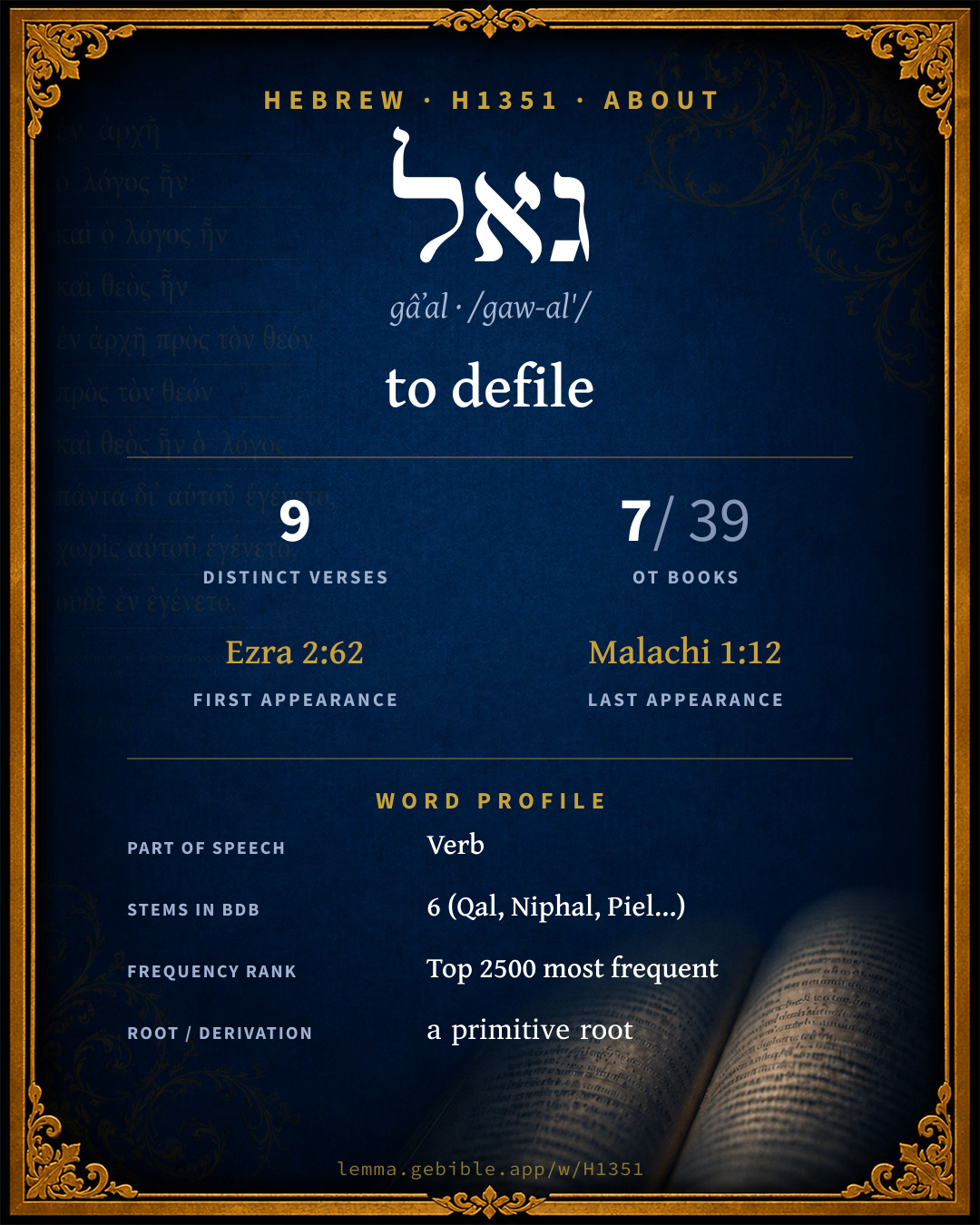
גָּאַל
to defile
also: pollute, desecrate fuller range ↓
Full lexicon entry — Brown-Driver-Briggs (BDB)
From Brown-Driver-Briggs (BDB)
Where this word appears
See every Pual verb in the Hebrew Bible →
Grammar key — what these labels mean
Part of speech
- Verb
- An action or state-of-being word.
Stem
- Pual
- The passive counterpart of the Piel.
- Niphal
- Usually the simple passive or reflexive of the Qal (“he was written”). Here: ‘refl. redeem oneself Lv 25’
- Hithpael
- The reflexive or reciprocal stem (the subject acts on itself).
- Hiphil
- The causative active stem (“he caused / brought about”).
- Piel
- An intensive or resultative active stem.
Form
- Sequential Imperfect
- An imperfect with prefixed waw — the standard past-narrative form (waw-consecutive imperfect).
- Perfect
- A completed action or state — Hebrew marks aspect (completeness) more than strict tense (“he wrote”).
- Participle Passive
- A verbal adjective expressing action received (“written”).
- Imperfect
- An incomplete, ongoing, or future action (“he will / would write”).
State
- Absolute
- The independent form of a noun, not bound to a following word.
Person
- 3rd Person
- The one spoken about (“he / she / it / they”).
- 1st Person
- The speaker (“I / we”).
Gender
- Masculine
- Grammatically masculine.
- Common
- Either gender — not distinguished for this form.
- Feminine
- Grammatically feminine.
Number
- Plural
- More than one (in Hebrew, generally three or more).
- Singular
- One.
Every verse where H1351 appears in the Book of Malachi — 2 distinct verses. Click any verse to open its interlinear word-by-word view. Verse text shown in the World English Bible for context — . Each verse’s Hebrew form is shown with its reference; the English is not keyword-highlighted, since the data carries no word-level English alignment. Use “Compare translations” on any verse to read it across multiple English versions. This concordance covers the Hebrew Bible; Septuagint (Greek Old Testament) occurrences are not indexed here.
Malachi
- Malachi 1:7 מְגֹאָ֔ל גֵֽאַלְנ֑וּ/ךָ Pual ptcp.pass ms Piel pf 1cp + sfx pers 2ms You offer polluted bread on my altar. You say, 'How have we polluted you?' In that you say, 'Yahweh's table contemptible.'
- Malachi 1:12 מְגֹאָ֣ל Pual ptcp.pass ms "But you profane it, in that you say, 'Yahweh's table is polluted, and its fruit, even its food, is contemptible.'
About this entry
At a glance — auto-summarized from this page’s data, not written by a person. Every figure links to its source below. This summary describes the numbers; it doesn’t interpret them.
The Hebrew verb גאל centers on the idea of “to defile.” Different stems carry different senses — BDB groups them under 6 stems, among them Qal and Niphal. It turns up in 9 verses across 7 books, an uncommon footprint. Its earliest occurrence is Ezra 2:62. It shares a root with גאל. Dig into 9-verse concordance and the renderings breakdown below.
Gloss history
Strong's 1890 vs modern scholarship
About this word
Strong's H1351 catalogs a Hebrew word from the Hebrew Old Testament.
These counts are not copied from any lexicon or concordance. They are computed here, from the morphology-tagged Hebrew Old Testament. What Lemma adds →
- 9
- distinct verses
- The word appears in 9 distinct verses.
- 7 / 39
- OT books
- The word appears in 7 of 39 Old Testament books.
- #2,210
- by frequency
- Top 2500 most frequent Hebrew words (rank 2,210 of 8,640 Hebrew words by occurrence).
View all 9 occurrences in the concordance →
By section of the Old Testament
By traditional corpus
Conventional, traditional groupings — biblical authorship is debated, so this is a traditional corpus grouping, not an authorship claim. Each share is this word’s portion of its verses in that division of the Hebrew canon. Each figure is a share of the word’s 9 distinct verses.
- Prophets (Nevi'im) 5 verses · 56%
- Writings (Ketuvim) 4 verses · 44%
How translations render this word
Counts come from each version’s own published word-to-Strong’s tagging or interlinear alignment — an approximate guide to how each version renders this word, not a word-level alignment the data otherwise carries. Because each total is that version’s own tagged count, the per-version totals vary from one another and need not match the appearance or distinct-verse counts above. These counts may also differ from a printed concordance because Lemma counts each distinctly tagged rendering and does not collapse phrase taggings into a single head-word total. This is a fixed set of word-tagged versions (KJV, ASV, BSB, ULT) and does not change with the reading translation you choose elsewhere. Each version’s license is shown beside its name below (and on Sources).
BDB lists this Strong’s number as 2 distinct words (homographs). Each count above pools all of them and is not split by sense — see the Senses section below. A low-frequency rendering may belong to a different one of those words, not the primary meaning.
- King James Version†: Polluted 2×, Therefore were they as polluted 2×
- American Standard Version†: Polluted 2×, Therefore were they deemed polluted 2×
- Berean Standard Bible†: Defiled 4×, Defile himself 2×, Were excluded 2×
- unfoldingWord Literal Text†: Defile himself 2×, They were desecrated 2×
King James Version Public Domain
Renders H1351 across 11† tagged occurrences — most commonly:
Plus 7 renderings that appear only once — usually multi-word phrases or single function words the recovered tagging swept in, not distinct renderings.
American Standard Version Public Domain
Renders H1351 across 11† tagged occurrences — most commonly:
Plus 7 renderings that appear only once — usually multi-word phrases or single function words the recovered tagging swept in, not distinct renderings.
Berean Standard Bible Public Domain
Renders H1351 across 11† tagged occurrences — most commonly:
Plus 3 renderings that appear only once — usually multi-word phrases or single function words the recovered tagging swept in, not distinct renderings.
unfoldingWord Literal Text CC BY-SA 4.0
Renders H1351 across 13† tagged occurrences — most commonly:
Plus 9 renderings that appear only once — usually multi-word phrases or single function words the recovered tagging swept in, not distinct renderings.
23 senses and sub-senses in the full BDB
Hebrew verbs can shift meaning by stem (binyan): Qal is the basic action, Niphal is often passive or reflexive, Piel often intensifies or makes it factitive, and Hiphil is typically causative. The senses below are grouped under the stem BDB assigns to each. This entry also uses Pual (the passive of Piel) and Hithpael (reflexive or reciprocal).
What do BDB’s symbols mean?
BDB uses these scholarly abbreviations:
| Symbol | Meaning |
|---|---|
| 𝔊 | the Septuagint (the ancient Greek translation, LXX) |
| 𝔙 | the Vulgate (the Latin translation) |
| 𝔖 | the Syriac version (the Peshitta) |
| 𝔗 | the Targum (the Aramaic translation) |
| ψ | the Psalms |
| √ | root (the underlying root or stem) |
| ‖ | parallel passage (a synonymous or contrasted parallel) |
| † | the dagger: every passage where the word occurs is cited |
The 23 senses and sub-senses the full Brown-Driver-Briggs lexicon distinguishes for this word, in lexicon order (not ranked by frequency), with BDB’s own verbatim wording and sub-sense lettering. Shown in Hebrew script with BDB’s own scholarly abbreviations. The condensed entry is in the Lexicon Entry tab. See also the Forms in the corpus table below.
גאל I redeem, act as kinsman (NH, Niph. be redeemed
Qal
- Pf. ג׳, etc. Is 44:23 + 14 times; Impf. יִגְאַל, etc. Lv 25:33 + 18 times; Imv. גְּאַל, etc. Ru 4:6 + 3 times; Inf. abs. גָּאֹל Lv 27:13 + 2 times cstr. לִגְאוֹל Ru 4:4 + 2 times; sf. לְגָאֳלֵךְ Ru 3:13; Pt. גֹּאֵל Lv 25:26 + 24 times, גּוֹאֵל Is 59 ψ 103:4; sf. גֹּאַלְךָ Is 48:17, גֹּאֲלֵךְ Is 54:8 (sf. 19 times); pass. pl. גְּאוּלִים, etc. Is 35:9 + 4 times;— e.g. Isaiah 44:23
- 1. act as kinsman, do the part of next of kin (chiefly in D H P Ru.), גֹּאֵל kinsman Lv 25:25 (H) Nu 5:8; 35:12 (P) Ru 2:20; 3:9, 12; 4:1, 3, 6, 8, 14 1 K 16:11. e.g. Leviticus 25:25
- a. in taking a kinsman’s widow אם יגאלך טוב יגאל ואם לא יחפץ לגאלך וגאלתיך if he will do thee the kinsman’s part (raise up children by the widow) well, let him do the kinsman’s part; but if he is not pleased to do thee the kinsman’s part then I will do thee the kinsman’s part Ru 3:13; e.g. Ruth 3:13
- b. in redeeming from bondage Lv 25:48, 49 (H); e.g. Leviticus 25:48
- c. in redeeming a field Lv 25:26, 23 (H) Ru 4:4, 6, e.g. Leviticus 25:26
- d. claim as kinsman Jb 3:5; e.g. Job 3:5
- e. גֹּאֵל הַדָּם the avenger of blood Nu 35:19, 21, 24, 25, 27(×2) Jos 20:3, 5 (?; notin 𝔊) v 9 (P). Dt 19:6, 12 (D) 2 S 14:11. e.g. Numbers 35:19
- 2. redeem, by payment of value assessed, of consecrated things, by the original owner Lv 27:13, 15, 19, 20, 31 (P). e.g. Leviticus 27:13
- 3. redeem, with God as subj. implying personal relationship, chiefly in poetry:—
- a. individuals, from death ψ 103:4 La 3:58 Ho 13:14; מכל רע Gn 48:16 (E poetry), נפשׁ ψ 69:19; 72:14, orphans Pr 23:11; Je 50:34, ריבה ריבי וגאלני ψ 119:154, גֹּאֲלִי Jb 19:25, צוּרִי וְגֹאֲלִי ψ 19:15. e.g. Psalms 103:4
- b. Israel, from Egyptian bondage Ex 6:6 (P?) 15:13 (song) ψ 74:2; 77:16; 78:35, מיד אויב ψ 106:10. e.g. Exodus 6:6
- c. from exile (chiefly Is 3, the vb. not in Is 1) Is 43:1; 44:22, 23; 48:20; 52:9; 63:9 Mi 4:10, מיד ψ 107:2; Je 31:11; Yahweh is גֹּאֵל Is 41:14; 43:14; 44:6, 24; 47:4; 48:17; 49:7, 26; 54:5, 8; 59:20; 60:16; 63:16; and the people גְּאוּלִים Is 35:9; 51:10; 62:12; 63:4 (cf. גְּאוּלַי infr.), ψ 107:2. e.g. Isaiah 43:1
Niphal
- Pf. נִגְאָ֑ל Lv 25:49; Lv Impf. יִגָּאֵל Lv 25:30 + 5 times; תִּגָּאֵ֑לוּ Is 52:3;— e.g. Leviticus 25:49
- 1. refl. redeem oneself Lv 25:49 (H). e.g. Leviticus 25:49
- 2. pass. be redeemed,
- a. field Lv 25:30 (H), slave Lv 25:54 (H); e.g. Leviticus 25:30
- b. consecrated things Lv 27:20, 27, 28, 33 (P); e.g. Leviticus 27:20
- c. Jerusalem by Yahweh Is 52:3. e.g. Isaiah 52:3
גאל II defile, late (cf. גָּעַל)
Niphal
- Pf. 3 mpl. נְגֹאֲלוּ Is 59:3 La 4:14, on form v. Ges§ 51 h, Köi 265; Pt. נִגְאָלָה Zp 3:1;—be defiled, hands with blood בַּדָּם, Is 59:3 cf. La 4:14; pt. as subst. defiled, polluted one Zp 3:1 of Jerusalem (‖ מֹֽרְאָה; appos. הָעִיר הַיּוֹנָה). e.g. Isaiah 59:3
Piel
- Pf. 1 pl. sf. גֵּאַלְנוּךָ Mal 1:7 pollute, desecrate, obj. י׳ (desecrated in his altar). e.g. Malachi 1:7
Pual
- Impf. וַיְגֹאֲלוּ מִן־הַכְּהֻנָּה Ezr 2:62 = Ne 7:64 cstr. pregn. and they were desecrated out of the priesthood, i.e. deposed, as desecrated ones; Pt. מְגֹאָל of bread laid on Yahweh’s altar Mal 1:7; of Yahweh’s altar (table, שֻׁלְחָן) v 12. e.g. Ezra 2:62
Hiphil
- Pf. 1 s. אֶגְאָ֑לְתִּי Is 63:3 (on Aramaic form v. Köi 27 Ges§ 53 R. 6 but) read perhaps גֵּאָ֑לְתִּי Pi., v. GFMThLZ 1887, 292 cf. also Gesl.c. N. Ol§ 255 b Sta§ 159 b, 3;—I have polluted, i.e. stained, all my raiment, e.g. Isaiah 63:3
Hithpael
- Impf. יִתְגָּאַל Dn 1:8; יִתְגָּאָ֑ל v 8;—defile himself. e.g. Daniel 1:8
Senses from the full Brown-Driver-Briggs lexicon (Brown, Driver, Briggs; Oxford 1906 — public domain), digitized via Sefaria, supplemented by the OpenScriptures HebrewLexicon (CC BY 4.0). Full attribution on Sources.
Word origin
I. vb. redeem, act as kinsman (NH, Niph. be redeemed; also גּוֹאֵל, גְּאוּלָּה)—
II. vb. defile, late (cf. גָּעַל)—
— Brown-Driver-Briggs (Oxford 1906, public domain), digitized via Sefaria, supplemented by the OpenScriptures HebrewLexicon (CC BY 4.0). See Sources.
Origin: a primitive root
Jastrow Dictionary
A second Hebrew/Aramaic lexicon for comparison, covering Aramaic and post-biblical (Talmudic, Targumic, Midrashic) usage that the biblical-Hebrew BDB does not. Matched by lemma rather than by Strong’s number, so a lemma may carry more than one Jastrow headword (shown separately below), and the entries cover usage well beyond the Bible.
גָּאַל
- (b. h.) [to cover, cmp. Job III, 4;] to ransom, redeem, protect. Pes. X, 6 גְּאָלָנוּ וג׳ וכ׳ has protected us and redeemed our ancestors. Gen. R. s. 78, beg.; Midr. Till. to Ps. XXV, beg.; Lam. R. to III, 23 אמונתך רבה לְגָאֳלֵנוּ thy faith is great enough to redeem us. Gen. R. s. 44.—Kidd. 20ᵇ לוה וגוֹאֵל וגוֹאֵל לחצאין he may borrow money and redeem his property (from the sanctuary), and may redeem in instalments. Midr. Till. to Ps. XXXI, beg. גְּאַל אותנו redeem us; a. fr.—V. גּוֹאֵל. e.g. Job 3:4
- to be redeemed. Ber. 9ᵃ כְּשֶׁנִּגְאֲלוּ ישראל וכ׳ when the Israelites were redeemed from Epypt. Kidd. 15ᵇ (ref. to Lev. XXV, 54) באלה הוא נ׳ וכ׳ through those (his relations) he may be redeemed, but he is not freed after six years of service (Ex. XXI, 2). Ib. 20ᵇ when the jubilee year arrives ולא נִגְאֲלָה and it (the field) has not been redeemed. Ib. יפה כחו לִיגָּאֵל מיד it has the privilege of immediate redemption. Sabb. 118ᵇ מיד נִגְאָלִין they would be released (from captivity) at once. Y. Taan. II, 65ᵈ top וסופן להִיגָּאֵל וכ׳ and they will be released &c.; Gen. R. s. 56 לִיגָּאֵל; a. fr.—[In b. h. ג׳ also: to cover (with blood), stain, make repulsive.]. V. געל. e.g. Leviticus 25:54
גְּאַל
- —Part. גָּאֵל, גָּאֵיל. Targ. O. Num. XXXV, 12; 19; 21, a. e. ג׳ דמא, v. גּוֹאֵל
A Dictionary of the Targumim, the Talmud Babli and Yerushalmi, and the Midrashic Literature (Marcus Jastrow; London, Luzac, 1903) — Public Domain. Digitized via Sefaria. Digitized via Sefaria. Full attribution on Sources.
Forms in the corpus
The 11 distinct written forms H1351 takes in the Hebrew Bible, most frequent first — each parse links to that stem’s occurrences in the concordance. Hebrew forms include their vowel points and cantillation, so a single lemma takes many written forms.
| Form | Parsing | Example | Uses |
|---|---|---|---|
| אֶגְאָֽלְתִּי | Verb, Hiphil, Perfect, 1st Person, Common, Singular | Isaiah 63:3 | 1 |
| גֵֽאַלְנ֑וּ/ךָ | Verb, Piel, Perfect, 1st Person, Common, Plural | Malachi 1:7 | 1 |
| וְ/נִגְאָלָ֑ה | Verb, Niphal, Participle Passive, Feminine, Singular, Absolute | Zephaniah 3:1 | 1 |
| וַ/יְגֹֽאֲל֖וּ | Verb, Pual, Sequential Imperfect, 3rd Person, Masculine, Plural | Nehemiah 7:64 | 1 |
| וַֽ/יְגֹאֲל֖וּ | Verb, Pual, Sequential Imperfect, 3rd Person, Masculine, Plural | Ezra 2:62 | 1 |
| יִתְגָּאַ֛ל | Verb, Hithpael, Imperfect, 3rd Person, Masculine, Singular | Daniel 1:8 | 1 |
| יִתְגָּאָֽל | Verb, Hithpael, Imperfect, 3rd Person, Masculine, Singular | Daniel 1:8 | 1 |
| מְגֹאָ֔ל | Verb, Pual, Participle Passive, Masculine, Singular, Absolute | Malachi 1:7 | 1 |
| מְגֹאָ֣ל | Verb, Pual, Participle Passive, Masculine, Singular, Absolute | Malachi 1:12 | 1 |
| נְגֹֽאֲל֖וּ | Verb, Niphal, Perfect, 3rd Person, Common, Plural | Lamentations 4:14 | 1 |
| נְגֹאֲל֣וּ | Verb, Niphal, Perfect, 3rd Person, Common, Plural | Isaiah 59:3 | 1 |
Same root — word family
Other BDB entries built from the same root as H1351, grouped by Strong’s listed origin. These share a root / origin per the lexicon — not necessarily a shared meaning. Each links to that word’s own entry.
Derived from this word
Compare all same-root words → They share a root, not necessarily a meaning.
Septuagint verse parallels
This word appears in 8 verses that also exist in the Greek Old Testament (Septuagint), out of the 9 Hebrew verses it occurs in. You can read those verses in Greek by switching the Old Testament edition to the Septuagint.
Read these verses in the Septuagint
This is a verse-level parallel only — the same verses exist in both the Hebrew and Greek Old Testaments. No word-level Hebrew↔Greek correspondence is claimed: the data carries no such alignment, so no Greek word is shown as this Hebrew word’s translation. Coverage is not total — the Septuagint omits the deuterocanon and renumbers the Psalms, so some Hebrew verses have no direct Greek parallel.