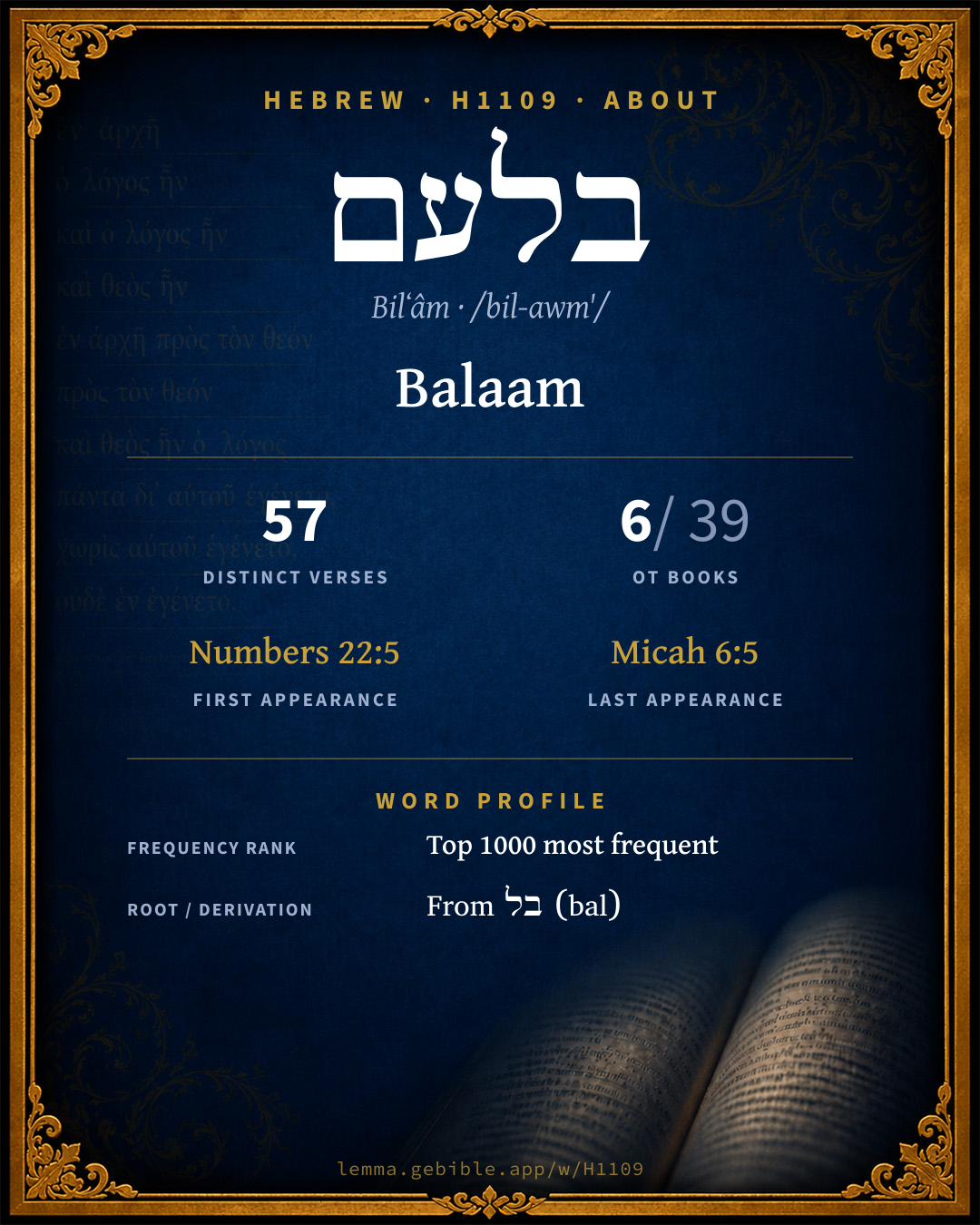
בִּלְעָם
Balaam
BDB lists 3 entries for ‘Balaam’ fuller range ↓
Full lexicon entry — Brown-Driver-Briggs (BDB)
From Brown-Driver-Briggs (BDB)
Where this word appears
Grammar key — what these labels mean
Part of speech
- Noun
- A naming word — a person, place, thing, or idea.
Noun type
- Proper
- A name of a specific person, place, or people (e.g. Abraham, Zion, Israel).
Every verse where H1109 appears in the Book of Deuteronomy — 2 distinct verses. Click any verse to open its interlinear word-by-word view. Verse text shown in the World English Bible for context — . Each verse’s Hebrew form is shown with its reference; the English is not keyword-highlighted, since the data carries no word-level English alignment. Use “Compare translations” on any verse to read it across multiple English versions. This concordance covers the Hebrew Bible; Septuagint (Greek Old Testament) occurrences are not indexed here.
Deuteronomy
- Deuteronomy 23:4 בִּלְעָ֣ם n Proper because they didn't meet you with bread and with water in the way, when you came forth out of Egypt, and because they hired against you Balaam the son of Beor from Pethor of Mesopotamia, to curse you.
- Deuteronomy 23:5 בִּלְעָ֔ם n Proper Nevertheless Yahweh your God wouldn't listen to Balaam; but Yahweh your God turned the curse into a blessing to you, because Yahweh your God loved you.
About this entry
At a glance — auto-summarized from this page’s data, not written by a person. Every figure links to its source below. This summary describes the numbers; it doesn’t interpret them.
בלעם (Bilʻâm) is a Hebrew name most often rendered “Balaam.” Numbers dominates its distribution — 49 of 57 verses. Spanning 57 verses in 6 books, it ranks among the moderately common words of the Hebrew Bible. It first appears in Numbers 22:5. The sections below give every occurrence and version rendering.
Gloss history
Strong's 1890 vs modern scholarship
About this word
Strong's H1109 catalogs a Hebrew word from the Hebrew Old Testament.
These counts are not copied from any lexicon or concordance. They are computed here, from the morphology-tagged Hebrew Old Testament. What Lemma adds →
- 57
- distinct verses
- The word appears in 57 distinct verses.
- 6 / 39
- OT books
- The word appears in 6 of 39 Old Testament books.
- #629
- by frequency
- Top 1000 most frequent Hebrew words (rank 629 of 8,640 Hebrew words by occurrence).
View all 57 occurrences in the concordance →
Most concentrated in
- Numbers 49 verses 86%
- Joshua 3 verses 5%
- Deuteronomy 2 verses 4%
By section of the Old Testament
By traditional corpus
Conventional, traditional groupings — biblical authorship is debated, so this is a traditional corpus grouping, not an authorship claim. Each share is this word’s portion of its verses in that division of the Hebrew canon. Each figure is a share of the word’s 57 distinct verses.
- Torah (Pentateuch) 51 verses · 89%
- Prophets (Nevi'im) 4 verses · 7%
- Writings (Ketuvim) 2 verses · 4%
How translations render this word
Counts come from each version’s own published word-to-Strong’s tagging or interlinear alignment — an approximate guide to how each version renders this word, not a word-level alignment the data otherwise carries. Because each total is that version’s own tagged count, the per-version totals vary from one another and need not match the appearance or distinct-verse counts above. These counts may also differ from a printed concordance because Lemma counts each distinctly tagged rendering and does not collapse phrase taggings into a single head-word total. This is a fixed set of word-tagged versions (KJV, ASV, BSB, ULT) and does not change with the reading translation you choose elsewhere. Each version’s license is shown beside its name below (and on Sources).
BDB lists this Strong’s number as 2 distinct words (homographs). Each count above pools all of them and is not split by sense — see the Senses section below. A low-frequency rendering may belong to a different one of those words, not the primary meaning.
- King James Version†: Balaam 53×, Balaam's 3×
- American Standard Version†: Balaam 56×
- Berean Standard Bible†: Balaam 54×, Balaam’s 3×
- unfoldingWord Literal Text†: Balaam 60×
King James Version Public Domain
Renders H1109 across 61† tagged occurrences — most commonly:
Plus 5 renderings that appear only once — usually multi-word phrases or single function words the recovered tagging swept in, not distinct renderings.
American Standard Version Public Domain
Renders H1109 across 61† tagged occurrences — most commonly:
Plus 5 renderings that appear only once — usually multi-word phrases or single function words the recovered tagging swept in, not distinct renderings.
Berean Standard Bible Public Domain
Renders H1109 across 60† tagged occurrences — most commonly:
Plus 3 renderings that appear only once — usually multi-word phrases or single function words the recovered tagging swept in, not distinct renderings. Not rendered by a distinct English word in 1 further occurrence.
unfoldingWord Literal Text CC BY-SA 4.0
Renders H1109 across 61† tagged occurrences — most commonly:
Plus 1 rendering that appears only once — usually multi-word phrases or single function words the recovered tagging swept in, not distinct renderings.
Senses in the full BDB
What do BDB’s symbols mean?
BDB uses these scholarly abbreviations:
| Symbol | Meaning |
|---|---|
| 𝔊 | the Septuagint (the ancient Greek translation, LXX) |
| 𝔙 | the Vulgate (the Latin translation) |
| 𝔖 | the Syriac version (the Peshitta) |
| 𝔗 | the Targum (the Aramaic translation) |
| ψ | the Psalms |
| √ | root (the underlying root or stem) |
| ‖ | parallel passage (a synonymous or contrasted parallel) |
| † | the dagger: every passage where the word occurs is cited |
The 0 senses and sub-senses the full Brown-Driver-Briggs lexicon distinguishes for this word, in lexicon order (not ranked by frequency), with BDB’s own verbatim wording and sub-sense lettering. Shown in Hebrew script with BDB’s own scholarly abbreviations. The condensed entry is in the Lexicon Entry tab. See also the Forms in the corpus table below.
בלעם I m. Balaam (according to Sta§ 293 = בלע + ם
בלעם II loc. town in Manasseh 1 Ch 6
Senses from the full Brown-Driver-Briggs lexicon (Brown, Driver, Briggs; Oxford 1906 — public domain), digitized via Sefaria, supplemented by the OpenScriptures HebrewLexicon (CC BY 4.0). Full attribution on Sources.
Word origin
I. n.pr.m. Balaam (according to Sta§ 293 = בלע + ם; NbrStud. Bib. i, 226 proposes בל = בעל + (god) עם), son of בְּעוֹר, prophet from פְּתוֹר (q.v.):—Nu 22:5, 7, 8, 9 + 47 times Nu 22–24 (all JE) 31:8, 16 (P) Dt 23:5, 6 (D) (cf. RD Jos 13:22) Jos 24:9, 10 (E) Mi 6:5 Ne 13:2.
II. n.pr.loc. town in Manasseh 1 Ch 6:55; A Ιβλααμ, 𝔊L Ιεβλααμ = יִבְלְעָם (q.v.) Jos 17:11 + 2 times mod. Belʿame, 6 hours N. of Nâblus, BdPal. 228, so Surveyii. 47.
— Brown-Driver-Briggs (Oxford 1906, public domain), digitized via Sefaria, supplemented by the OpenScriptures HebrewLexicon (CC BY 4.0). See Sources.
Derived from בל (bal) (H1077) — not.
Jastrow Dictionary
A second Hebrew/Aramaic lexicon for comparison, covering Aramaic and post-biblical (Talmudic, Targumic, Midrashic) usage that the biblical-Hebrew BDB does not. Matched by lemma rather than by Strong’s number, so a lemma may carry more than one Jastrow headword (shown separately below), and the entries cover usage well beyond the Bible.
בִּלְעָם
- (b. h.) pr. n. m. Balaam, the gentile prophet of the Pentateuch. Snh. 105ᵃ ב׳ בַּלַּע עם Ar. (Var. in Ar., a. ed. בַּלָּא) devourer (destroyer) of the people; other homilet. etymology ibid. שבִּלָּה עם he ruined the people (through debauchery; Rashi: = בִּלְבֵּל). Gen. R. s. 65. Ab. V, 19 (as type of false teachers); a. fr.
A Dictionary of the Targumim, the Talmud Babli and Yerushalmi, and the Midrashic Literature (Marcus Jastrow; London, Luzac, 1903) — Public Domain. Digitized via Sefaria. Digitized via Sefaria. Full attribution on Sources.
Forms in the corpus
The 18 distinct written forms H1109 takes in the Hebrew Bible, most frequent first — each parse links to that state’s occurrences in the concordance. Hebrew forms include their vowel points and cantillation, so a single lemma takes many written forms.
| Form | Parsing | Example | Uses |
|---|---|---|---|
| בִּלְעָ֔ם | Noun, Proper | Deuteronomy 23:5 | 13 |
| בִּלְעָם֙ | Noun, Proper | Nehemiah 13:2 | 9 |
| בִּלְעָ֑ם | Noun, Proper | Numbers 22:9 | 7 |
| בִּלְעָ֖ם | Noun, Proper | 1 Chronicles 6:70 | 7 |
| בִּלְעָ֗ם | Noun, Proper | Numbers 22:18 | 6 |
| בִּלְעָ֣ם | Noun, Proper | Deuteronomy 23:4 | 4 |
| בִּלְעָ֜ם | Noun, Proper | Numbers 22:34 | 3 |
| בִלְעָ֑ם | Noun, Proper | Numbers 22:36 | 2 |
| בִלְעָ֜ם | Noun, Proper | Numbers 24:2 | 1 |
| בִלְעָם֒ | Noun, Proper | Numbers 22:31 | 1 |
| בִּלְעָ֥ם | Noun, Proper | Joshua 13:22 | 1 |
| בִּלְעָֽם | Noun, Proper | Numbers 22:8 | 1 |
| בִּלְעָם֮ | Noun, Proper | Numbers 22:20 | 1 |
| וּ/בִלְעָ֛ם | Noun, Proper | Numbers 23:2 | 1 |
| לְ/בִלְעָ֑ם | Noun, Proper | Joshua 24:10 | 1 |
| לְ/בִלְעָ֔ם | Noun, Proper | Numbers 22:40 | 1 |
| לְ/בִלְעָ֥ם | Noun, Proper | Joshua 24:9 | 1 |
| לְ/בִלְעָם֙ | Noun, Proper | Numbers 22:28 | 1 |
Same root — word family
Other BDB entries built from the same root as H1109, grouped by Strong’s listed origin. These share a root / origin per the lexicon — not necessarily a shared meaning. Each links to that word’s own entry.
Derives from
Shares the same root
Proper names from this root
People and places named from this root — a name, not an additional meaning of the word.
Compare all same-root words → 1 of the same-root words is a proper name (a person or place). They share a root, not necessarily a meaning.
Bible dictionary
Public-domain dictionary articles matched to this entry by name (Balaam). A biblical name can be shared by more than one person or place, so an article may treat several.
Easton's Bible Dictionary · M. G. Easton, 1897
Lord of the people; foreigner or glutton, as interpreted by others, the son of Beor, was a man of some rank among the Midianites (Num. 31:8; comp. 16). He resided at Pethor (Deut. 23:4), in Mesopotamia (Num. 23:7). It is evident that though dwelling among idolaters he had some knowledge of the true God; and was held in such reputation that it was supposed that he whom he blessed was blessed, and he whom he cursed was cursed. When the Israelites were encamped on the plains of Moab, on the east of Jordan, by Jericho, Balak sent for Balaam "from Aram, out of the mountains of the east," to curse them; but by the remarkable interposition of God he was utterly unable to fulfil Balak's wish, however desirous he was to do so. The apostle Peter refers (2 Pet. 2:15, 16) to this as an historical event. In Micah 6:5 reference also is made to the relations between Balaam and Balak. Though Balaam could not curse Israel, yet he suggested a mode by which the divine displeasure might be caused to descend upon them (Num. 25). In a battle between Israel and the Midianites (q.v.) Balaam was slain while fighting on the side of Balak (Num. 31:8).
The "doctrine of Balaam" is spoken of in Rev. 2:14, in allusion to the fact that it was through the teaching of Balaam that Balak learned the way by which the Israelites might be led into sin. (See NICOLAITANES.) Balaam was constrained to utter prophecies regarding the future of Israel of wonderful magnificence and beauty of expression (Num. 24:5-9, 17).
Smith's Bible Dictionary · William Smith, 1863
(B.C. 1451), the son of beor, a man endowed with the gift of prophecy. (Numbers 22:5) He is mentioned in conjunction with the five kings of Midian, apparently as a person of the same rank. (Numbers 31:8) cf. Numb 31:16 He seems to have lived at Pethor, (23:4; Numbers 22:5) on the river Euphrates, in Mesopotamia. Such was his reputation that when the Israelites were encamped in the plains of Moab, Balak, the king of Moab, sent for Balaam to curse them. Balaam at first was prohibited by God from going. He was again sent for by the king and again refused, but was at length allowed to go. He yielded to the temptations of riches and honor which Balak set before him; but God's anger was kindled at this manifestation of determined self-will, and the angel of the Lord stood in the way for an adversary against him. See (2 Peter 2:16) Balaam predicted a magnificent career for the people whom he was called to curse, but he nevertheless suggested to the Moabites the expedient of seducing them to commit fornication. The effect of this is recorded in (Numbers 25:1) ... A battle was afterwards fought against the Midianites, in which Balaam sided with them, and was slain by the sword of the people whom he had endeavored to curse. (Numbers 31:8)
Hitchcock's Bible Names Dictionary · Roswell D. Hitchcock, 1869
the ancient of the people; the destruction of the people
Classic public-domain reference works; full attribution on Sources.
Septuagint verse parallels
This word appears in 55 verses that also exist in the Greek Old Testament (Septuagint), out of the 57 Hebrew verses it occurs in. You can read those verses in Greek by switching the Old Testament edition to the Septuagint.
Read these verses in the Septuagint
This is a verse-level parallel only — the same verses exist in both the Hebrew and Greek Old Testaments. No word-level Hebrew↔Greek correspondence is claimed: the data carries no such alignment, so no Greek word is shown as this Hebrew word’s translation. Coverage is not total — the Septuagint omits the deuterocanon and renumbers the Psalms, so some Hebrew verses have no direct Greek parallel.