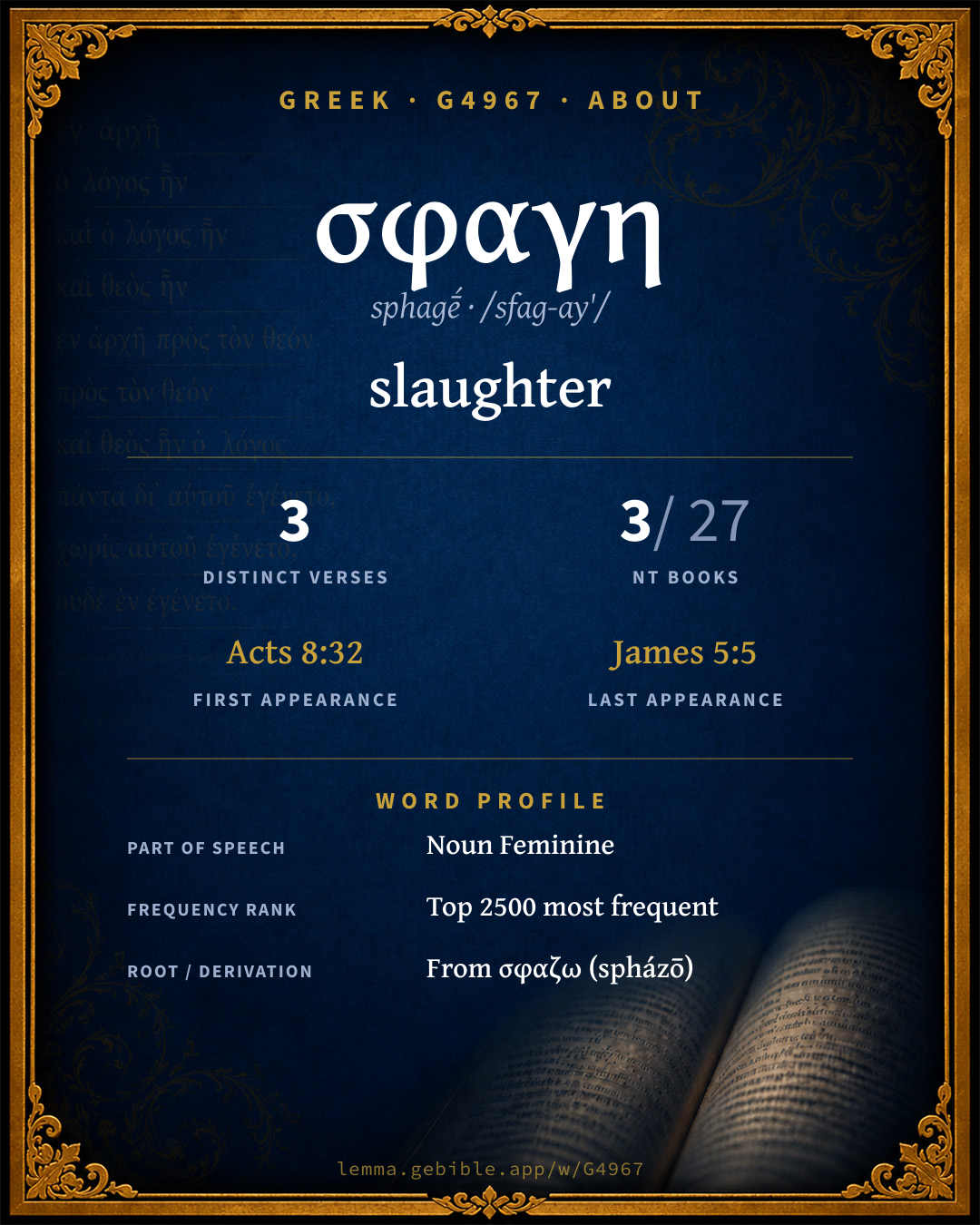
σφαγή
slaughter
Full lexicon entry — Thayer's Greek Lexicon
From Thayer's Greek Lexicon
Where this word appears
See every Genitive-case word in the Greek New Testament →
Grammar key — what these labels mean
Part of speech
- Noun
- A naming word — a person, place, thing, or idea.
Case
- Genitive
- The case of source, possession, or “of” — answers “whose / from what.”
- Accusative
- The case of the direct object and of extent.
Gender
- Feminine
- Grammatically feminine.
Number
- Singular
- One.
2 distinct verses where G4967 appears in the Genitive case, across 2 books. Filtered view — show all forms. Click any verse to open its interlinear word-by-word view. Verse text shown in the World English Bible for context — . Each verse’s Greek form is shown with its reference; the English is not keyword-highlighted, since the data carries no word-level English alignment. Use “Compare translations” on any verse to read it across multiple English versions. This concordance covers the Greek New Testament; Septuagint (Greek Old Testament) occurrences of this word are not indexed here.
Romans 1 verse
James 1 verse
About this entry
At a glance — auto-summarized from this page’s data, not written by a person. Every figure links to its source below. This summary describes the numbers; it doesn’t interpret them.
At its core, σφαγη (sphagḗ) means “slaughter.” It is rare — just 3 verses in the entire Greek New Testament. Its uses concentrate in Acts (33% of all occurrences). First canonically at Acts 8:32, it enters the text early. From the same root come σφαζω and σφαγιον. Each statement above links to its evidence; the full detail follows below.
Gloss history
Strong's 1890 vs modern scholarship
About this word
Strong's G4967 catalogs a Greek word from the Greek New Testament.
These counts are not copied from any lexicon or concordance. They are computed here, from the morphology-tagged Greek New Testament. What Lemma adds →
- 3
- distinct verses
- The word appears in 3 distinct verses.
- 3 / 27
- NT books
- The word appears in 3 of 27 New Testament books.
- #2,203
- by frequency
- Top 2500 most frequent Greek words (rank 2,203 of 5,347 Greek words by occurrence).
View all 3 occurrences in the concordance →
By section of the New Testament
By traditional corpus
Conventional, traditional groupings — biblical authorship is debated, so this is a traditional corpus grouping, not an authorship claim. Some books belong to more than one corpus (Luke is in both the Gospels and the Lukan corpus, and so on), so these shares overlap and need not total 100%. Each figure is a share of the word’s 3 distinct verses.
- Lukan (Luke–Acts) 1 verse · 33%
- Pauline corpus 1 verse · 33%
- General (Catholic) Epistles 1 verse · 33%
How translations render this word
Counts come from each version’s own published word-to-Strong’s tagging or interlinear alignment — an approximate guide to how each version renders this word, not a word-level alignment the data otherwise carries. Because each total is that version’s own tagged count, the per-version totals vary from one another and need not match the appearance or distinct-verse counts above. These counts may also differ from a printed concordance because Lemma counts each distinctly tagged rendering and does not collapse phrase taggings into a single head-word total. This is a fixed set of word-tagged versions (KJV, ASV, BSB, ULT) and does not change with the reading translation you choose elsewhere. Each version’s license is shown beside its name below (and on Sources).
- King James Version: Slaughter 3×
- American Standard Version: Slaughter 3×
- Berean Standard Bible: Slaughter 2×
- unfoldingWord Literal Text: Slaughter 3×
King James Version Public Domain
Renders G4967 across 3 tagged occurrences — most commonly:
American Standard Version Public Domain
Renders G4967 across 3 tagged occurrences — most commonly:
Berean Standard Bible Public Domain
Renders G4967 across 3 tagged occurrences — most commonly:
Plus 1 rendering that appears only once — usually multi-word phrases or single function words the recovered tagging swept in, not distinct renderings.
unfoldingWord Literal Text CC BY-SA 4.0
Renders G4967 across 3 tagged occurrences — most commonly:
Senses in Thayer's
The 1 sense Thayer's distinguishes for this word, in lexicon order (not ranked by frequency or importance). The full entry — with sub-senses — is in the Lexicon Entry tab.
- slaughter
Word origin
Derived from σφαζω (spházō) (G4969) — to slaughter.
From G4969 ; butchery (of animals for food or sacrifice or [figuratively] of men [ destruction ]): - slaughter.
— Strong’s Exhaustive Concordance (1890), public domain.
Forms in the corpus
The 2 distinct written forms G4967 takes in the Greek New Testament, most frequent first — each parse links to that case’s occurrences in the concordance.
| Form | Parsing | Example | Uses |
|---|---|---|---|
| σφαγῆς sphagē̂s | Noun, Genitive, Singular, Feminine | Romans 8:36 | 2 |
| σφαγὴν sphagḕn | Noun, Accusative, Singular, Feminine | Acts 8:32 | 1 |
Same root — word family
Other Thayer's entries built from the same root as G4967, grouped by Strong’s listed origin. These share a root / origin per the lexicon — not necessarily a shared meaning. Each links to that word’s own entry.
Derives from
Derived from this word
Compare all same-root words → They share a root, not necessarily a meaning.
Septuagint usage
The same Greek word σφαγη appears 20 times in the Greek Old Testament (Septuagint), across 20 verses in 8 books.
- 20
- LXX occurrences
- Tagged occurrences of this Greek word in the Septuagint.
- 20
- verses
- Distinct Septuagint verses containing this word.
- 8 / 39
- OT books
- The word appears in 8 of the 39 Old Testament books.
Sample Septuagint occurrences
- Job 10:16 σφαγή
- Psalms 43:23 σφαγή
- Proverbs 7:22 σφαγή
- Isaiah 34:2 σφαγή
- Jeremiah 12:3 σφαγή
- Ezekiel 21:20 σφαγή
- Obadiah 1:10 σφαγή
- Zechariah 11:4 σφαγή
Septuagint occurrences (same lexeme)
Every verse where the same Strong’s number (G4967) appears in the Greek Septuagint. Verse text shown in the World English Bible for context; the Greek form is the matched word — the English is not keyword-highlighted.
- Job 10:16 σφαγή If my head is held high, you hunt me like a lion. Again you show yourself powerful to me.
- Job 21:20 σφαγή Let his own eyes see his destruction. Let him drink of the wrath of the Almighty.
- Job 27:14 σφαγή If his children are multiplied, it is for the sword. His offspring shall not be satisfied with bread.
- Psalms 43:23 σφαγή
- Proverbs 7:22 σφαγή He followed her immediately, As an ox goes to the slaughter, As a fool stepping into a noose.
- Isaiah 34:2 σφαγή For Yahweh has indignation against all the nations, and wrath against all their host: he has utterly destroyed them, he has delivered them to the slaughter.
- Isaiah 34:6 σφαγή The sword of Yahweh is filled with blood, it is made fat with fatness, with the blood of lambs and goats, with the fat of the kidneys of rams; for Yahweh has a sacrifice in Bozrah, and a great slaughter in the land of Edom.
- Isaiah 53:7 σφαγή He was oppressed, yet when he was afflicted he didn't open his mouth; as a lamb that is led to the slaughter, and as a sheep that before its shearers is mute, so he didn't open his mouth.
- Isaiah 65:12 σφαγή I will destine you to the sword, and you shall all bow down to the slaughter; because when I called, you did not answer; when I spoke, you did not hear; but you did that which was evil in my eyes, and chose that in which I didn't delight.
- Jeremiah 12:3 σφαγή But you, Yahweh, know me; you see me, and try my heart toward you: pull them out like sheep for the slaughter, and prepare them for the day of slaughter.
- Jeremiah 15:3 σφαγή I will appoint over them four kinds, says Yahweh: the sword to kill, and the dogs to tear, and the birds of the sky, and the animals of the earth, to devour and to destroy.
- Jeremiah 19:6 σφαγή therefore, behold, the days come, says Yahweh, that this place shall no more be called Topheth, nor The valley of the son of Hinnom, but The valley of Slaughter.
- Jeremiah 27:27 σφαγή
- Jeremiah 28:40 σφαγή
- Jeremiah 31:15 σφαγή Thus says Yahweh: A voice is heard in Ramah, lamentation, and bitter weeping, Rachel weeping for her children; she refuses to be comforted for her children, because they are no more.
- Jeremiah 32:21 σφαγή and brought forth your people Israel out of the land of Egypt with signs, and with wonders, and with a strong hand, and with an outstretched arm, and with great terror;
- Ezekiel 21:20 σφαγή You shall appoint a way for the sword to come to Rabbah of the children of Ammon, and to Judah in Jerusalem the fortified.
- Obadiah 1:10 σφαγή For the violence done to your brother Jacob, shame will cover you, and you will be cut off forever.
- Zechariah 11:4 σφαγή Thus says Yahweh my God: "Feed the flock of slaughter.
- Zechariah 11:7 σφαγή So I fed the flock of slaughter, especially the oppressed of the flock. I took for myself two staffs. The one I called "Favor," and the other I called "Union," and I fed the flock.
These are occurrences of the same Greek lexeme (G4967) in the Septuagint — not a translation of any one Hebrew word. The store carries no word-level Hebrew↔Greek alignment, so no Hebrew original is asserted here. Counts come from the recovered LXX Strong's tagging — high-frequency vocabulary is well covered, while rare or late forms may be untagged — so they reflect tagged occurrences and may slightly undercount.