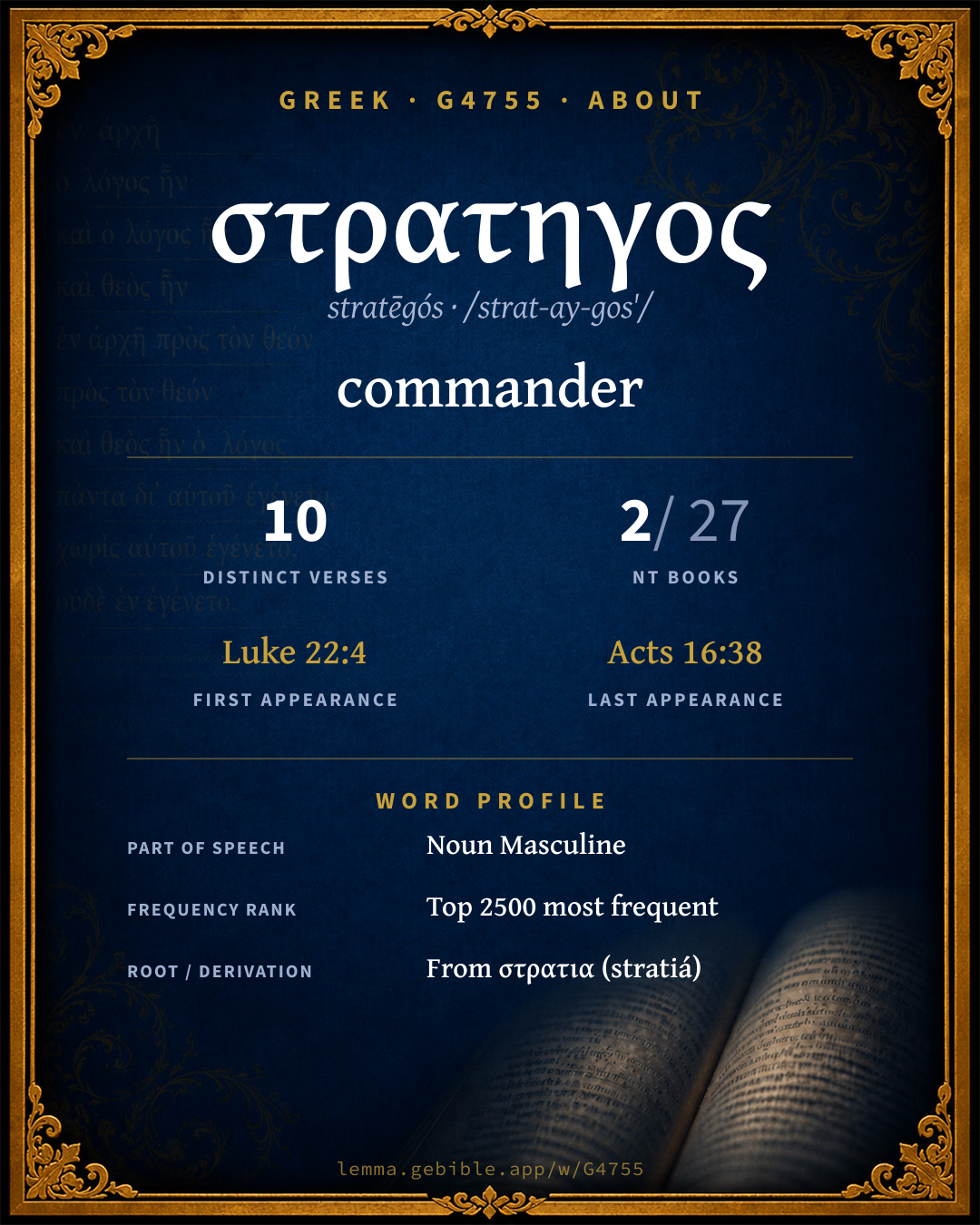
στρατηγός
commander
‘commander’ is one of 3 main senses fuller range ↓
Full lexicon entry — Thayer's Greek Lexicon
From Thayer's Greek Lexicon
Where this word appears
See every Nominative-case word in the Greek New Testament →
Grammar key — what these labels mean
Part of speech
- Noun
- A naming word — a person, place, thing, or idea.
Case
- Dative
- The case of the indirect object, means, or location — “to / for / with / in.”
- Nominative
- The case of the subject (and the predicate nominative).
- Accusative
- The case of the direct object and of extent.
Gender
- Masculine
- Grammatically masculine.
Number
- Plural
- More than one.
- Singular
- One.
Every verse where G4755 appears in the Book of Acts — 8 distinct verses. Click any verse to open its interlinear word-by-word view. Verse text shown in the World English Bible for context — . Each verse’s Greek form is shown with its reference; the English is not keyword-highlighted, since the data carries no word-level English alignment. Use “Compare translations” on any verse to read it across multiple English versions. This concordance covers the Greek New Testament; Septuagint (Greek Old Testament) occurrences of this word are not indexed here.
Acts
- Acts 4:1 στρατηγὸς n nom sg masc As they spoke to the people, the priests and the captain of the temple and the Sadducees came to them,
- Acts 5:24 στρατηγὸς n nom sg masc Now when the high priest, the captain of the temple, and the chief priests heard these words, they were very perplexed about them and what might become of this.
- Acts 5:26 στρατηγὸς n nom sg masc Then the captain went with the officers, and brought them without violence, for they were afraid that the people might stone them.
- Acts 16:20 στρατηγοῖς n dat pl masc When they had brought them to the magistrates, they said, "These men, being Jews, are agitating our city,
- Acts 16:22 στρατηγοὶ n nom pl masc The multitude rose up together against them, and the magistrates tore their clothes off of them, and commanded them to be beaten with rods.
- Acts 16:35 στρατηγοὶ n nom pl masc But when it was day, the magistrates sent the sergeants, saying, "Let those men go."
- Acts 16:36 στρατηγοὶ n nom pl masc The jailer reported these words to Paul, saying, "The magistrates have sent to let you go; now therefore come out, and go in peace."
- Acts 16:38 στρατηγοῖς n dat pl masc The sergeants reported these words to the magistrates, and they were afraid when they heard that they were Romans,
About this entry
At a glance — auto-summarized from this page’s data, not written by a person. Every figure links to its source below. This summary describes the numbers; it doesn’t interpret them.
στρατηγος — transliterated stratēgós — is a Greek noun carrying the sense “commander.” More than three-quarters of its appearances fall in Acts. It appears 10 verses across 2 books of the Greek New Testament, among its uncommon vocabulary. Its earliest occurrence is Luke 22:4. Thayer's distinguishes 3 senses for it. See the sense tree, 10-verse concordance, and the renderings breakdown below.
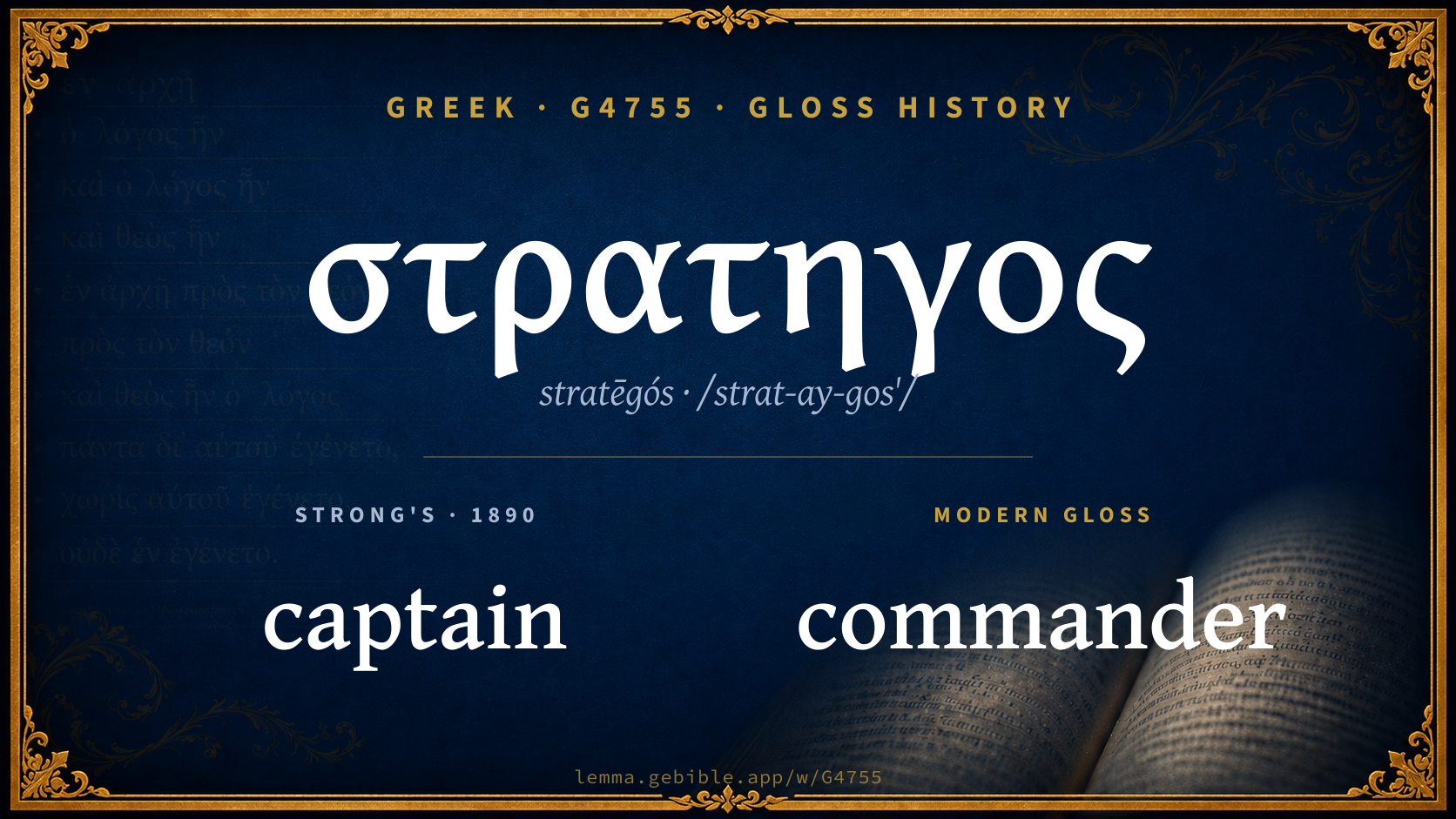
Gloss history
Strong's 1890 vs modern scholarship
About this word
Strong's G4755 catalogs a Greek word from the Greek New Testament.
These counts are not copied from any lexicon or concordance. They are computed here, from the morphology-tagged Greek New Testament. What Lemma adds →
- 10
- distinct verses
- The word appears in 10 distinct verses.
- 2 / 27
- NT books
- The word appears in 2 of 27 New Testament books.
- #1,056
- by frequency
- Top 2500 most frequent Greek words (rank 1,056 of 5,347 Greek words by occurrence).
View all 10 occurrences in the concordance →
By traditional corpus
Conventional, traditional groupings — biblical authorship is debated, so this is a traditional corpus grouping, not an authorship claim. Some books belong to more than one corpus (Luke is in both the Gospels and the Lukan corpus, and so on), so these shares overlap and need not total 100%. Each figure is a share of the word’s 10 distinct verses.
- Lukan (Luke–Acts) 10 verses · 100%
- Gospels 2 verses · 20%
How translations render this word
Counts come from each version’s own published word-to-Strong’s tagging or interlinear alignment — an approximate guide to how each version renders this word, not a word-level alignment the data otherwise carries. Because each total is that version’s own tagged count, the per-version totals vary from one another and need not match the appearance or distinct-verse counts above. These counts may also differ from a printed concordance because Lemma counts each distinctly tagged rendering and does not collapse phrase taggings into a single head-word total. This is a fixed set of word-tagged versions (KJV, ASV, BSB, ULT) and does not change with the reading translation you choose elsewhere. Each version’s license is shown beside its name below (and on Sources).
- King James Version: Magistrates 5×, Captain 3×, Captains 2×
- American Standard Version: Magistrates 4×, Captain 3×, Captains 2×
- Berean Standard Bible: Magistrates 5×, Captain 3×
- unfoldingWord Literal Text: Magistrates 5×, Captain 3×, Captains 2×
King James Version Public Domain
Renders G4755 across 10 tagged occurrences — most commonly:
American Standard Version Public Domain
Renders G4755 across 11 tagged occurrences — most commonly:
Plus 2 renderings that appear only once — usually multi-word phrases or single function words the recovered tagging swept in, not distinct renderings.
Berean Standard Bible Public Domain
Renders G4755 across 10 tagged occurrences — most commonly:
Plus 2 renderings that appear only once — usually multi-word phrases or single function words the recovered tagging swept in, not distinct renderings.
unfoldingWord Literal Text CC BY-SA 4.0
Renders G4755 across 11 tagged occurrences — most commonly:
Plus 1 rendering that appears only once — usually multi-word phrases or single function words the recovered tagging swept in, not distinct renderings.
Senses in Thayer's
The 3 senses Thayer's distinguishes for this word, in lexicon order (not ranked by frequency or importance). The full entry — with sub-senses — is in the Lexicon Entry tab.
- the commander of an army
- in the NT a civic commander, a governor
- captain of the temple, i.e. the commander of the Levites who kept guard in and around the temple
Word origin
Derived from στρατια (stratiá) (G4756) — army.
Forms in the corpus
The 4 distinct written forms G4755 takes in the Greek New Testament, most frequent first — each parse links to that case’s occurrences in the concordance.
| Form | Parsing | Example | Uses |
|---|---|---|---|
| στρατηγοὶ stratēgoì | Noun, Nominative, Plural, Masculine | Acts 16:22 | 3 |
| στρατηγοῖς stratēgoîs | Noun, Dative, Plural, Masculine | Luke 22:4 | 3 |
| στρατηγὸς stratēgòs | Noun, Nominative, Singular, Masculine | Acts 4:1 | 3 |
| στρατηγοὺς stratēgoùs | Noun, Accusative, Plural, Masculine | Luke 22:52 | 1 |
Same root — word family
Other Thayer's entries built from the same root as G4755, grouped by Strong’s listed origin. These share a root / origin per the lexicon — not necessarily a shared meaning. Each links to that word’s own entry.
Derives from
Shares the same root
- στρατευομαι strateúomai G4754 to serve as soldier
- στρατιωτης stratiṓtēs G4757 soldier
- στρατολογεω stratologéō G4758 to gather army
- στρατοπεδον stratópedon G4760 military camp
Compare all same-root words → Showing 4 of 6 — not the complete family. They share a root, not necessarily a meaning.
Septuagint usage
The same Greek word στρατηγος appears 23 times in the Greek Old Testament (Septuagint), across 21 verses in 9 books.
- 23
- LXX occurrences
- Tagged occurrences of this Greek word in the Septuagint.
- 21
- verses
- Distinct Septuagint verses containing this word.
- 9 / 39
- OT books
- The word appears in 9 of the 39 Old Testament books.
Sample Septuagint occurrences
- 1 Samuel 29:3 στρατηγός
- 1 Chronicles 11:6 στρατηγός
- 2 Chronicles 32:21 στρατηγός
- Ezra 12:16 στρατηγός
- Esther 3:12 στρατηγός
- Job 15:24 στρατηγός
- Jeremiah 28:23 στρατηγός
- Ezekiel 23:6 στρατηγός
- Daniel 3:2 στρατηγός
Septuagint occurrences (same lexeme)
Every verse where the same Strong’s number (G4755) appears in the Greek Septuagint. Verse text shown in the World English Bible for context; the Greek form is the matched word — the English is not keyword-highlighted.
- 1 Samuel 29:3 στρατηγός Then said the princes of the Philistines, What [do] these Hebrews [here]? Achish said to the princes of the Philistines, Isn't this David, the servant of Saul the king of Israel, who has been with me these days, or [rather] these years, and I have found no fault in him since he fell away [to me] to this day?
- 1 Samuel 29:4 στρατηγός But the princes of the Philistines were angry with him; and the princes of the Philistines said to him, Make the man return, that he may go back to his place where you have appointed him, and let him not go down with us to battle, lest in the battle he become an adversary to us: for with what should this [fellow] reconcile himself to his lord? should it not be with the heads of these men?
- 1 Chronicles 11:6 στρατηγός David said, Whoever strikes the Jebusites first shall be chief and captain. Joab the son of Zeruiah went up first, and was made chief.
- 1 Chronicles 12:20 στρατηγός As he went to Ziklag, there fell to him of Manasseh, Adnah, and Jozabad, and Jediael, and Michael, and Jozabad, and Elihu, and Zillethai, captains of thousands who were of Manasseh.
- 2 Chronicles 32:21 στρατηγός Yahweh sent an angel, who cut off all the mighty men of valor, and the leaders and captains, in the camp of the king of Assyria. So he returned with shame of face to his own land. When he was come into the house of his god, those who came forth from his own bowels killed him there with the sword.
- Ezra 12:16 στρατηγός
- Ezra 14:8 στρατηγός
- Ezra 22:40 στρατηγός
- Ezra 23:11 στρατηγός
- Esther 3:12 στρατηγός Then were the king's scribes called in the first month, on the thirteenth day of it; and there was written according to all that Haman commanded to the king's satraps, and to the governors who were over every province, and to the princes of every people, to every province according to the writing of it, and to every people after their language; in the name of king Ahasuerus was it written, and it was sealed with the king's ring.
- Job 15:24 στρατηγός Distress and anguish make him afraid; They prevail against him, as a king ready to the battle.
- Jeremiah 28:23 στρατηγός
- Jeremiah 28:28 στρατηγός
- Jeremiah 28:57 στρατηγός
- Ezekiel 23:6 στρατηγός who were clothed with blue, governors and rulers, all of them desirable young men, horsemen riding on horses.
- Ezekiel 23:12 στρατηγός She doted on the Assyrians, governors and rulers, [her] neighbors, clothed most gorgeously, horsemen riding on horses, all of them desirable young men.
- Ezekiel 23:23 στρατηγός the Babylonians and all the Chaldeans, Pekod and Shoa and Koa, [and] all the Assyrians with them; desirable young men, governors and rulers all of them, princes and men of renown, all of them riding on horses.
- Ezekiel 32:30 στρατηγός There are the princes of the north, all of them, and all the Sidonians, who are gone down with the slain; in the terror which they caused by their might they are put to shame; and they lie uncircumcised with those who are slain by the sword, and bear their shame with those who go down to the pit.
- Daniel 3:2 στρατηγός Then Nebuchadnezzar the king sent to gather together the satraps, the deputies, and the governors, the judges, the treasurers, the counselors, the sheriffs, and all the rulers of the provinces, to come to the dedication of the image which Nebuchadnezzar the king had set up.
- Daniel 10:13 στρατηγός But the prince of the kingdom of Persia withstood me twenty-one days; but, behold, Michael, one of the chief princes, came to help me: and I remained there with the kings of Persia.
- Daniel 10:20 στρατηγός Then he said, "Do you know why I have come to you? Now I will return to fight with the prince of Persia. When I go forth, behold, the prince of Greece shall come.
These are occurrences of the same Greek lexeme (G4755) in the Septuagint — not a translation of any one Hebrew word. The store carries no word-level Hebrew↔Greek alignment, so no Hebrew original is asserted here. Counts come from the recovered LXX Strong's tagging — high-frequency vocabulary is well covered, while rare or late forms may be untagged — so they reflect tagged occurrences and may slightly undercount.