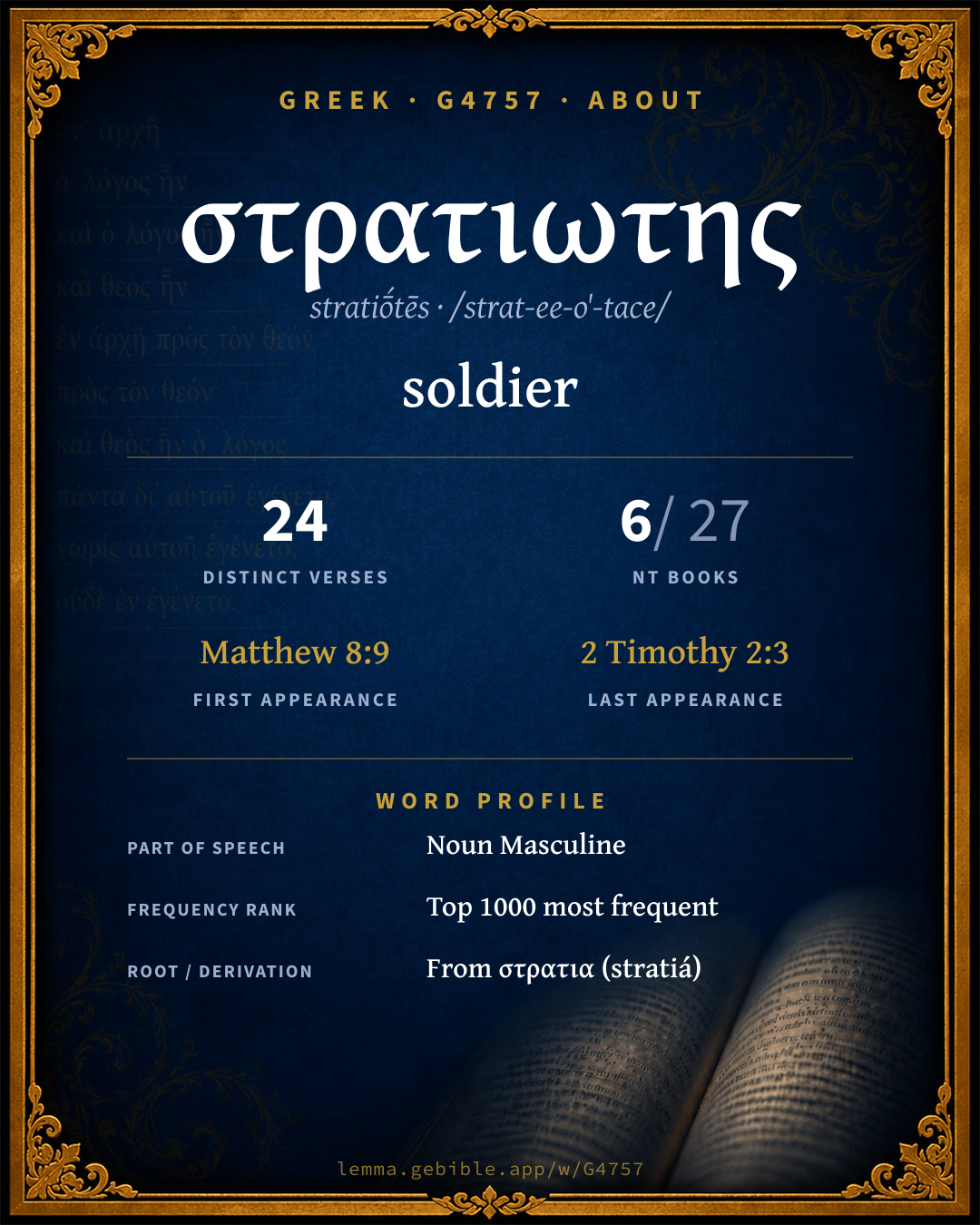
στρατιώτης
soldier
‘soldier’ is one of 2 main senses fuller range ↓
Full lexicon entry — Thayer's Greek Lexicon
From Thayer's Greek Lexicon
Where this word appears
See every Nominative-case word in the Greek New Testament →
Grammar key — what these labels mean
Part of speech
- Noun
- A naming word — a person, place, thing, or idea.
Case
- Nominative
- The case of the subject (and the predicate nominative).
- Accusative
- The case of the direct object and of extent.
- Genitive
- The case of source, possession, or “of” — answers “whose / from what.”
- Dative
- The case of the indirect object, means, or location — “to / for / with / in.”
Gender
- Masculine
- Grammatically masculine.
Number
- Plural
- More than one.
- Singular
- One.
Grammatical forms
- Noun, Nominative, Plural, Masculine 9 times (35%)
- Noun, Accusative, Plural, Masculine 5 times (19%)
- Noun, Genitive, Plural, Masculine 5 times (19%)
- Noun, Dative, Plural, Masculine 3 times (12%)
- Noun, Dative, Singular, Masculine 2 times (8%)
- Noun, Accusative, Singular, Masculine 1 time (4%)
- Noun, Nominative, Singular, Masculine 1 time (4%)
Parsed forms decoded from the imported morphology (Robinson–Tischendorf, public domain), counted across 26 parsed occurrences — not distinct verses.
Every verse where G4757 appears — 24 distinct verses across 6 books. Click any verse to open its interlinear word-by-word view. Verse text shown in the World English Bible for context — . Each verse’s Greek form is shown with its reference; the English is not keyword-highlighted, since the data carries no word-level English alignment. Use “Compare translations” on any verse to read it across multiple English versions. This concordance covers the Greek New Testament; Septuagint (Greek Old Testament) occurrences of this word are not indexed here.
Matthew 3 verses
- Matthew 8:9 στρατιώτας n acc pl masc For I am also a man under authority, having under myself soldiers. I tell this one, 'Go,' and he goes; and tell another, 'Come,' and he comes; and tell my servant, 'Do this,' and he does it."
- Matthew 27:27 στρατιῶται n nom pl masc Then the governor's soldiers took Jesus into the Praetorium, and gathered the whole garrison together against him.
- Matthew 28:12 στρατιώταις n dat pl masc When they were assembled with the elders, and had taken counsel, they gave a large amount of silver to the soldiers,
Mark 1 verse
Luke 2 verses
- Luke 7:8 στρατιώτας n acc pl masc For I also am a man placed under authority, having under myself soldiers. I tell this one, 'Go!' and he goes; and to another, 'Come!' and he comes; and to my servant, 'Do this,' and he does it."
- Luke 23:36 στρατιῶται n nom pl masc The soldiers also mocked him, coming to him and offering him vinegar,
John 5 verses
- John 19:2 στρατιῶται n nom pl masc The soldiers twisted thorns into a crown, and put it on his head, and dressed him in a purple garment.
- John 19:23 στρατιῶται στρατιώτῃ n nom pl masc n dat sg masc Then the soldiers, when they had crucified Jesus, took his garments and made four parts, to every soldier a part; and also the coat. Now the coat was without seam, woven from the top throughout.
- John 19:24 στρατιῶται n nom pl masc Then they said to one another, "Let's not tear it, but cast lots for it to decide whose it will be," that the Scripture might be fulfilled, which says, "They parted my garments among them. For my cloak they cast lots." Therefore the soldiers did these things.
- John 19:32 στρατιῶται n nom pl masc Therefore the soldiers came, and broke the legs of the first, and of the other who was crucified with him;
- John 19:34 στρατιωτῶν n gen pl masc However one of the soldiers pierced his side with a spear, and immediately blood and water came out.
Acts 12 verses
- Acts 10:7 στρατιώτην n acc sg masc When the angel who spoke to him had departed, Cornelius called two of his household servants and a devout soldier of those who waited on him continually.
- Acts 12:4 στρατιωτῶν n gen pl masc When he had arrested him, he put him in prison, and delivered him to four squads of four soldiers each to guard him, intending to bring him out to the people after the Passover.
- Acts 12:6 στρατιωτῶν n gen pl masc The same night when Herod was about to bring him out, Peter was sleeping between two soldiers, bound with two chains. Guards in front of the door kept the prison.
- Acts 12:18 στρατιώταις n dat pl masc Now as soon as it was day, there was no small stir among the soldiers about what had become of Peter.
- Acts 21:32 στρατιώτας στρατιώτας n acc pl masc n acc pl masc Immediately he took soldiers and centurions, and ran down to them. They, when they saw the chief captain and the soldiers, stopped beating Paul.
- Acts 21:35 στρατιωτῶν n gen pl masc When he came to the stairs, it happened that he was carried by the soldiers because of the violence of the crowd;
- Acts 23:23 στρατιώτας n acc pl masc He called to himself two of the centurions, and said, "Prepare two hundred soldiers to go as far as Caesarea, with seventy horsemen, and two hundred men armed with spears, at the third hour of the night."
- Acts 23:31 στρατιῶται n nom pl masc So the soldiers, carrying out their orders, took Paul and brought him by night to Antipatris.
- Acts 27:31 στρατιώταις n dat pl masc Paul said to the centurion and to the soldiers, "Unless these stay in the ship, you can't be saved."
- Acts 27:32 στρατιῶται n nom pl masc Then the soldiers cut away the ropes of the boat, and let it fall off.
- Acts 27:42 στρατιωτῶν n gen pl masc The soldiers' counsel was to kill the prisoners, so that none of them would swim out and escape.
- Acts 28:16 στρατιώτῃ n dat sg masc When we entered into Rome, the centurion delivered the prisoners to the captain of the guard, but Paul was allowed to stay by himself with the soldier who guarded him.
2 Timothy 1 verse
About this entry
At a glance — auto-summarized from this page’s data, not written by a person. Every figure links to its source below. This summary describes the numbers; it doesn’t interpret them.
At its core, στρατιωτης (stratiṓtēs) means “soldier.” The word gravitates to Acts (50%), then John and Matthew. It turns up in 24 verses across 6 books, an uncommon footprint. It first appears in Matthew 8:9. Ranging over 2 senses, it is not a single-sense word. Each statement above links to its evidence; the full detail follows below.
Gloss history
Strong's 1890 vs modern scholarship
About this word
Strong's G4757 catalogs a Greek word from the Greek New Testament.
These counts are not copied from any lexicon or concordance. They are computed here, from the morphology-tagged Greek New Testament. What Lemma adds →
- 24
- distinct verses
- The word appears in 24 distinct verses.
- 6 / 27
- NT books
- The word appears in 6 of 27 New Testament books.
- #513
- by frequency
- Top 1000 most frequent Greek words (rank 513 of 5,347 Greek words by occurrence).
View all 24 occurrences in the concordance →
By section of the New Testament
By traditional corpus
Conventional, traditional groupings — biblical authorship is debated, so this is a traditional corpus grouping, not an authorship claim. Some books belong to more than one corpus (Luke is in both the Gospels and the Lukan corpus, and so on), so these shares overlap and need not total 100%. Each figure is a share of the word’s 24 distinct verses.
- Lukan (Luke–Acts) 14 verses · 58%
- Gospels 11 verses · 46%
- Johannine 5 verses · 21%
- Pauline corpus 1 verse · 4%
How translations render this word
Counts come from each version’s own published word-to-Strong’s tagging or interlinear alignment — an approximate guide to how each version renders this word, not a word-level alignment the data otherwise carries. Because each total is that version’s own tagged count, the per-version totals vary from one another and need not match the appearance or distinct-verse counts above. These counts may also differ from a printed concordance because Lemma counts each distinctly tagged rendering and does not collapse phrase taggings into a single head-word total. This is a fixed set of word-tagged versions (KJV, ASV, BSB, ULT) and does not change with the reading translation you choose elsewhere. Each version’s license is shown beside its name below (and on Sources).
- King James Version: Soldiers 21×, Soldier 4×
- American Standard Version: Soldiers 19×, Soldier 4×
- Berean Standard Bible: Soldiers 22×, Soldier 4×
- unfoldingWord Literal Text: Soldiers 22×, Soldier 4×, A 2×
King James Version Public Domain
Renders G4757 across 26 tagged occurrences — most commonly:
Plus 1 rendering that appears only once — usually multi-word phrases or single function words the recovered tagging swept in, not distinct renderings.
American Standard Version Public Domain
Renders G4757 across 25 tagged occurrences — most commonly:
Plus 2 renderings that appear only once — usually multi-word phrases or single function words the recovered tagging swept in, not distinct renderings.
Berean Standard Bible Public Domain
Renders G4757 across 26 tagged occurrences — most commonly:
unfoldingWord Literal Text CC BY-SA 4.0
Renders G4757 across 29 tagged occurrences — most commonly:
Plus 1 rendering that appears only once — usually multi-word phrases or single function words the recovered tagging swept in, not distinct renderings.
Senses in Thayer's
The 2 senses Thayer's distinguishes for this word, in lexicon order (not ranked by frequency or importance). The full entry — with sub-senses — is in the Lexicon Entry tab.
- a (common) soldier
- metaph. a champion of the cause of Christ
Word origin
Derived from στρατια (stratiá) (G4756) — army.
From a presumed derivative of the same as G4756 ; a camperout that is a (common) warrior (literally or figuratively): - soldier.
— Strong’s Exhaustive Concordance (1890), public domain.
Forms in the corpus
The 7 distinct written forms G4757 takes in the Greek New Testament, most frequent first — each parse links to that case’s occurrences in the concordance.
| Form | Parsing | Example | Uses |
|---|---|---|---|
| στρατιῶται stratiō̂tai | Noun, Nominative, Plural, Masculine | Matthew 27:27 | 9 |
| στρατιωτῶν stratiōtō̂n | Noun, Genitive, Plural, Masculine | John 19:34 | 5 |
| στρατιώτας stratiṓtas | Noun, Accusative, Plural, Masculine | Matthew 8:9 | 5 |
| στρατιώταις stratiṓtais | Noun, Dative, Plural, Masculine | Matthew 28:12 | 3 |
| στρατιώτῃ stratiṓtē | Noun, Dative, Singular, Masculine | John 19:23 | 2 |
| στρατιώτην stratiṓtēn | Noun, Accusative, Singular, Masculine | Acts 10:7 | 1 |
| στρατιώτης stratiṓtēs | Noun, Nominative, Singular, Masculine | 2 Timothy 2:3 | 1 |
Same root — word family
Other Thayer's entries built from the same root as G4757, grouped by Strong’s listed origin. These share a root / origin per the lexicon — not necessarily a shared meaning. Each links to that word’s own entry.
Derives from
Shares the same root
- στρατευομαι strateúomai G4754 to serve as soldier
- στρατηγος stratēgós G4755 commander
- στρατολογεω stratologéō G4758 to gather army
- στρατοπεδον stratópedon G4760 military camp
Compare all same-root words → Showing 4 of 6 — not the complete family. They share a root, not necessarily a meaning.