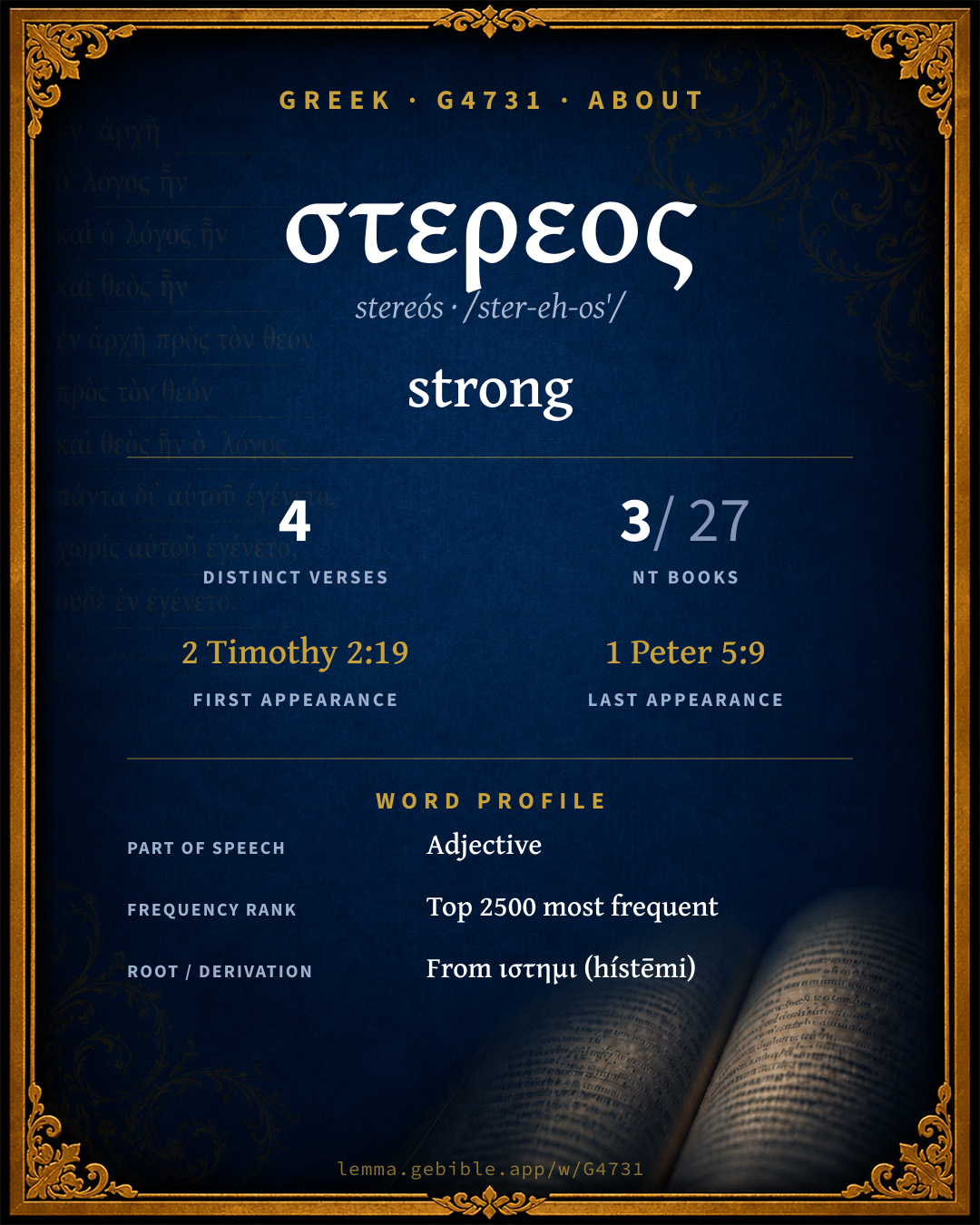
στερεός
strong
Full lexicon entry — Thayer's Greek Lexicon
From Thayer's Greek Lexicon
Where this word appears
See every Genitive-case word in the Greek New Testament →
Grammar key — what these labels mean
Part of speech
- Adjective
- A word that describes or qualifies a noun.
Case
- Genitive
- The case of source, possession, or “of” — answers “whose / from what.”
- Nominative
- The case of the subject (and the predicate nominative).
Gender
- Feminine
- Grammatically feminine.
- Masculine
- Grammatically masculine.
Number
- Singular
- One.
- Plural
- More than one.
1 verse where G4731 appears in the Nominative case in the Book of Hebrews. Filtered view — show all forms. Click any verse to open its interlinear word-by-word view. Verse text shown in the World English Bible for context — . Each verse’s Greek form is shown with its reference; the English is not keyword-highlighted, since the data carries no word-level English alignment. Use “Compare translations” on any verse to read it across multiple English versions. This concordance covers the Greek New Testament; Septuagint (Greek Old Testament) occurrences of this word are not indexed here.
Hebrews
About this entry
At a glance — auto-summarized from this page’s data, not written by a person. Every figure links to its source below. This summary describes the numbers; it doesn’t interpret them.
“strong” is the headline sense of the Greek adjective στερεος (stereós). It is rare — just 4 verses in the entire Greek New Testament. More than half of its appearances fall in Hebrews. First canonically at 2 Timothy 2:19, it enters the text early. Related forms include ιστημι, σθενοω and σταδιον. The sections below give every sense, occurrence, and version rendering.
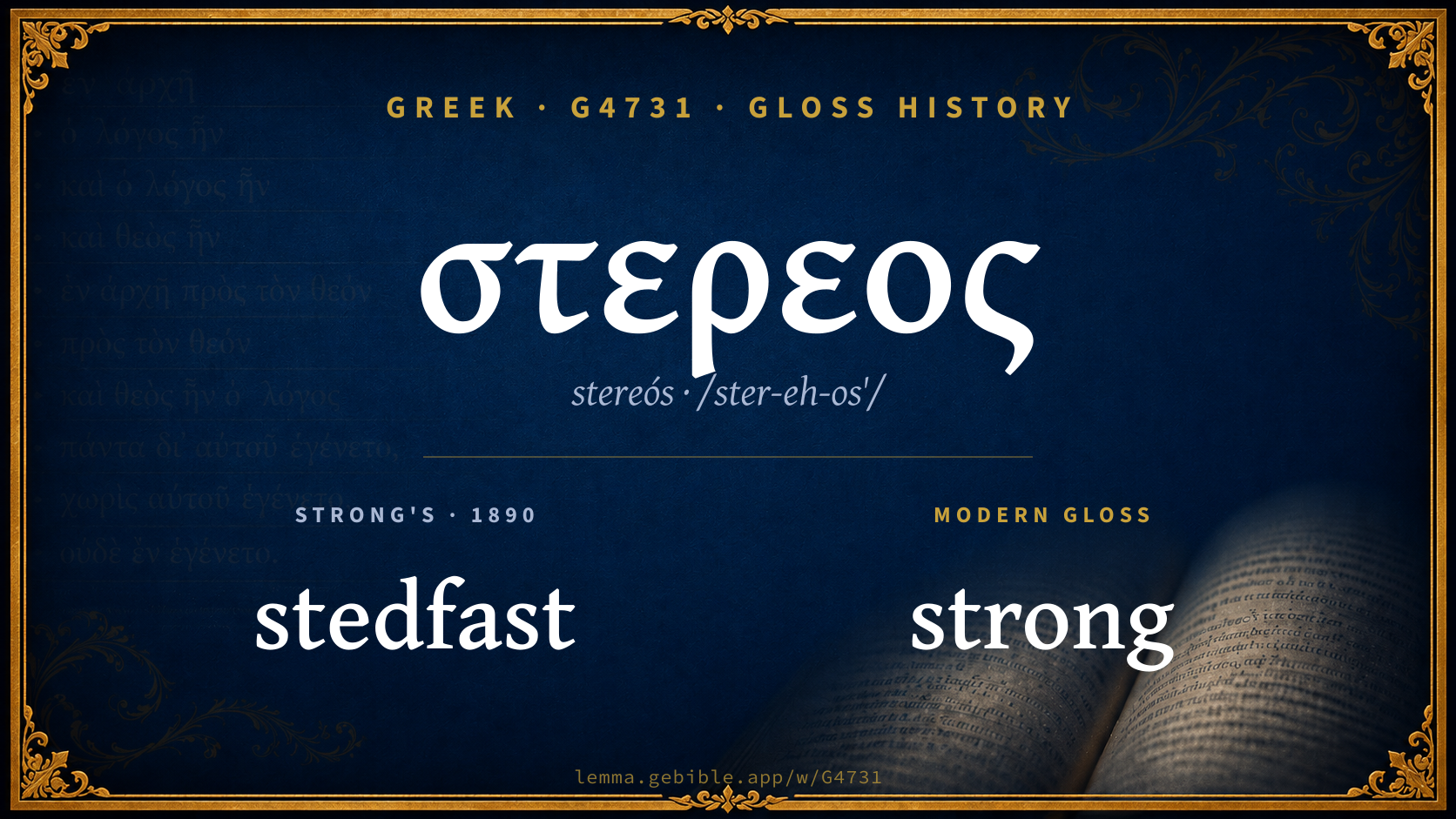
Gloss history
Strong's 1890 vs modern scholarship
About this word
Strong's G4731 catalogs a Greek word from the Greek New Testament.
These counts are not copied from any lexicon or concordance. They are computed here, from the morphology-tagged Greek New Testament. What Lemma adds →
- 4
- distinct verses
- The word appears in 4 distinct verses.
- 3 / 27
- NT books
- The word appears in 3 of 27 New Testament books.
- #1,877
- by frequency
- Top 2500 most frequent Greek words (rank 1,877 of 5,347 Greek words by occurrence).
View all 4 occurrences in the concordance →
By section of the New Testament
By traditional corpus
Conventional, traditional groupings — biblical authorship is debated, so this is a traditional corpus grouping, not an authorship claim. Some books belong to more than one corpus (Luke is in both the Gospels and the Lukan corpus, and so on), so these shares overlap and need not total 100%. Each figure is a share of the word’s 4 distinct verses.
- Hebrews 2 verses · 50%
- Pauline corpus 1 verse · 25%
- General (Catholic) Epistles 1 verse · 25%
How translations render this word
Counts come from each version’s own published word-to-Strong’s tagging or interlinear alignment — an approximate guide to how each version renders this word, not a word-level alignment the data otherwise carries. Because each total is that version’s own tagged count, the per-version totals vary from one another and need not match the appearance or distinct-verse counts above. These counts may also differ from a printed concordance because Lemma counts each distinctly tagged rendering and does not collapse phrase taggings into a single head-word total. This is a fixed set of word-tagged versions (KJV, ASV, BSB, ULT) and does not change with the reading translation you choose elsewhere. Each version’s license is shown beside its name below (and on Sources).
- King James Version: Strong 2×
- American Standard Version: Solid 2×
- Berean Standard Bible: Firm 2×, Solid 2×
- unfoldingWord Literal Text: Firm 2×, Solid 2×
King James Version Public Domain
Renders G4731 across 4 tagged occurrences — most commonly:
Plus 2 renderings that appear only once — usually multi-word phrases or single function words the recovered tagging swept in, not distinct renderings.
American Standard Version Public Domain
Renders G4731 across 4 tagged occurrences — most commonly:
Plus 2 renderings that appear only once — usually multi-word phrases or single function words the recovered tagging swept in, not distinct renderings.
Berean Standard Bible Public Domain
Renders G4731 across 4 tagged occurrences — most commonly:
unfoldingWord Literal Text CC BY-SA 4.0
Renders G4731 across 4 tagged occurrences — most commonly:
Senses in Thayer's
The 1 sense Thayer's distinguishes for this word, in lexicon order (not ranked by frequency or importance). The full entry — with sub-senses — is in the Lexicon Entry tab.
- strong, firm, immovable, solid, hard, rigid
Word origin
Derived from ιστημι (hístēmi) (G2476) — to stand.
From G2476 ; stiff that is solid stable (literally or figuratively): - stedfast strong sure.
— Strong’s Exhaustive Concordance (1890), public domain.
Forms in the corpus
The 4 distinct written forms G4731 takes in the Greek New Testament, most frequent first — each parse links to that case’s occurrences in the concordance.
| Form | Parsing | Example | Uses |
|---|---|---|---|
| στερεοὶ stereoì | Adjective, Nominative, Plural, Masculine | 1 Peter 5:9 | 1 |
| στερεὰ stereà | Adjective, Nominative, Singular, Feminine | Hebrews 5:14 | 1 |
| στερεὸς stereòs | Adjective, Nominative, Singular, Masculine | 2 Timothy 2:19 | 1 |
| στερεᾶς stereâs | Adjective, Genitive, Singular, Feminine | Hebrews 5:12 | 1 |
Same root — word family
Other Thayer's entries built from the same root as G4731, grouped by Strong’s listed origin. These share a root / origin per the lexicon — not necessarily a shared meaning. Each links to that word’s own entry.
Derives from
Shares the same root
- σθενοω sthenóō G4599 to strengthen
- σταδιον stádion G4712 furlong
- σταμνος stámnos G4713 jar
- στασις stásis G4714 insurrection
- σταυρος staurós G4716 cross
- σταχυς stáchys G4719 ear of grain
- στελλω stéllō G4724 to set
- στενος stenós G4728 narrow
- στηθος stēthos G4738 breast
- στηκω stḗkō G4739 to stand firm
- στηριζω stērízō G4741 to establish
- στοα stoá G4745 portico
- στυλος stŷlos G4769 pillar
Derived from this word
- στειρος steíros G4723 hard
- στερεοω stereóō G4732 to strengthen
- στρηνος strēnos G4764 excess strength
- στρωννυμι strṓnnymi G4766 to spread
Compare all same-root words → Showing 4 of 19 — not the complete family. They share a root, not necessarily a meaning.
Septuagint usage
The same Greek word στερεος appears 15 times in the Greek Old Testament (Septuagint), across 14 verses in 7 books.
- 15
- LXX occurrences
- Tagged occurrences of this Greek word in the Septuagint.
- 14
- verses
- Distinct Septuagint verses containing this word.
- 7 / 39
- OT books
- The word appears in 7 of the 39 Old Testament books.
Sample Septuagint occurrences
- Exodus 38:13 στερεός
- Numbers 8:4 στερεός
- Deuteronomy 32:13 στερεός
- 1 Samuel 4:8 στερεός
- Psalms 34:10 στερεός
- Isaiah 2:21 στερεός
- Jeremiah 15:18 στερεός
Septuagint occurrences (same lexeme)
Every verse where the same Strong’s number (G4731) appears in the Greek Septuagint. Verse text shown in the World English Bible for context; the Greek form is the matched word — the English is not keyword-highlighted.
- Exodus 38:13 στερεός For the east side eastward fifty cubits.
- Exodus 38:16 στερεός All the hangings around the court were of fine twined linen.
- Numbers 8:4 στερεός This was the workmanship of the lampstand, beaten work of gold. From its base to its flowers, it was beaten work: according to the pattern which Yahweh had shown Moses, so he made the lampstand.
- Deuteronomy 32:13 στερεός He made him ride on the high places of the earth, He ate the increase of the field; He made him to suck honey out of the rock, Oil out of the flinty rock;
- 1 Samuel 4:8 στερεός Woe to us! who shall deliver us out of the hand of these mighty gods? these are the gods that struck the Egyptians with all manner of plagues in the wilderness.
- Psalms 34:10 στερεός The young lions do lack, and suffer hunger, But those who seek Yahweh shall not lack any good thing.
- Isaiah 2:21 στερεός To go into the caverns of the rocks, And into the clefts of the ragged rocks, From before the terror of Yahweh, And from the glory of his majesty, When he arises to shake the earth mightily.
- Isaiah 5:28 στερεός Whose arrows are sharp, And all their bows bent. Their horses' hoofs will be like flint, And their wheels like a whirlwind.
- Isaiah 17:5 στερεός It shall be as when the harvester gathers the standing grain, and his arm reaps the ears; yes, it shall be as when one gleans ears in the valley of Rephaim.
- Isaiah 50:7 στερεός For the Lord Yahweh will help me; therefore I have not been confounded: therefore have I set my face like a flint, and I know that I shall not be disappointed.
- Isaiah 51:1 στερεός Listen to me, you who follow after righteousness, you who seek Yahweh: look to the rock whence you were hewn, and to the hold of the pit whence you were dug.
- Jeremiah 15:18 στερεός Why is my pain perpetual, and my wound incurable, which refuses to be healed? will you indeed be to me as a deceitful [brook], as waters that fail?
- Jeremiah 37:14 στερεός Then said Jeremiah, It is false; I am not falling away to the Chaldeans. But he didn't listen to him; so Irijah laid hold on Jeremiah, and brought him to the princes.
- Jeremiah 38:11 στερεός So Ebedmelech took the men with him, and went into the house of the king under the treasury, and took there rags and worn-out garments, and let them down by cords into the dungeon to Jeremiah.
These are occurrences of the same Greek lexeme (G4731) in the Septuagint — not a translation of any one Hebrew word. The store carries no word-level Hebrew↔Greek alignment, so no Hebrew original is asserted here. Counts come from the recovered LXX Strong's tagging — high-frequency vocabulary is well covered, while rare or late forms may be untagged — so they reflect tagged occurrences and may slightly undercount.