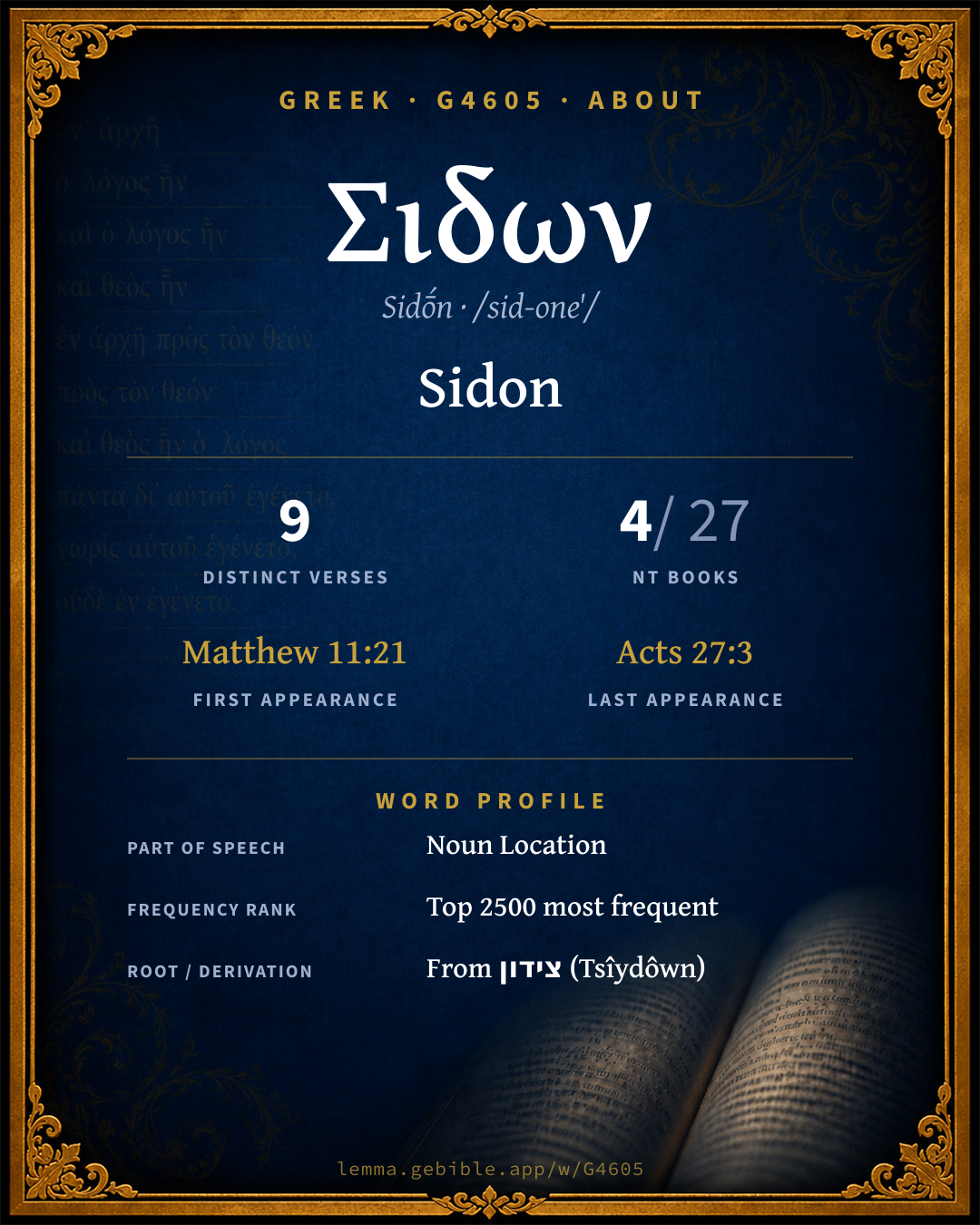
Σιδών
Sidon
Thayer's lists 2 entries for ‘Sidon’ fuller range ↓
Full lexicon entry — Thayer's Greek Lexicon
From Thayer's Greek Lexicon
Where this word appears
See every Dative-case word in the Greek New Testament →
Grammar key — what these labels mean
Part of speech
- Noun
- A naming word — a person, place, thing, or idea.
Case
- Dative
- The case of the indirect object, means, or location — “to / for / with / in.”
- Genitive
- The case of source, possession, or “of” — answers “whose / from what.”
- Accusative
- The case of the direct object and of extent.
Gender
- Feminine
- Grammatically feminine.
Number
- Singular
- One.
1 verse where G4605 appears in the Genitive case in the Book of Matthew. Filtered view — show all forms. Click any verse to open its interlinear word-by-word view. Verse text shown in the World English Bible for context — . Each verse’s Greek form is shown with its reference; the English is not keyword-highlighted, since the data carries no word-level English alignment. Use “Compare translations” on any verse to read it across multiple English versions. This concordance covers the Greek New Testament; Septuagint (Greek Old Testament) occurrences of this word are not indexed here.
Matthew
About this entry
At a glance — auto-summarized from this page’s data, not written by a person. Every figure links to its source below. This summary describes the numbers; it doesn’t interpret them.
The Greek name Σιδων centers on the idea of “Sidon.” First canonically at Matthew 11:21, it enters the text early. The Greek New Testament uses it across 9 verses — uncommon. Matthew dominates its distribution — 3 of 9 verses. Dig into 9-verse concordance and the renderings breakdown below.
Gloss history
Strong's 1890 vs modern scholarship
About this word
Strong's G4605 catalogs a Greek word from the Greek New Testament.
These counts are not copied from any lexicon or concordance. They are computed here, from the morphology-tagged Greek New Testament. What Lemma adds →
- 9
- distinct verses
- The word appears in 9 distinct verses.
- 4 / 27
- NT books
- The word appears in 4 of 27 New Testament books.
- #1,140
- by frequency
- Top 2500 most frequent Greek words (rank 1,140 of 5,347 Greek words by occurrence).
View all 9 occurrences in the concordance →
By section of the New Testament
By traditional corpus
Conventional, traditional groupings — biblical authorship is debated, so this is a traditional corpus grouping, not an authorship claim. Some books belong to more than one corpus (Luke is in both the Gospels and the Lukan corpus, and so on), so these shares overlap and need not total 100%. Each figure is a share of the word’s 9 distinct verses.
- Gospels 8 verses · 89%
- Lukan (Luke–Acts) 4 verses · 44%
How translations render this word
Counts come from each version’s own published word-to-Strong’s tagging or interlinear alignment — an approximate guide to how each version renders this word, not a word-level alignment the data otherwise carries. Because each total is that version’s own tagged count, the per-version totals vary from one another and need not match the appearance or distinct-verse counts above. These counts may also differ from a printed concordance because Lemma counts each distinctly tagged rendering and does not collapse phrase taggings into a single head-word total. This is a fixed set of word-tagged versions (KJV, ASV, BSB, ULT) and does not change with the reading translation you choose elsewhere. Each version’s license is shown beside its name below (and on Sources).
- King James Version: Sidon 10×
- American Standard Version: Sidon 9×
- Berean Standard Bible: Sidon 9×
- unfoldingWord Literal Text: Sidon 10×
King James Version Public Domain
Renders G4605 across 11 tagged occurrences — most commonly:
Plus 1 rendering that appears only once — usually multi-word phrases or single function words the recovered tagging swept in, not distinct renderings.
American Standard Version Public Domain
Renders G4605 across 11 tagged occurrences — most commonly:
Plus 2 renderings that appear only once — usually multi-word phrases or single function words the recovered tagging swept in, not distinct renderings.
Berean Standard Bible Public Domain
Renders G4605 across 9 tagged occurrences — most commonly:
unfoldingWord Literal Text CC BY-SA 4.0
Renders G4605 across 10 tagged occurrences — most commonly:
Senses in Thayer's
The 2 senses Thayer's distinguishes for this word, in lexicon order (not ranked by frequency or importance). The full entry — with sub-senses — is in the Lexicon Entry tab.
- Sidon or Zidon = "hunting"
- an ancient and wealthy city of Phoenicia…
Word origin
Derived from צידון (Tsîydôwn) (H6721) — Sidon.
Of hebrew origin [ H6721 ]; Sidon (that is Tsidon ) a place in Palestine : - Sidon.
— Strong’s Exhaustive Concordance (1890), public domain.
Forms in the corpus
The 3 distinct written forms G4605 takes in the Greek New Testament, most frequent first — each parse links to that case’s occurrences in the concordance.
| Form | Parsing | Example | Uses |
|---|---|---|---|
| Σιδῶνι Sidō̂ni | Noun, Dative, Singular, Feminine | Matthew 11:21 | 4 |
| Σιδῶνος Sidō̂nos | Noun, Genitive, Singular, Feminine | Matthew 15:21 | 3 |
| Σιδῶνα Sidō̂na | Noun, Accusative, Singular, Feminine | Mark 3:8 | 2 |
Same root — word family
Other Thayer's entries built from the same root as G4605, grouped by Strong’s listed origin. These share a root / origin per the lexicon — not necessarily a shared meaning. Each links to that word’s own entry.
Derives from
Proper names from this root
People and places named from this root — a name, not an additional meaning of the word.
Compare all same-root words → 3 of the same-root words are proper names (people or places). They share a root, not necessarily a meaning.
Bible dictionary
Public-domain dictionary articles matched to this entry by name (Sidon). A biblical name can be shared by more than one person or place, so an article may treat several.
Easton's Bible Dictionary · M. G. Easton, 1897
Fishing; fishery, Gen. 10:15, 19 (A.V. marg., Tzidon; R.V., Zidon); Matt. 11:21, 22; Luke 6:17. (See ZIDON.)
Smith's Bible Dictionary · William Smith, 1863
the Greek form of the Phoenician name Zidon. [Zidon, Or Sidon]
Hitchcock's Bible Names Dictionary · Roswell D. Hitchcock, 1869
hunting; fishing; venison
Classic public-domain reference works; full attribution on Sources.
Septuagint usage
The same Greek word Σιδων appears 19 times in the Greek Old Testament (Septuagint), across 19 verses in 9 books.
- 19
- LXX occurrences
- Tagged occurrences of this Greek word in the Septuagint.
- 19
- verses
- Distinct Septuagint verses containing this word.
- 9 / 39
- OT books
- The word appears in 9 of the 39 Old Testament books.
Sample Septuagint occurrences
- Genesis 10:15 σιδῶν
- Joshua 11:2 σιδών
- Judges 1:31 σιδών
- 2 Samuel 24:6 σιδών
- Isaiah 23:4 σιδών
- Jeremiah 29:4 σιδών
- Ezekiel 27:8 σιδών
- Joel 4:4 σιδών
- Zechariah 9:2 σιδών
Septuagint occurrences (same lexeme)
Every verse where the same Strong’s number (G4605) appears in the Greek Septuagint. Verse text shown in the World English Bible for context; the Greek form is the matched word — the English is not keyword-highlighted.
- Genesis 10:15 σιδῶν Canaan became the father of Sidon (his firstborn), Heth,
- Genesis 10:19 σιδῶν The border of the Canaanites was from Sidon, as you go toward Gerar, to Gaza; as you go toward Sodom, Gomorrah, Admah, and Zeboiim, to Lasha.
- Genesis 49:13 σιδῶν "Zebulun will dwell at the haven of the sea. He will be for a haven of ships. His border will be on Sidon.
- Joshua 11:2 σιδών and to the kings who were on the north, in the hill-country, and in the Arabah south of Chinneroth, and in the lowland, and in the heights of Dor on the west,
- Joshua 11:8 σιδών Yahweh delivered them into the hand of Israel, and they struck them, and chased them to great Sidon, and to Misrephoth Maim, and to the valley of Mizpeh eastward; and they struck them, until they left them none remaining.
- Joshua 19:28 σιδών and Ebron, and Rehob, and Hammon, and Kanah, even to great Sidon;
- Judges 1:31 σιδών Asher didn't drive out the inhabitants of Acco, nor the inhabitants of Sidon, nor of Ahlab, nor of Achzib, nor of Helbah, nor of Aphik, nor of Rehob;
- Judges 10:6 σιδών The children of Israel again did that which was evil in the sight of Yahweh, and served the Baals, and the Ashtaroth, and the gods of Syria, and the gods of Sidon, and the gods of Moab, and the gods of the children of Ammon, and the gods of the Philistines; and they forsook Yahweh, and didn't serve him.
- 2 Samuel 24:6 σιδών then they came to Gilead, and to the land of Tahtim Hodshi; and they came to Dan Jaan, and round about to Sidon,
- Isaiah 23:4 σιδών Be ashamed, Sidon; for the sea has spoken, the stronghold of the sea, saying, I have not travailed, nor brought forth, neither have I nourished young men, nor brought up virgins.
- Isaiah 23:12 σιδών He said, You shall no more rejoice, you oppressed virgin daughter of Sidon: arise, pass over to Kittim; even there shall you have no rest.
- Jeremiah 29:4 σιδών Thus says Yahweh of Hosts, the God of Israel, to all the captivity, whom I have caused to be carried away captive from Jerusalem to Babylon:
- Jeremiah 32:9 σιδών I bought the field that was in Anathoth of Hanamel my uncle's son, and weighed him the money, even seventeen shekels of silver.
- Jeremiah 34:3 σιδών and you shall not escape out of his hand, but shall surely be taken, and delivered into his hand; and your eyes shall see the eyes of the king of Babylon, and he shall speak with you mouth to mouth, and you shall go to Babylon.
- Ezekiel 27:8 σιδών The inhabitants of Sidon and Arvad were your rowers: your wise men, Tyre, were in you, they were your pilots.
- Ezekiel 28:21 σιδών Son of man, set your face toward Sidon, and prophesy against it,
- Ezekiel 28:22 σιδών and say, Thus says the Lord Yahweh: Behold, I am against you, Sidon; and I will be glorified in the midst of you; and they shall know that I am Yahweh, when I shall have executed judgments in her, and shall be sanctified in her.
- Joel 4:4 σιδών
- Zechariah 9:2 σιδών And Hamath, also, which borders on it; Tyre and Sidon, because they are very wise.
These are occurrences of the same Greek lexeme (G4605) in the Septuagint — not a translation of any one Hebrew word. The store carries no word-level Hebrew↔Greek alignment, so no Hebrew original is asserted here. Counts come from the recovered LXX Strong's tagging — high-frequency vocabulary is well covered, while rare or late forms may be untagged — so they reflect tagged occurrences and may slightly undercount.