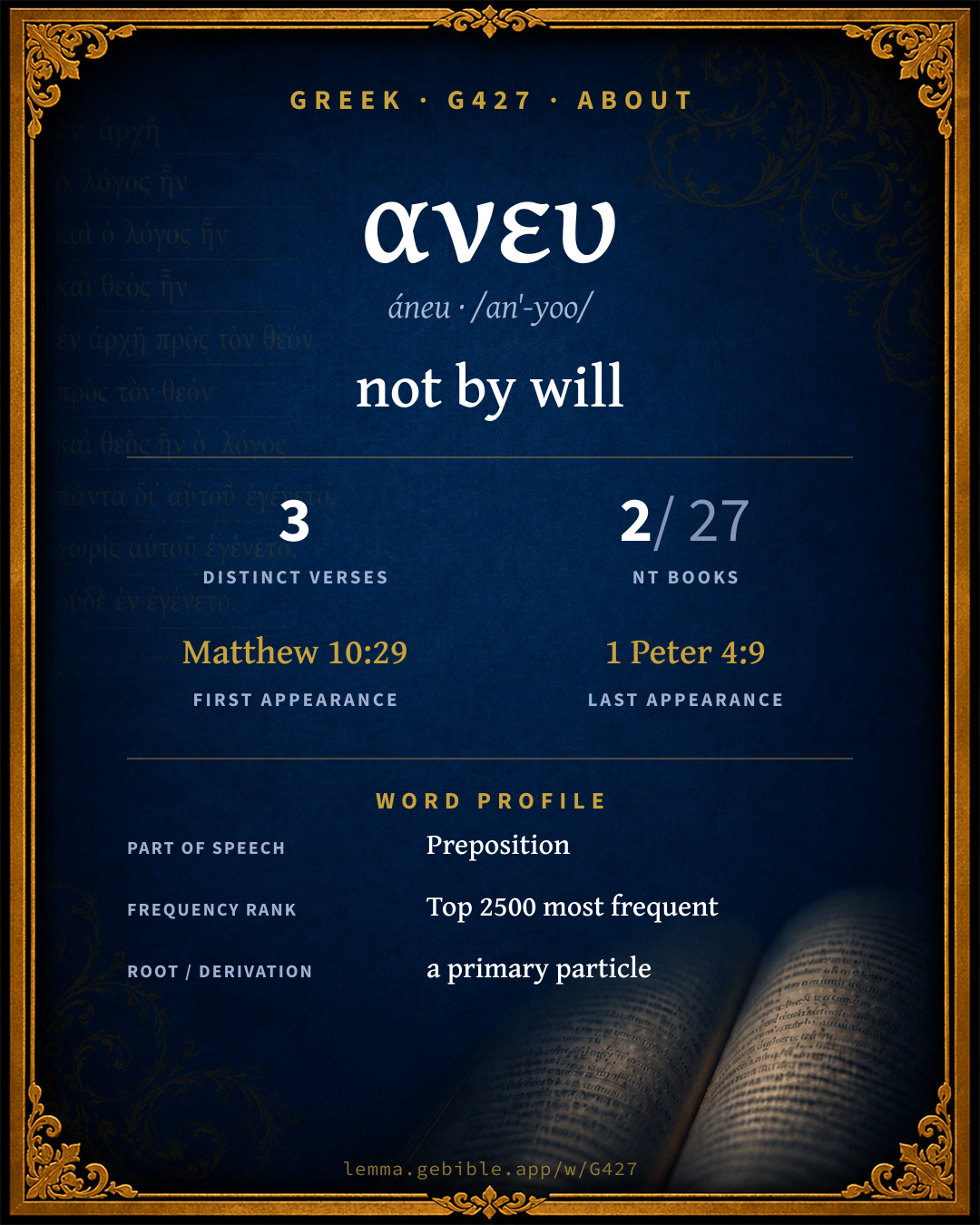
ἄνευ
not by will
Full lexicon entry — Thayer's Greek Lexicon
From Thayer's Greek Lexicon
Where this word appears
Grammar key — what these labels mean
Part of speech
- Preposition
- A relational word governing a noun in a particular case.
Every verse where G427 appears in the Book of Matthew — 1 distinct verse. Click any verse to open its interlinear word-by-word view. Verse text shown in the World English Bible for context — . Each verse’s Greek form is shown with its reference; the English is not keyword-highlighted, since the data carries no word-level English alignment. Use “Compare translations” on any verse to read it across multiple English versions. This concordance covers the Greek New Testament; Septuagint (Greek Old Testament) occurrences of this word are not indexed here.
Matthew
About this entry
At a glance — auto-summarized from this page’s data, not written by a person. Every figure links to its source below. This summary describes the numbers; it doesn’t interpret them.
The Greek preposition ανευ centers on the idea of “not by will.” A scarce word — 3 verses in all of the Greek New Testament. The word gravitates to 1 Peter (67%), then Matthew. Its earliest occurrence is Matthew 10:29. It shares a root with ατερ. For the data behind this summary, explore the sense tree and the renderings breakdown below.
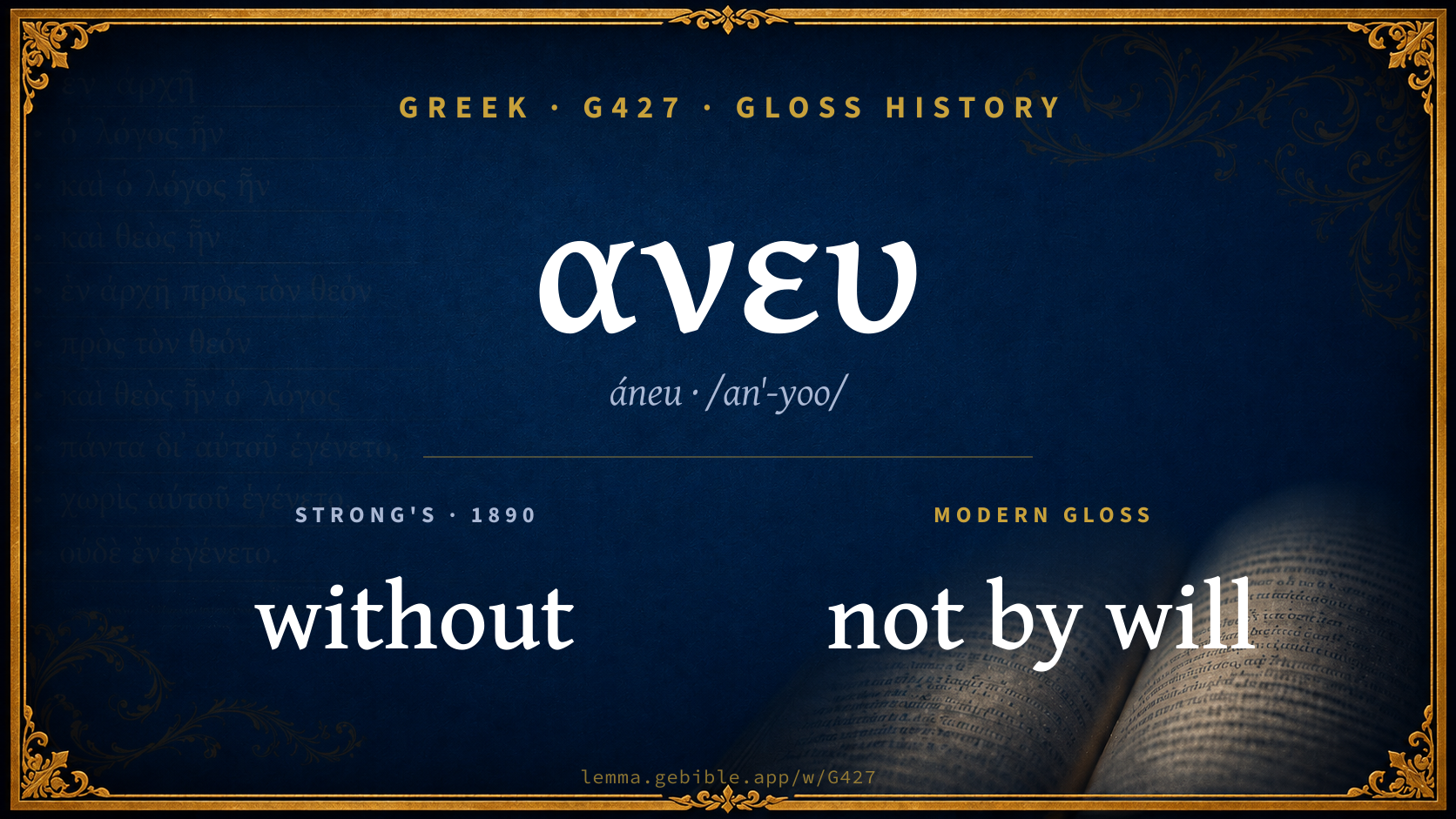
Gloss history
Strong's 1890 vs modern scholarship
About this word
Strong's G427 catalogs a Greek word from the Greek New Testament.
These counts are not copied from any lexicon or concordance. They are computed here, from the morphology-tagged Greek New Testament. What Lemma adds →
- 3
- distinct verses
- The word appears in 3 distinct verses.
- 2 / 27
- NT books
- The word appears in 2 of 27 New Testament books.
- #2,203
- by frequency
- Top 2500 most frequent Greek words (rank 2,203 of 5,347 Greek words by occurrence).
View all 3 occurrences in the concordance →
By traditional corpus
Conventional, traditional groupings — biblical authorship is debated, so this is a traditional corpus grouping, not an authorship claim. Some books belong to more than one corpus (Luke is in both the Gospels and the Lukan corpus, and so on), so these shares overlap and need not total 100%. Each figure is a share of the word’s 3 distinct verses.
- General (Catholic) Epistles 2 verses · 67%
- Gospels 1 verse · 33%
How translations render this word
Counts come from each version’s own published word-to-Strong’s tagging or interlinear alignment — an approximate guide to how each version renders this word, not a word-level alignment the data otherwise carries. Because each total is that version’s own tagged count, the per-version totals vary from one another and need not match the appearance or distinct-verse counts above. These counts may also differ from a printed concordance because Lemma counts each distinctly tagged rendering and does not collapse phrase taggings into a single head-word total. This is a fixed set of word-tagged versions (KJV, ASV, BSB, ULT) and does not change with the reading translation you choose elsewhere. Each version’s license is shown beside its name below (and on Sources).
- King James Version: Without 3×
- American Standard Version: Without 3×
- Berean Standard Bible: Without 2×
- unfoldingWord Literal Text: Without 2×
King James Version Public Domain
Renders G427 across 3 tagged occurrences — most commonly:
American Standard Version Public Domain
Renders G427 across 3 tagged occurrences — most commonly:
Berean Standard Bible Public Domain
Renders G427 across 3 tagged occurrences — most commonly:
Plus 1 rendering that appears only once — usually multi-word phrases or single function words the recovered tagging swept in, not distinct renderings.
unfoldingWord Literal Text CC BY-SA 4.0
Renders G427 across 3 tagged occurrences — most commonly:
Plus 1 rendering that appears only once — usually multi-word phrases or single function words the recovered tagging swept in, not distinct renderings.
Senses in Thayer's
The 1 sense Thayer's distinguishes for this word, in lexicon order (not ranked by frequency or importance). The full entry — with sub-senses — is in the Lexicon Entry tab.
- without one's will or intervention
Word origin
Origin: a primary particle
A primary particle; without : - without. Compare G1 .
— Strong’s Exhaustive Concordance (1890), public domain.
Same root — word family
Other Thayer's entries built from the same root as G427, grouped by Strong’s listed origin. These share a root / origin per the lexicon — not necessarily a shared meaning. Each links to that word’s own entry.
Derived from this word
Compare all same-root words → They share a root, not necessarily a meaning.
Septuagint usage
The same Greek word ανευ appears 27 times in the Greek Old Testament (Septuagint), across 24 verses in 10 books.
- 27
- LXX occurrences
- Tagged occurrences of this Greek word in the Septuagint.
- 24
- verses
- Distinct Septuagint verses containing this word.
- 10 / 39
- OT books
- The word appears in 10 of the 39 Old Testament books.
Sample Septuagint occurrences
- Genesis 41:16 ἄνευ
- Exodus 21:11 ἄνευ
- 1 Samuel 6:7 ἄνευ
- 2 Kings 18:25 ἄνευ
- Job 6:6 ἄνευ
- Psalms 9:27 ἄνευ
- Isaiah 10:15 ἄνευ
- Jeremiah 51:19 ἄνευ
- Daniel 2:34 ἄνευ
- Amos 3:5 ἄνευ
Septuagint occurrences (same lexeme)
Every verse where the same Strong’s number (G427) appears in the Greek Septuagint. Verse text shown in the World English Bible for context; the Greek form is the matched word — the English is not keyword-highlighted.
- Genesis 41:16 ἄνευ Joseph answered Pharaoh, saying, "It isn't in me. God will give Pharaoh an answer of peace."
- Genesis 41:44 ἄνευ Pharaoh said to Joseph, "I am Pharaoh, and without you shall no man lift up his hand or his foot in all the land of Egypt."
- Exodus 21:11 ἄνευ If he doesn't do these three things for her, she may go free without paying any money.
- 1 Samuel 6:7 ἄνευ Now therefore take and prepare yourselves a new cart, and two milk cattle, on which there has come no yoke; and tie the cattle to the cart, and bring their calves home from them;
- 2 Kings 18:25 ἄνευ Am I now come up without Yahweh against this place to destroy it? Yahweh said to me, Go up against this land, and destroy it.
- Job 6:6 ἄνευ Can that which has no flavor be eaten without salt? Or is there any taste in the white of an egg?
- Job 8:11 ἄνευ "Can the papyrus grow up without mire? Can the rushes grow without water?
- Job 24:7 ἄνευ They lie all night naked without clothing, And have no covering in the cold.
- Job 30:28 ἄνευ I go mourning without the sun. I stand up in the assembly, and cry for help.
- Job 31:39 ἄνευ If I have eaten the fruits of it without money, Or have caused the owners of it to lose their life:
- Job 34:6 ἄνευ Notwithstanding my right I am considered a liar; My wound is incurable, though I am without disobedience.'
- Job 34:32 ἄνευ Teach me that which I don't see. If I have done iniquity, I will do it no more'?
- Job 39:16 ἄνευ She deals harshly with her young ones, as if they were not hers. Though her labor is in vain, she is without fear,
- Psalms 9:27 ἄνευ
- Psalms 43:13 ἄνευ
- Psalms 58:5 ἄνευ Which doesn't listen to the voice of charmers, No matter how skillful the charmer may be.
- Isaiah 10:15 ἄνευ Shall the axe boast itself against him who hews therewith? Shall the saw magnify itself against him who wields it? as if a rod should wield those who lift it up, [or] as if a staff should lift up [him who is] not wood.
- Isaiah 28:1 ἄνευ Woe to the crown of pride of the drunkards of Ephraim, and to the fading flower of his glorious beauty, which is on the head of the fat valley of those who are overcome with wine!
- Isaiah 36:10 ἄνευ Am I now come up without Yahweh against this land to destroy it? Yahweh said to me, Go up against this land, and destroy it.
- Isaiah 55:1 ἄνευ Ho, everyone who thirsts, come you to the waters, and he who has no money; come you, buy, and eat; yes, come, buy wine and milk without money and without price.
- Jeremiah 51:19 ἄνευ The portion of Jacob is not like these; for he is the former of all things; and [Israel] is the tribe of his inheritance: Yahweh of Hosts is his name.
- Daniel 2:34 ἄνευ You saw until a stone was cut out without hands, which struck the image on its feet that were of iron and clay, and broke them in pieces.
- Daniel 2:45 ἄνευ Because you saw that a stone was cut out of the mountain without hands, and that it broke in pieces the iron, the brass, the clay, the silver, and the gold; the great God has made known to the king what shall happen hereafter: and the dream is certain, and the interpretation of it sure.
- Amos 3:5 ἄνευ Can a bird fall in a trap on the earth, Where no snare is set for him? Does a snare spring up from the ground, When there is nothing to catch?
These are occurrences of the same Greek lexeme (G427) in the Septuagint — not a translation of any one Hebrew word. The store carries no word-level Hebrew↔Greek alignment, so no Hebrew original is asserted here. Counts come from the recovered LXX Strong's tagging — high-frequency vocabulary is well covered, while rare or late forms may be untagged — so they reflect tagged occurrences and may slightly undercount.