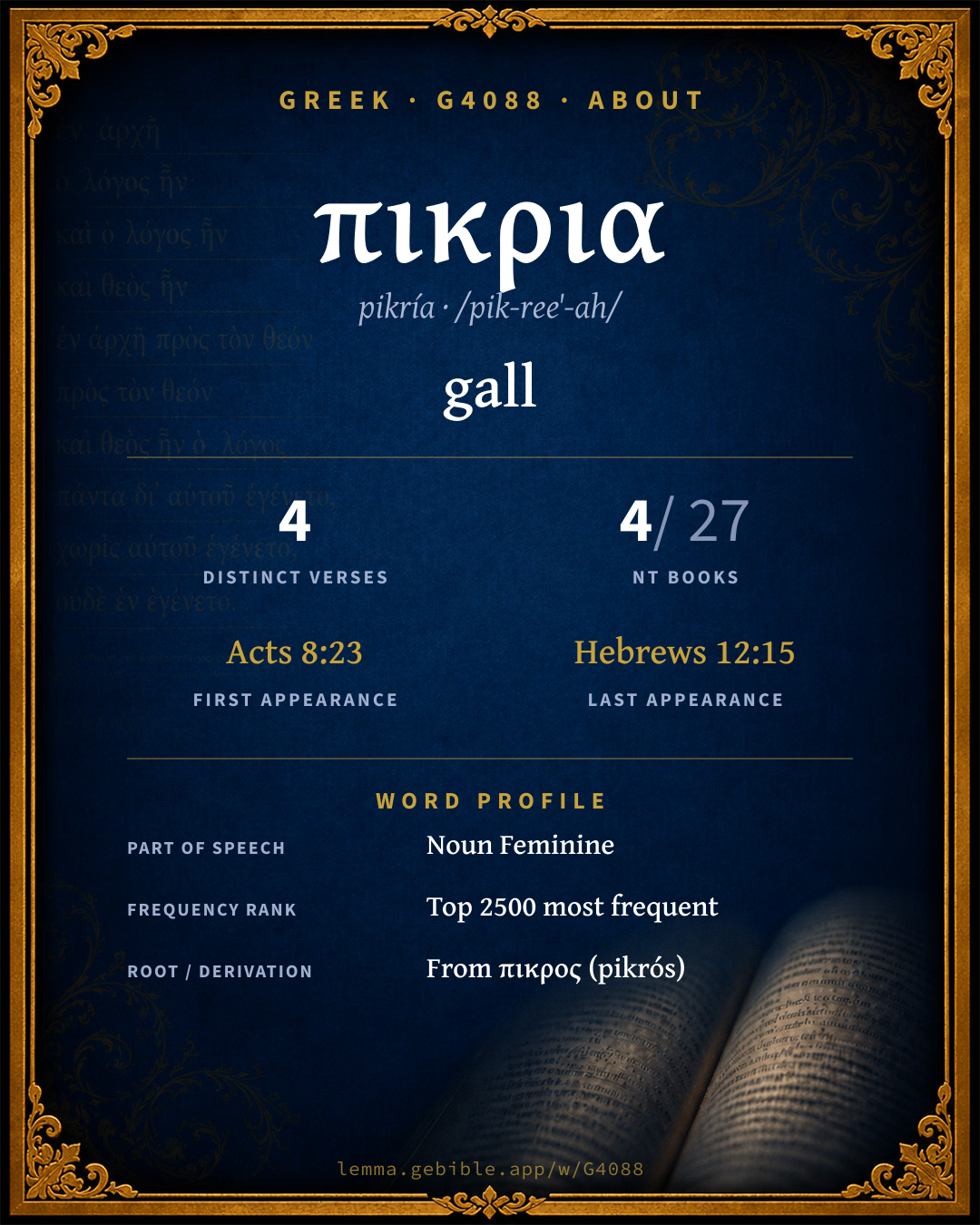
πικρία
gall
Full lexicon entry — Thayer's Greek Lexicon
From Thayer's Greek Lexicon
Where this word appears
Grammar key — what these labels mean
Part of speech
- Noun
- A naming word — a person, place, thing, or idea.
Case
- Genitive
- The case of source, possession, or “of” — answers “whose / from what.”
- Nominative
- The case of the subject (and the predicate nominative).
Gender
- Feminine
- Grammatically feminine.
Number
- Singular
- One.
Every verse where G4088 appears in the Book of Ephesians — 1 distinct verse. Click any verse to open its interlinear word-by-word view. Verse text shown in the World English Bible for context — . Each verse’s Greek form is shown with its reference; the English is not keyword-highlighted, since the data carries no word-level English alignment. Use “Compare translations” on any verse to read it across multiple English versions. This concordance covers the Greek New Testament; Septuagint (Greek Old Testament) occurrences of this word are not indexed here.
Ephesians
About this entry
At a glance — auto-summarized from this page’s data, not written by a person. Every figure links to its source below. This summary describes the numbers; it doesn’t interpret them.
At its core, πικρια (pikría) means “gall.” A scarce word — 4 verses in all of the Greek New Testament. Its uses concentrate in Acts (25% of all occurrences). First canonically at Acts 8:23, it enters the text early. From the same root come πικρος, πικραινω and πικρως. Each statement above links to its evidence; the full detail follows below.
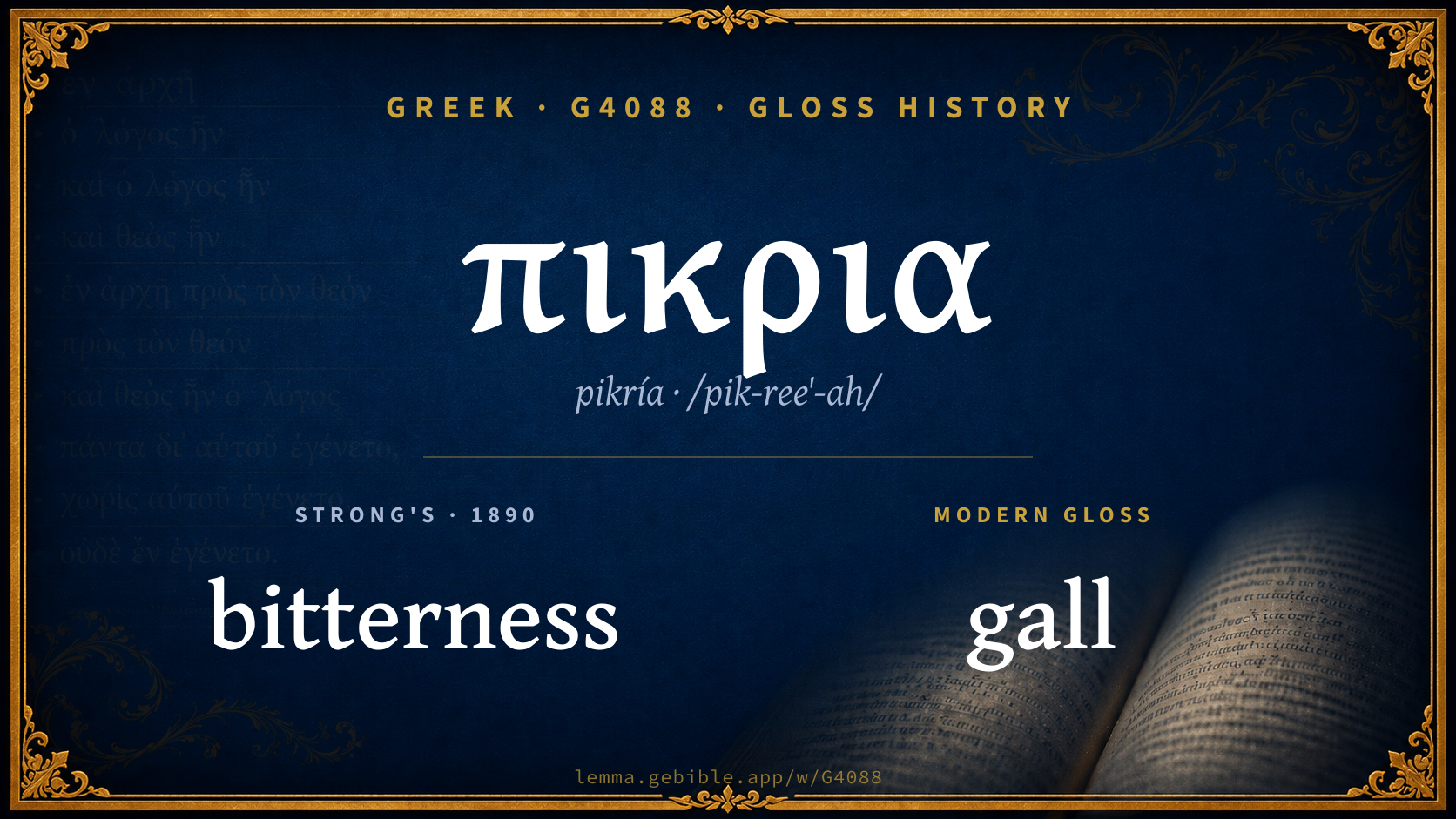
Gloss history
Strong's 1890 vs modern scholarship
About this word
Strong's G4088 catalogs a Greek word from the Greek New Testament.
These counts are not copied from any lexicon or concordance. They are computed here, from the morphology-tagged Greek New Testament. What Lemma adds →
- 4
- distinct verses
- The word appears in 4 distinct verses.
- 4 / 27
- NT books
- The word appears in 4 of 27 New Testament books.
- #1,877
- by frequency
- Top 2500 most frequent Greek words (rank 1,877 of 5,347 Greek words by occurrence).
View all 4 occurrences in the concordance →
By section of the New Testament
By traditional corpus
Conventional, traditional groupings — biblical authorship is debated, so this is a traditional corpus grouping, not an authorship claim. Some books belong to more than one corpus (Luke is in both the Gospels and the Lukan corpus, and so on), so these shares overlap and need not total 100%. Each figure is a share of the word’s 4 distinct verses.
- Pauline corpus 2 verses · 50%
- Lukan (Luke–Acts) 1 verse · 25%
- Hebrews 1 verse · 25%
How translations render this word
Counts come from each version’s own published word-to-Strong’s tagging or interlinear alignment — an approximate guide to how each version renders this word, not a word-level alignment the data otherwise carries. Because each total is that version’s own tagged count, the per-version totals vary from one another and need not match the appearance or distinct-verse counts above. These counts may also differ from a printed concordance because Lemma counts each distinctly tagged rendering and does not collapse phrase taggings into a single head-word total. This is a fixed set of word-tagged versions (KJV, ASV, BSB, ULT) and does not change with the reading translation you choose elsewhere. Each version’s license is shown beside its name below (and on Sources).
- King James Version: Bitterness 4×
- American Standard Version: Bitterness 4×
- Berean Standard Bible: Bitterness 4×
- unfoldingWord Literal Text: Bitterness 4×
King James Version Public Domain
Renders G4088 across 4 tagged occurrences — most commonly:
American Standard Version Public Domain
Renders G4088 across 4 tagged occurrences — most commonly:
Berean Standard Bible Public Domain
Renders G4088 across 4 tagged occurrences — most commonly:
unfoldingWord Literal Text CC BY-SA 4.0
Renders G4088 across 4 tagged occurrences — most commonly:
Senses in Thayer's
The 1 sense Thayer's distinguishes for this word, in lexicon order (not ranked by frequency or importance). The full entry — with sub-senses — is in the Lexicon Entry tab.
- bitter gall
Word origin
Derived from πικρος (pikrós) (G4089) — bitter.
From G4089 ; acridity (especially poison ) literally or figuratively : - bitterness.
— Strong’s Exhaustive Concordance (1890), public domain.
Forms in the corpus
The 2 distinct written forms G4088 takes in the Greek New Testament, most frequent first — each parse links to that case’s occurrences in the concordance.
| Form | Parsing | Example | Uses |
|---|---|---|---|
| πικρίας pikrías | Noun, Genitive, Singular, Feminine | Acts 8:23 | 3 |
| πικρία pikría | Noun, Nominative, Singular, Feminine | Ephesians 4:31 | 1 |
Same root — word family
Other Thayer's entries built from the same root as G4088, grouped by Strong’s listed origin. These share a root / origin per the lexicon — not necessarily a shared meaning. Each links to that word’s own entry.
Derives from
Shares the same root
Compare all same-root words → They share a root, not necessarily a meaning.
Septuagint usage
The same Greek word πικρια appears 20 times in the Greek Old Testament (Septuagint), across 19 verses in 9 books.
- 20
- LXX occurrences
- Tagged occurrences of this Greek word in the Septuagint.
- 19
- verses
- Distinct Septuagint verses containing this word.
- 9 / 39
- OT books
- The word appears in 9 of the 39 Old Testament books.
Sample Septuagint occurrences
- Exodus 15:23 πικρία
- Deuteronomy 29:17 πικρία
- Job 3:20 πικρία
- Psalms 9:28 πικρία
- Isaiah 28:21 πικρία
- Jeremiah 2:21 πικρία
- Lamentations 3:15 πικρία
- Ezekiel 28:24 πικρία
- Amos 6:12 πικρία
Septuagint occurrences (same lexeme)
Every verse where the same Strong’s number (G4088) appears in the Greek Septuagint. Verse text shown in the World English Bible for context; the Greek form is the matched word — the English is not keyword-highlighted.
- Exodus 15:23 πικρία When they came to Marah, they couldn't drink from the waters of Marah, for they were bitter. Therefore the name of it was called Marah.
- Deuteronomy 29:17 πικρία and you have seen their abominations, and their idols, wood and stone, silver and gold, which were among them);
- Deuteronomy 32:32 πικρία For their vine is of the vine of Sodom, Of the fields of Gomorrah: Their grapes are grapes of gall, Their clusters are bitter:
- Job 3:20 πικρία "Why is light given to him who is in misery, Life to the bitter in soul,
- Job 7:11 πικρία "Therefore I will not keep silent. I will speak in the anguish of my spirit. I will complain in the bitterness of my soul.
- Job 9:18 πικρία He will not allow me to take my breath, But fills me with bitterness.
- Job 10:1 πικρία "My soul is weary of my life; I will give free course to my complaint. I will speak in the bitterness of my soul.
- Job 21:25 πικρία Another dies in bitterness of soul, And never tastes of good.
- Psalms 9:28 πικρία
- Psalms 13:3 πικρία Behold, and answer me, Yahweh, my God. Give light to my eyes, lest I sleep in death;
- Isaiah 28:21 πικρία For Yahweh will rise up as on Mount Perazim, he will be angry as in the valley of Gibeon; that he may do his work, his strange work, and bring to pass his act, his strange act.
- Isaiah 28:28 πικρία Bread [grain] is ground; for he will not be always threshing it: and though the wheel of his cart and his horses scatter it, he does not grind it.
- Isaiah 37:29 πικρία Because of your raging against me, and because your arrogance is come up into my ears, therefore will I put my hook in your nose, and my bridle in your lips, and I will turn you back by the way by which you came.
- Jeremiah 2:21 πικρία Yet I had planted you a noble vine, wholly a right seed: how then are you turned into the degenerate branches of a foreign vine to me?
- Jeremiah 15:17 πικρία I didn't sit in the assembly of those who make merry, nor rejoiced; I sat alone because of your hand; for you have filled me with indignation.
- Lamentations 3:15 πικρία He has filled me with bitterness, he has sated me with wormwood.
- Lamentations 3:19 πικρία Remember my affliction and my misery, the wormwood and the gall.
- Ezekiel 28:24 πικρία There shall be no more a pricking brier to the house of Israel, nor a hurting thorn of any that are round about them, that did despite to them; and they shall know that I am the Lord Yahweh.
- Amos 6:12 πικρία Do horses run on the rocky crags? Does one plow there with oxen? But you have turned justice into poison, And the fruit of righteousness into bitterness;
These are occurrences of the same Greek lexeme (G4088) in the Septuagint — not a translation of any one Hebrew word. The store carries no word-level Hebrew↔Greek alignment, so no Hebrew original is asserted here. Counts come from the recovered LXX Strong's tagging — high-frequency vocabulary is well covered, while rare or late forms may be untagged — so they reflect tagged occurrences and may slightly undercount.