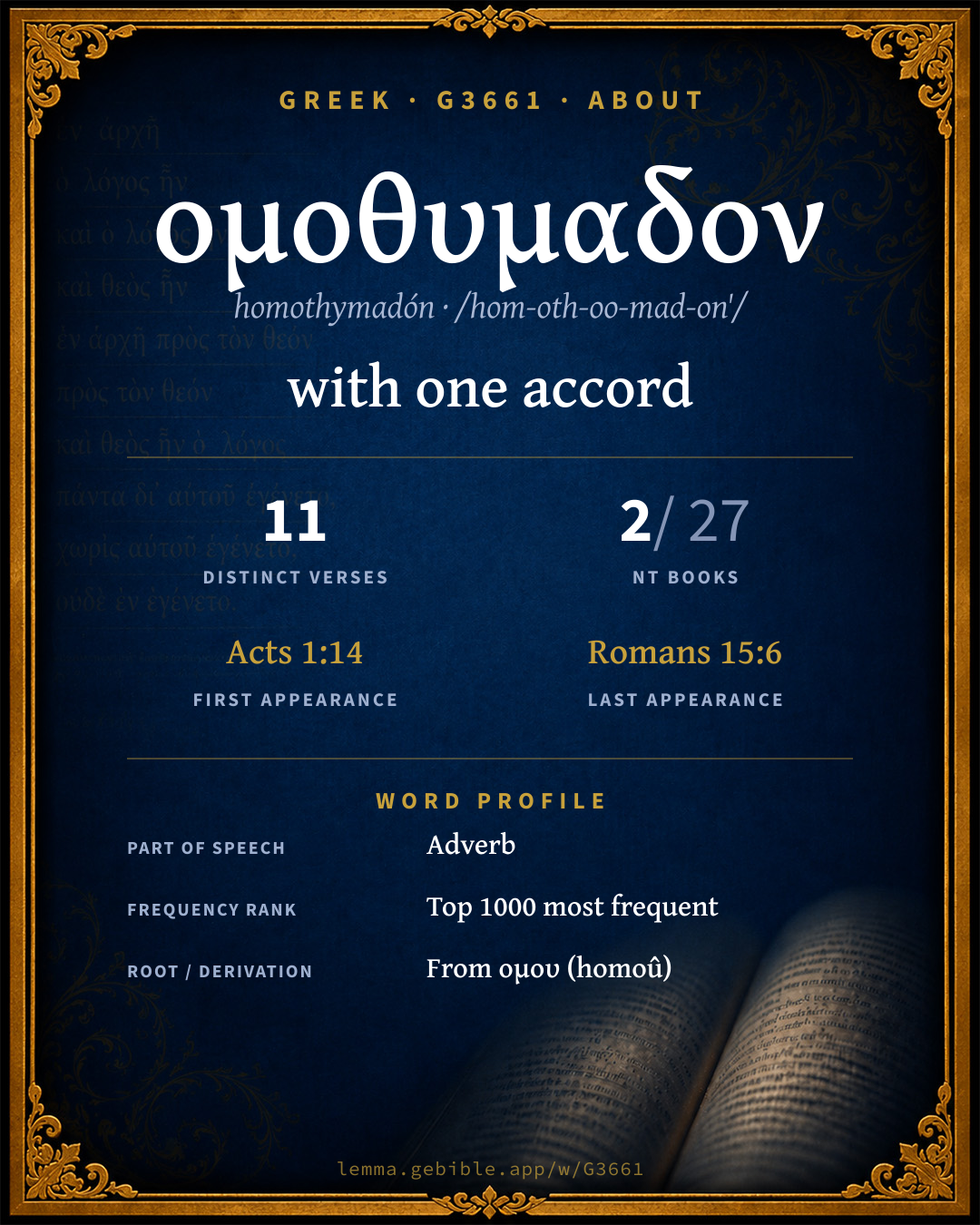
ὁμοθυμαδόν
with one accord
Full lexicon entry — Thayer's Greek Lexicon
From Thayer's Greek Lexicon
Where this word appears
Grammar key — what these labels mean
Part of speech
- Adverb
- A word that modifies a verb, adjective, or other adverb.
Every verse where G3661 appears in the Book of Romans — 1 distinct verse. Click any verse to open its interlinear word-by-word view. Verse text shown in the World English Bible for context — . Each verse’s Greek form is shown with its reference; the English is not keyword-highlighted, since the data carries no word-level English alignment. Use “Compare translations” on any verse to read it across multiple English versions. This concordance covers the Greek New Testament; Septuagint (Greek Old Testament) occurrences of this word are not indexed here.
Romans
About this entry
At a glance — auto-summarized from this page’s data, not written by a person. Every figure links to its source below. This summary describes the numbers; it doesn’t interpret them.
ομοθυμαδον (homothymadón) is a Greek verb most often rendered “with one accord.” Acts dominates its distribution — 10 of 11 verses. Spanning 11 verses in 2 books, it ranks among the uncommon words of the Greek New Testament. Scripture first uses it in Acts 1:14. Older and newer Bibles part ways — “one accord” in the King James Version, “unanimously” (unfoldingWord Literal Text) in modern versions. See the renderings breakdown. For the data behind this summary, explore the sense tree and the renderings breakdown below.
Gloss history
Strong's 1890 vs modern scholarship
About this word
Strong's G3661 catalogs a Greek word from the Greek New Testament.
These counts are not copied from any lexicon or concordance. They are computed here, from the morphology-tagged Greek New Testament. What Lemma adds →
- 11
- distinct verses
- The word appears in 11 distinct verses.
- 2 / 27
- NT books
- The word appears in 2 of 27 New Testament books.
- #978
- by frequency
- Top 1000 most frequent Greek words (rank 978 of 5,347 Greek words by occurrence).
View all 11 occurrences in the concordance →
By traditional corpus
Conventional, traditional groupings — biblical authorship is debated, so this is a traditional corpus grouping, not an authorship claim. Some books belong to more than one corpus (Luke is in both the Gospels and the Lukan corpus, and so on), so these shares overlap and need not total 100%. Each figure is a share of the word’s 11 distinct verses.
- Lukan (Luke–Acts) 10 verses · 91%
- Pauline corpus 1 verse · 9%
How translations render this word
Counts come from each version’s own published word-to-Strong’s tagging or interlinear alignment — an approximate guide to how each version renders this word, not a word-level alignment the data otherwise carries. Because each total is that version’s own tagged count, the per-version totals vary from one another and need not match the appearance or distinct-verse counts above. These counts may also differ from a printed concordance because Lemma counts each distinctly tagged rendering and does not collapse phrase taggings into a single head-word total. This is a fixed set of word-tagged versions (KJV, ASV, BSB, ULT) and does not change with the reading translation you choose elsewhere. Each version’s license is shown beside its name below (and on Sources).
- King James Version: One accord 10×
- American Standard Version: One accord 8×
- Berean Standard Bible: One accord 4×, Together 2×
- unfoldingWord Literal Text: Unanimously 9×
King James Version Public Domain
Renders G3661 across 12 tagged occurrences — most commonly:
Plus 2 renderings that appear only once — usually multi-word phrases or single function words the recovered tagging swept in, not distinct renderings.
American Standard Version Public Domain
Renders G3661 across 12 tagged occurrences — most commonly:
Plus 4 renderings that appear only once — usually multi-word phrases or single function words the recovered tagging swept in, not distinct renderings.
Berean Standard Bible Public Domain
Renders G3661 across 10 tagged occurrences — most commonly:
Plus 4 renderings that appear only once — usually multi-word phrases or single function words the recovered tagging swept in, not distinct renderings. Not rendered by a distinct English word in 1 further occurrence.
unfoldingWord Literal Text CC BY-SA 4.0
Renders G3661 across 11 tagged occurrences — most commonly:
Plus 2 renderings that appear only once — usually multi-word phrases or single function words the recovered tagging swept in, not distinct renderings.
Senses in Thayer's
The 1 sense Thayer's distinguishes for this word, in lexicon order (not ranked by frequency or importance). The full entry — with sub-senses — is in the Lexicon Entry tab.
- with one mind…
Word origin
Derived from ομου (homoû) (G3674) — together.
Forms in the corpus
The 2 distinct written forms G3661 takes in the Greek New Testament, most frequent first — each parse links to that case’s occurrences in the concordance.
| Form | Parsing | Example | Uses |
|---|---|---|---|
| ὁμοθυμαδὸν homothymadòn | Adverb | Acts 1:14 | 10 |
| ὁμοθυμαδόν homothymadón | Adverb | Acts 15:25 | 1 |
Same root — word family
Other Thayer's entries built from the same root as G3661, grouped by Strong’s listed origin. These share a root / origin per the lexicon — not necessarily a shared meaning. Each links to that word’s own entry.
Derives from
Shares the same root
- ομιλος hómilos G3658 crowd
- ομοιος hómoios G3664 like
- ομολογεω homologéō G3670 to agree with
- ομοτεχνος homótechnos G3673 same trade
- ομοφρων homóphrōn G3675 like-minded
- ομως hómōs G3676 nevertheless
Compare all same-root words → Showing 4 of 8 — not the complete family. They share a root, not necessarily a meaning.
Septuagint usage
The same Greek word ομοθυμαδον appears 20 times in the Greek Old Testament (Septuagint), across 20 verses in 5 books.
- 20
- LXX occurrences
- Tagged occurrences of this Greek word in the Septuagint.
- 20
- verses
- Distinct Septuagint verses containing this word.
- 5 / 39
- OT books
- The word appears in 5 of the 39 Old Testament books.
Sample Septuagint occurrences
- Exodus 19:8 ὁμοθυμαδόν
- Numbers 24:24 ὁμοθυμαδόν
- Job 2:11 ὁμοθυμαδόν
- Jeremiah 5:5 ὁμοθυμαδόν
- Lamentations 2:8 ὁμοθυμαδόν
Septuagint occurrences (same lexeme)
Every verse where the same Strong’s number (G3661) appears in the Greek Septuagint. Verse text shown in the World English Bible for context; the Greek form is the matched word — the English is not keyword-highlighted.
- Exodus 19:8 ὁμοθυμαδόν All the people answered together, and said, "All that Yahweh has spoken we will do." Moses reported the words of the people to Yahweh.
- Numbers 24:24 ὁμοθυμαδόν But ships [shall come] from the coast of Kittim, They shall afflict Asshur, and shall afflict Eber; He also shall come to destruction.
- Numbers 27:21 ὁμοθυμαδόν He shall stand before Eleazar the priest, who shall inquire for him by the judgment of the Urim before Yahweh: at his word shall they go out, and at his word they shall come in, both he, and all the children of Israel with him, even all the congregation.
- Job 2:11 ὁμοθυμαδόν Now when Job's three friends heard of all this evil that had come on him, they each came from his own place: Eliphaz the Temanite, Bildad the Shuhite, and Zophar the Naamathite, and they made an appointment together to come to sympathize with him and to comfort him.
- Job 3:18 ὁμοθυμαδόν There the prisoners are at ease together. They don't hear the voice of the taskmaster.
- Job 6:2 ὁμοθυμαδόν "Oh that my anguish were weighed, And all my calamity laid in the balances!
- Job 9:32 ὁμοθυμαδόν For he is not a man, as I am, that I should answer him, That we should come together in judgment.
- Job 16:10 ὁμοθυμαδόν They have gaped on me with their mouth; They have struck me on the cheek reproachfully. They gather themselves together against me.
- Job 17:16 ὁμοθυμαδόν Shall it go down with me to the gates of Sheol, Or descend together into the dust?"
- Job 19:12 ὁμοθυμαδόν His troops come on together, Build a siege ramp against me, And encamp around my tent.
- Job 21:26 ὁμοθυμαδόν They lie down alike in the dust, The worm covers them.
- Job 24:4 ὁμοθυμαδόν They turn the needy out of the way. The poor of the earth all hide themselves.
- Job 24:17 ὁμοθυμαδόν For the morning is to all of them like thick darkness, For they know the terrors of the thick darkness.
- Job 31:38 ὁμοθυμαδόν If my land cries out against me, And the furrows of it weep together;
- Job 34:15 ὁμοθυμαδόν All flesh would perish together, And man would turn again to dust.
- Job 38:33 ὁμοθυμαδόν Do you know the laws of the heavens? Can you establish the dominion of it over the earth?
- Job 40:13 ὁμοθυμαδόν Hide them in the dust together. Bind their faces in the hidden place.
- Jeremiah 5:5 ὁμοθυμαδόν I will get me to the great men, and will speak to them; for they know the way of Yahweh, and the law of their God. But these with one accord have broken the yoke, and burst the bonds.
- Jeremiah 26:21 ὁμοθυμαδόν and when Jehoiakim the king, with all his mighty-men, and all the princes, heard his words, the king sought to put him to death; but when Uriah heard it, he was afraid, and fled, and went into Egypt:
- Lamentations 2:8 ὁμοθυμαδόν Yahweh has purposed to destroy the wall of the daughter of Zion; He has stretched out the line, he has not withdrawn his hand from destroying; He has made the rampart and wall to lament; they languish together.
These are occurrences of the same Greek lexeme (G3661) in the Septuagint — not a translation of any one Hebrew word. The store carries no word-level Hebrew↔Greek alignment, so no Hebrew original is asserted here. Counts come from the recovered LXX Strong's tagging — high-frequency vocabulary is well covered, while rare or late forms may be untagged — so they reflect tagged occurrences and may slightly undercount.