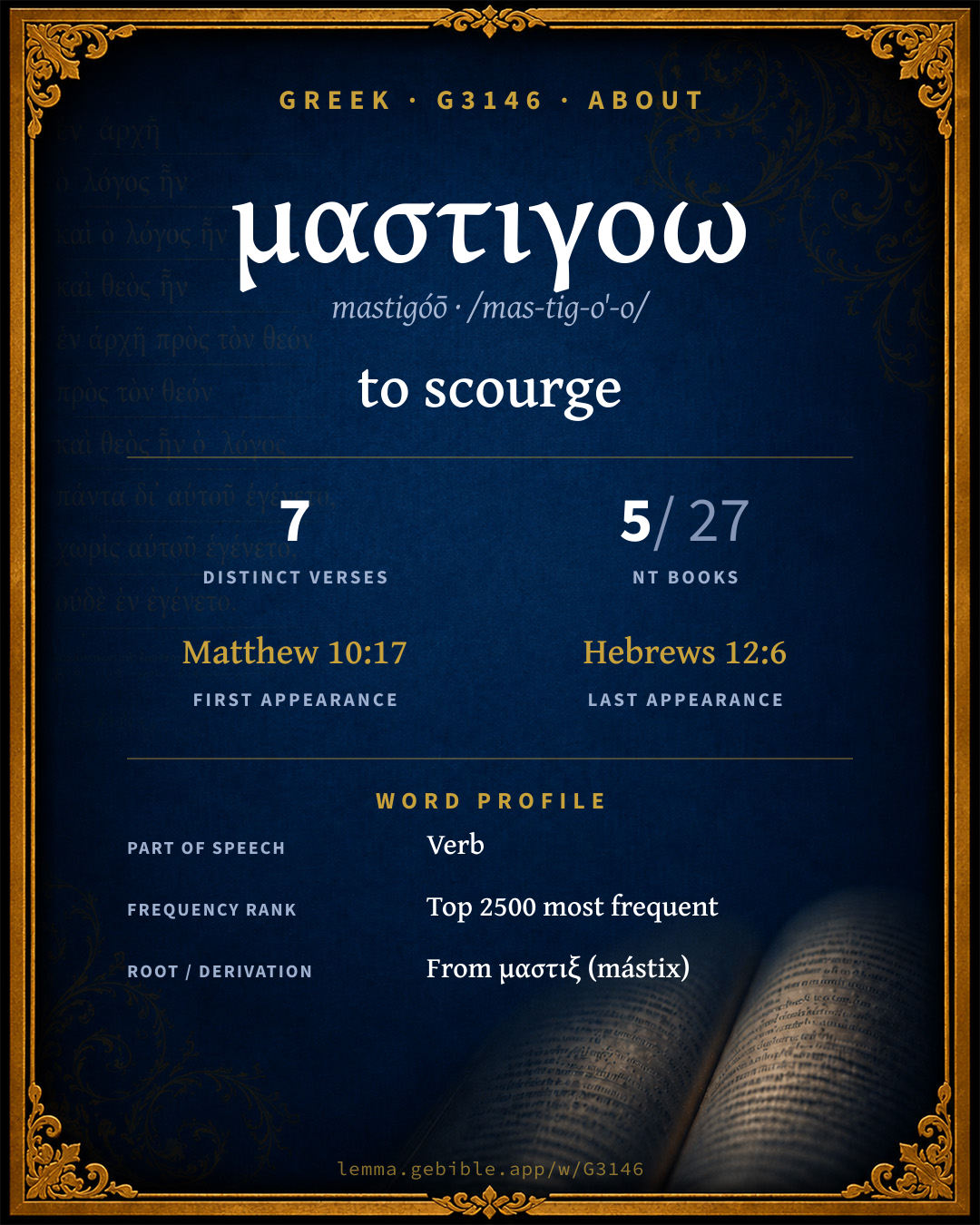
μαστιγόω
to scourge
Full lexicon entry — Thayer's Greek Lexicon
From Thayer's Greek Lexicon
Where this word appears
See every Aorist-tense verb in the Greek New Testament →
Grammar key — what these labels mean
Part of speech
- Verb
- An action or state-of-being word.
Tense
- Future
- Action expected in future time.
- Aorist
- Action viewed as a simple whole, without regard to duration — often past (perfective aspect).
- Present
- Ongoing or general action in present time (imperfective aspect).
Voice
- Active
- The subject performs the action.
Mood
- Indicative
- States a fact or asks a factual question (the mood of reality).
- Infinitive
- A verbal noun (“to write”), unmarked for person or number.
- Participle
- A verbal adjective (“writing,” “having written”).
Case
- Nominative
- The case of the subject (and the predicate nominative).
Person
- 3rd person
- The one spoken about (“he / she / it / they”).
- 2nd person
- The one addressed (“you”).
Gender
- Masculine
- Grammatically masculine.
Number
- Plural
- More than one.
- Singular
- One.
3 distinct verses where G3146 appears in the Future tense, across 2 books. Filtered view — show all forms. Click any verse to open its interlinear word-by-word view. Verse text shown in the World English Bible for context — . Each verse’s Greek form is shown with its reference; the English is not keyword-highlighted, since the data carries no word-level English alignment. Use “Compare translations” on any verse to read it across multiple English versions. This concordance covers the Greek New Testament; Septuagint (Greek Old Testament) occurrences of this word are not indexed here.
Matthew 2 verses
- Matthew 10:17 μαστιγώσουσιν fut act ind 3pl But beware of men: for they will deliver you up to councils, and in their synagogues they will scourge you.
- Matthew 23:34 μαστιγώσετε fut act ind 2pl Therefore, behold, I send to you prophets, wise men, and scribes. Some of them you will kill and crucify; and some of them you will scourge in your synagogues, and persecute from city to city;
Mark 1 verse
About this entry
At a glance — auto-summarized from this page’s data, not written by a person. Every figure links to its source below. This summary describes the numbers; it doesn’t interpret them.
“to scourge” is the headline sense of the Greek verb μαστιγοω (mastigóō). Its earliest occurrence is Matthew 10:17. The Greek New Testament uses it across 7 verses — uncommon. More than a third of its appearances fall in Matthew. The sections below give every sense, occurrence, and version rendering.
Gloss history
Strong's 1890 vs modern scholarship
About this word
Strong's G3146 catalogs a Greek word from the Greek New Testament.
These counts are not copied from any lexicon or concordance. They are computed here, from the morphology-tagged Greek New Testament. What Lemma adds →
- 7
- distinct verses
- The word appears in 7 distinct verses.
- 5 / 27
- NT books
- The word appears in 5 of 27 New Testament books.
- #1,358
- by frequency
- Top 2500 most frequent Greek words (rank 1,358 of 5,347 Greek words by occurrence).
View all 7 occurrences in the concordance →
By section of the New Testament
By traditional corpus
Conventional, traditional groupings — biblical authorship is debated, so this is a traditional corpus grouping, not an authorship claim. Some books belong to more than one corpus (Luke is in both the Gospels and the Lukan corpus, and so on), so these shares overlap and need not total 100%. Each figure is a share of the word’s 7 distinct verses.
- Gospels 6 verses · 86%
- Lukan (Luke–Acts) 1 verse · 14%
- Johannine 1 verse · 14%
- Hebrews 1 verse · 14%
How translations render this word
Counts come from each version’s own published word-to-Strong’s tagging or interlinear alignment — an approximate guide to how each version renders this word, not a word-level alignment the data otherwise carries. Because each total is that version’s own tagged count, the per-version totals vary from one another and need not match the appearance or distinct-verse counts above. These counts may also differ from a printed concordance because Lemma counts each distinctly tagged rendering and does not collapse phrase taggings into a single head-word total. This is a fixed set of word-tagged versions (KJV, ASV, BSB, ULT) and does not change with the reading translation you choose elsewhere. Each version’s license is shown beside its name below (and on Sources).
- King James Version: Scourge 1×, Scourged 1×, Scourgeth 1×
- American Standard Version: Scourge 1×, Scourged him 1×, Scourgeth 1×
- Berean Standard Bible: Flog 2×
- unfoldingWord Literal Text: Him 2×, Whip 2×
King James Version Public Domain
Renders G3146 across 7 tagged occurrences — most commonly:
American Standard Version Public Domain
Renders G3146 across 7 tagged occurrences — most commonly:
Berean Standard Bible Public Domain
Renders G3146 across 7 tagged occurrences — most commonly:
Plus 5 renderings that appear only once — usually multi-word phrases or single function words the recovered tagging swept in, not distinct renderings.
unfoldingWord Literal Text CC BY-SA 4.0
Renders G3146 across 9 tagged occurrences — most commonly:
Plus 5 renderings that appear only once — usually multi-word phrases or single function words the recovered tagging swept in, not distinct renderings.
Senses in Thayer's
The 1 sense Thayer's distinguishes for this word, in lexicon order (not ranked by frequency or importance). The full entry — with sub-senses — is in the Lexicon Entry tab.
- to scourge
Word origin
Derived from μαστιξ (mástix) (G3148) — whip.
From G3148 ; to flog (literally or figuratively): - scourge.
— Strong’s Exhaustive Concordance (1890), public domain.
Forms in the corpus
The 6 distinct written forms G3146 takes in the Greek New Testament, most frequent first — each parse links to that tense’s occurrences in the concordance.
| Form | Parsing | Example | Uses |
|---|---|---|---|
| μαστιγώσουσιν mastigṓsousin | Verb, Future, Active, Indicative, 3rd person, Plural | Matthew 10:17 | 2 |
| μαστιγοῖ mastigoî | Verb, Present, Active, Indicative, 3rd person, Singular | Hebrews 12:6 | 1 |
| μαστιγώσαντες mastigṓsantes | Verb, Aorist, Active, Participle, Nominative, Plural, Masculine | Luke 18:33 | 1 |
| μαστιγώσετε mastigṓsete | Verb, Future, Active, Indicative, 2nd person, Plural | Matthew 23:34 | 1 |
| μαστιγῶσαι mastigō̂sai | Verb, Aorist, Active, Infinitive | Matthew 20:19 | 1 |
| ἐμαστίγωσεν emastígōsen | Verb, Aorist, Active, Indicative, 3rd person, Singular | John 19:1 | 1 |
Septuagint usage
The same Greek word μαστιγοω appears 17 times in the Greek Old Testament (Septuagint), across 16 verses in 9 books.
- 17
- LXX occurrences
- Tagged occurrences of this Greek word in the Septuagint.
- 16
- verses
- Distinct Septuagint verses containing this word.
- 9 / 39
- OT books
- The word appears in 9 of the 39 Old Testament books.
Sample Septuagint occurrences
- Exodus 5:14 μαστιγόω
- Deuteronomy 25:2 μαστιγόω
- 1 Kings 12:24 μαστιγόω
- 2 Chronicles 25:16 μαστιγόω
- Job 15:11 μαστιγόω
- Psalms 72:5 μαστιγόω
- Proverbs 3:12 μαστιγόω
- Jeremiah 5:3 μαστιγόω
- Daniel 4:19 μαστιγόω
Septuagint occurrences (same lexeme)
Every verse where the same Strong’s number (G3146) appears in the Greek Septuagint. Verse text shown in the World English Bible for context; the Greek form is the matched word — the English is not keyword-highlighted.
- Exodus 5:14 μαστιγόω The officers of the children of Israel, whom Pharaoh's taskmasters had set over them, were beaten, and demanded, "Why haven't you fulfilled your quota both yesterday and today, in making brick as before?"
- Exodus 5:16 μαστιγόω No straw is given to your servants, and they tell us, 'Make brick!' and, behold, your servants are beaten; but the fault is in your own people."
- Deuteronomy 25:2 μαστιγόω and it shall be, if the wicked man be worthy to be beaten, that the judge shall cause him to lie down, and to be beaten before his face, according to his wickedness, by number.
- Deuteronomy 25:3 μαστιγόω Forty stripes he may give him, he shall not exceed; lest, if he should exceed, and beat him above these with many stripes, then your brother should seem vile to you.
- 1 Kings 12:24 μαστιγόω Thus says Yahweh, You shall not go up, nor fight against your brothers the children of Israel: return every man to his house; for this thing is of me. So they listened to the word of Yahweh, and returned and went their way, according to the word of Yahweh.
- 2 Chronicles 25:16 μαστιγόω It happened, as he talked with him, that [the king] said to him, Have we made you of the king's counsel? Stop! Why should you be struck down? Then the prophet stopped, and said, I know that God has determined to destroy you, because you have done this, and have not listened to my counsel.
- Job 15:11 μαστιγόω Are the consolations of God too small for you, Even the word that is gentle toward you?
- Job 30:21 μαστιγόω You have turned to be cruel to me. With the might of your hand you persecute me.
- Psalms 72:5 μαστιγόω They shall fear you while the sun endures; And as long as the moon, throughout all generations.
- Psalms 72:14 μαστιγόω He will redeem their soul from oppression and violence. Their blood will be precious in his sight.
- Proverbs 3:12 μαστιγόω For whom Yahweh loves, he reproves; Even as a father reproves the son in whom he delights.
- Proverbs 17:10 μαστιγόω A rebuke enters deeper into one who has understanding Than a hundred lashes into a fool.
- Proverbs 19:25 μαστιγόω Flog a scoffer, and the simple will learn prudence; Rebuke one who has understanding, and he will gain knowledge.
- Proverbs 27:22 μαστιγόω Though you grind a fool in a mortar with a pestle along with grain, Yet his foolishness will not be removed from him.
- Jeremiah 5:3 μαστιγόω O Yahweh, don't your eyes look on truth? you have stricken them, but they were not grieved; you have consumed them, but they have refused to receive correction: they have made their faces harder than a rock; they have refused to return.
- Daniel 4:19 μαστιγόω Then Daniel, whose name was Belteshazzar, was stricken mute for a while, and his thoughts troubled him. The king answered, Belteshazzar, don't let the dream, or the interpretation, trouble you. Belteshazzar answered, My lord, the dream be to those who hate you, and the interpretation of it to your adversaries.
These are occurrences of the same Greek lexeme (G3146) in the Septuagint — not a translation of any one Hebrew word. The store carries no word-level Hebrew↔Greek alignment, so no Hebrew original is asserted here. Counts come from the recovered LXX Strong's tagging — high-frequency vocabulary is well covered, while rare or late forms may be untagged — so they reflect tagged occurrences and may slightly undercount.