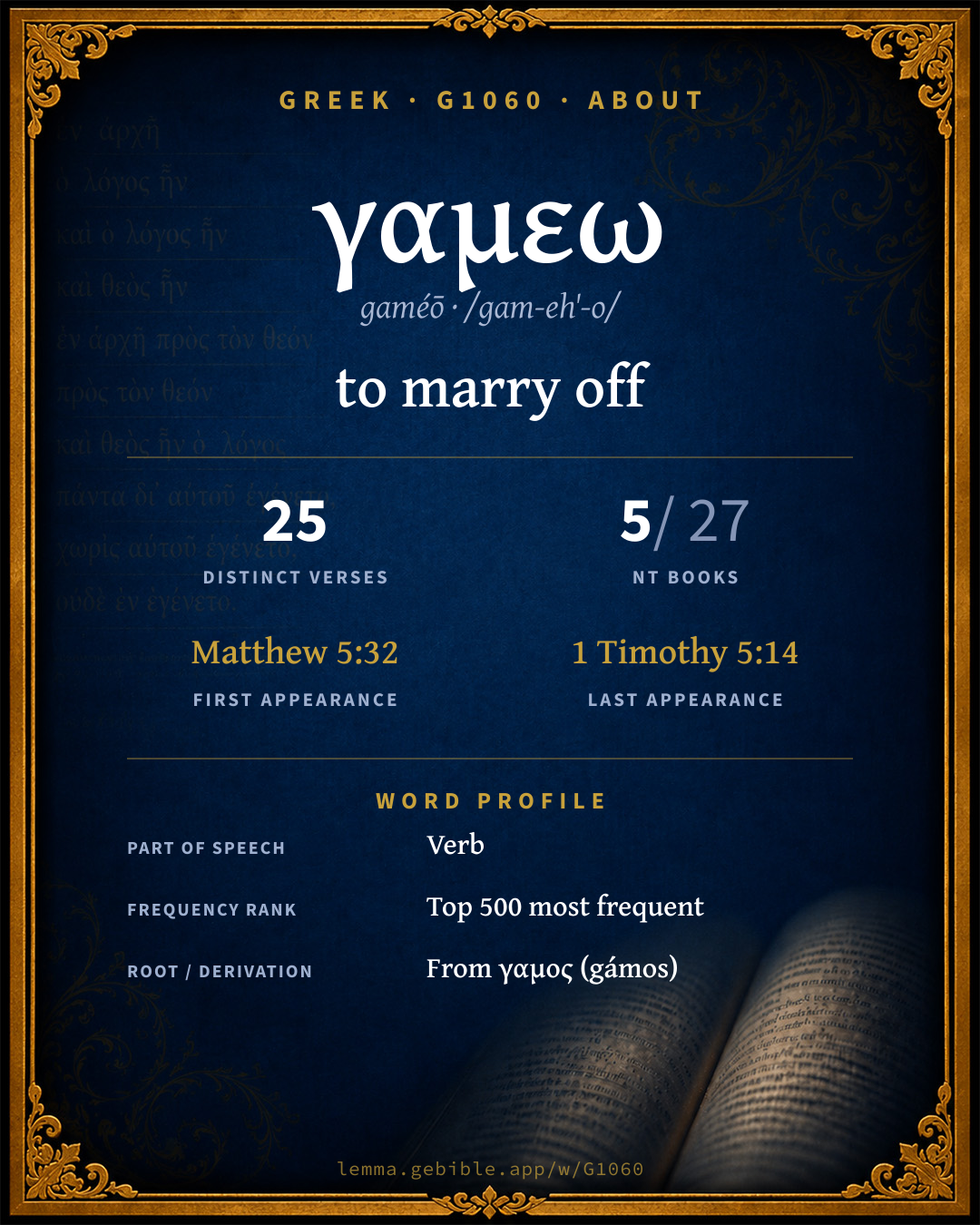
γαμέω
to marry off
‘to marry off’ is one of 2 main senses fuller range ↓
Full lexicon entry — Thayer's Greek Lexicon
From Thayer's Greek Lexicon
Where this word appears
See every Aorist-tense verb in the Greek New Testament →
Grammar key — what these labels mean
Part of speech
- Verb
- An action or state-of-being word.
Tense
- Aorist
- Action viewed as a simple whole, without regard to duration — often past (perfective aspect).
- Present
- Ongoing or general action in present time (imperfective aspect).
- Imperfect
- Continuous or repeated action in past time (“was writing”).
- Perfect
- A completed past action with continuing present results.
Voice
- Active
- The subject performs the action.
- Passive
- The subject receives the action.
Mood
- Subjunctive
- Expresses probability, purpose, or possibility (the mood of contingency).
- Indicative
- States a fact or asks a factual question (the mood of reality).
- Infinitive
- A verbal noun (“to write”), unmarked for person or number.
- Participle
- A verbal adjective (“writing,” “having written”).
- Imperative
- Expresses a command or request.
Case
- Nominative
- The case of the subject (and the predicate nominative).
- Dative
- The case of the indirect object, means, or location — “to / for / with / in.”
Person
- 3rd person
- The one spoken about (“he / she / it / they”).
- 1st person
- The speaker (“I / we”).
- 2nd person
- The one addressed (“you”).
Gender
- Masculine
- Grammatically masculine.
- Feminine
- Grammatically feminine.
Number
- Singular
- One.
- Plural
- More than one.
Grammatical forms 16 distinct
- Verb, Aorist, Active, Subjunctive, 3rd person, Singular 5 times (18%)
- Verb, Present, Active, Indicative, 3rd person, Plural 4 times (14%)
- Verb, Present, Active, Infinitive 4 times (14%)
- Verb, Aorist, Active, Participle, Nominative, Singular, Masculine 2 times (7%)
- Verb, Present, Active, Participle, Nominative, Singular, Masculine 2 times (7%)
- Verb, Aorist, Active, Indicative, 1st person, Singular 1 time (4%)
- Verb, Aorist, Active, Indicative, 3rd person, Singular 1 time (4%)
- Verb, Aorist, Active, Imperative, 3rd person, Plural 1 time (4%)
+8 more forms (8 occurrences)
Parsed forms decoded from the imported morphology (Robinson–Tischendorf, public domain), counted across 28 parsed occurrences — not distinct verses.
Every verse where G1060 appears — 25 distinct verses across 5 books. Click any verse to open its interlinear word-by-word view. Verse text shown in the World English Bible for context — . Each verse’s Greek form is shown with its reference; the English is not keyword-highlighted, since the data carries no word-level English alignment. Use “Compare translations” on any verse to read it across multiple English versions. This concordance covers the Greek New Testament; Septuagint (Greek Old Testament) occurrences of this word are not indexed here.
Matthew 6 verses
- Matthew 5:32 γαμήσῃ aor act subj 3sg but I tell you that whoever puts away his wife, except for the cause of sexual immorality, makes her an adulteress; and whoever marries her when she is put away commits adultery.
- Matthew 19:9 γαμήσῃ aor act subj 3sg I tell you that whoever divorces his wife, except for sexual immorality, and marries another, commits adultery; and he who marries her when she is divorced commits adultery."
- Matthew 19:10 γαμῆσαι aor act inf His disciples said to him, "If this is the case of the man with his wife, it is not expedient to marry."
- Matthew 22:25 γήμας aor act ptcp nom sg masc Now there were with us seven brothers. The first married and died, and having no seed left his wife to his brother.
- Matthew 22:30 γαμοῦσιν pres act ind 3pl For in the resurrection they neither marry, nor are given in marriage, but are like God's angels in heaven.
- Matthew 24:38 γαμοῦντες pres act ptcp nom pl masc For as in those days which were before the flood they were eating and drinking, marrying and giving in marriage, until the day that Noah entered into the ark,
Mark 4 verses
- Mark 6:17 ἐγάμησεν aor act ind 3sg For Herod himself had sent out and arrested John, and bound him in prison for the sake of Herodias, his brother Philip's wife, for he had married her.
- Mark 10:11 γαμήσῃ aor act subj 3sg He said to them, "Whoever divorces his wife, and marries another, commits adultery against her.
- Mark 10:12 γαμήσῃ aor act subj 3sg If a woman herself divorces her husband, and marries another, she commits adultery."
- Mark 12:25 γαμοῦσιν pres act ind 3pl For when they will rise from the dead, they neither marry, nor are given in marriage, but are like angels in heaven.
Luke 5 verses
- Luke 14:20 ἔγημα aor act ind 1sg "Another said, 'I have married a wife, and therefore I can't come.'
- Luke 16:18 γαμῶν γαμῶν pres act ptcp nom sg masc pres act ptcp nom sg masc Everyone who divorces his wife, and marries another, commits adultery. He who marries one who is divorced from a husband commits adultery.
- Luke 17:27 ἐγάμουν impf act ind 3pl They ate, they drank, they married, they were given in marriage, until the day that Noah entered into the ark, and the flood came, and destroyed them all.
- Luke 20:34 γαμοῦσιν pres act ind 3pl Jesus said to them, "The children of this age marry, and are given in marriage.
- Luke 20:35 γαμοῦσιν pres act ind 3pl But those who are considered worthy to attain to that age and the resurrection from the dead, neither marry, nor are given in marriage.
1 Corinthians 7 verses
- 1 Corinthians 7:9 γαμησάτωσαν γαμεῖν aor act impv 3pl pres act inf But if they don't have self-control, let them marry. For it's better to marry than to burn.
- 1 Corinthians 7:10 γεγαμηκόσιν perf act ptcp dat pl masc But to the married I command--not I, but the Lord--that the wife not leave her husband
- 1 Corinthians 7:28 γαμήσῃς γήμῃ aor act subj 2sg aor act subj 3sg But if you marry, you have not sinned. If a virgin marries, she has not sinned. Yet such will have oppression in the flesh, and I want to spare you.
- 1 Corinthians 7:33 γαμήσας aor act ptcp nom sg masc but he who is married is concerned about the things of the world, how he may please his wife.
- 1 Corinthians 7:34 γαμήσασα aor act ptcp nom sg fem There is also a difference between a wife and a virgin. The unmarried woman cares about the things of the Lord, that she may be holy both in body and in spirit. But she who is married cares about the things of the world--how she may please her husband.
- 1 Corinthians 7:36 γαμείτωσαν pres act impv 3pl But if any man thinks that he is behaving inappropriately toward his virgin, if she is past the flower of her age, and if need so requires, let him do what he desires. He doesn't sin. Let them marry.
- 1 Corinthians 7:39 γαμηθῆναι aor pass inf A wife is bound by law for as long as her husband lives; but if the husband is dead, she is free to be married to whoever she desires, only in the Lord.
1 Timothy 3 verses
- 1 Timothy 4:3 γαμεῖν pres act inf forbidding marriage and commanding to abstain from foods which God created to be received with thanksgiving by those who believe and know the truth.
- 1 Timothy 5:11 γαμεῖν pres act inf But refuse younger widows, for when they have grown wanton against Christ, they desire to marry;
- 1 Timothy 5:14 γαμεῖν pres act inf I desire therefore that the younger widows marry, bear children, rule the household, and give no occasion to the adversary for reviling.
About this entry
At a glance — auto-summarized from this page’s data, not written by a person. Every figure links to its source below. This summary describes the numbers; it doesn’t interpret them.
At its core, γαμεω (gaméō) means “to marry off.” The King James Version usually renders it “marry,” while modern versions prefer “marries” (Berean Standard Bible) — see the renderings breakdown. Spanning 25 verses in 5 books, it ranks among the uncommon words of the Greek New Testament. Its uses concentrate in 1 Corinthians (28% of all occurrences). Catalogued under 2 senses, its meaning is not single-sense. Dig into 25-verse concordance and the renderings breakdown below.
Gloss history
Strong's 1890 vs modern scholarship
About this word
Strong's G1060 catalogs a Greek word from the Greek New Testament.
These counts are not copied from any lexicon or concordance. They are computed here, from the morphology-tagged Greek New Testament. What Lemma adds →
- 25
- distinct verses
- The word appears in 25 distinct verses.
- 5 / 27
- NT books
- The word appears in 5 of 27 New Testament books.
- #485
- by frequency
- Top 500 most frequent Greek words (rank 485 of 5,347 Greek words by occurrence).
View all 25 occurrences in the concordance →
Most concentrated in
- 1 Corinthians 7 verses 28%
- Matthew 6 verses 24%
- Luke 5 verses 20%
By section of the New Testament
By traditional corpus
Conventional, traditional groupings — biblical authorship is debated, so this is a traditional corpus grouping, not an authorship claim. Some books belong to more than one corpus (Luke is in both the Gospels and the Lukan corpus, and so on), so these shares overlap and need not total 100%. Each figure is a share of the word’s 25 distinct verses.
- Gospels 15 verses · 60%
- Pauline corpus 10 verses · 40%
- Lukan (Luke–Acts) 5 verses · 20%
How translations render this word
Counts come from each version’s own published word-to-Strong’s tagging or interlinear alignment — an approximate guide to how each version renders this word, not a word-level alignment the data otherwise carries. Because each total is that version’s own tagged count, the per-version totals vary from one another and need not match the appearance or distinct-verse counts above. These counts may also differ from a printed concordance because Lemma counts each distinctly tagged rendering and does not collapse phrase taggings into a single head-word total. This is a fixed set of word-tagged versions (KJV, ASV, BSB, ULT) and does not change with the reading translation you choose elsewhere. Each version’s license is shown beside its name below (and on Sources).
- King James Version: Marry 11×, Be married 2×, Let them marry 2×
- American Standard Version: Marry 13×, Is married 2×, Let them marry 2×
- Berean Standard Bible: Marries 7×, Marry 7×, Married 2×
- unfoldingWord Literal Text: Marry 10×, Marries 4×, Marrying 3×
King James Version Public Domain
Renders G1060 across 29 tagged occurrences — most commonly:
Plus 10 renderings that appear only once — usually multi-word phrases or single function words the recovered tagging swept in, not distinct renderings.
American Standard Version Public Domain
Renders G1060 across 34 tagged occurrences — most commonly:
Plus 13 renderings that appear only once — usually multi-word phrases or single function words the recovered tagging swept in, not distinct renderings.
Berean Standard Bible Public Domain
Renders G1060 across 28 tagged occurrences — most commonly:
Plus 10 renderings that appear only once — usually multi-word phrases or single function words the recovered tagging swept in, not distinct renderings.
unfoldingWord Literal Text CC BY-SA 4.0
Renders G1060 across 32 tagged occurrences — most commonly:
Plus 9 renderings that appear only once — usually multi-word phrases or single function words the recovered tagging swept in, not distinct renderings.
Senses in Thayer's
The 2 senses Thayer's distinguishes for this word, in lexicon order (not ranked by frequency or importance). The full entry — with sub-senses — is in the Lexicon Entry tab.
- to lead in marriage, take to wife
- to give a daughter in marriage
Word origin
Derived from γαμος (gámos) (G1062) — wedding.
From G1062 ; to wed (of either sex): - marry (a wife).
— Strong’s Exhaustive Concordance (1890), public domain.
Forms in the corpus
The 18 distinct written forms G1060 takes in the Greek New Testament, most frequent first — each parse links to that tense’s occurrences in the concordance.
Same root — word family
Other Thayer's entries built from the same root as G1060, grouped by Strong’s listed origin. These share a root / origin per the lexicon — not necessarily a shared meaning. Each links to that word’s own entry.
Derives from
Shares the same root
Compare all same-root words → They share a root, not necessarily a meaning.