
Zechariah 6:7

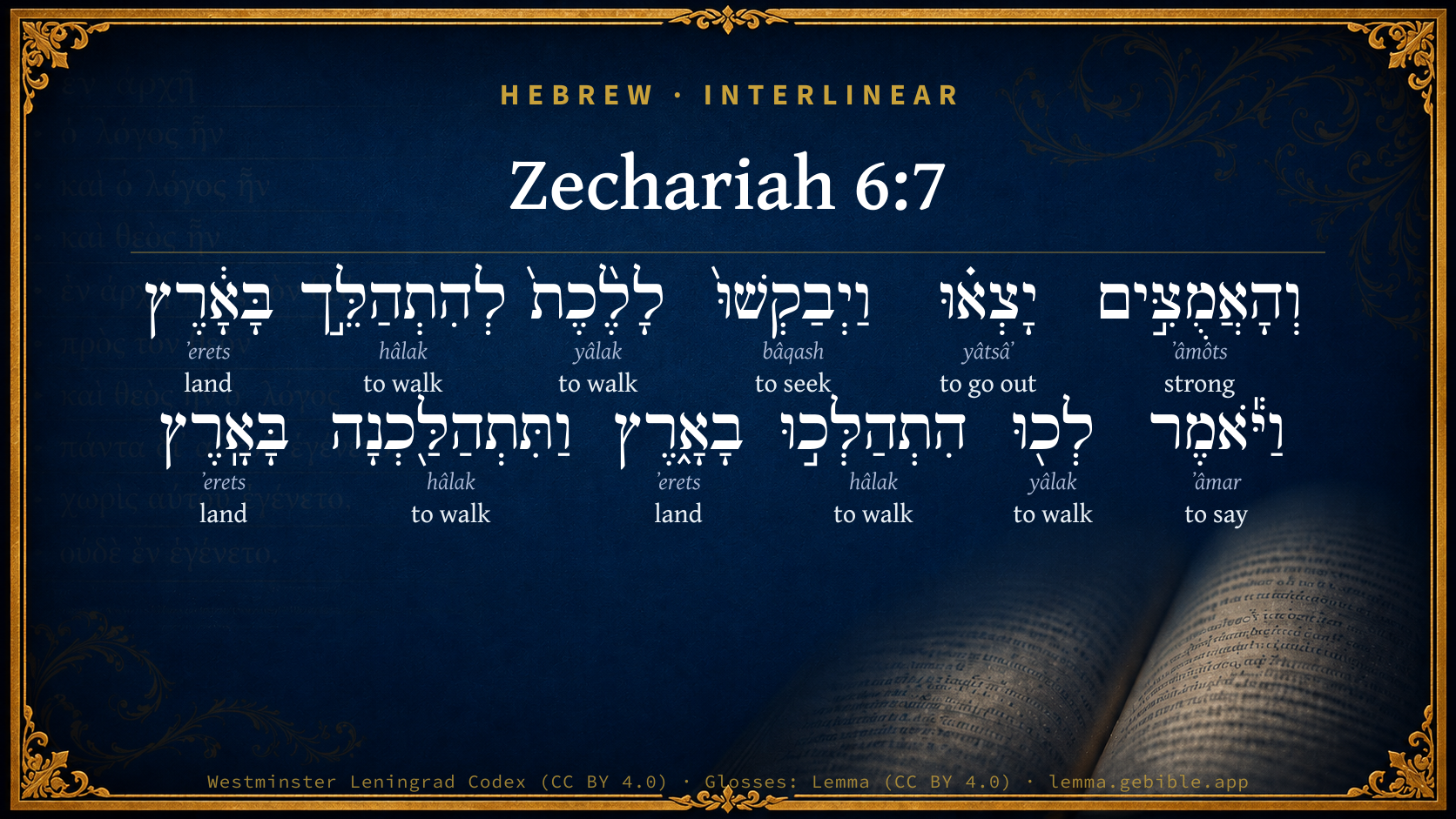
Hebrew (Westminster Leningrad Codex) Zechariah 6:7 appears in the Hebrew Old Testament. The text above is from the Westminster Leningrad Codex. Each word links to its Strong’s number, a concise gloss, and parsing drawn from the Open Scriptures Hebrew Bible morphology. Click any word for its full Brown-Driver-Briggs (BDB) entry.
Download image
Cite this verse

Zechariah 6:7 (World English Bible). Public Domain. Lemma interlinear Bible study tool, https://lemma.gebible.app/v/zechariah/6/7.

Show BibTeX & RIS
BibTeX
RIS
English Translation
The strong went out, and sought to go that they might walk back and forth through the earth: and he said, "Go around and through the earth!" So they walked back and forth through the earth.
World English Bible · Public Domain
Download a study sheet

One document with this verse’s original text, its word-by-word gloss line, the meaning frame, cross-references with their text, attributed commentary, and full source and license credits — printable, and it pastes into notes with its structure intact.

This verse Autodidact and up

Study sheet (.html) Plain text (.txt)

A passage Seminary Student

Up to 50 verses in one chapter. A passage sheet keeps up to 6 commentary sources and 12 cross-references per verse, in the order this page ranks them, and says so on the sheet whenever that leaves anything out. Ask for a single verse and you get the Autodidact verse sheet above.

Everything on this page stays free to read, with no account — the sheet is a download of what is already on screen, not access to it.

Want to remove ads? Support Godless Engineer
Compare translations 3

The same verse in 3 English versions, stacked beneath the original-language interlinear above. Click any original word for its lexicon entry.

Each is an independent rendering of the whole verse — the interlinear is not word-aligned to these translations.

Highlighted words mark where these versions differ — a whole-verse word diff, not a word-by-word alignment.

  • World English Bible Public Domain
    The strong went out, and sought to go that they might walk back and forth through the earth: and he said, "Go around and through the earth!" So they walked back and forth through the earth.
  • King James Version Public Domain
    And the bay went forth, and sought to go that they might walk to and fro through the earth: and he said, Get you hence, walk to and fro through the earth. So they walked to and fro through the earth.
  • unfoldingWord Literal Text CC BY-SA 4.0
    And the strong ones went out and sought to go to walk about in the earth. And he said, “Go, walk about in the earth.” And they walked about in the earth.

unfoldingWord Literal Text — © unfoldingWord, licensed CC BY-SA 4.0. Word-aligned USFM3 via Door43 (git.door43.org/unfoldingWord/en_ult).

Versions to compare (up to 4)

3 of 4 selected

Show all 18 translations

Every available English version of this verse, each an independent rendering of the whole verse.

  • World English Bible Public Domain
    The strong went out, and sought to go that they might walk back and forth through the earth: and he said, "Go around and through the earth!" So they walked back and forth through the earth.
  • Berean Standard Bible Public Domain
    As the strong horses went out, they were eager to go and patrol the earth; and the LORD said, “Go and patrol the earth.” So they patrolled the earth.
  • Majority Standard Bible Public Domain
    As the strong horses went out, they were eager to go and patrol the earth; and the LORD said, “Go and patrol the earth.” So they patrolled the earth.
  • King James Version Public Domain
    And the bay went forth, and sought to go that they might walk to and fro through the earth: and he said, Get you hence, walk to and fro through the earth. So they walked to and fro through the earth.
  • American Standard Version (1901) Public Domain
    And the strong went forth, and sought to go that they might walk to and fro through the earth: and he said, Get you hence, walk to and fro through the earth. So they walked to and fro through the earth.
  • Revised Version (1885) Public Domain
    And the bay went forth, and sought to go that they might walk to and fro through the earth: and he said, Get you hence, walk to and fro through the earth. So they walked to and fro through the earth.
  • Geneva Bible (1599) Public Domain
    And the reddish went out, and required to go, and passe through the world, and he sayde, Goe passe through the worlde. So they went thorowout the world.
  • Douay-Rheims (1899) Public Domain
    And they that were most strong, went out, and sought to go, and to run to and fro through all the earth. And he said: Go, walk throughout the earth: and they walked throughout the earth.
  • Young's Literal Translation Public Domain
    and the strong ones have come forth, and they seek to go to walk up and down in the earth;' and he saith, `Go, walk up and down in the earth;' and they walk up and down in the earth.
  • Literal Standard Version CC BY-SA 4.0
    and the strong ones have come forth, and they seek to go to walk up and down in the earth”; and he says, “Go, walk up and down in the earth”; and they walk up and down in the earth.
  • Unlocked Literal Bible CC BY-SA 4.0
    These strong horses went out and sought to go and roam over the earth, so the angel said, “Go and roam over the earth!” and they left for all the earth.
  • unfoldingWord Literal Text CC BY-SA 4.0
    And the strong ones went out and sought to go to walk about in the earth. And he said, “Go, walk about in the earth.” And they walked about in the earth.
  • Darby Bible Public Domain
    and the strong go forth, and seek to go that they may walk to and fro through the earth. And he said, Go, walk to and fro through the earth. And they walked to and fro through the earth.
  • World Messianic Bible Public Domain
    The strong went out, and sought to go that they might walk back and forth through the earth. He said, “Go around and through the earth!” So they walked back and forth through the earth.
  • Webster's Bible Public Domain
    And the bay went forth, and sought to go that they might walk to and fro through the earth: and he said, Go hence, walk to and fro through the earth. So they walked to and fro through the earth.
  • Free Bible Version CC BY-SA 4.0
    When the strong horses came out they were eager to set off to patrol the earth. And he said, “Go and patrol the earth!” So they left and patrolled the earth.
  • Bible in Basic English Public Domain
    And the red ones go to the east; and they made request that they might go up and down through the earth: and he said, Go up and down through the earth. So they went up and down through the earth.
  • JPS Tanakh (1917) Public Domain
    and the bay went forth'. And they sought to go that they might walk to and fro through the earth; and he said: 'Get you hence, walk to and fro through the earth.' So they walked to and fro through the earth.

Literal Standard Version (2020), Covenant Press — licensed CC BY-SA 4.0. Text via the HelloAO Bible API (eBible.org). Unlocked Literal Bible (unfoldingWord) — licensed CC BY-SA 4.0. Text via the HelloAO Bible API (eBible.org). unfoldingWord Literal Text — © unfoldingWord, licensed CC BY-SA 4.0. Word-aligned USFM3 via Door43 (git.door43.org/unfoldingWord/en_ult). Free Bible Version, Dr. Jonathan Gallagher — licensed CC BY-SA 4.0. Text via the HelloAO Bible API (eBible.org).

Word by word

More ways to search: Search by grammar → Find every occurrence → Compare this word →

Practice this passage: Drill this verse → Learn its vocabulary →

וְהָאֲמֻצִּ֣ים
ʼâmôts
H554
“and · the · strong”
Conjunction + Particle, Definite Article + Adjective, Adjective, Masculine, Plural, Absolute
Part of Speech
Conjunction + Particle + Adjective
Type
Adjective
Gender
Masculine
Number
Plural
State
Absolute
Full BDB Definition

Origin: probably from H553

TWOT: 117c

strong - bay, dappled, piebald (of colour)
  1. יָצְא֗וּ yâtsâʼ H3318 “to go out” Verb, Qal, Perfect, 3rd Person, Common, Plural
  2. וַיְבַקְשׁוּ֙ bâqash H1245 “and · to seek” Conjunction + Verb, Piel, Sequential Imperfect, 3rd Person, Masculine, Plural
  3. לָלֶ֨כֶת֙ yâlak H3212 “to walk” Preposition + Verb, Qal, Infinitive Construct
  4. לְהִתְהַלֵּ֣ך hâlak H1980 “to walk” Preposition + Verb, Hithpael, Infinitive Construct
  5. בָּאָ֔רֶץ ʼerets H776 “in/at the · land” Preposition, Determined + Noun, Common, Both, Singular, Absolute
  6. וַיֹּ֕אמֶר ʼâmar H559 “and · to say” Conjunction + Verb, Qal, Sequential Imperfect, 3rd Person, Masculine, Singular
  7. לְכ֖וּ yâlak H3212 “walk” Verb, Qal, Imperative, 2nd Person, Masculine, Plural
  8. הִתְהַלְּכ֣וּ hâlak H1980 “walk” Verb, Hithpael, Imperative, 2nd Person, Masculine, Plural
  9. בָאָ֑רֶץ ʼerets H776 “in/at the · land” Preposition, Determined + Noun, Common, Both, Singular, Absolute
  10. וַתִּתְהַלַּ֖כְנָה hâlak H1980 “and · to walk” Conjunction + Verb, Hithpael, Sequential Imperfect, 3rd Person, Feminine, Plural
  11. בָּאָֽרֶץ ʼerets H776 “in/at the · land” Preposition, Determined + Noun, Common, Both, Singular, Absolute

About this verse

These counts appear in no published source. They are computed here, from the morphology-tagged text and Lemma’s own curated glosses. What Lemma adds →

12
words
7
distinct lemmas
Prophets
section

Notable vocabulary

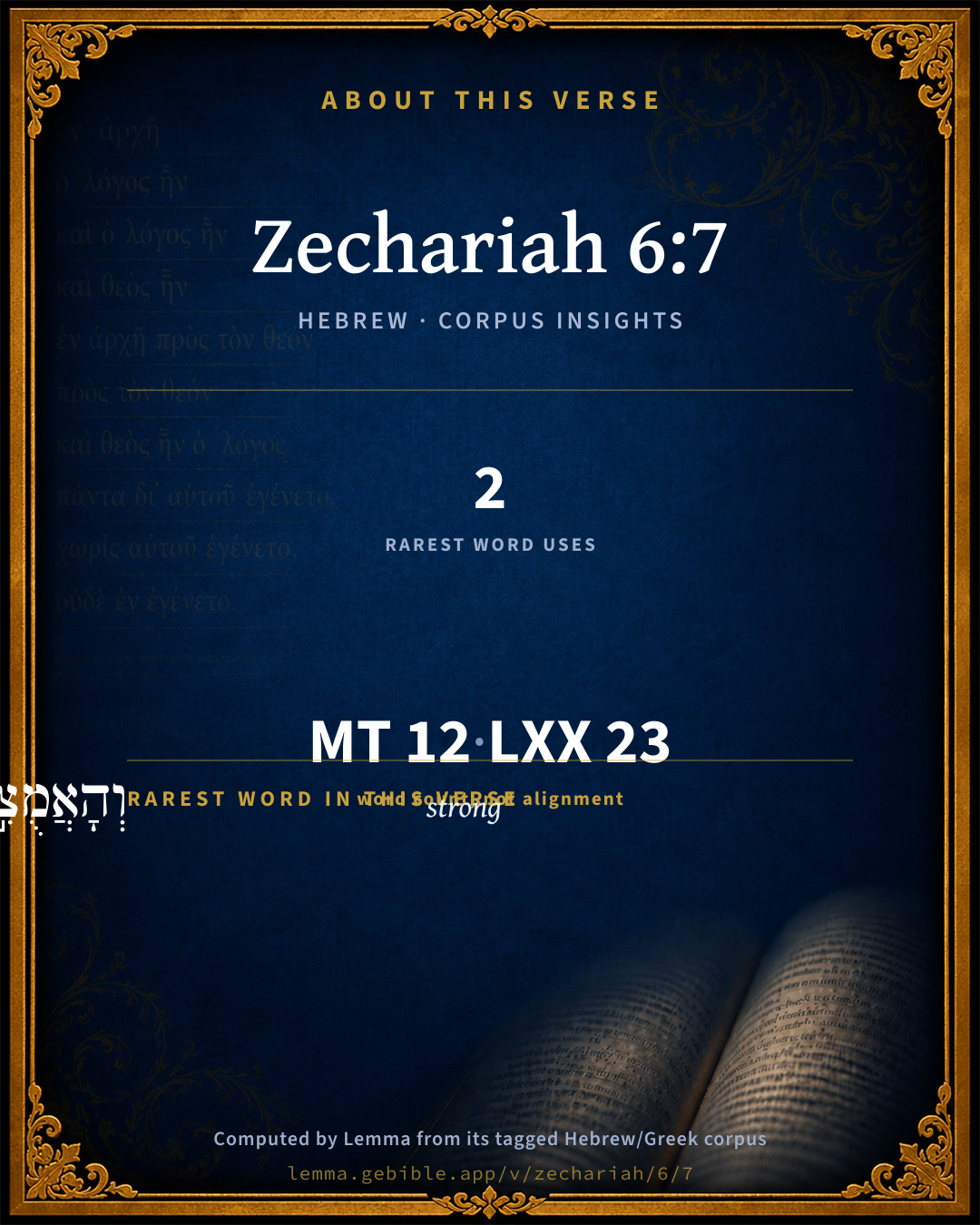
The rarest word here is וְהָאֲמֻצִּ֣ים strong H554 — appearing just 2 times in the whole Hebrew Bible.

Shared distinctive vocabulary

וְהָאֲמֻצִּ֣ים strong H554 occurs in 2 verses of the Hebrew Bible. Also found in:

Grammatical profile

  • 8 verbs
  • 3 nouns
  • 1 adjective

Verb forms

  • יָצְא֗וּ Qal · Perfect
  • וַיְבַקְשׁוּ֙ Piel · Sequential Imperfect
  • לָלֶ֨כֶת֙ Qal · Infinitive Construct
  • לְהִתְהַלֵּ֣ך Hithpael · Infinitive Construct
  • וַיֹּ֕אמֶר Qal · Sequential Imperfect
  • לְכ֖וּ Qal · Imperative
  • הִתְהַלְּכ֣וּ Hithpael · Imperative
  • וַתִּתְהַלַּ֖כְנָה Hithpael · Sequential Imperfect

Repetition

Words recur within this verse — often emphatic in Hebrew:

  • לְהִתְהַלֵּ֣ך to walk H1980 ×3
  • בָּאָ֔רֶץ land H776 ×3
  • לָלֶ֨כֶת֙ to walk H3212 ×2

Hebrew & Septuagint length

In English translation the verse runs 36 words from the Hebrew and 26 from the Septuagint (LXX English) — closely comparable.

A rough comparison of the two English renderings, which tokenize alike — not a word-level alignment.

Word counts can differ between the Hebrew and the Greek without any difference in meaning — e.g. the Hebrew direct-object marker אֵת has no separate Greek word, and Greek often adds the article ὁ.

In the original languages it is 12 Hebrew tokens and 23 Greek tokens — but the two are counted differently (Hebrew bundles its prefixes and suffixes into one token; the Greek is in lemma form), so that isn’t a like-for-like length.

Cross-references

7

Topical passages linked to Zechariah 6:7 in the Treasury of Scripture Knowledge — connected by theme and wording, ordered by reader-vote popularity; previews shown in the World English Bible.

  • 2 Chronicles 16:9 For the eyes of Yahweh run back and forth throughout the whole earth, to show himself strong in the behalf of them whose heart is perfect toward him. Herein you have done foolishly; for from henceforth you shall have wars.
  • Zechariah 1:10 The man who stood among the myrtle trees answered, "They are the ones Yahweh has sent to go back and forth through the earth."
  • Genesis 13:17 Arise, walk through the land in the length of it and in the breadth of it; for I will give it to you."
  • Job 1:6–7 Now it happened on the day when the sons of God came to present themselves before Yahweh, that Satan also came among them.
  • Job 2:1–2 Again it happened on the day when the sons of God came to present themselves before Yahweh, that Satan came also among them to present himself before Yahweh.
  • Daniel 7:19 Then I desired to know the truth concerning the fourth animal, which was diverse from all of them, exceedingly terrible, whose teeth were of iron, and its nails of brass; which devoured, broke in pieces, and stamped the residue with its feet;
  • Daniel 7:24 As for the ten horns, out of this kingdom shall ten kings arise: and another shall arise after them; and he shall be diverse from the former, and he shall put down three kings.

Cross-references courtesy of OpenBible.info (CC BY 4.0).

Hebrew and Greek witnesses Masoretic Hebrew ↔ Greek Septuagint

The same verse in the two great witnesses to the Old Testament, shown verse-for-verse.

These are two independent witnesses, not word-aligned to each other, and the Septuagint is shown in lemma (dictionary) form.

Hebrew Zechariah 6:7 Masoretic · Westminster Leningrad Codex

וְהָאֲמֻצִּ֣ים יָצְא֗וּ וַיְבַקְשׁוּ֙ לָלֶ֨כֶת֙ לְהִתְהַלֵּ֣ך בָּאָ֔רֶץ וַיֹּ֕אמֶר לְכ֖וּ הִתְהַלְּכ֣וּ בָאָ֑רֶץ וַתִּתְהַלַּ֖כְנָה בָּאָֽרֶץ

The strong went out, and sought to go that they might walk back and forth through the earth: and he said, "Go around and through the earth!" So they walked back and forth through the earth.

World English Bible · Public Domain

Greek LXX Zechariah 6:7 Septuagint · lemma form

καί ὁ ψαρός ἐκπορεύομαι καί ἐπιβλέπω ὁ πορεύομαι ὁ περιὁδεύω ὁ γῆ καί εἶπον πορεύομαι καί περιὁδεύω ὁ γῆ καί περιὁδεύω ὁ γῆ

And the ash-colored went out, and looked to go and compass the earth: and he said, Go, and compass the earth. And they compassed the earth.

LXX2012 (modern English Septuagint) · Public Domain

On this verse, Haydock's Catholic Bible Commentary discusses the Septuagint’s reading. Read the note in Commentary ↓

Hebrew: Westminster Leningrad Codex (CC BY 4.0). Greek: Septuagint (public domain); English from LXX2012 (modern English Septuagint) (Public Domain). How the Septuagint differs from the Hebrew →

Targum (Aramaic paraphrase)

1

The Targum is the ancient Jewish Aramaic paraphrase of the Hebrew Scriptures — an interpretive translation, not the Hebrew text itself. Onkelos (literal) and Pseudo-Jonathan (expansive) render the Torah, and Jonathan the Prophets. Coverage is partial: where no permissively-licensed English translation exists for a verse, only the Aramaic is shown. This is verse-level text, not a word-by-word alignment to the Hebrew.

  1. Targum Jonathan Prophets (Joshua–Malachi)
    וְקִטְמָנִין נְפָקוּ וּבְעוֹ לְמֵיזַל לְהַלָכָא בְּאַרְעָא וַאֲמַר אֱזִילוּ וְהַלִיכוּ בְּאַרְעָא וְהַלִיכוּ בְּאַרְעָא:

    (no public-domain English translation for this verse)

    Targum Jonathan — Aramaic: “Mikraot Gedolot” (public domain). English: “Sefaria Community Translation” (CC0 1.0 (public-domain dedication)); “London "Chaldee Paraphrase," 1871” (public domain). Text via Sefaria.

Commentary

Notes on Zechariah 6:7 from classic Christian and Jewish commentators (each source and its license shown beneath its notes). The classic Christian expositions comment on the surrounding passage and are grouped to its opening verse, so a note may address several verses; the Jewish commentaries on the Tanakh (Rashi and others) are per-verse, so they appear only where the commentator wrote on this verse.

Lemma curates 59 commentaries, every one of them public domain or Creative Commons licensed, each selected and text-cleaned for this edition rather than reprinted as found. About our sources →

Trapp's Complete Commentary

John Trapp

Zec 6:7 And the bay went forth, and sought to go that they might walk to and fro through the earth: and he said, Get you hence, walk to and fro through the earth. So they walked to and fro through the earth.

Ver. 7. And the bay went forth, &c.] Junius reads it, And the strong, or confirmed ones; that is, the angels, armed with power and authority from God for the execution of his will: Isa 10:34 "Lebanon shall fall by a mighty one," that is, by an angel. 2Th 1:7, they are called the angels of God’s power; and elsewhere, principalities and powers.

And sought to go, that they might walk to and fro through the earth] Not only toward the south, as Zec 6:6. This doth not teach that the angels are more careful of this world than God is, of whom they desired it. But first, that they can do nothing without commission from him Secondly, that they are ever ready to offer their service and to yield obedience, upon the least intimation of the Divine pleasure.

John Trapp, A Commentary or Exposition upon All the Books of the Old and New Testament (1647–1656) — public domain. Text from a community e-Sword module.

Tyndale Open Study Notes

Tyndale Open Resources

6:7 The teams of horses are portrayed as powerful and eager to do the Lord’s work (6:5). They move only at the Lord’s command.

Tyndale Open Study Notes — © Tyndale Open Resources, licensed CC BY-SA 4.0. Text via the HelloAO Bible API.

Geneva Bible (1599)

Geneva Bible translators

That is, they of divers colors, which ask […], to signify that Satan hath no power to hurt or afflict, till God gives it him, Job 1:12.

Geneva Bible (1599) marginal notes — public domain. Text via Bolls.life.

Jamieson, Fausset & Brown

Robert Jamieson, A. R. Fausset & David Brown

bay--rather, the "fleet" (or "strong"). As the "red" are not otherwise mentioned, the epithet "fleet" (as the Hebrew for "bay" ought to be translated) in Zac 6:3 seems to apply to all four, and here especially to the "red." Their office is to complete hereafter the work already in part executed by the previous three who have stilled Babylon, Medo-Persia, and Græco-Macedonia; namely, to punish finally the last great foe of Israel, the final form assumed by the fourth world kingdom, Rome, which is to continue down to the second advent of Christ. Hence they "walk to and fro through the earth," counterworking Satan's "going to and fro in the earth" (Job 1:7; Th2 2:8-9; Ti1 4:1), in connection with the last awful development of the fourth world kingdom. Their "fleetness" is needed to counteract his restless activity; their red color implies the final great carnage (Eze. 39:1-29; Rev 19:17-18, Rev 19:21).

Jamieson, Fausset & Brown — Commentary Critical and Explanatory on the Whole Bible (1871) — public domain (CC PDM 1.0). Text via the HelloAO Bible API.

Adam Clarke's Commentary

Verse 7. And the bay went forth] The Seleucidae, who conquered Syria and the upper provinces, and who wished to extend their conquests, and "sought to go, that they might walk to and fro throughout the earth," were of unbounded ambition, and sought universal empire; such as Antiochus the Great. "So they walked to and fro," did extend their conquests; and harassed many countries by their vexatious and almost continual wars. Some think the Romans are meant, who carried their conquests hither and thither, just as the Divine providence permitted them.

Adam Clarke's Commentary on the Bible (1810–1826) — public domain. Text from a community e-Sword/MySword module.

John Calvin's Commentaries

But he says, that being not satisfied with the land of the south, they asked of God permission to go to and fro through the whole world. And though neither the devil nor the wicked regard God’s bidding, but are led, without knowing and against their will, wherever God drives them; yet the Prophet says, that they asked; for they could not overstep the limits prescribed to them. Though Satan asked, as to Job, to be allowed to do this and that, we are not yet too curiously to inquire whether Satan asks leave of God whenever he intends to attempt anything; for there is no doubt but that he is carried away by his violent rage to try in every way to overturn the government of God. But this only ought to satisfy us — that neither Satan nor the wicked can advance one inch, except as God permits them. The meaning then is, that after the last chariot went forth first to the land of the south, a permission was given to it to go through the whole world. He now adds —

John Calvin's Commentaries (1540-1563) — public domain. Text from the Calvin Translation Society English edition (1840s-50s) via the Christian Classics Ethereal Library (ccel.org). Calvin's coverage is partial (roughly two-thirds of the Bible); uncommented books and verses are honest gaps, never fabricated. The 19th-century editor's footnotes and remarks are omitted so the notes are faithfully Calvin's own voice.

Ellicott's Commentary for English Readers

(7) Bay.—Better, powerful; but in the Hebrew the word which the English Version renders “red” must be substituted here, and rendered bay. Then the destinations of all the four coloured horses—bay, black, white, and grey—will be accounted for.

Get you hence.—Simply, Go ye.

A Bible Commentary for English Readers, edited by Charles John Ellicott (1878–1897) — public domain. Text from a community e-Sword module.

The Cambridge Bible for Schools and Colleges

gen. ed. J. J. S. Perowne

7. walk to and fro through the earth] The supposed mixed colour of these horses has been thought to signify a mixed exercise of judgment and mercy by the power which they represent: “partim ut malis supplicia irrogarent, partim ut bonos, si qui supersint, defenderent.” Rosenm. But the scope of the vision seems rather to point to judgment exclusively.

The Cambridge Bible for Schools and Colleges (gen. ed. J. J. S. Perowne; Cambridge University Press, 1878–1918) — public domain. Text from a community e-Sword module.

John Gill's Exposition

And the bay went forth, and sought to go,.... Without leave: these design either the Romans; or, since distinct from the grisled, the Huns, Goths, and Vandals; who sought to go out of their own places into other countries: and were desirous

that they might walk to and fro through the earth: without control; overrunning as they, did the Roman empire, and set up ten kingdoms in it; unless this is to be understood of the land of Judea only, through which the Romans walked to and fro at pleasure, and subdued it:

and he said; that is, the Lord of the whole earth, before whom they stood:

Get ye hence, walk to and fro through the earth; as being filled with indignation at them, and yet suffered them to have their will; and so Kimchi interprets the phrase,

"he gave them power to go and subdue lands;''

and to the same purpose Jarchi,

"he gave them power to rule with great authority; and this is the kingdom of Edom or Rome:''

So they walked to and fro through the earth; either the land of Judea, as the Romans did, and made it a Roman province; and these may represent Rome Papal, set up and supported by the above people, even the beast of Rome, which has reigned over the kings of the earth, to whom the ten kings gave their kingdom and power.

John Gill's Exposition of the Whole Bible (1746–1763) — public domain (CC PDM 1.0). Text via the HelloAO Bible API.

Albert Barnes' Notes on the Bible

And the strong went forth and sought to go, that they might walk to and fro through the earth - The mention of their strength corresponds to the extent of the power and commission, for which they asked, to go to and fro, up and down, at their will, unhindered, through the whole earth. The Babylonian empire held Egypt only out of Asia; the Persian was conquered in its efforts against Europe, in Greece; Alexander’s was like a meteor, gleaming but breaking into the four: the Roman combined East and West and within large limits tranquilly.

And he said go, walk to and fro in the earth - He commanded, and they, which were before withheld, went, “and they walked to and fro on the earth,” ordering all things at their will, under the Providence of God, whereby He gave free access to the Gospel in all their wide empire. The Greek empire being extinguished, the Romans no longer went into any given country, but superintended and governed all human things in (it is the language of the New Testament) “all the world.” Cyril: “These same, the dappled and ashen-grey horses were commanded to traverse the earth, and they did traverse it; for they mastered all under heaven, and ruled the whole earth, God consenting and arraying those who swayed the Roman might with this brilliant glory. For, as God, He knew beforehand the greatness of their future piety.”

Albert Barnes' Notes on the Bible (1834–1885) — public domain. Text from a community e-Sword/MySword module.

Haydock's Catholic Bible Commentary

Strong. Septuagint, "variegated;" Greek: psaroi, (Haydock) sturnini. (St. Jerome) --- Earth. This well describes the ambition and power of the Seleucides, particularly of Antiochus the great, (Calmet) or of the Roman generals down to Cæsar. (Menochius)

George Leo Haydock (1774–1849), Haydock's Catholic Family Bible and Commentary, 1859 edition — public domain. Excludes Psalms (Douay-Rheims chapter numbering differs from Protestant) and Deuterocanonical books (Catholic canon only).

Matthew Poole's English Annotations

The bay went forth, from the place where the prophet saw them at first standing as at the starting-place,

and sought to go, either asked commission or waited for it, that they might walk to and fro through the earth: they had a larger commission, say some, the whole earth; or a particular commission to keep their rounds in the land of Judea, and to take care of their affairs for the comfort of that people.

He said, Christ, who hath all power in heaven and on earth,

Get you hence; stay no longer here, hasten to your charge; as you have desired, so do.

So they walked to and fro through the earth; they obey immediately, and do his commands. These bay horses are here represented as attempting, or making essay, which at first seems to take little effect, though at last, by a full commission empowered, they do succeed in the attempt. This might give ground to suppose here is some kingdom aimed at, which made some attempts to enlarge itself through all the earth, but failed in its attempt, which no wonder, since the angels which were to assist were not commissioned to walk through the whole earth, and they keeping to their commission gave no further help, for want of which the design failed. How far this may concern Goths and Vandais, or any more late empires and kingdoms, I have neither skill nor will further to inquire. Nor yet to inquire whether these bay horses were not emblems of angels employed by the Lord, in the government of the rest of the kingdoms of the world remote from Judea, but not remote from God’s wise and sovereign providence governing all the earth. The known empires here are supposed to have been managed by particular angels, represented according to the analogy between the colours of the horses and the complexion of the kingdoms. And it may seem likely that the rest of the world was not left without some to have care of them.

Matthew Poole's English Annotations on the Holy Bible (1683–1685) — public domain. Text from a community e-Sword/MySword module.

The Pulpit Commentary

The bay; rather, the strong, as in ver. 3; the horses in the fourth chariot, whose special mission needed peculiar powers. Septuagint, oi qaroi : but the Vulgate, qui erant robustissimi. Sought to go. These agents desired a wider sphere, and asked permission to extend their action, and to walk to and fro through the earth. Famine and pestilence, which this chariot symbolizes, come at different times and in different places mysteriously and unexpectedly "as arrows shot from the hand of God (Eze_5:16) on the objects of his displeasure" (Alexander). LXX, Kai epeblepon S, (2) Kai ezhtoun kai epeblepon tou poreuesyai tou A, kai periodeusai th , "And looked to go and compass the earth."

The Pulpit Commentary (1880–1919), ed. H.D.M. Spence-Jones & Joseph S. Exell — public domain. Text from a community e-Sword module.

John Wesley's Explanatory Notes

Sought to go - Waited for a commission. He said - Christ who hath all power in heaven and on earth. Through the earth - Thro' the rest of the kingdoms of the world remote from Judea, but not remote from God's wise and sovereign providence.

John Wesley, Explanatory Notes Upon the Whole Bible (1754–1765) — public domain. Text via the GEBible commentary corpus.

unfoldingWord translationNotes

Door43 World Missions Community

he called out to me

"the angel called out to me"

Look at the ones

"Look at the black horses"

they will appease my spirit concerning the north country

The words "my spirit" refer to Yahweh, so many translations change this to read "Yahweh's spirit." Possible meanings are 1) the word "spirit" represents Yahweh's emotions and appeasing his spirit means that the chariots will cause Yahweh no longer to be angry with the north country AT: "they will calm my anger concerning the north country" or 2) the word "spirit" represents Yahweh's presence and the chariots will cause the Jews who live in the north land to experience Yahweh's blessings. AT: "they will cause my spirit to rest in the north country" (See: Metonymy)

translationWords

horse

earth

spirit

unfoldingWord translationNotes — © Distant Shores Media and the Door43 World Missions Community, licensed CC BY-SA 4.0. Source: git.door43.org/Door43/en_tn.

Rashi

Rabbi Shlomo Yitzchaki (Rashi)

And the ash-colored ones went forth and begged of Him that they have a very long rule, to go throughout all the earth.

And He said, “Go, walk to and fro on the earth” He gave them permission to rule a great ruling, and that is the kingdom of Edom.

Rashi on the Tanakh — English translations: “The Judaica Press complete Tanach with Rashi, translated by A. J. Rosenberg” (CC BY 4.0); “Pentateuch with Rashi's commentary by M. Rosenbaum and A.M. Silbermann, 1929-1934” (public domain); “The Metsudah Tanach series, Lakewood, N.J” (CC BY 4.0); and “The Book of Joshua, Metsudah Publications, 1997” (CC BY 4.0). Text via Sefaria.

Lesson kit

Teaching starters — assembled from the data on this page, not authored interpretation. Every prompt links to the verse data it draws on. Edit before teaching.

Zechariah, in the Prophets, opens this verse with 12 words (7 distinct Hebrew lemmas). Its most distinctive word is ʼâmôts (“strong”). A historical commentator’s framing appears above. Read the whole chapter for the surrounding context.

Discussion questions

  1. How does “strong” (ʼâmôts) shape what this verse is saying?
  2. Zechariah 6:3 shares the word «strong» with this verse. How do the two illuminate each other?
  3. “to walk” occurs 3× in this one verse. What is the effect of the repetition?
  4. These translations render this verse differently. What is at stake in choosing one wording over another?
  5. The verb «יָצְא֗וּ» is Qal Perfect. How does its form color the action?
  6. Reading how Trapp's Complete Commentary and Tyndale Open Study Notes read this verse, where do the two commentators agree and where do they part?

Things to notice

Reading settings

Reading text

Shown beneath each verse's original-language words.

Old Testament
Old Testament edition

Read the OT as the Masoretic Hebrew (MT) or the Greek Septuagint (LXX).

English shown for the Greek Septuagint (in the Hebrew ↔ Greek comparison).

Comparing translations? Open the Compare panel on any verse page to stack up to four side by side.