
Zechariah 4:8

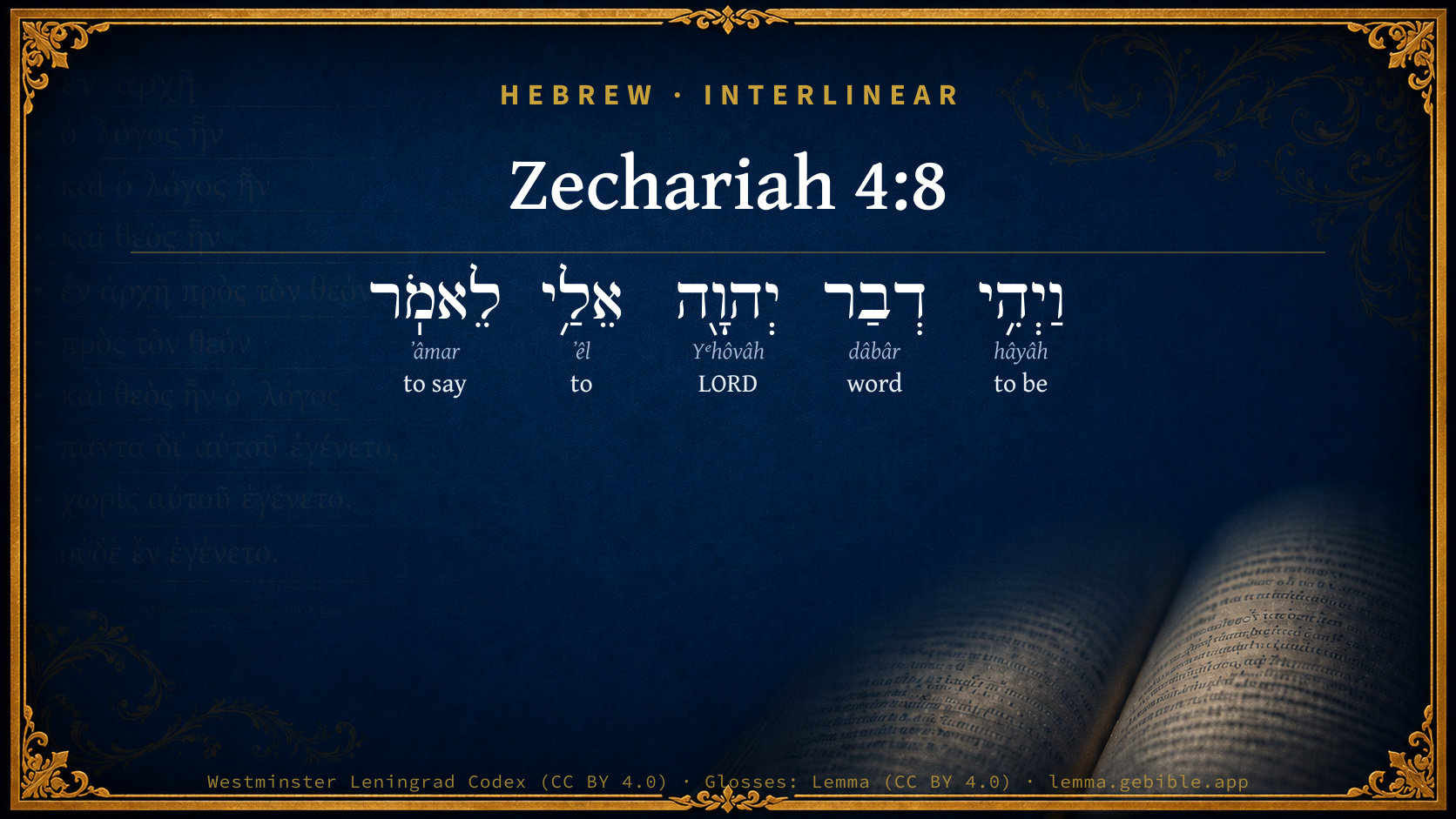
Hebrew (Westminster Leningrad Codex) Zechariah 4:8 appears in the Hebrew Old Testament. The text above is from the Westminster Leningrad Codex. Each word links to its Strong’s number, a concise gloss, and parsing drawn from the Open Scriptures Hebrew Bible morphology. Click any word for its full Brown-Driver-Briggs (BDB) entry.
Download image
Cite this verse

Zechariah 4:8 (World English Bible). Public Domain. Lemma interlinear Bible study tool, https://lemma.gebible.app/v/zechariah/4/8.

Show BibTeX & RIS
BibTeX
RIS
English Translation
Moreover the word of Yahweh came to me, saying,
World English Bible · Public Domain
Download a study sheet

One document with this verse’s original text, its word-by-word gloss line, the meaning frame, cross-references with their text, attributed commentary, and full source and license credits — printable, and it pastes into notes with its structure intact.

This verse Autodidact and up

Study sheet (.html) Plain text (.txt)

A passage Seminary Student

Up to 50 verses in one chapter. A passage sheet keeps up to 6 commentary sources and 12 cross-references per verse, in the order this page ranks them, and says so on the sheet whenever that leaves anything out. Ask for a single verse and you get the Autodidact verse sheet above.

Everything on this page stays free to read, with no account — the sheet is a download of what is already on screen, not access to it.

Want to remove ads? Support Godless Engineer
Compare translations 3

The same verse in 3 English versions, stacked beneath the original-language interlinear above. Click any original word for its lexicon entry.

Each is an independent rendering of the whole verse — the interlinear is not word-aligned to these translations.

Highlighted words mark where these versions differ — a whole-verse word diff, not a word-by-word alignment.

  • World English Bible Public Domain
    Moreover the word of Yahweh came to me, saying,
  • King James Version Public Domain
    Moreover the word of the LORD came unto me, saying,
  • unfoldingWord Literal Text CC BY-SA 4.0
    And the word of Yahweh came to me, saying,

unfoldingWord Literal Text — © unfoldingWord, licensed CC BY-SA 4.0. Word-aligned USFM3 via Door43 (git.door43.org/unfoldingWord/en_ult).

Versions to compare (up to 4)

3 of 4 selected

Show all 18 translations

Every available English version of this verse, each an independent rendering of the whole verse.

  • World English Bible Public Domain
    Moreover the word of Yahweh came to me, saying,
  • Berean Standard Bible Public Domain
    Then the word of the LORD came to me, saying,
  • Majority Standard Bible Public Domain
    Then the word of the LORD came to me, saying,
  • King James Version Public Domain
    Moreover the word of the LORD came unto me, saying,
  • American Standard Version (1901) Public Domain
    Moreover the word of Jehovah came unto me, saying,
  • Revised Version (1885) Public Domain
    Moreover the word of the LORD came unto me, saying,
  • Geneva Bible (1599) Public Domain
    Moreouer, the word of the Lord came vnto me, saying,
  • Douay-Rheims (1899) Public Domain
    And the word of the Lord came to me, saying:
  • Young's Literal Translation Public Domain
    And there is a word of Jehovah to me, saying,
  • Literal Standard Version CC BY-SA 4.0
    And there is a word of YHWH to me, saying,
  • Unlocked Literal Bible CC BY-SA 4.0
    The word of Yahweh came to me, saying,
  • unfoldingWord Literal Text CC BY-SA 4.0
    And the word of Yahweh came to me, saying,
  • Darby Bible Public Domain
    And the word of Jehovah came unto me, saying,
  • World Messianic Bible Public Domain
    Moreover the LORD’s word came to me, saying,
  • Webster's Bible Public Domain
    Moreover the word of the LORD came to me, saying,
  • Free Bible Version CC BY-SA 4.0
    Then the Lord gave me another message.
  • Bible in Basic English Public Domain
    Then the word of the Lord came to me, saying,
  • JPS Tanakh (1917) Public Domain
    Moreover the word of the LORD came unto me, saying:

Literal Standard Version (2020), Covenant Press — licensed CC BY-SA 4.0. Text via the HelloAO Bible API (eBible.org). Unlocked Literal Bible (unfoldingWord) — licensed CC BY-SA 4.0. Text via the HelloAO Bible API (eBible.org). unfoldingWord Literal Text — © unfoldingWord, licensed CC BY-SA 4.0. Word-aligned USFM3 via Door43 (git.door43.org/unfoldingWord/en_ult). Free Bible Version, Dr. Jonathan Gallagher — licensed CC BY-SA 4.0. Text via the HelloAO Bible API (eBible.org).

Word by word

More ways to search: Search by grammar → Find every occurrence → Compare this word →

Practice this passage: Drill this verse → Learn its vocabulary →

About this verse

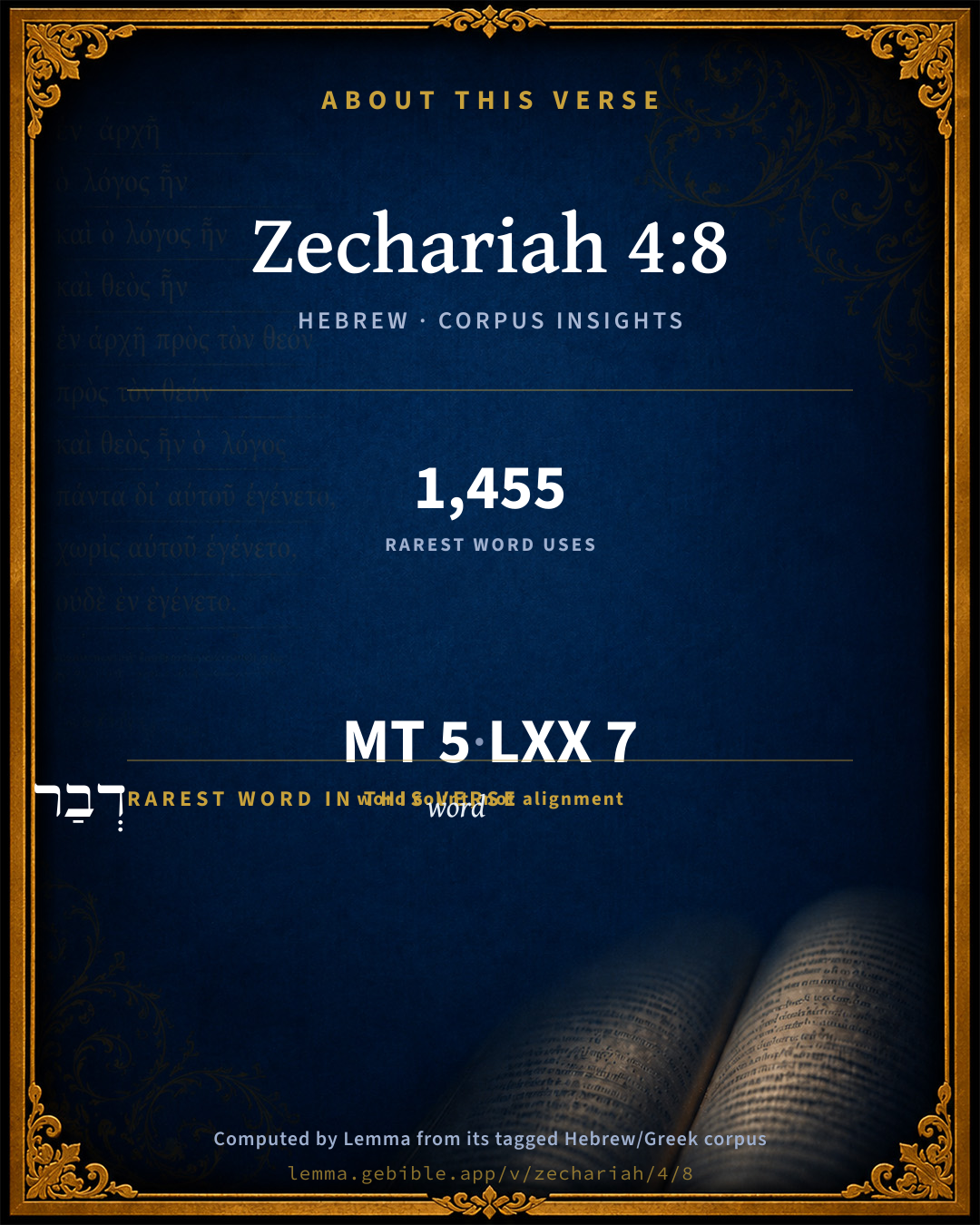
These counts appear in no published source. They are computed here, from the morphology-tagged text and Lemma’s own curated glosses. What Lemma adds →

5
words
5
distinct lemmas
Prophets
section

Grammatical profile

  • 2 verbs
  • 2 nouns
  • 1 preposition

Verb forms

  • וַיְהִ֥י Qal · Sequential Imperfect
  • לֵאמֹֽר Qal · Infinitive Construct

Hebrew & Septuagint length

In English translation the verse runs 9 words from the Hebrew and 10 from the Septuagint (LXX English) — closely comparable.

A rough comparison of the two English renderings, which tokenize alike — not a word-level alignment.

Word counts can differ between the Hebrew and the Greek without any difference in meaning — e.g. the Hebrew direct-object marker אֵת has no separate Greek word, and Greek often adds the article ὁ.

In the original languages it is 5 Hebrew tokens and 7 Greek tokens — but the two are counted differently (Hebrew bundles its prefixes and suffixes into one token; the Greek is in lemma form), so that isn’t a like-for-like length.

Hebrew and Greek witnesses Masoretic Hebrew ↔ Greek Septuagint

The same verse in the two great witnesses to the Old Testament, shown verse-for-verse.

These are two independent witnesses, not word-aligned to each other, and the Septuagint is shown in lemma (dictionary) form.

Hebrew Zechariah 4:8 Masoretic · Westminster Leningrad Codex

וַיְהִ֥י דְבַר יְהוָ֖ה אֵלַ֥י לֵאמֹֽר

Moreover the word of Yahweh came to me, saying,

World English Bible · Public Domain

Greek LXX Zechariah 4:8 Septuagint · lemma form

καί γίγνομαι λόγος κύριος πρός ἐγώ λέγω

And the word of the Lord came to me, saying,

LXX2012 (modern English Septuagint) · Public Domain

On this verse, Keil & Delitzsch discusses the Septuagint’s reading. Read the note in Commentary ↓

Hebrew: Westminster Leningrad Codex (CC BY 4.0). Greek: Septuagint (public domain); English from LXX2012 (modern English Septuagint) (Public Domain). How the Septuagint differs from the Hebrew →

Targum (Aramaic paraphrase)

1

The Targum is the ancient Jewish Aramaic paraphrase of the Hebrew Scriptures — an interpretive translation, not the Hebrew text itself. Onkelos (literal) and Pseudo-Jonathan (expansive) render the Torah, and Jonathan the Prophets. Coverage is partial: where no permissively-licensed English translation exists for a verse, only the Aramaic is shown. This is verse-level text, not a word-by-word alignment to the Hebrew.

  1. Targum Jonathan Prophets (Joshua–Malachi)
    וַהֲוָה פִּתְגַם נְבוּאָה מִן קֳדָם יְיָ עִמִי לְמֵימָר:

    (no public-domain English translation for this verse)

    Targum Jonathan — Aramaic: “Mikraot Gedolot” (public domain). English: “Sefaria Community Translation” (CC0 1.0 (public-domain dedication)); “London "Chaldee Paraphrase," 1871” (public domain). Text via Sefaria.

Commentary

Notes on Zechariah 4:8 from classic Christian and Jewish commentators (each source and its license shown beneath its notes). The classic Christian expositions comment on the surrounding passage and are grouped to its opening verse, so a note may address several verses; the Jewish commentaries on the Tanakh (Rashi and others) are per-verse, so they appear only where the commentator wrote on this verse.

Lemma curates 59 commentaries, every one of them public domain or Creative Commons licensed, each selected and text-cleaned for this edition rather than reprinted as found. About our sources →

John Gill's Exposition

Moreover, the word of the Lord came unto me, saying. As follows; which is a confirmation of the angel's interpretation of the vision.

Moreover, the word of the Lord came unto me, saying. As follows; which is a confirmation of the angel's interpretation of the vision.

Zechariah 4:9

zac 4:9

zac 4:9

zac 4:9The hands of Zerubbabel have laid the foundation of this house,.... The temple at Jerusalem, which was laid, or however renewed, after it had been long neglected, even the four and twentieth day of the ninth month, two months before this vision and prophecy, Hag 2:18 compared with Zac 1:7,

his hands shall also finish it: signified by bringing in the head or top stone, Zac 4:7 and so Christ our great Zerubbabel has laid the foundation of his church, which is no other than himself; and is a foundation firm and strong, sure and certain, immovable and everlasting; and his hands will finish the building of it, by bringing and laying every elect soul upon this foundation; which may be concluded from his hands being those which have laid the foundations of the heavens and the earth; uphold all things in being, and hold the reins of government; and who, as Mediator, has all the persons of his people in his hands, and all grace and glory for them: his hands also have laid the foundation of grace in the hearts of his people, and he will finish it; he, who is the author, will be the finisher of faith:

and thou shall know that the Lord of hosts hath sent me unto you; this clause is not an address to Zerubbabel, as Aben Ezra and others think; but to the people of the Jews, as appears from the plural word used, at the end of it; nor are the words spoken by the prophet of himself; though the Targum paraphrases them to this sense,

"and ye shall know that the Lord of hosts hath sent me to prophesy unto you;''

that is, when they should see his prophecies accomplished, and the temple built, then they would know and acknowledge that he was a true prophet, sent of God unto them; nor is the angel designed, so often mentioned, that talked with the prophet; for he was sent, not to the Jews, but to him; but they are spoken by the Messiah, called "the Word of the Lord"; Zac 4:8 who, when he shall have finished the work of grace on every man's heart by his Spirit, and shall have completed the whole Gospel building, the church, by gathering in everyone of the elect; then it shall be known and owned by all, both the converted Jews and Gentiles, that he is the true Messiah, the sent of God to the forefathers of the Jews, who came to preach the Gospel to them, work miracles among them, and obtain eternal redemption for men.

John Gill's Exposition of the Whole Bible (1746–1763) — public domain (CC PDM 1.0). Text via the HelloAO Bible API.

Trapp's Complete Commentary

John Trapp

Zec 4:8 Moreover the word of the LORD came unto me, saying,

Ver. 8. Moreover the word of the Lord came unto me, saying] This is a confirmation of the former comfort and a seal of the former promise; all which was but little enough by reason of the people’ s distrust and infidelity. Against which the prophet here produceth his warrant, God’s own word; q.d. "This is a faithful saying, and worthy of all acceptation." "This is a pillar and ground of truth." {See Trapp on "1Ti 3:15"}

John Trapp, A Commentary or Exposition upon All the Books of the Old and New Testament (1647–1656) — public domain. Text from a community e-Sword module.

Keil & Delitzsch

C. F. Keil & F. Delitzsch

A further and still clearer explanation of the angel's answer (Zac 4:6 and Zac 4:7) is given in the words of Jehovah which follow in Zac 4:8-10. Zac 4:8. "And the word of Jehovah came to me thus: Zac 4:9. The hands of Zerubbabel have laid the foundation of this house, and his hands will finish it; and thou wilt know that Jehovah of hosts hath sent me to you. Zac 4:10. For who despiseth the day of small things? and they joyfully behold the plummet in the hand of Zerubbabel, those seven: the eyes of Jehovah, they sweep through the whole earth." This word of God is not addressed to the prophet through the angelus interpres, but comes direct from Jehovah, though, as Zac 4:9 clearly shows when compared with Zac 2:9 and Zac 2:11, through the Maleach Jehovah. Although the words "the hands of Zerubbabel have laid the foundation of this house" unquestionably refer primarily to the building of the earthly temple, and announce the finishing of that building by Zerubbabel, yet the apodosis commencing with "and thou shalt know" shows that the sense is not thereby exhausted, but rather that the building is simply mentioned here as a type of the spiritual temple (as in Zac 7:12-13), and that the completion of the typical temple simply furnishes a pledge of the completion of the true temple. For it was not by the finishing of the earthly building, but solely by the carrying out of the kingdom of God which this shadowed forth, that Judah could discern that the angel of Jehovah had been sent to it. This is also apparent from the reason assigned for this promise in Zac 4:10, the meaning of which has been explained in very different ways. Many take ושׂמחוּ וגו as an apodosis, and connect it with כּי מי בז as the protasis: "for whoever despises the day of small things, they shall see with joy," etc. (lxx, Chald., Pesh., Vulg., Luther., Calv., and others); but מי can hardly be taken as an indefinite pronoun, inasmuch as the introduction of the apodosis by Vav would be unsuitable, and it has hitherto been impossible to find a single well-established example of the indefinite מי followed by a perfect with Vav consec. And the idea that vesâmechū is a circumstantial clause, in the sense of "whereas they see with joy" (Hitzig, Koehler), is equally untenable, for in a circumstantial clause the verb never stands at the head, but always the subject; and this is so essential, that if the subject of the minor (or circumstantial) clause is a noun which has already been mentioned in a major clause, either the noun itself, or at any rate its pronoun, must be repeated (Ewald, 341, a), because this is the only thing by which the clause can be recognised as a circumstantial clause. We must therefore take מי as an interrogative pronoun: Who has ever despised the day of the small things? and understand the question in the sense of a negation, "No one has ever despised," etc. The perfect baz with the syllable sharpened, for bâz, from būz (like tach for tâch in Isa 44:18; cf. Ges. 72, Anm. 8), expresses a truth of experience resting upon facts. The words contain a perfect truth, if we only take them in the sense in which they were actually intended, - namely, that no one who hopes to accomplish, or does accomplish, anything great, despises the day of the small things. Yōm qetannōth, a day on which only small things occur (cf. Num 22:18). This does not merely mean the day on which the foundation-stone of the temple was first laid, and the building itself was still in the stage of its small beginnings, according to which the time when the temple was built up again in full splendour would be the day of great things (Koehler and others). For the time when Zerubbabel's temple was finished - namely, the sixth year of Darius - was just as miserable as that in which the foundation was laid, and the building that had been suspended was resumed once more. The whole period from Darius to the coming of the Messiah, who will be the first to accomplish great things, is a day of small things, as being a period in which everything that was done for the building of the kingdom of God seemed but small, and in comparison with the work of the Messiah really was small, although it contained within itself the germs of the greatest things.

The following perfects, ושׂמחוּ וראוּ, have Vav consec., and express the consequence, though not "the necessary consequence, of their having despised the day of small beginnings," as Koehler imagines, who for that reason properly rejects this view, but the consequence which will ensue if the day of small things is not despised. The fact that the clause beginning with vesâmechū is attached to the first clause of the verse in the form of a consequence, may be very simply explained on the ground that the question "who hath despised," with its negative answer, contains an admonition to the people and their rulers not to despise the small beginnings. If they lay this admonition to heart, the seven eyes of God will see with delight the plumb-lead in the hand of Zerubbabel. In the combination ושׂמחוּ וראוּ the verb sâmechū takes the place of an adverb (Ges. 142, 3, a). אבן הבּדיל is not a stone filled up with lead, but an 'ebhen which is lead, i.e., the plumb-lead or plummet. A plummet in the hand is a sign of being engaged in the work of building, or of superintending the erection of a building. The meaning of the clause is therefore, "Then will the seven eyes of Jehovah look with joy, or with satisfaction, upon the execution," not, however, in the sense of "They will find their pleasure in this restored temple, and look upon it with protecting care" (Kliefoth); for if this were the meaning, the introduction of the plummet in the hand of Zerubbabel would be a very superfluous addition. Zerubbabel is still simply the type of the future Zerubbabel - namely, the Messiah - who will build the true temple of God; and the meaning is the following: Then will the seven eyes of God help to carry out this building. שׁבעה אלּה cannot be grammatically joined to עיני יהוה in the sense of "these seven eyes," as the position of 'ēlleh (these) between the numeral and the noun precludes this; but עיני יהוה is an explanatory apposition to שׁבעה אלּה: "those (well-known) seven, (viz.) the eyes of Jehovah." The reference is to the seven eyes mentioned in the previous vision, which are directed upon a stone. These, according to Zac 3:9, are the sevenfold radiations or operations of the Spirit of the Lord. Of these the angel of the Lord says still further here: They sweep through the whole earth, i.e., their influence stretches over all the earth. These words also receive their full significance only on the supposition that the angel of Jehovah is speaking of the Messianic building of the house or kingdom of God. For the eyes of Jehovah would not need to sweep through the whole earth, in order to see whatever could stand in the way and hinder the erection of Zerubbabel's temple, but simply to watch over the opponents of Judah in the immediate neighbourhood and the rule of Darius.

Keil & Delitzsch — Biblical Commentary on the Old Testament (1861–1891) — public domain (CC PDM 1.0). Text via the HelloAO Bible API. (Old Testament only.)

John Calvin's Commentaries

He confirms in this passage what I lately stated — That there was no reason for the faithful to entertain doubts or to feel anxious, because they saw that the beginning of the building was mean and despised by the world; for the Lord would at length show that it was built by his sanction and command, and that it would succeed far better than all of them had thought.

But he says that the word of Jehovah came to him; and yet at the end of the next verse he shows that this address came from the mouth of the angel. But it is a well-known and a common mode of speaking, that God himself is said to speak, when he employs either angels or men as his agents; for the person of the messenger lessens in no degree the reverence due to the word: the majesty, then, of God ought to remain inviolable in his word, whether brought to us by men or by angels. Now the Prophet felt assured that nothing was adduced by the angel, but what he conveyed as the minister of God.

The sum of the whole is, that the temple, though some interruptions happened, was yet so begun that its completion was at length to be expected; as God had made use of the labors of Zerubbabel, so he would not forsake the work of his hands. Since, then, God was the chief founder of the building, it could not be but that the temple would at length be completed.

John Calvin's Commentaries (1540-1563) — public domain. Text from the Calvin Translation Society English edition (1840s-50s) via the Christian Classics Ethereal Library (ccel.org). Calvin's coverage is partial (roughly two-thirds of the Bible); uncommented books and verses are honest gaps, never fabricated. The 19th-century editor's footnotes and remarks are omitted so the notes are faithfully Calvin's own voice.

Ellicott's Commentary for English Readers

(8) Me.—The word of the Lord now comes directly to the prophet, as, possibly, in Zec_2:6-13.

A Bible Commentary for English Readers, edited by Charles John Ellicott (1878–1897) — public domain. Text from a community e-Sword module.

Albert Barnes' Notes on the Bible

And the word of the Lord - Keil: “This word of the Lord is not addressed through ‘the interpreting angel,’ but direct from the Lord, and that through the ‘Angel of the Lord’ . For though in the first instance the words, “the hands of Zerubbabel etc.,” relate to the building of the material temple, and announce its completion through Zerubbabel yet the inference, “and thou shalt know theft the Lord of hosts hath sent me unto you,” shows that the meaning is not exhausted thereby, but that here too this building is mentioned only as a type of the building of the spiritual temple ; and the completion of the typical temple is but a pledge of the completion of the true temple. For not through the completion of the material temple, but only through the building of the kingdom of God, shadowed forth by it, can Judah know, that the Angel of the Lord was sent to him.”

Albert Barnes' Notes on the Bible (1834–1885) — public domain. Text from a community e-Sword/MySword module.

Matthew Poole's English Annotations

Either at another time, or else at the same time, was added what now Zechariah declares.

Matthew Poole's English Annotations on the Holy Bible (1683–1685) — public domain. Text from a community e-Sword/MySword module.

The Pulpit Commentary

The word of the Lord came unto me. The word came through the interpreting angel, as is clear from the expression in ver. 9, "The Lord hath sent me unto you." He explains more fully what had been already announced figuratively.

Vers. 8-14. The Church sustained.

"Moreover the word of the Lord came unto me, saying, The hands of Zerubbabel have laid the foundation of this house," etc. These verses continue the metaphors of the previous portion, but in the opposite order. Vers. 1-7 begin with the "olive trees" and end with the "house;" vers. 8-14 begin with the "house" (vers. 8-10) and conclude with the "trees." We may look on this latter passage, therefore, as a kind of additional message ("moreover," ver. 8) on the same general subject and to the same general purport as before. The principal difference is in connection with the questions of order and depth. As we learned before not a little, first as to the secret, and secondly as to the completeness, of the restored life of the Jewish Church, so here we learn very much more

(1) as to that same completeness, and

(2) as to that same secret, of this same restored life.

I ITS COMPLETENESS. As conveyed, we suppose, by what is said respecting the material "house" (or typical Church) then in process of erection. We find this described in vers. 9, 10. And of the promise contained therein we may notice:

1. How peculiarly explicit it is. Not only is the work which Zerubbabel had begun to be finished; it is to be finished by "his hands," and therefore, of course, in his time. Not only, again, is it to be so far finished as to be capable, as it were, of habitation and use; but so far finished as to be ready for that most absolutely ultimate of all building processes, the process of testing the work done. How graphic the description of this! "They shall see the plummet in the hands of Zerubbabel.

2. How exceedingly deliberate it is. To start the work of erecting this temple to begin such a true spiritual Church restoration was a great thing. To accomplish it, a still greater. If accomplished, indeed, that of itself would be a sufficient proof of a true mission from God. (see the end of ver. 9; also, to some extent, 2Sa_7:12, 2Sa_7:13) Especially would this be so in that "day of small things," when even well wishers persons ready to "rejoice" in such a tiring, if really accomplished as it were "despised" the idea. All this was known, all this was recognized, when the promise was given.

3. How fully assured it is. Was there not One "sent" to accomplish this, even that Angel-Jehovah represented by the "stone" of Zec_3:9? And was there not sent also, of necessity, together with him, a full supply of all that was necessary to accomplish these wonders? (See end of ver. 10, and the reference there to "those seven" eyes to be found on that "stone;" Rev_5:6; also 2Ch_16:9; and compare end of ver. 6 in this chapter) To secure that "stone" is to secure that sevenfold blessing, and all it involves.

II ITS SECRET. A yet further point, in regard to this, seems revealed to us in that which comes next. It is not enough to have the blessing referred to, so to speak, in reversion. If the Church is to shine as a living witness, some channel of communication must be in existence by which it can be always supplied therewith without fail. To understand the emblem employed (as before described in ver. 3) to represent this, we may notice:

1. The prophets ignorance of its meaning. See this five times referred to, viz. in vers. 4, 5, 11, 12, 13. Whatever he meant, therefore, it is evidently something the nature of which is so far occult and secret that even the eyes of a prophet might fail to discern it at first.

2. The angel"s surprise at his ignorance. "Knowest thou not?". (see vers. 5 and 13; and comp. Joh_3:10 Mar_4:13 Rom_6:3, 16 7:1) The prophet ought to have discerned it, although he did not.

3. The explanation that follows. (Ver. 14) An explanation which seems to show us:

(1) Why the prophet ought to have understood the emblem, viz. because it represented an ordinance carefully ordered and arranged, even that of certain persons "anointed" for special service; an ordinance, also, ancient and settled ("stand by," as a custom or habit); an ordinance of most extensive import, even affecting the whole earth.

(2) What we may understand thereby; viz. that God always maintains in the world a succession of special witnesses for him, who "stand by" him, as it were, so as to be informed of his will, and who are "anointed," as it were, so as to keep alive in turn the general witness of his Church; (see 2Co_5:18-20 2Co_4:7 2Ti_2:2 Gen_18:17 Amo_3:7) and who also, either as being always sufficient in number, (2Co_13:1, and references; also Rev_11:3, Rev_11:4) or else as being usually divided, as were Zerubbabel and Jeshua, in the spirit of Luk_10:24 and 1Ti_5:17, are set forth to us as "two" in number. In these ways it is that it pleases God always to keep alive the life of his Church. (1Co_1:21)

See illustrated here also, in conclusion:

1. Gods great love for his people. He gives his Son for them in order, afterwards, to give them his Spirit as well. (Joh_4:10 Gal_4:4-6) He buys these earthen vessels for a sum beyond cost, in order, then, to fill them with an ointment which is also beyond cost!

2. God"s great care for his Church. Whatever the objects of the "ministry of angels," God has entrusted specially to men the duty of keeping alight among men the "candlestick" of his truth. How often this light has been all but extinct! (Gen_6:5-8 Gen_12:1 compared with Jos_24:2 1Sa_3:1 1Sa_7:3 1Ki_19:10, 14 Psa_12:1 Isa_53:1 Mic_7:2 Rev_11:7-10) Yet how wonderfully preserved throughout; and to be preserved to the end! (Mat_16:18)

The Pulpit Commentary (1880–1919), ed. H.D.M. Spence-Jones & Joseph S. Exell — public domain. Text from a community e-Sword module.

unfoldingWord translationNotes

Door43 World Missions Community

Connecting Statement:

The angel who speaks with Zechariah continues to explain the vision.

The word of Yahweh came to me, saying, "The hands

This idiom is used to introduce a special message from God. AT: "Yahweh gave a message to me. He said, 'The hands" or "Yahweh spoke this message to me: 'The hands" (See: Idiom)

The hands of Zerubbabel have laid ... his hands will bring it to completion

Here the word "hands" represents Zerubbabel. AT: "Zerubbabel has laid ... he will bring it to completion" (See: Synecdoche)

the foundation of this house

The word "house" represents the temple. AT: "the foundation of this temple" (See: Metonymy)

Who has despised the day of small things? These people will rejoice

Zechariah uses this rhetorical question to speak specifically about those who have "despised the day of small things." It can be translated as a statement. AT: "Those who have despised the day of small things will rejoice" (See: Rhetorical Question)

the day of small things

"the time of small things." This phrase refers to the time when the people were building the temple and appeared to be making little progress. AT: "the time when progress was slow" (See: Assumed Knowledge and Implicit Information)

plumb stone

This refers to an instrument made with a heavy object attached to the end of a string that builders used to ensure that the walls of buildings were straight.

These seven lamps ... these two olive trees

These phrases refer to the lamps and olive trees that Zechariah saw in Zechariah 4:2-3.

These seven lamps are the eyes of Yahweh that roam over the whole earth

The seven lamps symbolize the eyes of Yahweh, but they are not literally the eyes of Yahweh. The angel speaks of Yahweh seeing everything that happens on the earth as if his eyes roamed over the whole earth. AT: "These seven lamps represent the eyes of Yahweh, who sees everything that happens on the earth" (See: Symbolic Language and Metaphor)

translationWords

olive

lampstand

unfoldingWord translationNotes — © Distant Shores Media and the Door43 World Missions Community, licensed CC BY-SA 4.0. Source: git.door43.org/Door43/en_tn.

Lesson kit

Teaching starters — assembled from the data on this page, not authored interpretation. Every prompt links to the verse data it draws on. Edit before teaching.

Zechariah, in the Prophets, opens this verse with 5 words (5 distinct Hebrew lemmas). Its most distinctive word is dâbâr (“word”). A historical commentator’s framing appears above. Read the whole chapter for the surrounding context.

Discussion questions

  1. The word dâbâr carries the sense “word.” How does it shape the verse?
  2. These translations render this verse differently; the difference is in the English rendering, not the original. What questions does that raise?
  3. «וַיְהִ֥י» is a Qal Sequential Imperfect verb. How does that grammatical form shape the action described?
  4. Compare how John Gill's Exposition and Trapp's Complete Commentary read this verse. Where do they agree or differ?

Things to notice

Reading settings

Reading text

Shown beneath each verse's original-language words.

Old Testament
Old Testament edition

Read the OT as the Masoretic Hebrew (MT) or the Greek Septuagint (LXX).

English shown for the Greek Septuagint (in the Hebrew ↔ Greek comparison).

Comparing translations? Open the Compare panel on any verse page to stack up to four side by side.