Romans 4:23

Greek (Tischendorf 8th ed.) Romans 4:23 appears in the Greek New Testament. The text above is from the Tischendorf 8th edition. Each word links to its Strong’s number and a concise gloss. Click any word for its full Thayer’s Greek Lexicon entry.
Download image
Cite this verse

Romans 4:23 (World English Bible). Public Domain. Lemma interlinear Bible study tool, https://lemma.gebible.app/v/romans/4/23.

Show BibTeX & RIS
BibTeX
RIS
English Translation
Now it was not written that it was accounted to him for his sake alone,
World English Bible · Public Domain
Download a study sheet

One document with this verse’s original text, its word-by-word gloss line, the meaning frame, cross-references with their text, attributed commentary, and full source and license credits — printable, and it pastes into notes with its structure intact.

This verse Autodidact and up

Study sheet (.html) Plain text (.txt)

A passage Seminary Student

Up to 50 verses in one chapter. A passage sheet keeps up to 6 commentary sources and 12 cross-references per verse, in the order this page ranks them, and says so on the sheet whenever that leaves anything out. Ask for a single verse and you get the Autodidact verse sheet above.

Everything on this page stays free to read, with no account — the sheet is a download of what is already on screen, not access to it.

Want to remove ads? Support Godless Engineer
Compare translations 3

The same verse in 3 English versions, stacked beneath the original-language interlinear above. Click any original word for its lexicon entry.

Each is an independent rendering of the whole verse — the interlinear is not word-aligned to these translations.

Highlighted words mark where these versions differ — a whole-verse word diff, not a word-by-word alignment.

  • World English Bible Public Domain
    Now it was not written that it was accounted to him for his sake alone,
  • King James Version Public Domain
    Now it was not written for his sake alone, that it was imputed to him;
  • unfoldingWord Literal Text CC BY-SA 4.0
    Now it was not written only for his sake, “It was credited to him,”

unfoldingWord Literal Text — © unfoldingWord, licensed CC BY-SA 4.0. Word-aligned USFM3 via Door43 (git.door43.org/unfoldingWord/en_ult).

Versions to compare (up to 4)

3 of 4 selected

Show all 19 translations

Every available English version of this verse, each an independent rendering of the whole verse.

  • World English Bible Public Domain
    Now it was not written that it was accounted to him for his sake alone,
  • Berean Standard Bible Public Domain
    Now the words “it was credited to him” were written not only for Abraham,
  • Majority Standard Bible Public Domain
    Now the words “it was credited to him” were written not only for Abraham,
  • King James Version Public Domain
    Now it was not written for his sake alone, that it was imputed to him;
  • American Standard Version (1901) Public Domain
    Now it was not written for his sake alone, that it was reckoned unto him;
  • Revised Version (1885) Public Domain
    Now it was not written for his sake alone, that it was reckoned unto him;
  • Geneva Bible (1599) Public Domain
    Nowe it is not written for him onely, that it was imputed to him for righteousnesse,
  • Douay-Rheims (1899) Public Domain
    Now it is not written only for him, that it was reputed to him unto justice,
  • Young's Literal Translation Public Domain
    And it was not written on his account alone, that it was reckoned to him,
  • Literal Standard Version CC BY-SA 4.0
    And it was not written on his account alone that it was reckoned to him,
  • Unlocked Literal Bible CC BY-SA 4.0
    Now it was not written only for his benefit, that it was counted for him.
  • unfoldingWord Literal Text CC BY-SA 4.0
    Now it was not written only for his sake, “It was credited to him,”
  • Darby Bible Public Domain
    Now it was not written on his account alone that it was reckoned to him,
  • World Messianic Bible Public Domain
    Now it was not written that it was accounted to him for his sake alone,
  • Webster's Bible Public Domain
    Now it was not written for his sake alone, that it was imputed to him;
  • Free Bible Version CC BY-SA 4.0
    The words “Abraham was considered right” weren't just written down for his benefit.
  • Bible in Basic English Public Domain
    Now, it was not because of him only that this was said,
  • Text-Critical English NT CC BY 4.0
    Now the statement “it was counted to him” was not written only for Abraham's sake,
  • Tyndale New Testament (1534) Public Domain
    It is not written for him only that it was reckened to him for rightewesnes:

Literal Standard Version (2020), Covenant Press — licensed CC BY-SA 4.0. Text via the HelloAO Bible API (eBible.org). Unlocked Literal Bible (unfoldingWord) — licensed CC BY-SA 4.0. Text via the HelloAO Bible API (eBible.org). unfoldingWord Literal Text — © unfoldingWord, licensed CC BY-SA 4.0. Word-aligned USFM3 via Door43 (git.door43.org/unfoldingWord/en_ult). Free Bible Version, Dr. Jonathan Gallagher — licensed CC BY-SA 4.0. Text via the HelloAO Bible API (eBible.org).

Word by word

More ways to search: Search by grammar → Find every occurrence → Compare this word →

Practice this passage: Drill this verse → Learn its vocabulary →

ἐλογίσθη
logízomai
G3049
“to reckon”
Verb, Aorist, Passive, Indicative, 3rd person, Singular
Part of Speech
Verb
Tense
Aorist
Voice
Passive
Mood
Indicative
Person
3rd person
Number
Singular
Full Thayer's Definition

Origin: middle voice from G3056

TDNT: 08:44,5

1. to reckon, count, compute, calculate, count over a. to take into account, to make an account of 1. metaph. to pass to one's account, to impute 2. a thing is reckoned as or to be something, i.e. as availing for or equivalent to something, as having the like force and weight b. to number among, reckon with c. to reckon or account 2. to reckon inward, count up or weigh the reasons, to deliberate 3. by reckoning up all the reasons, to gather or infer a. to consider, take into account, weigh, meditate on b. to suppose, deem, judge c. to determine, purpose, decide This word deals with reality. If I "logizomai" or reckon that my bank book has $25 in it, it has $25 in it. Otherwise I am deceiving myself. This word refers to facts not suppositions.
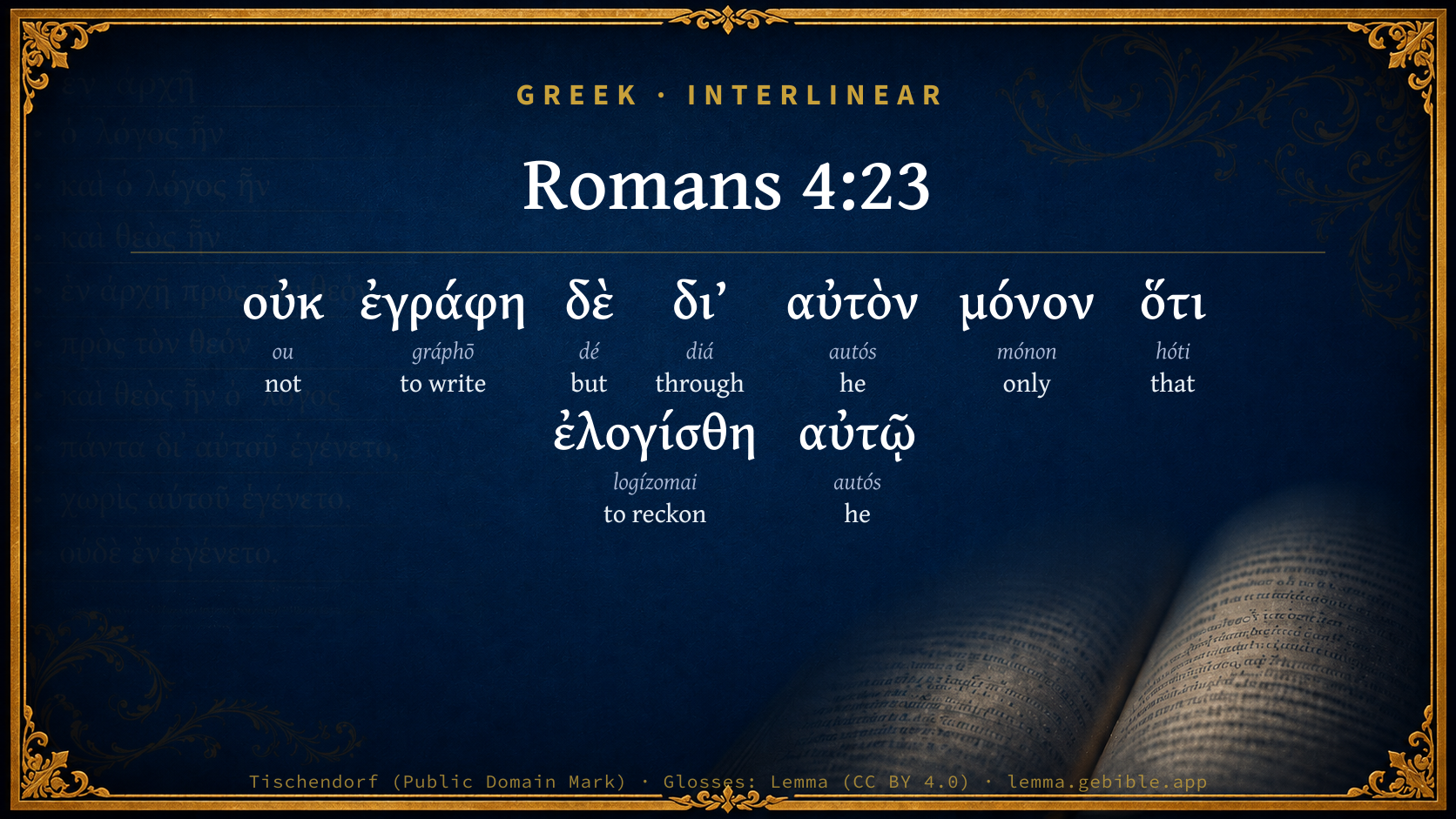
  1. οὐκ ou G3756 “not” Particle, Negative
  2. ἐγράφη gráphō G1125 “to write” Verb, Aorist, Passive, Indicative, 3rd person, Singular
  3. δὲ dé G1161 “but” Conjunction
  4. δι’ diá G1223 “through” Preposition
  5. αὐτὸν autós G846 “he” Personal pronoun, Accusative, Singular, Masculine
  6. μόνον mónon G3440 “only” Adverb
  7. ὅτι hóti G3754 “that” Conjunction
  8. αὐτῷ autós G846 “he” Personal pronoun, Dative, Singular, Masculine

About this verse

These counts appear in no published source. They are computed here, from the morphology-tagged text and Lemma’s own curated glosses. What Lemma adds →

9
words
8
distinct lemmas
Pauline Epistles
section

Shared distinctive vocabulary

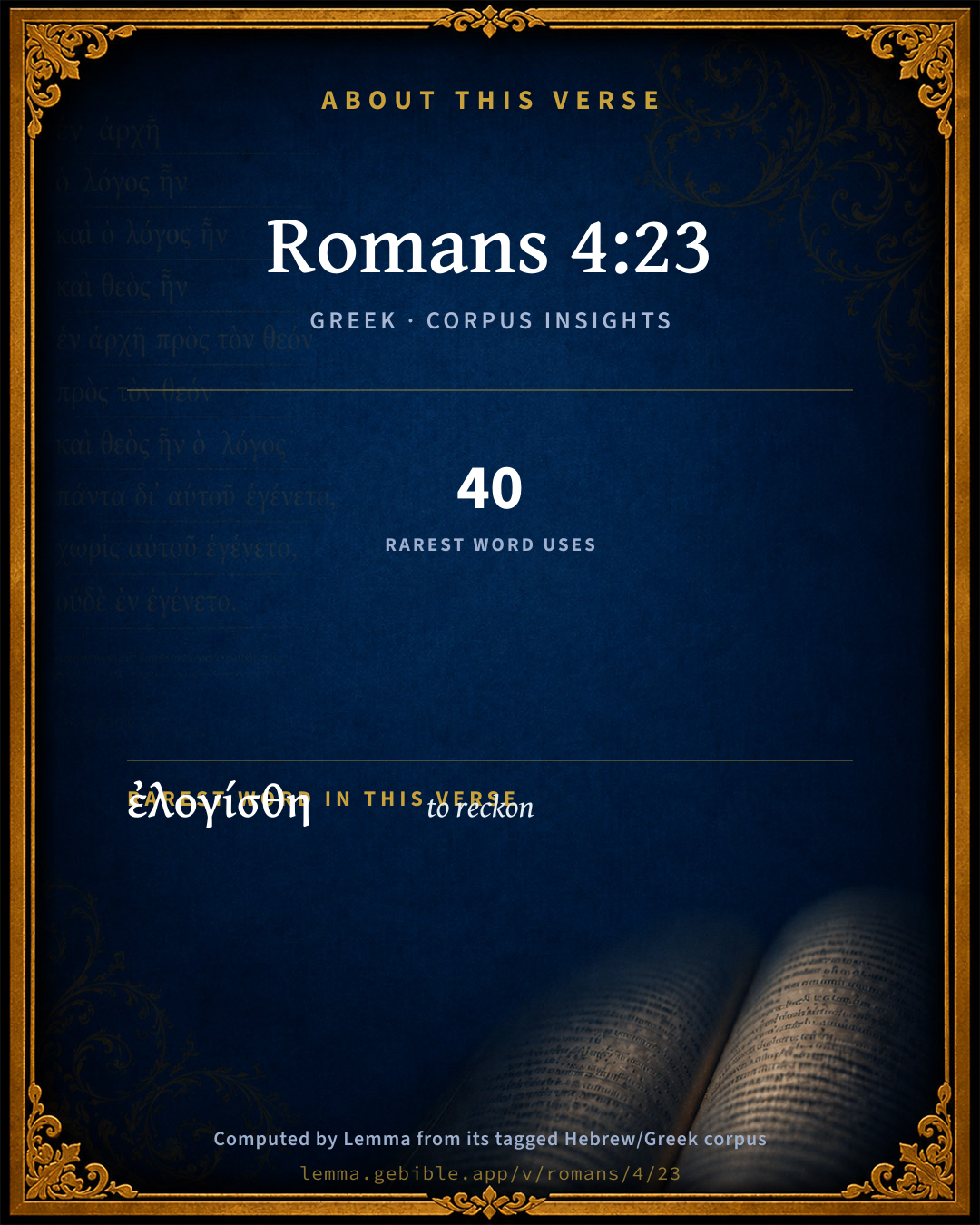
ἐλογίσθη to reckon G3049 occurs in 39 verses of the Greek New Testament. Also found in:

Repetition

A word recurs within this verse:

  • αὐτὸν he G846 ×2

Cross-references

5

Topical passages linked to Romans 4:23 in the Treasury of Scripture Knowledge — connected by theme and wording, ordered by reader-vote popularity; previews shown in the World English Bible.

  • 1 Corinthians 10:11 Now all these things happened to them by way of example, and they were written for our admonition, on whom the ends of the ages have come.
  • Romans 15:4 For whatever things were written before were written for our learning, that through patience and through encouragement of the Scriptures we might have hope.
  • 1 Corinthians 10:6 Now these things were our examples, to the intent we should not lust after evil things, as they also lusted.
  • 2 Timothy 3:16–17 Every writing inspired by God is profitable for teaching, for reproof, for correction, and for instruction which is in righteousness,
  • 1 Corinthians 9:9–10 For it is written in the law of Moses, "You shall not muzzle an ox while it treads out the grain." Is it for the oxen that God cares,

Cross-references courtesy of OpenBible.info (CC BY 4.0).

Commentary

Notes on Romans 4:23 from classic Christian and Jewish commentators (each source and its license shown beneath its notes). The classic Christian expositions comment on the surrounding passage and are grouped to its opening verse, so a note may address several verses; the Jewish commentaries on the Tanakh (Rashi and others) are per-verse, so they appear only where the commentator wrote on this verse.

Lemma curates 59 commentaries, every one of them public domain or Creative Commons licensed, each selected and text-cleaned for this edition rather than reprinted as found. About our sources →

The Biblical Illustrator

Joseph S. Exell

Rom_4:23-25

Now it was not written for his sake alone.

The Scriptures used by every generation

Do you ever think, as you pass along the chapters of the Bible, that they are now like the kings highways; that more saints than tongue could count have walked along these pages toward heaven; that each verse has been a bosom like a mothers to some child in Christ; that each verse has had in it blessings for multitude of souls; that these passages of hope and joy have made melody for thrice ten million struggling souls; that these Scriptures are a sublime renewal of the miracle of the loaf which increases by using, and which feeds without diminution? These unwasting chapters have supplied armies and multitudes of faint and hungry saints, but there is not a particle gone. There is as much yet for the famishing soul as when first they were set forth. To the end the loaf shall be broken, and shall yield a liberal abundance for every human want; and to the end the undiminished whole shall remain a witness and a miracle of the Divine spiritual bounty. (H. W. Beecher.)

Lessons of faith from Abraham

I. The end of our faith--deliverance from sin.

II. The basis of our faith--Gods promise--the death and resurrection of Christ.

III. The encouragement of our faith--Abrahams example. (J. Lyth, D. D.)

Abrahams example

As Abraham believed in life from the dead, so also we, because--

1. God gives us a pledge of it in the resurrection of Christ.

2. God promises to raise us from a death of sin to a life of righteousness.

3. Faith realises the resurrection power. (J. Lyth, D. D.)

It shall be imputed.--

Imputed righteousness

A man is denominated righteous as a wall may be esteemed red or green. Now that comes to pass two manners of ways--either by the colour inherent and belonging to the wall itself, or by the same colour in some diaphanous, transparent body, as glass, which, by the beam of the sun shining on the wall, doth externally affect the same as if it were its own, and covers that true inherent colour which it hath of itself. In like manner, by the strict covenant of the law, we ought to be righteous from a righteousness inherent in and performed by ourselves; but in the new covenant of grace we are righteous by the righteousness of Christ, which shineth upon us, and presenteth us in His colour unto the sight of His Father. Here, in both covenants, the righteousness from whence the denomination groweth is the same, namely, the satisfying of the demands of the whole law; but the manner of our right and property thereunto is much varied. In the one we have right unto it by law, because we have done it ourselves; in the other we have right unto it only by grace and favour, because another mans doing of it is bestowed upon us and accounted ours. (G. H. Salter.)

Christs imputed righteousness

We read in our chronicles that Edmund, surnamed Ironside and Canute, the first Danish king, after many encounters and equal fights, at length embraced a present agreement, which was made by parting England betwixt them two, and confirmed by oath and sacrament, putting on each others apparel and arms, as a ceremony, to express the atonement of their minds, as if they had made transactions of their persons to each other; Canute became Edmund, and Edmund became Canute. Even such a change of apparel is betwixt Christ and His Church--Christ and every true repentant sinner; He taketh upon Him their sins, and putteth upon them His righteousness; He changeth their rags into robes; He arrays them with the righteousness of the saints; that two-fold righteousness, imputed and imparted; that of justification, and the other of sanctification; that is an undercoat, this is an upper; that clean and fair, this white and fair; and both from Himself, who is made unto them not only wisdom, but righteousness, sanctification, and redemption. (G. H. Salter.)

Jesus our Lord.

Jesus our Lord

1. It is the part of Faith to accept great contrasts, if laid down in the Word, and to make them a part of her daily speech. This name, Lord, is a great contrast to incarnation and humiliation. In the manger, in poverty, shame, and death, Jesus was still Lord.

2. These strange conditions for our Lord to be found in are no difficulties to that faith which is the fruit of the Spirit. For she sees in the death of Jesus a choice reason for His being our Lord (Php_2:7-11). Wherefore God hath highly exalted Him. She delights in that Lordship as the fruit of resurrection; but there could have been no resurrection without death (Act_2:32-36). She hears the voice of Jehovah behind all the opposition endured by Jesus proclaiming Him Lord of all (Psa_2:1-12; Psa_110:1-7).

3. It never happens that our faith in Jesus for salvation makes us less reverently behold in Him the Lord of all. He is Jesus and also our Lord. Born a child, and yet a King. My Beloved, and yet My Lord and my God. Our simple trust in Him, our familiar love to Him, our hold approaches to Him in prayer, our near and dear communion with Him, and, most of all, our marriage union with Him, still leave him our Lord.

I. His tender condescensions endear the title. Jesus our Lord is a very sweet name to a believers heart.

1. We claim to render it to Him specially as man, who was delivered for our offences, and was raised again for our justification (Rom_4:25). As Jesus of Nazareth He is Lord.

2. We acknowledge Him as Lord the more fully and unreservedly because He loved us and gave Himself for us.

3. In all the privileges accorded to us in Him He is Lord.

(1) In our salvation we have received Christ Jesus the Lord (Col_2:6).

(2) In entering the Church we find Him the Head of the body, to whom all are subject (Eph_5:23).

(3) In our life work He is Lord. We live unto the Lord (Rom_14:8). We glorify God in His name (Eph_5:20).

(4) In resurrection He is the firstborn from the dead (Col_1:18).

(5) At the Advent His appearing will be the chief glory (Tit_2:13).

(6) In eternal glory He is worshipped forever (Rev_5:12-13).

4. In our dearest fellowship at the table He is Jesus our Lord. It is the Lords table, the Lords supper, the cup of the Lord, the body and blood of our Lord; and our object is to show the Lords death (1Co_11:20; 1Co_11:26-27; 1Co_11:29).

II. Our loving hearts read the title with peculiar emphasis.

1. We yield it to Him only. Moses is a servant, but Jesus alone is Lord. One is your Master (Mat_23:8; Mat_23:10).

2. To Him most willingly. Ours is delighted homage.

3. To Him unreservedly. We wish our obedience to be perfect.

4. To Him in all matter of law making and truth teaching. He is Master and Lord; His word decides practice and doctrine.

5. To Him in all matters of administration in the Church and in providence. It is the Lord, let Him do what seemeth Him good (1Sa_3:18).

6. To Him trustfully, feeling that He will act a Lords part right well. No king can be so wise, good, great as He (Job_1:21).

7. To Him forever. He reigns in the Church without successor. Now, as in the first days, we call Him Master and Lord (Heb_7:3).

III. We find much sweetness in the word our.

1. It makes us remember our personal interest in our Lord. Each believer uses this title in the singular, and calls Him from his heart, My Lord. David wrote, Jehovah said unto my Lord. Elisabeth spoke of The mother of my Lord. Magdalene said, They have taken away my Lord. Thomas said, My Lord and my God. Paul wrote, The knowledge of Jesus Christ my Lord, etc.

2. It brings a host of brethren before our minds, for it is in union with them that we say our Lord, and so it makes us remember each other (Eph_3:14-15).

3. It fosters unity and creates a holy clanship as we all rally around our one Lord. Saints of all ages are one in this.

4. His example as Lord fosters practical love. Remember the foot washing and His words on that occasion (Joh_13:14).

5. Our zeal to make Him Lord forbids all self-exaltation. Be not ye called Rabbi: for one is your Master, even Christ. Neither be ye called masters, etc. (Mat_23:8; Mat_23:10).

6. His position as Lord reminds us of the confidence of the Church in doing His work. All power is given unto Me in heaven and in earth. Go ye, therefore, and teach, etc. (Mat_28:18-19). The Lord working with them (Mar_16:20).

7. Our common joy in Jesus as our Lord becomes an evidence of grace, and thus of union with each other (1Co_12:3). Conclusion:

1. Let us worship Jesus as our Lord and God.

2. Let us imitate Him, copying our Lords humility and love.

3. Let us serve Him, obeying His every command. (C. H. Spurgeon.)

Who was delivered for our offences, and was raised again for our justification.--

An epitome of the gospel

I. Christ was delivered, etc.--the person--delivered--unto death--for our offences--by the determinate counsel of God.

II. Christ was raised, etc.--the fact--the design--because a demonstration of Divine power and grace, and a guarantee to faith. (J. Lyth, D. D.)

The great substitute

During the Reign of Terror in trance, when many persons every day were being executed by the guillotine, a young man was led to the foot of the scaffold among others to die. His father stood by him, and when the sons name was called the father stepped forward, ascended the scaffold, and died in his place. Here Christ is said to have died for us. Let us look at--

I. The cause of Christs death.

1. Offences. Sins. Transgressions. Sin is not a trifle to be forgotten. It is seed that bears terrible fruit. Someone is injured by every sin we commit. Sin harms ourselves and offends God.

2. Our offences. Christ Himself was without sin, but our sin was laid upon Him (Isa_23:6). Our sins are not one, but many. (Rom_5:16).

II. The manner of it.

1. He was delivered, that is, handed over like a criminal to the executioner. Between two thieves.

2. It was voluntary.

3. Preceded by great sufferings.

4. Painful beyond expression.

III. The virtue of it. It was a sufficient atonement. Christ did not fail in redeeming us. He was raised again for our justification.

IV. The claims of it. Such love claims our love and service. (Preachers Magazine.)

Christs deliverance and resurrection

I. Christ was delivered for our offences.

1. Whom was He delivered by?

(1) God (Act_2:23).

(2) Judas.

2. What to?

(1) To shame (Isa_53:3).

(2) To pain (Isa_53:4-5).

(3) To death (Gal_3:13).

3. What for? Our offences.

(1) All men are guilty (Psa_14:3; Gal_3:22).

(2) This guilt cannot be taken away but by satisfying Gods justice (Heb_9:22).

(3) No creature can satisfy it (Psa_49:7-8).

(4) Hence Christ undertook it (1Ti_2:5).

(5) Neither could He do it but by suffering (Heb_9:22; Mat_15:28; 1Ti_2:6).

(6) No suffering would serve the turn but death, and that on the Cross.

(7) By His death He hath satisfied for our offences (1Jn_2:2; Rom_3:25 : Rev_1:5).

(8) Hence our sins came to be pardoned; and so, He being delivered for us, we are delivered from our offences--

(a) As to their guilt (Mat_1:21).

(b) As to their strength (Act_3:26).

III. He was raised again for our justification.

1. How raised again? From death by God (Act_2:23-24; Mat_28:13-15; Luk_24:4-6).

(1) He was a real man.

(2) He really died (Mat_27:50).

(3) He really rose again (Luk_24:37-40; Joh_20:27).

2. What is justification? A forensic term opposed to accusation (chap. 8:33).

(1) Man hath sinned (Rom_3:23).

(2) This he is accused for by--

(a) Gods justice.

(b) The law.

(c) Satan.

(d) Conscience (Rom_2:15; 1Jn_3:20).

(3) Christ hath borne our punishment (Isa_53:6).

(4) He hath also performed obedience for us.

(5) This His righteousness is imputed to us (2Co_5:21).

(6) By this we are cleared from the charge brought against us.

(7) This is my justification.

3. In what sense did Christ rise for our justification, or what dependence hath our justification on Christs resurrection?

(1) Christ undertook to satisfy Gods justice for us.

(2) This He could not do but by suffering death.

(3) So long as dead, He had not done this (1Co_15:14).

(4) His rising again argued death conquered, and justice satisfied (Act_2:24).

4. Therefore being risen He cleanses us from our sins and so justifies us.

Conclusion:

1. Was Christ delivered? Then--

(1) Admire the mercy of God in delivering His Son for us.

(2) Be mindful of Him.

2. Is Christ risen? Then--

(1) We shall rise (1Co_15:12).

(2) Let us mind the things where He is (Col_3:1).

3. Did He rise for our justification? Then believe on Him that you may be justified (Rom_5:1).

(1) In the merits of His death.

(2) The truth of His resurrection.

(3) The constancy of His intercession. (Bp. Beveridge.)

The resurrection the Saviours recompense

The resurrection of our Lord is but one of that series of acts by which the Son of God is fulfilling the commission which He received from the Father to bring back to Him lost creation. We must never so fix our attention on the details of the work of Christ as to lose sight of its wholeness. It was not the first appearance of the Son of God as man which began that work; it was not His disappearance from mortal sight which completed it. Nor is it any one specific link of Christs appearance in the flesh on which the salvation of the world exclusively hangs; but on all of them taken together, inserted into, and mutually dependent on each other, as visible parts of that far greater invisible whole. And, accordingly, St. Paul makes mention of the resurrection of Jesus as consequent upon (not in order of time merely, but of relation) the death of Jesus; and this death, again, as consequent upon (in similar order of relation, and of cause and effect) the offences of mankind: For means on account of, as the result of, our offences, Christ was delivered by the Father to an expiatory death; and on account of, as the result of, our justification, that expiation having been thereby effected, Christ was raised again to everlasting life. Here, then, we see the resurrection of Jesus, connected not merely in the sequence of time, but in the consequence of cause and effect, with the expiatory death of Jesus. Wherein does the connection consist? I answer, the resurrection was vouchsafed by God to Jesus--

I. As the reward of that justifying death. This is a doctrine which St. Paul exhibits more clearly than by the single particle of our text in Php_2:9 (see also Psa_45:7; Psa_91:14; Isa_53:11-12; Heb_12:21). And here we have an instance of Gods general principle of conduct towards His people. He is a rewarder of them that diligently seek Him. Them that honour Him He will honour. God is not unrighteous to forget your work and labour of love which ye have showed towards His name. Be thou faithful unto death, and I will give thee a crown of life. And we must not let the thought lie idle in our minds; we must live upon it by an appropriating faith. Faith in the absolute certainty and constant exercise of Gods moral and retributive government, gives life and spirit to our energies, and patient perseverance to our struggles.

II. As the public testimony from God of its efficacy and acceptance. Jesus had undertaken a mighty work--no less than the taking away the sin of the world; and the assurance of the full sufficiency and complete acceptance of His sacrifice is essential to our faith, and peace, and holiness. As, therefore, God vouchsafed to testify His acceptance of preceding offerings, so, by raising up His Son, did He testify that the justifying act was done and was sufficient, that access to His presence was procured for every penitent, that we may now have boldness to enter into the holiest by the blood of Jesus. When Abraham offered sacrifice God vouchsafed to give him visible testimony of its acceptance (Gen_15:17-18). When Moses and the Israelites offered burnt offerings to the Lord then they saw the God of Israel--they saw God and did eat and drink. When Elijah had prepared the burnt sacrifice then the fire of the Lord fell and consumed the burnt sacrifice, etc. And so, too, after the sacrifice of Jesus was offered, then came there the sign from heaven; then was there the public proclamation--now, by facts, of what had been already told in words--This is My beloved Son in whom I am well pleased! Thou art My Son, this day have I begotten Thee! Oh, let the anxious penitent, who feels that on his justification through the merits of Christ must ever hang all his peace and hope, look with thankful adoration to the testimony given thereto. He was raised again for--for having wrought out and completed--our justification; and that raising again is the public manifesto from the court of heaven that the act is registered and recognised before the throne of God. Does anyone urge that his particular justification could not have been accomplished before his repentance and faith? Then observe that our personal faith is not the antecedent to our justification, but simply the recipient of that which has been wrought out for us by Jesus only, on the Cross. It is the benefits of justification to the individual penitent that depends upon his laying hold of that free gift which has been prepared for him. What he needs is simply warrant to return to God; and, therefore, when he is turning, what more is requisite for him to do but to lift the eye of faith, and see that the path is open, that the barriers between him and his God have been long ago removed; that the new and living way has been consecrated through the veil; that is to say, Christs flesh; and, therefore, that he has only to draw near with a true heart in full assurance of faith? Your state of justification, your feelings of acceptance and adoption, depend, indeed, on having in your bosom the scroll of pardon, sealed with Jesuss blood; and your continuance in the enjoyment of that state depends on your frequent looking at it, and your watchful preservation of it: but the act of justification--it has been already achieved; the pardon itself--it has already passed the great seal; the scroll in which it is recorded--it has been already exhibited on the Cross of Jesus; and you cannot write, nor seal, nor countersign it. Look up then upon the record and leap for joy; behold the public testimony of it, and bless the God and Father of our Lord Jesus Christ, who of His abundant mercy hath begotten you again unto a lively hope by the resurrection of Jesus Christ from the dead.

III. As the pledge that all who realise in themselves the efficacy of that death shall be similarly rewarded with participation in that resurrection. Jesus died, not as an individual only, but as the substitute and representative of guilty man; and Jesus was raised again, not as an individual only, but as the head and representative of pardoned men; and consequently as we realise the efficacy of His death, so does the fact which Easter commemorates assure us that we shall realise the glory of His resurrection (Rom_6:5-10). (T. Griffith, A. M.)

Christ raised for our justification

Justification (in the full sense of the word) is the holding righteous, not merely the not holding guilty. The man who is justified is not merely not condemned, he is actually accounted to be righteous. And the apostle, in the text, connects the former with the death, the latter with the resurrection, of Christ. By that, the record of our sins is blotted out from Gods book; by this, there is conveyed to us our title to a place in His eternal and glorious kingdom. Why is our justification thus associated with the Resurrection, as our forgiveness is with the Passion? In answer, remember that there are three moments in the act of redemption as manifested in time, and that these are severally embodied in the nativity, the passion, and the resurrection of Christ. Now--

1. Man is alienated from God, and the question is how shall he be set at one with God? The method which God devised was the personal union of Deity and humanity in the Word made flesh. And thus the mystery of the Incarnation marks the first step in this Divine process of restitution.

2. But the union of the human race with God in the unity of the Incarnate Son, is merely inchoate and partial, while there remains the barrier of sin. And therefore, God sending His own Son in the flesh, and for sin (i.e., as a sin offering)

, condemned sin in the flesh. Christ died for us, and we in Him; and at His death our old man was crucified with Him, that the body of sin might be destroyed, that henceforth we should not serve sin. And thus the Incarnation and the Atonement are each the necessary complement of the other. The Incarnation was necessary that the Atonement might be effected as it was effected: the Atonement was necessary to carry out the work of the Incarnation.

3. But are we at liberty to stop here? Shall we say that the Consummatum est of Calvary marked the completion and close of our redemption, as it symbolised that of our Redeemers atoning sacrifice? Not so. By His act of self-immolation Christ threw down the barriers of sin; by it He continually is and will be throwing them down until all things are put under His feet. And therefore He was delivered for our offences. But the very act by which those barriers were thrown down impaired the personal union of God and man in Christ. For, although neither the soul nor the body of the Saviour during their temporary separation ceased to be in union with the Divine Word, yet, as Pearson says, As far … as humanity consists in the essential union of the parts of human nature, so far the humanity of Christ upon His death did cease to be, and consequently He ceased to be man. Accordingly, the great sacrifice of the Cross removed the obstacle to carrying out the process of restitution initiated in the Incarnation, at the price of partially reversing the Incarnation itself. The work of redemption had indeed gone a step forward, but it had also gone a step backward. A remedy had been provided for sin, but the remedy had left results which needed a further remedy.

4. And then came the Resurrection, which not only set its seal to the Incarnation and the Atonement, but completed the work of both.

(1) Jesus was declared to be the Son of God with power, and the Incarnation itself began anew when God raised up Jesus again; as it is written, Thou art My Son, this day have I begotten Thee.

(2) As the atonement on the Cross, by the condemnation of sin in the flesh, purchased for man the non-imputation of sin, and cleared the way for the imputation to him of righteousness--so, from the Incarnation restored and perfected in our risen Lord, flows forth to His redeemed and believing people, both the imputation and also the reality of positive righteousness. Conclusion: In speaking as I do of the power of His resurrection, I am not merely using the language of technical theology, but that of Holy Scripture itself. We are told that baptized and believing Christians were crucified with Christ, died with Him, were planted together in the likeness of His death, were buried with Him by baptism into death, are dead unto sin--and then, on the Other hand, that God brought us to life with Christ, and raised us up with Him, and seated us together with Him in the heavenly places in Christ Jesus, so that we may now reckon ourselves to be dead indeed unto sin, but alive unto God through Jesus Christ our Lord. So again, the same apostle who tells us all this, also says, that, while we were yet sinners, Christ died for us. Much more then, being now justified--the word is here used in its negative sense--by His blood, we shall be saved from wrath through Him. For if, when we were enemies, we were reconciled to God by the death of His Son, much more, being reconciled, we shall be saved by His life. And in like manner St. Peter tells us that Baptism doth now save us … by the resurrection of Jesus Christ, and opens his Epistle with a triumphant burst of thanksgiving (1Pe_1:3-4). (Bp. Basil Jones.)

Christ risen our justification

I. The death and resurrection of Christ have each their own efficacy and distinct gift.

1. That death paid the ransom for the whole world, but the world lay as yet in darkness and sin. In that awful night, when the first fruits of our redemption, the pardoned malefactor, was by Christs side in Paradise, and He brought that blessed tidings to the righteous departed who had so long awaited His coming, how lay our earth? Apostles dismayed and perplexed; Peter weeping his fall; the blood of the Redeemer resting on the Jews and their children; the chief priests seeking to secure the past by further sin; the sun gone down at noon, with drawing itself from witnessing mans extremest sin. The mercy of the Redemption had been accomplished, but the ransomed were not as yet set free. They were yet in their sins. For this blessed day it was reserved to bring life out of death, to bring out the prisoners from the prison, and let the oppressed go free, to bring in everlasting righteousness. His death atoned for us; His resurrection justifies us.

2. What St. Paul declares here, he teaches elsewhere (1Co_15:17). He says not merely if Christ be not risen no proof hath been given that His atonement hath been accepted, but your faith is vain; ye are yet in your sins; the worlds sin has been atoned for, but the cleansing blood has not reached to you. The Cross, then, did not at once justify us. Before, all in a manner looked on to it (Rev_13:8). Since all looks back to it, all flows from it (Rev_5:12). Yet such was the will of God, that it should not by itself directly convey the mercies it obtained. What He purchased for us by His death He giveth us through His life. It is our living Lord who imparts to us the fruits of His own death (Joh_10:17; Rev_1:18). As truly, then, as the death of Christ was the true remission of our sins, though not yet imparted to us, so truly was His resurrection our true justification imparting to us the efficacy of His death, and justifying us, or making us righteous in the sight of God.

II. Scripture tells us how the resurrection is to us the source of justification and life.

1. It was the especial promise of the resurrection that our Lord would thereby come into a closer relation with His disciples, no longer to be in outward presence with them, but to be in them and be their life (Joh_14:17-23).

2. And with this agrees the language in which the blessings of the gospel are, in such a marked and repeated way, afterwards expressed, that we are in Christ Jesus, and that His Spirit dwelleth in us. But we can be in Christ only by His taking us into Him by His Spirit (2Co_13:5). Again, as our Lord declared, I am the Life, so St. Paul says, having been crucified with Christ, it is not I which live, but Christ liveth in me, your life is hid with Christ in God.

3. These are indeed all one gift, variously spoken of according to our various needs, or deaths. It is life, as opposed to our state of death in sin; righteousness, whereas we were unrighteous; sanctification, since we were unholy; redemption, as Satans captives; wisdom, as become brutish; truth, as in error; but the one gift in all is our Incarnate Lord, who is Himself made unto us Wisdom, and Righteousness, and Sanctification, and Redemption; the Way, the Truth, and the Life. He doth not merely give these gifts as gifts, precious indeed, yet still outward to and without Himself. He Himself is them, and all to us. These are the gifts which, as man, He received, to shed down abundantly on man, through His risen and glorified humanity.

4. So, further, St. Paul speaks of the knowledge of Christ, and of the power of His resurrection, as the fruit of being found in Him, and of the Spirit of Him who raised up Jesus from the dead dwelling in us, and of the exceeding greatness of His power to us-ward who believe being according or conformable to the working of the might of His power which He wrought in Christ, when He raised Him from the dead; in all cases bringing our life close to the resurrection, and showing how the same Spirit, whereby His body was raised, is communicated to us, and that, because we are in Him, taken unto Him by His indwelling Spirit, and having the Spirit, because in Him. This, then, is the sum of what Holy Scripture teaches many ways. All salvation, forgiveness, overcoming of death, restoration to life, oneness with God; all treasures of wisdom, mercy, and righteousness, and holiness lay in His atoning blood; but, that they might be applied to us, He in whom they were must come to us and take Us unto Himself. What in Himself He is, that to us He becometh, by dwelling in us, that we may dwell in Him. And of these gifts His resurrection was the pledge and beginning. It was the earnest that that same Spirit, through which His holy body was raised, should be diffused through that whole body which He purposed to join to Himself, the Head. It was the commencement of that, of which the day of Pentecost was the fulfilment; and thus our weekly festival is at once that of the rising of our Lord, and His coming to us by the Spirit. On the Cross our Lord gave Himself for us; through the resurrection He giveth Himself to us. On the Cross, He was the Lamb which was slain for the sins of the world: in the resurrection, that body which was slain became life giving. (E. B. Pusey, D. D.)

Christs resurrection

On the Sacro Monte, at Varallo, is a supposed imitation of the sepulchre of the Lord Jesus. It was a singular thing to stoop down and enter it, of course finding it empty, like the one which it feebly pictured. What a joyful word was that of the angel, He is not here! Sweet assurance--millions of the dead are here in the sepulchre, thousands of saints are here in the grave, but He is not here. If He had remained there, then all manhood had been forever imprisoned in the tomb, but He who died for His Church, and was shut up as her hostage, has risen as her representative, surety, and head, and all His saints have risen in Him, and shall eventually rise like Him. (C. H. Spurgeon.)

.

The Biblical Illustrator, edited by Joseph S. Exell (c. 1880s–1900s) — public domain. Text from a community e-Sword module.

Joseph Benson's Commentary

Rom 4:23-25. Now it was not written — In the sacred records, which are to reach the remotest ages; for his sake alone — Merely or chiefly to do a personal honour to that illustrious patriarch; but for us also — For our sakes likewise; namely, to direct, encourage, and establish us in seeking justification by faith, and not by works: and to afford a full answer to those who say, that “to be justified by works means only, by Judaism: to be judged by faith, means by embracing Christianity, that is, the system of doctrines so called.” Sure it is that Abraham could not, in this sense, be justified either by faith or works: and equally sure, that David (taking the word thus) was justified by works, and not by faith. To whom it — The like faith; shall be imputed — Namely, for righteousness, if we steadily believe on him — In the power, and love, and faithfulness of him, who not only brought Isaac from the dead womb of Sarah, but, in the most literal sense, raised up Jesus our Lord from the dead — When he lay among them, slain and mangled by his cruel enemies. Here God the Father is represented as the proper object of justifying faith, in whose power, and love, and faithfulness to his promises, the penitent sinner, that would be justified, must confide for the pardon of his sins, acceptance with God, and the whole salvation of the gospel. For as Abraham’s faith, which was counted to him for righteousness, consisted in his being fully persuaded that what God had promised concerning the number of his seed, &c, he was able and willing to perform; so the faith which is counted for righteousness to believers in all ages must be so far of the same nature, as to imply a full persuasion that what God hath declared and promised, namely, in the revelation which he hath made us of his will, he is able and willing to perform, and actually will perform. This persuasion, however, must be in and through the mediation, that is, the sacrifice and intercession, of Christ. Who was delivered — To ignominy, torture, and death; for our offences —

Namely, to make an atonement for them. See note on Rom 3:25-26. And raised for our justification — That is, for the perfecting of our justification; and that in three respects: 1st, To show us that the sacrifice which he offered for the expiation of our sins was accepted by the Father. Having, as our surety, engaged to pay our debt, he was arrested for it by divine justice, and thrown into the prison of death and the grave. If he had been detained in that prison, it would have been a proof that he had not paid it: but his release from that prison was the greatest assurance possible that God’s justice was satisfied, and our debt discharged. 2d, He was raised that he might ascend and appear in the presence of God, as our advocate and intercessor, and obtain from the Father our acquittance. And, 3d, That he might receive for us the Holy Spirit, to inspire us with the faith whereby alone we can be justified, to seal a pardon on the consciences of believers, and sanctify their nature; and thus to entitle them to, and prepare them for, a resurrection, like his, to immortal life and felicity. Accordingly, the apostle puts an especial emphasis on Christ’s resurrection, ascension, and intercession, with regard to our justification, Rom 8:34, saying, Who is he that condemneth? It is Christ that died, yea rather, that is risen again, who is even at the right hand of God, who also maketh intercession for us. We may add here, with Bishop Sherlock, that Christ may also be said to be raised for our justification, because his resurrection demonstrated him to be the true Messiah, the Son of God, the Saviour of the world; and so laid a firm foundation for that faith in him, by which we are justified.

Joseph Benson's Commentary on the Old and New Testaments (1811–1818) — public domain. Text from a community e-Sword module.

Whedon's Commentary on the Bible

Daniel D. Whedon

Abrahamic Faith is identical with Justifying Faith in Christ, Rom_4:23-25.

By a conclusive application of his argument St. Paul now asserts that Abraham’s faith and Christian faith are one. The Old Testament Church and the New Testament Church have the same foundation. Believers in Christ are the true sons of Abraham; the true Christian is the true Jew.

23. The record that faith was imputed to him was not written for his sake alone. That record is an honour to him, but it is a lesson and an example for us.

Daniel D. Whedon (gen. ed.), Commentary on the Old and New Testaments (1874–1909) — public domain. Text from a community e-Sword module.

Bengel's Gnomon

Johann Albrecht Bengel

Rom 4:23. Δἰ ἀυτὸν, for his sake) who was dead long before.—ὃτι, that.

Δἰ ἡμας, for us) who ought to be stirred up by the example of Abraham.—V. g.

Bengel's Gnomon of the New Testament — English translation (T&T Clark, Edinburgh, 1860) — public domain. Text from a community e-Sword module.

Meyer's Critical & Exegetical Commentary

Heinrich August Wilhelm Meyer

Rom_4:23-25. Relation of the Scripture testimony as to Abrahams justification to the justification of Christians by faith; with which the proof for the νόμον ἱστῶμεν διὰ τῆς πίστεως (Rom_3:31) is completed.

διʼ αὐτόν] on his account, in order to set forth the mode of his justification. Then, corresponding thereto: διʼ ἡμᾶς. Comp Beresch R. 40, 8 : Quicquid scriptum est de Abrahamo, scriptum est de filiis ejus. On the idea generally comp Rom_14:4; 1Co_9:10; 1Co_10:6; 1Co_10:11; Gal_3:8.

μέλλει λογίζεσθαι] namely the πιστεύειν, which, in accordance with the divine ordination, is to be reckoned to us Christians (μέλλει),to us, as those who believe on Him that raised up Jesus. μέλλει (comp on Rom_8:13) is therefore not to be taken for ἔμελλε (Böhme, comp Olshausen), but contains what God has willed, which shall accomplish itself continuously as to each concrete case (not for the first time at the judgment, as Fritzsche thinks) where Christ is believed on. The ἡμεῖς, i.e. the community of believers (not however conceived as becoming such, as Hofmann supposes), are the constant recipients of the fulfilment of that which was once written not merely for Abrahams sake but also for theirs.

τοῖς πιστεύουσιν] not: who from time to time become believing (Hofmann), which is not consistent with ἡμᾶς, but: quippe qui credunt. The ἐπὶ τὸν ἑγείραντα κ.τ.λ[1106] that is added then points out the specific contents, which is implied in the μέλλει λογίζεσθαι, for the ΠΙΣΤΕΎΕΙΝ that has not yet been more precisely defined. In and with this faith we have constantly the blessing of the ΛΟΓΊΖΕΣΘΑΙ divinely annexed to it. Comp Rom_8:1. And the ἘΠῚ ΤῸΝ ἘΓΕΊΡΑΝΤΑ Κ.Τ.Λ[1108] (comp Rom_10:9) is purposely chosen to express the character of the faith, partly on account of the necessary analogy with Rom_4:17,[1110] and partly because the divine omnipotence, which raised up Jesus, was at the same time the strongest proof of divine grace (Rom_4:25). Regarding ἐπί, comp on Rom_4:5

παρεδόθη] standing designation for the divine surrender of Christ, surrender unto death (Rom_8:32), perhaps after Isa_53:12. It is at the same time self-surrender (Gal_2:20; Eph_5:2), since Christ was obedient to his Father.

διὰ τὰ παραπτ. ἡμῶν] on account of our sins, namely, that they might be atoned for by the ἱλαστήριον of Jesus, Rom_3:24 f., Rom_5:8 f.

διὰ τὴν δικαίωσιν ἡμῶν] on account of our justification, in order to accomplish on us the judicial act of transference into the relation of δικαιοσύνη. Comp Rom_5:18. For this object God raised Jesus from the dead;[1113] for the resurrection of the sacrificed One was required to produce in men the faith, through which alone the objective fact of the atoning offering of Jesus could have the effect of δικαίωσις subjectively, because Christ is the ἱλαστήριον διὰ τῆς πίστεως, Rom_3:25. Without His resurrection therefore the atoning work of His death would have remained without subjective appropriation; His surrender διὰ τὰ παραπτ. ἡμῶν would not have attained its end, our justification. Comp especially 1Co_15:17; 2Co_5:20 f., 15; 1Pe_1:21. Moreover the two definitions by ΔΙΆ are not two different things, but only the two aspects of the same exhibition of grace, the negative and the positive; of which, however, the former by means of the parallelism, in which both are put in juxtaposition, is aptly attributed to the death as the objective ἱλαστήριον, and the latter to the resurrection, as the divine act that is the means of its appropriation.[1115] Melancthon has well said: Quanquam enim praecessit meritum, tamen ita ordinatum fuit ab initio, ut tunc singulis applicaretur, cum fide acciperent. The latter was to be effected by the resurrection of Jesus; the meritum lay in His death, but the raising Him up took place for the δικαίωσις, in which His meritum was to be realised in the faithful. Comp Rom_8:34. Against the Catholic theologians, who referred ΔΙΚ. to sanctification (as Maier, Bisping, Döllinger and Reithmayr still do), see Calovius. Nor is intercession even (Rom_8:34) to be introduced into διὰ τὴν δικαίωσιν ἡμῶν (Calvin and others; also Tholuck and Philippi), since that does not take place to produce the ΔΙΚΑΙΟΣΎΝΗ, but has reference to those who are already justified, with a view to preserve them in the state of salvation; consequently the δικαίωσις of the subjects concerned precedes it.

[1106] .τ.λ. καὶ τὰ λοιπά.

[1108] .τ.λ. καὶ τὰ λοιπά.

[1110] But in point of fact to believe on Christ and to believe on God who raised Christ, are identical, because in both cases Christ is the specific object.

[1113] Compare Weiss, bibl. Theol. p. 329. For the view which the older Reformed theologians (comp. also Gerhard in Calovius) took of the state of the case as an acquittal from our sins, which was accorded to Christ and to us with Him through His resurrection, see Ritschl, Rechtfertigung und Versöhnung, I. p. 283 f. According to Beza, Christ could not have furnished the atonement of our sins, if He had not, as the risen victor, vanquished death. But the case is rather conceived as the converse: Christ could not have risen, if His death had not expiated our sins. In this way Christ has not merely died ὑπὲρ ἡμῶν, but has also been raised again (2Co_5:15); without His saving power, however, having been in itself conditioned only by the resurrection (to which, in the main, the views of Öttinger and Menken ultimately come).

[1115] The reference to the fellowship with the death of Christ, whereby believers have died to their former life, and with His resurrection as an entrance into a new state of life no longer conditioned by the flesh (see Rich. Schmidt, Paulin. Christol. p. 74), is inadmissible; because it does not correspond to the prototype of Abraham, which determines the entire representation of justification in this chapter.

Meyer — Critical and Exegetical Commentary on the New Testament — English translation by Peter Christie, edited by Frederick Crombie (T&T Clark, 1880) — public domain. Text from a community e-Sword module.

Expositor's Greek Testament

ed. W. Robertson Nicoll

Rom 4:23-25 . Conclusion of the argument. Οὐκ ἐγράφη δὲ διʼ αὐτὸν μόνον : cf. Rom 14:4 , 1Co 9:10 ; 1Co 10:6 ; 1Co 10:11 , Gal 3:8 . The formula for quoting Scripture is not ἐγράφη but γέγραπται : i.e. , Scripture conveys not a historical truth, relating to one person (as here, to Abraham), but a present eternal truth, with some universal application. διʼ ἡμᾶς : to show the mode of our justification. οἷς μέλλει λογίζεσθαι : to whom it (the act of believing) is to be imputed as righteousness. μέλλει conveys the idea of a Divine order under which things proceed so. τοῖς πιστεύουσιν is in apposition to οἷς : “believing as we do”. (Weiss.) The object of the Christian’s faith is the same as that of Abraham’s, God that giveth life to the dead. Only in this case it is Specifically God as He who raised Jesus our Lord. Cf. 1Pe 1:21 , where Christians are described as those who through Christ believe in God who raised Him from the dead. In Abraham’s case, “God that quickeneth the dead” is merely a synonym for God Omnipotent, who can do what man cannot. In Paul, on the other hand, while omnipotence is included in the description of God for in Eph 1:19 , in order to give an idea of the greatest conceivable power, the Apostle can do no more than say that it is according to that working of the strength of God’s might which He wrought in Christ when He raised Him from the dead omnipotence is not sole object of the Christian’s faith. His spiritual attitude toward God is the same as Abraham’s, but God is revealed to him, and offered to his faith, in a character in which Abraham did not yet know Him. This is conveyed in the description of the Person in relation to whom the Omnipotence of God has been displayed to Christians. That Person is “Jesus our Lord, who was delivered up for our offences, and raised for our justification”. The Resurrection of Jesus our Lord entitles us to conceive of God’s Omnipotence not as mere unqualified power, but as power no less than infinite engaged in the work of man’s salvation from sin . In the Resurrection of Jesus, omnipotence is exhibited as redeeming power: and in this omnipotence we, like Abraham, believe. παρεδόθη is used in LXX, Isa 53:12 , and its N.T. use, whether God or Christ be the subject of the παραδιδόναι (Rom 8:32 : Gal 2:20 , Eph 5:2 ), may be derived thence. There is considerable difficulty with the parallel clauses διὰ τὰ παραπτώματα ἡμῶν , and διὰ τὴν δικαίωσιν ἡμῶν . It is safe to assert that Paul did not make an abstract separation between Christ’s Death and His Resurrection, as if the Death and the Resurrection either had different motives, or served ends separable from each other. There is a sort of mannerism in the expression here, as there is in Rom 14:9 , which puts us on our guard against over-precision. This granted, it seems simplest and best to adopt such an interpretation as maintains the same meaning for διὰ in both clauses. This has been done in two ways. (1) The διὰ has been taken retrospectively. “He was delivered up because we had sinned, and raised because we were justified” sc. by His death. But though Paul writes in Rom 5:9 , δικαιωθέντες νῦν ἐν τῷ αἵματι αὐτοῦ , it is impossible to believe that he would have written as this interpretation requires him to do that we were justified by Christ’s death, and that Christ was therefore raised from the dead by God. Justification is not only an act of God, but a spiritual experience; it is dependent upon faith (Rom 3:25 ); and it is realised in men as one by one, in the time determined by Providence, they receive the Gospel. Hence διὰ τὴν δικαίωσιν ἡμῶν at least must be prospective. (2) The διὰ has been taken in both clauses prospectively. “He was delivered up on account of our offences to make atonement for them; and he was raised on account of our justification that it might become an accomplished fact.” That this interpretation is legitimate, so far as the language goes, cannot be questioned; and if we avoid unreal separations between things that really form one whole, it is thoroughly Pauline. Paul does ascribe expiatory value to the death or the blood of Christ; in that sense it is true the work of Christ was finished on the Cross. But Paul never A thought of that by itself; he knew Christ, only as the Risen One who had died, and, who had the virtue of His atoning death ever in Him; this Christ was One , in all that He did and suffered the Christ who had evoked in him the faith by which he was justified, the only Christ through faith in whom sinful men ever could be justified; and it is natural, therefore, that he should conceive Him as raised with a view to our justification. But it would have been equally legitimate to say that He died for our justification. It is only another way of expressing what every Christian understands that we believe in a living Saviour, and that it is faith in Him which justifies. But then it is faith in Him as One who not only lives, but was delivered up to death to atone for our offences. He both died and was raised for our justification; the work is one and its end is one. And it is a mistake to argue, as Beyschlag does ( Neutest. Theologie , ii., 164), that this reference of faith to the Risen Christ who died is inconsistent with the vicarious nature of His expiatory sufferings. That His sufferings had this character is established on independent grounds; and to believe in the Risen Christ is to believe in One in whom the power of that propitiatory vicarious suffering abides for ever. It is indeed solely because the virtue of that suffering is in Him that faith in the Risen Lord does justify. For an exposition of the passage, in which the retrospective force is given to διὰ , see Candlish in Expositor , Dec., 1893. See also Bruce, St. Paul’s Conception of Christianity , p. 160 ff. The identity in principle of Abrahamic and Christian faith is seen in this, that both are faith in God. But Abraham’s is faith in a Divine promise, which only omnipotence could make good; the Christian’s is faith in the character of God as revealed in the work of redemption wrought by Christ. That, too, however, involves omnipotence. It was the greatest display of power ever made to man when God raised Christ from the dead, and set Him at His own right hand in the heavenly places; and the Christ so raised was one who had been delivered to death for our offences. That is only another way of saying that the ultimate power in the world the omnipotence of God is in the service of a love which provides at infinite cost for the expiation of sin. The only right attitude for any human being in presence of this power is utter self-renunciation, utter abandonment of self to God. This is faith, and it is this which is imputed to men in all ages and under all dispensations for righteousness.

The Expositor's Greek Testament, edited by W. Robertson Nicoll (1897–1910) — public domain. Text from a community e-Sword module.

Hodge's Commentary on Romans, Ephesians & First Corinthians

Charles Hodge

Rom_4:23, Rom_4:24

Now, it was not written for his sake alone, that it was imputed to him. The record concerning the faith and consequent justification of Abraham, was not made with the simple intention of giving a correct history of that patriarch. It had a much higher purpose. Abraham was a representative person. What was true of him, was true of all others who stood in the same relation to God. The method in which he was justified, is the method in which other sinners must be justified. That he was justified by faith, is recorded in the Scriptures to be a perpetual testimony as to the true method of justification before God. The apostle therefore adds, that it was δι ̓ ἡμᾶς, on our account. That is, on account of those to whom it shall be imputed; οἷς μέλλει λογίζεσθαι to whom it is appointed to be imputed; in case they should believe. As all men are sinners, the method in which one was certainly justified is the method by which others may secure the same blessing. If Abraham was justified by faith, we may be justified by faith. If the object of Abrahams faith was the promise of redemption, the same must be the object of our faith. He believed in God as quickening the dead, that is, as able to raise up from one as good as dead, the promised Redeemer. Therefore those to whom faith shall now be imputed for righteousness are described as those who believe that God hath raised up Jesus from the dead. By thus raising him from the dead, he declared him to be his Son, and the seed of Abraham, in whom all the nations of the earth were to be blessed. The object of the Christians faith, therefore, is the same as the object of the faith of Abraham. Both believe the promise of redemption through the promised seed, which is Christ. When we are said to believe in God, who raised up Christ, it of course implies that we believe that Christ was thus raised up. As the resurrection of Christ was the great decisive evidence of the divinity of his mission, and the validity of all his claims, to believe that he rose from the dead, is to believe he was the Son of God, the propitiation for our sins, the Redeemer and the Lord of men; that he was all he claimed to be, and had accomplished all he purposed to effect. Compare Rom_10:9; Act_1:22; Act_4:33; 1 Corinthians 15, and other passages, in which the resurrection of Christ is spoken of as the corner-stone of the gospel, as the great fact to be proved, and which, being proved, involves all the rest.

Charles Hodge — Commentary on Romans (1835), First Corinthians (1857), and Ephesians (1856) — public domain. Text from a community e-Sword module.

Geneva Bible (1599)

Geneva Bible translators

The rule of justification is always one, both in Abraham and in all the faithful: that is to say, faith in God, who after that there was made a full satisfaction for our sins in Christ our mediator, raised him from the dead, that we also being justified, might be saved in him.

Geneva Bible (1599) marginal notes — public domain. Text via Bolls.life.

Matthew Henry's Commentary

In the close of the chapter, he applies all to us; and, having abundantly proved that Abraham was justified by faith, he here concludes that his justification was to be the pattern or sampler of ours: It was not written for his sake alone. It was not intended only for an historical commendation of Abraham, or a relation of something peculiar to him (as some antipaedobaptists will needs understand that circumcision was a seal of the righteousness of the faith, Rom 4:11, only to Abraham himself, and no other); no, the scripture did not intend hereby to describe some singular way of justification that belonged to Abraham as his prerogative. The accounts we have of the Old Testament saints were not intended for histories only, barely to inform and divert us, but for precedents to direct us, for ensamples (Co1 10:11) for our learning, Rom 15:4. And this particularly concerning Abraham was written for us also, to assure us what that righteousness is which God requireth and accepteth to our salvation, - for us also, that are man and vile, that come so far short of Abraham in privileges and performances, us Gentiles as well as the Jews, for the blessing of Abraham comes upon the Gentiles through Christ, - for us on whom the ends of the world are come, as well as for the patriarchs; for the grace of God is the same yesterday, today, and for ever. His application of it is but short. Only we may observe,

I. Our common privilege; it shall be imputed to us, that is, righteousness shall. The gospel way of justification is by an imputed righteousness, mellei logizesthai - it shall be imputed; he uses a future verb, to signify the continuation of this mercy in the church, that as it is the same now so it will be while God has a church in the world, and there are any of the children of men to be justified; for there is a fountain opened that is inexhaustible.

II. Our common duty, the condition of this privilege, and that is believing. The proper object of this believing is a divine revelation. The revelation to Abraham was concerning a Christ to come; the revelation to us is concerning a Christ already come, which difference in the revelation does not alter the case. Abraham believed the power of God in raising up an Isaac from the dead womb of Sarah; we are to believe the same power exerted in a higher instance, the resurrection of Christ from the dead. The resurrection of Isaac was in a figure (Heb 11:19); the resurrection of Christ was real. Now we are to believe on him that raised up Christ; not only believe his power, that he could do it, but depend upon his grace in raising up Christ as our surety; so he explains it, Rom 4:25, where we have a brief account of the meaning of Christ's death and resurrection, which are the two main hinges on which the door of salvation turns. 1. He was delivered for our offences. God the Father delivered him, he delivered up himself as a sacrifice for sin. He died indeed as a malefactor, because he died for sin; but it was not his own sin, but the sins of the people. He died to make atonement for our sins, to expiate our guilt, to satisfy divine justice. 2. He was raised again for our justification, for the perfecting and completing of our justification. By the merit of his death he paid our debt, in his resurrection he took out our acquittance. When he was buried he lay a prisoner in execution for our debt, which as a surety he had undertaken to pay; on the third day an angel was sent to roll away the stone, and so to discharge the prisoner, which was the greatest assurance possible that divine justice was satisfied, the debt paid, or else he would never have released the prisoner: and therefore the apostle puts a special emphasis on Christ's resurrection; it is Christ that died, yea, rather that has risen again, Rom 8:34. So that upon the whole matter it is very evident that we are not justified by the merit of our own works, but by a fiducial obediential dependence upon Jesus Christ and his righteousness, as the condition on our part of our right to impunity and salvation, which was the truth that Paul in this and the foregoing chapter had been fixing as the great spring and foundation of all our comfort.

Matthew Henry's Commentary on the Whole Bible (1708–1710) — public domain (CC PDM 1.0). Text via the HelloAO Bible API.

Jamieson, Fausset & Brown

Robert Jamieson, A. R. Fausset & David Brown

Now, &c.--Here is the application of this whole argument about Abraham: These things were not recorded as mere historical facts, but as illustrations for all time of God's method of justification by faith.

Jamieson, Fausset & Brown — Commentary Critical and Explanatory on the Whole Bible (1871) — public domain (CC PDM 1.0). Text via the HelloAO Bible API.

Adam Clarke's Commentary

Verse 23. Now it was not written for his sake alone] The fact of Abraham's believing and receiving salvation through that faith is not recorded as a mere circumstance in the patriarch's life, intended to do him honour: see Ro 4:24.

Adam Clarke's Commentary on the Bible (1810–1826) — public domain. Text from a community e-Sword/MySword module.

John Calvin's Commentaries

23. Now it was not written, etc. A proof from example is not always valid, of which I have before reminded you; lest this should be questioned, Paul expressly affirms, that in the person of Abraham was exhibited an example of a common righteousness, which belongs equally to all.

We are, by this passage, reminded of the duty of seeking profit from the examples recorded in Scripture. That history is the teacher of what life ought to be, is what heathens have with truth said; but as it is handed down by them, no one can derive from it sound instruction. Scripture alone justly claims to itself an office of this kind. For in the first place it prescribes general rules, by which we may test every other history, so as to render it serviceable to us: and in the second place, it clearly points out what things are to be followed, and what things are to be avoided. But as to doctrine, which it especially teaches, it possesses this peculiarity, — that it clearly reveals the providence of God, his justice and goodness towards his own people, and his judgments on the wicked.

What then is recorded of Abraham is by Paul denied to have been written only for his sake; for the subject is not what belongs to the special call of one or of any particular person; but that way of obtaining righteousness is described, which is ever the same with regard to all; and it is what belonged to the common father of the faithful, on whom the eyes of all ought to be fixed.

If then we would make a right and proper use of sacred histories, we must remember so to use them as to draw from them sound doctrine. They instruct us, in some parts, how to frame our life; in others, how to strengthen faith; and then, how we are to be stirred up to serve the Lord. In forming our life, the example of the saints may be useful; and we may learn from them sobriety, chastity, love, patience, moderation, contempt of the world, and other virtues. What will serve to confirm faith is the help which God ever gave them, the protection which brought comfort in adversities, and the paternal care which he ever exercised over them. The judgments of God, and the punishments inflicted on the wicked, will also aid us, provided they fill us with that fear which imbues the heart with reverence and devotion.

But by saying, not on his account only, he seems to intimate, that it was written partly for his sake. Hence some think, that what Abraham obtained by faith was commemorated to his praise, because the Lord will have his servants to be forever remembered, according to what Solomon says, that their name will be blessed. (Proverbs 10:7.) But what if you take the words, not on his account only, in a simpler form, as though it were some singular privilege, not fit to be made an example of, but yet suitable to teach us, who must be justified in the same manner? This certainly would be a more appropriate sense.

John Calvin's Commentaries (1540-1563) — public domain. Text from the Calvin Translation Society English edition (1840s-50s) via the Christian Classics Ethereal Library (ccel.org). Calvin's coverage is partial (roughly two-thirds of the Bible); uncommented books and verses are honest gaps, never fabricated. The 19th-century editor's footnotes and remarks are omitted so the notes are faithfully Calvin's own voice.

Ellicott's Commentary for English Readers

(23-25) Application of the foregoing. The history of Abraham is a type of the dispensation of grace; his faith, the imputation of righteousness to him, and his reward, each severally a type of the same things in the Christian. Even in details the resemblance holds. Abraham put faith in a God “who quickeneth the dead,” and in like manner the Christian must put faith in God as the Author of a scheme of salvation attested by the resurrection of Christ. The death of Christ was the ground of that scheme, the resurrection of Christ its proof, without which it would not have been brought home to man.

A Bible Commentary for English Readers, edited by Charles John Ellicott (1878–1897) — public domain. Text from a community e-Sword module.

The Cambridge Bible for Schools and Colleges

gen. ed. J. J. S. Perowne

23. Now, &c.] In this ver. and 24, 25, St Paul sums up this part of his argument;—the proof from Abraham’s case. He shews its full applicability to those who now likewise “give glory” to the same God by like absolute trust in respect of His explicit Promise of Justification, a Promise finally sealed by the Resurrection of His Son.

for his sake] Lit. because of him; i.e. “because Abraham was justified by faith; merely to tell us that.”

The Cambridge Bible for Schools and Colleges (gen. ed. J. J. S. Perowne; Cambridge University Press, 1878–1918) — public domain. Text from a community e-Sword module.

John Gill's Exposition

Who was delivered for our offences,.... Christ was delivered into the hands of men, and into the hands of justice, and unto death; and he was delivered by men, by Judas, to the chief priests, and by them to Pilate, and by Pilate to the Jews and Roman soldiers to be put to death; and he was also delivered up by his Father into the hands of justice and death, according to his determinate counsel and foreknowledge; but not without his own free consent, who voluntarily laid down his life, and gave himself a ransom for his people: he was delivered to death, not for any offences of his own, for he committed none; nor for the offences of angels, for these were not spared; nor for the offences, of all men, since all will not be saved; but for the offences of all God's elect: he was delivered for these, as the causes of his death, and as the end for which he died; namely, to make reconciliation, atonement, and satisfaction for them; which shows the love of the Father in delivering him up, and the grace and condescension of the Son in being willing to be delivered up on such an account: the nature and end of Christ's death may be learnt from hence, that he died not merely as a martyr, or as an example; nor only for the good, but in the room and stead of his people: we may also learn from hence the nature of sin, the strictness of justice, the obligations we lie under to Christ, and how many favours and blessings we may expect from God through him: who also

was raised again for our justification; he was raised again from the dead by his Father, to whom this is often ascribed; and by himself, by his own power, which proves him to be the mighty God; and this was done not only that he might live an immortal and glorious life in our nature, having finished the work he undertook and came about, but for "our justification". He died in the room and stead of his people, and by dying made satisfaction for their sins; he rose again as their head and representative, and was legally discharged, acquitted, and justified, and they in him. Christ's resurrection did not procure the justification of his people, that was done by his obedience and death; but was for the testification of it, that it might fully appear that sin was atoned for, and an everlasting righteousness was brought in; and for the application of it, or that Christ might live and see his righteousness imputed, and applied to all those for whom he had wrought it out.

Next: Romans Chapter 5

John Gill's Exposition of the Whole Bible (1746–1763) — public domain (CC PDM 1.0). Text via the HelloAO Bible API.

Trapp's Complete Commentary

John Trapp

23 Now it was not written for his sake alone, that it was imputed to him;

Ver. 23. For his sake alone] But for our instruction and encouragement, Rom 15:4. {See Trapp on "Rom 15:4"}

John Trapp, A Commentary or Exposition upon All the Books of the Old and New Testament (1647–1656) — public domain. Text from a community e-Sword module.

Albert Barnes' Notes on the Bible

Now it was not written - The record of this extraordinary faith was not made on his account only; but it was made to show the way in which men may be regarded and treated as righteous by God. If Abraham was so regarded and treated, then, on the same principle, all others may be. God has but one mode of justifying people.

Imputed - Reckoned; accounted. He was regarded and treated as the friend of God.

Albert Barnes' Notes on the Bible (1834–1885) — public domain. Text from a community e-Sword/MySword module.

Matthew Poole's English Annotations

Here it may be inquired, If Abraham’s faith did justify him, and it was imputed to him for righteousness, what doth this concern us? The apostle answers, it was recorded of him for our sakes; see Rom 15:4; and to us there shall be the like imputation, if we believe in God, that raised up Jesus our Lord from the dead. This a greater act of faith than Abraham’s was. And the nature of justifying faith lies rather in affiance, or in putttag trust in God through our Lord Jesus Christ, than in assent, or in giving credit, to the truth of his promise.

Question. Why doth the apostle single out this act of raising Christ from the dead to describe the Father by?

Answer. To maintain the proportion betwixt the faith or Abraham and the faith of his seed; that as his respected the power of God, in raising, as it were, the dead, so in like sort should ours. So some. But the apostle speaks as if there were some special reason and ground for confidence in God for justification in this act of raising Christ from the dead; and indeed nothing is more fit to establish our faith in persuasion of our justification than this; for when God raised up our Lord Jesus Christ, having loosed the pains of death, he gave full assurance that his justice is fully satisfied for our sins. Had not Christ Jesus, our surety, paid the utmost farthing that was due for our sins, he had still continued in prison, and under the power of death. Hence it is that the apostle Peter tells us, 1Pe 1:3, that God hath begotten us to a lively hope of the heavenly inheritance by the resurrection of Christ from the dead; there being no more effectual means to persuade us of the pardon of sin, of reconciliation with God, and of acceptance to eternal life, than that Jesus Christ, our surety and sponsor, is risen from the dead.

Matthew Poole's English Annotations on the Holy Bible (1683–1685) — public domain. Text from a community e-Sword/MySword module.

The Pulpit Commentary

Vers. 23-25. Our faith and righteousness.

Abraham"s faith was virtually faith in the saving love of God; the special manifestation of that love to him was the raising up of a holy seed. Our faith is a faith in the ultimate Seed of Abraham which has been raised up as the supreme Manifestation of God"s love.

I OUR FAITH. Our faith and Abraham"s are one in this that they lay hold upon God, and God at work for us.

1. The one supreme Object of our faith. God! Whatever God may say to us, whatever he may do for us, the essential Object of our faith is himself. Yes, himself in all his saving love. And though in successive ages he may have revealed more and more of his purposes as men were able to bear it, yet he himself has been ever the same, the Object of man"s trust. And though now his purposes and past actions may be variously conceived by men, and though indeed they may be more or less misconceived, yet if he himself, as the Good One, the saving God, be trusted, all is well. We "believe on him.

2. The special subject-matter of our faith. "That raised Jesus," etc. It was not revealed to Abraham how God would eventually work out salvation for mankind, but such salvation as he could grasp was promised the raising up of a posterity which should possess the world. To us the full meaning of that promise has been made known.

(1) The "delivering up" of Jesus "for our trespasses." Man"s sin the necessitating cause: "that he might be just," etc. . (Rom_3:26) God"s love the efficient cause: "so loved the world," etc. . (Joh_3:16)

(2) The "raising" of Jesus "for our justification." The death did its work; man was justified (i.e. potentially). But if so, the justification of man through the death of Christ demanded his resurrection, just as the trespasses demanded his death. God raised him; our Lord of life for evermore. And it is this grandly operative love that claims our faith.

II OUR RIGHTEOUSNESS.

1. An objective righteousness, complete now by reason of our faith in the atoning work of Christ. What was potential for all men is actual to us, who have received it with humble hearts even justification through Christ.

2. A subjective righteousness, pledged by the faith which trusts the living Lord. The faith itself the germ also of future righteousness, and therefore "reckoned" for what it will more and more perfectly bring forth.

To us? Oh, simple condition believe on him! T.F.L.

Vers. 23, 24. The gospel in Genesis.

The story takes us back to that starry night when the twinkling lamps of the firmament were Abraham"s arithmetical calculator concerning the numerous posterity that should trace their descent to him. His faith triumphed over all the obstacles of sense, over all the arguments of improbability which reason suggested. He was a true servant of God, a holy man, yet does the historian speak of him as justified, not on account of his devoted life, his blameless conduct, but by his unwavering acceptance of the promise of the Almighty. Faith was indeed the root-grace out of which his virtues sprang; it was the secret sustaining power which supported him under the trials of a pilgrim and sojourner. The significant statement in Genesis was fastened on by the apostle and triumphantly wielded as a weapon to slay all Jewish prejudices against the gospel doctrine of justification by faith. What could be more convincing than to find the cardinal principle of Christianity in a place where no suspicion could attach to it in the very account of Divine honour conferred on the great progenitor of the Hebrew nation? It was like finding in an old book an account of an experiment forestalling a modern discovery.

I THE SCRIPTURES A RECORD OF REVELATION. The distinction between the revelation and its history is important, many theories of inspiration failing to recognize the human side visible in the record. The Bible contains the account of the way in which God has revealed and gradually achieved his great purpose of redemption, selecting the man, the family, the tribe, the nation, to be the channel of blessing to the world, till in the fulness of time there appeared the representative Man, Christ Jesus, consummating the revelation and its gracious effects. The Old Testament is not to be identified with Mosaism; it includes the Law, and more. The patriarchal dispensation and the prophetical teachings must be equally regarded. Nor was there any discrepancy between the grace of the patriarchal covenant and the rigour of the Law. The Law was a stern process of education, necessary to the continuity of development, as the green fruit is acid prior to its maturity. And when the Jew contemned Christianity as a bastard growth, the apostle pointed to the prediction of the gospel clearly presented in God"s dealings with Abraham, justifying Christianity as a legitimate scion of Judaism; the grandchild, as often happens, displaying features of likeness to the grandparent not so marked in the intermediate generation.

II ADVANTAGES OF A WRITTEN RECORD. A particular instance here of the general statement in Ro 15 that "these things were written aforetime for our learning." Writing is the natural complement of articulate utterance, the chief instrument of the progress of the race. It perpetuates the memory of noble thoughts and deeds, enabling each generation to commence where its predecessor left off. Printing is improved writing, facilitating the multiplication of copies. The impression of a speech weakens and fades like the water-ripples caused by a stone, but the written page is powerful to the last, like the inhaling of the fragrance of a rose. Latest readers may compare their ideas with the earliest receivers of a revelation, and misunderstandings are corrected. To peruse the story in Genesis is to note how the bud by its markings afforded promise of the full-grown flower. In the child were seen glimpses of the manhood of religion, when there should be a system freed from burdensome ordinances, and adapted to every clime, race, and age. And since "no man liveth unto himself," the record of Abraham"s faith stimulates the faith of every subsequent reader. The patriarchal hero has had posthumous glory from the narrative, beside the comfort of the assurance divinely communicated that his faith was reckoned for righteousness. The unity of the Divine character is attested by the same method of justification being adopted in the olden days. Cf. with the apostle"s appreciation of a written record the puerile remarks of Peter Chrysologus, Archbishop of Ravenna: "Let the mind hold and the memory guard this decree of salvation, this symbol of life the Creed, lest vile paper depreciate the gift of Divinity, lest black ink obscure the mystery of light.

III MEANS OF PERSONALLY BENEFITING BY THE RECORD. Frequent perusal and the application by analogy of the principle implied in the history wilt show that the Christian, like Abraham, has demands made upon his faith by the wonders of the gospel narrative, and by reliance on God can he likewise remain steadfast in obedient righteousness. We have a promise to lean on as Abraham had. We have the resurrection of Christ to proclaim God"s power and intent to save, his satisfaction with the work of Christ and his ability to give life from the dead to every sinful soul that trusts him. Humbly yet thankfully and firmly clasp this declaration to your breast. S.R.A.

The Pulpit Commentary (1880–1919), ed. H.D.M. Spence-Jones & Joseph S. Exell — public domain. Text from a community e-Sword module.

John Wesley's Explanatory Notes

On his account only - To do personal honour to him.

John Wesley, Explanatory Notes Upon the Whole Bible (1754–1765) — public domain. Text via the GEBible commentary corpus.

Scofield Reference Notes

C. I. Scofield

imputed

Or, reckoned, i.e. put to the account of. See Phm 1:18; same word:

The Scofield Reference Bible (1917 edition), notes by C. I. Scofield — public domain. Text from a community e-Sword module.

Kretzmann's Popular Commentary

Paul E. Kretzmann

The conclusion of the argument:

v. 23. Now it was not written for his sake alone, that it was imputed to him,

v. 24. but for us also, to whom it shall be imputed, if we believe on Him that raised up Jesus, our Lord, from the dead;

v. 25. who was delivered for our offenses, and was raised again for our justification.

What is written of Abraham in this chapter and in other parts of the Bible, especially in the book of Genesis, is not written for the sake of Abraham alone. The story of the faith and consequent justification of Abraham was not included in Scriptures with the mere intention of offering a correct history of the patriarch, to let posterity know that his faith was imputed to him for righteousness. Throughout the discussion, Abraham must he regarded as a representative of all believers. What became true in his case will become true of all men that stand in the same relation to God. The Lord has only one method of justifying sinners. So the record of Abraham’s faith is preserved for our sake, for the sake of the believers of the New Testament; for it is the intention of God that the same righteousness is to be imputed to us also, if we believe on Him that raised Jesus, our Lord, from the dead. Jesus was not one of the ordinary mortals whom the almighty power of God called back to life in a miracle, such as are recorded in the gospels and in several books of the Old Testament, but He is the Lord, our great Representative and Head. And therefore the act of raising Jesus from the dead was a proclamation that He is in reality what He claimed to be, the Son of God and our Redeemer. Since the resurrection of Christ was the decisive evidence of the divinity of His work and the validity of all His claims, therefore to believe that He arose from the dead is to believe that He is the Son of God, the atonement for our sins, the Redeemer and Lord of men. He was delivered for our offenses, and raised again for our justification. On account of our offenses, our sins and transgressions, God raised Christ from the dead, because His object was to justify us, and this object was attained in the resurrection. Thus the resurrection of Christ effected our justification. The expiation through Christ’s sufferings on the cross, the atonement of death, have been sealed by the resurrection of Christ; for it is a declaration before all the world that the object of Christ’s death has been gained, that God has accepted the reconciliation, that the victory of Jesus is a formal and solemn absolution which God has pronounced upon sinful mankind. And so He is our Lord, and we have become His own. By the faith which God wrought in our hearts, we have accepted His atonement and are declared to be righteous in the sight of God.

Summary

Abraham is the spiritual father of all believers, inasmuch as they all, like him, are justified by faith alone, through grace, thus receiving the inheritance, inasmuch as the faith of Abraham lives in all believers, disregarding their own person and clinging to the promise of God alone.

Paul E. Kretzmann, Popular Commentary of the Bible (1921–1924) — public domain. Text from a community e-Sword module.

Godbey's Commentary on the New Testament

William B. Godbey

23. “But it was not written for the sake of him alone that it was imputed unto him,

William B. Godbey, Commentary on the New Testament (1896–1900) — public domain. Text from a community e-Sword module.

McGarvey & Pendleton's Commentaries

J. W. McGarvey

Now it was not written for his sake alone, that it was reckoned unto him ;

J. W. McGarvey (with Philip Y. Pendleton), Commentaries on the New Testament (The Fourfold Gospel, 1914; Acts; and the epistles) — public domain. Text from a community e-Sword/MySword module.

The People's New Testament

B. W. Johnson

23–25. Now it was not written for his sake alone. But in order that we might have an example of God's plan of justification.

B. W. Johnson's The People's New Testament with Notes (1889–1891) — public domain. Electronic text from the Christian Classics Ethereal Library (CCEL) ThML edition.

unfoldingWord translationNotes

Door43 World Missions Community

Now it was

"Now" is used here to connect Abraham's being made right by faith to present-day believer's being made right by faith in Christ's death and resurrection.

only for his benefit

"for Abraham only"

that it was counted for him

You can translate this in an active form. AT: "that God counted righteousness to him" or "God considered him righteous" (See: Active or Passive)

for us

The word "us" refers to Paul and includes all believers in Christ. (See: Inclusive "We")

It was written also for us, for whom it will be counted, we who believe

You can translate this in an active form. AT: "It was also for our benefit, because God will consider us righteous also if we believe" (See: Active or Passive)

him who raised Jesus our Lord from the dead

"Raised ... from the dead" here is an idiom for "caused to live again." AT: "him who caused Jesus our Lord to live again" (See: Idiom)

who was delivered up for our trespasses and was raised for our justification

You can translate this in an active form. AT: "whom God gave over to enemies for our trespasses and whom God brought back to life so he could make us right with him" (See: Active or Passive)

translationWords

written

believe

raise

Jesus

lord

trespass

just

unfoldingWord translationNotes — © Distant Shores Media and the Door43 World Missions Community, licensed CC BY-SA 4.0. Source: git.door43.org/Door43/en_tn.

Cambridge Greek Testament for Schools and Colleges

23. οὐκ ἐγράφη δὲ κ.τ.λ. Cf. Rom 15:4; 1Co 9:10; 1Co 10:11; 2Ti 3:16.

Cambridge Greek Testament for Schools and Colleges (Cambridge University Press, 1896; 21 vols, various authors incl. Carr, Maclear, Plummer, Farrar, Lumby, Moule, M. R. James, Simcox) — public domain. Text from a community e-Sword module.

Alford’s Greek Testament

Henry Alford

23-25.] Application of that which is said of Abraham, to all believers on Christ.

23.] ἐγράφη, was written, not the more usual γέγραπται, ‘is written:’ similarly in the parallel, 1Co 10:11; and in our ch. 15:4. The aorist asserts the design of God’s Spirit at the time of penning the words: the perfect may imply that, but more directly asserts the intent of our Scriptures as we now find them. Now it was not written for his sake alone (merely to bear testimony to him and his faith) that it was reckoned unto him,—but for our sake also (for our benefit, to bear testimony to us of the efficacy of faith like his. Observe that διὰ in the two clauses has not exactly the same sense,—‘for his sake’ being = (1) to celebrate his faith,—and (2) for our sake = for our profit; see on ver. 25), to whom it (i.e. τὸ πιστεύειν τῷ θεῷ, as ver. 22) shall be reckoned (for righteousness:—μέλλει λογ. is a future, as ch. 3:30; 5:19 (Thol.),—not, as Olsh. al., spoken as from the time and standing of Abraham), who believe on (this specifies the ἡμᾶς: and the belief is not a mere historical but a fiducial belief) Him who raised Jesus our Lord from the dead (the central fact in our redemption, as the procreation of the seed of promise was in the performance of the promise to Abraham, see ch. 1:4; 1Co 15:14 ff.; and resembling it in the ζωοποιῆσαι τοὺς νεκρούς).

Henry Alford, The Greek Testament (1849–1861) — public domain. Text from a community e-Sword module.

International Critical Commentary

23-25. In this it is a type of the Christian’s Faith, to which is annexed a like acceptance and which also has for its object a ‘birth from the dead’—the Death and Resurrection of Christ.

17In this light Abraham is regarded by God before whom he is represented as standing—that God who infuses life into the dead (as He was about to infuse it into Abraham’s dead body), and who issues His summons (as He issued it then) to generations yet unborn.

18In such a God Abraham believed. Against all ordinary hope of becoming a father he yet had faith, grounded in hope, and enabling him to become the father not of Jews only but of wide-spread nations, to whom the Promise alluded when it said (Gen 15:5) ‘Like the stars of the heaven shall thy descendants be.’

19Without showing weakness in his faith, he took full note of the fact that at his advanced years (for he was now about a hundred years old) his own vital powers were decayed; he took full note of the barrenness of Sarah his wife; 20and yet with the promise in view no impulse of unbelief made him hesitate; his faith endowed him with the power which he seemed to lack; he gave praise to God for the miracle that was to be wrought in him, 21having a firm conviction that What God had promised He was able also to perform. 22And for this reason that faith of his was credited to him as righteousness.

23Now when all this was recorded in Scripture, it was not Abraham alone who was in view 24but we too—the future generations of Christians, who will find a like acceptance, as we have a like faith. Abraham believed on Him who caused the birth of Isaac from elements that seemed as good as dead: and we too believe on the same God who raised up from the dead Jesus our Lord, 25who was delivered into the hands of His murderers to atone for our sins, and rose again to effect our justification (i.e. to put the crown and seal to the Atonement wrought by His Death, and at the same time to evoke the faith which makes the Atonement effectual).

23. διʼ αὐτὸν μόνον. Beresh. R. xl. 8 ‘Thou findest that all that is recorded of Abraham is repeated in the history of his children’ (Wetstein, who is followed by Meyer, and Delitzsch ad loc.). Wetstein also quotes Taanith ii. 1 Fratres nostri, de Ninevitis non dictum est: et respexit Deus saccum eorum.

International Critical Commentary — older volumes (1896–1929), various authors — public domain. Text from a community e-Sword module.

Godet's Commentaries

Frédéric Louis Godet

Vv. 23, 24. “Now it was not written for him only, that it was imputed to him; but for us also, to whom it shall be imputed, when we believe on him that raised up Jesus our Lord from the dead.”

The apostle extracts the permanent principle contained in Abraham’s case to apply it to us. The δέ, now, marks this advance. Δἰ αὐτόν, for him (strictly: on account of him), does not signify to his honor (Beza, Thol.). The idea is that the narrative was written not merely to relate a fact belonging to Abraham’s history, but also to preserve the knowledge of an event which should take place in ours. So it will be on the condition expressed by the following participle τοῖς πιστεύουσιν, for us who believe, the meaning of which we have rendered freely in the translation (when we believe). Every time this condition shall be fulfilled, the same imputation will certainly take place; such is the meaning of the word μέλλει, is to.

But what in our position now will be the object of faith? Faith in the biblical sense can only have one object. Whether Abraham or we be the parties in question, this object, always the same, is God and His manifestation. But in consequence of the unceasing progress, which takes place in the divine work, the mode of this manifestation cannot but change. In the case of Abraham God revealed Himself by the promise of an event to be accomplished; the patriarch required therefore to believe in the form of hope, by cleaving to the divine attribute which could realize it. In our position now we are in presence of an accomplished fact, the display of the almighty grace of God in the resurrection of Jesus. The object of faith is therefore different in form and yet the same in substance: God and His manifestation, then in word, now in act. What closely binds the two historical facts brought into connection, though so distant, the birth of Isaac and the resurrection of Jesus, is that they are the two extreme links of one and the same chain, the one the point of departure, the other the consummation of the history of salvation. But it must not be imagined that, because it falls to us to believe in an accomplished fact, faith is now nothing more than historical credence given to the reality of this fact. The apostle at once sets aside this thought when he says, not: “when we believe in the resurrection of Jesus,” but: “when we believe in God who raised Jesus;” comp. Col 2:12. He excludes it likewise when he designates this Jesus raised from the dead as our Lord, one who has been raised by this divine act to the position of representative of the divine sovereignty, and especially to the Headship of the body of the church. He gives it to be understood, finally, by unfolding in the following verse the essential contents of this supreme object of faith.

Frédéric Louis Godet — Commentaries on Luke, John, Romans, and 1 Corinthians — English translation (T&T Clark, Edinburgh, 1870s–1890s) — public domain. Text from a community e-Sword module.

Lesson kit

Teaching starters — assembled from the data on this page, not authored interpretation. Every prompt links to the verse data it draws on. Edit before teaching.

Romans, in the Pauline Epistles, opens this verse with 9 words (8 distinct Greek lemmas). Its most distinctive word is logízomai (“to reckon”). A historical commentator’s framing appears above. Read the whole chapter for the surrounding context.

Discussion questions

  1. How does “to reckon” (logízomai) shape what this verse is saying?
  2. How does Luke 22:37, which shares the word «to reckon», read alongside this verse?
  3. What does the repetition of “he” (2× in this one verse) do in this verse?
  4. These translations render this verse differently; the difference is in the English rendering, not the original. What questions does that raise?
  5. Compare how The Biblical Illustrator and Joseph Benson's Commentary read this verse. Where do they agree or differ?

Things to notice

  • These translations choose different wording for 5 words in this verse.
  • “he” occurs 2× in this single verse.
  • 8 distinct Greek lemmas span 9 words in this verse.

Reading settings

Reading text

Shown beneath each verse's original-language words.

Old Testament
Old Testament edition

Read the OT as the Masoretic Hebrew (MT) or the Greek Septuagint (LXX).

English shown for the Greek Septuagint (in the Hebrew ↔ Greek comparison).

Comparing translations? Open the Compare panel on any verse page to stack up to four side by side.