
Romans 16:11

Greek (Tischendorf 8th ed.) Romans 16:11 appears in the Greek New Testament. The text above is from the Tischendorf 8th edition. Each word links to its Strong’s number and a concise gloss. Click any word for its full Thayer’s Greek Lexicon entry.
Download image
Cite this verse

Romans 16:11 (World English Bible). Public Domain. Lemma interlinear Bible study tool, https://lemma.gebible.app/v/romans/16/11.

Show BibTeX & RIS
BibTeX
RIS
English Translation
Greet Herodion, my kinsman. Greet them of the household of Narcissus, who are in the Lord.
World English Bible · Public Domain
Highlights
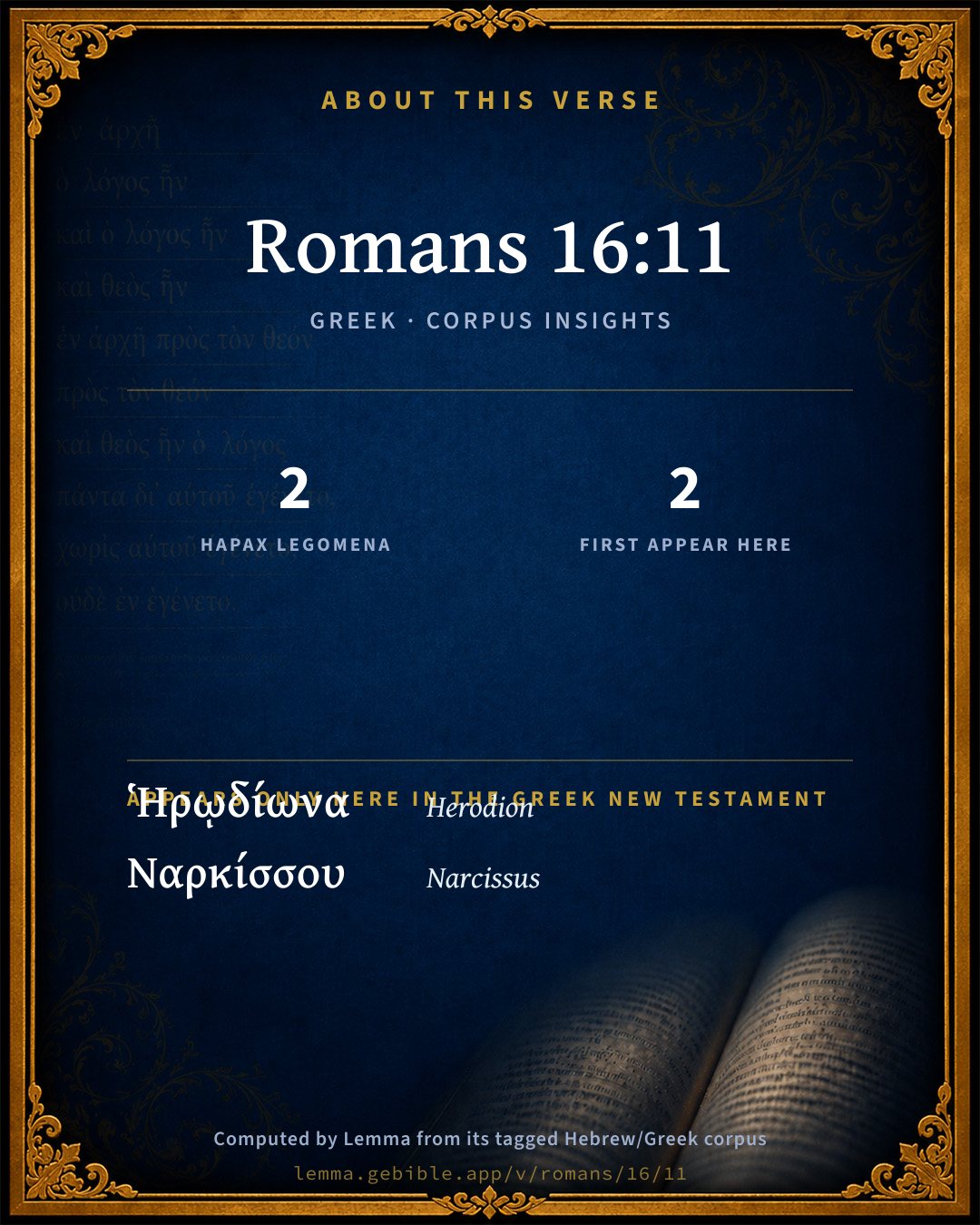
  • 2 hapax legomena — only here in the Greek New Testament
  • 2 first appearances in the Greek New Testament
Full analysis ↓
Download a study sheet

One document with this verse’s original text, its word-by-word gloss line, the meaning frame, cross-references with their text, attributed commentary, and full source and license credits — printable, and it pastes into notes with its structure intact.

This verse Autodidact and up

Study sheet (.html) Plain text (.txt)

A passage Seminary Student

Up to 50 verses in one chapter. A passage sheet keeps up to 6 commentary sources and 12 cross-references per verse, in the order this page ranks them, and says so on the sheet whenever that leaves anything out. Ask for a single verse and you get the Autodidact verse sheet above.

Everything on this page stays free to read, with no account — the sheet is a download of what is already on screen, not access to it.

Want to remove ads? Support Godless Engineer
Compare translations 3

The same verse in 3 English versions, stacked beneath the original-language interlinear above. Click any original word for its lexicon entry.

Each is an independent rendering of the whole verse — the interlinear is not word-aligned to these translations.

Highlighted words mark where these versions differ — a whole-verse word diff, not a word-by-word alignment.

  • World English Bible Public Domain
    Greet Herodion, my kinsman. Greet them of the household of Narcissus, who are in the Lord.
  • King James Version Public Domain
    Salute Herodion my kinsman. Greet them that be of the household of Narcissus, which are in the Lord.
  • unfoldingWord Literal Text CC BY-SA 4.0
    Greet Herodion, my kinsman. Greet the ones from the household of Narcissus, the ones being in the Lord.

unfoldingWord Literal Text — © unfoldingWord, licensed CC BY-SA 4.0. Word-aligned USFM3 via Door43 (git.door43.org/unfoldingWord/en_ult).

Versions to compare (up to 4)

3 of 4 selected

Show all 19 translations

Every available English version of this verse, each an independent rendering of the whole verse.

  • World English Bible Public Domain
    Greet Herodion, my kinsman. Greet them of the household of Narcissus, who are in the Lord.
  • Berean Standard Bible Public Domain
    Greet Herodion, my fellow countryman. Greet those from the household of Narcissus who are in the Lord.
  • Majority Standard Bible Public Domain
    Greet Herodion, my fellow countryman. Greet those from the household of Narcissus who are in the Lord.
  • King James Version Public Domain
    Salute Herodion my kinsman. Greet them that be of the household of Narcissus, which are in the Lord.
  • American Standard Version (1901) Public Domain
    Salute Herodion my kinsman. Salute them of the `household' of Narcissus, that are in the Lord.
  • Revised Version (1885) Public Domain
    Salute Herodion my kinsman. Salute them of the household of Narcissus, which are in the Lord.
  • Geneva Bible (1599) Public Domain
    Salute Herodion my kinsman. Greete them which are of the friendes of Narcissus which are in the Lord.
  • Douay-Rheims (1899) Public Domain
    Salute them that are of Aristobulus' household. Salute Herodian, my kinsman. Salute them that are of Narcissus' household, who are in the Lord.
  • Young's Literal Translation Public Domain
    salute Herodion, my kinsman; salute those of the `household' of Narcissus, who are in the Lord;
  • Literal Standard Version CC BY-SA 4.0
    greet Herodion, my relative; greet those of the [household] of Narcissus, who are in the LORD;
  • Unlocked Literal Bible CC BY-SA 4.0
    Greet Herodion, my kinsman. Greet those of the household of Narcissus, who are in the Lord.
  • unfoldingWord Literal Text CC BY-SA 4.0
    Greet Herodion, my kinsman. Greet the ones from the household of Narcissus, the ones being in the Lord.
  • Darby Bible Public Domain
    Salute Herodion, my kinsman. Salute those who belong to Narcissus, who are in [the] Lord.
  • World Messianic Bible Public Domain
    Greet Herodion, my kinsman. Greet them of the household of Narcissus, who are in the Lord.
  • Webster's Bible Public Domain
    Salute Herodion my kinsman. Greet them that are of the household of Narcissus, who are in the Lord.
  • Free Bible Version CC BY-SA 4.0
    to my countryman Herodion, and to those from Narcissus' family who belong to the Lord.
  • Bible in Basic English Public Domain
    Give my love to Herodion, my relation. Say a kind word to those of the house of Narcissus, who are in the Lord.
  • Text-Critical English NT CC BY 4.0
    Greet Herodion, my kinsman. Greet those of the household of Narcissus, who are in the Lord.
  • Tyndale New Testament (1534) Public Domain
    Salute Herodion my kynsman. Grete them of the housholde of Narcissus which are in the Lorde.

Literal Standard Version (2020), Covenant Press — licensed CC BY-SA 4.0. Text via the HelloAO Bible API (eBible.org). Unlocked Literal Bible (unfoldingWord) — licensed CC BY-SA 4.0. Text via the HelloAO Bible API (eBible.org). unfoldingWord Literal Text — © unfoldingWord, licensed CC BY-SA 4.0. Word-aligned USFM3 via Door43 (git.door43.org/unfoldingWord/en_ult). Free Bible Version, Dr. Jonathan Gallagher — licensed CC BY-SA 4.0. Text via the HelloAO Bible API (eBible.org).

Word by word

More ways to search: Search by grammar → Find every occurrence → Compare this word →

Practice this passage: Drill this verse → Learn its vocabulary →

Ἡρῳδίωνα
Hērōdíōn
G2267
“Herodion”
Noun, Accusative, Singular, Masculine
Part of Speech
Noun
Case
Accusative
Number
Singular
Gender
Masculine
Full Thayer's Definition

Origin: from G2264

TDNT: None

Herodian = "heroic" 1. a certain Christian
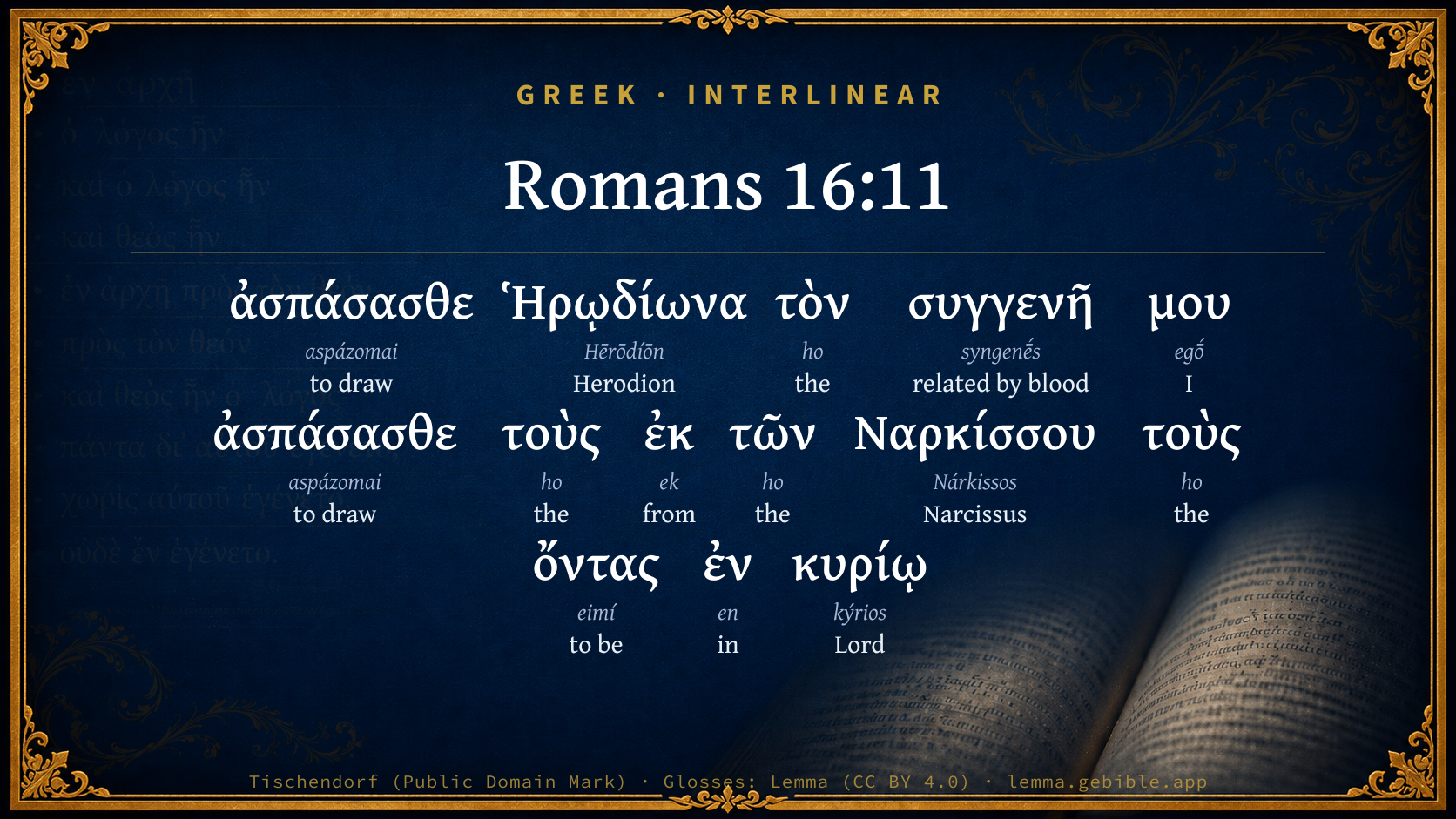
  1. ἀσπάσασθε aspázomai G782 “to draw” Verb, Aorist, Middle deponent, Imperative, 2nd person, Plural
  2. τὸν ho G3588 “the” Article, Accusative, Singular, Masculine
  3. συγγενῆ syngenḗs G4773 “related by blood” Adjective, Accusative, Singular, Masculine
  4. μου egṓ G1473 “I” Personal pronoun, 1st person, Genitive, Singular
  5. ἀσπάσασθε aspázomai G782 “to draw” Verb, Aorist, Middle deponent, Imperative, 2nd person, Plural
  6. τοὺς ho G3588 “the” Article, Accusative, Plural, Masculine
  7. ἐκ ek G1537 “from” Preposition
  8. τῶν ho G3588 “the” Article, Genitive, Plural, Masculine
  9. Ναρκίσσου Nárkissos G3488 “Narcissus” Noun, Genitive, Singular, Masculine
  10. τοὺς ho G3588 “the” Article, Accusative, Plural, Masculine
  11. ὄντας eimí G1510 “to be” Verb, Present, Active, Participle, Accusative, Plural, Masculine
  12. ἐν en G1722 “in” Preposition
  13. κυρίῳ kýrios G2962 “Lord” Noun, Dative, Singular, Masculine

About this verse

These counts appear in no published source. They are computed here, from the morphology-tagged text and Lemma’s own curated glosses. What Lemma adds →

14
words
10
distinct lemmas
Pauline Epistles
section

Notable vocabulary

2 hapax legomena — words that appear only here in the entire Greek New Testament:

  • Ἡρῳδίωνα Herodion G2267
  • Ναρκίσσου Narcissus G3488

First appearance in Scripture

These words make their first canonical appearance in the Greek New Testament here:

  • Ἡρῳδίωνα Herodion G2267
  • Ναρκίσσου Narcissus G3488

Shared distinctive vocabulary

συγγενῆ related by blood G4773 occurs in 12 verses of the Greek New Testament. Also found in:
Repetition

Words recur within this verse:

  • ἀσπάσασθε to draw G782 ×2
  • τὸν the G3588 ×4

Cross-references

2

Topical passages linked to Romans 16:11 in the Treasury of Scripture Knowledge — connected by theme and wording, ordered by reader-vote popularity; previews shown in the World English Bible.

  • Romans 16:21 Timothy, my fellow worker, greets you, as do Lucius, Jason, and Sosipater, my relatives.
  • Romans 16:7 Greet Andronicus and Junias, my relatives and my fellow prisoners, who are notable among the apostles, who also were in Christ before me.

Cross-references courtesy of OpenBible.info (CC BY 4.0).

Commentary

Notes on Romans 16:11 from classic Christian and Jewish commentators (each source and its license shown beneath its notes). The classic Christian expositions comment on the surrounding passage and are grouped to its opening verse, so a note may address several verses; the Jewish commentaries on the Tanakh (Rashi and others) are per-verse, so they appear only where the commentator wrote on this verse.

Lemma curates 59 commentaries, every one of them public domain or Creative Commons licensed, each selected and text-cleaned for this edition rather than reprinted as found. About our sources →

Bengel's Gnomon

Johann Albrecht Bengel

Rom 16:11. ὄντας, who are) Therefore a part of that family were heathens.

Bengel's Gnomon of the New Testament — English translation (T&T Clark, Edinburgh, 1860) — public domain. Text from a community e-Sword module.

Meyer's Critical & Exegetical Commentary

Heinrich August Wilhelm Meyer

Rom_16:11-12. Narcissus is by Grotius, Michaelis, and Neander, held to be the powerful freedman of Claudius (Suet. Claud. 28; Tacit. Ann. xi. 29 ff., xii. 57). It is possible, although Narcissus, according to Tacitus, Ann. xiii. 1, was already dead (see Wieseler, Chronol. p. 371 ff.). A decision, however, cannot be arrived at; but, considering the frequency of the name, the suspicion of an anachronism (Lucht) is groundless.

The three women, Rom_16:12, perhaps deaconesses, are otherwise unknown. Note how Persis is distinguished above the two previously named women; as also how delicately Paul has not added μου, after τὴν ἀγαπητήν, as with the mens names, Rom_16:8-9, although he means his sentiment of love towards Persis. Observe, also, the distinction between κοπιώσας (present) and ἐκοπίασεν. The particular circumstances of the case are unknown to us.

Meyer — Critical and Exegetical Commentary on the New Testament — English translation by Peter Christie, edited by Frederick Crombie (T&T Clark, 1880) — public domain. Text from a community e-Sword module.

Expositor's Greek Testament

ed. W. Robertson Nicoll

Rom 16:11 . Ἡρωδίωνα τὸν συγγενὴ μου . This agrees very well with the interpretation just given to τοὺς ἐκ τῶν Ἀριστοβούλου . In the household of Herod’s grandson there might naturally be a Jew with a name of this type, whom Paul, for some cause or other, could single out for a special greeting. τοὺς ἐκ τῶν Ναρκίσσου τοὺς ὄντας ἐν Κυρίῳ : the last words may suggest that, though only the Christians in this household have a greeting sent to them, there were other members of it with whom the Church had relations. The Narcissus meant is probably the notorious freedman of Claudius, who was put to death shortly after the accession of Nero (Tac., Ann. , xiii., 1), and therefore two or three years before this epistle was written. His slaves would probably pass into the emperor’s hands, and increase “Cæsar’s househould” as Narcissiani (Lightfoot, loc. cit .).

The Expositor's Greek Testament, edited by W. Robertson Nicoll (1897–1910) — public domain. Text from a community e-Sword module.

Jamieson, Fausset & Brown

Robert Jamieson, A. R. Fausset & David Brown

Salute Herodion, my kinsman--(See on Rom 16:7).

Greet them that be of the household of Narcissus, which are in the Lord--which implies that others in his house, including probably himself, were not Christians.

Jamieson, Fausset & Brown — Commentary Critical and Explanatory on the Whole Bible (1871) — public domain (CC PDM 1.0). Text via the HelloAO Bible API.

Adam Clarke's Commentary

Verse 11. Herodion, my kinsman.] Probably another converted Jew. See Clarke on Ro 16:7.

Of the household of Narcissus] Probably dead also, as we have supposed Aristobulus to have been at this time.

Which are in the Lord.] This might intimate that some of this family were not Christians; those only of that family that were converted to the Lord being saluted. There was a person of the name of Narcissus, who was a freed man of the Emperor Claudius, mentioned by Suetonius in his life of that prince, cap. 37; and by Tacitus, An., lib. xii. cap. 57: but there does not seem any reason to suppose that this was the person designed by St. Paul.

Adam Clarke's Commentary on the Bible (1810–1826) — public domain. Text from a community e-Sword/MySword module.

John Calvin's Commentaries

11. Who are of the family of Narcissus It would have been unbecoming to have passed by Peter in so long a catalogue, if he was then at Rome: yet he must have been there, if we believe the Romanists. But since in doubtful things nothing is better than to follow probable conjecture, no one, who judges impartially, will be persuaded that what they affirm is true; for he could not surely have been omitted by Paul.

It is further to be noticed, that we hear nothing here of splendid and magnificent titles, by which we might conclude that men high in rank were Christians; for all those whom Paul mentions were the obscure and the ignoble at Rome. Narcissus, whom he here names, was, I think, the freeman of Claudius, a man notorious for many crimes and vices. The more wonderful was the goodness of God, which penetrated into that impure house, abounding in all kinds of wickedness; not that Narcissus himself had been converted to Christ, but it was a great thing that a house, which was like hell, should be visited by the grace of Christ. And as they, who lived under a foul pander, the most voracious robber, and the most corrupt of men, worshipped Christ in purity, there is no reason that servants should wait for their masters, but every one ought to follow Christ for himself. Yea, the exception added by Paul shows that the family was divided, so that the faithful were only a few.

John Calvin's Commentaries (1540-1563) — public domain. Text from the Calvin Translation Society English edition (1840s-50s) via the Christian Classics Ethereal Library (ccel.org). Calvin's coverage is partial (roughly two-thirds of the Bible); uncommented books and verses are honest gaps, never fabricated. The 19th-century editor's footnotes and remarks are omitted so the notes are faithfully Calvin's own voice.

Ellicott's Commentary for English Readers

(11) My kinsman.—See the Note on Rom_16:7.

Them that be of the household of Narcissus.—A phrase similar to that which is translated, “Them which are of Aristobulus’ household,” above. Narcissus, too, is an historical name. There had been a famous Narcissus, a freed-man and favourite of Claudius, who had been put to death three or four years before this Epistle was written. His household would naturally pass into the hands of the emperor, though still keeping his name. In the case of Aristobulus, the transference would be effected by bequest, in that of Narcissus by confiscation. Many instances of both methods occur in the history and records of the time.

The interpretation here given, and the identification of Aristobulus and Narcissus with the historical bearers of those names, is some way short of certain, but may be said to have some degree of probability.

A Bible Commentary for English Readers, edited by Charles John Ellicott (1878–1897) — public domain. Text from a community e-Sword module.

The Cambridge Bible for Schools and Colleges

gen. ed. J. J. S. Perowne

11. Herodion my kinsman] See on Rom_16:7. The name is Greek.

them that be of the household of Narcissus] Lit., as just above, those from amongst Narcissus’. There was one notorious Narcissus, a freedman of Claudius; and another, one of Nero’s bad favourites. Either of these may have been the master of the Christian dependents here saluted; but the name was a common one. The freedman of Claudius was probably by this time dead, but his household may have been subsisting still.

The Cambridge Bible for Schools and Colleges (gen. ed. J. J. S. Perowne; Cambridge University Press, 1878–1918) — public domain. Text from a community e-Sword module.

John Gill's Exposition

Salute Tryphena and Tryphosa, who labour in the Lord,.... These two were women, and are said to be noble women of Iconium, whom the apostle converted there, and afterwards went to Rome the names are Greek (t), though they might be Jewish women, since Tryphon is the name of a man among the Jews. Trypho, the famous Jew, with whom Justin Martyr had his dialogue, is well known, and perhaps is the same with R. Tarphon, or Tryphon, so often mentioned in the Misnic and Talmudic writings: however, as these were women, their labour cannot be understood of their labouring in the word of the Lord, or in the public ministry of it, since this was forbid by the apostle, and therefore would never commend them on account of it; but of their great usefulness and indefatigableness, in serving the interest of their dear Lord with their purses; in relieving the poor of the church, in entertaining and supplying the ministers of the Gospel, as well as by their private instructions, exhortations, and giving an account of their own experience, whereby they might greatly encourage, edify, and strengthen young converts, and other Christians, as Priscilla with her husband did; and were unwearied in doing everything that they were capable of, in promoting the Gospel and kingdom of Christ:

salute the beloved Persis, which laboured much in the Lord; who being a woman also, and perhaps of Persic original, and might have her name from her country; her labour must be understood of the same kind with the former, only with this addition, that she abounded and exceeded in it; she is said by the Syriac scholiast to be the wife of Rufus, mentioned in Rom 16:13.

(t) Vid. Gutherleth. Animadv. Philolog. in Inscript. Smyrn. p. 115, &c.

John Gill's Exposition of the Whole Bible (1746–1763) — public domain (CC PDM 1.0). Text via the HelloAO Bible API.

Trapp's Complete Commentary

John Trapp

11 Salute Herodion my kinsman. Greet them that be of the household of Narcissus, which are in the Lord.

Ver. 11. My kinsman] In the flesh, but more in the faith, that surest tie.

John Trapp, A Commentary or Exposition upon All the Books of the Old and New Testament (1647–1656) — public domain. Text from a community e-Sword module.

Matthew Poole's English Annotations

Salute Herodion my kinsman: see Rom 16:7.

Greet them that be of the household of Narcissus: this Narcissus is reported by Suetonius to have been in great favour with Claudius the emperor, and to have abounded in wealth, so that he was worth ten millions. He was a wicked man himself, yet it seems he had divers good Christians in his family. So we read that there were saints in Nero’s house or court, Phi 4:22. To what a degree of wickedness are they arrived, who will not suffer a religious person to dwell in their houses! This shows, that good Christians may serve wicked masters with a good conscience.

Which are in the Lord; this may be added, because that all in Narcissus’s family were not Christians, or members of the church of Christ.

Matthew Poole's English Annotations on the Holy Bible (1683–1685) — public domain. Text from a community e-Sword/MySword module.

Whedon's Commentary on the Bible

Daniel D. Whedon

11. Household of Narcissus—The emperor had a noted freedman, by the name of Narcissus, who died two or three years before this epistle was written. Yet it may be his household, or rather those which are in the Lord belonging to his household, who are here greeted.

Daniel D. Whedon (gen. ed.), Commentary on the Old and New Testaments (1874–1909) — public domain. Text from a community e-Sword module.

The Pulpit Commentary

Salute Herodion my kinsman. Greet them of the household of Narcissus that are in the Lord. This Narcissus may possibly have been the powerful freedman of Claudius, mentioned by Tacitus, "Ann.," 11:29, seq.; 12:57; and by Suetonius, "Claud.," 28. The fact that he appears from "Ann.," 13:1, to have been put to death on the accession of Nero, A.D. 54, is not inconsistent with the supposition. For his human chattels would be likely to pass into the possession of Nero, and so become part of Caeasar"s household, and might still be called by their late master"s name. This may also have been the case with the household of Aristobulus above referred to. It is observable that, at a later period, the apostle, writing from Rome to the Philippians, sends special greetings from them "that are of Caesar"s household". (Php_4:23)

The Pulpit Commentary (1880–1919), ed. H.D.M. Spence-Jones & Joseph S. Exell — public domain. Text from a community e-Sword module.

John Wesley's Explanatory Notes

Those of the family of Aristobulus and Narcissus, who are in the Lord - It seems only part of their families were converted. Probably, some of them were not known to St. Paul by face, but only by character. Faith does not create moroseness, but courtesy, which even the gravity of an apostle did not hinder.

John Wesley, Explanatory Notes Upon the Whole Bible (1754–1765) — public domain. Text via the GEBible commentary corpus.

McGarvey & Pendleton's Commentaries

J. W. McGarvey

Salute Herodion my kinsman. Salute them of the household of Narcissus, that are in the Lord . [This is probably Narcissus the rich freedman and favorite of Cæsar's, whose household would therefore be compounded with Cæsar's. (Comp. Phi_4:22 ) He died A. D. 54, or some three years before Paul wrote this Epistle. For references as to Narcissus, see Tac. Ann. 11:29, seq.; 12:57; 13:1; Suet. Claud. 28. "Bishop Lightfoot argues very plausibly that most of those here greeted by Paul were Nero's servants, once in Greece, especially Philippi, and now called to Rome, whence they later sent back greetings to Philippi ( Phi_4:22 ). An imperial burial-ground at Rome bears names like most of these, and the parties there buried lived in Paul's day"--Moule.]

J. W. McGarvey (with Philip Y. Pendleton), Commentaries on the New Testament (The Fourfold Gospel, 1914; Acts; and the epistles) — public domain. Text from a community e-Sword/MySword module.

The People's New Testament

B. W. Johnson

11. The household of Narcissus. At the time Paul wrote, a favorite of Nero, named Narcissus, was all powerful in Rome. He probably meant a number of his servants having accepted Christ.

B. W. Johnson's The People's New Testament with Notes (1889–1891) — public domain. Electronic text from the Christian Classics Ethereal Library (CCEL) ThML edition.

Cambridge Greek Testament for Schools and Colleges

11. Ἡρῳδίωνα. Coming between the two groups of slaves, prob. belonged to the former: the name suggests a connexion with the Herod family.

τοὺς ἐκ τῶν Ναρκίσσου. N. is reasonably identified with the freedman of that name, powerful under Claudius and put to death by Agrippina shortly after Nero’s accession. S. H., Lft.

Cambridge Greek Testament for Schools and Colleges (Cambridge University Press, 1896; 21 vols, various authors incl. Carr, Maclear, Plummer, Farrar, Lumby, Moule, M. R. James, Simcox) — public domain. Text from a community e-Sword module.

International Critical Commentary

11. Ἡρῳδίωνα τὸν συγγενῆ μου. A mention of the household of Aristobulus is followed by a name which at once suggests the Herod family, and is specially stated to have been that of a Jew. This seems to corroborate the argument of the preceding note.

τοὺς ἐκ τῶν Ναρκίσσου, ‘the household of Narcissus,’ ‘Narcissiani.’ The Narcissus in question was very possibly the well-known freedman of that name, who had been put to death by Agrippina shortly after the accession of Nero some three or four years before (Tac. Ann. xiii. 1; Dio Cass. lx. 34). His slaves would then in all probability become the property of the Emperor, and would help to swell the imperial household. The name is common, especially among slaves and freedmen, cf. C.I.L. vi.4123 (in the household of Livia), 4346, 5206 heliconis narcissi | avgnstiani | : 22875 narcissvs ∙ avg ∙ lib. Lft. quotes also the two names Ti. Claudius Narcissus (see below), Ti. Iulius Narcissus from Muratori, and also the form Narcissianus, ti ∙ clavdio ∙ sp ∙ f ∙ narcissiano (Murat. p. 1150. 4). The following inscription belongs to a somewhat later date: C.I.L. vi. 9035 d. m. | t ∙ flavivs ∙ avg ∙ lib | narcissvs ∙ fecit ∙ sibi | et ∙ coeliae ∙ sp ∙ filiae | ieriae ∙ conivgi ∙ svae …, and lower down t flavivs ∙ avg ∙ lib ∙ firmvs ∙ narcissianvs | relator ∙ avctionvm ∙ monvmentvm ∙ refecit. See also 9035 a. (Lightfoot, Phil. p. 173.)

Dr. Plumptre (Biblical Studies, p. 428) refers to the following interesting inscription. It may be found in C.I.L. v. 154* being reputed to have come from Ferrara. d. m. | clavdiae | dicaeosynae | ti ∙ clavdivs | narcissvs | lib. aeid. coiv | pientissimae | et frvgalissi | b. m. Tiberius Claudius suggests the first century, but the genuineness of the Ins. is not sufficiently attested. The editor of the fifth volume of the Corpus writes: Testimonia auctorum aut incertorum … aut fraudulentorum de loco cum parum defendant titulum cum exclusi, quamquam fieri potest ut sit genuinus nec multum corruptus. The name Dicaeosyne is curious but is found elsewhere C.I.L. iii. 2391; vi. 25866: x. 649. There is nothing distinctively Christian about it.

International Critical Commentary — older volumes (1896–1929), various authors — public domain. Text from a community e-Sword module.

Vincent's Word Studies in the New Testament

Marvin R. Vincent

Narcissus. This name was borne by a distinguished freedman, who was secretary of letters to Claudius. Juvenal alludes to his wealth and his influence over Claudius, and says that Messalina, the wife of Claudius, was put to death by his order (" Satire, " 14, 330). His household slaves, passing into the hands of the emperor or of some other master, would continue to bear his name.

Marvin R. Vincent, Word Studies in the New Testament (1887–1900) — public domain. Text from a community e-Sword/MySword module.

Godet's Commentaries

Frédéric Louis Godet

Vv. 11, 12. “Salute Herodion my countryman. Salute them that be of the household of Narcissus, which are in the Lord. Salute Tryphena and Tryphosa, who labor in the Lord. Salute Persis the beloved, which labored much in the Lord.”

Here, again, συγγενής may signify either countryman or kinsman (see Rom 16:7). The Roman writers Suetonius, Pliny, Tacitus, speak of a freedman of Claudius, of the name of Narcissus. Is it the house of this imperial favorite which is here referred to? He himself had been executed four years before the composition of our Epistle; but his house might still exist at Rome.

Frédéric Louis Godet — Commentaries on Luke, John, Romans, and 1 Corinthians — English translation (T&T Clark, Edinburgh, 1870s–1890s) — public domain. Text from a community e-Sword module.

Hodge's Commentary on Romans, Ephesians & First Corinthians

Charles Hodge

Rom_16:8-15

My beloved in the Lord. The preposition in (ἐν), here, as frequently elsewhere, points out the relation or respect in which the word, to which it refers is to be understood; brother beloved, both in the flesh and in the Lord (Phm_1:16), both in reference to our external relations, and our relation to the Lord. And thus in the following, Rom_16:9, our helper in Christ, i.e. as it regards Christ; Rom_16:10, approved in Christ, i.e. in his relation to Christ; an approved or tried Christian; Rom_16:12, who labor in the Lord; and, which labored much in the Lord, i.e. who, as it regards the Lord, labored much; it was a Christian or religious service. The names, Tryphena, Tryphosa, and Persis, all are feminine. The last is commonly supposed to indicate the native country of the person who bore it, as it was not unusual to name persons from the place of their origin, as Mysa, Syria, Lydia, Andria, etc.; such names, however, soon became common, and were given without any reference to the birthplace of those who received them. Chosen in the Lord, i.e. not one chosen by the Lord; chosen, (i.e., approved, precious; see 1Pe_2:4,) in his relation to the Lord, as a Christian. It is not merely elect in Christ, that is, chosen to eternal life, for this could be said of every Christian; but Rufus is here designated as a chosen man, as a distinguished Christian. It is worth noticing, that at Rome, as at Corinth, few of the great or learned seem to have been called. These salutations are all addressed to men not distinguished for their rank or official dignity. Mylius, as quoted by Calov, says: Notanda hic fidelium istorum conditio: nemo hic nominatur consul, nemo quaestor aut dictator insignitur, minime omnium episcopatuum et cardinalatuum dignitate hic personant: sed operarum, laborum, captivitate titulis plerique notantur. Ita verum etiam in Romana ecclesia fuit olim, quod apostouls scribit, non multi potentis, non multi nobiles, sed stuta mundi electa sunt a Deo. Papatus autem Caesarei, qualis adjuvante diabolo, in perniciem religionis, posteris saeculis Romae involuit, ne umbra quidem apostolorum aetate istic fuit: tantum abest, ut ille originem ab apostolis ipsis traxerit.

Charles Hodge — Commentary on Romans (1835), First Corinthians (1857), and Ephesians (1856) — public domain. Text from a community e-Sword module.

Lesson kit

Teaching starters — assembled from the data on this page, not authored interpretation. Every prompt links to the verse data it draws on. Edit before teaching.

Romans, in the Pauline Epistles, opens this verse with 14 words (10 distinct Greek lemmas). Its most distinctive word is Hērōdíōn (“Herodion”). A historical commentator’s framing appears above. Read the whole chapter for the surrounding context.

Discussion questions

  1. The word Hērōdíōn carries the sense “Herodion.” How does it shape the verse?
  2. 2 words here appear nowhere else in the Greek New Testament. Why might the author reach for such rare wording?
  3. 2 words make their first appearance in Scripture here. What does this debut establish?
  4. How does Mark 6:4, which shares the word «related by blood», read alongside this verse?
  5. What does the repetition of “to draw” (2× in this one verse) do in this verse?
  6. These translations render this verse differently; the difference is in the English rendering, not the original. What questions does that raise?
  7. Compare how Bengel's Gnomon and Meyer's Critical & Exegetical Commentary read this verse. Where do they agree or differ?

Things to notice

  • 2 words in this verse appear nowhere else in the Greek New Testament.
  • 2 words make their first canonical appearance in Scripture here.
  • These translations choose different wording for 5 words in this verse.
  • “to draw” occurs 2× in this single verse.
  • 10 distinct Greek lemmas span 14 words in this verse.

Reading settings

Reading text

Shown beneath each verse's original-language words.

Old Testament
Old Testament edition

Read the OT as the Masoretic Hebrew (MT) or the Greek Septuagint (LXX).

English shown for the Greek Septuagint (in the Hebrew ↔ Greek comparison).

Comparing translations? Open the Compare panel on any verse page to stack up to four side by side.