
Psalms 119:57

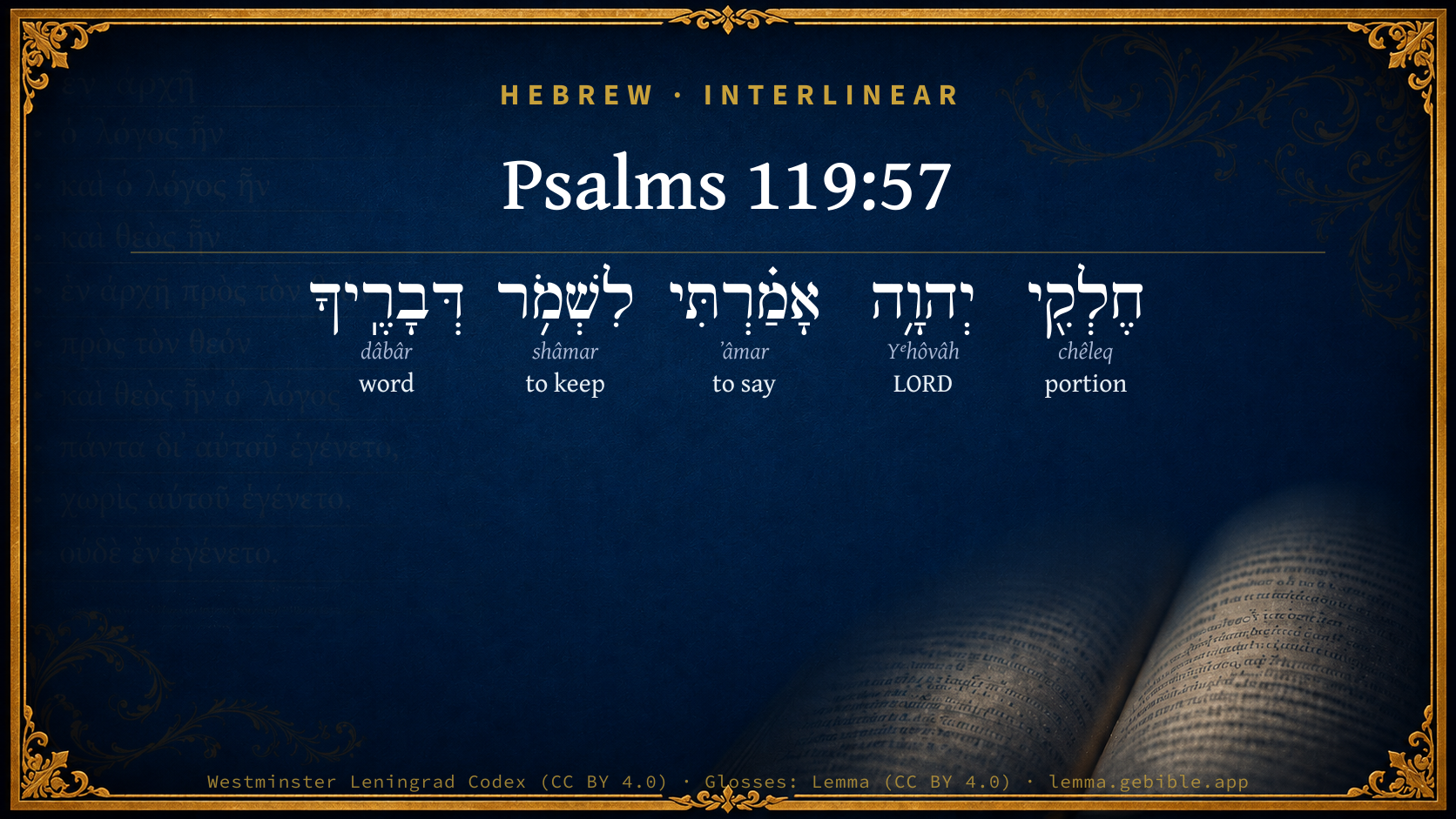
Hebrew (Westminster Leningrad Codex) Psalms 119:57 appears in the Hebrew Old Testament. The text above is from the Westminster Leningrad Codex. Each word links to its Strong’s number, a concise gloss, and parsing drawn from the Open Scriptures Hebrew Bible morphology. Click any word for its full Brown-Driver-Briggs (BDB) entry.
Download image
Cite this verse

Psalms 119:57 (World English Bible). Public Domain. Lemma interlinear Bible study tool, https://lemma.gebible.app/v/psalms/119/57.

Show BibTeX & RIS
BibTeX
RIS
English Translation
Yahweh is my portion. I promised to obey your words.
World English Bible · Public Domain
Download a study sheet

One document with this verse’s original text, its word-by-word gloss line, the meaning frame, cross-references with their text, attributed commentary, and full source and license credits — printable, and it pastes into notes with its structure intact.

This verse Autodidact and up

Study sheet (.html) Plain text (.txt)

A passage Seminary Student

Up to 50 verses in one chapter. A passage sheet keeps up to 6 commentary sources and 12 cross-references per verse, in the order this page ranks them, and says so on the sheet whenever that leaves anything out. Ask for a single verse and you get the Autodidact verse sheet above.

Everything on this page stays free to read, with no account — the sheet is a download of what is already on screen, not access to it.

Want to remove ads? Support Godless Engineer
Compare translations 3

The same verse in 3 English versions, stacked beneath the original-language interlinear above. Click any original word for its lexicon entry.

Each is an independent rendering of the whole verse — the interlinear is not word-aligned to these translations.

Highlighted words mark where these versions differ — a whole-verse word diff, not a word-by-word alignment.

  • World English Bible Public Domain
    Yahweh is my portion. I promised to obey your words.
  • King James Version Public Domain
    Thou art my portion, O LORD: I have said that I would keep thy words.
  • unfoldingWord Literal Text CC BY-SA 4.0
    Yahweh my portion; I promise to observe your words.

unfoldingWord Literal Text — © unfoldingWord, licensed CC BY-SA 4.0. Word-aligned USFM3 via Door43 (git.door43.org/unfoldingWord/en_ult).

Versions to compare (up to 4)

3 of 4 selected

Show all 17 translations

Every available English version of this verse, each an independent rendering of the whole verse.

  • World English Bible Public Domain
    Yahweh is my portion. I promised to obey your words.
  • Berean Standard Bible Public Domain
    The LORD is my portion; I have promised to keep Your words.
  • Majority Standard Bible Public Domain
    The LORD is my portion; I have promised to keep Your words.
  • King James Version Public Domain
    Thou art my portion, O LORD: I have said that I would keep thy words.
  • American Standard Version (1901) Public Domain
    HHETH. Jehovah is my portion: I have said that I would observe thy words.
  • Revised Version (1885) Public Domain
    The LORD is my portion: I have said that I would observe thy words.
  • Geneva Bible (1599) Public Domain
    CHETH. O Lord, that art my portion, I haue determined to keepe thy wordes.
  • Young's Literal Translation Public Domain
    `Cheth.' My portion `is' Jehovah; I have said -- to keep Thy words,
  • Literal Standard Version CC BY-SA 4.0
    [HETH] YHWH [is] my portion; I have said I would keep Your words,
  • Unlocked Literal Bible CC BY-SA 4.0
    Yahweh is my portion; I have determined to observe your words.
  • unfoldingWord Literal Text CC BY-SA 4.0
    Yahweh my portion; I promise to observe your words.
  • Darby Bible Public Domain
    CHETH. My portion, O Jehovah, I have said, is to keep thy words.
  • World Messianic Bible Public Domain
    The LORD is my portion. I promised to obey your words.
  • Webster's Bible Public Domain
    CHETH. Thou art my portion, O LORD: I have said that I would keep thy words.
  • Free Bible Version CC BY-SA 4.0
    Lord, you are mine! I have promised to do as you say.
  • Bible in Basic English Public Domain
    CHETH The Lord is my heritage: I have said that I would be ruled by your words.
  • JPS Tanakh (1917) Public Domain
    HETH. My portion is the LORD, I have said that I would observe Thy words.

Literal Standard Version (2020), Covenant Press — licensed CC BY-SA 4.0. Text via the HelloAO Bible API (eBible.org). Unlocked Literal Bible (unfoldingWord) — licensed CC BY-SA 4.0. Text via the HelloAO Bible API (eBible.org). unfoldingWord Literal Text — © unfoldingWord, licensed CC BY-SA 4.0. Word-aligned USFM3 via Door43 (git.door43.org/unfoldingWord/en_ult). Free Bible Version, Dr. Jonathan Gallagher — licensed CC BY-SA 4.0. Text via the HelloAO Bible API (eBible.org).

Word by word

More ways to search: Search by grammar → Find every occurrence → Compare this word →

Practice this passage: Drill this verse → Learn its vocabulary →

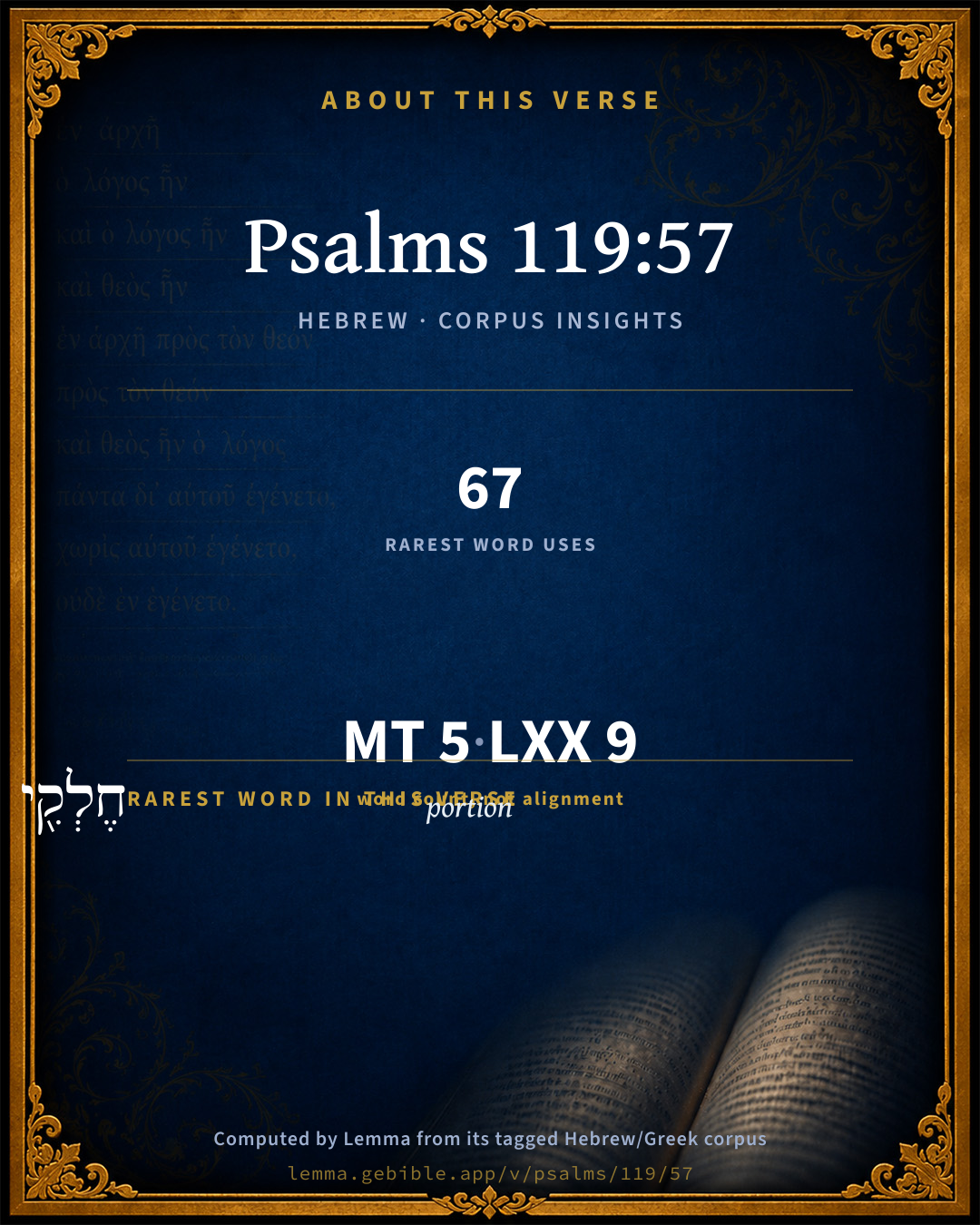
About this verse

These counts appear in no published source. They are computed here, from the morphology-tagged text and Lemma’s own curated glosses. What Lemma adds →

5
words
5
distinct lemmas
Wisdom
section

Grammatical profile

  • 2 verbs
  • 3 nouns

Verb forms

  • אָמַ֗רְתִּי Qal · Perfect
  • לִשְׁמֹ֥ר Qal · Infinitive Construct

Hebrew & Septuagint length

In English translation the verse runs 10 words from the Hebrew and 14 from the Septuagint (LXX English) — closely comparable.

A rough comparison of the two English renderings, which tokenize alike — not a word-level alignment.

Word counts can differ between the Hebrew and the Greek without any difference in meaning — e.g. the Hebrew direct-object marker אֵת has no separate Greek word, and Greek often adds the article ὁ.

In the original languages it is 5 Hebrew tokens and 9 Greek tokens — but the two are counted differently (Hebrew bundles its prefixes and suffixes into one token; the Greek is in lemma form), so that isn’t a like-for-like length.

Cross-references

14

Topical passages linked to Psalms 119:57 in the Treasury of Scripture Knowledge — connected by theme and wording, ordered by reader-vote popularity; previews shown in the World English Bible.

  • Lamentations 3:24 Yahweh is my portion, says my soul; therefore will I hope in him.
  • Psalms 16:5 Yahweh assigned my portion and my cup. You made my lot secure.
  • Psalms 142:5 I cried to you, Yahweh. I said, "You are my refuge, My portion in the land of the living."
  • Psalms 73:26 My flesh and my heart fails, But God is the strength of my heart and my portion forever.
  • Jeremiah 10:16 The portion of Jacob is not like these; for he is the former of all things; and Israel is the tribe of his inheritance: Yahweh of Hosts is his name.
  • Psalms 119:115 Depart from me, you evildoers, That I may keep the commandments of my God.
  • Joshua 24:15 If it seem evil to you to serve Yahweh, choose you this day whom you will serve; whether the gods which your fathers served that were beyond the River, or the gods of the Amorites, in whose land you dwell: but as for me and my house, we will serve Yahweh.
  • Joshua 24:18 and Yahweh drove out from before us all the peoples, even the Amorites who lived in the land: therefore we also will serve Yahweh; for he is our God.
  • Joshua 24:21 The people said to Joshua, No; but we will serve Yahweh.
  • Joshua 24:24–27 The people said to Joshua, Yahweh our God will we serve, and to his voice will we listen.
  • Deuteronomy 26:17–18 You have declared Yahweh this day to be your God, and that you would walk in his ways, and keep his statutes, and his commandments, and his ordinances, and listen to his voice:
  • Psalms 66:14 which my lips promised, And my mouth spoke, when I was in distress.
  • Psalms 119:106 I have sworn, and have confirmed it, That I will obey your righteous ordinances.
  • Nehemiah 10:29–39 They joined with their brothers, their nobles, and entered into a curse, and into an oath, to walk in God's law, which was given by Moses the servant of God, and to observe and do all the commandments of Yahweh our Lord, and his ordinances and his statutes;

Cross-references courtesy of OpenBible.info (CC BY 4.0).

Hebrew and Greek witnesses Masoretic Hebrew ↔ Greek Septuagint

The same verse in the two great witnesses to the Old Testament, shown verse-for-verse.

You’re reading Greek Psalm 118 (Hebrew Psalm 119). The Septuagint counts the superscription, so verse numbers can differ from the Hebrew — chapter-level alignment, not verse-by-verse. Numbering follows Rahlfs.

These are two independent witnesses, not word-aligned to each other, and the Septuagint is shown in lemma (dictionary) form.

Hebrew Psalms 119:57 Masoretic · Westminster Leningrad Codex

חֶלְקִ֖י יְהוָ֥ה אָמַ֗רְתִּי לִשְׁמֹ֥ר דְּבָרֶֽיךָ

Yahweh is my portion. I promised to obey your words.

World English Bible · Public Domain

Greek LXX Greek Psalm 118:57 Septuagint · lemma form

ηθ μερίς ἐγώ κύριος εἶπον φυλάσσω ὁ νόμος σύ

You are my portion, O Lord: I said that I would keep your law.

LXX2012 (modern English Septuagint) · Public Domain

On this verse, The Cambridge Bible for Schools and Colleges discusses the Septuagint’s reading. Read the note in Commentary ↓

Hebrew: Westminster Leningrad Codex (CC BY 4.0). Greek: Septuagint (public domain); English from LXX2012 (modern English Septuagint) (Public Domain). How the Septuagint differs from the Hebrew →

Commentary

Notes on Psalms 119:57 from classic Christian and Jewish commentators (each source and its license shown beneath its notes). The classic Christian expositions comment on the surrounding passage and are grouped to its opening verse, so a note may address several verses; the Jewish commentaries on the Tanakh (Rashi and others) are per-verse, so they appear only where the commentator wrote on this verse.

Lemma curates 59 commentaries, every one of them public domain or Creative Commons licensed, each selected and text-cleaned for this edition rather than reprinted as found. About our sources →

Trapp's Complete Commentary

John Trapp

Psa 119:57 CHETH. [Thou art] my portion, O LORD: I have said that I would keep thy words.

Ver. 57. Thou art my portion, O Lord] While other men’s portion sunt divitiae vel deliciae, nothing short of God can satisfy me.

I have said, &c.] i.e. Purposed and promised the obedience of faith.

John Trapp, A Commentary or Exposition upon All the Books of the Old and New Testament (1647–1656) — public domain. Text from a community e-Sword module.

The Biblical Illustrator

Joseph S. Exell

Psa_119:57

Thou art my portion, O Lord: I have said that I would keep Thy words.

The wealth of life

A mans portion is that which he deliberately chooses as the chief object of his life, that on which he concentrates his thought, bestows his energy, lavishes his affection; that which in turn colours him, moulds him. No man need tell us in so many words what is his portion, his life is an eloquent proclamation of that fact. The sensualist who wallows in mire writes this message like the mark of the beast across his brow, Lust is my portion. The pleasure-seeker, whose one thought is selfish gratification, and who flits from gaiety to gaiety like a short-lived butterfly from flower to flower, announces by his whole bearing, Enjoyment is my portion. The avaricious man, whether known as a miser or not, as he surveys the golden pile and smiles over his ever-fattening bank account, tells you, heedless of his shrinking soul, that Mammon is his portion. The student, as he betakes himself to some sequestered nook where he can quiz the angel Truth, and secure sweet whispers from her lips, quietly asseverates, Learning is my portion. It may help us to realize how rich we are in God if I name a feature or two of this portion.

I. It is spiritual. One of the saddest phases of life to-day is the disparagement and denial of the spiritual nature of man. The body is too much in evidence to be denied or disparaged. The mind, too, comes in for a good measure of attention, but our real self, our upper self, our spiritual part, has meagre attention. Some deny the existence of the soul, others treat it just as though it were not; and there can be no doubt that the soul of many is an undiscovered world. Yet, in spite of our bad treatment of it, our spiritual nature will assert itself,--As the hart panteth after the water brooks, so panteth my soul after Thee, O God. I am not to be put off with matter. It is no use sending ms to Nature--singing streams, flowery meadows, towering hills, shining stars, beauteous phenomena, shifting scenes of splendour cannot satisfy me. I am not to be put off with mind. It is no use sending me to books. I am a person, and only a person can satisfy me. I am a spirit, and only the spiritual can meet my mighty longings. I am immortal, and only the eternal can be enough for me. And so it comes to pass, the moment a man discovers himself, he feels that no earthly portion can cover the whole of his necessity, can slake the whole of his thirst, and so he looks heavenwards, stretches out his little hands to grasp the hands of the Infinite One, and cries, Whom have I in heaven but Thee, there is none upon the earth that I desire beside Thee. My flesh and my heart faileth, but God is the strength of my heart and my portion for ever.

II. It is present. The psalmist was not thinking of a far away patrimony which would be his when the river we call death should be crossed. God was then his treasure--Thou art my portion. And we have not to think of God as an estate which we have to die to realize in some distant heaven. That kind of feeling has wrought incalculable mischief in numberless Christian lives. There are those who conceive of their portion as wholly yonder, and they doom the present to sheer emptiness. Be not deceived. The whole of our heaven is not there, a good slice of it is hero. Yonder is the tree of life, but the branches hang over the wall, and the grapes are not too high to be sour. Whatever God will be to us in heaven He is to us in large measure on earth. We need not go through the world as paupers, seeing we have such treasure at hand, Our life need not be a wilderness waste, a flowerless garden, a waterless well, a bankrupt bank, a sunless day, since God is ours. Let us appropriate our treasures; let us seek a present heaven; let us believe that we have in God an unspeakable fund of blessing--a present love, higher than the heavens, deeper than the sea, broader than the earth, and closer than the atmosphere; a present joy, keeping the heart young and warm, the face bright, the tongue musical; a present peace, keeping the soul unchafed and the life tranquil amid the strife of unfriendly voices; and a present grace enough for our sorest need, our darkest hour.

III. It is permanent. Many portions are precarious, perishable, evanescent. Millionaires have ore this seen their mountain of gold vanish. Grand estates have exchanged hands by a stroke of the pen. A great preacher says, Nothing really belongs to a man if it can be taken from him. What we may lose we can scarcely be said to have. The only thing that is worth calling mine is something that so passes into and saturates the very substance of my soul; that, like a piece of cloth dyed in the grain, as long as two threads hold together, the tint will be there. That is how God gives Us Himself, and nothing can take Him out of a mans soul. As the sun gives itself to the flower, nourishing, painting, and perfecting it, so God gives Himself unto the soul that trusts in Him. We may have all that belongs to God in perpetual possession. He and all He has are ours every day alike.

IV. It is satisfying. Pleasure, does that satisfy? It never did; it never can. Xerxes felt, when surfeited with his indulgences, that something more was wanted, and offered a reward to the man who would invent a new pleasure. Wealth, does that satisfy? Nay, it rather breeds dissatisfaction. Social distinctions and worldly honours, are these satisfying? (W. Pearce.)

God our portion, and His Word our treasure

1. Observe the close connection between privilege and duty. Thou art my portion, O Lord; this is an unspeakable happiness. I have said that I would keep Thy words--this is the fitting return for such a blessing. Every mercy given us of the Lord brings with it a claim which we ought in gratitude to recognize.

2. Notice very carefully the order in which the privilege and the duty are arranged. The blessing of grace is first and the fruit of gratitude next. The grace given is the root and the resolve is the fruit growing out of it.

3. Each possession not only involves service, but appropriate service, even as each plant bears its own flower. The general principle which calls for service bears a particular application, for each particular Gospel benefit is linked with some special Gospel service. The unspeakable boon of having God for our portion has here fastened to it the peculiar excellence of keeping Gods words.

I. The infinite possesion. Thou art my portion, O Lord.

1. A clear distinction. The psalmist declares the Lord to be his portion in distinction to the portion of the ungodly. The seventy-third psalm gives a full and particular description of the ungodly in their prime and glory, when their eyes stand out with fatness, and they have more than heart can wish. But David did not desire to share their short-lived joys, he sought his happiness elsewhere, looking to the Creator rather than the creatures and to eternity rather than time.

2. The positive claim--Thou art my portion, O Lord. He deliberately declares this in the silence of his soul. As for the ungodly, they are boasting of their prosperity, they are girding themselves with pride as with a golden chain; but I dare not seek my joy in such matters, Thou art my portion, O Lord. You see he speaks in the present tense. Thou art my portion, O Lord. There are some things which I have not received as yet, but I have already laid hold upon my God. At this hour My Beloved is mine, and I am His. I know whom I have believed, and I know that He has given Himself to me as I have given myself to Him. Beyond a doubt, Thou art at this very moment my portion, O Lord.

3. The portion itself. Thou.

(1) What a boundless portion.

(2) How abiding it is.

(3) An appropriate portion, in every way suitable go content the soul.

(4) In the fullest degree satisfying.

(5) An elevating portion.

(6) If God be my portion, then my portion is all of grace, for no one can merit God.

II. The appropriate resolution.

1. The preface, I have said. Why did he not put it, Thou art my portion, O Lord; I will keep Thy words? No, he writes I have said it, which means deliberation. He had thought over his happiness in having such a portion. What then? His thoughts began to stir within Him and to devise a fit expression for his gratitude, and he at last said, I will keep Thy words. It was no hasty thought, but a determined resolve. I suppose he also means that he had given a distinct pledge. He had opened his mouth to the Lord, and could not go back.

2. The link between the portion possessed and the resolution made: it is not very difficult to discover. God is best known to us by His words. His works reveal Him by a reflected light as ,the moon, but His words display Him by a direct light as a very sun of light to us. How do I know God except by His words? The God of the inspired Word is our God, and because this God is our portion, and we know Him by His words, therefore have we said we will keep His words.

3. What is this work of keeping Gods words?

(1) First, then, there is a Word which above all is to be kept, enshrined in the heart and obeyed in the life. In the beginning was the Word. That very name, the Word, given to Christ puts the highest honour upon every other word of revelation. Beware of trifling or being negligent towards any word of the Lord, since Jesus Christ is the chief and sum of the words of God.

(2) The word of the Gospel.

(3) Doctrines.

(4) Precepts.

(5) Promises. (C. H. Spurgeon.)

The wealth of the good

What is the portion of a good man? Nothing less than the Lord Himself.

I. This is an all-comprehensive portion. It embraces everything else: all good in this life and for ever. The man who can say, The Lord is mine, can say, All things are mine.

II. This is a soul-satisfying portion. Nothing short of this can satisfy the soul. Mans spiritual nature has a deep hunger that the whole universe cannot satisfy, that nothing but God Himself can appease.

III. This is an imperishable portion. All inheritances of the earth will pass away, the kingdoms of the world will vanish as a cloud.

IV. This is an attainable portion. There are but few men in any generation that can attain an earthly inheritance of any value; but here is a portion open to all, He of[ors Himself Seek the Lord while He may be found. (Homilist,)

The Biblical Illustrator, edited by Joseph S. Exell (c. 1880s–1900s) — public domain. Text from a community e-Sword module.

The Treasury of David

Charles H. Spurgeon

Ver. 57. Thou art my portion, O LORD. A broken sentence. The translators have mended it by insertions, but perhaps it had been better to have left it alone, and then it would have appeared as an exclamation, "My portion, O Lord!" The poet is lost in wonder while he sees that the great and glorious God is all his own! Well might he be so, for there is no possession like Jehovah himself. The form of the sentence expresses joyous recognition and appropriation, "My portion, O Jehovah!" David had often seen the prey divided, and heard the victors shouting over it; here he rejoices as one who seizes his share of the spoil; he chooses the Lord to be his part of the treasure. Like the Levites, he took God to be his portion, and left other matters to those who coveted them. This is a large and lasting heritage, for it includes all, and more than all, and it outlasts all; and yet no man chooses it for himself until God has chosen and renewed him. Who that is truly wise could hesitate for a moment when the infinitely blessed God is set before him to be the object of his choice? David leaped at the opportunity, and grasped the priceless boon. Our author here dares exhibit the title deeds of his portion before the eye of the Lord himself, for he addresses his joyful utterance directly to God whom he boldly calls his own. With much else to choose from, for he was a king, and a man of great resources, Ire deliberately turns from all the treasures of the world, and declares that the Lord, even Jehovah, is his portion.

I have said that I would keep thy words. We cannot always look back with comfort upon what we have said, but in this instance David had spoken wisely and well. He had declared his choice: he preferred the word of God to the wealth of worldlings. It was his firm resolve to keep that is, treasure up and observe the words of his God, and as he had aforetime solemnly expressed it in the presence of the Lord himself, so here he confesses the binding obligation of his former vow. Jesus said, "If a man love me, he will keep my words, "and this is a case which he might have quoted as an illustration; for the Psalmist's love to God as his portion led to his keeping the words of God. David took God to be his Prince as well as his Portion. He was confident as to his interest in God, and therefore he was resolute in his obedience to him. Full assurance is a powerful source of holiness. The very words of God are to be stored up; for whether they relate to doctrine, promise, or precept, they are most precious. When the heart is determined to keep these words, and has registered its purpose in the court of heaven, it is prepared for all the temptations and trials that may befall it; for, with God as its heritage, it is always in good case.

This begins a new division of the Psalm, indicated by the Hebrew letter Cheth, which may be represented in English by hh. Albert Barnes.

Ver. 57-64. In this section David laboureth to confirm his faith, and to comfort himself in the certainty of his regeneration, by eight properties of a sound believer, or eight marks of a new creature. The first whereof is his choosing of God for his portion. Whence learn,

1. Such as God hath chosen and effectually called, they get grace to make God their choice, their delight, and their portion; and such as have chosen God for their portion have an evidence of their regeneration and election also; for here David maketh this a mark of his regeneration: Thou art my portion.

2. It is another mark of regeneration, after believing in God, and choosing him for our portion, to resolve to bring forth the fruits of faith in new obedience, as David did: I have said that I would keep thy words.

3. As it is usual for God's children, now and then because of sin falling out, to be exercised with a sense of God's displeasure, so it is a mark of a new creature not to lie stupid and senseless under this exercise, but to deal with God earnestly, for restoring the sense of reconciliation, and giving new experience of his mercy, as the Psalmist did; I intreated thy favour with my whole heart; and this is the third evidence of a new creature.

4. The penitent believer hath the word of grace and the covenant of God for his assurance to be heard when he seeketh mercy: Be merciful unto me according to thy word.

5. The searching in what condition we are in, and examination of our ways according to the word, and renewing of repentance, with an endeavour of amendment, is a fourth mark of a new creature: I thought on my ways, and turned my feet unto thy testimonies.

6. When we do see our sin we are naturally slow to amend our doings; but the sooner we turn us to the way of God's obedience, we speed the better, and the more speedy the reforming of our life be, the more sound mark is it of a new creature: I made haste, and delayed not to keep thy commandments.

7. Enduring of persecution and spoiling of our goods, for adhering to God's word, without forsaking of his cause, is a fifth mark of a new creature: The bands of the wicked have robbed me: but I have not forgotten thy law.

8. As it is the lot of God's children who resolve to be godly, to suffer persecution, and to be forced either to lose their temporal goods or else to lose a good cause and a good conscience; so it is the wisdom of the godly to remember what the Lord's word requireth of us and speaketh unto us, and this shall comfort our conscience more than the loss of things temporal can trouble our minds: The bands of the wicked have robbed me: but I have not forgotten thy law.

9. A sixth mark of a new creature is, to be so far from fretting under hard exercise as to thank God in secret cheerfully for his gracious word, and for all the passages of his providence, where none seeth us, and where there is no hazard of ostentation: At midnight I will rise to give thanks unto thee because of thy righteous judgments.

10. A seventh mark of a renewed creature is, to associate ourselves and keep communion with such as are truly gracious, and do fear God indeed, as we are able to discern them: I am a companion of all them that fear thee.

11. The fear of God is evidenced by believing and obeying the doctrine and direction of the Scripture, and no other ways: I am a companion of all them that fear thee, and of them that keep thy precepts.

12. The eighth mark of a new creature is, not to rest in any measure of renovation, but earnestly to deal with God for the increase of saving knowledge, and fruitful obedience of it; for, Teach me thy statutes, is the prayer of the man of God, in whom all the former marks are found.

13. As the whole of the creatures are witnesses of God's bounty to man, and partakers of that bounty themselves, so are they pawns of God's pleasure to bestow upon his servants greater gifts than these, even the increase of sanctification, in further illumination of mind and reformation of life: for this the Psalmist useth for an argument to be more and more sanctified: The earth, O Lord, is full of thy mercy: teach me thy statutes. David Dickson.

Ver. 57. Thou art my portion, O LORD. The sincerity of this claim may be gathered, because he speaks by way of address to God. He doth not say barely, "He is my portion"; but challengeth God to his face:

Thou art my portion, O LORD. Elsewhere it is said, "The Lord is my portion, saith my soul" (La 3:24). There he doth not speak it by way of address to God, but he adds, "saith my soul"; but here to God himself, who knows the secrets of the heart. To speak thus of God to God, argues our sincerity, when to God's face we avow our trust and choice; as Peter, "Lord, thou knowest all things; thou knowest that I love thee" (Joh 21:17). Thomas Manton.

Ver. 57. Thou art my portion, O LORD. Luther counsels every Christian to answer all temptations with this short saying, "Christianus sum, "I am a Christian; and I would counsel every Christian to answer all temptations with this short saying, "The Lord is my portion." O Christian, when Satan or the world shall tempt thee with honours, answer, "The Lord is my portion"; when they shall tempt thee with riches, answer, "The Lord is my portion"; when they shall tempt thee with preferments, answer, "The Lord is my portion"; and when they shall tempt thee with the favours of great ones, answer, "The Lord is my portion"; yea, and when this persecuting world shall threaten thee with the loss of thy estate, answer, "The Lord is my portion": and when they shall threaten thee with the loss of thy liberty, answer, "The Lord is my portion"; and when they shall threaten thee with the loss of friends, answer, "The Lord is my portion"; and when they shall threaten thee with the loss of life, answer, "The Lord is my portion." O, sir, if Satan should come to thee with an apple, as once he did to Eve, tell him that "the Lord is your portion"; or with a grape, as once he did to Noah, tell him that "the Lord is your portion"; or with a change of raiment, as once he did to Gehazi, tell him that "the Lord is your portion"; or with a wedge of gold, as once he did to Achan, tell him that "the Lord is your portion"; or with a bag of money, as once he did to Judas, tell him that "the Lord is your portion"; or with a crown, a kingdom, as once he did to Moses, tell him that "the Lord is your portion." Thomas Brooks.

Ver. 57. Thou art my portion, O LORD. God is all sufficient; get him for your "portion", and you have all; then you have infinite wisdom to direct you, infinite knowledge to teach you, infinite mercy to pity, and save you, infinite love to care and comfort you, and infinite power to protect and keep you. If God be yours, all his attributes are yours; all his creatures, all his works of providence, shall do you good, as you have need of them. He is an eternal, full, satisfactory portion. He is an ever living, ever loving, ever present friend; and without him you are a cursed creature in every condition, and all things will work against you. John Mason, 1694.

Ver. 57. Thou art my portion, O LORD. If there was a moment in the life of David in which one might feel inclined to envy him, it would not be in that flush of youthful victory, when Goliath lay prostrate at his feet, nor in that hour of even greater triumph, when the damsels of Israel sang his praise in the dance, saying, "Saul hath slain his thousands, and David his ten thousands"; it would not be on that royal day, when his undisputed claim to the throne of Israel was acknowledged on every side and by every tribe; but it would be in that moment when, with a loving and trustful heart, he looked up to God and said, "Thou art my portion." In a later Psalm (142), which bears with it as its title, "A prayer of David, when he was in the cave, "we have the very same expression: "I said, Thou art my refuge and my portion in the land of the living." It adds immeasurably to such an expression, if we believe it to have been uttered at a time when every other possession and inheritance was taken from him, and the Lord alone was his portion. Barton Bouchier.

Ver. 57. He is an exceedingly covetous fellow to whom God is not sufficient; and he is an exceeding fool to whom the world is sufficient. For God is all inexhaustible treasury of all riches, sufficing innumerable men; while the world has mere trifles and fascinations to offer, and leads the soul into deep and sorrowful poverty. Thomas Le Blanc.

Ver. 57. They who are without an ample patrimony in this life, may make to themselves a portion in heavenly blessedness. Solomon Gessler.

Ver. 57. I have said that I would keep thy words. This he brings in by way of proving that which he said in the former words. Many will say with David, that God is their portion; but here is the point: how do they prove it? If God were their portion, they would love him; if they loved him they would love his word; if they loved his word they would live by it and make it the rule of their life. William Cowper.

Ver. 57. I have said that I would keep thy words. He was resolved to keep his commandments, lay up his promises, observe his ordinances, profess and retain a belief in his doctrines. John, Gill.

Outlines Upon Keywords of the Psalm, By Pastor C. A. Davis.

Verse 57-64. The believer's portion. The Lord is the believer's portion (Ps 119:57); heartily sought (Ps 119:58-60); remaining though all else be taken away (Ps 119:61); causing joy even at midnight (Ps 119:62), and the selection of congenial company (Ps 119:63-64).

Ver. 57.

1. The infinite possession: "Thou art my portion, O LORD." Notice

(a) A clear distinction made by the Psalmist between his

portion and that of the ungodly here and hereafter:

See Ps 48:2.

(b) positive claim: "Thou art my portion, O LORD." This

"portion" is boundless, abiding, appropriate, satisfying,

elevating, all of grace.

2. The appropriate resolution: "I have said that I would keep thy words."

(a) Notice the preface: "I have said."

(b) The link between the portion possessed and the

resolution made.

(c) The work of keeping God's words. Keep him who is the

Word Christ Jesus. Keep the word of the gospel

doctrines, precepts, promises (kept in the heart to comfort

the believer). This blessed subject suggests a solemn

contrast. See the portion of that servant who did not keep

his Lord's word: Mt 24:48-51 See "Spurgeon's Sermons, "

No. 1372: "God our Portion, and his Word our Treasure."

Ver. 57 (first clause). The believer's portion.

1. Show the validity of his claim: "my."

(a) A gift by covenant: Heb 8:10-13.

(b) Involved in joint heirship with Christ: Ro 8:17.

(c) Confirmed by the experience of faith.

2. Survey the superlative value of his possession: "The Lord."

(a) Absolutely good.

(b) Infinitely precious.

(c) Inexhaustibly full.

(d) Everlastingly sure.

3. Suggest a method of deriving the greatest present advantage from it.

(a) Meditate much upon God, under the conviction that he is

your portion.

(b) Carry all cares to him, and cast every burden on him.

(c) Refer every temptation to the word of his law, and

every doubt to the word of his promise.

(d) Draw largely upon his riches to meet every need as it

arises. John Field, of Sevenoaks, 1882.

Ver. 57-58. The believer's estate, profession, and petition.

Psalms 119:58*

Charles H. Spurgeon's The Treasury of David (1869–1885) — public domain. Psalms only. Text from a community e-Sword/MySword module.

Joseph Benson's Commentary

CHETH.

Psa 119:57-58. Thou art my portion, O Lord — Whereas other men place their portion and happiness in worldly things, I have chosen thee for my portion and chief treasure: and thou art an all-sufficient and excellent portion for me: see notes on Psa 16:5; Psa 73:26. I have said that I would keep thy words — I have not only purposed it in my own heart, but have professed it before others, and I do not repent of it. I entreated thy favour, &c. — Thy gracious presence and merciful assistance.

Joseph Benson's Commentary on the Old and New Testaments (1811–1818) — public domain. Text from a community e-Sword module.

Keil & Delitzsch

C. F. Keil & F. Delitzsch

The eightfold Heth. To understand and to keep God's word is his portion, the object of his incessant praying and thanksgiving, the highest grace or favour that can come to him. According to Psa 16:5; Psa 73:26, the words חלקי ה belong together. Psa 119:57 is an inference drawn from it (אמר ל as in Exo 2:14, and frequently), and the existing division of the verse is verified. חלּה פּני, as in Psa 45:13, is an expression of caressing, flattering entreaty; in Latin, caput mulcere (demulcere). His turning to the word of God the poet describes in Psa 119:59 as a result of a careful trying of his actions. After that he quickly and cheerfully, Psa 119:60, determined to keep it without any long deliberation with flesh and blood, although the snares of wicked men surround him. The meaning of חבלי is determined according to Psa 119:110 : the pointing does not distinguish so sharply as one might have expected between חבלי, ὠδῖνας, and חבלי, snares, bonds (vid., Psa 18:5.); but the plural nowhere, according to the usage of the language as we now have it, signifies bands (companies), from the singular in Sa1 10:5 (Bttcher, 800). Thankfulness urges him to get up at midnight (acc. temp. as in Job 34:20) to prostrate himself before God and to pray. Accordingly he is on friendly terms with, he is closely connected with (Pro 28:24), all who fear God. Out of the fulness of the loving-kindness of God, which is nowhere unattested upon earth (Psa 119:64 = Psa 33:5), he implores for himself the inward teaching concerning His word as the highest and most cherished of mercies.

Keil & Delitzsch — Biblical Commentary on the Old Testament (1861–1891) — public domain (CC PDM 1.0). Text via the HelloAO Bible API. (Old Testament only.)

J. A. Alexander on Psalms

Joseph Addison Alexander

57. (Psa 119:57) My portion, O Jehovah, I have said, (is) to keep thy words. This construction is rejected by Hengstenberg and others, as forbidden by the accents and the analogy of Ps. 16:5, 73:26. But as the same words may either express the sense here given or my portion (is) Jehovah, we are at liberty to choose the one best suited to the context, even in opposition to the accents, which cannot be regarded as an ultimate authority. In favour of the sense first given is its perfect agreement with the close of the preceding stanza. In reference to the resolution there recorded and described as having been fulfilled, he here adds, thus have I said (declared my purpose), O Lord, to obey thy words.

Joseph Addison Alexander, The Psalms Translated and Explained (1850) — public domain. Text from a community e-Sword module.

Tyndale Open Study Notes

Tyndale Open Resources

119:57-64 Heth (ח): The psalmist seeks God’s favor and unfailing love. Although surrounded by evildoers, he remains a loyal servant of the Lord.

Tyndale Open Study Notes — © Tyndale Open Resources, licensed CC BY-SA 4.0. Text via the HelloAO Bible API.

Geneva Bible (1599)

Geneva Bible translators

I am persuaded that to keep thy Law is an heritage and great gain for me.

Geneva Bible (1599) marginal notes — public domain. Text via Bolls.life.

Matthew Henry's Commentary

We may hence gather the character of a godly man. 1. He makes the favour of God his felicity: Thou art my portion, O Lord! Others place their happiness in the wealth and honours of this world. Their portion is in this life; they look no further; they desire no more; these are their good things, Luk 16:25. But all that are sanctified take the Lord for the portion of their inheritance and their cup, and nothing less will satisfy them. David can appeal to God in this matter: "Lord, thou knowest that I have chosen thee for my portion, and depend upon thee to make me happy." 2. He makes the law of God his rule: "I have said that I would keep thy words; and what I have said by thy grace I will do, and will abide by it to the end." Note, Those that take God for their portion must take him for their prince, and swear allegiance to him; and, having promised to keep his word, we must often put ourselves in mind of our promise, Psa 39:1.

Matthew Henry's Commentary on the Whole Bible (1708–1710) — public domain (CC PDM 1.0). Text via the HelloAO Bible API.

Adam Clarke's Commentary

LETTER ח CHETH. - Eighth Division

Verse 57. Thou art my portion, O Lord] From the fifty-seventh to the sixtieth verse may be seen the progress of the work of grace on the human heart, from the first dawn of heavenly light till the soul is filled with the fulness of God. But as I consider this Psalm as notes selected from diaries of past experience, formed at different times; and that the author has been obliged, for the support of his acrostic plan, to interchange circumstances, putting that sometimes behind which in the order of grace comes before; because, to put it in its right place, the letters would not accord with the alphabetical arrangement; I shall therefore follow what I conceive to be its order in the connexion of grace, and not in the order in which the words are here laid down. See Clarke on Ps 119:60.

Adam Clarke's Commentary on the Bible (1810–1826) — public domain. Text from a community e-Sword/MySword module.

John Calvin's Commentaries

57. Thou art my portion, O Jehovah! The meaning of this clause is doubtful, because the term Jehovah may be rendered either in the nominative or vocative case, and the phrase, I have said, may relate either to the former or latter part of the verse. One lection then is, Jehovah is my portion, and, therefore, I have resolved to observe thy law. Another is, O God! who art my portion, I have resolved to observe thy law. A third is, I have said, or have resolved, that God is my portion, in order to observe his law. A fourth is, I have said, or have resolved, O Lord! that my portion is to observe thy law; and this is the reading of which I approve. The following interpretation is quite applicable, That God being our portion, ought to animate and encourage us to observe his law. We have already noticed in several other passages, that God is denominated the heritage of the faithful, because he alone is sufficient for their full and entire happiness. And seeing he has chosen us for his peculiar possession, it is only reasonable on our part, that we should rest satisfied with him alone; and if we do this, our hearts will also be disposed to keep his law and, renouncing all the lusts of the flesh, our supreme delight, and firm resolution, will be to continue in the same.

I have already said, that this exposition is not inconsistent with the scope of the passage, and that it furnishes a very useful doctrine. But the last and fourth reading, of which I remarked I approved, is more simple, — I am fully persuaded that my best portion consists in keeping God’s law; — and this accords with the saying of Paul, “Godliness is the best gain,” (1 Timothy 6:6). David here draws a comparison between the keeping of the law, and the imaginary good which captivates the ambition of mankind. “Let every one covet what seems to him good, and revel in his own pleasures; I have no ground to envy them, provided I retain this as my portion, the complete surrender of myself to the word of God.”

John Calvin's Commentaries (1540-1563) — public domain. Text from the Calvin Translation Society English edition (1840s-50s) via the Christian Classics Ethereal Library (ccel.org). Calvin's coverage is partial (roughly two-thirds of the Bible); uncommented books and verses are honest gaps, never fabricated. The 19th-century editor's footnotes and remarks are omitted so the notes are faithfully Calvin's own voice.

Ellicott's Commentary for English Readers

CHETH.

(57) Thou art my portion, O Lord.—This rendering is in accordance with Psa_16:5; Psa_73:26. But, even with these passages in view, a better rendering would be—

“This is my portion, O Lord, I said (it),

To keep Thy words.”

A Bible Commentary for English Readers, edited by Charles John Ellicott (1878–1897) — public domain. Text from a community e-Sword module.

The Cambridge Bible for Schools and Colleges

gen. ed. J. J. S. Perowne

57. Thou art my portion, O Lord] So some MSS of the LXX (AT); but the Heb. text must be rendered, Jehovah is my portion: I have purposed to observe thy words: or, Jehovah is my portion, have I said: that I may observe thy words: or, more simply, with cod. א of the LXX, and the Vulg., Jehovah my portion, I have purposed &c. Cp. Psa_16:5; Psa_73:26; Psa_142:5.

57–64. Chçth. The Psalmist’s devotion to Jehovah and His law.

The Cambridge Bible for Schools and Colleges (gen. ed. J. J. S. Perowne; Cambridge University Press, 1878–1918) — public domain. Text from a community e-Sword module.

John Gill's Exposition

I thought on my ways,.... What they were, whether right or wrong; whither they led, what would be the consequences of walking in them: the Septuagint and Arabic versions read, "thy ways"; no doubt the psalmist thought of both; of his own ways, in which he had walked; and of God's ways, which he directed him to walk in: and, considering the superior pleasure and profit of the latter, he preferred them to the former. The Targum is, "I thought to mend my ways", or "make them good". Hence he took the following step:

and turned my feet unto thy testimonies; betook himself to the word of God, which testifies of his will, and directs to those ways he would have his people to walk in; and he steered his course of life and actions thereby; he turned from his own ways into the ways of God; under the influence of divine grace, he turned, being turned.

John Gill's Exposition of the Whole Bible (1746–1763) — public domain (CC PDM 1.0). Text via the HelloAO Bible API.

Albert Barnes' Notes on the Bible

Thou art my portion, O Lord - This begins a new division of the psalm, indicated by the Hebrew letter Cheth (ח ch), which may be represented in English by “ch.” On the meaning of the language here, see the notes at Psa 16:5. God was to him what other people seek in wealth, honor, pleasure, fame. To him, God was all and in all. He asked nothing else.

I have said - I have formed the purpose, and have expressed it. It is the deliberate and settled design of my life.

That I would keep thy words - That I would obey thee at all times; that I would keep all thy commandments.

Albert Barnes' Notes on the Bible (1834–1885) — public domain. Text from a community e-Sword/MySword module.

Matthew Poole's English Annotations

CHETH

Whereas other men place their portion and happiness in worldly things, I have chosen thee for my portion and chief treasure, as he said, Psa 16:5; 73:26, and thou hast an all-sufficient and an excellent portion for me.

I have said; I have not only purposed it in my own heart, but have professed and owned it before others, and I do not repent of it.

Matthew Poole's English Annotations on the Holy Bible (1683–1685) — public domain. Text from a community e-Sword/MySword module.

Whedon's Commentary on the Bible

Daniel D. Whedon

ח, Cheth.

57-64. Thou art my portion—Having found in the statutes of the Lord the joy and solace mentioned in the last division, the writer now earnestly prays that, as the highest good, he may have a stronger hold upon it.

Self-examination reveals his inward need of being thoroughly possessed by it. Bands, here, does not mean companies, but cords, constraints, and the sense is, The constraints of the wicked hampered me. Many a devout Israelite must have had that to say during the captivity.

Righteous judgments—Not acts of judgment, but precepts of judgment and law— doctrines.

Thy precepts—God’s holy requirements.

Daniel D. Whedon (gen. ed.), Commentary on the Old and New Testaments (1874–1909) — public domain. Text from a community e-Sword module.

The Pulpit Commentary

jCHETH.

Thou art my Portion, O Lord. (see Psa_73:26 Psa_142:5; and comp. Num_18:20 Jos_13:33) . I have said that I would keep thy words; or, "I have resolved" (Cheyne).

Vers. 57-64. God the Portion of his people.

This may be understood either way: as the portion which God gives his people he bestows himself upon them; or the portion which they choose and claim. Probably the latter is the meaning here. They have turned their backs on the world as a portion, and have resolved that as for them they will be the Lord"s, and he shall be theirs. Accordingly, we have given here sundry signs and effects of God being his people"s Portion.

I APPROPRIATION. The word "my" denotes that. Until our faith in God advances to this personal appropriation of him, it will not do much for us. We must believe in God, not only as a Portion for his people, but each one of us must be able to say, "He is my Portion". (cf. Psa_91:2)

II CONSECRATION AND CONFESSION. "I have said that I would," etc. (ver. 57). Not only is there the inward resolve to live the life of obedience, but the open avowal thereof. Wonderful is the increased hold of God which confessing him gives to the soul.

III SUPPLICATION. More of God" is the soul"s craving and cry; with the whole heart his favor is entreated (ver. 58). The hunger after God grows by what it feeds on. God is the One only satisfying Portion of the soul. (cf. Psa_63:1, Psa_63:2) His loving-kindness is deemed better than life.

IV CONSIDERATION. There will be the thinking on our ways. We shall consider them, examine them, hold them up to the light, so as to see if they be what God would have them be. And such consideration will be followed by its proper consequence it will not stop short with itself, but will go on, and that speedily (ver. 60), to the practical result of turning our feet unto," etc. (ver. 59). There is much consideration which never advances so far as this, much thought which never bears this blessed fruit. Then there will be

V CONSOLATION. This ever follows, never precedes, such practical consideration as that just spoken of. But it does follow. There will be trials to be met, and burdens to be borne, and many temptations; but there will be support and consolation abundant (vers. 61, 62).

VI ASSOCIATION. The instinct of the regenerate soul is to find others like itself They will associate, let the cost be what it may.

VII ASPIRATION. The soul recognizes how full the earth is of God"s mercy. It would enjoy more for itself. S.C.

The Pulpit Commentary (1880–1919), ed. H.D.M. Spence-Jones & Joseph S. Exell — public domain. Text from a community e-Sword module.

John Wesley's Explanatory Notes

Said - I have professed and owned it.

John Wesley, Explanatory Notes Upon the Whole Bible (1754–1765) — public domain. Text via the GEBible commentary corpus.

unfoldingWord translationNotes

Door43 World Missions Community

HETH

This is the name of the eighth letter of the Hebrew alphabet. In the Hebrew language, each line of verses 57-64 begins with this letter.

Yahweh is my portion

This means Yahweh is all he wants. Just as the Levites did not receive vast territories of land for the Lord was to be their portion so the writer claims Yahweh as the satisfier of his needs. (See: Assumed Knowledge and Implicit Information)

translationWords

Yahweh

word of God

favor

heart

mercy

promise

unfoldingWord translationNotes — © Distant Shores Media and the Door43 World Missions Community, licensed CC BY-SA 4.0. Source: git.door43.org/Door43/en_tn.

Rashi

Rabbi Shlomo Yitzchaki (Rashi)

to keep Your words the fulfillment of your words, with which You gave me hope, in that You are my portion.

Rashi on the Tanakh — English translations: “The Judaica Press complete Tanach with Rashi, translated by A. J. Rosenberg” (CC BY 4.0); “Pentateuch with Rashi's commentary by M. Rosenbaum and A.M. Silbermann, 1929-1934” (public domain); “The Metsudah Tanach series, Lakewood, N.J” (CC BY 4.0); and “The Book of Joshua, Metsudah Publications, 1997” (CC BY 4.0). Text via Sefaria.

Lesson kit

Teaching starters — assembled from the data on this page, not authored interpretation. Every prompt links to the verse data it draws on. Edit before teaching.

Psalms, in the Wisdom, opens this verse with 5 words (5 distinct Hebrew lemmas). Its most distinctive word is chêleq (“portion”). A historical commentator’s framing appears above. Read the whole chapter for the surrounding context.

Discussion questions

  1. How does “portion” (chêleq) shape what this verse is saying?
  2. How does Lamentations 3:24, which shares this passage’s theme, read alongside this verse?
  3. These translations render this verse differently; the difference is in the English rendering, not the original. What questions does that raise?
  4. «אָמַ֗רְתִּי» is a Qal Perfect verb. How does that grammatical form shape the action described?
  5. Compare how Trapp's Complete Commentary and The Biblical Illustrator read this verse. Where do they agree or differ?

Things to notice

Reading settings

Reading text

Shown beneath each verse's original-language words.

Old Testament
Old Testament edition

Read the OT as the Masoretic Hebrew (MT) or the Greek Septuagint (LXX).

English shown for the Greek Septuagint (in the Hebrew ↔ Greek comparison).

Comparing translations? Open the Compare panel on any verse page to stack up to four side by side.