
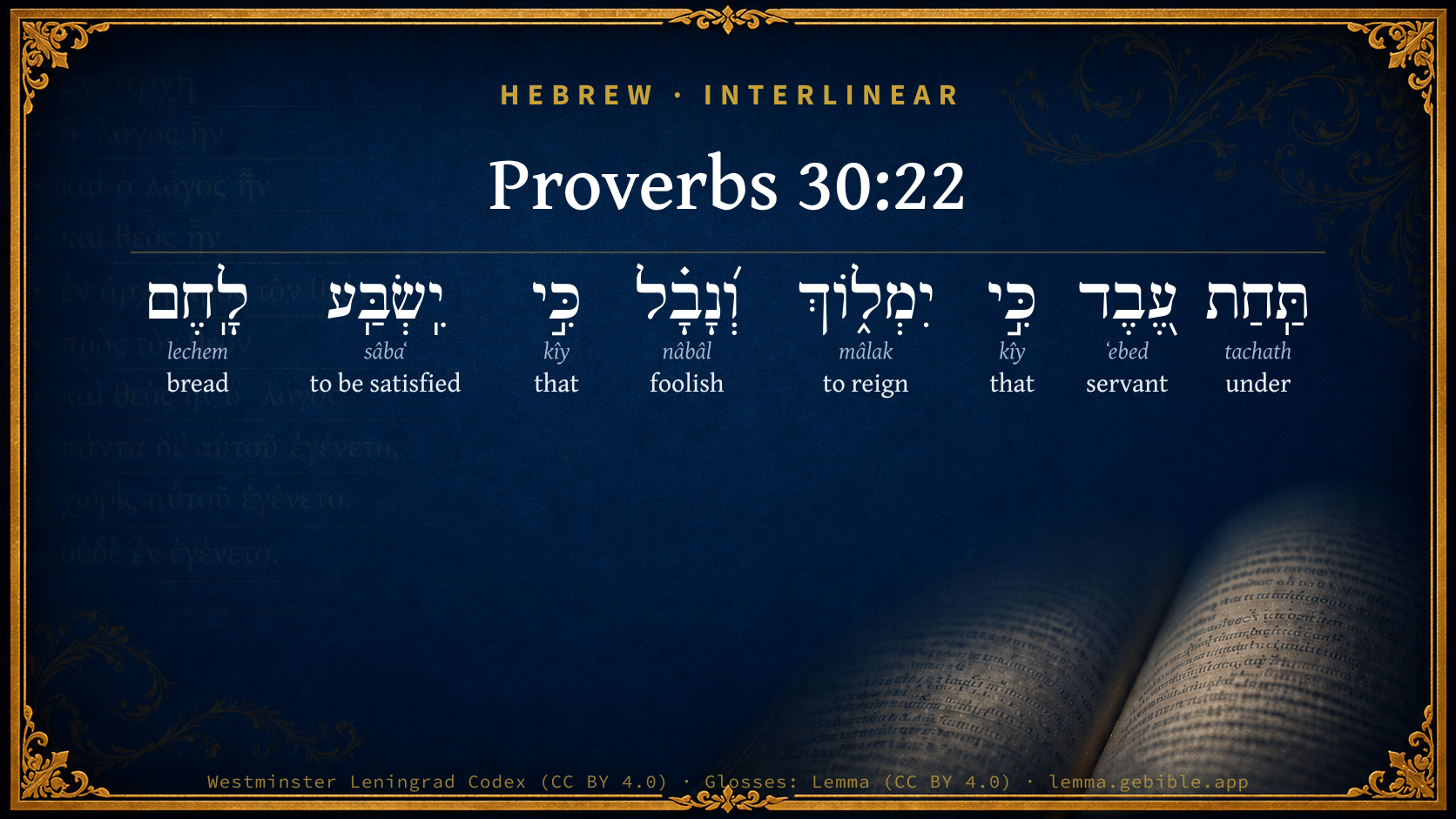
Proverbs 30:22

Hebrew (Westminster Leningrad Codex) Proverbs 30:22 appears in the Hebrew Old Testament. The text above is from the Westminster Leningrad Codex. Each word links to its Strong’s number, a concise gloss, and parsing drawn from the Open Scriptures Hebrew Bible morphology. Click any word for its full Brown-Driver-Briggs (BDB) entry.
Download image
Cite this verse

Proverbs 30:22 (World English Bible). Public Domain. Lemma interlinear Bible study tool, https://lemma.gebible.app/v/proverbs/30/22.

Show BibTeX & RIS
BibTeX
RIS
English Translation
For a servant when he is king; A fool when he is filled with food;
World English Bible · Public Domain
Download a study sheet

One document with this verse’s original text, its word-by-word gloss line, the meaning frame, cross-references with their text, attributed commentary, and full source and license credits — printable, and it pastes into notes with its structure intact.

This verse Autodidact and up

Study sheet (.html) Plain text (.txt)

A passage Seminary Student

Up to 50 verses in one chapter. A passage sheet keeps up to 6 commentary sources and 12 cross-references per verse, in the order this page ranks them, and says so on the sheet whenever that leaves anything out. Ask for a single verse and you get the Autodidact verse sheet above.

Everything on this page stays free to read, with no account — the sheet is a download of what is already on screen, not access to it.

Want to remove ads? Support Godless Engineer
Compare translations 3

The same verse in 3 English versions, stacked beneath the original-language interlinear above. Click any original word for its lexicon entry.

Each is an independent rendering of the whole verse — the interlinear is not word-aligned to these translations.

Highlighted words mark where these versions differ — a whole-verse word diff, not a word-by-word alignment.

  • World English Bible Public Domain
    For a servant when he is king; A fool when he is filled with food;
  • King James Version Public Domain
    For a servant when he reigneth; and a fool when he is filled with meat;
  • unfoldingWord Literal Text CC BY-SA 4.0
    under a slave when he becomes king and a worthless one when he is satisfied with bread,

unfoldingWord Literal Text — © unfoldingWord, licensed CC BY-SA 4.0. Word-aligned USFM3 via Door43 (git.door43.org/unfoldingWord/en_ult).

Versions to compare (up to 4)

3 of 4 selected

Show all 18 translations

Every available English version of this verse, each an independent rendering of the whole verse.

  • World English Bible Public Domain
    For a servant when he is king; A fool when he is filled with food;
  • Berean Standard Bible Public Domain
    a servant who becomes king, a fool who is filled with food,
  • Majority Standard Bible Public Domain
    a servant who becomes king, a fool who is filled with food,
  • King James Version Public Domain
    For a servant when he reigneth; and a fool when he is filled with meat;
  • American Standard Version (1901) Public Domain
    For a servant when he is king; And a fool when he is filled with food;
  • Revised Version (1885) Public Domain
    For a servant when he is king; and a fool when he is filled with meat;
  • Geneva Bible (1599) Public Domain
    For a seruant when he reigneth, and a foole when he is filled with meate,
  • Douay-Rheims (1899) Public Domain
    By a slave when he reigneth: by a fool when he is filled with meat:
  • Young's Literal Translation Public Domain
    For a servant when he reigneth, And a fool when he is satisfied with bread,
  • Literal Standard Version CC BY-SA 4.0
    For a servant when he reigns, || And a fool when he is satisfied with bread,
  • Unlocked Literal Bible CC BY-SA 4.0
    a slave when he becomes king; a fool when he is filled with food;
  • unfoldingWord Literal Text CC BY-SA 4.0
    under a slave when he becomes king and a worthless one when he is satisfied with bread,
  • Darby Bible Public Domain
    Under a servant when he reigneth, and a churl when he is filled with meat;
  • World Messianic Bible Public Domain
    For a servant when he is king, a fool when he is filled with food,
  • Webster's Bible Public Domain
    For a servant when he reigneth; and a fool when he is filled with food.
  • Free Bible Version CC BY-SA 4.0
    a slave becoming a king, a stupid person eating like a pig,
  • Bible in Basic English Public Domain
    A servant when he becomes a king; a man without sense when his wealth is increased;
  • JPS Tanakh (1917) Public Domain
    For a servant when he reigneth; and a churl when he is filled with food;

Literal Standard Version (2020), Covenant Press — licensed CC BY-SA 4.0. Text via the HelloAO Bible API (eBible.org). Unlocked Literal Bible (unfoldingWord) — licensed CC BY-SA 4.0. Text via the HelloAO Bible API (eBible.org). unfoldingWord Literal Text — © unfoldingWord, licensed CC BY-SA 4.0. Word-aligned USFM3 via Door43 (git.door43.org/unfoldingWord/en_ult). Free Bible Version, Dr. Jonathan Gallagher — licensed CC BY-SA 4.0. Text via the HelloAO Bible API (eBible.org).

Word by word

More ways to search: Search by grammar → Find every occurrence → Compare this word →

Practice this passage: Drill this verse → Learn its vocabulary →

About this verse

These counts appear in no published source. They are computed here, from the morphology-tagged text and Lemma’s own curated glosses. What Lemma adds →

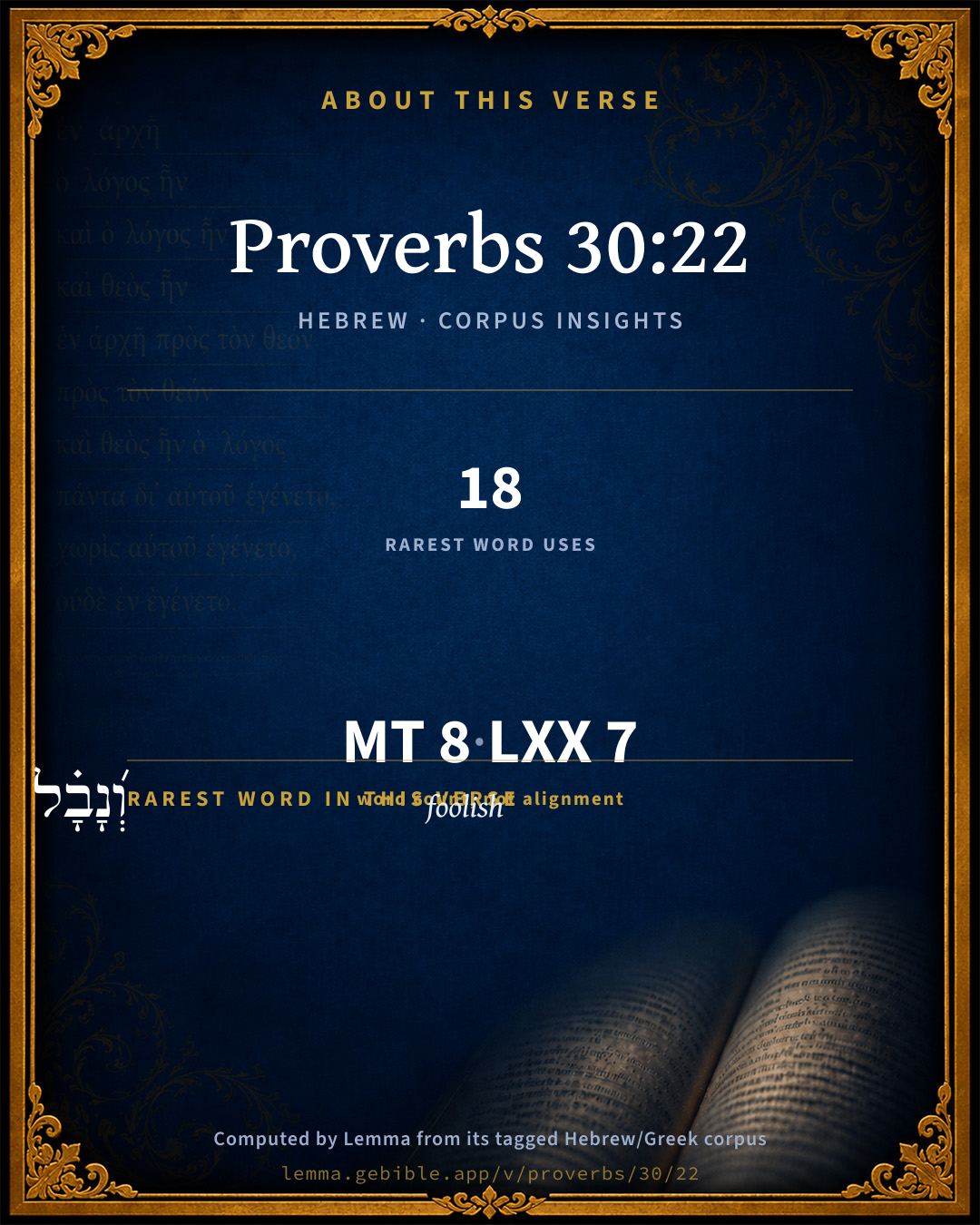
8
words
7
distinct lemmas
Wisdom
section

Notable vocabulary

The rarest word here is וְ֝נָבָ֗ל foolish H5036 — appearing just 18 times in the whole Hebrew Bible.

Shared distinctive vocabulary

וְ֝נָבָ֗ל foolish H5036 occurs in 18 verses of the Hebrew Bible. Also found in:

Grammatical profile

  • 2 verbs
  • 2 nouns
  • 1 adjective
  • 1 preposition
  • 2 conjunctions

Verb forms

  • יִמְל֑וֹךְ Qal · Imperfect
  • יִֽשְׂבַּֽע Qal · Imperfect

Repetition

A word recurs within this verse — often emphatic in Hebrew:

  • כִּ֣י that H3588 ×2

Hebrew & Septuagint length

In English translation the verse runs 15 words from the Hebrew and 11 from the Septuagint (LXX English) — closely comparable.

A rough comparison of the two English renderings, which tokenize alike — not a word-level alignment.

Word counts can differ between the Hebrew and the Greek without any difference in meaning — e.g. the Hebrew direct-object marker אֵת has no separate Greek word, and Greek often adds the article ὁ.

In the original languages it is 8 Hebrew tokens and 7 Greek tokens — but the two are counted differently (Hebrew bundles its prefixes and suffixes into one token; the Greek is in lemma form), so that isn’t a like-for-like length.

Cross-references

9

Topical passages linked to Proverbs 30:22 in the Treasury of Scripture Knowledge — connected by theme and wording, ordered by reader-vote popularity; previews shown in the World English Bible.

  • Proverbs 19:10 Delicate living is not appropriate for a fool, Much less for a servant to have rule over princes.
  • Ecclesiastes 10:7 I have seen servants on horses, and princes walking like servants on the earth.
  • 1 Samuel 25:3 Now the name of the man was Nabal; and the name of his wife Abigail; and the woman was of good understanding, and of a beautiful face: but the man was churlish and evil in his doings; and he was of the house of Caleb.
  • 1 Samuel 25:10–11 Nabal answered David's servants, and said, Who is David? and who is the son of Jesse? there are many servants now-a-days who break away every man from his master.
  • 1 Samuel 25:25 Please don't let my lord regard this worthless fellow, even Nabal; for as his name is, so is he; Nabal is his name, and folly is with him: but I your handmaid didn't see the young men of my lord, whom you did send.
  • 1 Samuel 25:36–38 Abigail came to Nabal; and, behold, he held a feast in his house, like the feast of a king; and Nabal's heart was merry within him, for he was very drunken: therefore she told him nothing, less or more, until the morning light.
  • 1 Samuel 30:16 When he had brought him down, behold, they were spread abroad over all the ground, eating and drinking, and dancing, because of all the great spoil that they had taken out of the land of the Philistines, and out of the land of Judah.
  • Isaiah 3:4–5 I will give boys to be their princes, And children shall rule over them.
  • Proverbs 28:3 A needy man who oppresses the poor Is like a driving rain which leaves no crops.

Cross-references courtesy of OpenBible.info (CC BY 4.0).

Hebrew and Greek witnesses Masoretic Hebrew ↔ Greek Septuagint

The same verse in the two great witnesses to the Old Testament, shown verse-for-verse.

These are two independent witnesses, not word-aligned to each other, and the Septuagint is shown in lemma (dictionary) form.

Hebrew Proverbs 30:22 Masoretic · Westminster Leningrad Codex

תַּֽחַת עֶ֭בֶד כִּ֣י יִמְל֑וֹךְ וְ֝נָבָ֗ל כִּ֣י יִֽשְׂבַּֽע לָֽחֶם

For a servant when he is king; A fool when he is filled with food;

World English Bible · Public Domain

Greek LXX Proverbs 30:22 Septuagint · lemma form

ἐάν οἰκέτης βασιλεύω καί ἄφρων πίμπλημι σιτίον

if a servant reign; or a fool be filled with food;

LXX2012 (modern English Septuagint) · Public Domain

Hebrew: Westminster Leningrad Codex (CC BY 4.0). Greek: Septuagint (public domain); English from LXX2012 (modern English Septuagint) (Public Domain). How the Septuagint differs from the Hebrew →

Commentary

Notes on Proverbs 30:22 from classic Christian and Jewish commentators (each source and its license shown beneath its notes). The classic Christian expositions comment on the surrounding passage and are grouped to its opening verse, so a note may address several verses; the Jewish commentaries on the Tanakh (Rashi and others) are per-verse, so they appear only where the commentator wrote on this verse.

Lemma curates 59 commentaries, every one of them public domain or Creative Commons licensed, each selected and text-cleaned for this edition rather than reprinted as found. About our sources →

Trapp's Complete Commentary

John Trapp

Pro 30:22 For a servant when he reigneth; and a fool when he is filled with meat;

Ver. 22. For a servant when he reigneth.] As Jeroboam, Saul, Zimri, Herod, Heliogabalus, Phocas. {See Trapp on "Pro 19:10"} Vespasian only, of all the emperors, is said to have been better for his advancement.

For a fool when he is filled with meat.] When his belly is filled with God’s "hid treasure"; {Psa 17:14} when he prospers and hath what he will. Prosperity is hard meat to fools; they cannot digest it. {a} They grow giddy, as weak heads do after a cup of generous wine, and lay about them like madmen; the folly of these rich fools is foolishness with a witness. {Pro 14:24} {See Trapp on "Pro 14:24"}

{a} Luxuriant animi rebus plerumque secundis. - Ovid.

John Trapp, A Commentary or Exposition upon All the Books of the Old and New Testament (1647–1656) — public domain. Text from a community e-Sword module.

Geneva Bible (1599)

Geneva Bible translators

These commonly abuse the state whereunto they are called.

Geneva Bible (1599) marginal notes — public domain. Text via Bolls.life.

Ellicott's Commentary for English Readers

(22) For a servant when he reigneth.—The mischief done by Oriental favourites at court, who often began life as slaves, was proverbial.

A fool (nâbhâl).—See above, on Pro_17:7. It is only when he has to work hard for his living that he will behave himself decently; if he gets a little money, it will soon be wasted in idleness and self-indulgence.

A Bible Commentary for English Readers, edited by Charles John Ellicott (1878–1897) — public domain. Text from a community e-Sword module.

The Cambridge Bible for Schools and Colleges

gen. ed. J. J. S. Perowne

22. reigneth] Better, is, or becomes king.

filled with meat] i.e. is rich and prosperous. See Pro_30:8-9 above.

The Cambridge Bible for Schools and Colleges (gen. ed. J. J. S. Perowne; Cambridge University Press, 1878–1918) — public domain. Text from a community e-Sword module.

John Gill's Exposition

For a servant, when he reigneth,.... Being unfit for it through his education, not having been trained up in and learned the arts of government and maxims of it; and through the disposition of his mind, which is mean, abject, and servile; and as he has been used himself when a servant, so he will use others (c) and through his circumstances, being poor, he will take oppressive methods to become rich; and being raised from a low estate, he is the more imperious, proud, and haughty (d); all which and more make his reign intolerable; see Pro 19:10. This may be applied to antichrist, the "servus servorum", who in a haughty, tyrannical, and insolent manner, exalts himself above all that is called God: and reigns over the kings of the earth, at least has done so, and that in such a manner as was unbearable; deposing kings at pleasure, disposing of their kingdoms, and trampling upon their necks, and making their subjects his vassals; see Th2 2:4;

and a fool, when he is filled with meat; as Nabal at his feast, when he behaved so intolerably in his cups towards David and his messengers, that he determined on his destruction, had not Abigail interposed, Sa1 25:10; and there are many such fools, who having their bellies full of food, and their heads full of liquor, are very overbearing in company, and give their tongues such a loose as is very disturbing: or this may intend such fools, or wicked men, who are full of wealth and riches, and being purse proud, are exceeding haughty and insolent; set their mouths against the heaven, and blaspheme God that is in it; and their tongues walk through the earth, and spare none, but lash all in an insufferable manner. These disquiet families, neighbourhoods, communities, and commonwealths; see Psa 73:7.

(c) "Nec bellua tetrior ulla est, quam servi rabies in libera colla furentis", Claudian. in Eutrop. l. 1. v. 183, 184. (d) "Asperius nihil est humili, cum surgit in altum", Claudian. ib. v. 181.

John Gill's Exposition of the Whole Bible (1746–1763) — public domain (CC PDM 1.0). Text via the HelloAO Bible API.

Matthew Poole's English Annotations

When he reigneth; when he is advanced to great power and dignity; for such a one is ignorant and unfit for his place, and therefore commits many errors; he is poor, and therefore an insatiable oppressor, according to Pro 28:3; he is proud and imperious, and being maligned and hated by others, he is provoked to hate them, and to be injurious and cruel to them.

A fool, a conceited and wilful fool, or all obstinately wicked man,

when he is filled with meat; either,

1. When he is glutted with meat or drink, which dulls men’s reason, and heats their blood, and stirs them up to many insolencies. Or rather,

2. When he abounds in wealth, which in that case is like a sword in a madman’s hand, being an instrument and occasion of innumerable wickednesses and mischiefs, as appears from common experience.

Matthew Poole's English Annotations on the Holy Bible (1683–1685) — public domain. Text from a community e-Sword/MySword module.

The Pulpit Commentary

For a servant when he reigneth; or, under a slave when he becometh king. This startling vicissitude was not uncommon in Eastern states; and even if the slave was not preferred to regal power, he was often advanced by unwise favouritism to high position, for which he was wholly unfitted, and which he used only to aggrandize himself at the expense and to the injury of others, This incongruity has been already noticed at Pro_19:10 (where see note). And a fool when he is filled with meat. "Fool" is here nabal, a low, profligate fellow, who is rich and without care. When such a one rises to high position, or has power over others, he becomes arrogant, selfish, unbearable. (comp. ver. 9 Pro_28:12 Pro_29:2)

The Pulpit Commentary (1880–1919), ed. H.D.M. Spence-Jones & Joseph S. Exell — public domain. Text from a community e-Sword module.

John Wesley's Explanatory Notes

A servant - For such an one is commonly ignorant, and therefore commits many errors; he is poor, and therefore insatiable, he is proud and imperious, and usually injurious and cruel. A fool - A conceited fool. When - When he abounds in wealth.

John Wesley, Explanatory Notes Upon the Whole Bible (1754–1765) — public domain. Text via the GEBible commentary corpus.

Lesson kit

Teaching starters — assembled from the data on this page, not authored interpretation. Every prompt links to the verse data it draws on. Edit before teaching.

Proverbs, in the Wisdom, opens this verse with 8 words (7 distinct Hebrew lemmas). Its most distinctive word is nâbâl (“foolish”). A historical commentator’s framing appears above. Read the whole chapter for the surrounding context.

Discussion questions

  1. How does “foolish” (nâbâl) shape what this verse is saying?
  2. Deuteronomy 32:6 shares the word «foolish» with this verse. How do the two illuminate each other?
  3. “that” occurs 2× in this one verse. What is the effect of the repetition?
  4. The translations on this page render this verse differently — a whole-verse word diff, not a word-by-word alignment. What might account for the different wordings?
  5. The verb «יִמְל֑וֹךְ» is Qal Imperfect. How does its form color the action?
  6. Reading how Trapp's Complete Commentary and Geneva Bible (1599) read this verse, where do the two commentators agree and where do they part?

Things to notice

Reading settings

Reading text

Shown beneath each verse's original-language words.

Old Testament
Old Testament edition

Read the OT as the Masoretic Hebrew (MT) or the Greek Septuagint (LXX).

English shown for the Greek Septuagint (in the Hebrew ↔ Greek comparison).

Comparing translations? Open the Compare panel on any verse page to stack up to four side by side.