
Proverbs 26:10

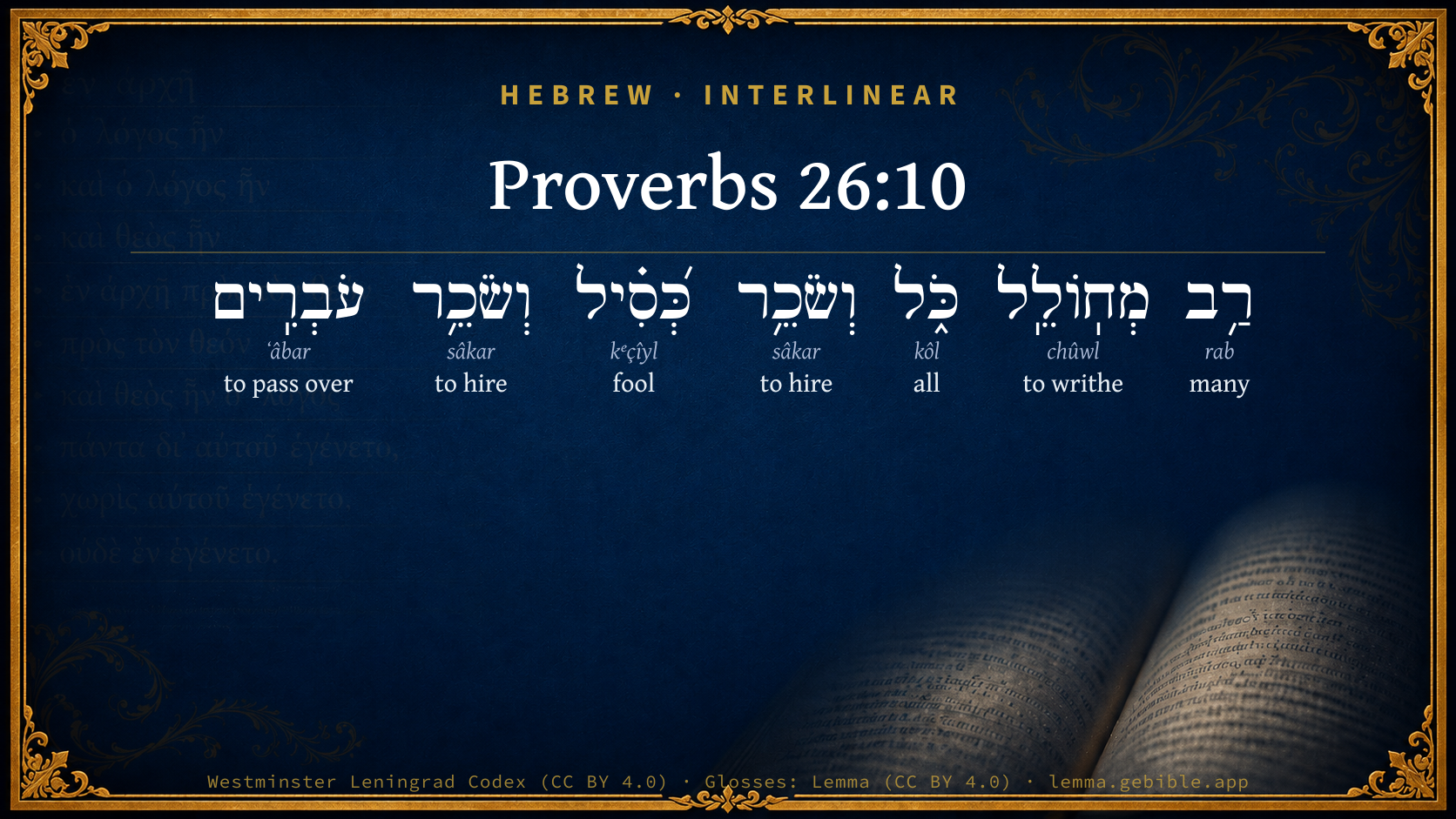
Hebrew (Westminster Leningrad Codex) Proverbs 26:10 appears in the Hebrew Old Testament. The text above is from the Westminster Leningrad Codex. Each word links to its Strong’s number, a concise gloss, and parsing drawn from the Open Scriptures Hebrew Bible morphology. Click any word for its full Brown-Driver-Briggs (BDB) entry.
Download image
Cite this verse

Proverbs 26:10 (World English Bible). Public Domain. Lemma interlinear Bible study tool, https://lemma.gebible.app/v/proverbs/26/10.

Show BibTeX & RIS
BibTeX
RIS
English Translation
As an archer who wounds all, So is he who hires a fool Or he who hires those who pass by.
World English Bible · Public Domain
Download a study sheet

One document with this verse’s original text, its word-by-word gloss line, the meaning frame, cross-references with their text, attributed commentary, and full source and license credits — printable, and it pastes into notes with its structure intact.

This verse Autodidact and up

Study sheet (.html) Plain text (.txt)

A passage Seminary Student

Up to 50 verses in one chapter. A passage sheet keeps up to 6 commentary sources and 12 cross-references per verse, in the order this page ranks them, and says so on the sheet whenever that leaves anything out. Ask for a single verse and you get the Autodidact verse sheet above.

Everything on this page stays free to read, with no account — the sheet is a download of what is already on screen, not access to it.

Want to remove ads? Support Godless Engineer
Compare translations 3

The same verse in 3 English versions, stacked beneath the original-language interlinear above. Click any original word for its lexicon entry.

Each is an independent rendering of the whole verse — the interlinear is not word-aligned to these translations.

Highlighted words mark where these versions differ — a whole-verse word diff, not a word-by-word alignment.

  • World English Bible Public Domain
    As an archer who wounds all, So is he who hires a fool Or he who hires those who pass by.
  • King James Version Public Domain
    The great God that formed all things both rewardeth the fool, and rewardeth transgressors.
  • unfoldingWord Literal Text CC BY-SA 4.0
    An archer piercing everyone, so one hiring a stupid and hiring passersby.

unfoldingWord Literal Text — © unfoldingWord, licensed CC BY-SA 4.0. Word-aligned USFM3 via Door43 (git.door43.org/unfoldingWord/en_ult).

Versions to compare (up to 4)

3 of 4 selected

Show all 18 translations

Every available English version of this verse, each an independent rendering of the whole verse.

  • World English Bible Public Domain
    As an archer who wounds all, So is he who hires a fool Or he who hires those who pass by.
  • Berean Standard Bible Public Domain
    Like an archer who wounds at random is he who hires a fool or passerby.
  • Majority Standard Bible Public Domain
    Like an archer who wounds at random is he who hires a fool or passerby.
  • King James Version Public Domain
    The great God that formed all things both rewardeth the fool, and rewardeth transgressors.
  • American Standard Version (1901) Public Domain
    `As' an archer that woundeth all, So is he that hireth a fool and he that hireth them that pass by.
  • Revised Version (1885) Public Domain
    As an archer that woundeth all, so is he that hireth the fool and he that hireth them that pass by.
  • Geneva Bible (1599) Public Domain
    The excellent that formed all things, both rewardeth the foole and rewardeth the transgressers.
  • Douay-Rheims (1899) Public Domain
    Judgment determineth causes: and he that putteth a fool to silence, appeaseth anger.
  • Young's Literal Translation Public Domain
    Great `is' the Former of all, And He is rewarding a fool, And is rewarding transgressors.
  • Literal Standard Version CC BY-SA 4.0
    The Former of all [is] great, || And He is rewarding a fool, || And is rewarding transgressors.
  • Unlocked Literal Bible CC BY-SA 4.0
    Like an archer who wounds all those around him is one who hires a fool or hires anyone who passes by.
  • unfoldingWord Literal Text CC BY-SA 4.0
    An archer piercing everyone, so one hiring a stupid and hiring passersby.
  • Darby Bible Public Domain
    A master roughly worketh every one: he both hireth the fool and hireth passers-by.
  • World Messianic Bible Public Domain
    As an archer who wounds all, so is he who hires a fool or he who hires those who pass by.
  • Webster's Bible Public Domain
    The great God that formed all things both rewardeth the fool, and rewardeth transgressors.
  • Free Bible Version CC BY-SA 4.0
    Anyone who hires someone stupid or just a passer-by is like an archer wounding people by shooting arrows at random.
  • Bible in Basic English Public Domain
    Like an archer wounding all who go by, is a foolish man overcome by drink.
  • JPS Tanakh (1917) Public Domain
    A master performeth all things; but he that stoppeth a fool is as one that stoppeth a flood.

Literal Standard Version (2020), Covenant Press — licensed CC BY-SA 4.0. Text via the HelloAO Bible API (eBible.org). Unlocked Literal Bible (unfoldingWord) — licensed CC BY-SA 4.0. Text via the HelloAO Bible API (eBible.org). unfoldingWord Literal Text — © unfoldingWord, licensed CC BY-SA 4.0. Word-aligned USFM3 via Door43 (git.door43.org/unfoldingWord/en_ult). Free Bible Version, Dr. Jonathan Gallagher — licensed CC BY-SA 4.0. Text via the HelloAO Bible API (eBible.org).

Word by word

More ways to search: Search by grammar → Find every occurrence → Compare this word →

Practice this passage: Drill this verse → Learn its vocabulary →

About this verse

These counts appear in no published source. They are computed here, from the morphology-tagged text and Lemma’s own curated glosses. What Lemma adds →

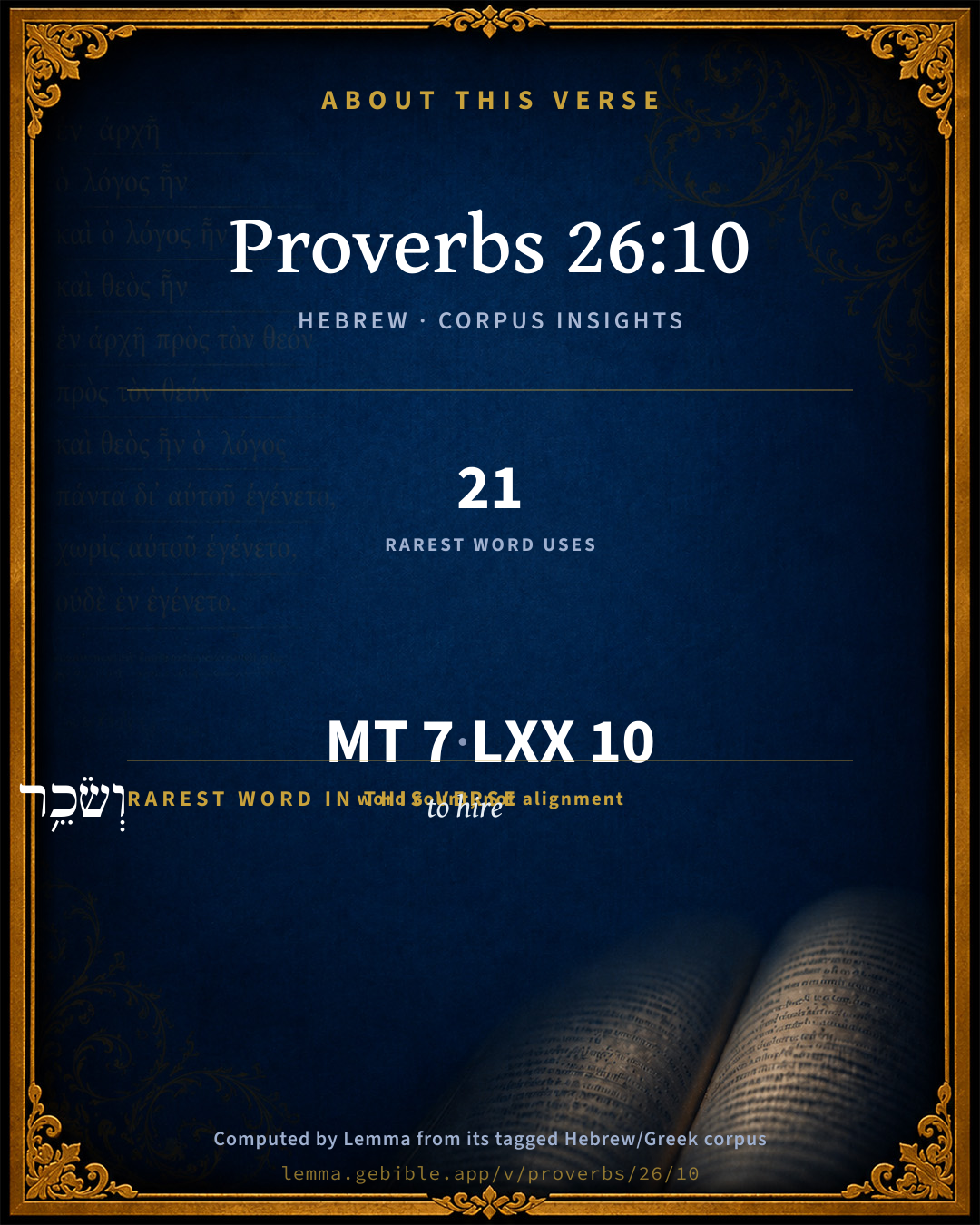
7
words
6
distinct lemmas
Wisdom
section

Notable vocabulary

The rarest word here is וְשֹׂכֵ֥ר to hire H7936 — appearing just 21 times in the whole Hebrew Bible.

Shared distinctive vocabulary

וְשֹׂכֵ֥ר to hire H7936 occurs in 18 verses of the Hebrew Bible. Also found in:

Grammatical profile

  • 4 verbs
  • 1 noun
  • 2 adjectives

Verb forms

  • מְחֽוֹלֵֽל Poel · Participle Active
  • וְשֹׂכֵ֥ר Qal · Participle Active
  • וְשֹׂכֵ֥ר Qal · Participle Active
  • עֹבְרִֽים Qal · Participle Active

Repetition

A word recurs within this verse — often emphatic in Hebrew:

  • וְשֹׂכֵ֥ר to hire H7936 ×2

Hebrew & Septuagint length

In English translation the verse runs 21 words from the Hebrew and 15 from the Septuagint (LXX English) — the Septuagint runs noticeably shorter here. See the side-by-side →

A rough comparison of the two English renderings, which tokenize alike — not a word-level alignment.

Word counts can differ between the Hebrew and the Greek without any difference in meaning — e.g. the Hebrew direct-object marker אֵת has no separate Greek word, and Greek often adds the article ὁ.

In the original languages it is 7 Hebrew tokens and 10 Greek tokens — but the two are counted differently (Hebrew bundles its prefixes and suffixes into one token; the Greek is in lemma form), so that isn’t a like-for-like length.

Cross-references

2

Topical passages linked to Proverbs 26:10 in the Treasury of Scripture Knowledge — connected by theme and wording, ordered by reader-vote popularity; previews shown in the World English Bible.

  • Proverbs 11:31 Behold, the righteous shall be repaid in the earth; How much more the wicked and the sinner!
  • Romans 2:6 who "will pay back to everyone according to their works:"

Cross-references courtesy of OpenBible.info (CC BY 4.0).

Hebrew and Greek witnesses Masoretic Hebrew ↔ Greek Septuagint

The same verse in the two great witnesses to the Old Testament, shown verse-for-verse.

Here the Septuagint runs noticeably shorter than the Hebrew — LXX2012 (modern English Septuagint) 15 words vs World English Bible 21. A rough length comparison of the two English translations, not a word-level alignment — read both below.

These are two independent witnesses, not word-aligned to each other, and the Septuagint is shown in lemma (dictionary) form.

Hebrew Proverbs 26:10 Masoretic · Westminster Leningrad Codex

רַ֥ב מְחֽוֹלֵֽל כֹּ֑ל וְשֹׂכֵ֥ר כְּ֝סִ֗יל וְשֹׂכֵ֥ר עֹבְרִֽים

As an archer who wounds all, So is he who hires a fool Or he who hires those who pass by.

World English Bible · Public Domain

Greek LXX Proverbs 26:10 Septuagint · lemma form

πολύς χειμάζω πᾶς σάρξ ἄφρων συντρίβω γάρ ὁ ἔκστασις αὐτός

All the flesh of fools endures much hardship; for their fury is brought to nothing.

LXX2012 (modern English Septuagint) · Public Domain

On this verse, Keil & Delitzsch discusses the Septuagint’s reading. Read the note in Commentary ↓

Hebrew: Westminster Leningrad Codex (CC BY 4.0). Greek: Septuagint (public domain); English from LXX2012 (modern English Septuagint) (Public Domain). How the Septuagint differs from the Hebrew →

Commentary

Notes on Proverbs 26:10 from classic Christian and Jewish commentators (each source and its license shown beneath its notes). The classic Christian expositions comment on the surrounding passage and are grouped to its opening verse, so a note may address several verses; the Jewish commentaries on the Tanakh (Rashi and others) are per-verse, so they appear only where the commentator wrote on this verse.

Lemma curates 59 commentaries, every one of them public domain or Creative Commons licensed, each selected and text-cleaned for this edition rather than reprinted as found. About our sources →

Trapp's Complete Commentary

John Trapp

Pro 26:10 The great [God] that formed all [things] both rewardeth the fool, and rewardeth transgressors.

Ver. 10. The great God that formed all things.] As he made all so he maintains all, even the evil and the unthankful. God deals not as that cruel Duke of Alva did in the Netherlands; - some he roasted to death, saith the historian, {a} starved others, and that even after quarter, saying, though he promised to give them their lives, he did not promise to find them meat; - but as he hath given them their lives, forfeited in Adam, so he allows them a livelihood, gives them their portion in this life, fills their bellies with his good treasure, but by it sends leanness into their souls, or if he fattens them, it is to fit them for destruction, as fated ware is fitted for the meat market.

{a} Grimston.

John Trapp, A Commentary or Exposition upon All the Books of the Old and New Testament (1647–1656) — public domain. Text from a community e-Sword module.

Joseph Benson's Commentary

Pro 26:10. The great God formed all things, &c. — The Hebrew text of this verse will admit of different translations, as the reader may see by the margin, and commentators are much divided in their opinions of its meaning. The Hebrew word רב, rab, here rendered great, may be applied either to God or to a prince, and the proverb may be considered as declaring either how God the Creator and Governor of the universe will deal with sinners, or how kings and princes ought to act toward their subjects. Bishop Patrick’s paraphrase, which includes both, seems to give the most probable sense of the verse, thus: “The great God, who made all things, governs them also most wisely and equally; dispensing, for instance, his punishments suitable to men’s sins, whether out of ignorance, or of wilful wickedness; whom a good prince imitates; but a bad one proves a universal grievance, by employing either fools or profane persons in his service, who vex the rest of his subjects.”

Joseph Benson's Commentary on the Old and New Testaments (1811–1818) — public domain. Text from a community e-Sword module.

Keil & Delitzsch

C. F. Keil & F. Delitzsch

All that we have hitherto read is surpassed in obscurity by this proverb, which is here connected because of the resemblance of ושכר to שכור. We translate it thus, vocalizing differently only one word:

Much bringeth forth from itself all;

But the reward and the hirer of the fool pass away.

The lxx translates πολλὰ χειμάζεται πᾶσα σὰρξ ἀφρόνων (all the flesh of fools suffers much), συντριβήσεται γὰρ ἧ ἔκστασις αὐτῶν, which is in Hebrew:

רב מחולל כל בּשׂר כסיל

ישּׁבר עברתם

An unfortunate attempt so to rectify the words that some meaning might be extracted from them. The first line of this translation has been adopted by the Syr. and Targ., omitting only the כל, in which the self-condemnation of this deciphering lies (for כל בשׂר means elsewhere, humanity, not the whole body of each individual); but they translate the second line as if the words were:

ישׁכּר עבר ים

i.e., and the drunken man sails over the sea (עברים is separated into עבר ים, as בבקרים, Amo 6:12, is to be separated into בּבּקר ים); but what does that mean? Does it mean that to a drunkard (but שׁכּור, the drunken man, and not סבא, the drunkard, is used) nothing remains but to wander over the sea? or that the drunken man lets his imagination wander away over the sea, while he neglects the obligation that lies upon him? Symmachus and Theodotion, with the Midrash (Rashi) and Saadia (Kimchi), take שׂכר in 10b = סגר (like Isa 19:10, שׂכר = embankment, cf. סכּרין, Kelim, Pro 23:5); the former translates by καὶ ὁ φράσσων ἄφρονα ἐμφράσσει τὰς ὀργὰς αὐτοῦ, the latter by καὶ φιμῶν ἄφρονα φιμοῖ χόλους, yielding to the imagination that עברים, like עברות, may be the plur. of עברה, anger. Jerome punctuates רב as, Pro 25:8, רב, and interprets, as Symmachus and Theodotion, שׂכר both times = סגר, translating: Judicium determinat causas, et qui imponit stulto silentium iras mitigat; but רב does not mean judicium, nor מחולל determinat, nor כל causas. As Gussetius, so also Ralbag (in the first of his three explanations), Meri, Elia Wilna interpret the proverb as a declaration regarding quarrelsome persons: he causeth woe to all, and hireth fools, hireth transgressors, for his companions; but in that case we must read רב for רב; מחולל, bringing woe, would be either the Po. of חלל, to bore through, or Pilel of חיל (חוּל), to put into distress (as with pangs); but עברים, transgressors = sinners, is contrary to the O.T. usus loq., Pro 22:3 (Pro 27:12) is falsely cited in its favour; besides, for רב there should have been at least אישׁ רב and why שׂכרו is repeated remains inexplicable. Others take מחולל־כל as the name of God, the creator of all men and things; and truly this is the nearest impression of these two words, for חולל is the usual designation for divine production, e.g., Psa 90:2. Accordingly Kimchi explains: The Lord is the creator of all, and He gives to fools and to transgressors their maintenance; but עברים, transgressors, is Mishnic, not bibl.; and שׂכר means to hire, but not to supply with food. The proverb is thus incapable of presenting a thought like Mat 5:45 (He maketh His sun to rise on the evil and on the good). Others translate: "The Lord is creator of all, and takes fools, takes idlers, into His service." Thus rendered, the proverb is offensive; wherefore Rashi, Moses Kimchi, Arama, and others regard the Mashal as in the mouth of fools, and thus they take Pro 26:9 and Pro 26:10 together as a tetrastich. Certainly this second collection of proverbs contains also tetrastiches; but Pro 26:9 and Pro 26:10 cannot be regarded as together forming a tetrastich, because רב (which is valid against Kimchi also) cannot mean God the Lord: רב, Lord, is unheard of in bibl. Heb., and at least the word הרב must be used for God. The Venet. on this account does not follow Kimchi, but translates, Ἄρχων πλάττει πάντα, καὶ μισθοῦται μωρὸν καὶ μισθοῦται ὡς παραβάτης (ought to have been παραβάτας); but who could this cunning man be? Perhaps the Venet. is to be understood, after Gecatilia (in Rashi): a great (rich) man performs all manner of things; but if he hires a fool, it is as if he hired the first best who pass along the way. But that חולל is used in the general sense of to execute, to perform, is without example, and improbable. Also the explanation: a ruler brings grief, i.e., severe oppression, upon all (Abulwald, Immanuel, Aben Ezra, who, in his smaller grammar, explains רב = רב after Isa 49:9; C. B. Michaelis: dolore afficit omnes), does not recommend itself; for חולל, whether it be from חלל, Isa 51:9 (to bore through), or from חיל, Psa 29:9 (to bring on the pangs of birth), is too strong a word for hurting; also the clause, thus generally understood, is fortunately untrue. Translated as by Euchel: "the prominent persons destroy all; they keep fools in pay, and favour vagabonds," - it sounds as if it had been picked up in an assembly of democrats. On the other hand, the proverb, as translated by Luther:

A good master maketh a thing right;

But he who hireth a bungler, by him it is spoiled,

is worthy of the Book of Proverbs. The second line is here freely rendered, but it is also appropriate, if we abide closer by the words of the text, in this connection. Fleischer: Magister (artifex peritus) effingit omnia (i.e., bene perficit quaecunque ei committuntur); qui autem stultum conducit, conducit transeuntes (i.e., idem facit ac si homines ignotos et forte transeuntes ad opus gravius et difficilius conduceret). Thus also Gesenius, Bttcher, and others, who all, as Gecatilia above, explain עברים, τοὺς τυχόντας, the first best. But we are reluctantly constrained to object to this thought, because רב nowhere in bibl. Hebrew signifies a master; and the ו of the second ושׂכר dno cannot bear that rendering, ac si. And if we leave it out, we nevertheless encounter a difficulty in חולל, which cannot be used of human production. Many Christian interpreters (Cocceius, Schultens, Schelling, Ewald, Bertheau, Stier, Zckler) give to רב a meaning which is found in no Jewish interpreter, viz., sagittarius, from רבב (רבב), Gen 49:23 (and perhaps Psa 18:15), after the forms צר, שׂר, the plur. of which, רבּים, is found at Job 16:13; Jer 50:29, but in a connection which removes all doubt from the meaning of the word. Here also רב may be more closely defined by מחולל; but how then does the proverb stand? "an archer who wounds everything, and he who hires a fool, and hires passers-by" (Ewald: street-runners), i.e., they are alike. But if the archer piercing everything is a comic Hercules furens, then, in order to discover the resemblance between the three, there is need of a portion of ingenuity, such as is only particularly assigned to the favoured. But it is also against the form and the usage of the word to interpret עברים simply of rogues and vagabonds. Several interpreters have supposed that רב and כל must stand in a certain interchangeable relation to each other. Thus, e.g., Ahron b. Josef: "Much makes amazement to all, but especially one who hires a fool...." But this "especially" (Before all) is an expression smuggled in. Agreeing with Umbreit and Hitzig, we translate line first; but in translating line second, we follow our own method:

Much bringeth all out of it;

i.e., where there is much, then one has it in his power, if he begins right, to undertake everything. רב has by כּל the definition of a neuter, so as to designate not only many men, Exo 19:21, but also much ability in a pecuniary and facultative sense (cf. the subst. רב, Isa 63:7; Psa 145:7); and of the much which bringeth forth all out of itself, effects all by itself, חולל with equal right might be used, as Pro 25:23, of the north wind. The antithesis 10b takes this form:

But the reward (read וּשׂכר) and the master (who hires him for wages) of the fool pass away,

i.e., perish; עברים, as if עבר, is used of chaff, Isa 29:5; of stubble, Jer 13:24; of shadow, Psa 144:4. That which the fool gains passes away, for he squanders it; and he who took him into his service for wages is ruined along with him, for his work is only pernicious, not useful. Although he who possesses much, and has great ability, may be able to effect everything of himself, yet that is not the case when he makes use of the assistance therein of foolish men, who not only do not accomplish anything, but, on the contrary, destroy everything, and are only ruinous to him who, with good intention, associates them with himself in his work. That the word must be more accurately ושׂכר, instead of ושׂכרוו, one may not object, since ושׂכר is perfectly unambiguous, and is manifestly the object.

Keil & Delitzsch — Biblical Commentary on the Old Testament (1861–1891) — public domain (CC PDM 1.0). Text via the HelloAO Bible API. (Old Testament only.)

Tyndale Open Study Notes

Tyndale Open Resources

26:10 A fool or a bystander might easily be lazy (see 10:4-6) or incompetent (see 26:6-7). An employer should beware!

Tyndale Open Study Notes — © Tyndale Open Resources, licensed CC BY-SA 4.0. Text via the HelloAO Bible API.

Geneva Bible (1599)

Geneva Bible translators

Meaning, God.

Geneva Bible (1599) marginal notes — public domain. Text via Bolls.life.

Matthew Henry's Commentary

Our translation gives this verse a different reading in the text and in the margin; and accordingly it expresses either, 1. The equity of a good God. The Master, or Lord (so Rab signifies), or, as we read it, The great God that formed all things at first, and still governs them in infinite wisdom, renders to every man according to his work. He rewards the fool, who sinned through ignorance, who knew not his Lord's will, with few stripes; and he rewards the transgressor, who sinned presumptuously and with a high hand, who knew his Lord's will and would not do it, with many stripes. Some understand it of the goodness of God's common providence even to fools and transgressors, on whom he causes his sun to shine and his rain to fall. Or, 2. The iniquity of a bad prince (so the margin reads it): A great man grieves all, and he hires the fool; he hires also the transgressors. When a wicked man gets power in his hand, by himself, and by the fools and knaves whom he employs under him, whom he hires and chooses to make use of, he grieves all who are under him and is vexatious to them. We should therefore pray for kings and all in authority, that, under them, our lives may be quiet and peaceable.

Matthew Henry's Commentary on the Whole Bible (1708–1710) — public domain (CC PDM 1.0). Text via the HelloAO Bible API.

Jamieson, Fausset & Brown

Robert Jamieson, A. R. Fausset & David Brown

Various versions of this are proposed (compare Margin). Better perhaps--"Much He injures (or literally, "wounds") all who reward," &c., that is, society is injured by encouraging evil men.

transgressors--may be rendered "vagrants." The word "God" is improperly supplied.

Jamieson, Fausset & Brown — Commentary Critical and Explanatory on the Whole Bible (1871) — public domain (CC PDM 1.0). Text via the HelloAO Bible API.

Adam Clarke's Commentary

Verse 10. The great God that formed all things] See the margin, where this verse is very differently translated. I shall add that of Coverdale: "A man of experience discerneth all thinges well: but whoso hyreth a foole, hyreth soch one as wyl take no hede." The רב rab may mean either the great God, or a great man: hence the two renderings, in the text and in the margin.

Adam Clarke's Commentary on the Bible (1810–1826) — public domain. Text from a community e-Sword/MySword module.

Ellicott's Commentary for English Readers

(10) The great God that formed all things both rewardeth the fool, and rewardeth transgressors.—If this rendering of the passage could stand, Mat_6:2 might be quoted in illustration of it. If fools and transgressors will set their mind upon “husks” (Luk_15:16) instead of the food God has provided for His children, He does not deny it to them; they have the reward they seek for. But the Hebrew can hardly yield this meaning. Of all the various renderings suggested, perhaps the most unobjectionable is as follows. A master (one skilled in his art), produces everything (by his own care and oversight he sees himself that it is properly done); but a fool hires (others to do his work), and he hires passers by., i.e., any casual person that comes in his way, whether skilled or not, and so the work is done badly.

A Bible Commentary for English Readers, edited by Charles John Ellicott (1878–1897) — public domain. Text from a community e-Sword module.

The Cambridge Bible for Schools and Colleges

gen. ed. J. J. S. Perowne

10. The number and variety of interpretations which have been given to this verse justify the remark of R.V. marg. that “The Hebrew is obscure.”

The rendering of R.V. text is: As an archer (comp. Job_16:13, where the same Heb. word is so rendered) that woundeth all, so is he that hireth the fool and he that hireth them that pass by. But the objection to this is that instead of the fool being the main subject, as he is in all this group of proverbs, he is out of place, and the introduction of him mars the symmetry of the proverb, which should run: As an archer who wounds every one within his reach, friend and foe alike, so is a master who hires all who pass by, good workman and bad indifferently.

For this reason, if for no other, the rendering of R.V. margin is to be preferred: A master-worker formeth all things (we may supply in thought, either (1) and in order to do so makes wise choice of his instruments, or (2) he therefore is wise who employs such an one); but he that hireth the fool is as he that hireth them that pass by—every unskilled instrument that comes to his hand.

The introduction of the word God in A.V. is without authority, and the sense given by it to the proverb is less pertinent.

The Cambridge Bible for Schools and Colleges (gen. ed. J. J. S. Perowne; Cambridge University Press, 1878–1918) — public domain. Text from a community e-Sword module.

John Gill's Exposition

The great God, that formed all things,.... That made the heavens, earth, and sea, and all that are in them; who is great in the perfections of his nature, and in the works of his hands, and greatly to be praised;

both rewardeth the fool, and rewardeth transgressors; according to their works; every transgression of the law receiving its just recompence of reward, whether a man transgresses it ignorantly or wilfully; as his transgressions are, whether through error or presumption, so shall his punishment be; though some understand this, as Kimchi, of the Lord's doing good in a providential way, to the wise and unwise, the righteous and the wicked: the words are by some rendered to another sense, "a great one grieveth all, and he hireth the fool, and he hireth the transgressors" (y); that is, a great man, a tyrannical prince, grieves all his good subjects; or, as Hottinger (z), from the use of the word in the Arabic tongue, changes all things, inverts their order, or administers all at his will, that is, wrongly; when he hires fools and wicked men to do those bad things for him which others would not, to the great detriment of the commonwealth; and rewards them for it, putting them into posts of honour and trust, to the great grief and trouble of all his best subjects.

(y) So Mercerus, Piscator. (z) Smegm. Oriental. l. 1. c. 2. p. 171.

John Gill's Exposition of the Whole Bible (1746–1763) — public domain (CC PDM 1.0). Text via the HelloAO Bible API.

Albert Barnes' Notes on the Bible

The word “God” is not in the original, and the adjective translated “great” is never used elsewhere absolutely in that sense. The simplest and best interpretation is: As the archer that woundeth everyone, so is he who hireth the fool, and he who hireth every passerby. Acting at random, entrusting matters of grave moment to men of bad repute, is as likely to do mischief as to shoot arrows at everyone.

Albert Barnes' Notes on the Bible (1834–1885) — public domain. Text from a community e-Sword/MySword module.

Haydock's Catholic Bible Commentary

Anger, and prevent lawsuits. Hebrew is variously read and translated. (Calmet) --- Protestants, "the great God, that formed all things, both rewardeth the fool and rewardeth the transgressors." Marginal note, "a great man giveth all, and he hireth the fool," &c. Septuagint, "all the flesh of fools is exposed to many storms, for their excess is punished." (Haydock)

George Leo Haydock (1774–1849), Haydock's Catholic Family Bible and Commentary, 1859 edition — public domain. Excludes Psalms (Douay-Rheims chapter numbering differs from Protestant) and Deuterocanonical books (Catholic canon only).

Matthew Poole's English Annotations

God, who is oft called

great, as Psa 86:10; 135:5, &c., and is described by the name of

the Most High, as Psa 9:2; 21:7, &c., who created all things, and therefore observeth and governeth all men and things, will certainly give that recompence which is meet for and deserved by fools and transgressors, i.e. by such as sin either through ignorance and heedlessness, or wilfully and wickedly. Or, as it is the margin, A great man (a prince or potentate, who are called by this title, Est 1:8; Dan 1:3, &c.) grieveth (as this word is used, Isa 51:9; 53:5, and elsewhere) all, (to wit, all that are subject to him, or all that stand in his way) he hireth (as this word most commonly signifies) the fools, he hireth also transgressors. So the sense is, It is the manner of many princes to vex and oppress their subjects, which because they cannot do by themselves alone, they hire others, both fools, who do not know or consider what they do, and transgressors, who are ready to execute all their commands, right or wrong, that they may be their instruments in that work.

Matthew Poole's English Annotations on the Holy Bible (1683–1685) — public domain. Text from a community e-Sword/MySword module.

Whedon's Commentary on the Bible

Daniel D. Whedon

10. The great God, etc. — Here again we have a verse of much difficulty, by reason of the uncertainty of the true import of several words. The word GOD is not in the original. רב, (rabh,) great, among its many meanings has such as these: mighty, the Mighty, agreat one, chief leader, master, doctor, teacher, etc. The word מחולל, (mehholel,) formed, is equally, or more, latitudinarian in sense. There is seemingly nothing in the construction to aid in reaching the true meaning, and the Versions yield little help. The Septuagint and Vulgate “are hopelessly unintelligible.” The simplest and best rendering, perhaps, is that found in the Speaker’s Commentary: “As the archer that woundeth every one, so is he who hireth the fool, and he who hireth every passer by.” Or thus: “A master-workman endangers everything when he employs a fool or employs vagrants.” With this, substantially, agrees Lange. The note of the Speaker’s Commentary is good: “Acting at random, intrusting matters of grave moment to men of bad repute, or to any chance comer, is as likely to do mischief as one who shoots arrows at every one.” Conant translates: “A master-workman forms all things, but he that hires a fool is as he that hires passers by.”

Daniel D. Whedon (gen. ed.), Commentary on the Old and New Testaments (1874–1909) — public domain. Text from a community e-Sword module.

The Pulpit Commentary

Few passages have given greater difficulty than this verse; almost every word has been differently explained. The Authorized Version is, The great God that formed all things both rewardeth the fool, and rewardeth transgressors; Revised Version, As an archer (Job_16:13) that woundeth all, so is he that hireth the fool and he that hireth thorn that pass by. At first sight one would hardly suppose that these could be versions of the same passage. To show the diversity that obtained in early times we quote the Greek and Latin versions. Septuagint, "All the flesh of fools is much distressed (polla ceimazetai ), for their distraction (ekstasiv ) is brought to nought;" Vulgate, "Judgment decides causes, and he who imposes silence on a fool appeases wrath." From the various interpretations of which this proverb is capable, it may be surmised that it was originally one of those hard sayings which were intended to exercise the ingenuity of auditors. It has certainly had that effect in modern times. We may at once eliminate the rendering of the Authorized Version, though the sense is good and scriptural, denoting that the great Creator recompenses the good and punishes sinners. So the medieval jingle"Ante Dei vultum nihil unquam restat inultum.

"God" is not in the Hebrew, and rab, "great," is never used absolutely as equivalent to "God." Nor is the word used elsewhere to mean "head workman;" so the Revised Version margin, "a master worker formeth all things," is suspicious. Some translate, "A great man woundeth equivalent to "punisheth all; he renders their due to fools and to transgressors." One does not see why this should be attributed to the great man; it certainly is not generally true. Rosenmuller, "The mighty man causes terror; so does he who hires the fool and the transgressor;" but it is not clear why the hiring of a fool should occasion terror. The rendering in the Revised Version, or something very similar, has found favour with many modern commentators, though quite unknown to the mere ancient versions. According to this interpretation, the proverb says that a careless, random way of doing business, taking into one"s service fools, or entrusting matters of importance to any chance loiterer, is as dangerous as shooting arrows about recklessly without caring whither they flew or whom they wounded. To this view Nowack objects that it is unparalleled to present an archer as a picture of what is unusual and profitless; that it does not explain why "hireth" is twice repeated; that the connection between shooter and the hire of fool and loiterer is net obvious; and that does not mean "vagabonds" or "passers by." None of these objections are of much importance; and this interpretation still holds its ground. There is also much to be said for the rendering of the Revised Version margin, which is virtually that of Gesenius, Fleischer, Wordsworth, Nutt, and others: A skilful man, a master workman, produces, makes, everything by his own care and superintendence; but he that hires a fool to do his work hires, as it were, any casual vagabond who may know nothing of the business. One objection to this interpretation is that the verb llwj, does not elsewhere have the meaning here attributed to it. Considering all the above interpretations unsatisfactory, Hitzig, after Umbreit, followed herein by Delitzsch and Nowack, translates, "Much bringeth forth all," which means that he who possesses much can do anything, or, as St. Mat_13:12, "Whosoever hath, to him shall be given". (comp. Pro_1:5) But the second hemistich comes in rather lamely, "But he who hires a fool is as one who hires a vagabond." Hence Delitzsch reads dkcW for the first rke and renders, "But the hire and the hirer of the fool pass away," i.e. what the fool gets as wages is soon squandered, and the person who took him into his service is ruined by his incapacity. In this case the connection of the two clauses would be this: A rich man, in the nature of things, grows richer; but there are exceptions to this rule; for he who employs stupid and incapable people to do his business suffers for it in property, reputation, and probably in person also; and the incompetent person derives no benefit from the connection. It is impossible to give a decided preference to any of these expositions; and the passage must be left as a crux. It is most probable that the Hebrew text is defective. This would account for the great variations in the versions.

The Pulpit Commentary (1880–1919), ed. H.D.M. Spence-Jones & Joseph S. Exell — public domain. Text from a community e-Sword module.

John Wesley's Explanatory Notes

Rewardeth - Will certainly give that recompence which is deserved by fools and transgressors, by such as sin either thro' ignorance, or wilfully.

John Wesley, Explanatory Notes Upon the Whole Bible (1754–1765) — public domain. Text via the GEBible commentary corpus.

Bridges on Proverbs

Charles Bridges

It is difficult to fix with certainty the interpretation of this Proverb.†1 All however expound from it the Divine government, direct or permissive. Suppose the Great One to be God, that formed all things. He proportions exactly the reward of the wicked.†2 The fool is responsible for sins of ignorance; not only for the little he knew, but for the much, which, had he not neglected the means, he might have known. The transgressor is much more responsible for his sins against knowledge, warning, and conviction. And at "the day of revelation of the righteous judgment of God, he will render to every man according to his deeds. The servant, that knew his Lord’s will, and prepared not himself, neither did according to his will, shall be beaten with many stripes. But he that knew not, and did commit things worthy of stripes, shall be beaten with few stripes."†3

Or suppose the Great One to be a mighty prince; powerful in forming the minds, character, and principles of all around him. If he "rule in the fear of God" (2Sa 23:3 ), will not he reward the fool and the transgressor, the ignorant and the presumptuous? For how can his kingdom prosper upon the encouragement of the wicked?†4

Or if he be a wicked prince, he grieveth all by his countenance of sin: hiring transgressors as instruments of his will.†5 Still is it the government of God. The scepter is in the hands of unlimited power, wisdom, and goodness. "The wicked are his sword, his hand, the rod of his anger, and the staff of his indignation."†6 Shall we then "reply against God?" Reverence, faith, humility, patience, expectation, are graces of the Lord’s children. "Clouds and darkness are round about him; righteousness and judgment are the habitation of his throne." (Psa 97:2 .) There is no sleeping of his Providence; no interruption of his Government. We are living only in a preparatory state. The veil will soon be lifted up, and the grand consummation will explain all. Fools and transgressors will receive their just reward; and one universal chorus will burst from heaven — "Who shall not fear thee, O Lord, and glorify thy name? For thou only art holy; for thy judgments are made manifest." (Rev 15:4 .)

Footnotes:

†1 Our venerable translators have supplied with some doubtfulness an ellipsis of the principle term. The word in the original may mean either the Great God, or a great man. Nor does the construction clearly determine either meaning.

†2 Psa 31:23. Isa 3:11 .

†3 Rom 2:5-6. Luk 12:47-48 .

†4 Hab 2:1-3. Pro 20:12 ; Pro 15:31 .

†5 Jdg 9:4. 1Ki 21:10 .

†6 Psa 17:13-14. Isa 10:5 .

Charles Bridges, An Exposition of the Book of Proverbs (1846) — public domain. Text from a community e-Sword module.

Rashi

Rabbi Shlomo Yitzchaki (Rashi)

The Master created all The Holy One, blessed be He, created all and sustains all, the fool like the wise man. We do not need any wisdom.

and He hires a fool Unlike a mortal, who hires only expert workers, and who hires only those engaged in his work, the Holy One, blessed be He, creates all and hires the fools and hires wayfarers, who are idle from all work. [According to] Midrash Aggadah, ושכר כסיל is from an expression of (Gen. 8:2) “And the fountains of the deep were closed (ויסכרו),” and an expression of (Isa. 19:10) “who make dams (שכר).” The Holy One, blessed be He, closes up the constellation of Orion (כסיל), which serves in the summer from Tishri on, and from then on, He closes off all who traverse the sea from going into it until Passover. And in the words of Rabbi Moses, I saw: רב מחולל כל, A wealthy man has many activities, and if he hires a fool, it is as though he is hiring all wayfarers who witness the deterioration of the work, to instruct how to rectify it and how he should work. This is, however, an empty thing and has no connection here.

Rashi on the Tanakh — English translations: “The Judaica Press complete Tanach with Rashi, translated by A. J. Rosenberg” (CC BY 4.0); “Pentateuch with Rashi's commentary by M. Rosenbaum and A.M. Silbermann, 1929-1934” (public domain); “The Metsudah Tanach series, Lakewood, N.J” (CC BY 4.0); and “The Book of Joshua, Metsudah Publications, 1997” (CC BY 4.0). Text via Sefaria.

Lesson kit

Teaching starters — assembled from the data on this page, not authored interpretation. Every prompt links to the verse data it draws on. Edit before teaching.

Proverbs, in the Wisdom, opens this verse with 7 words (6 distinct Hebrew lemmas). Its most distinctive word is sâkar (“to hire”). The Greek Septuagint runs shorter here. A historical commentator’s framing appears above. Read the whole chapter for the surrounding context.

Discussion questions

  1. The word sâkar carries the sense “to hire.” How does it shape the verse?
  2. Genesis 30:16 shares the word «to hire» with this verse. How do the two illuminate each other?
  3. “to hire” occurs 2× in this one verse. What is the effect of the repetition?
  4. Compared with the Hebrew, the Septuagint runs shorter here. What questions does that raise?
  5. These translations render this verse differently. What is at stake in choosing one wording over another?
  6. The verb «מְחֽוֹלֵֽל» is Poel Participle Active. How does its form color the action?
  7. Reading how Trapp's Complete Commentary and Joseph Benson's Commentary read this verse, where do the two commentators agree and where do they part?

Things to notice

Reading settings

Reading text

Shown beneath each verse's original-language words.

Old Testament
Old Testament edition

Read the OT as the Masoretic Hebrew (MT) or the Greek Septuagint (LXX).

English shown for the Greek Septuagint (in the Hebrew ↔ Greek comparison).

Comparing translations? Open the Compare panel on any verse page to stack up to four side by side.