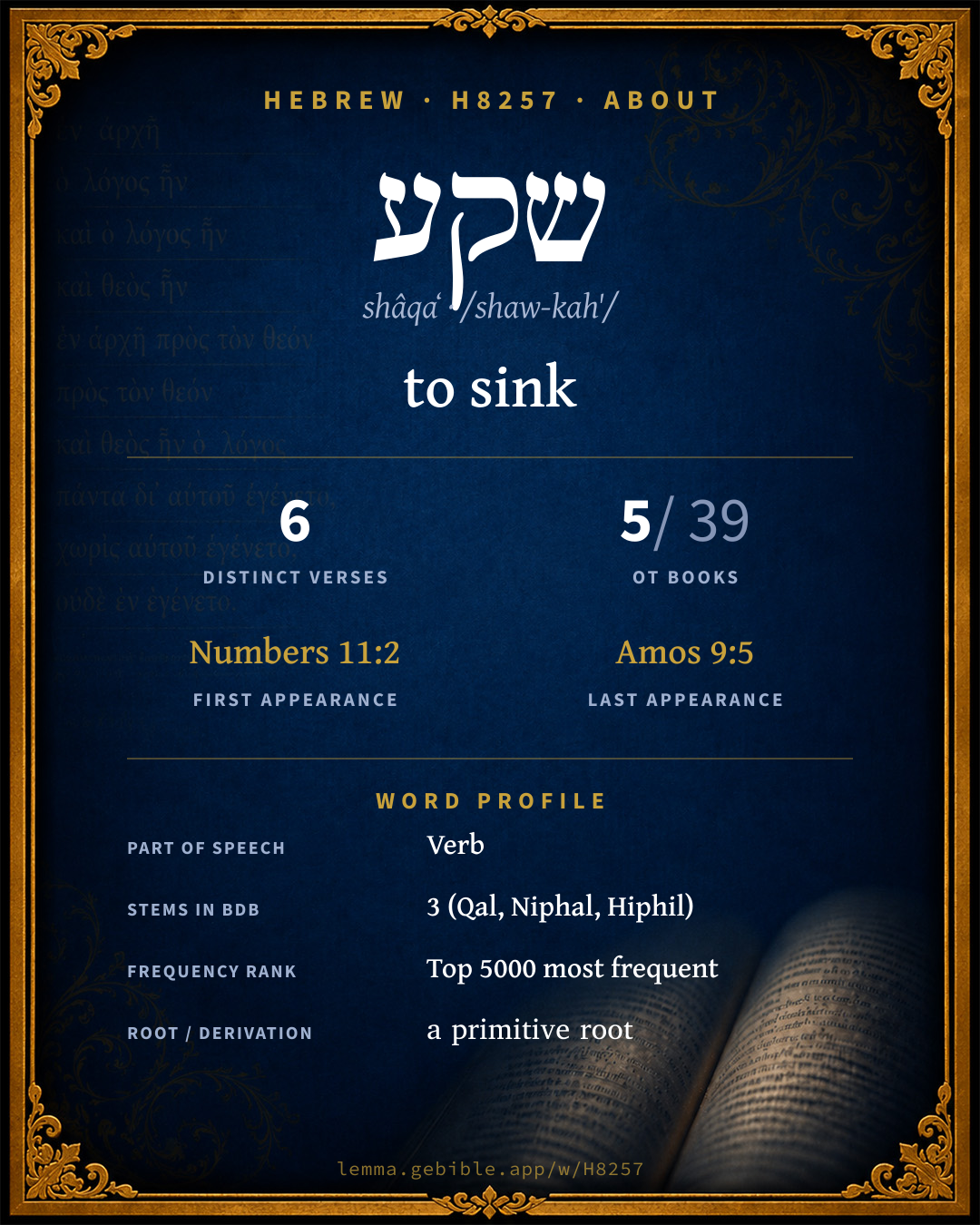
שָׁקַע
to sink
also: sink down, subside fuller range ↓
Full lexicon entry — Brown-Driver-Briggs (BDB)
From Brown-Driver-Briggs (BDB)
Where this word appears
See every Qal verb in the Hebrew Bible →
Grammar key — what these labels mean
Part of speech
- Verb
- An action or state-of-being word.
Stem
- Niphal
- Usually the simple passive or reflexive of the Qal (“he was written”).
- Qal
- The basic, simple active stem — the plain form of the verb (“he wrote”). Here: ‘it shall sink’
- Hiphil
- The causative active stem (“he caused / brought about”).
Form
- Sequential Perfect
- A perfect with prefixed waw continuing a preceding imperfect or command (waw-consecutive perfect).
- Perfect
- A completed action or state — Hebrew marks aspect (completeness) more than strict tense (“he wrote”).
- Sequential Imperfect
- An imperfect with prefixed waw — the standard past-narrative form (waw-consecutive imperfect).
- Imperfect
- An incomplete, ongoing, or future action (“he will / would write”).
Person
- 3rd Person
- The one spoken about (“he / she / it / they”).
- 1st Person
- The speaker (“I / we”).
- 2nd Person
- The one addressed (“you”).
Gender
- Feminine
- Grammatically feminine.
- Common
- Either gender — not distinguished for this form.
- Masculine
- Grammatically masculine.
Number
- Singular
- One.
Grammatical forms
- Verb, Niphal, Sequential Perfect, 3rd Person, Feminine, Singular 1 time (17%)
- Verb, Qal, Perfect, 3rd Person, Feminine, Singular 1 time (17%)
- Verb, Qal, Sequential Imperfect, 3rd Person, Feminine, Singular 1 time (17%)
- Verb, Hiphil, Imperfect, 1st Person, Common, Singular 1 time (17%)
- Verb, Hiphil, Imperfect, 2nd Person, Masculine, Singular 1 time (17%)
- Verb, Qal, Imperfect, 3rd Person, Feminine, Singular 1 time (17%)
Parsed forms decoded from the imported morphology (morphhb / Westminster Leningrad Codex — WLC text public domain, morphhb tagging CC BY 4.0), counted across 6 parsed occurrences — not distinct verses.
Every verse where H8257 appears — 6 distinct verses across 5 books. Click any verse to open its interlinear word-by-word view. Verse text shown in the World English Bible for context — . Each verse’s Hebrew form is shown with its reference; the English is not keyword-highlighted, since the data carries no word-level English alignment. Use “Compare translations” on any verse to read it across multiple English versions. This concordance covers the Hebrew Bible; Septuagint (Greek Old Testament) occurrences are not indexed here.
Numbers 1 verse
Job 1 verse
Jeremiah 1 verse
Ezekiel 1 verse
Amos 2 verses
- Amos 8:8 וְ/נִשְׁקְעָ֖ה conj + Niphal wpf 3fs Won't the land tremble for this, And everyone mourn who dwells in it? Yes, it will rise up wholly like the River; And it will be stirred up and sink again, like the River of Egypt.
- Amos 9:5 וְ/שָׁקְעָ֖ה conj + Qal pf 3fs For the Lord, Yahweh of Hosts, is he who touches the land and it melts, and all who dwell in it will mourn; and it will rise up wholly like the River, and will sink again, like the River of Egypt.
About this entry
At a glance — auto-summarized from this page’s data, not written by a person. Every figure links to its source below. This summary describes the numbers; it doesn’t interpret them.
At its core, שקע (shâqaʻ) means “to sink.” It first appears in Numbers 11:2. Spanning 6 verses in 5 books, it ranks among the uncommon words of the Hebrew Bible. Its uses concentrate in Amos (33% of all occurrences). Read the stem: it spans 3 stems, including Qal and Niphal. Dig into 6-verse concordance and the renderings breakdown below.
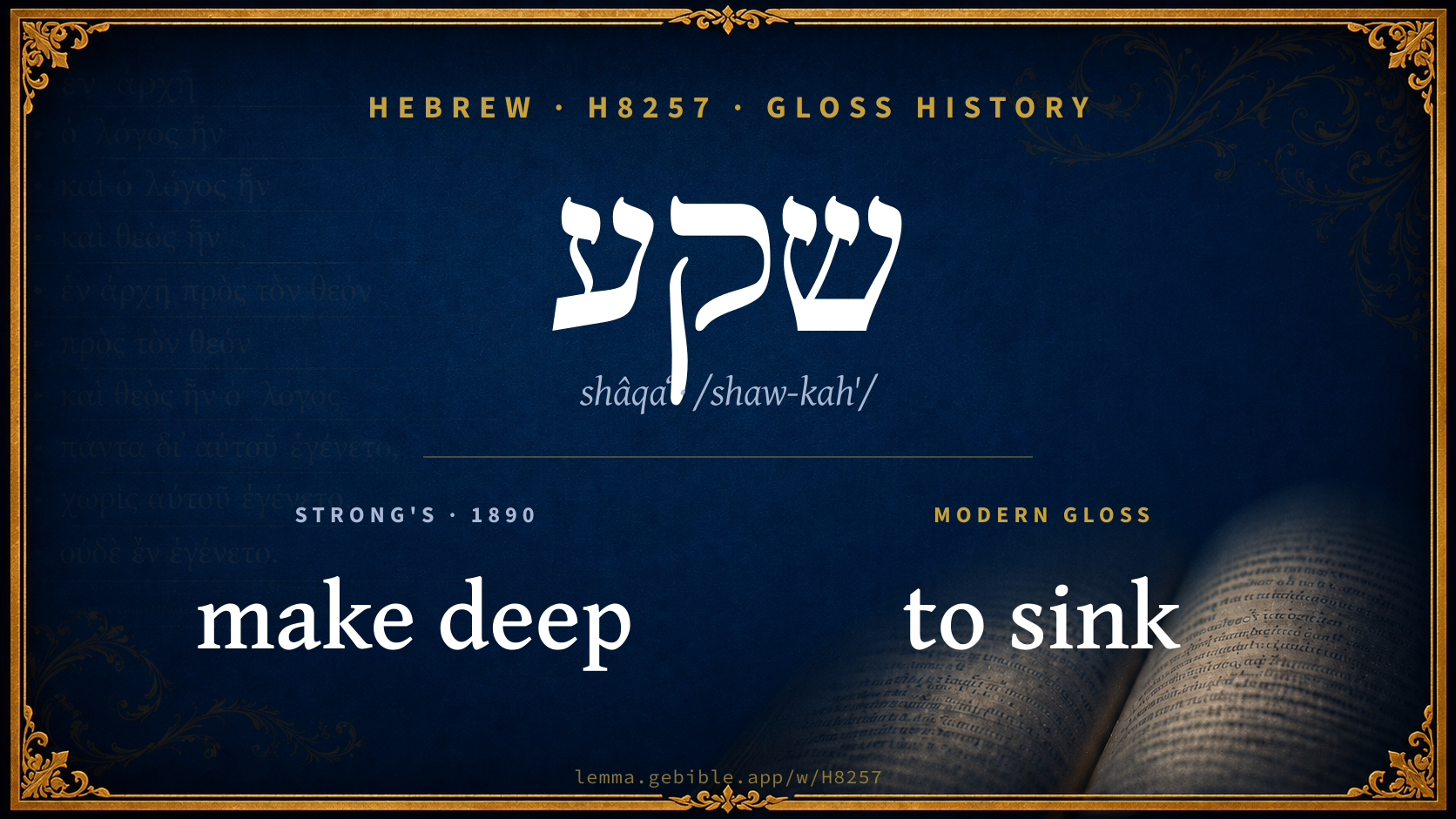
Gloss history
Strong's 1890 vs modern scholarship
About this word
Strong's H8257 catalogs a Hebrew word from the Hebrew Old Testament.
These counts are not copied from any lexicon or concordance. They are computed here, from the morphology-tagged Hebrew Old Testament. What Lemma adds →
- 6
- distinct verses
- The word appears in 6 distinct verses.
- 5 / 39
- OT books
- The word appears in 5 of 39 Old Testament books.
- #3,040
- by frequency
- Top 5000 most frequent Hebrew words (rank 3,040 of 8,640 Hebrew words by occurrence).
View all 6 occurrences in the concordance →
By section of the Old Testament
By traditional corpus
Conventional, traditional groupings — biblical authorship is debated, so this is a traditional corpus grouping, not an authorship claim. Each share is this word’s portion of its verses in that division of the Hebrew canon. Each figure is a share of the word’s 6 distinct verses.
- Prophets (Nevi'im) 4 verses · 67%
- Torah (Pentateuch) 1 verse · 17%
- Writings (Ketuvim) 1 verse · 17%
How translations render this word
Counts come from each version’s own published word-to-Strong’s tagging or interlinear alignment — an approximate guide to how each version renders this word, not a word-level alignment the data otherwise carries. Because each total is that version’s own tagged count, the per-version totals vary from one another and need not match the appearance or distinct-verse counts above. These counts may also differ from a printed concordance because Lemma counts each distinctly tagged rendering and does not collapse phrase taggings into a single head-word total. This is a fixed set of word-tagged versions (KJV, ASV, BSB, ULT) and does not change with the reading translation you choose elsewhere. Each version’s license is shown beside its name below (and on Sources).
- King James Version: Deep 1×, Drowned 1×, Shall be drowned 1×
- American Standard Version: Sink 2×
- Berean Standard Bible: Died down 1×, Settle 1×, Sinks 1×
- unfoldingWord Literal Text: And 1×, I will calm 1×, Sank 1×
King James Version Public Domain
Renders H8257 across 6 tagged occurrences — most commonly:
American Standard Version Public Domain
Renders H8257 across 5 tagged occurrences — most commonly:
Plus 3 renderings that appear only once — usually multi-word phrases or single function words the recovered tagging swept in, not distinct renderings.
Berean Standard Bible Public Domain
Renders H8257 across 4 tagged occurrences — most commonly:
Not rendered by a distinct English word in 1 further occurrence.
unfoldingWord Literal Text CC BY-SA 4.0
Renders H8257 across 6 tagged occurrences — most commonly:
Senses in the full BDB
Hebrew verbs can shift meaning by stem (binyan): Qal is the basic action, Niphal is often passive or reflexive, Piel often intensifies or makes it factitive, and Hiphil is typically causative. The senses below are grouped under the stem BDB assigns to each.
What do BDB’s symbols mean?
BDB uses these scholarly abbreviations:
| Symbol | Meaning |
|---|---|
| 𝔊 | the Septuagint (the ancient Greek translation, LXX) |
| 𝔙 | the Vulgate (the Latin translation) |
| 𝔖 | the Syriac version (the Peshitta) |
| 𝔗 | the Targum (the Aramaic translation) |
| ψ | the Psalms |
| √ | root (the underlying root or stem) |
| ‖ | parallel passage (a synonymous or contrasted parallel) |
| † | the dagger: every passage where the word occurs is cited |
The 3 senses and sub-senses the full Brown-Driver-Briggs lexicon distinguishes for this word, in lexicon order (not ranked by frequency), with BDB’s own verbatim wording and sub-sense lettering. Shown in Hebrew script with BDB’s own scholarly abbreviations. The condensed entry is in the Lexicon Entry tab. See also the Forms in the corpus table below.
Qal
- it shall sink; it sank down
Niphal
- . sink
Hiphil
- . I will make their waters sink
Senses from the full Brown-Driver-Briggs lexicon (Brown, Driver, Briggs; Oxford 1906 — public domain), digitized via Sefaria, supplemented by the OpenScriptures HebrewLexicon (CC BY 4.0). Full attribution on Sources.
Word origin
[ שָׁקַע ] vb. sink, sink down
— Brown-Driver-Briggs (Oxford 1906, public domain), digitized via Sefaria, supplemented by the OpenScriptures HebrewLexicon (CC BY 4.0). See Sources.
Origin: a primitive root
Jastrow Dictionary
A second Hebrew/Aramaic lexicon for comparison, covering Aramaic and post-biblical (Talmudic, Targumic, Midrashic) usage that the biblical-Hebrew BDB does not. Matched by lemma rather than by Strong’s number, so a lemma may carry more than one Jastrow headword (shown separately below), and the entries cover usage well beyond the Bible.
שָׁקַע
- (b. h.)
- 1. to be depressed, sink, go down. Y. Ab. Zar. III, 42ᶜ bot. אם היה חותמה שׁוֹקֵעַ if the seal on it was engraven, opp. בולט; Tosef. Ab. Zar. V (VI), 2; Bab. Ab. Zar. 43ᵇ. Gen. R. s. 19 (ref. to לרוח היום, Gen. III, 8) לרוח ששׁוֹקַעַת עם היום by the (western) wind that goes down with the day. Ib. כל שהיום שוקע וכ׳ the more the day goes down, the cooler it grows. Y. Sabb. I, 3ᵈ top אחד צף ואחד שוקע וכ׳ one kind of poison floats, another settles &c. Mikv. X, 1 צלוחית שפיה שוקע a bottle the mouth of which is turned down. Men. 103ᵇ, v. Hithpa.; a. fr. e.g. Genesis 3:8
- 2. to sink, let down. B. Mets. V, 7 מששְׁקָעוֹ בכבשן after he let the lime stones down into the kiln (Y. ed. משיִשְׁקַע כבשנו, or משיְשַׁקֵּעַ) when he has filled his kiln). Yalk. Koh. 966, v. שָׁלָה; a. e.—Part. pass. שָׁקוּעַ; f. שְׁקוּעָה &c. Bekh. 43ᵇ, v. חָרַם. Ex. R. s. 1522 והארץ ש׳ במים the earth was submerged in water. Sifra Thazr., Par. 5, ch. XV (ref. to פחתת, Lev. XIII, 55) שיהיו כל מראיה שְׁקוּעִין Rabad (ed. שׁוֹקְעִין) that all its colors appear lower (v. שַׁקִּיעַ; cmp. עָמוֹק); Yalk. Lev. 553 שׁוֹקְעִין; a. e.—Bekh. VII, 1 ראשו ש׳, v. שָׁקוּט. e.g. Leviticus 13:55
- to sink, let down. Snh. VI, 4 מְשַׁקְּעִין את הקורה וכ׳ they insert the trunk (of the gallows) in the ground. Y. Shek. V, end, 49ᵇ כמה ממון שִׁיקְּעוּ אבותי כאן how much money have my ancestors sunk here (in building that synagogue)!; כמה נפשות שיקעו וכ׳ how many souls did thy ancestors sink here! were there no people to study the Law (on whom that money might have been spent)?; Y. Peah VIII, end, 21ᵇ. B. Mets. V, 7 Y. ed., v. supra; a. e.—Trnsf. toembody in a collection without regard to original wording, to edit, abridge. Y. Hor. III, 48ᶜ top; Y. Sabb. XVI, 15ᶜ הדא דאת אמר עד שלא ש׳ בו רבי רוב משניות אבל משש׳ וכ׳ what you say (that the study of the Mishnah collection is preferable) refers to the time before Rabbi had embodied and abridged most of the Mishnayoth in his edition, but since then, run at all times after the Talmud (where the discussions are quoted in their original form).—Part. pass. מְשׁוּקָּע; f. מְשׁוּקַּעַת; pl. מְשׁוּקָּעִים, מְשׁוּקָּעִין; מְשׁוּקָּעוֹת. Koh. R. to I, 15 מקצתה מש׳ בארץ part of the boat rests on dry land. Y. B. Mets. II, beg. 8ᵇ במש׳ בו when the objeot is found stuck in it, opp. בנתון בו when it is seen that it was put there. Gen. R. s. 33 שהיתה התיבה מש׳ במים וכ׳ that the ark was eleven cubits in the water. Y. Yoma VII, beg. 44ᵃ זרעו של דוד מש׳ שם the seed of David is sunk there (in the family of the Resh Galutha). Y. Sabb. III, 6ᵃ top כסא שרגליו מש׳ בטיט a chair the feet of which stick in the mud. Y. Ḥag. I, 76ᵈ top; Y. Peah II, 17ᵃ כמה … וכולהן מש׳ במשנה many Hălakhoth have been communicated to Moses from Sinai, and they all are embodied in the Mishnah; a. e.
- to sink, let down. Gen. R. s. 68 ה׳ הקב"ה גלגל וכ׳ the Lord caused the sun to set before its time. Ib. מה אתה בצאתך הִשְׁקַעְתִּי חמה וכ׳ as I caused the sun to set when thou didst go out &c. Lev. R. s. 21; Pesik. Aḥăre, p. 176ᵃ לעולם יַשְׁקִיעַ וכ׳ (Ar. s. v. רתק: יְשַׁקֵּעַ or יִשְׁקַע) man should at all times sink himself into the study of the Mishnah, for when he knocks &c., v. רָתַק. Koh. R. to I, 5 עד שלא ה׳ שמשו … הזריח וכ׳ before God made the sun of Moses to set, he made the sun of Joshua to rise, v. שֶׁמֶשׁ. Ib. 4 היוצר הזה מַשְׁקִיעַ כבשונו מה שמשקיע וכ׳ the potter fills his oven; what he sinks into it first, is the last to come out; a. fr.
- 1. to be sunk, drowned; to be mixed up beyond recognition. Midr. Till. to Ps. XXII המִשְׁתַּקְּעִים שוקעים את שוקעיהן those that were to be drowned, drowned those that wanted to drown them. Ruth R. to I, 17 נ׳ … בחליו was three days unconscious on his sick-bed, opp. נתישבה דעתו he came to. Ex. R. s. 156 מִשְׁתַּקְּעִין בעונות וכ׳ are sunk in sins through the evil inclination. Ib.15 עד שנִשְׁתַּקְּעוּ תהומות until the depths were filled with water. Y. Shek. VIII, beg. 51ᵃ והיו עולי רגלים משתקעין וכ׳ the pilgrims sank in blood up to their knees; Men. 103ᵇ שוקעין; Tosef. Eduy. III, 2 מפקיעין בדם וכ׳ ed. Zuck. (read: מְשׁוּקָּעִין; Var. מְשַׁקְּעִין את ארכובותיהן). Arakh. 6ᵇ עד שלא נ׳ שם וכ׳ as long as the name of its owner (that donated it) is not merged (but is still traceable). Kidd. 75ᵃ עד שיִשְׁתַּקֵּעַ שם ע"א ממנו until the name of idolatry has disappeared from him (until his idolatrous ancestry is no longer traceable). Y. Keth. I, 25ᵈ top משפחה שנ׳ בה פסול וכ׳ if a genealogical blemish is mixed up in a family, you must investigate it back to four mothers; Y. Kidd. IV, 65ᵈ bot. Ib. מה נאשה ונִשְׁתַּקְּעוּ בהן גדולי הדור what can we do (with these families), since prominent men of the generation are mixed up with them? Ib. חמשת … וכולם נשתקעו בכהונה וכ׳ Pashhur ben Imer had five thousand slaves, and they are all mixed up with high priestly families; Y. Yeb. VIII, 9ᵈ top; (Kidd. 70ᵇ נטמעו). Tanḥ. Noah 5 the Lord supported Noah שלא יִשְׁתַּקֵּעַ במעשה דור המבול lest he sink down in (the mud of) the deeds of the generation of the flood; a. fr.
- 2. to settle permanently, be naturalized. Sifré Deut. 301 (ref. to Deut. XXVI, 5 ויגר) מלמד … להִשְׁתַּקֵּע אלא לגור שם this shows that he (Jacob) did not go down (to Egypt) to settle there as a citizen, but only to sojourn there. e.g. Deuteronomy 26:5
- 3. to be lost in forests, fields &c. Y. Ber. II, end, 5ᵈ ובשעה שהוא משתקע וכ׳ but when one is lost, he may even trespass on a field of crocus; (B. Kam. 81ᵃ תועה). Y. Ber. l. c.; Y. B. Bath. V, 15ᵃ bot. וראו … משתקע ובא כנגדן they saw R. J. b. P. having lost his way and coming (through fields) towards them.
שְׁקַע
- Targ. Y. Ex. XV, 10.—Y. Snh. X, 29ᵃ bot. רעדת … ושְׁקוֹעַת the earth shook and sank. Lev. R. s. 5 חמי בגרמיה דש׳ באריסותיה when he sees that he is sinking (going back) in his tenancy. Lev. R. s. 17 שָׁקִיעַ ביתא, v. לְוַט.
- to sink, insert, immerse, cover. Targ. O. Ex. XXV, 7. Targ. Y. II, Num. IV, 20 (h. text בלע).—Y. Sabb. VII, 10ᵃ bot. כד מְשַׁקַּע, v. באנטרין. Men. 96ᵃ קנים שַׁקּוּעֵי משקע להו as to the staves, he may have stuck them (into the bread before it was baked). Ab. Zar. 75ᵇ חזי … לשַׁקּוּעֵיה he saw that the gentile (that pawned it) intended to forfeit it; a. e.—Part. pass. מְשַׁקַּע inlaid; engraven. Targ. II Esth. I, 2 (some ed. מְשֻׁקַּע Hebraism). Targ. Y. Ex. XXV, 33, sq. מְשַׁקְּעִין (h. text משקדים).
- to sink, go down; to be immersed, flooded. Targ. O. Ex. XV, 10. Targ. Jer. LI, 64. Targ. Y. Deut. XXIX, 22. Targ. Am. IX, 5. Ib. VIII, 8; a. e.
A Dictionary of the Targumim, the Talmud Babli and Yerushalmi, and the Midrashic Literature (Marcus Jastrow; London, Luzac, 1903) — Public Domain. Digitized via Sefaria. Digitized via Sefaria. Full attribution on Sources.
Forms in the corpus
The 6 distinct written forms H8257 takes in the Hebrew Bible, most frequent first — each parse links to that stem’s occurrences in the concordance. Hebrew forms include their vowel points and cantillation, so a single lemma takes many written forms.
| Form | Parsing | Example | Uses |
|---|---|---|---|
| אַשְׁקִ֣יעַ | Verb, Hiphil, Imperfect, 1st Person, Common, Singular | Ezekiel 32:14 | 1 |
| וְ/נִשְׁקְעָ֖ה | Verb, Niphal, Sequential Perfect, 3rd Person, Feminine, Singular | Amos 8:8 | 1 |
| וְ/שָׁקְעָ֖ה | Verb, Qal, Perfect, 3rd Person, Feminine, Singular | Amos 9:5 | 1 |
| וַ/תִּשְׁקַ֖ע | Verb, Qal, Sequential Imperfect, 3rd Person, Feminine, Singular | Numbers 11:2 | 1 |
| תִּשְׁקַ֨ע | Verb, Qal, Imperfect, 3rd Person, Feminine, Singular | Jeremiah 51:64 | 1 |
| תַּשְׁקִ֥יעַ | Verb, Hiphil, Imperfect, 2nd Person, Masculine, Singular | Job 41:1 | 1 |
Same root — word family
Other BDB entries built from the same root as H8257, grouped by Strong’s listed origin. These share a root / origin per the lexicon — not necessarily a shared meaning. Each links to that word’s own entry.
Derived from this word
Compare all same-root words → They share a root, not necessarily a meaning.
Septuagint verse parallels
This word appears in 5 verses that also exist in the Greek Old Testament (Septuagint), out of the 6 Hebrew verses it occurs in. You can read those verses in Greek by switching the Old Testament edition to the Septuagint.
Read these verses in the Septuagint
This is a verse-level parallel only — the same verses exist in both the Hebrew and Greek Old Testaments. No word-level Hebrew↔Greek correspondence is claimed: the data carries no such alignment, so no Greek word is shown as this Hebrew word’s translation. Coverage is not total — the Septuagint omits the deuterocanon and renumbers the Psalms, so some Hebrew verses have no direct Greek parallel.