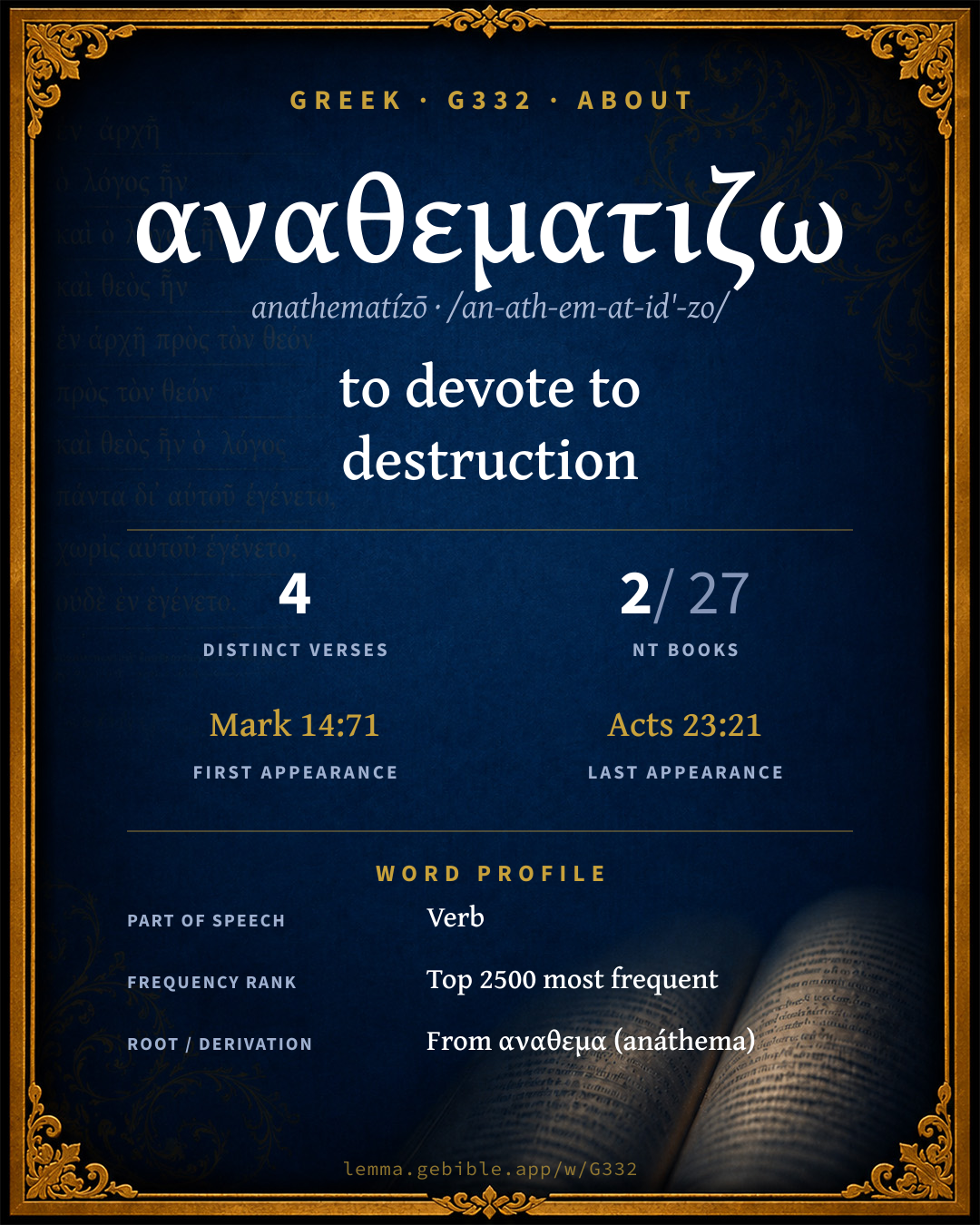
ἀναθεματίζω
to devote to destruction
‘to devote to destruction’ is one of 2 main senses fuller range ↓
Full lexicon entry — Thayer's Greek Lexicon
From Thayer's Greek Lexicon
Where this word appears
See every Aorist-tense verb in the Greek New Testament →
Grammar key — what these labels mean
Part of speech
- Verb
- An action or state-of-being word.
Tense
- Aorist
- Action viewed as a simple whole, without regard to duration — often past (perfective aspect).
- Present
- Ongoing or general action in present time (imperfective aspect).
Voice
- Active
- The subject performs the action.
Mood
- Indicative
- States a fact or asks a factual question (the mood of reality).
- Infinitive
- A verbal noun (“to write”), unmarked for person or number.
Person
- 3rd person
- The one spoken about (“he / she / it / they”).
- 1st person
- The speaker (“I / we”).
Number
- Plural
- More than one.
Grammatical forms
- Verb, Aorist, Active, Indicative, 3rd person, Plural 2 times (50%)
- Verb, Aorist, Active, Indicative, 1st person, Plural 1 time (25%)
- Verb, Present, Active, Infinitive 1 time (25%)
Parsed forms decoded from the imported morphology (Robinson–Tischendorf, public domain), counted across 4 parsed occurrences — not distinct verses.
Every verse where G332 appears — 4 distinct verses across 2 books. Click any verse to open its interlinear word-by-word view. Verse text shown in the World English Bible for context — . Each verse’s Greek form is shown with its reference; the English is not keyword-highlighted, since the data carries no word-level English alignment. Use “Compare translations” on any verse to read it across multiple English versions. This concordance covers the Greek New Testament; Septuagint (Greek Old Testament) occurrences of this word are not indexed here.
Mark 1 verse
Acts 3 verses
- Acts 23:12 ἀνεθεμάτισαν aor act ind 3pl When it was day, some of the Jews banded together, and bound themselves under a curse, saying that they would neither eat nor drink until they had killed Paul.
- Acts 23:14 ἀνεθεματίσαμεν aor act ind 1pl They came to the chief priests and the elders, and said, "We have bound ourselves under a great curse, to taste nothing until we have killed Paul.
- Acts 23:21 ἀνεθεμάτισαν aor act ind 3pl Therefore don't yield to them, for more than forty men lie in wait for him, who have bound themselves under a curse neither to eat nor to drink until they have killed him. Now they are ready, looking for the promise from you."
About this entry
At a glance — auto-summarized from this page’s data, not written by a person. Every figure links to its source below. This summary describes the numbers; it doesn’t interpret them.
αναθεματιζω (anathematízō) is a Greek verb most often rendered “to devote to destruction.” It is rare — just 4 verses in the entire Greek New Testament. Acts dominates its distribution — 3 of 4 verses. Scripture first uses it in Mark 14:71. Ranging over 2 senses, it is not a single-sense word. For the data behind this summary, explore the sense tree and the renderings breakdown below.
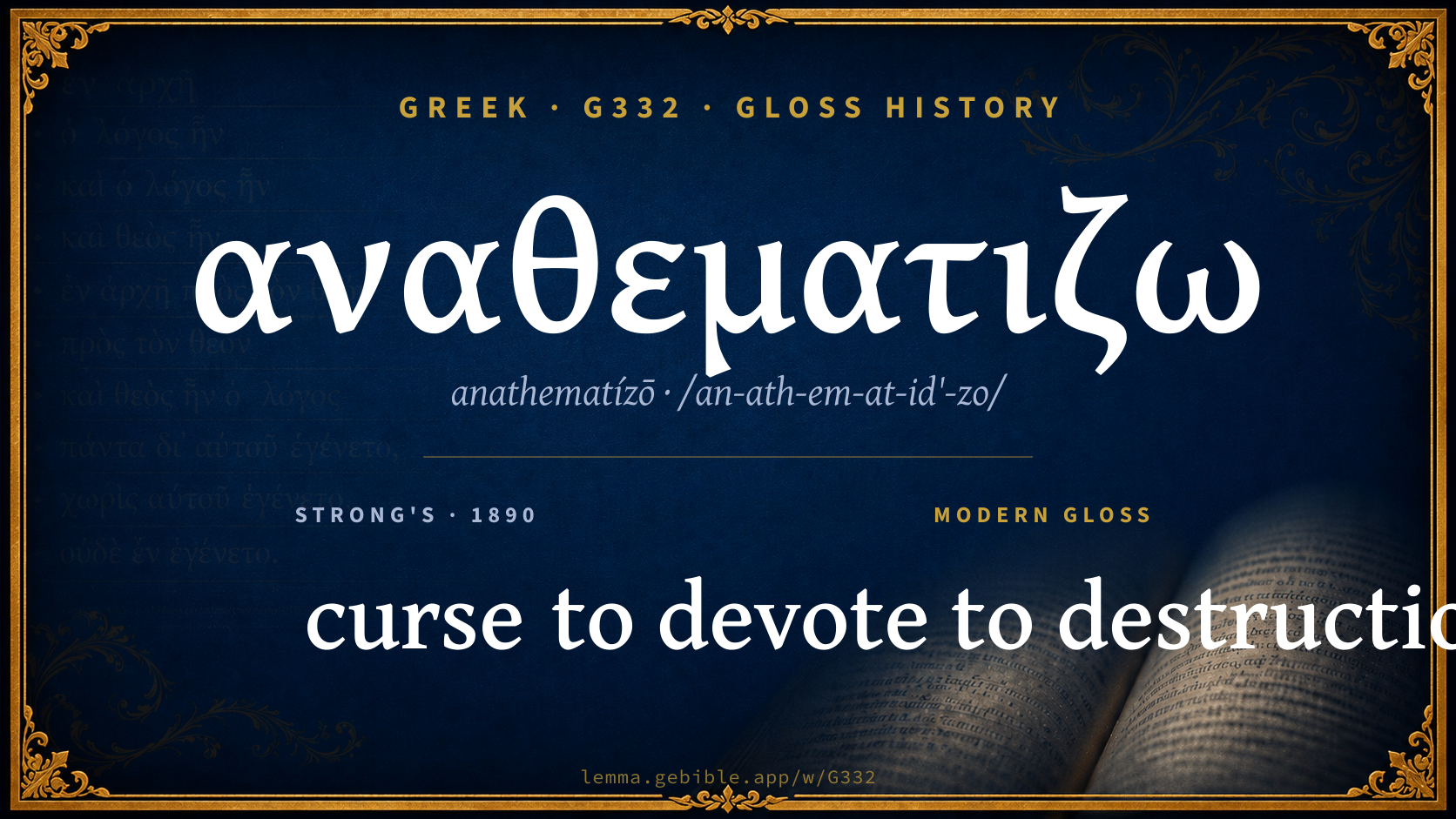
Gloss history
Strong's 1890 vs modern scholarship
About this word
Strong's G332 catalogs a Greek word from the Greek New Testament.
These counts are not copied from any lexicon or concordance. They are computed here, from the morphology-tagged Greek New Testament. What Lemma adds →
- 4
- distinct verses
- The word appears in 4 distinct verses.
- 2 / 27
- NT books
- The word appears in 2 of 27 New Testament books.
- #1,877
- by frequency
- Top 2500 most frequent Greek words (rank 1,877 of 5,347 Greek words by occurrence).
View all 4 occurrences in the concordance →
By traditional corpus
Conventional, traditional groupings — biblical authorship is debated, so this is a traditional corpus grouping, not an authorship claim. Some books belong to more than one corpus (Luke is in both the Gospels and the Lukan corpus, and so on), so these shares overlap and need not total 100%. Each figure is a share of the word’s 4 distinct verses.
- Lukan (Luke–Acts) 3 verses · 75%
- Gospels 1 verse · 25%
How translations render this word
Counts come from each version’s own published word-to-Strong’s tagging or interlinear alignment — an approximate guide to how each version renders this word, not a word-level alignment the data otherwise carries. Because each total is that version’s own tagged count, the per-version totals vary from one another and need not match the appearance or distinct-verse counts above. These counts may also differ from a printed concordance because Lemma counts each distinctly tagged rendering and does not collapse phrase taggings into a single head-word total. This is a fixed set of word-tagged versions (KJV, ASV, BSB, ULT) and does not change with the reading translation you choose elsewhere. Each version’s license is shown beside its name below (and on Sources).
- King James Version: Bound 1×, Curse 1×, Have bound 1×
- American Standard Version: Under a curse 2×
- Berean Standard Bible: Bound themselves with an oath 1×, Curse 1×, Have bound themselves with an oath 1×
- unfoldingWord Literal Text: Curse 1×, Cursed 1×, Have cursed 1×
King James Version Public Domain
Renders G332 across 6 tagged occurrences — most commonly:
American Standard Version Public Domain
Renders G332 across 6 tagged occurrences — most commonly:
Plus 4 renderings that appear only once — usually multi-word phrases or single function words the recovered tagging swept in, not distinct renderings.
Berean Standard Bible Public Domain
Renders G332 across 4 tagged occurrences — most commonly:
unfoldingWord Literal Text CC BY-SA 4.0
Renders G332 across 4 tagged occurrences — most commonly:
Senses in Thayer's
The 2 senses Thayer's distinguishes for this word, in lexicon order (not ranked by frequency or importance). The full entry — with sub-senses — is in the Lexicon Entry tab.
- to devote to destruction
- to declare one's self liable to the severest divine penalties
Word origin
Derived from αναθεμα (anáthema) (G331) — accursed thing.
From G331 ; to declare or vow under penalty of execration : - (bind under a) curse bind with an oath.
— Strong’s Exhaustive Concordance (1890), public domain.
Forms in the corpus
The 3 distinct written forms G332 takes in the Greek New Testament, most frequent first — each parse links to that tense’s occurrences in the concordance.
| Form | Parsing | Example | Uses |
|---|---|---|---|
| ἀνεθεμάτισαν anethemátisan | Verb, Aorist, Active, Indicative, 3rd person, Plural | Acts 23:12 | 2 |
| ἀναθεματίζειν anathematízein | Verb, Present, Active, Infinitive | Mark 14:71 | 1 |
| ἀνεθεματίσαμεν anethematísamen | Verb, Aorist, Active, Indicative, 1st person, Plural | Acts 23:14 | 1 |
Septuagint usage
The same Greek word αναθεματιζω appears 11 times in the Greek Old Testament (Septuagint), across 11 verses in 8 books.
- 11
- LXX occurrences
- Tagged occurrences of this Greek word in the Septuagint.
- 11
- verses
- Distinct Septuagint verses containing this word.
- 8 / 39
- OT books
- The word appears in 8 of the 39 Old Testament books.
Sample Septuagint occurrences
- Numbers 18:14 ἀναθεματίζω
- Deuteronomy 13:16 ἀναθεματίζω
- Joshua 6:21 ἀναθεματίζω
- Judges 21:11 ἀναθεματίζω
- 1 Samuel 15:3 ἀναθεματίζω
- 2 Kings 19:11 ἀναθεματίζω
- 1 Chronicles 4:41 ἀναθεματίζω
- Ezra 10:8 ἀναθεματίζω
Septuagint occurrences (same lexeme)
Every verse where the same Strong’s number (G332) appears in the Greek Septuagint. Verse text shown in the World English Bible for context; the Greek form is the matched word — the English is not keyword-highlighted.
- Numbers 18:14 ἀναθεματίζω Everything devoted in Israel shall be yours.
- Numbers 21:2 ἀναθεματίζω Israel vowed a vow to Yahweh, and said, If you will indeed deliver this people into my hand, then I will utterly destroy their cities.
- Numbers 21:3 ἀναθεματίζω Yahweh listened to the voice of Israel, and delivered up the Canaanites; and they utterly destroyed them and their cities: and the name of the place was called Hormah.
- Deuteronomy 13:16 ἀναθεματίζω You shall gather all the spoil of it into the midst of the street of it, and shall burn with fire the city, and all the spoil of it every whit, to Yahweh your God: and it shall be a heap forever; it shall not be built again.
- Deuteronomy 20:17 ἀναθεματίζω but you shall utterly destroy them: the Hittite, and the Amorite, the Canaanite, and the Perizzite, the Hivite, and the Jebusite; as Yahweh your God has commanded you;
- Joshua 6:21 ἀναθεματίζω They utterly destroyed all that was in the city, both man and woman, both young and old, and ox, and sheep, and donkey, with the edge of the sword.
- Judges 21:11 ἀναθεματίζω This is the thing that you shall do: you shall utterly destroy every male, and every woman who has lain by man.
- 1 Samuel 15:3 ἀναθεματίζω Now go and strike Amalek, and utterly destroy all that they have, and don't spare them; but kill both man and woman, infant and suckling, ox and sheep, camel and donkey.
- 2 Kings 19:11 ἀναθεματίζω Behold, you have heard what the kings of Assyria have done to all lands, by destroying them utterly: and shall you be delivered?
- 1 Chronicles 4:41 ἀναθεματίζω These written by name came in the days of Hezekiah king of Judah, and struck their tents, and the Meunim who were found there, and destroyed them utterly to this day, and lived in their place; because there was pasture there for their flocks.
- Ezra 10:8 ἀναθεματίζω and that whoever didn't come within three days, according to the counsel of the princes and the elders, all his substance should be forfeited, and himself separated from the assembly of the captivity.
These are occurrences of the same Greek lexeme (G332) in the Septuagint — not a translation of any one Hebrew word. The store carries no word-level Hebrew↔Greek alignment, so no Hebrew original is asserted here. Counts come from the recovered LXX Strong's tagging — high-frequency vocabulary is well covered, while rare or late forms may be untagged — so they reflect tagged occurrences and may slightly undercount.