
Leviticus 21:16

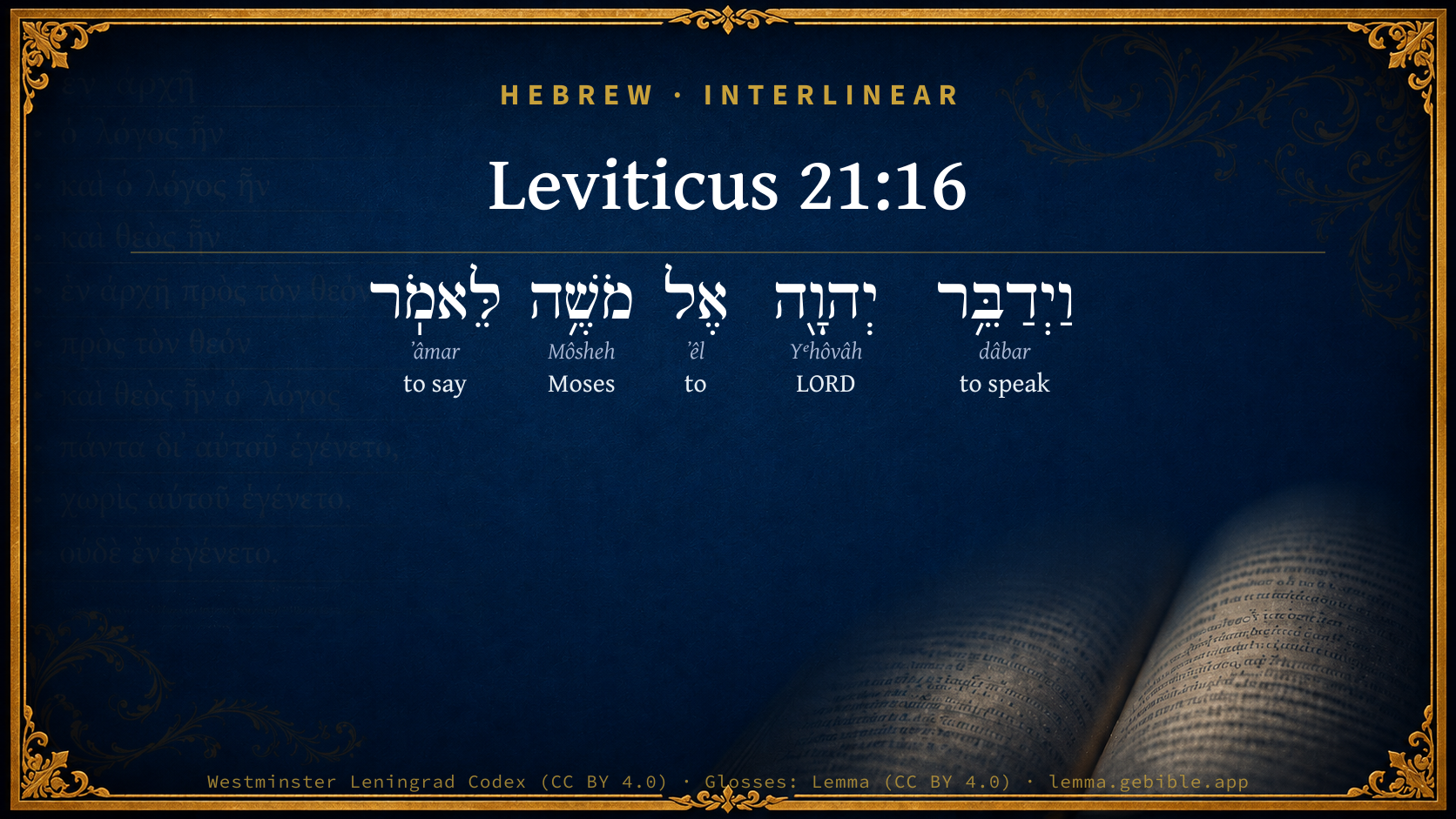
Hebrew (Westminster Leningrad Codex) Leviticus 21:16 appears in the Hebrew Old Testament. The text above is from the Westminster Leningrad Codex. Each word links to its Strong’s number, a concise gloss, and parsing drawn from the Open Scriptures Hebrew Bible morphology. Click any word for its full Brown-Driver-Briggs (BDB) entry.
Download image
Cite this verse

Leviticus 21:16 (World English Bible). Public Domain. Lemma interlinear Bible study tool, https://lemma.gebible.app/v/leviticus/21/16.

Show BibTeX & RIS
BibTeX
RIS
English Translation
Yahweh spoke to Moses, saying,
World English Bible · Public Domain
Download a study sheet

One document with this verse’s original text, its word-by-word gloss line, the meaning frame, cross-references with their text, attributed commentary, and full source and license credits — printable, and it pastes into notes with its structure intact.

This verse Autodidact and up

Study sheet (.html) Plain text (.txt)

A passage Seminary Student

Up to 50 verses in one chapter. A passage sheet keeps up to 6 commentary sources and 12 cross-references per verse, in the order this page ranks them, and says so on the sheet whenever that leaves anything out. Ask for a single verse and you get the Autodidact verse sheet above.

Everything on this page stays free to read, with no account — the sheet is a download of what is already on screen, not access to it.

Want to remove ads? Support Godless Engineer
Compare translations 3

The same verse in 3 English versions, stacked beneath the original-language interlinear above. Click any original word for its lexicon entry.

Each is an independent rendering of the whole verse — the interlinear is not word-aligned to these translations.

Highlighted words mark where these versions differ — a whole-verse word diff, not a word-by-word alignment.

  • World English Bible Public Domain
    Yahweh spoke to Moses, saying,
  • King James Version Public Domain
    And the LORD spake unto Moses, saying,
  • unfoldingWord Literal Text CC BY-SA 4.0
    And Yahweh spoke to Moses, saying,

unfoldingWord Literal Text — © unfoldingWord, licensed CC BY-SA 4.0. Word-aligned USFM3 via Door43 (git.door43.org/unfoldingWord/en_ult).

Versions to compare (up to 4)

3 of 4 selected

Show all 18 translations

Every available English version of this verse, each an independent rendering of the whole verse.

  • World English Bible Public Domain
    Yahweh spoke to Moses, saying,
  • Berean Standard Bible Public Domain
    Then the LORD said to Moses,
  • Majority Standard Bible Public Domain
    Then the LORD said to Moses,
  • King James Version Public Domain
    And the LORD spake unto Moses, saying,
  • American Standard Version (1901) Public Domain
    And Jehovah spake unto Moses, saying,
  • Revised Version (1885) Public Domain
    And the LORD spake unto Moses, saying,
  • Geneva Bible (1599) Public Domain
    And the Lord spake vnto Moses, saying,
  • Douay-Rheims (1899) Public Domain
    And the Lord spoke to Moses, saying:
  • Young's Literal Translation Public Domain
    And Jehovah speaketh unto Moses, saying,
  • Literal Standard Version CC BY-SA 4.0
    And YHWH speaks to Moses, saying,
  • Unlocked Literal Bible CC BY-SA 4.0
    Yahweh spoke to Moses, saying,
  • unfoldingWord Literal Text CC BY-SA 4.0
    And Yahweh spoke to Moses, saying,
  • Darby Bible Public Domain
    And Jehovah spoke to Moses, saying,
  • World Messianic Bible Public Domain
    The LORD spoke to Moses, saying,
  • Webster's Bible Public Domain
    And the LORD spoke to Moses, saying,
  • Free Bible Version CC BY-SA 4.0
    The Lord told Moses,
  • Bible in Basic English Public Domain
    And the Lord said to Moses,
  • JPS Tanakh (1917) Public Domain
    And the LORD spoke unto Moses, saying:

Literal Standard Version (2020), Covenant Press — licensed CC BY-SA 4.0. Text via the HelloAO Bible API (eBible.org). Unlocked Literal Bible (unfoldingWord) — licensed CC BY-SA 4.0. Text via the HelloAO Bible API (eBible.org). unfoldingWord Literal Text — © unfoldingWord, licensed CC BY-SA 4.0. Word-aligned USFM3 via Door43 (git.door43.org/unfoldingWord/en_ult). Free Bible Version, Dr. Jonathan Gallagher — licensed CC BY-SA 4.0. Text via the HelloAO Bible API (eBible.org).

Word by word

More ways to search: Search by grammar → Find every occurrence → Compare this word →

Practice this passage: Drill this verse → Learn its vocabulary →

About this verse

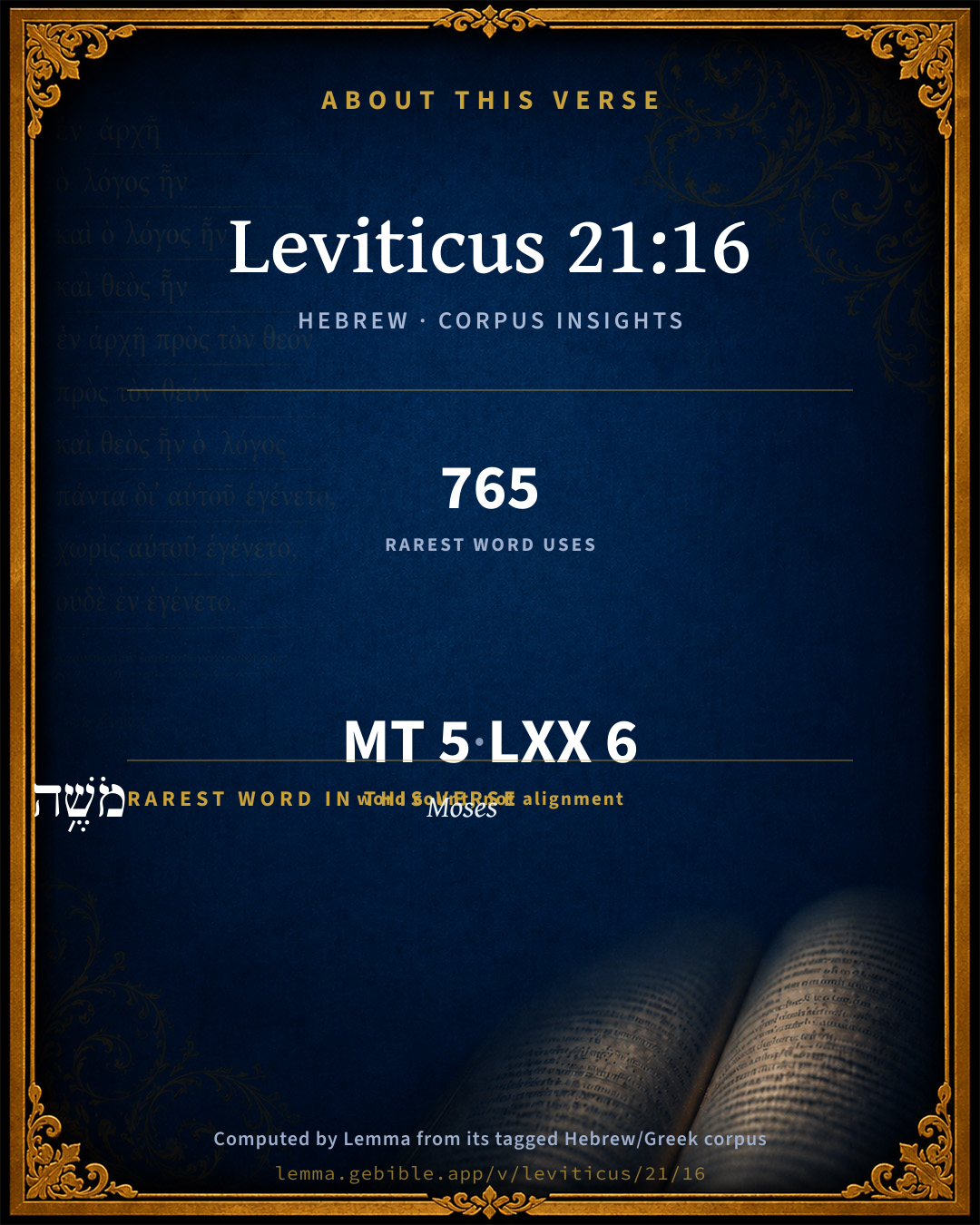
These counts appear in no published source. They are computed here, from the morphology-tagged text and Lemma’s own curated glosses. What Lemma adds →

5
words
5
distinct lemmas
Pentateuch
section

Grammatical profile

  • 2 verbs
  • 2 nouns
  • 1 preposition

Verb forms

  • וַיְדַבֵּ֥ר Piel · Sequential Imperfect
  • לֵּאמֹֽר Qal · Infinitive Construct

Hebrew & Septuagint length

In English translation the verse runs 5 words from the Hebrew and 7 from the Septuagint (LXX English) — closely comparable.

A rough comparison of the two English renderings, which tokenize alike — not a word-level alignment.

Word counts can differ between the Hebrew and the Greek without any difference in meaning — e.g. the Hebrew direct-object marker אֵת has no separate Greek word, and Greek often adds the article ὁ.

In the original languages it is 5 Hebrew tokens and 6 Greek tokens — but the two are counted differently (Hebrew bundles its prefixes and suffixes into one token; the Greek is in lemma form), so that isn’t a like-for-like length.

Hebrew and Greek witnesses Masoretic Hebrew ↔ Greek Septuagint

The same verse in the two great witnesses to the Old Testament, shown verse-for-verse.

These are two independent witnesses, not word-aligned to each other, and the Septuagint is shown in lemma (dictionary) form.

Hebrew Leviticus 21:16 Masoretic · Westminster Leningrad Codex

וַיְדַבֵּ֥ר יְהוָ֖ה אֶל מֹשֶׁ֥ה לֵּאמֹֽר

Yahweh spoke to Moses, saying,

World English Bible · Public Domain

Greek LXX Leviticus 21:16 Septuagint · lemma form

καί λαλέω κύριος πρός μωυσῆς λέγω

And the Lord spoke to Moses, saying,

LXX2012 (modern English Septuagint) · Public Domain

On this verse, Keil & Delitzsch discusses the Septuagint’s reading. Read the note in Commentary ↓

Hebrew: Westminster Leningrad Codex (CC BY 4.0). Greek: Septuagint (public domain); English from LXX2012 (modern English Septuagint) (Public Domain). How the Septuagint differs from the Hebrew →

Targum (Aramaic paraphrase)

2

The Targum is the ancient Jewish Aramaic paraphrase of the Hebrew Scriptures — an interpretive translation, not the Hebrew text itself. Onkelos (literal) and Pseudo-Jonathan (expansive) render the Torah, and Jonathan the Prophets. Coverage is partial: where no permissively-licensed English translation exists for a verse, only the Aramaic is shown. This is verse-level text, not a word-by-word alignment to the Hebrew.

  1. Targum Onkelos Torah (Genesis–Deuteronomy)
    וּמַלִיל יְיָ עִם מֹשֶׁה לְמֵימָר

    (no public-domain English translation for this verse)

    Targum Onkelos — Aramaic: “Onkelos Genesis” (public domain); “Onkelos Exodus” (public domain); “Onkelos Leviticus” (public domain); “Onkelos Numbers” (public domain); “Onkelos Deuteronomy” (public domain). English: “Sefaria Community Translation” (CC0 1.0 (public-domain dedication)); “J.W. Etheridge. The Targums of Onkelos and Jonathan Ben Uzziel on the Pentateuch. London: Longmans, Green, 1862” (public domain). Text via Sefaria.

  2. Targum Pseudo-Jonathan Torah (Genesis–Deuteronomy)
    וּמַלֵיל יְיָ עִם משֶׁה לְמֵימָר

    And the Lord spake with Mosheh, saying:

    Targum Pseudo-Jonathan — Aramaic: “Targum Jonathan on Genesis” (public domain); “Targum Jonathan on Exodus” (public domain); “Targum Jonathan on Leviticus” (public domain); “Targum Jonathan on Numbers” (public domain); “Targum Jonathan on Deuteronomy” (public domain). English: “The Targum of Jonathan ben Uzziel, trans. J. W. Etheridge, London, 1862” (public domain). Text via Sefaria.

Commentary

Notes on Leviticus 21:16 from classic Christian and Jewish commentators (each source and its license shown beneath its notes). The classic Christian expositions comment on the surrounding passage and are grouped to its opening verse, so a note may address several verses; the Jewish commentaries on the Tanakh (Rashi and others) are per-verse, so they appear only where the commentator wrote on this verse.

Lemma curates 59 commentaries, every one of them public domain or Creative Commons licensed, each selected and text-cleaned for this edition rather than reprinted as found. About our sources →

Matthew Henry's Commentary

The priesthood being confined to one particular family, and entailed upon all the male issue of that family throughout their generations, it was very likely that some or other in after-ages that were born to the priesthood would have natural blemishes and deformities: the honour of the priesthood would not secure them from any of those calamities which are common to men. Divers blemishes are here specified; some that were ordinarily for life, as blindness; others that might be for a time, as a scurf or scab, and, when they were gone, the disability ceased. Now,

I. The law concerning priests that had blemishes was, 1. That they might live upon the altar (Lev 21:22): He shall eat of the sacrifices with the other priests, even the most holy things, such as the show-bread and the sin-offerings, as well as the holy things, such as the tithes and first-fruits, and the priests' share of the peace-offerings. The blemishes were such as they could not help, and therefore, though they might not work, they must not starve. Note, None must be abused for their natural infirmities. Even the deformed child in the family must have its child's part. 2. Yet they must not serve at the altar, at either of the altars, nor be admitted to attend or assist the other priests in offering sacrifice or burning incense, Lev 21:17, Lev 21:21, Lev 21:23. Great men choose to have such servants about them as are sightly, and it was fit that the great God should have such in his house then, when he was pleased to manifest his glory in external indications of it. But it was especially requisite that comely men should be chosen to minister about holy things, for the sake of the people, who were apt to judge according to outward appearance, and to think meanly of the service, how honourable soever it was made by the divine institution, of those that performed it looked despicably or went about it awkwardly. This provision God made for the preserving of the reputation of his altar, that it might not at any time fall under contempt. It was for the credit of the sanctuary that none should appear there who were any way disfigured, either by nature or accident.

II. Under the gospel, 1. Those that labour under any such blemishes as these have reason to thank God that they are not thereby excluded from offering spiritual sacrifices to God; nor, if otherwise qualified for it, from the office of the ministry. There is many a healthful beautiful soul lodged in a crazy deformed body. Yet, 2. We ought to infer hence how incapable those are to serve God acceptably whose minds are blemished and deformed by any reigning vice. Those are unworthy to be called Christians, and unfit to be employed as minsters, that are spiritually blind, and lame, and crooked, whose sins render them scandalous and deformed, so as that the offerings of the Lord are abhorred for their sakes. The deformities of Hophni and Phinehas were worse than any of the blemishes here mentioned. Let such therefore as are openly vicious be put out of the priesthood as polluted persons; and let all that are made to our God spiritual priests be before him holy and without blemish, and comfort themselves with this, that, though in this imperfect state they have spots that are the spots of God's children, yet they shall shortly appear before the throne of God without spot, or wrinkle, or any such thing.

Matthew Henry's Commentary on the Whole Bible (1708–1710) — public domain (CC PDM 1.0). Text via the HelloAO Bible API.

Jamieson, Fausset & Brown

Robert Jamieson, A. R. Fausset & David Brown

Whosoever he be . . . hath any blemish, let him not approach to offer the bread of his God--As visible things exert a strong influence on the minds of men, any physical infirmity or malformation of body in the ministers of religion, which disturbs the associations or excites ridicule, tends to detract from the weight and authority of the sacred office. Priests laboring under any personal defect were not allowed to officiate in the public service; they might be employed in some inferior duties about the sanctuary but could not perform any sacred office. In all these regulations for preserving the unsullied purity of the sacred character and office, there was a typical reference to the priesthood of Christ (Heb 7:26).

Next: Leviticus Chapter 22

Jamieson, Fausset & Brown — Commentary Critical and Explanatory on the Whole Bible (1871) — public domain (CC PDM 1.0). Text via the HelloAO Bible API.

Ellicott's Commentary for English Readers

(16) And the Lord spake unto Moses.—In the preceding part of this chapter the priests were forbidden voluntarily to disfigure themselves, or to disqualify themselves and their descendants for their sacred office by illegal alliances. The legislator, therefore, now passes on to other blemishes, which, though not voluntarily contracted, likewise disqualify the priests for performing sacerdotal duties in the sanctuary.

A Bible Commentary for English Readers, edited by Charles John Ellicott (1878–1897) — public domain. Text from a community e-Sword module.

The Cambridge Bible for Schools and Colleges

gen. ed. J. J. S. Perowne

16–24. Physical disqualifications for a priest

The Cambridge Bible for Schools and Colleges (gen. ed. J. J. S. Perowne; Cambridge University Press, 1878–1918) — public domain. Text from a community e-Sword module.

John Gill's Exposition

And the Lord spake unto Moses,.... After he had spoken to him of the holiness of the priests, that they should not defile themselves, neither with the dead nor with impure marriages, he proceeded to add some things concerning blemishes in their bodies, which rendered them unfit for the service:

saying; as follows.

John Gill's Exposition of the Whole Bible (1746–1763) — public domain (CC PDM 1.0). Text via the HelloAO Bible API.

Albert Barnes' Notes on the Bible

He was not treated as an outcast, but enjoyed his privileges as a son of Aaron, except in regard to active duties.

Lev 21:20

A dwarf - One who is small and wasted, either short, as in the text, or slender, as in the margin. It is hardly likely that dwarfishness would be overlooked in this enumeration. So most critical authorities.

Scurry or scabbed - These words most probably include all affected with any skin disease.

Lev 21:22

See Lev 2:3 note; Lev 6:25 note.

Lev 21:23

Sanctuaries - The places especially holy, including the most holy place, the holy place, and the altar.

This law is of course to be regarded as one development of the great principle that all which is devoted to the service of God should be as perfect as possible of its kind.

Albert Barnes' Notes on the Bible (1834–1885) — public domain. Text from a community e-Sword/MySword module.

The Pulpit Commentary

Vers. 16-24. Perfection of the body being typical of perfection of the mind and of the whole man, and symbolical perfection being required of the priest of God, none may be admitted to the priesthood with bodily defects, or excrescences, or grievous blemishes. The translation dwarf, in verse 20, is better than the marginal rendering "too slender," or withered. Being the descendants of Aaron, these priests, blemished as they were, were to be supported as the other priests were supported. He shall eat the bread of his God, both of the most holy, and of the holy; that is, the priests" portions of the meat offerings, (Lev_2:3, 10 6:17) of the sin offerings, (Lev_6:29) of the trespass offerings, (Lev_7:1) of the shewbread, (Lev_24:9) which were most holy, and of the heave offerings, wave offerings, firstfruit offerings, firstlings, and things devoted, (Num_11:11-19) which were holy. They were also apparently employed in the less formal and conspicuous duties of the priests, such as examining lepers, and any other functions which did not bring them nigh unto the altar. But they were not to profane God"s sanctuaries, by which is meant the holy of holies, the holy place, and the court in which the altar stood. To none of these is the blemished priest to be admitted for the purpose of officiating, though he might enter the court and probably the holy place for other purposes, and might eat the offerings of the priests in the accustomed place.

Vers. 16-24. Unblemished service.

We gain three truths from these verses.

I THE PRIMARY TRUTH, INTENDED FOR THE HEBREW NATION. The special instruction contained in this passage is that the altar of God was to be honoured in every possible way; therefore to be preserved from everything that would bring it into disregard; and therefore to be unapproached by any priest who had a bodily blemish. It was impossible for the people to dissociate the altar itself from those who ministered thereat; if, therefore, any physical disfigurement had been allowed, and those who were uncomely or misshapen had been permitted to officiate, the sacred ordinances of God would have suffered, in some degree, from the association in thought of the man with the thing. The priest with a blemish might not "come nigh unto the altar,... that he profane not my sanctuaries" (verse 23). We may learn, in passing, that it is almost impossible to overestimate the influence for good or ill which is unconsciously exerted by those who minister, in any function, in the Church of Christ on the popular estimate of their office.

II THE SECONDARY TRUTH, APPLICABLE TO US ALL. In a typical system it is necessary that the body should frequently represent the soul, the organs of the one picturing the faculties of the other. The requirement of a perfect bodily frame on the part of those who "approached to offer the bread of their God" (verse 17), intimated to them, and now indicates to us, the essential and eternal truth that the beast is to be brought to the service of God: not that with which we can most easily part, but the very best that we can bring.

1. Not the unattractive service ("flat nose," "scabbed," etc.), but that which is as beautiful and inviting in its form as we can make it.

2. Not unacquaintance with our subject ("a blind man"), but the fullest possible acquisition and understanding.

3. Not an example which is defective, a walking which is irregular (a "lameman," "crookbackt"), but an upright, honourable demeanour, "walking in the commandments of the Lord blameless.

4. Not a feeble and faltering delivery ("broken-handed"), but a facile, skilful "handling of the Word of God." We may note, before we pass, that the God whom we serve is expectant, but is not inconsiderate. He who refuses to allow a priest with any blemish "to approach to offer the bread of his God," expressly desired that such priest should "eat the bread of his God, both of the most holy, and of the holy" (verse 22); be might not serve, but he should not suffer, on account of a bodily misfortune. God requires of us that, in approaching him, we should bring not our exhaustion but our freshness, not our hurried but our patient preparation, not our remnants but our substance, not our worthless belongings but our worthiest self; at the same time, he makes every allowance for our weakness, our infirmity, our human feebleness and frailty: "he knoweth our frame; he remembereth that we are dust.

III A FURTHER TRUTH, RELATING TO THE FUTURE LIFE. We dare not hope to render to God any absolutely unblemished, service here. "If we say that we have no sin, we deceive ourselves". (1Jn_1:8) Here our holiest services are marred by spiritual imperfection. It should be our aim, our prayer, our endeavour, to make our worship, our work, and our life as little blemished as may be; to make all our service as elevated in spirit and motive as may be; and doing this, we may look confidently and joyously onward to the time when "his servants shall serve him" in the very fullness of their strength and joy, and when their service shall be not only undimmed by any gathering tear, but unstained with any rising thought of sin. C.

The Pulpit Commentary (1880–1919), ed. H.D.M. Spence-Jones & Joseph S. Exell — public domain. Text from a community e-Sword module.

Keil & Delitzsch

C. F. Keil & F. Delitzsch

Directions for the sons (descendants) of Aaron who were afflicted with bodily imperfections. As the spiritual nature of a man is reflected in his bodily form, only a faultless condition of body could correspond to the holiness of the priest; just as the Greeks and Romans required, for the very same reason, that the priests should be ὁλόκληροι, integri corporis (Plato de legg. 6, 759; Seneca excerpt. controv. 4, 2; Plutarch quaest. rom. 73). Consequently none of the descendants of Aaron, "according to their generations," i.e., in all future generations (see Exo 12:14), who had any blemish (mum, μῶμος, bodily fault) were to approach the vail, i.e., enter the holy place, or draw near to the altar (in the court) to offer the food of Jehovah, viz., the sacrifices. No blind man, or lame man, or charum, κολοβόριν (from κολοβός and ῥίν), naso mutilus (lxx), i.e., one who had sustained any mutilation, especially in the face, on the nose, ears, lips, or eyes, not merely one who had a flat or stunted nose; or שׂרוּע, lit., stretched out, i.e., one who had anything beyond what was normal, an ill-formed bodily member therefore; so that a man who had more than ten fingers and ten toes might be so regarded (Sa2 21:20).

Keil & Delitzsch — Biblical Commentary on the Old Testament (1861–1891) — public domain (CC PDM 1.0). Text via the HelloAO Bible API. (Old Testament only.)

unfoldingWord translationNotes

Door43 World Missions Community

he must not approach to offer the food to his God

The full meaning of this statement can be made explicit. AT: "he must not come to burn the burnt offering of food on God's altar" (See: Assumed Knowledge and Implicit Information)

translationWords

Yahweh

Moses

Aaron

descend

generation

unfoldingWord translationNotes — © Distant Shores Media and the Door43 World Missions Community, licensed CC BY-SA 4.0. Source: git.door43.org/Door43/en_tn.

Lesson kit

Teaching starters — assembled from the data on this page, not authored interpretation. Every prompt links to the verse data it draws on. Edit before teaching.

Leviticus, in the Pentateuch, opens this verse with 5 words (5 distinct Hebrew lemmas). Its most distinctive word is Môsheh (“Moses”). A historical commentator’s framing appears above. Read the whole chapter for the surrounding context.

Discussion questions

  1. How does “Moses” (Môsheh) shape what this verse is saying?
  2. These translations render this verse differently; the difference is in the English rendering, not the original. What questions does that raise?
  3. The verb «וַיְדַבֵּ֥ר» is Piel Sequential Imperfect. How does its form color the action?
  4. Reading how Matthew Henry's Commentary and Jamieson, Fausset & Brown read this verse, where do the two commentators agree and where do they part?

Things to notice

Reading settings

Reading text

Shown beneath each verse's original-language words.

Old Testament
Old Testament edition

Read the OT as the Masoretic Hebrew (MT) or the Greek Septuagint (LXX).

English shown for the Greek Septuagint (in the Hebrew ↔ Greek comparison).

Comparing translations? Open the Compare panel on any verse page to stack up to four side by side.