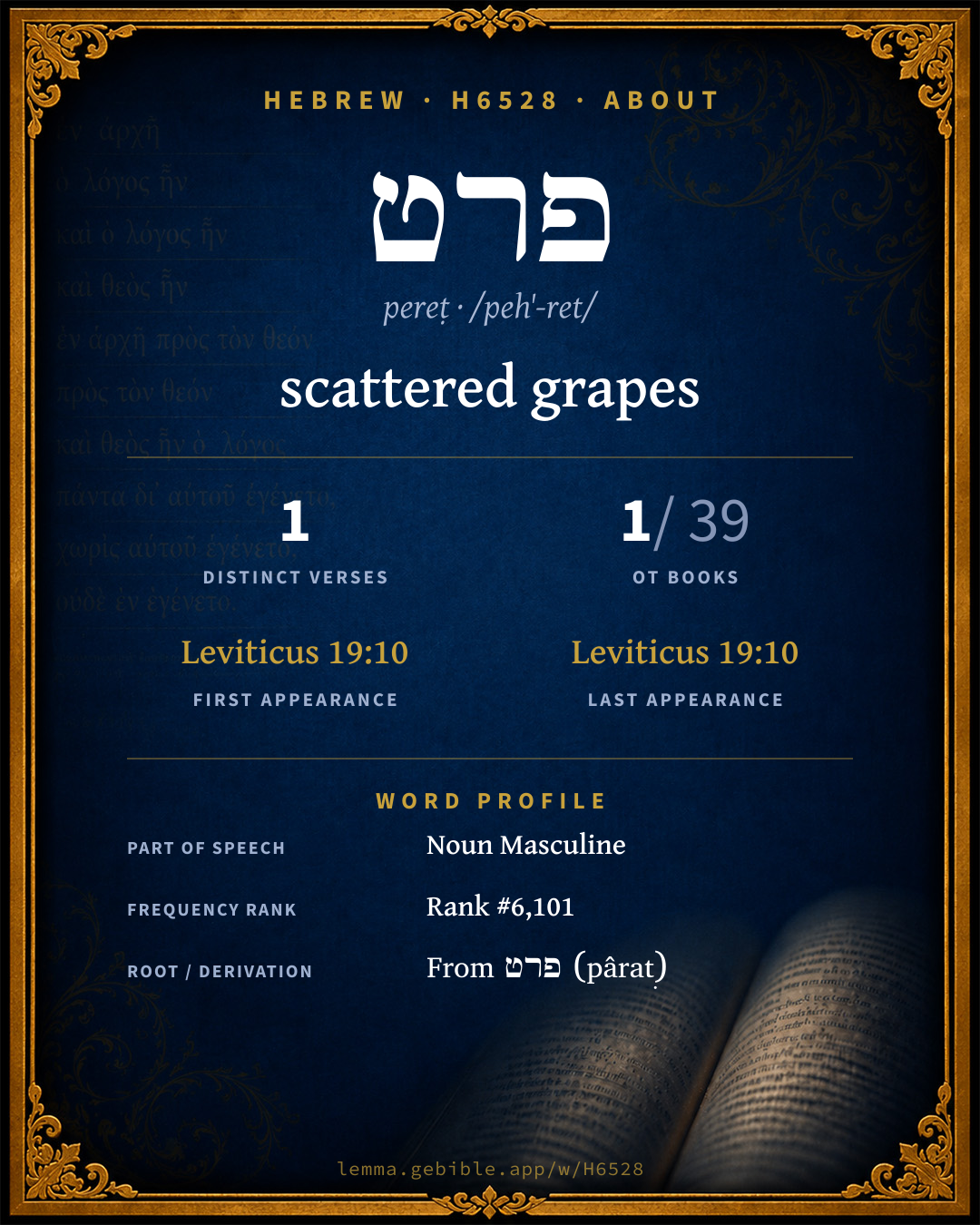
פֶּ֫רֶט
scattered grapes
‘scattered grapes’ is one of 2 main senses fuller range ↓
Full lexicon entry — Brown-Driver-Briggs (BDB)
From Brown-Driver-Briggs (BDB)
Where this word appears
Grammar key — what these labels mean
Noun type
- Common
- A common noun — a general class of person, place, or thing (“king,” “city,” “water”), not a specific name.
State
- Construct
- A noun bound to a following noun in a possessive / “of” relationship (the construct chain).
Gender
- Masculine
- Grammatically masculine.
Number
- Singular
- One.
Every verse where H6528 appears — 1 distinct verse across 1 book. Click any verse to open its interlinear word-by-word view. Verse text shown in the World English Bible for context — . Each verse’s Hebrew form is shown with its reference; the English is not keyword-highlighted, since the data carries no word-level English alignment. Use “Compare translations” on any verse to read it across multiple English versions. This concordance covers the Hebrew Bible; Septuagint (Greek Old Testament) occurrences are not indexed here.
Leviticus 1 verse
About this entry
At a glance — auto-summarized from this page’s data, not written by a person. Every figure links to its source below. This summary describes the numbers; it doesn’t interpret them.
פרט — transliterated pereṭ — is a Hebrew noun carrying the sense “scattered grapes.” It is rare — just 1 verse in the entire Hebrew Bible. Its uses cluster heavily in Leviticus (100% of all occurrences). Its lone occurrence is Leviticus 19:10. BDB distinguishes 2 senses for it. Each statement above links to its evidence; the full detail follows below.
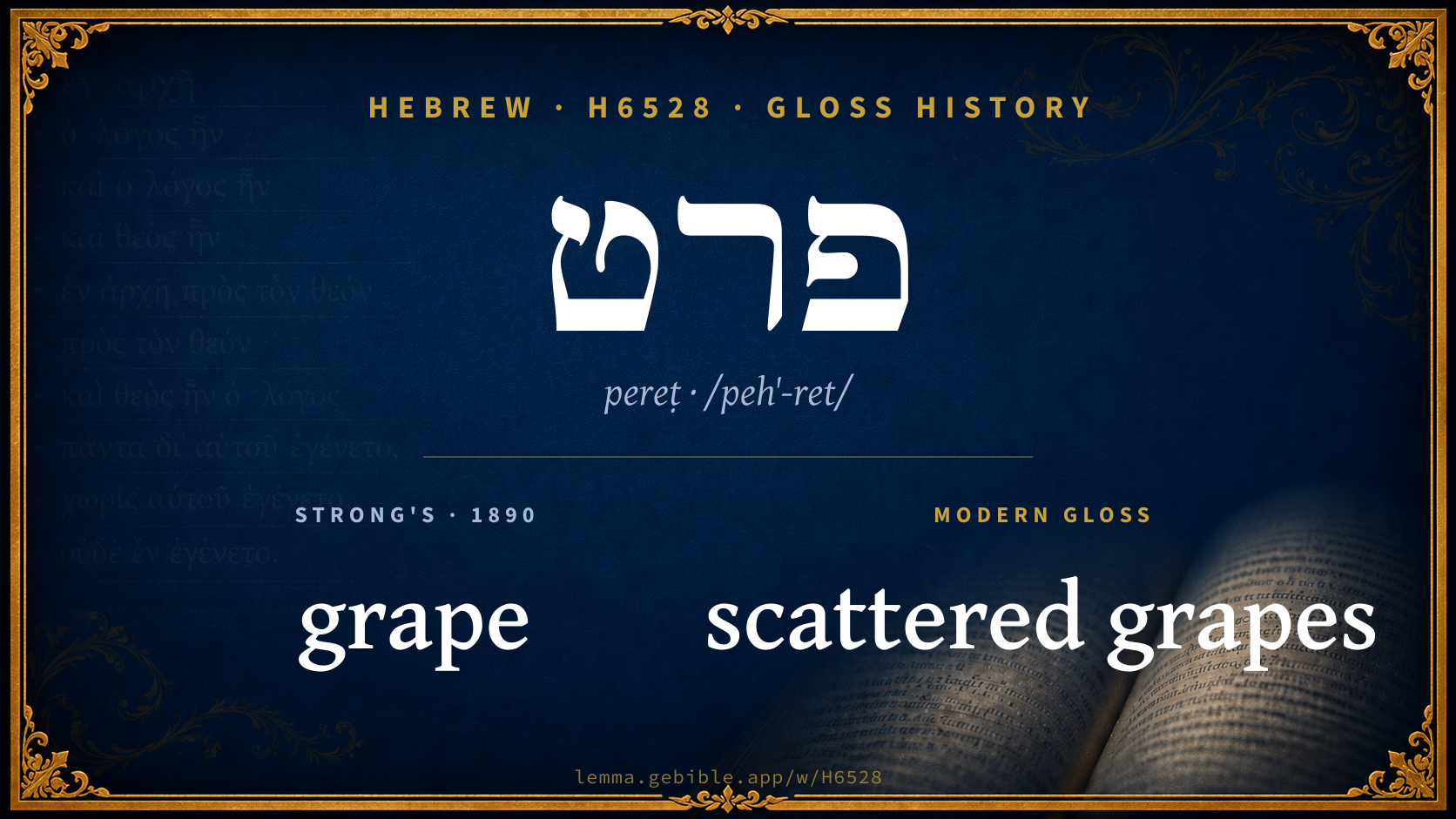
Gloss history
Strong's 1890 vs modern scholarship
About this word
Strong's H6528 catalogs a Hebrew word from the Hebrew Old Testament.
These counts are not copied from any lexicon or concordance. They are computed here, from the morphology-tagged Hebrew Old Testament. What Lemma adds →
- 1
- distinct verses
- The word appears in 1 distinct verse.
- 1 / 39
- OT books
- The word appears in 1 of 39 Old Testament books.
- #6,101
- by frequency
- Rank #6,101 (rank 6,101 of 8,640 Hebrew words by occurrence).
View all 1 occurrence in the concordance →
Most concentrated in
- Leviticus 1 verse 100%
By section of the Old Testament
By traditional corpus
Conventional, traditional groupings — biblical authorship is debated, so this is a traditional corpus grouping, not an authorship claim. Each share is this word’s portion of its verses in that division of the Hebrew canon. Each figure is a share of the word’s 1 distinct verse.
- Torah (Pentateuch) 1 verse · 100%
How translations render this word
Counts come from each version’s own published word-to-Strong’s tagging or interlinear alignment — an approximate guide to how each version renders this word, not a word-level alignment the data otherwise carries. Because each total is that version’s own tagged count, the per-version totals vary from one another and need not match the appearance or distinct-verse counts above. These counts may also differ from a printed concordance because Lemma counts each distinctly tagged rendering and does not collapse phrase taggings into a single head-word total. This is a fixed set of word-tagged versions (KJV, ASV, BSB, ULT) and does not change with the reading translation you choose elsewhere. Each version’s license is shown beside its name below (and on Sources).
- King James Version: Every grape 1×
- American Standard Version: Fallen fruit 1×
- Berean Standard Bible: Fallen grapes 1×
- unfoldingWord Literal Text: Fallen grapes of 1×, The 1×
King James Version Public Domain
Renders H6528 across 1 tagged occurrence — most commonly:
American Standard Version Public Domain
Renders H6528 across 1 tagged occurrence — most commonly:
Berean Standard Bible Public Domain
Renders H6528 across 1 tagged occurrence — most commonly:
unfoldingWord Literal Text CC BY-SA 4.0
Renders H6528 across 2 tagged occurrences — most commonly:
Senses in BDB
The 2 senses BDB distinguishes for this word, in lexicon order (not ranked by frequency or importance). The full entry — with sub-senses — is in the Lexicon Entry tab.
- the broken off, something scattered
- fallen grapes
Word origin
פֶּ֫רֶט n.[m.] the broken off, i.e. fallen grapes;—cstr. Lv 19:10.
— Brown-Driver-Briggs (Oxford 1906, public domain), digitized via Sefaria, supplemented by the OpenScriptures HebrewLexicon (CC BY 4.0). See Sources.
Derived from פרט (pâraṭ) (H6527) — to chant.
Jastrow Dictionary
A second Hebrew/Aramaic lexicon for comparison, covering Aramaic and post-biblical (Talmudic, Targumic, Midrashic) usage that the biblical-Hebrew BDB does not. Matched by lemma rather than by Strong’s number, so a lemma may carry more than one Jastrow headword (shown separately below), and the entries cover usage well beyond the Bible.
פָּרַט
- (b. h.)
- 1. to split, open. Lev. R. s. 5 (ref. to Am. VI, 5) שהיו פוֹרְטִים פיהם וכ׳ they opened their mouths wide with cynical speech. Maasr. II, 6 אוכל, פּוֹרֵט he splits (the pomegranate) and eats (a slice). Ib. III, 9. e.g. Amos 6:5
- 2. (cmp. עָרַף) to break into small change, to change money. Maas. Sh. II, 8, sq. הפורט סלע וכ׳ he who breaks (changes at the banker’s) a Sela of second-tithes money. B. Bath. 8ᵇ גבאי צדקה … פּוֹרְטִין וכ׳ charity treasurers that have no poor among whom to distribute, may exchange for others (at a fee for the benefit of the fund), but not for themselves. Ex. R. s. 35 יש אדם פורט זהוב וכ׳ a man changes one gold piece, and covers with it many expenses; a. fr.
- 3. to single out, specify. Mekh. Mishp., s. 5 משמע שניהם כאחת … עד שיִפְרוֹט לך הכתוב יחדו the Vav conjunctive may mean both together (and), or each separately (or), unless the text explicitly states ‘together’ (as Deut. XXII, 10, sq.); Snh. 85ᵇ, a. e. שיְפָרֵט (Pi.). Pes. 21ᵇ כל מקום … עד שיפרוט לך הכתוב כדרך שפ׳ וכ׳ wherever the Law says, ye shall not eat &c., it implies the prohibition of both eating and using, unless the text explicitly permits the use as it does with reference to carcasses (Deut. XIV, 21). Mekh. Bo, s. 5 פרסמו ופְרָטוֹ וכ׳ (or ופֵרְטוֹ Pi.) the Scripture publishes and specifies him (by name); a. fr. e.g. Deuteronomy 22:10
- 1. to be split, separated. Peah VII, 3 נפל לארץ ונ׳ if a cluster fell to the ground and was separated into single grapes (פֶּרֶט); Sifra K’dosh., Par. 1, ch. III.
- 2. to be specified, examined singly. Taan. 11ᵃ … בשעת פטירתו נִפְרָטִין לפניו וכ׳ (not נפטרין, Ms. M. נכתבין) when man departs to his eternal home, all his deeds are called up before him one by one, and they say to him &c.
- to divide, specify &c., v. supra.—Part. pass. מְפוֹרָט. Tosef. Kel. B. Bath. V, 10 במ׳ ed. Zuck. (Var. במְפוֹרָשׁ) that part which is torn off (and attached only at one point; prob. to be read: במְפוֹרָם, v. פָּרַם).—[Pesik. R. s. 23-24 מפרטתו, read: מסטרתו, v. סָטַר.]
פְּרַט
- 1. to break, divide. Ned. 91ᵇ פַּרְטֵיה וכ׳, v. הוּצָא I.—Part. pass. פָּרִיט; f. פְּרִיטָא; pl. פְּרִיטִין; פְּרִיטָן. B. Kam. 117ᵃ bot. דפריטן שפוותיה וכ׳ Ms. R. a. Ar. (Ms. M. דפריט׳; ed. Sonc. דפְרִיטָה; ed. דפרטיה, corr. acc.) he saw that his (R. Kahana’s) lips were parted, and thought he was laughing at him.
- 2. to specify. M. Kat. 16ᵃ דפַרְטִינָן חטאיה וכ׳ that we must specify his offence in a public proclamation.
- 3. to belittle, talk against, sneer at. Lam. R. to II, 10 Ar., v. פְּרַת.
פֶּרֶט
- preced.) single grapes, esp. pereṭ, grapes fallen off during cutting, poor man’s share (Lev. XIX, 10). Sifra K’dosh., Par. 1, ch. III; Peah VII, 3 איזהו פ׳ הנושר וכ׳ pereṭ is that which drops &c. Ib. VI, 5 שני גרגרים פ׳ וכ׳ two berries fallen at a time are pereṭ (belong to the poor), three are not pereṭ (may be picked up by the owner); a. fr. e.g. Leviticus 19:10
פֶּרֶט ²
- Targ. Y. II, Lev. XIX, 10.
פְּרָט
- (preced. wds.)
- 1. that which is singled out, specification, explicit statement, opp. כְּלָל. Sifra introd., v. כְּלָל. B. Kam. 54ᵇ (ref. to Deut. V, 14) מה הפ׳ מפורש בעלי חיים וכ׳ as the explicit specification (thy ox and thy ass) mentions animated beings, so the general expression (and all thy b’hemah) refers to all kinds of animals (including birds). B. Bath. 123ᵃ בפְרָטָן in the detailed account of them, v. כְּלָל. Gen. R. s. 94 (ref. to I Chr. XXV, 3) חמשה בפ׳ ובכללן ששה in the specification there are five (sons of Jeduthun), and in the summing up it says ‘six’; Midr. Sam. ch. XXXII בפְרָטִים חמשה ובכלל ששה; a. v. fr.—Pl. פְּרָטוֹת, פְּרָטִים. Sot. 37ᵇ כללות … ופ׳ באוהל מועד general principles were proclaimed at Sinai, and detailed laws in the Tabernacle; Ḥag. 6ᵃ sq. Ex. R. s. 32, beg. Midr. Sam. l. c.; a. fr. e.g. Deuteronomy 5:14
- 2. פ׳ ל־ [this is especially mentioned as against], to the exclusion of. Arakh. 30ᵇ; Snh. 86ᵃ, v. מָצָא. B. Kam. 64ᵇ פ׳ למרשיע את עצמו this excludes (exempts from the fine) him who accuses himself; a. v. fr.
A Dictionary of the Targumim, the Talmud Babli and Yerushalmi, and the Midrashic Literature (Marcus Jastrow; London, Luzac, 1903) — Public Domain. Digitized via Sefaria. Digitized via Sefaria. Full attribution on Sources.
Septuagint verse parallels
This word appears in 1 verse that also exists in the Greek Old Testament (Septuagint), out of the 1 Hebrew verse it occurs in. You can read those verses in Greek by switching the Old Testament edition to the Septuagint.
Read these verses in the Septuagint
This is a verse-level parallel only — the same verses exist in both the Hebrew and Greek Old Testaments. No word-level Hebrew↔Greek correspondence is claimed: the data carries no such alignment, so no Greek word is shown as this Hebrew word’s translation. Coverage is not total — the Septuagint omits the deuterocanon and renumbers the Psalms, so some Hebrew verses have no direct Greek parallel.