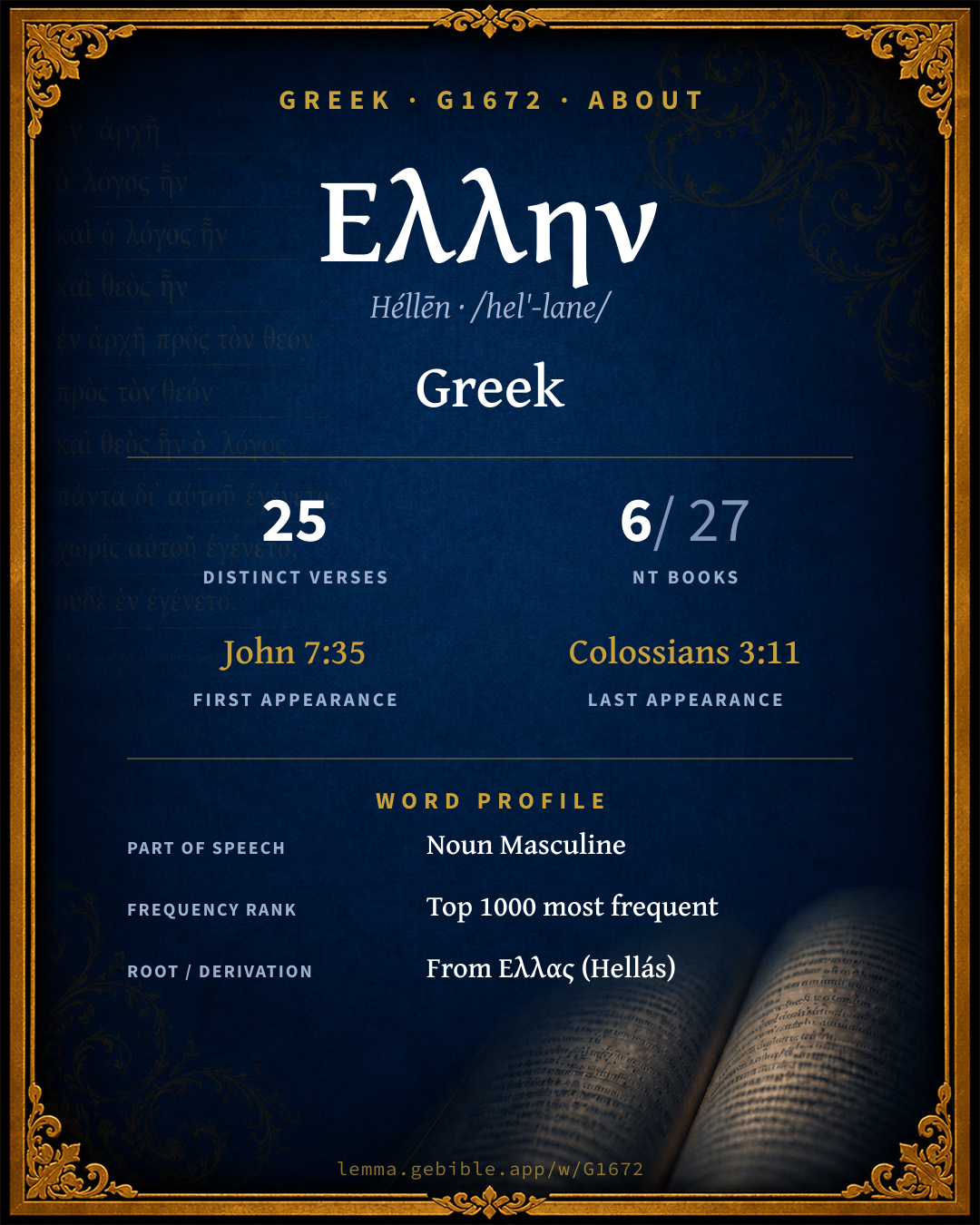
Ἕλλην
Greek
Thayer's lists 2 entries for ‘Greek’ fuller range ↓
Full lexicon entry — Thayer's Greek Lexicon
From Thayer's Greek Lexicon
Where this word appears
See every Dative-case word in the Greek New Testament →
Grammar key — what these labels mean
Part of speech
- Noun
- A naming word — a person, place, thing, or idea.
Case
- Accusative
- The case of the direct object and of extent.
- Dative
- The case of the indirect object, means, or location — “to / for / with / in.”
- Nominative
- The case of the subject (and the predicate nominative).
- Genitive
- The case of source, possession, or “of” — answers “whose / from what.”
Gender
- Masculine
- Grammatically masculine.
Number
- Plural
- More than one.
- Singular
- One.
Grammatical forms
- Noun, Accusative, Plural, Masculine 6 times (23%)
- Noun, Dative, Plural, Masculine 5 times (19%)
- Noun, Nominative, Singular, Masculine 4 times (15%)
- Noun, Genitive, Plural, Masculine 3 times (12%)
- Noun, Genitive, Singular, Masculine 3 times (12%)
- Noun, Nominative, Plural, Masculine 3 times (12%)
- Noun, Dative, Singular, Masculine 2 times (8%)
Parsed forms decoded from the imported morphology (Robinson–Tischendorf, public domain), counted across 26 parsed occurrences — not distinct verses.
Every verse where G1672 appears — 25 distinct verses across 6 books. Click any verse to open its interlinear word-by-word view. Verse text shown in the World English Bible for context — . Each verse’s Greek form is shown with its reference; the English is not keyword-highlighted, since the data carries no word-level English alignment. Use “Compare translations” on any verse to read it across multiple English versions. This concordance covers the Greek New Testament; Septuagint (Greek Old Testament) occurrences of this word are not indexed here.
John 2 verses
- John 7:35 Ἑλλήνων Ἕλληνας n gen pl masc n acc pl masc The Jews therefore said among themselves, "Where will this man go that we won't find him? Will he go to the Dispersion among the Greeks, and teach the Greeks?
- John 12:20 Ἕλληνές n nom pl masc Now there were certain Greeks among those that went up to worship at the feast.
Acts 10 verses
- Acts 11:20 Ἑλληνάς n acc pl masc But there were some of them, men of Cyprus and Cyrene, who, when they had come to Antioch, spoke to the Greeks, preaching the Lord Jesus.
- Acts 14:1 Ἑλλήνων n gen pl masc It happened in Iconium that they entered together into the synagogue of the Jews, and so spoke that a great multitude both of Jews and of Greeks believed.
- Acts 16:1 Ἕλληνος n gen sg masc He came to Derbe and Lystra: and behold, a certain disciple was there, named Timothy, the son of a Jewess who believed; but his father was a Greek.
- Acts 16:3 Ἕλλην n nom sg masc Paul wanted to have him go out with him, and he took and circumcised him because of the Jews who were in those parts; for they all knew that his father was a Greek.
- Acts 17:4 Ἑλλήνων n gen pl masc Some of them were persuaded, and joined Paul and Silas, of the devout Greeks a great multitude, and not a few of the chief women.
- Acts 18:4 Ἕλληνας n acc pl masc He reasoned in the synagogue every Sabbath, and persuaded Jews and Greeks.
- Acts 19:10 Ἕλληνας n acc pl masc This continued for two years, so that all those who lived in Asia heard the word of the Lord Jesus, both Jews and Greeks.
- Acts 19:17 Ἕλλησιν n dat pl masc This became known to all, both Jews and Greeks, who lived at Ephesus. Fear fell on them all, and the name of the Lord Jesus was magnified.
- Acts 20:21 Ἕλλησιν n dat pl masc testifying both to Jews and to Greeks repentance toward God, and faith toward our Lord Jesus.
- Acts 21:28 Ἕλληνας n acc pl masc crying out, "Men of Israel, help! This is the man who teaches all men everywhere against the people, and the law, and this place. Moreover, he also brought Greeks into the temple, and has defiled this holy place!"
Romans 6 verses
- Romans 1:14 Ἕλλησίν n dat pl masc I am debtor both to Greeks and to foreigners, both to the wise and to the foolish.
- Romans 1:16 Ἕλληνι n dat sg masc For I am not ashamed of the Gospel of Christ, for it is the power of God for salvation for everyone who believes; for the Jew first, and also for the Greek.
- Romans 2:9 Ἕλληνος n gen sg masc oppression and anguish, on every soul of man who works evil, on the Jew first, and also on the Greek.
- Romans 2:10 Ἕλληνι n dat sg masc But glory and honor and peace to every man who works good, to the Jew first, and also to the Greek.
- Romans 3:9 Ἕλληνας n acc pl masc What then? Are we better than they? No, in no way. For we previously charged both Jews and Greeks, that they are all under sin.
- Romans 10:12 Ἕλληνος n gen sg masc For there is no distinction between Jew and Greek; for the same Lord is Lord of all, and is rich to all who call on him.
1 Corinthians 4 verses
- 1 Corinthians 1:22 Ἕλληνες n nom pl masc For Jews ask for signs, Greeks seek after wisdom,
- 1 Corinthians 1:24 Ἕλλησιν n dat pl masc but to those who are called, both Jews and Greeks, Christ is the power of God and the wisdom of God.
- 1 Corinthians 10:32 Ἕλλησιν n dat pl masc Give no occasions for stumbling, either to Jews, or to Greeks, or to the assembly of God;
- 1 Corinthians 12:13 Ἕλληνες n nom pl masc For in one Spirit we were all baptized into one body, whether Jews or Greeks, whether bond or free; and were all given to drink into one Spirit.
Galatians 2 verses
Colossians 1 verse
About this entry
At a glance — auto-summarized from this page’s data, not written by a person. Every figure links to its source below. This summary describes the numbers; it doesn’t interpret them.
The Greek name Ελλην centers on the idea of “Greek.” Its earliest occurrence is John 7:35. Spanning 25 verses in 6 books, it ranks among the uncommon words of the Greek New Testament. Acts dominates its distribution — 10 of 25 verses. For the data behind this summary, explore 25-verse concordance and the renderings breakdown below.
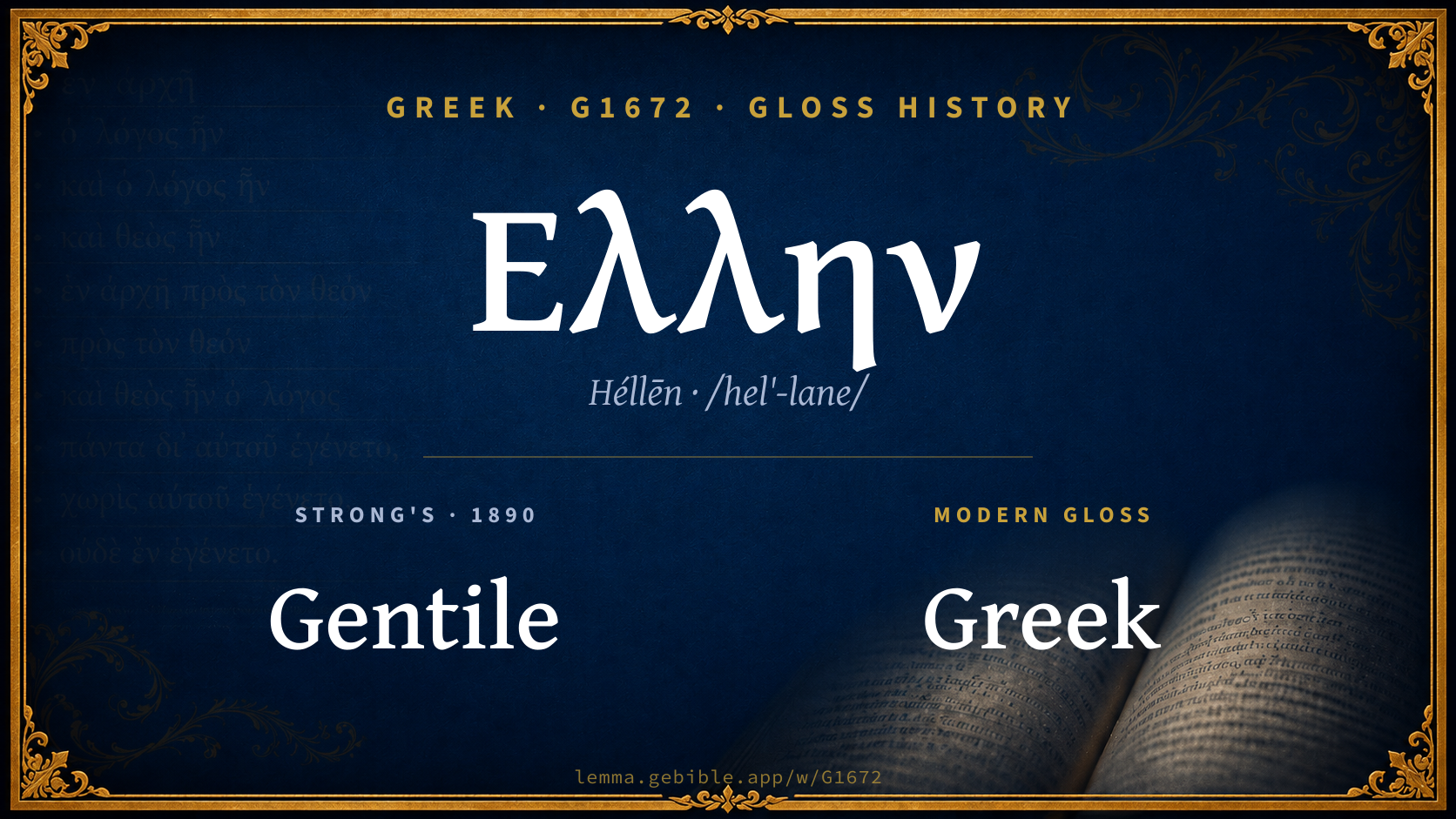
Gloss history
Strong's 1890 vs modern scholarship
About this word
Strong's G1672 catalogs a Greek word from the Greek New Testament.
These counts are not copied from any lexicon or concordance. They are computed here, from the morphology-tagged Greek New Testament. What Lemma adds →
- 25
- distinct verses
- The word appears in 25 distinct verses.
- 6 / 27
- NT books
- The word appears in 6 of 27 New Testament books.
- #513
- by frequency
- Top 1000 most frequent Greek words (rank 513 of 5,347 Greek words by occurrence).
View all 25 occurrences in the concordance →
Most concentrated in
- Acts 10 verses 40%
- Romans 6 verses 24%
- 1 Corinthians 4 verses 16%
By section of the New Testament
By traditional corpus
Conventional, traditional groupings — biblical authorship is debated, so this is a traditional corpus grouping, not an authorship claim. Some books belong to more than one corpus (Luke is in both the Gospels and the Lukan corpus, and so on), so these shares overlap and need not total 100%. Each figure is a share of the word’s 25 distinct verses.
- Pauline corpus 13 verses · 52%
- Lukan (Luke–Acts) 10 verses · 40%
- Gospels 2 verses · 8%
- Johannine 2 verses · 8%
How translations render this word
Counts come from each version’s own published word-to-Strong’s tagging or interlinear alignment — an approximate guide to how each version renders this word, not a word-level alignment the data otherwise carries. Because each total is that version’s own tagged count, the per-version totals vary from one another and need not match the appearance or distinct-verse counts above. These counts may also differ from a printed concordance because Lemma counts each distinctly tagged rendering and does not collapse phrase taggings into a single head-word total. This is a fixed set of word-tagged versions (KJV, ASV, BSB, ULT) and does not change with the reading translation you choose elsewhere. Each version’s license is shown beside its name below (and on Sources).
- King James Version: Greeks 13×, Greek 6×, Gentiles 4×
- American Standard Version: Greeks 15×, Greek 8×
- Berean Standard Bible: Greeks 16×, Greek 9×
- unfoldingWord Literal Text: Greeks 16×, Greek 9×
King James Version Public Domain
Renders G1672 across 27 tagged occurrences — most commonly:
Plus 2 renderings that appear only once — usually multi-word phrases or single function words the recovered tagging swept in, not distinct renderings.
American Standard Version Public Domain
Renders G1672 across 27 tagged occurrences — most commonly:
Plus 4 renderings that appear only once — usually multi-word phrases or single function words the recovered tagging swept in, not distinct renderings.
Berean Standard Bible Public Domain
Renders G1672 across 25 tagged occurrences — most commonly:
unfoldingWord Literal Text CC BY-SA 4.0
Renders G1672 across 26 tagged occurrences — most commonly:
Plus 1 rendering that appears only once — usually multi-word phrases or single function words the recovered tagging swept in, not distinct renderings.
Senses in Thayer's
The 2 senses Thayer's distinguishes for this word, in lexicon order (not ranked by frequency or importance). The full entry — with sub-senses — is in the Lexicon Entry tab.
- a Greek either by nationality, whether a native of the main land or of the Greek islands or colonies
- in a wider sense the name embraces all nations not Jews that made the language…
Word origin
Derived from Ελλας (Hellás) (G1671) — Greece.
From G1671 ; a hellen ( Grecian ) or inhabitant of hellas; by extension a Greek speaking person especially a non-Jew : - Gentile Greek.
— Strong’s Exhaustive Concordance (1890), public domain.
Forms in the corpus
The 10 distinct written forms G1672 takes in the Greek New Testament, most frequent first — each parse links to that case’s occurrences in the concordance.
| Form | Parsing | Example | Uses |
|---|---|---|---|
| Ἕλληνας Héllēnas | Noun, Accusative, Plural, Masculine | John 7:35 | 5 |
| Ἕλλην Héllēn | Noun, Nominative, Singular, Masculine | Acts 16:3 | 4 |
| Ἕλλησιν Héllēsin | Noun, Dative, Plural, Masculine | Acts 19:17 | 4 |
| Ἑλλήνων Hellḗnōn | Noun, Genitive, Plural, Masculine | John 7:35 | 3 |
| Ἕλληνος Héllēnos | Noun, Genitive, Singular, Masculine | Acts 16:1 | 3 |
| Ἕλληνες Héllēnes | Noun, Nominative, Plural, Masculine | 1 Corinthians 1:22 | 2 |
| Ἕλληνι Héllēni | Noun, Dative, Singular, Masculine | Romans 1:16 | 2 |
| Ἑλληνάς Hellēnás | Noun, Accusative, Plural, Masculine | Acts 11:20 | 1 |
| Ἕλληνές Héllēnés | Noun, Nominative, Plural, Masculine | John 12:20 | 1 |
| Ἕλλησίν Héllēsín | Noun, Dative, Plural, Masculine | Romans 1:14 | 1 |
Same root — word family
Other Thayer's entries built from the same root as G1672, grouped by Strong’s listed origin. These share a root / origin per the lexicon — not necessarily a shared meaning. Each links to that word’s own entry.
Derives from
Proper names from this root
People and places named from this root — a name, not an additional meaning of the word.
- Ελληνικος Hellēnikós G1673 Grecian
- Ελληνις Hellēnís G1674 Greek woman
- Ελληνιστης Hellēnistḗs G1675 Hellenist
Compare all same-root words → Showing 4 of 5 — not the complete family. 4 of the same-root words are proper names (people or places). They share a root, not necessarily a meaning.
Bible dictionary
Public-domain dictionary articles matched to this entry by name (Greek). A biblical name can be shared by more than one person or place, so an article may treat several.
Easton's Bible Dictionary · M. G. Easton, 1897
Found only in the New Testament, where a distinction is observed between "Greek" and "Grecian" (q.v.). The former is (1) a Greek by race (Acts 16:1-3; 18:17; Rom. 1:14), or (2) a Gentile as opposed to a Jew (Rom. 2:9, 10). The latter, meaning properly "one who speaks Greek," is a foreign Jew opposed to a home Jew who dwelt in Palestine.
The word "Grecians" in Acts 11:20 should be "Greeks," denoting the heathen Greeks of that city, as rendered in the Revised Version according to the reading of the best manuscripts ("Hellenes").
Classic public-domain reference works; full attribution on Sources.
Septuagint usage
The same Greek word Ελλην appears 6 times in the Greek Old Testament (Septuagint), across 6 verses in 4 books.
- 6
- LXX occurrences
- Tagged occurrences of this Greek word in the Septuagint.
- 6
- verses
- Distinct Septuagint verses containing this word.
- 4 / 39
- OT books
- The word appears in 4 of the 39 Old Testament books.
Sample Septuagint occurrences
- Isaiah 9:11 ἕλλην
- Daniel 8:21 ἕλλην
- Joel 4:6 ἕλλην
- Zechariah 9:13 ἕλλην
Septuagint occurrences (same lexeme)
Every verse where the same Strong’s number (G1672) appears in the Greek Septuagint. Verse text shown in the World English Bible for context; the Greek form is the matched word — the English is not keyword-highlighted.
- Isaiah 9:11 ἕλλην Therefore Yahweh will set up on high against him the adversaries of Rezin, and will stir up his enemies,
- Daniel 8:21 ἕλλην The rough male goat is the king of Greece: and the great horn that is between his eyes is the first king.
- Daniel 10:20 ἕλλην Then he said, "Do you know why I have come to you? Now I will return to fight with the prince of Persia. When I go forth, behold, the prince of Greece shall come.
- Daniel 11:2 ἕλλην Now will I show you the truth. Behold, there shall stand up yet three kings in Persia; and the fourth shall be far richer than they all: and when he has grown strong through his riches, he shall stir up all against the realm of Greece.
- Joel 4:6 ἕλλην
- Zechariah 9:13 ἕλλην For indeed I bend Judah as a bow for me. I have filled the bow with Ephraim; And I will stir up your sons, Zion, Against your sons, Greece, And will make you like the sword of a mighty man.
These are occurrences of the same Greek lexeme (G1672) in the Septuagint — not a translation of any one Hebrew word. The store carries no word-level Hebrew↔Greek alignment, so no Hebrew original is asserted here. Counts come from the recovered LXX Strong's tagging — high-frequency vocabulary is well covered, while rare or late forms may be untagged — so they reflect tagged occurrences and may slightly undercount.