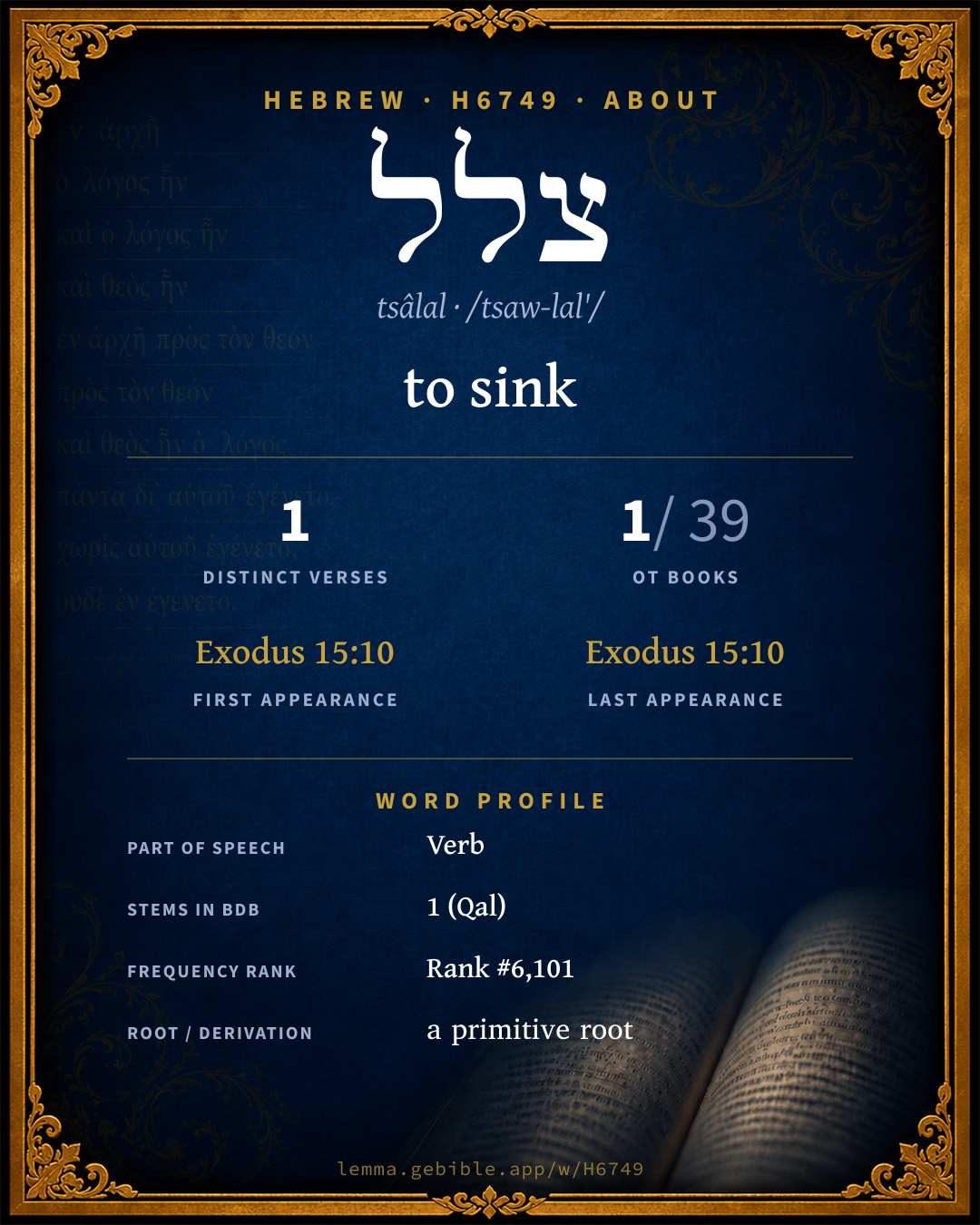
צָלַל
to sink
Full lexicon entry — Brown-Driver-Briggs (BDB)
From Brown-Driver-Briggs (BDB)
Where this word appears
Grammar key — what these labels mean
Part of speech
- Verb
- An action or state-of-being word.
Stem
- Qal
- The basic, simple active stem — the plain form of the verb (“he wrote”).
Form
- Perfect
- A completed action or state — Hebrew marks aspect (completeness) more than strict tense (“he wrote”).
Person
- 3rd Person
- The one spoken about (“he / she / it / they”).
Gender
- Common
- Either gender — not distinguished for this form.
Number
- Plural
- More than one (in Hebrew, generally three or more).
Every verse where H6749 appears — 1 distinct verse across 1 book. Click any verse to open its interlinear word-by-word view. Verse text shown in the World English Bible for context — . Each verse’s Hebrew form is shown with its reference; the English is not keyword-highlighted, since the data carries no word-level English alignment. Use “Compare translations” on any verse to read it across multiple English versions. This concordance covers the Hebrew Bible; Septuagint (Greek Old Testament) occurrences are not indexed here.
Exodus 1 verse
About this entry
At a glance — auto-summarized from this page’s data, not written by a person. Every figure links to its source below. This summary describes the numbers; it doesn’t interpret them.
צלל — transliterated tsâlal — is a Hebrew verb carrying the sense “to sink.” It is rare — just 1 verse in the entire Hebrew Bible. Its uses cluster heavily in Exodus (100% of all occurrences). A true hapax — its single appearance is Exodus 15:10. From the same root come צלול, צלל and צלל. See the sense tree, 1-verse concordance, and the renderings breakdown below.
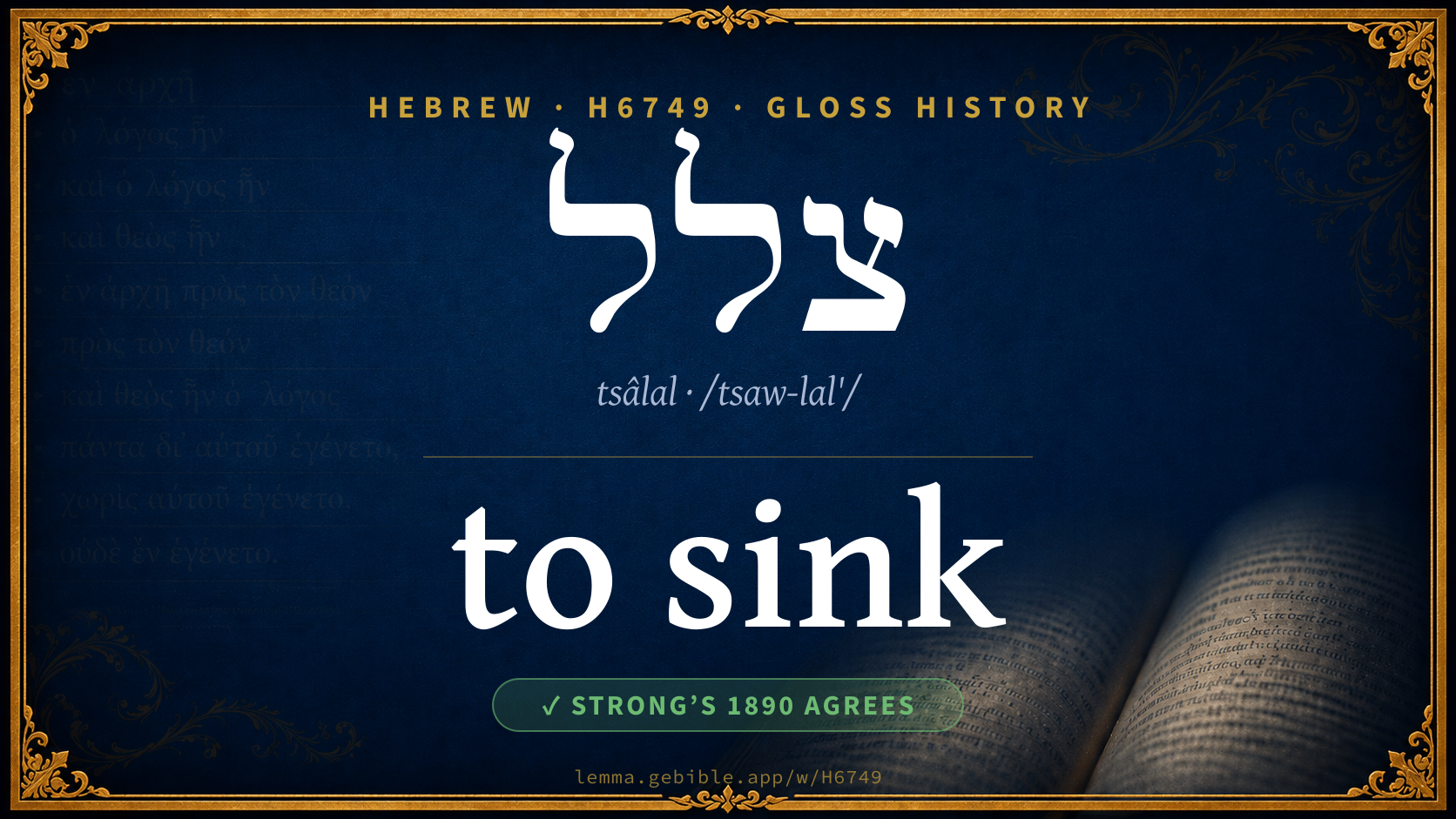
Gloss history
Strong's 1890 vs modern scholarship
About this word
Strong's H6749 catalogs a Hebrew word from the Hebrew Old Testament.
These counts are not copied from any lexicon or concordance. They are computed here, from the morphology-tagged Hebrew Old Testament. What Lemma adds →
- 1
- distinct verses
- The word appears in 1 distinct verse.
- 1 / 39
- OT books
- The word appears in 1 of 39 Old Testament books.
- #6,101
- by frequency
- Rank #6,101 (rank 6,101 of 8,640 Hebrew words by occurrence).
View all 1 occurrence in the concordance →
Most concentrated in
- Exodus 1 verse 100%
By section of the Old Testament
By traditional corpus
Conventional, traditional groupings — biblical authorship is debated, so this is a traditional corpus grouping, not an authorship claim. Each share is this word’s portion of its verses in that division of the Hebrew canon. Each figure is a share of the word’s 1 distinct verse.
- Torah (Pentateuch) 1 verse · 100%
How translations render this word
Counts come from each version’s own published word-to-Strong’s tagging or interlinear alignment — an approximate guide to how each version renders this word, not a word-level alignment the data otherwise carries. Because each total is that version’s own tagged count, the per-version totals vary from one another and need not match the appearance or distinct-verse counts above. These counts may also differ from a printed concordance because Lemma counts each distinctly tagged rendering and does not collapse phrase taggings into a single head-word total. This is a fixed set of word-tagged versions (KJV, ASV, BSB, ULT) and does not change with the reading translation you choose elsewhere. Each version’s license is shown beside its name below (and on Sources).
- King James Version: They sank 1×
- American Standard Version: Them 1×
- Berean Standard Bible: They sank 1×
- unfoldingWord Literal Text: They sank 1×
King James Version Public Domain
Renders H6749 across 1 tagged occurrence — most commonly:
American Standard Version Public Domain
Renders H6749 across 1 tagged occurrence — most commonly:
Berean Standard Bible Public Domain
Renders H6749 across 1 tagged occurrence — most commonly:
unfoldingWord Literal Text CC BY-SA 4.0
Renders H6749 across 1 tagged occurrence — most commonly:
Senses in the full BDB
What do BDB’s symbols mean?
BDB uses these scholarly abbreviations:
| Symbol | Meaning |
|---|---|
| 𝔊 | the Septuagint (the ancient Greek translation, LXX) |
| 𝔙 | the Vulgate (the Latin translation) |
| 𝔖 | the Syriac version (the Peshitta) |
| 𝔗 | the Targum (the Aramaic translation) |
| ψ | the Psalms |
| √ | root (the underlying root or stem) |
| ‖ | parallel passage (a synonymous or contrasted parallel) |
| † | the dagger: every passage where the word occurs is cited |
The 1 sense the full Brown-Driver-Briggs lexicon distinguishes for this word, in lexicon order (not ranked by frequency), with BDB’s own verbatim wording and sub-sense lettering. Shown in Hebrew script with BDB’s own scholarly abbreviations. The condensed entry is in the Lexicon Entry tab.
Qal
- Pf. 3 pl. צָֽלְלוּ Hb 3:16; Impf. 3 fpl. תְּצִלֶּינָה 1 S 3:11, תִּצַּלְנָה (Ges§ 67g) 2 K 21:12; Je 19:3;—tingle, of ears, at horrid sound 1 S 3:11; 2 K 21:12; Je 19:3 (all of dreadful news); of lips, quiver in terror Hb 3:16. e.g. Habakkuk 3:16
Senses from the full Brown-Driver-Briggs lexicon (Brown, Driver, Briggs; Oxford 1906 — public domain), digitized via Sefaria, supplemented by the OpenScriptures HebrewLexicon (CC BY 4.0). Full attribution on Sources.
Word origin
vb. tingle, quiver (NH צִלְצֵל whirr; Arabic صَلَّ, صَلْصَلَ; 𝔗 צְלַל; Syriac ܨܰܠ );—
— Brown-Driver-Briggs (Oxford 1906, public domain), digitized via Sefaria, supplemented by the OpenScriptures HebrewLexicon (CC BY 4.0). See Sources.
Origin: a primitive root
Jastrow Dictionary
A second Hebrew/Aramaic lexicon for comparison, covering Aramaic and post-biblical (Talmudic, Targumic, Midrashic) usage that the biblical-Hebrew BDB does not. Matched by lemma rather than by Strong’s number, so a lemma may carry more than one Jastrow headword (shown separately below), and the entries cover usage well beyond the Bible.
צָלַל
- 1. to move, shake, hang over; denom. צֵל.
- 2. to turn, circle, roll (v. Jud. VII, 13); to eddy, sink. Koh. R. to XII, 7; Y. Ber. IV, 7ᵇ bot., a. e. (ref. to צולה, Is. XLIV, 27) why is Babylonia called tsulah, ששם צָלְלוּ מיתי וכ׳ because there sank the corpses of the generation of the flood; Lam. R. introd. (R. Josh. 2) צללו מי מבול (corr. acc.); v. infra.—3) (cmp. שָׁקַע) to settle, be clear; to clarify. Tosef. Nidd. III, 11 צָלְלוּ לא יחזור וכ׳ if the mixture has settled (become clear), he must not stir it up again; Nidd. 20ᵃ, v. עָכַר. Y. Keth. I, 25ᵇ bot. וחוזרת וצוֹלֶלֶת, v. צָכַר. Gen. R. s. 80, end וצָלַלְנוּ, v. צָכַר; a. e.—Part. pass. צָלוּל; f. צְלוּלָה; pl. צְלוּלִים, צְלוּלִין; צְלוּלוֹת. Ib. צ׳ היתה, v. צָכַר. Y. Ter. V, end, 43ᵈ יין צ׳ clarified wine. Sabb. 109ᵃ; 139ᵇ; a. fr.—Pesik. Haʿomer, p. 71ᵃ (play on צלול, K’ri צליל, Jud. VII, 13) על שצלול היה אותו הדור וכ׳ (not על שצלל עליהם, v. Rashi to Jud. l. c.) because that generation was cleared (bared) of righteous men; Pesik. R. s. 18 שצליל עליהם corr. acc.); Yalk. Jud. 62, Yalk. Lev. 643 (corr. acc.).—[ e.g. Judges 7:13
- 4. to glisten, be bright; (of sound) to vibrate, ring; v. מְצִילָּה, צִלְצֵל &c.]
- to be cleared. Y. Nidd. II, end, 50ᵇ יִצָּלְלוּ ולא יעכרו, v. עָכַר. Sabb. XX, 2 (139ᵇ) שיִצַּלּוּ (Bab. ed. שיִצּוֹלּוּ; v. Rabb. D. S. a. l. note 20) that they (the dregs) may settle.
- 1. to become clear, settle. Par. VIII, 11 עד שתָּצֵל until it is settled.
- 2. (denom. of צֵל) to shade. Pes. 50ᵃ (ref. to מצלות, Zech. XIV, 20) there will be an addition to the sacred precincts of Jerusalem עד שהסוס רץ ומֵיצֵל Ms. M. (ed. ומֵצֵיל; Rashi: עד שעה שהסרס וכ׳) as far as a horse can run (from sunrise) until it gives shade (casts its shadow under itself, i.e. till noon-time; Y. ib. III, end, 30ᵇ עד מקום שהסוס רץ ואינו עושה צל); Bab. l. c. כל ביזה … עד שהסוס רץ ומיצל וכ׳ whatever booty Israel will make (from morning) to the time &c., will be sacred &c. e.g. Zechariah 14:20
- to be sunk, dumped. Zeb. 113ᵇ שכל מתי מבול נִצְטַלְּלוּ לשם Ms. R. a. K. (ed. נִצְתַּלְּלוּ שם) because all the corpses of the flood were dumped there (in Babylonia); Sabb. 113ᵇ; v. supra.
צְלַל
- 1. to vibrate, ring. Targ. II Kings XXI, 12; Targ. I Sam. III, 11; Targ. Jer. XIX, 3.
- 2. to be clear; to clarify. Sabb. 75ᵃ דלֵיצוּל some ed. (oth. דלֵיצִיל, fr. צִיל), v. צֶבַע ch.—Part. pass. צָלִיל, f. צְלִילָא; pl. צְלִילִין; צְלִילָן, צְלִילָתָא. Targ. Y. Ex. VII, 24. Targ. Y. Gen. I, 21 צְלִילָתָא (not צְלִילְ׳).
- 3. to cast a long shadow (cmp. Neh. XIII, 19).—Part. צָלֵיל; f. צְלִילָא. Y. Shebi. IX, 39ᵃ top כד תחמון רגלא צ׳ וכ׳ when you see the foot casting a long shadow (towards evening, when people are going home from market), take it out of the market &c. e.g. Nehemiah 13:19
A Dictionary of the Targumim, the Talmud Babli and Yerushalmi, and the Midrashic Literature (Marcus Jastrow; London, Luzac, 1903) — Public Domain. Digitized via Sefaria. Digitized via Sefaria. Full attribution on Sources.
Same root — word family
Other BDB entries built from the same root as H6749, grouped by Strong’s listed origin. These share a root / origin per the lexicon — not necessarily a shared meaning. Each links to that word’s own entry.
Derived from this word
Compare all same-root words → They share a root, not necessarily a meaning.
Septuagint verse parallels
This word appears in 1 verse that also exists in the Greek Old Testament (Septuagint), out of the 1 Hebrew verse it occurs in. You can read those verses in Greek by switching the Old Testament edition to the Septuagint.
Read these verses in the Septuagint
This is a verse-level parallel only — the same verses exist in both the Hebrew and Greek Old Testaments. No word-level Hebrew↔Greek correspondence is claimed: the data carries no such alignment, so no Greek word is shown as this Hebrew word’s translation. Coverage is not total — the Septuagint omits the deuterocanon and renumbers the Psalms, so some Hebrew verses have no direct Greek parallel.