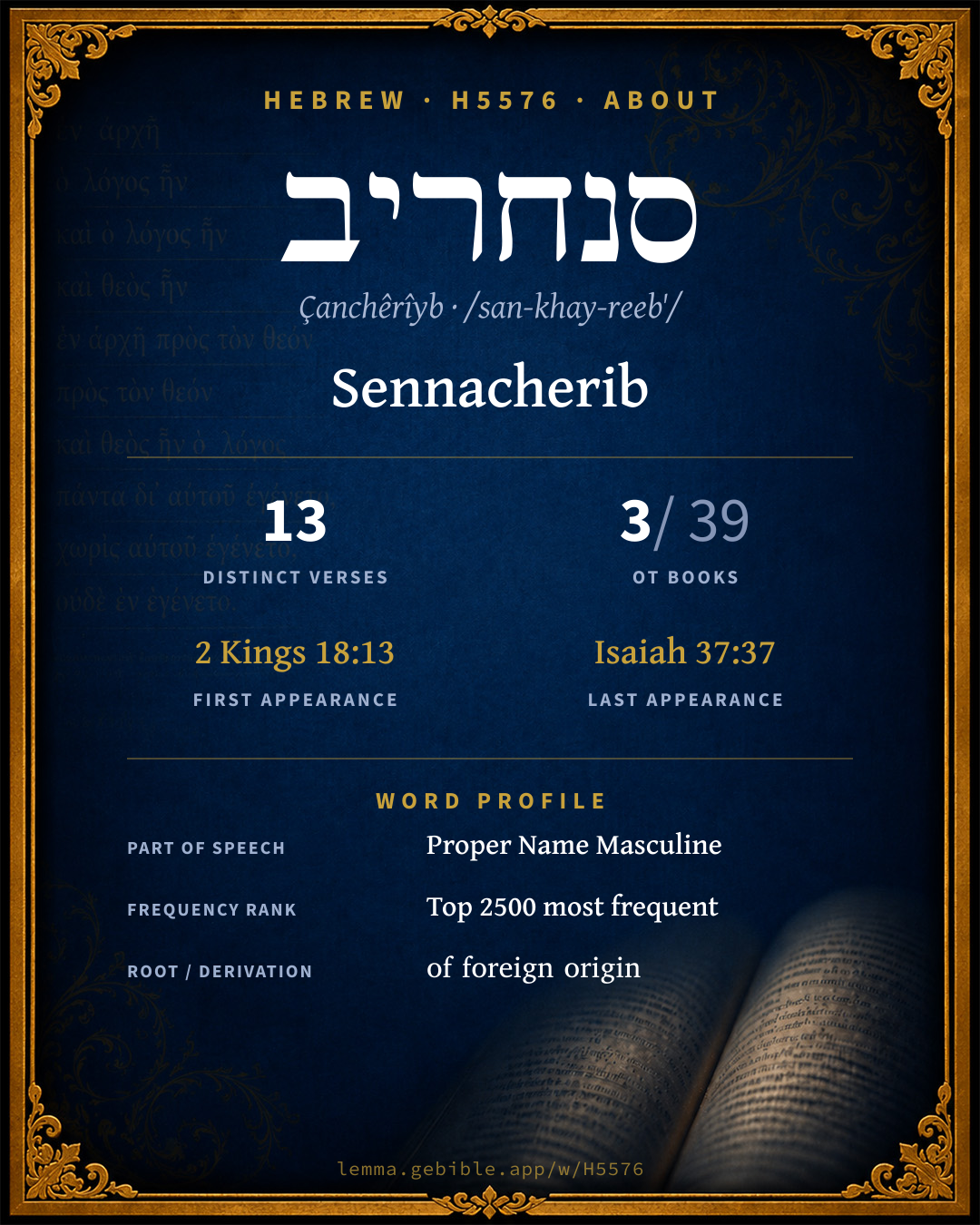
סַנְחֵרִיב
Sennacherib
BDB lists 2 entries for ‘Sennacherib’ fuller range ↓
Full lexicon entry — Brown-Driver-Briggs (BDB)
From Brown-Driver-Briggs (BDB)
Where this word appears
Grammar key — what these labels mean
Part of speech
- Noun
- A naming word — a person, place, thing, or idea.
Noun type
- Proper
- A name of a specific person, place, or people (e.g. Abraham, Zion, Israel).
Every verse where H5576 appears — 13 distinct verses across 3 books. Click any verse to open its interlinear word-by-word view. Verse text shown in the World English Bible for context — . Each verse’s Hebrew form is shown with its reference; the English is not keyword-highlighted, since the data carries no word-level English alignment. Use “Compare translations” on any verse to read it across multiple English versions. This concordance covers the Hebrew Bible; Septuagint (Greek Old Testament) occurrences are not indexed here.
2 Kings 4 verses
- 2 Kings 18:13 סַנְחֵרִ֤יב n Proper Now in the fourteenth year of king Hezekiah did Sennacherib king of Assyria come up against all the fortified cities of Judah, and took them.
- 2 Kings 19:16 סַנְחֵרִ֔יב n Proper Incline your ear, Yahweh, and hear; open your eyes, Yahweh, and see; and hear the words of Sennacherib, with which he has sent him to defy the living God.
- 2 Kings 19:20 סַנְחֵרִ֥ב n Proper Then Isaiah the son of Amoz sent to Hezekiah, saying, Thus says Yahweh, the God of Israel, Whereas you have prayed to me against Sennacherib king of Assyria, I have heard [you].
- 2 Kings 19:36 סַנְחֵרִ֣יב n Proper So Sennacherib king of Assyria departed, and went and returned, and lived at Nineveh.
2 Chronicles 5 verses
- 2 Chronicles 32:1 סַנְחֵרִ֣יב n Proper After these things, and this faithfulness, Sennacherib king of Assyria came, and entered into Judah, and encamped against the fortified cities, and thought to win them for himself.
- 2 Chronicles 32:2 סַנְחֵרִ֑יב n Proper When Hezekiah saw that Sennacherib was come, and that he was purposed to fight against Jerusalem,
- 2 Chronicles 32:9 סַנְחֵרִ֨יב n Proper After this did Sennacherib king of Assyria send his servants to Jerusalem, (now he was before Lachish, and all his power with him), to Hezekiah king of Judah, and to all Judah who were at Jerusalem, saying,
- 2 Chronicles 32:10 סַנְחֵרִ֖יב n Proper Thus says Sennacherib king of Assyria, Whereon do you trust, that you abide the siege in Jerusalem?
- 2 Chronicles 32:22 סַנְחֵרִ֥יב n Proper Thus Yahweh saved Hezekiah and the inhabitants of Jerusalem from the hand of Sennacherib the king of Assyria, and from the hand of all [others], and guided them on every side.
Isaiah 4 verses
- Isaiah 36:1 סַנְחֵרִ֤יב n Proper Now it happened in the fourteenth year of king Hezekiah, that Sennacherib king of Assyria came up against all the fortified cities of Judah, and took them.
- Isaiah 37:17 סַנְחֵרִ֔יב n Proper Turn your ear, Yahweh, and hear; open your eyes, Yahweh, and behold; and hear all the words of Sennacherib, who has sent to defy the living God.
- Isaiah 37:21 סַנְחֵרִ֖יב n Proper Then Isaiah the son of Amoz sent to Hezekiah, saying, Thus says Yahweh, the God of Israel, Whereas you have prayed to me against Sennacherib king of Assyria,
- Isaiah 37:37 סַנְחֵרִ֣יב n Proper So Sennacherib king of Assyria departed, and went and returned, and lived at Nineveh.
About this entry
At a glance — auto-summarized from this page’s data, not written by a person. Every figure links to its source below. This summary describes the numbers; it doesn’t interpret them.
סנחריב (Çanchêrîyb) is a Hebrew name most often rendered “Sennacherib.” Scripture first uses it in 2 Kings 18:13. It turns up in 13 verses across 3 books, an uncommon footprint. It concentrates in 2 Chronicles, which alone accounts for 38% of its uses. For the data behind this summary, explore 13-verse concordance and the renderings breakdown below.
Gloss history
Strong's 1890 vs modern scholarship
About this word
Strong's H5576 catalogs a Hebrew word from the Hebrew Old Testament.
These counts are not copied from any lexicon or concordance. They are computed here, from the morphology-tagged Hebrew Old Testament. What Lemma adds →
- 13
- distinct verses
- The word appears in 13 distinct verses.
- 3 / 39
- OT books
- The word appears in 3 of 39 Old Testament books.
- #2,001
- by frequency
- Top 2500 most frequent Hebrew words (rank 2,001 of 8,640 Hebrew words by occurrence).
View all 13 occurrences in the concordance →
Most concentrated in
- 2 Chronicles 5 verses 38%
- 2 Kings 4 verses 31%
- Isaiah 4 verses 31%
By section of the Old Testament
By traditional corpus
Conventional, traditional groupings — biblical authorship is debated, so this is a traditional corpus grouping, not an authorship claim. Each share is this word’s portion of its verses in that division of the Hebrew canon. Each figure is a share of the word’s 13 distinct verses.
- Prophets (Nevi'im) 8 verses · 62%
- Writings (Ketuvim) 5 verses · 38%
How translations render this word
Counts come from each version’s own published word-to-Strong’s tagging or interlinear alignment — an approximate guide to how each version renders this word, not a word-level alignment the data otherwise carries. Because each total is that version’s own tagged count, the per-version totals vary from one another and need not match the appearance or distinct-verse counts above. These counts may also differ from a printed concordance because Lemma counts each distinctly tagged rendering and does not collapse phrase taggings into a single head-word total. This is a fixed set of word-tagged versions (KJV, ASV, BSB, ULT) and does not change with the reading translation you choose elsewhere. Each version’s license is shown beside its name below (and on Sources).
- King James Version: Sennacherib 8×, Against sennacherib 2×, Did sennacherib 2×
- American Standard Version: Sennacherib 9×, Against sennacherib 2×, Did sennacherib 2×
- Berean Standard Bible: Sennacherib 13×
- unfoldingWord Literal Text: Sennacherib 13×
King James Version Public Domain
Renders H5576 across 13 tagged occurrences — most commonly:
Plus 1 rendering that appears only once — usually multi-word phrases or single function words the recovered tagging swept in, not distinct renderings.
American Standard Version Public Domain
Renders H5576 across 13 tagged occurrences — most commonly:
Berean Standard Bible Public Domain
Renders H5576 across 13 tagged occurrences — most commonly:
unfoldingWord Literal Text CC BY-SA 4.0
Renders H5576 across 13 tagged occurrences — most commonly:
Senses in BDB
The 2 senses BDB distinguishes for this word, in lexicon order (not ranked by frequency or importance). The full entry — with sub-senses — is in the Lexicon Entry tab.
- Sennacherib = "Sin multiplied brothers" (Sin = the moon)
- son of Sargon…
Word origin
n.pr.m. Sennacherib (= Sinaḫê-irba, Sin multiplied brothers, SchrCOT 2 K 18:13);—son of Sargon and father of Esarhaddon, king of Assyria (b. c. 705–681; cf. TieleGesch. 285 ff.); 2 K 18:13; 19:16, 20, 36 = Is 36:1; 37:17, 21, 37; 2 Ch 32:1, 2, 9, 10, 22 (all as above, except סַנְחֵרִב 2 K 19:20); 𝔊 Σενναχηρειμ, 𝔊L Σενναχειρειμ; Σεναχήριβος JosAnt. x. 1 ff.; Σαναχάρβον (acc.) Herodot.ii. 141.
— Brown-Driver-Briggs (Oxford 1906, public domain), digitized via Sefaria, supplemented by the OpenScriptures HebrewLexicon (CC BY 4.0). See Sources.
Origin: of foreign origin
Forms in the corpus
The 8 distinct written forms H5576 takes in the Hebrew Bible, most frequent first — each parse links to that state’s occurrences in the concordance. Hebrew forms include their vowel points and cantillation, so a single lemma takes many written forms.
| Form | Parsing | Example | Uses |
|---|---|---|---|
| סַנְחֵרִ֣יב | Noun, Proper | 2 Chronicles 32:1 | 3 |
| סַנְחֵרִ֔יב | Noun, Proper | 2 Kings 19:16 | 2 |
| סַנְחֵרִ֖יב | Noun, Proper | 2 Chronicles 32:10 | 2 |
| סַנְחֵרִ֤יב | Noun, Proper | 2 Kings 18:13 | 2 |
| סַנְחֵרִ֑יב | Noun, Proper | 2 Chronicles 32:2 | 1 |
| סַנְחֵרִ֥ב | Noun, Proper | 2 Kings 19:20 | 1 |
| סַנְחֵרִ֥יב | Noun, Proper | 2 Chronicles 32:22 | 1 |
| סַנְחֵרִ֨יב | Noun, Proper | 2 Chronicles 32:9 | 1 |
Bible dictionary
Public-domain dictionary articles matched to this entry by name (Sennacherib). A biblical name can be shared by more than one person or place, so an article may treat several.
Easton's Bible Dictionary · M. G. Easton, 1897
Sin (the god) sends many brothers, son of Sargon, whom he succeeded on the throne of Assyria (B.C. 705), in the 23rd year of Hezekiah. "Like the Persian Xerxes, he was weak and vainglorious, cowardly under reverse, and cruel and boastful in success." He first set himself to break up the powerful combination of princes who were in league against him. Among these was Hezekiah, who had entered into an alliance with Egypt against Assyria. He accordingly led a very powerful army of at least 200,000 men into Judea, and devastated the land on every side, taking and destroying many cities (2 Kings 18:13-16; comp. Isa. 22, 24, 29, and 2 Chr. 32:1-8). His own account of this invasion, as given in the Assyrian annals, is in these words: "Because Hezekiah, king of Judah, would not submit to my yoke, I came up against him, and by force of arms and by the might of my power I took forty-six of his strong fenced cities; and of the smaller towns which were scattered about, I took and plundered a countless number. From these places I took and carried off 200,156 persons, old and young, male and female, together with horses and mules, asses and camels, oxen and sheep, a countless multitude; and Hezekiah himself I shut up in Jerusalem, his capital city, like a bird in a cage, building towers round the city to hem him in, and raising banks of earth against the gates, so as to prevent escape...Then upon Hezekiah there fell the fear of the power of my arms, and he sent out to me the chiefs and the elders of Jerusalem with 30 talents of gold and 800 talents of silver, and divers treasures, a rich and immense booty...All these things were brought to me at Nineveh, the seat of my government." (Comp. Isa. 22:1-13 for description of the feelings of the inhabitants of Jerusalem at such a crisis.)
Hezekiah was not disposed to become an Assyrian feudatory. He accordingly at once sought help from Egypt (2 Kings 18:20-24). Sennacherib, hearing of this, marched a second time into Palestine (2 Kings 18:17, 37; 19; 2 Chr. 32:9-23; Isa. 36:2-22. Isa. 37:25 should be rendered "dried up all the Nile-arms of Matsor," i.e., of Egypt, so called from the "Matsor" or great fortification across the isthmus of Suez, which protected it from invasions from the east). Sennacherib sent envoys to try to persuade Hezekiah to surrender, but in vain. (See TIRHAKAH.) He next sent a threatening letter (2 Kings 19:10-14), which Hezekiah carried into the temple and spread before the Lord. Isaiah again brought an encouraging message to the pious king (2 Kings 19:20-34). "In that night" the angel of the Lord went forth and smote the camp of the Assyrians. In the morning, "behold, they were all dead corpses." The Assyrian army was annihilated.
This great disaster is not, as was to be expected, taken notice of in the Assyrian annals.
Though Sennacherib survived this disaster some twenty years, he never again renewed his attempt against Jerusalem. He was murdered by two of his own sons (Adrammelech and Sharezer), and was succeeded by another son, Esarhaddon (B.C. 681), after a reign of twenty-four years.
Hitchcock's Bible Names Dictionary · Roswell D. Hitchcock, 1869
bramble of destruction
Classic public-domain reference works; full attribution on Sources.
Septuagint verse parallels
This word appears in 13 verses that also exist in the Greek Old Testament (Septuagint), out of the 13 Hebrew verses it occurs in. You can read those verses in Greek by switching the Old Testament edition to the Septuagint.
Read these verses in the Septuagint
This is a verse-level parallel only — the same verses exist in both the Hebrew and Greek Old Testaments. No word-level Hebrew↔Greek correspondence is claimed: the data carries no such alignment, so no Greek word is shown as this Hebrew word’s translation. Coverage is not total — the Septuagint omits the deuterocanon and renumbers the Psalms, so some Hebrew verses have no direct Greek parallel.