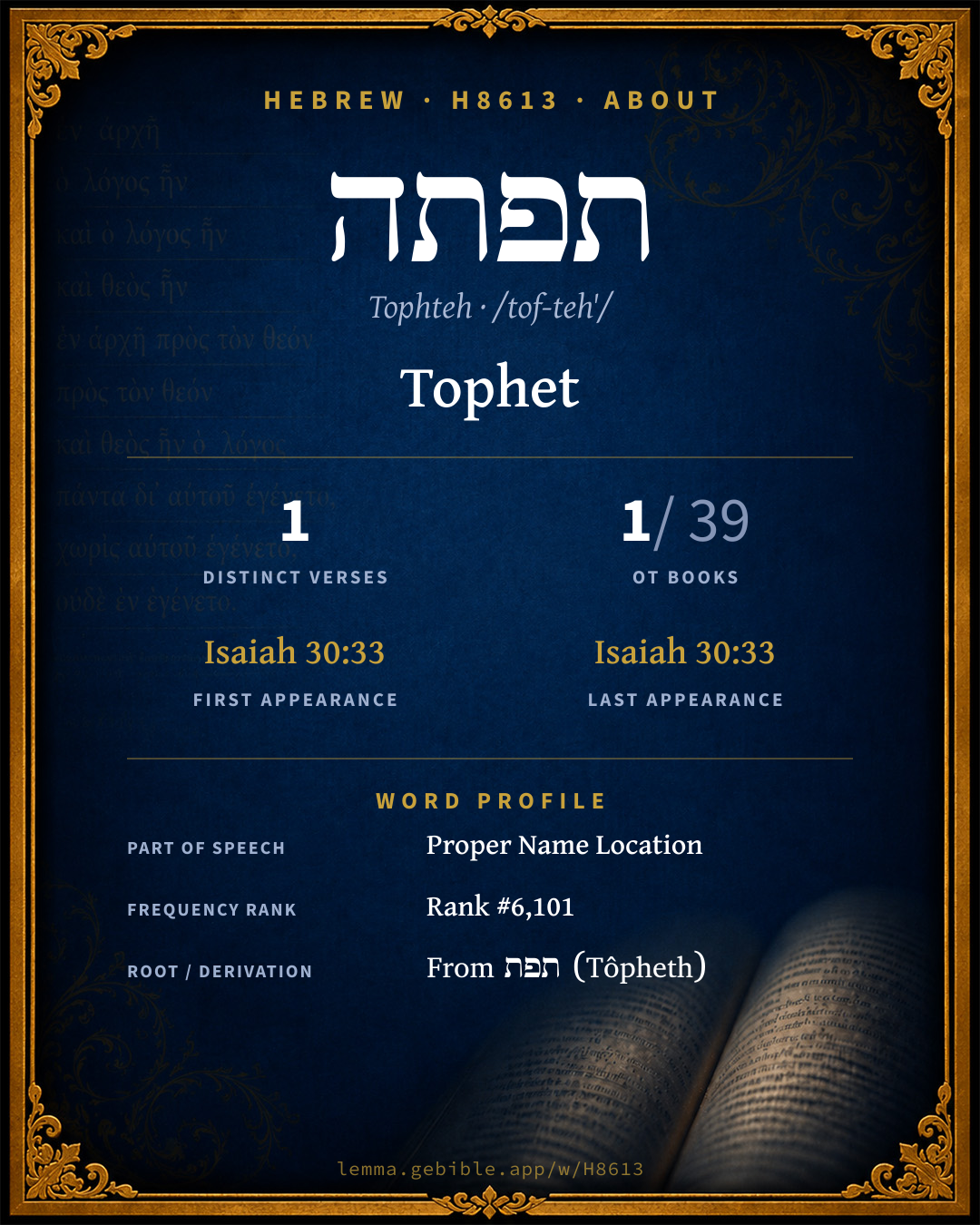
תׇּפְתֶּה
Tophet
BDB lists 2 entries for ‘Tophet’ fuller range ↓
Full lexicon entry — Brown-Driver-Briggs (BDB)
From Brown-Driver-Briggs (BDB)
Where this word appears
Grammar key — what these labels mean
Part of speech
- Noun
- A naming word — a person, place, thing, or idea.
Noun type
- Proper
- A name of a specific person, place, or people (e.g. Abraham, Zion, Israel).
Every verse where H8613 appears — 1 distinct verse across 1 book. Click any verse to open its interlinear word-by-word view. Verse text shown in the World English Bible for context — . Each verse’s Hebrew form is shown with its reference; the English is not keyword-highlighted, since the data carries no word-level English alignment. Use “Compare translations” on any verse to read it across multiple English versions. This concordance covers the Hebrew Bible; Septuagint (Greek Old Testament) occurrences are not indexed here.
Isaiah 1 verse
About this entry
At a glance — auto-summarized from this page’s data, not written by a person. Every figure links to its source below. This summary describes the numbers; it doesn’t interpret them.
תפתה (Tophteh) is a Hebrew name most often rendered “Tophet.” It occurs a mere 1 verse across Scripture. Isaiah dominates its distribution — 1 of 1 verses. Scripture uses it exactly once, at Isaiah 30:33. For the data behind this summary, explore 1-verse concordance and the renderings breakdown below.
Gloss history
Strong's 1890 vs modern scholarship
About this word
Strong's H8613 catalogs a Hebrew word from the Hebrew Old Testament.
These counts are not copied from any lexicon or concordance. They are computed here, from the morphology-tagged Hebrew Old Testament. What Lemma adds →
- 1
- distinct verses
- The word appears in 1 distinct verse.
- 1 / 39
- OT books
- The word appears in 1 of 39 Old Testament books.
- #6,101
- by frequency
- Rank #6,101 (rank 6,101 of 8,640 Hebrew words by occurrence).
View all 1 occurrence in the concordance →
Most concentrated in
- Isaiah 1 verse 100%
By section of the Old Testament
By traditional corpus
Conventional, traditional groupings — biblical authorship is debated, so this is a traditional corpus grouping, not an authorship claim. Each share is this word’s portion of its verses in that division of the Hebrew canon. Each figure is a share of the word’s 1 distinct verse.
- Prophets (Nevi'im) 1 verse · 100%
How translations render this word
Counts come from each version’s own published word-to-Strong’s tagging or interlinear alignment — an approximate guide to how each version renders this word, not a word-level alignment the data otherwise carries. Because each total is that version’s own tagged count, the per-version totals vary from one another and need not match the appearance or distinct-verse counts above. These counts may also differ from a printed concordance because Lemma counts each distinctly tagged rendering and does not collapse phrase taggings into a single head-word total. This is a fixed set of word-tagged versions (KJV, ASV, BSB, ULT) and does not change with the reading translation you choose elsewhere. Each version’s license is shown beside its name below (and on Sources).
- King James Version: Tophet 1×
- American Standard Version: Topheth 1×
- Berean Standard Bible: Topheth 1×
- unfoldingWord Literal Text: Topheth 1×
King James Version Public Domain
Renders H8613 across 1 tagged occurrence — most commonly:
American Standard Version Public Domain
Renders H8613 across 1 tagged occurrence — most commonly:
Berean Standard Bible Public Domain
Renders H8613 across 1 tagged occurrence — most commonly:
unfoldingWord Literal Text CC BY-SA 4.0
Renders H8613 across 1 tagged occurrence — most commonly:
Senses in BDB
The 2 senses BDB distinguishes for this word, in lexicon order (not ranked by frequency or importance). The full entry — with sub-senses — is in the Lexicon Entry tab.
- Tophet = "place of fire"
- a place in the southeast end of the valley of the son of Hinnom south of Jerusalem
Word origin
n.pr.loc. (si vera l.) id.;—as a place of burning, in fig. of י׳’s judgment on Assyria Is 30:33 (Klo Che Buhl Marti al. תֹּפֶת, joining ה to following as interrogative).
— Brown-Driver-Briggs (Oxford 1906, public domain), digitized via Sefaria, supplemented by the OpenScriptures HebrewLexicon (CC BY 4.0). See Sources.
Derived from תפת (Tôpheth) (H8612) — Tophet.
Jastrow Dictionary
A second Hebrew/Aramaic lexicon for comparison, covering Aramaic and post-biblical (Talmudic, Targumic, Midrashic) usage that the biblical-Hebrew BDB does not. Matched by lemma rather than by Strong’s number, so a lemma may carry more than one Jastrow headword (shown separately below), and the entries cover usage well beyond the Bible.
תָּפְתֶּה
- (b. h.) symbolical name of Gehenna. Erub. 19ᵃ, v. פָּחָה. Lam. R. to I, 9; a. e.
A Dictionary of the Targumim, the Talmud Babli and Yerushalmi, and the Midrashic Literature (Marcus Jastrow; London, Luzac, 1903) — Public Domain. Digitized via Sefaria. Digitized via Sefaria. Full attribution on Sources.
Bible dictionary
Public-domain dictionary articles matched to this entry by name (Tophet). A biblical name can be shared by more than one person or place, so an article may treat several.
Easton's Bible Dictionary · M. G. Easton, 1897
=Topheth, from Heb. toph "a drum," because the cries of children here sacrificed by the priests of Moloch were drowned by the noise of such an instrument; or from taph or toph, meaning "to burn," and hence a place of burning, the name of a particular part in the valley of Hinnom. "Fire being the most destructive of all elements, is chosen by the sacred writers to symbolize the agency by which God punishes or destroys the wicked. We are not to assume from prophetical figures that material fire is the precise agent to be used. It was not the agency employed in the destruction of Sennacherib, mentioned in Isa. 30:33...Tophet properly begins where the Vale of Hinnom bends round to the east, having the cliffs of Zion on the north, and the Hill of Evil Counsel on the south. It terminates at Beer Ayub, where it joins the Valley of Jehoshaphat. The cliffs on the southern side especially abound in ancient tombs. Here the dead carcasses of beasts and every offal and abomination were cast, and left to be either devoured by that worm that never died or consumed by that fire that was never quenched." Thus Tophet came to represent the place of punishment. (See HINNOM.)
Hitchcock's Bible Names Dictionary · Roswell D. Hitchcock, 1869
a drum; betraying
Classic public-domain reference works; full attribution on Sources.
Septuagint verse parallels
This word appears in 1 verse that also exists in the Greek Old Testament (Septuagint), out of the 1 Hebrew verse it occurs in. You can read those verses in Greek by switching the Old Testament edition to the Septuagint.
Read these verses in the Septuagint
This is a verse-level parallel only — the same verses exist in both the Hebrew and Greek Old Testaments. No word-level Hebrew↔Greek correspondence is claimed: the data carries no such alignment, so no Greek word is shown as this Hebrew word’s translation. Coverage is not total — the Septuagint omits the deuterocanon and renumbers the Psalms, so some Hebrew verses have no direct Greek parallel.