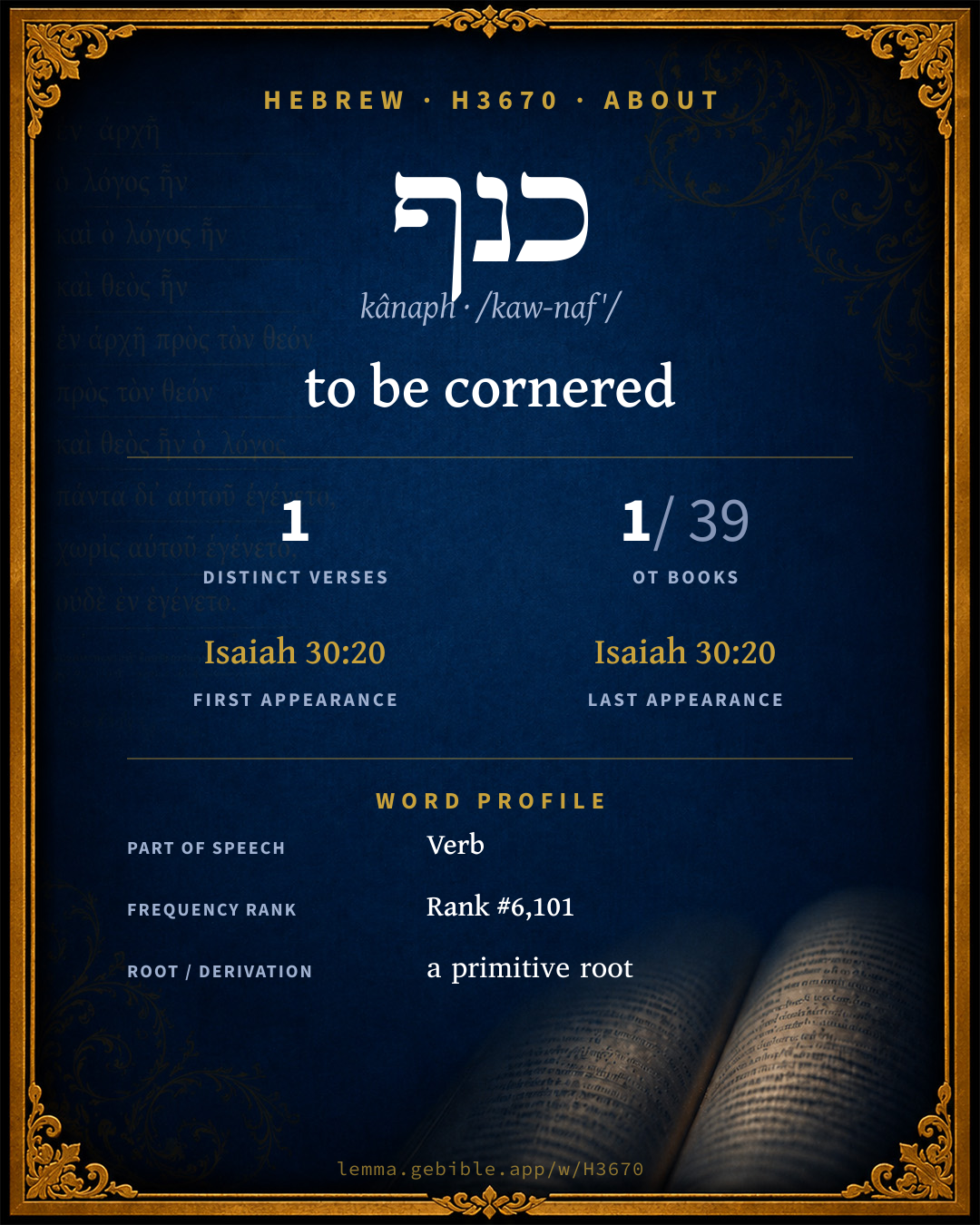
כָּנַף
to be cornered
Full lexicon entry — Brown-Driver-Briggs (BDB)
From Brown-Driver-Briggs (BDB)
Where this word appears
Grammar key — what these labels mean
Part of speech
- Verb
- An action or state-of-being word.
Stem
- Niphal
- Usually the simple passive or reflexive of the Qal (“he was written”).
Form
- Imperfect
- An incomplete, ongoing, or future action (“he will / would write”).
Person
- 3rd Person
- The one spoken about (“he / she / it / they”).
Gender
- Masculine
- Grammatically masculine.
Number
- Singular
- One.
Every verse where H3670 appears — 1 distinct verse across 1 book. Click any verse to open its interlinear word-by-word view. Verse text shown in the World English Bible for context — . Each verse’s Hebrew form is shown with its reference; the English is not keyword-highlighted, since the data carries no word-level English alignment. Use “Compare translations” on any verse to read it across multiple English versions. This concordance covers the Hebrew Bible; Septuagint (Greek Old Testament) occurrences are not indexed here.
Isaiah 1 verse
About this entry
At a glance — auto-summarized from this page’s data, not written by a person. Every figure links to its source below. This summary describes the numbers; it doesn’t interpret them.
The Hebrew verb כנף centers on the idea of “to be cornered.” It occurs a mere 1 verse across Scripture. The word gravitates to Isaiah (100%). Found nowhere else but Isaiah 30:20. It shares a root with כנף. For the data behind this summary, explore the sense tree and the renderings breakdown below.
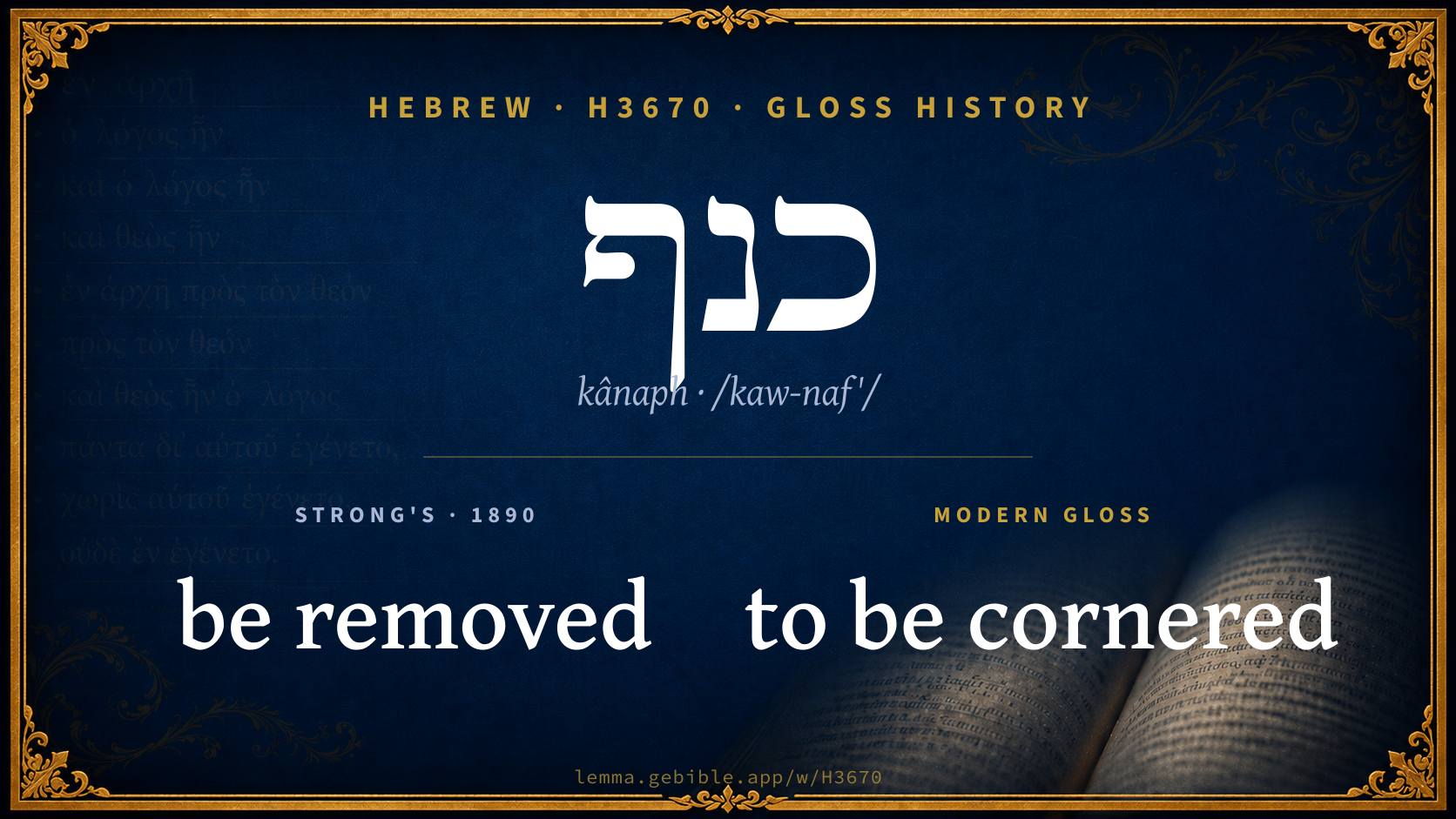
Gloss history
Strong's 1890 vs modern scholarship
About this word
Strong's H3670 catalogs a Hebrew word from the Hebrew Old Testament.
These counts are not copied from any lexicon or concordance. They are computed here, from the morphology-tagged Hebrew Old Testament. What Lemma adds →
- 1
- distinct verses
- The word appears in 1 distinct verse.
- 1 / 39
- OT books
- The word appears in 1 of 39 Old Testament books.
- #6,101
- by frequency
- Rank #6,101 (rank 6,101 of 8,640 Hebrew words by occurrence).
View all 1 occurrence in the concordance →
Most concentrated in
- Isaiah 1 verse 100%
By section of the Old Testament
By traditional corpus
Conventional, traditional groupings — biblical authorship is debated, so this is a traditional corpus grouping, not an authorship claim. Each share is this word’s portion of its verses in that division of the Hebrew canon. Each figure is a share of the word’s 1 distinct verse.
- Prophets (Nevi'im) 1 verse · 100%
How translations render this word
Counts come from each version’s own published word-to-Strong’s tagging or interlinear alignment — an approximate guide to how each version renders this word, not a word-level alignment the data otherwise carries. Because each total is that version’s own tagged count, the per-version totals vary from one another and need not match the appearance or distinct-verse counts above. These counts may also differ from a printed concordance because Lemma counts each distinctly tagged rendering and does not collapse phrase taggings into a single head-word total. This is a fixed set of word-tagged versions (KJV, ASV, BSB, ULT) and does not change with the reading translation you choose elsewhere. Each version’s license is shown beside its name below (and on Sources).
- King James Version: Be removed into a corner 1×
- American Standard Version: Be hidden 1×
- Berean Standard Bible: Hide 1×
- unfoldingWord Literal Text: Hide himself 1×, Will 1×
King James Version Public Domain
Renders H3670 across 1 tagged occurrence — most commonly:
American Standard Version Public Domain
Renders H3670 across 1 tagged occurrence — most commonly:
Berean Standard Bible Public Domain
Renders H3670 across 1 tagged occurrence — most commonly:
unfoldingWord Literal Text CC BY-SA 4.0
Renders H3670 across 2 tagged occurrences — most commonly:
Senses in BDB
The 1 sense BDB distinguishes for this word, in lexicon order (not ranked by frequency or importance). The full entry — with sub-senses — is in the Lexicon Entry tab.
- (Niphal) to be put or thrust in or into a corner, be hidden from view, be cornered, be thrust aside
Word origin
כָּנַף vb. denom. only Niph. be cornered, thrust into a corner or aside;— Is 30:20
— Brown-Driver-Briggs (Oxford 1906, public domain), digitized via Sefaria, supplemented by the OpenScriptures HebrewLexicon (CC BY 4.0). See Sources.
Origin: a primitive root
Jastrow Dictionary
A second Hebrew/Aramaic lexicon for comparison, covering Aramaic and post-biblical (Talmudic, Targumic, Midrashic) usage that the biblical-Hebrew BDB does not. Matched by lemma rather than by Strong’s number, so a lemma may carry more than one Jastrow headword (shown separately below), and the entries cover usage well beyond the Bible.
כָּנַף
- (b. h.) to bend; to cover.
- to be covered, hidden. Pesik. Zachor, p. 29ᵃ, a. e., v. כָּנָף.
כְּנַף I
- , to press, crowd; to gather. Targ. Ps. XLI, 7 (v. כְּנַס).—Taan. 23ᵇ ניתי לִיכְנוֹף גבי הדדי Ms. M. (ed. נִיכְּנִיף הדדי) let us go and crowd together (for prayer). Ab. Zar. 19ᵇ כָּנוּף ואתי וכ׳ all the world crowded about him.—Part. pass. כְּנִיף. Snh. 29ᵇ כְּנִיפֵי ויתבי if they (before whom he made the admission, v. אוֹדִיתָא) were assembled (for some other business), opp. to כּנּפִינְהוּ איהו if he himself called them to a meeting.
- 1. to collect, grab (corresp. to גָּבַב). Sabb. 73ᵇ האי מאן דכ׳ וכ׳ he who grabs (skims with his palm) salt out of the salina. Bets. 33ᵇ מחזי כמאן דמְכַנֵּיף וכ׳ Ms. M. (ed. מכניא, corr. acc.) it looks as though he raked together for the next day.
- 2. to assemble, call a meeting. Targ. Y. I Deut. I, 1.—Snh. l. c., v. supra. B. Kam. 113ᵃ לדידכו כַּנְּפִינְהוּ Ms. M. (ed. v. כְּנוּפְיָא) have we assembled them for your individual benefit?—Part. pass. מְכַנַּף. Ber. 58ᵇ כמאה … דמְכַנְּפֵי like one hundred stars … collected in one spot, opp. מבדרי. Gitt. 20ᵃ, v. infra.
- 3. (corresp. to קָפַל) to fold, crease. Sabb. 147ᵃ אדעתא דלכַנּוּפֵי with the intention of creasing.
- 1. to be assembled, to meet, join. Targ. Cant. VIII, 7.—Taan. 23ᵇ, v. supra.
- 2. to be compressed. Gitt. 20ᵃ כַּנּוּפֵי מִכְּנִיף (ed. Rashi מְכַנַּף), v. חֲרַץ.
כָּנָף
- (mostly) m.(b. h.; [bend,]
- 1. wing, wing-feather. Kel. XVII, 14 כְּנַף העוז things made of feathers of the sea-eagle; a. e.—Du. כְּנָפַיִם, pl. כְּנָפִים, כַּנְפוֹת. Ib. Toh. I, 2. Ḥull. III, 4 נמרטו כנָפֶיהָ if the wing-feathers are plucked out, v. נוֹצָה. Ib. 7 כל שיש לו ארבע כ׳ … וכְנָפָיו וכ׳ … that (locust) which has four feet and four wings …, and whose wings cover the larger portion of its body (is clean); a. fr.
- 2. border, lap. Sifré Num. 115 מן הכ׳, v. גְּדִילָה II. Ib. מצות כ׳ the law concerning the borders of garments (Num. XV, 38).—Pl. as ab. Lev. R. s. 18; Koh. R. to XII, 3 (ref. to הראות ib.) אלו כַּנְפֵי הריאה those are the laps (extreme ends) of the lungs. Ḥull. 45ᵃ עד כנפי ריאה התחתונה to the borders of the lowest lung (of the animal suspended by its feet).—Euphem. for a woman’s lap (pudenda). Yeb. 4ᵃ; 49ᵃ (expl. Deut. XXIII, 1) כ׳ שראה אביו the lap which his father has seen, i.e. any woman with whom his father has had sexual connection. e.g. Numbers 15:38
- 3. cover. Pesik. Zakh., p. 29ᵃ; Pesik. R. s. 12; Tanḥ. Ki Thetsé 11 (ref. to יִכָּנֵף, Is. XXX, 20) … כל זמן כ׳ מכסה וכ׳ as long as the seed of Amalek survives, it is as if a cover hid the face (of Divinity) &c. e.g. Isaiah 30:20
- 4. (pl.) hands, arms; (of animals) shoulders, fore-legs. Pes. VII, 11 (84ᵃ) ראשי כ׳ the cartilaginous tops of the fore-legs. Y. Naz. VI, 55ᶜ bot. (ref. to Num. VI, 19) בין שיש לו כ׳ וכ׳ whether or not he has hands (to receive the offerings; Bab. Naz. 46ᵇ כַּפַּיִם). Tosef. Dem. II, 11 מקבלין לכ׳ we accept a ḥaber (v. חָבֵר), if he promises to observe levitical cleanness of hands; Bekh. 30ᵇ. Y. Dem. II, 23ᵃ top מקריבין לכ׳. Ib. כ׳ מדפות וכ׳ the laws concerning hands, &c., v. מִדָּף.—אלישע בעל כ׳ one Elisha, a ḥaber observing cleanness of hands. Y. Ber. I, 4ᶜ bot.; Sabb. 49ᵃ; 130ᵃ (legendary origin of the surname).—Lev. R. s. 32 בעל כ׳ the winged angel. e.g. Numbers 6:19
- 5. curved attachments, handles &c. Kel. XI, 6; Tosef. ib. B. Mets. I, 7, v. סִימְפּוֹנְיָא. Kel. XIV, 4 הכ׳ המקבלות וכ׳ the curves on the harness for holding the reins; ib. 5 כ׳ העשוים לנוי for ornament.—Trnsf. כנפי השכינה or כ׳ divine protection; תחת כ׳ הש׳ under the wings of divine Majesty, i.e. belief and faith in God, Jewish religion. Lev. R. s. 2 פושטין … להכניסו תחת כ׳ הש׳ we must reach out a hand to him (the proselyte) in order to take him in &c. Mekh. B’shall., Amalek, s. 2 לאבד … מתחת כְּנָפֶיךָ to lead thy people away from the faith in thee.—Ruth R. to II, 12; a. fr.
כְּנַף II
- 1. wing, lap. Targ. I Kings VI, 24; a. fr.—Targ. Zech. VIII, 23; a. fr.—B. Mets. 85ᵃ בכַנְפֵיה דרבו in the lap of Rabbi’s garment. Sabb. 5ᵃ פשיט כנפיה וכ׳ he spread the lap of his garment and received it. B. Bath. 12ᵇ בכנפיה דאבוה on her father’s lap. Ib. 58ᵃ בכַנְפָהּ דשרה in Sarah’s lap; a. fr.—[Euphem. Targ. Deut. XXIII, 1, v. preced.]—Trnsf. protection. Targ. II Esth. IX, 14.—Pl. כַּנְפִין, כַּנְפַיָּא, כַּנְפֵי. Ib. Targ. Ez. XVII, 3. Targ. O. Num. XV, 38; a. fr.—[כַּנְפָתָא, constr. כַּנְפָת. Targ. Y. II ib., emend. by Bxt., ed. צָנְפַת.]
- 2. בַּת כַּנְפָא name of an unclean bird. Targ. O. Deut. XIV, 13 (h. text הראה).
A Dictionary of the Targumim, the Talmud Babli and Yerushalmi, and the Midrashic Literature (Marcus Jastrow; London, Luzac, 1903) — Public Domain. Digitized via Sefaria. Digitized via Sefaria. Full attribution on Sources.
Same root — word family
Other BDB entries built from the same root as H3670, grouped by Strong’s listed origin. These share a root / origin per the lexicon — not necessarily a shared meaning. Each links to that word’s own entry.
Derived from this word
Compare all same-root words → They share a root, not necessarily a meaning.
Septuagint verse parallels
This word appears in 1 verse that also exists in the Greek Old Testament (Septuagint), out of the 1 Hebrew verse it occurs in. You can read those verses in Greek by switching the Old Testament edition to the Septuagint.
Read these verses in the Septuagint
This is a verse-level parallel only — the same verses exist in both the Hebrew and Greek Old Testaments. No word-level Hebrew↔Greek correspondence is claimed: the data carries no such alignment, so no Greek word is shown as this Hebrew word’s translation. Coverage is not total — the Septuagint omits the deuterocanon and renumbers the Psalms, so some Hebrew verses have no direct Greek parallel.