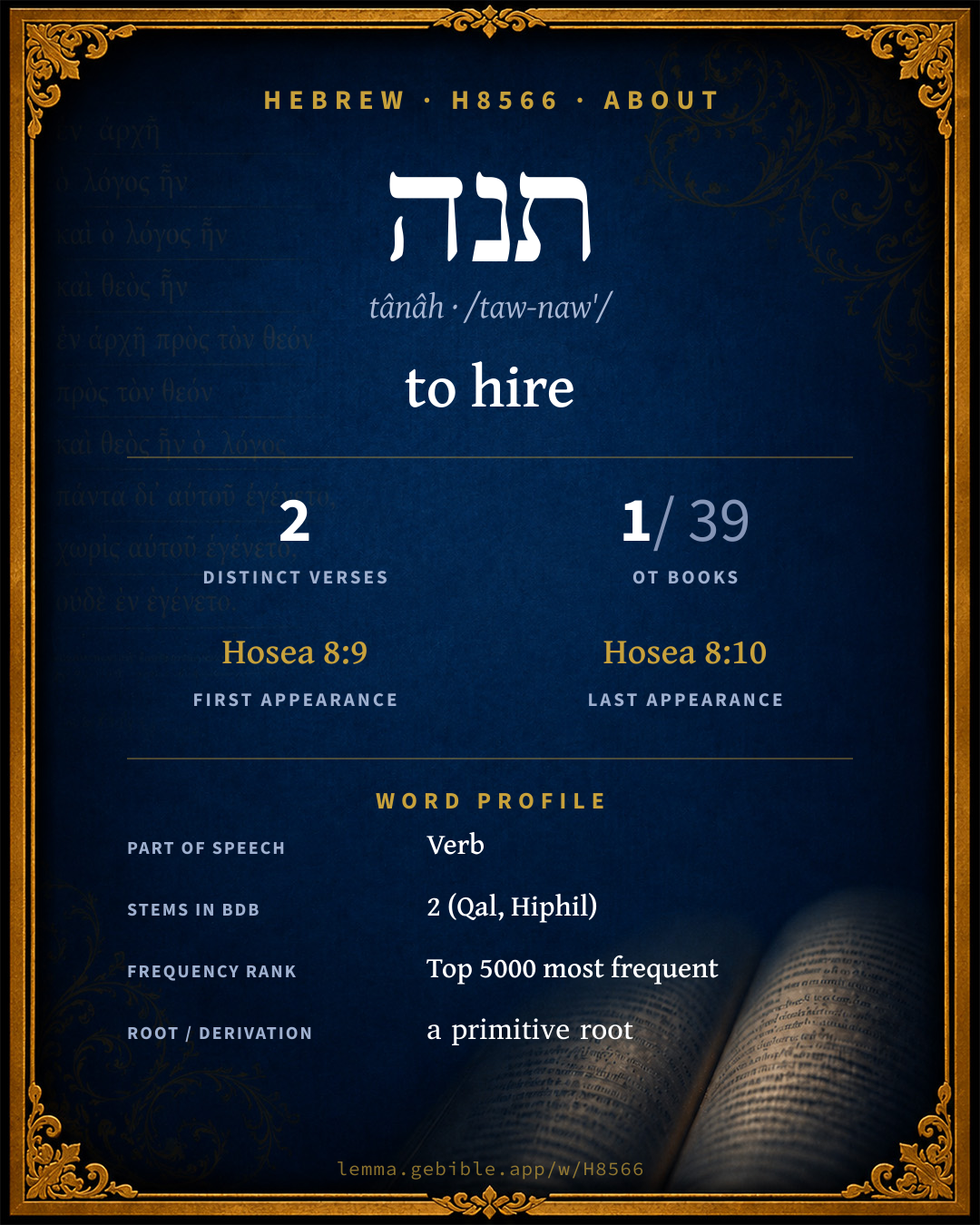
תָּנָה
to hire
‘to hire’ is one of 3 main senses fuller range ↓
Full lexicon entry — Brown-Driver-Briggs (BDB)
From Brown-Driver-Briggs (BDB)
Where this word appears
See every Hiphil verb in the Hebrew Bible →
Grammar key — what these labels mean
Part of speech
- Verb
- An action or state-of-being word.
Stem
- Hiphil
- The causative active stem (“he caused / brought about”).
- Qal
- The basic, simple active stem — the plain form of the verb (“he wrote”). Here: ‘hire’
Form
- Perfect
- A completed action or state — Hebrew marks aspect (completeness) more than strict tense (“he wrote”).
- Imperfect
- An incomplete, ongoing, or future action (“he will / would write”).
Person
- 3rd Person
- The one spoken about (“he / she / it / they”).
Gender
- Common
- Either gender — not distinguished for this form.
- Masculine
- Grammatically masculine.
Number
- Plural
- More than one (in Hebrew, generally three or more).
Grammatical forms
- Verb, Hiphil, Perfect, 3rd Person, Common, Plural 1 time (50%)
- Verb, Qal, Imperfect, 3rd Person, Masculine, Plural 1 time (50%)
Parsed forms decoded from the imported morphology (morphhb / Westminster Leningrad Codex — WLC text public domain, morphhb tagging CC BY 4.0), counted across 2 parsed occurrences — not distinct verses.
Every verse where H8566 appears — 2 distinct verses across 1 book. Click any verse to open its interlinear word-by-word view. Verse text shown in the World English Bible for context — . Each verse’s Hebrew form is shown with its reference; the English is not keyword-highlighted, since the data carries no word-level English alignment. Use “Compare translations” on any verse to read it across multiple English versions. This concordance covers the Hebrew Bible; Septuagint (Greek Old Testament) occurrences are not indexed here.
Hosea 2 verses
- Hosea 8:9 הִתְנ֥וּ Hiphil pf 3cp For they have gone up to Assyria, Like a wild donkey wandering alone. Ephraim has hired lovers for himself.
- Hosea 8:10 יִתְנ֥וּ Qal impf 3mp But although they sold themselves among the nations, I will now gather them; and they begin to waste away because of the oppression of the king of mighty ones.
About this entry
At a glance — auto-summarized from this page’s data, not written by a person. Every figure links to its source below. This summary describes the numbers; it doesn’t interpret them.
At its core, תנה (tânâh) means “to hire.” The Hebrew Bible uses it only 2 verses. The word gravitates to Hosea (100%). First canonically at Hosea 8:9, it enters the text early. Different stems carry different senses — BDB groups them under 2 stems, among them Qal and Hiphil. Each statement above links to its evidence; the full detail follows below.
Gloss history
Strong's 1890 vs modern scholarship
About this word
Strong's H8566 catalogs a Hebrew word from the Hebrew Old Testament.
These counts are not copied from any lexicon or concordance. They are computed here, from the morphology-tagged Hebrew Old Testament. What Lemma adds →
- 2
- distinct verses
- The word appears in 2 distinct verses.
- 1 / 39
- OT books
- The word appears in 1 of 39 Old Testament books.
- #4,807
- by frequency
- Top 5000 most frequent Hebrew words (rank 4,807 of 8,640 Hebrew words by occurrence).
View all 2 occurrences in the concordance →
Most concentrated in
- Hosea 2 verses 100%
By section of the Old Testament
By traditional corpus
Conventional, traditional groupings — biblical authorship is debated, so this is a traditional corpus grouping, not an authorship claim. Each share is this word’s portion of its verses in that division of the Hebrew canon. Each figure is a share of the word’s 2 distinct verses.
- Prophets (Nevi'im) 2 verses · 100%
How translations render this word
Counts come from each version’s own published word-to-Strong’s tagging or interlinear alignment — an approximate guide to how each version renders this word, not a word-level alignment the data otherwise carries. Because each total is that version’s own tagged count, the per-version totals vary from one another and need not match the appearance or distinct-verse counts above. These counts may also differ from a printed concordance because Lemma counts each distinctly tagged rendering and does not collapse phrase taggings into a single head-word total. This is a fixed set of word-tagged versions (KJV, ASV, BSB, ULT) and does not change with the reading translation you choose elsewhere. Each version’s license is shown beside its name below (and on Sources).
- King James Version: Hath hired 1×, Yea though they have hired 1×
- American Standard Version: Ephraim hath hired 1×, Yea 1×
- Berean Standard Bible: Has hired 1×, They hire allies 1×
- unfoldingWord Literal Text: Has hired 1×, They hire 1×
King James Version Public Domain
Renders H8566 across 2 tagged occurrences — most commonly:
American Standard Version Public Domain
Renders H8566 across 2 tagged occurrences — most commonly:
Berean Standard Bible Public Domain
Renders H8566 across 2 tagged occurrences — most commonly:
unfoldingWord Literal Text CC BY-SA 4.0
Renders H8566 across 2 tagged occurrences — most commonly:
Senses in the full BDB
Hebrew verbs can shift meaning by stem (binyan): Qal is the basic action, Niphal is often passive or reflexive, Piel often intensifies or makes it factitive, and Hiphil is typically causative. The senses below are grouped under the stem BDB assigns to each.
What do BDB’s symbols mean?
BDB uses these scholarly abbreviations:
| Symbol | Meaning |
|---|---|
| 𝔊 | the Septuagint (the ancient Greek translation, LXX) |
| 𝔙 | the Vulgate (the Latin translation) |
| 𝔖 | the Syriac version (the Peshitta) |
| 𝔗 | the Targum (the Aramaic translation) |
| ψ | the Psalms |
| √ | root (the underlying root or stem) |
| ‖ | parallel passage (a synonymous or contrasted parallel) |
| † | the dagger: every passage where the word occurs is cited |
The 2 senses and sub-senses the full Brown-Driver-Briggs lexicon distinguishes for this word, in lexicon order (not ranked by frequency), with BDB’s own verbatim wording and sub-sense lettering. Shown in Hebrew script with BDB’s own scholarly abbreviations. The condensed entry is in the Lexicon Entry tab. See also the Forms in the corpus table below.
Qal
- hire
Hiphil
- . have hired
Senses from the full Brown-Driver-Briggs lexicon (Brown, Driver, Briggs; Oxford 1906 — public domain), digitized via Sefaria, supplemented by the OpenScriptures HebrewLexicon (CC BY 4.0). Full attribution on Sources.
Word origin
Origin: a primitive root
Jastrow Dictionary
A second Hebrew/Aramaic lexicon for comparison, covering Aramaic and post-biblical (Talmudic, Targumic, Midrashic) usage that the biblical-Hebrew BDB does not. Matched by lemma rather than by Strong’s number, so a lemma may carry more than one Jastrow headword (shown separately below), and the entries cover usage well beyond the Bible.
תָּנָה
- , v. תני
תני
- v. שָׁנָה) [to repeat,] to tell.
- same. Gen. R. s. 6 (ref. to Ps. L, 6) לעתיד … שמים מְתַנִּים וכ׳ in the future the heavens shall tell the righteousness which the Lord does to his world. Yalk. Jer. 277 והיה מְתַנֶּה נסים וכ׳ and he told the wonders that happened to him &c.; (Ber. 13ᵃ מספר). Midr. Till. to Ps. CXVIII, 14 לא לי לתַנּוֹת כל וכ׳ is it not my duty to tell all the wonders &c.?; a. e. e.g. Psalms 50:6
- to stipulate, agree, make a condition. B. Bath. 8ᵇ רשאין … להַתְנוֹת על וכ׳ the residents of a town have a right to stipulate measures, prices of food, and wages of laborers. Keth. IX, 1 שה׳ על מה שכתוב וכ׳ because he made an agreement contrary to what is written in the Law; וכל המַתְנֶה על וכ׳, v. תְּנַאי. Erub. III, 5 מתנה אדם על ערובו וכ׳ a man may lay his ‘Erub (v. עֵירוּב) on condition and say, if gentiles come &c. Ib. 36ᵇ אין אדם מתנה על … כאחד no man can lay down conditions for two alternatives together (so as to reserve to himself the choice in the event of both alternatives coming to pass); a. fr.—Part. pass. מוּתְנֶה; pl. מוּתְנִים; מוּתְנִין. Y. Keth. X, end, 34ᵃ; Y. B. Kam. IV, 4ᵇ top שוורים כמ׳ הן in the case of oxen (of several owners, consecutively gored by the same ox) it is as if an agreement had been made beforehand.
A Dictionary of the Targumim, the Talmud Babli and Yerushalmi, and the Midrashic Literature (Marcus Jastrow; London, Luzac, 1903) — Public Domain. Digitized via Sefaria. Digitized via Sefaria. Full attribution on Sources.
Forms in the corpus
The 2 distinct written forms H8566 takes in the Hebrew Bible, most frequent first — each parse links to that stem’s occurrences in the concordance. Hebrew forms include their vowel points and cantillation, so a single lemma takes many written forms.
| Form | Parsing | Example | Uses |
|---|---|---|---|
| הִתְנ֥וּ | Verb, Hiphil, Perfect, 3rd Person, Common, Plural | Hosea 8:9 | 1 |
| יִתְנ֥וּ | Verb, Qal, Imperfect, 3rd Person, Masculine, Plural | Hosea 8:10 | 1 |
Same root — word family
Other BDB entries built from the same root as H8566, grouped by Strong’s listed origin. These share a root / origin per the lexicon — not necessarily a shared meaning. Each links to that word’s own entry.
Derived from this word
Compare all same-root words → They share a root, not necessarily a meaning.
Septuagint verse parallels
This word appears in 2 verses that also exist in the Greek Old Testament (Septuagint), out of the 2 Hebrew verses it occurs in. You can read those verses in Greek by switching the Old Testament edition to the Septuagint.
Read these verses in the Septuagint
This is a verse-level parallel only — the same verses exist in both the Hebrew and Greek Old Testaments. No word-level Hebrew↔Greek correspondence is claimed: the data carries no such alignment, so no Greek word is shown as this Hebrew word’s translation. Coverage is not total — the Septuagint omits the deuterocanon and renumbers the Psalms, so some Hebrew verses have no direct Greek parallel.