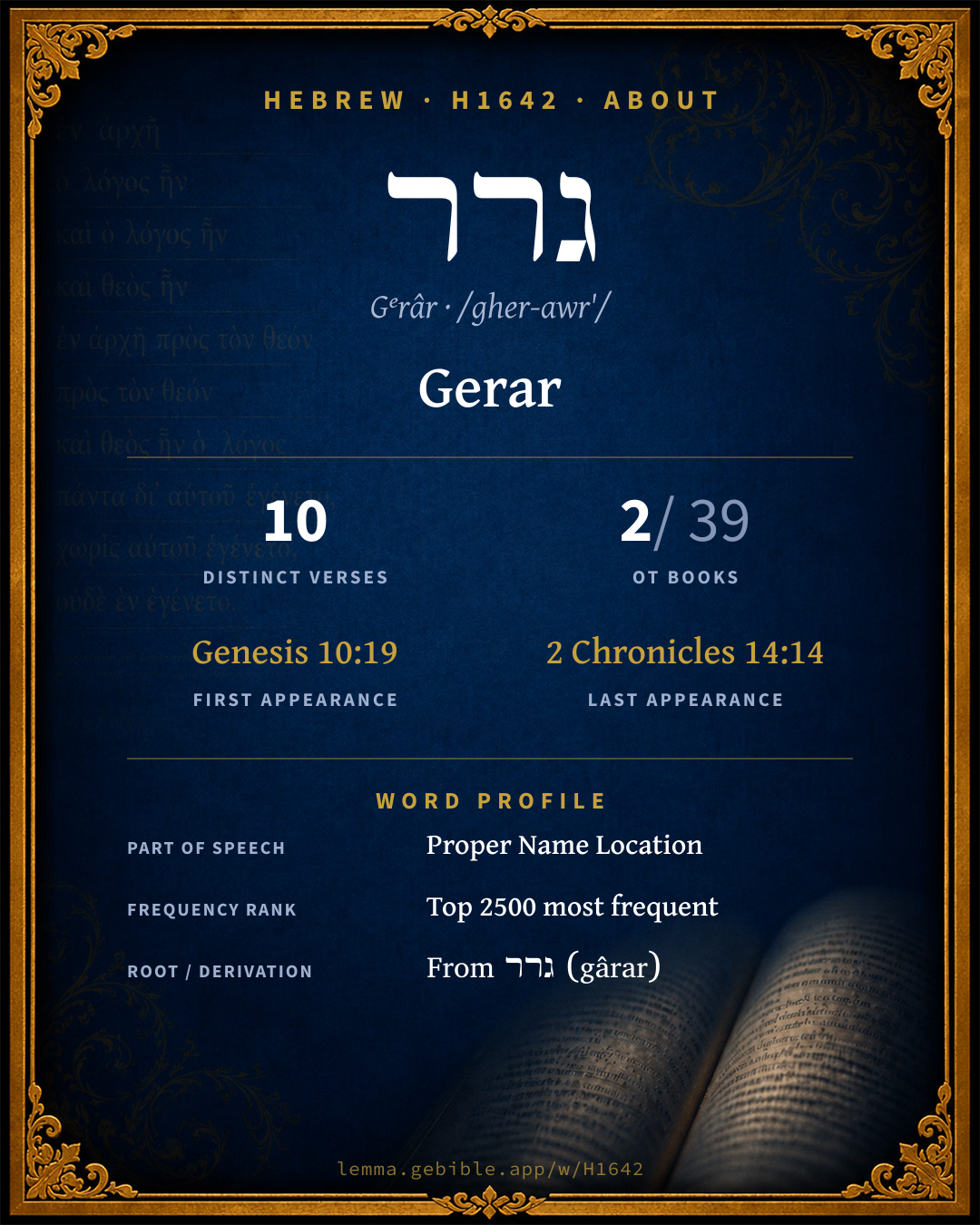
גְּרָר
Gerar
BDB lists 2 entries for ‘Gerar’ fuller range ↓
Full lexicon entry — Brown-Driver-Briggs (BDB)
From Brown-Driver-Briggs (BDB)
Where this word appears
Grammar key — what these labels mean
Part of speech
- Noun
- A naming word — a person, place, thing, or idea.
Noun type
- Proper
- A name of a specific person, place, or people (e.g. Abraham, Zion, Israel).
Every verse where H1642 appears — 10 distinct verses across 2 books. Click any verse to open its interlinear word-by-word view. Verse text shown in the World English Bible for context — . Each verse’s Hebrew form is shown with its reference; the English is not keyword-highlighted, since the data carries no word-level English alignment. Use “Compare translations” on any verse to read it across multiple English versions. This concordance covers the Hebrew Bible; Septuagint (Greek Old Testament) occurrences are not indexed here.
Genesis 8 verses
- Genesis 10:19 גְרָ֖רָ/ה n Proper + sfx dem The border of the Canaanites was from Sidon, as you go toward Gerar, to Gaza; as you go toward Sodom, Gomorrah, Admah, and Zeboiim, to Lasha.
- Genesis 20:1 בִּ/גְרָֽר prep + n Proper Abraham traveled from there toward the land of the South, and lived between Kadesh and Shur. He lived as a foriegner in Gerar.
- Genesis 20:2 גְּרָ֔ר n Proper Abraham said about Sarah his wife, "She is my sister." Abimelech king of Gerar sent, and took Sarah.
- Genesis 26:1 גְּרָֽרָ/ה n Proper + sfx dem There was a famine in the land, besides the first famine that was in the days of Abraham. Isaac went to Abimelech king of the Philistines, to Gerar.
- Genesis 26:6 בִּ/גְרָֽר prep + n Proper Isaac lived in Gerar.
- Genesis 26:17 גְּרָ֖ר n Proper Isaac departed from there, encamped in the valley of Gerar, and lived there.
- Genesis 26:20 גְרָ֗ר n Proper The herdsmen of Gerar argued with Isaac's herdsmen, saying, "The water is ours." He called the name of the well Esek, because they contended with him.
- Genesis 26:26 מִ/גְּרָ֑ר prep + n Proper Then Abimelech went to him from Gerar, and Ahuzzath his friend, and Phicol the captain of his host.
2 Chronicles 2 verses
- 2 Chronicles 14:13 לִ/גְרָר֒ prep + n Proper Asa and the people who were with him pursued them to Gerar: and there fell of the Ethiopians so many that they could not recover themselves; for they were destroyed before Yahweh, and before his host; and they carried away very much booty.
- 2 Chronicles 14:14 גְּרָ֔ר n Proper They struck all the cities round about Gerar; for the fear of Yahweh came on them: and they despoiled all the cities; for there was much spoil in them.
About this entry
At a glance — auto-summarized from this page’s data, not written by a person. Every figure links to its source below. This summary describes the numbers; it doesn’t interpret them.
“Gerar” is the headline sense of the Hebrew name גרר (Gᵉrâr). It clusters heavily in Genesis, which alone accounts for 80% of its uses. It turns up in 10 verses across 2 books, an uncommon footprint. First canonically at Genesis 10:19, it enters the text early. The sections below give every occurrence and version rendering.
Gloss history
Strong's 1890 vs modern scholarship
About this word
Strong's H1642 catalogs a Hebrew word from the Hebrew Old Testament.
These counts are not copied from any lexicon or concordance. They are computed here, from the morphology-tagged Hebrew Old Testament. What Lemma adds →
- 10
- distinct verses
- The word appears in 10 distinct verses.
- 2 / 39
- OT books
- The word appears in 2 of 39 Old Testament books.
- #2,342
- by frequency
- Top 2500 most frequent Hebrew words (rank 2,342 of 8,640 Hebrew words by occurrence).
View all 10 occurrences in the concordance →
Most concentrated in
- Genesis 8 verses 80%
- 2 Chronicles 2 verses 20%
By section of the Old Testament
By traditional corpus
Conventional, traditional groupings — biblical authorship is debated, so this is a traditional corpus grouping, not an authorship claim. Each share is this word’s portion of its verses in that division of the Hebrew canon. Each figure is a share of the word’s 10 distinct verses.
- Torah (Pentateuch) 8 verses · 80%
- Writings (Ketuvim) 2 verses · 20%
How translations render this word
Counts come from each version’s own published word-to-Strong’s tagging or interlinear alignment — an approximate guide to how each version renders this word, not a word-level alignment the data otherwise carries. Because each total is that version’s own tagged count, the per-version totals vary from one another and need not match the appearance or distinct-verse counts above. These counts may also differ from a printed concordance because Lemma counts each distinctly tagged rendering and does not collapse phrase taggings into a single head-word total. This is a fixed set of word-tagged versions (KJV, ASV, BSB, ULT) and does not change with the reading translation you choose elsewhere. Each version’s license is shown beside its name below (and on Sources).
- King James Version: Gerar 10×
- American Standard Version: Gerar 9×
- Berean Standard Bible: Gerar 9×
- unfoldingWord Literal Text: Gerar 9×
King James Version Public Domain
Renders H1642 across 10 tagged occurrences — most commonly:
American Standard Version Public Domain
Renders H1642 across 10 tagged occurrences — most commonly:
Plus 1 rendering that appears only once — usually multi-word phrases or single function words the recovered tagging swept in, not distinct renderings.
Berean Standard Bible Public Domain
Renders H1642 across 10 tagged occurrences — most commonly:
Plus 1 rendering that appears only once — usually multi-word phrases or single function words the recovered tagging swept in, not distinct renderings.
unfoldingWord Literal Text CC BY-SA 4.0
Renders H1642 across 10 tagged occurrences — most commonly:
Plus 1 rendering that appears only once — usually multi-word phrases or single function words the recovered tagging swept in, not distinct renderings.
Senses in BDB
The 2 senses BDB distinguishes for this word, in lexicon order (not ranked by frequency or importance). The full entry — with sub-senses — is in the Lexicon Entry tab.
- Gerar = "a lodging place"
- a Philistine town south of Gaza, modern 'Umm'
Word origin
n.pr.loc. south of Gaza, usually identif. with mod. Umm Jerâr BdPal. 159 GuérinJudée ii. 257 ff.; but Wady Jerūr W. of ʿAin Ḳadīs according to Trumbull Kadesh Barnea 61 ff. cf. Guthe ZPV viii. 1885, 215; Gn 20:2; 26:6, 20, 26; 2 Ch 14:12, 13; גְּרָ֫רָה Gn 10:19; 26:1; נַ֫חַל גְּרָר Gn 26:17; וַיָּגָר בִּגְרָר Gn 20:1.
— Brown-Driver-Briggs (Oxford 1906, public domain), digitized via Sefaria, supplemented by the OpenScriptures HebrewLexicon (CC BY 4.0). See Sources.
Derived from גרר (gârar) (H1641) — to drag away.
Jastrow Dictionary
A second Hebrew/Aramaic lexicon for comparison, covering Aramaic and post-biblical (Talmudic, Targumic, Midrashic) usage that the biblical-Hebrew BDB does not. Matched by lemma rather than by Strong’s number, so a lemma may carry more than one Jastrow headword (shown separately below), and the entries cover usage well beyond the Bible.
גָּרַר I
- v. גָּרָה) [to produce a grating, scraping sound,]
- 1. to scratch, scrape, shave (v. גָּרַד, גָּרַע I). Sabb. VIII, 6 (81ᵃ) כדי לִגְרוֹר וכ׳ (Ar. a. Y. ed. לגרוד) large enough to scrape with it the top &c. R. Hash. 27ᵇ גְּרָרוֹ Ms. M. (ed. גרדו), v. גֶּלֶד. Keth. 60ᵃ; Kerith. 21ᵇ גֹּורְרוֹ וכ׳ he must scrape the blood off before eating the bread; a. fr.—Part. pass. גָּרוּר, v. גָּרוּד.
- 2. to drag, to move without lifting;(also neut. verb) to follow. Sabb. 29ᵇ, a. fr. גורר אדם וכ׳ one may, on the Sabbath, pull or push a couch &c. (on the floor). Y. Kil. I, 27ᵇ bot. לא יָגוֹר אדם וכ׳ one must not pull &c. Tanḥ. Thazr. 8 גְּרָרוּהוּ מקברו they dragged him out of his grave. Tosef. Erub. XI (VIII), 13; Tosef. Bets. II, 19 דלת הגֹּורֶרֶת … הגֹּורְרִים (Y. Erub. X, 26ᵇ bot. גודרת, corr. acc., v. גָּדַר) a door which drags along the ground (on opening), a matting which is moved by dragging, or large kegs which &c.; Erub. 101ᵃ דלת הנִגְרֶרֶת … הנִגְרָר. Cant. R. to II, 15 אני גוֹרְרוֹ למבולו I will drag him to the flood in which to perish; a. fr.—Tanḥ. Thazr. 9 (ref. to Ps. V, 5 יגרך) אין אתה נגרר … ואין הרעה גוֹרֶרֶת אותך וכ׳ neither art thou dragged behind (attracted by) evil, nor does evil drag (have power over) thee, nor does it dwell with thee; Yalk. Kings 231 אין אתה גורר אחר … גוררת אחריך.—Part. pass. גָּרוּר dragged along, hanging on.—Pl. גְּרוּרִים, גְּרוּרִין. Num. R. s. 18 ח׳ ג׳ eight threads dragged along (as fringes; Tanḥ. Korah 12 ח׳ חוטין). Ab. Zar. 3ᵇ, a. e. גרים ג׳ proselytes who have attached themselves but have not been admitted, v. גֵּר. e.g. Psalms 5:5
- 3. to carry with it, to cause; to affect (v. גָּרַם). Y. Hor. I, 46ᵃ bot.; Y. Pes. VII, 34ᶜ שבט אחד גֹּורֵר וכ׳ (a majority of) one tribe affects the legal status of the entire nation, i.e. the majority of tribes (seven) decides, though it may be a minority of the people as a whole. Lev. R. s. 13, end (play on gerah, Lev. XI, 4 sq.) גָּרְרָה מלכות וכ׳ carried another government after it, i.e. was followed by another oppressive government. Ab. IV, 2 מצוה גוֹרֶרֶת וכ׳ a good deed begets a good deed &c. Tosef. Sabb. XV (XVI), 6 [read:] אין גֹּורֵר וכ׳ it is not considered a corpse so as to cause uncleanness to man or vessels. e.g. Leviticus 11:4
- 4. to saw, split. Sabb. XVII, 2 (122ᵇ) a saw (may be used on the Sabbath) לָגוֹר בה וכ׳ (Ms. M. לִגְרוֹר, Mish. ed. Pes. לגָרֵר, v. Rabb. D. S. a. l. note) to saw cheese with it. Ohol. XV, 8 עתיד לָגוֹר Ar. intended to be sawed apart (ed. לגוד, fr. גדד, v. Tosef. ib. XV, 8). Tosef. Kel. B. Mets. II, 18 לָגוֹר וכ׳ to saw off a part &c.
- 1. to be dragged, pulled. Erub. X, 11 נגר הנג׳ a bolt which is dragged along (with the door, i.e. attached and hanging down). Ib. 101ᵃ, v. supra. Tanḥ. Thazr. 9, v. supra. Bets. II, 10 (23ᵇ) אינה נִגְרֶרֶת; Bets. אין נִגְרָרִין must not be dragged or pulled, a. fr.
- 2. to be scraped, planed. B. Kam. 119ᵇ הנ׳ במגירה shavings, opp. נפסק במגירה chips.—Nidd. 55ᵇ נִגְרָרִין דרך הפה (secretions of the nose) scraped (discharged) through the mouth (v. גָּרַף).
- 1. to drag. Pes. IV, 9 (56ᵃ) ג׳ עצמות וכ׳ he had the bones of his father carried out on a bed of ropes. Pes. I, 2 (9ᵃ); a. fr.—Tosef. Sabb. VI (VII), 1 (a superstitious custom) המְגָרֶרֶת בנה וכ׳ Var. (ed. Zuck. המגוררת) one who drags her son among the dead (to the cemetery).
- 2. to scrape, plane. Ib. XVI (XVII), 19 מְגָרְרָן he may scrape them (clean his feet of mud). Tosef. Kel. B. Mets. II, 17; Ḥull. 25ᵃ עתיד … לגָרֵר requiring planing for finish; a. fr.—Part. pass. מְגוֹרָר a) scratched, full of scabs. Gen. R. s. 64 (play on מגרר, Gen. XXVI, 26) ד"א מג׳ וכ׳ another explanation is m’gorar, for eruptions grew on him (with ref. to Job II, 8); Yalk. ib. 111; v. גָּרַר II. b) planed. Tosef. Sot. XV, 1 מְגוֹרָרוֹת במגר׳ היו Var. (ed. Zuck. היה מְגָרֵר) the stones were planed with a plane. e.g. Genesis 26:26
- to be scraped. Tosef. Sabb. XVI (XVII), 19 אין מִתְגָּרְרִין במגוררת ed. Zuck. (Var. מגרדין במגרדת, Sabb. 147ᵇ גוררין במגררת, Ms. M. גודרין במגדירה, corr. acc.) one must not be scraped with a strigil. Ib. XXII, 6 (147ᵃ) מתגררין, Talm. ed. (Mish. מִתְגָּרְדִין, v. Rabb. D. S. to 147ᵇ, note 70).
גְּרַר
- 1. to drag, pull, push.—Part. pass. גְּרִיר dragged, following, guided by. Targ. Y. II, Ex. XIV, 25 גְּרֵירַן וכ׳ (some ed. גריד׳) pushed from behind.—B. Kam. 18ᵇ בתר גופיה גְּרִירִין they are clinging to his body. Taan. 24ᵃ אנן בתרייהו גרירין Rashi (ed. גררינן, read גְּרִירִינָן, Ms. M. קאזלינן) we must be guided by their order. Ab. Zar. 72ᵇ all the wine in the barrel אגישתא … ג׳ moves towards the siphon. B. Mets. 85ᵃ דג׳ עלמא וכ׳ that all the world followed David.
- 2. to scratch, scrape. Targ. Jud. VIII, 16, v. גְּרַד.—Ḥull. 83ᵇ ולִיגְרְרֵיה ונכסי (Ar. גרד) let him scrape off the blood and cover it. Ib. ונִגְרוֹר.—Part. גָּרֵיר Ib.
- 3. to rub, to whet the appetite. Ber. 35ᵇ כי היכי דנִגְרְרֵיה לליביה (Ar. everywhere גרד) in order to stimulate his appetite. Ib. טובא גָרֵיר a large quantity has an appetizing effect. Pes. 107ᵇ מִגְרַר גָּרֵיר. Sabb. 140ᵇ משום דג׳ because it stimulates the appetite.
- to make appetizing. Esth. R. to I, 9 [read:] אנא מְגָרֵיר וכ׳ I will make their drinks appetizing (induce them to get intoxicated, interpreting Jer. LI, 39; differ. in comment.).—2) to saw off. Targ. Y. Deut. XXXIII, 20 דמְגָרֵר וכ׳ (or דמַגְרַר Af., ed. דמִגְרַר, corr. acc.) for he cuts off the arm &c. (II מַפְרַק). e.g. Jeremiah 51:39
- 1. to be dragged. Y. Kidd. I, 60ᵈ large bags דארחיהון מִתְגָּרְרָה which are commonly dragged (not lifted).
- 2. to stimulate, instigate one another. Targ. Ps. XXII, 8 מִתְגָּרְרִין (some ed. מִתְגָּרְדִין, ed. Lag. מִתְגָּרִין, fr. גרי; h. text יפטירו).
*גָּרַר II
- (fr. a Polel of גּוּר; cmp. גָּלַל) to roll; cmp. גַּרְגַּר.—Part. pass. מְגוֹרָר whirled, reeling. Gen. R. s. 64 (play on מגרר, Gen. XXVI, 26) מג׳ … שנכנסו וכ׳ reeling (after a night revel) &c.; v. גָּרַר I. e.g. Genesis 26:26
- , Hithpol. הִתְגּוֹרֵר (v. Jer. XXX, 23, cmp. XXIII, 19) to roll one’s self, esp. (cmp. חָבַט II, חָנַן, נָפַל Hithpa.) to lie in contrition, asking forgiveness. Mekh. B’shall., Vayassa 1, [read as in] Yalk. Ex. 256 (ref. to וישלך אל המים, Ex. XV, 25, as if meaning, ‘and he caused them to throw themselves down in contrition over their sin by the sea-side’). היו ישראל מתחננים ומִתְגָּרְרִים … כבן שהוא מתחנן לפני אביו וכתלמיד שמִתְגּוֹרֵר לפני רבו כך היו ישראל מתחננין ומִתְגּוֹרְרִין וכ׳ the Israelites prayed beseechingly and rolled themselves in contrition before &c. e.g. Jeremiah 30:23
גֶּרֶר
- , v. גֶּרֶד
A Dictionary of the Targumim, the Talmud Babli and Yerushalmi, and the Midrashic Literature (Marcus Jastrow; London, Luzac, 1903) — Public Domain. Digitized via Sefaria. Digitized via Sefaria. Full attribution on Sources.
Forms in the corpus
The 8 distinct written forms H1642 takes in the Hebrew Bible, most frequent first — each parse links to that state’s occurrences in the concordance. Hebrew forms include their vowel points and cantillation, so a single lemma takes many written forms.
| Form | Parsing | Example | Uses |
|---|---|---|---|
| בִּ/גְרָֽר | Noun, Proper | Genesis 20:1 | 2 |
| גְּרָ֔ר | Noun, Proper | Genesis 20:2 | 2 |
| גְרָ֖רָ/ה | Noun, Proper | Genesis 10:19 | 1 |
| גְרָ֗ר | Noun, Proper | Genesis 26:20 | 1 |
| גְּרָ֖ר | Noun, Proper | Genesis 26:17 | 1 |
| גְּרָֽרָ/ה | Noun, Proper | Genesis 26:1 | 1 |
| לִ/גְרָר֒ | Noun, Proper | 2 Chronicles 14:13 | 1 |
| מִ/גְּרָ֑ר | Noun, Proper | Genesis 26:26 | 1 |
Same root — word family
Other BDB entries built from the same root as H1642, grouped by Strong’s listed origin. These share a root / origin per the lexicon — not necessarily a shared meaning. Each links to that word’s own entry.
Derives from
Shares the same root
- גרגר gargar H1620 berry
- גרגרות gargᵉrôwth H1621 neck
- גרה gêrâh H1625 cud
- גרה gêrâh H1626 gerah
- גרון gârôwn H1627 throat
- מגרה mᵉgêrâh H4050 saw
Compare all same-root words → Showing 4 of 8 — not the complete family. They share a root, not necessarily a meaning.
Bible dictionary
Public-domain dictionary articles matched to this entry by name (Gerar). A biblical name can be shared by more than one person or place, so an article may treat several.
Easton's Bible Dictionary · M. G. Easton, 1897
A region; lodging-place, a very ancient town and district in the south border of Palestine, which was ruled over by a king named Abimelech (Gen. 10:19; 20:1, 2). Abraham sojourned here, and perhaps Isaac was born in this place. Both of these patriarchs were guilty of the sin of here denying their wives, and both of them entered into a treaty with the king before they departed to Beersheba (21:23-34; 26). It seems to have been a rich pastoral country (2 Chr. 14:12-18). Isaac here reaped an hundred-fold, and was blessed of God (Gen. 26:12). The "valley of Gerar" (Gen. 26:17) was probably the modern Wady el-Jerdr.
Smith's Bible Dictionary · William Smith, 1863
(a lodging-place), a very ancient city south of Gaza. It occurs chiefly in Genesis, (Genesis 10:19; 20:1; 26:17) also incidentally in (2 Chronicles 14:13,14) It must have trenched on the "south" or "south country" of later Palestine. From a comparison of (Genesis 21:32) with Genesis26:23,26 Beersheba would seem to be just on the verge of this territory, and perhaps to be its limit towards the northeast.
Hitchcock's Bible Names Dictionary · Roswell D. Hitchcock, 1869
same as Gera
Classic public-domain reference works; full attribution on Sources.
Septuagint verse parallels
This word appears in 10 verses that also exist in the Greek Old Testament (Septuagint), out of the 10 Hebrew verses it occurs in. You can read those verses in Greek by switching the Old Testament edition to the Septuagint.
Read these verses in the Septuagint
This is a verse-level parallel only — the same verses exist in both the Hebrew and Greek Old Testaments. No word-level Hebrew↔Greek correspondence is claimed: the data carries no such alignment, so no Greek word is shown as this Hebrew word’s translation. Coverage is not total — the Septuagint omits the deuterocanon and renumbers the Psalms, so some Hebrew verses have no direct Greek parallel.