
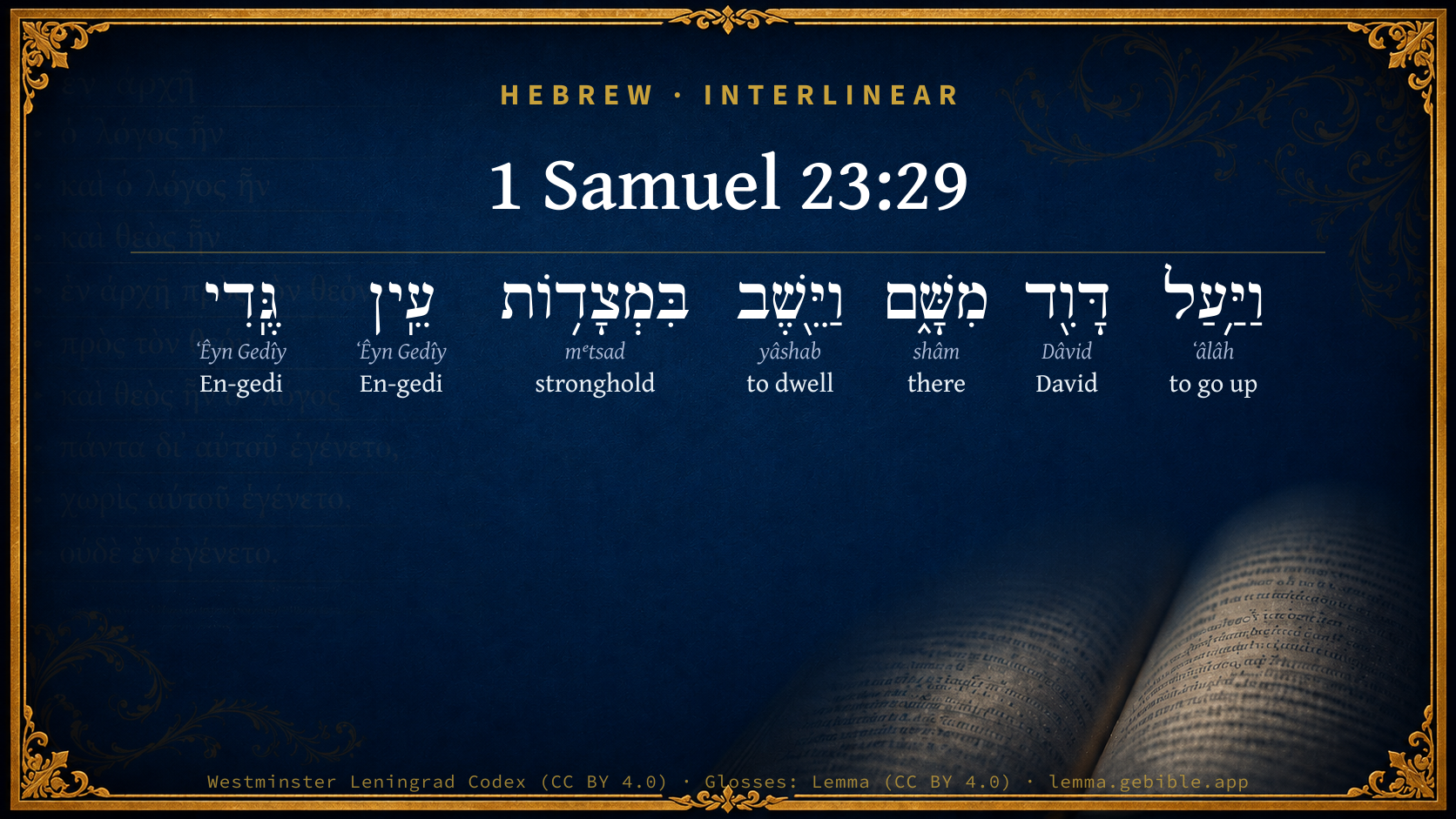
1 Samuel 23:29

Hebrew (Westminster Leningrad Codex) 1 Samuel 23:29 appears in the Hebrew Old Testament. The text above is from the Westminster Leningrad Codex. Each word links to its Strong’s number, a concise gloss, and parsing drawn from the Open Scriptures Hebrew Bible morphology. Click any word for its full Brown-Driver-Briggs (BDB) entry.
Download image
Cite this verse

1 Samuel 23:29 (World English Bible). Public Domain. Lemma interlinear Bible study tool, https://lemma.gebible.app/v/1-samuel/23/29.

Show BibTeX & RIS
BibTeX
RIS
English Translation
David went up from there, and lived in the strongholds of En Gedi.
World English Bible · Public Domain
Download a study sheet

One document with this verse’s original text, its word-by-word gloss line, the meaning frame, cross-references with their text, attributed commentary, and full source and license credits — printable, and it pastes into notes with its structure intact.

This verse Autodidact and up

Study sheet (.html) Plain text (.txt)

A passage Seminary Student

Up to 50 verses in one chapter. A passage sheet keeps up to 6 commentary sources and 12 cross-references per verse, in the order this page ranks them, and says so on the sheet whenever that leaves anything out. Ask for a single verse and you get the Autodidact verse sheet above.

Everything on this page stays free to read, with no account — the sheet is a download of what is already on screen, not access to it.

Want to remove ads? Support Godless Engineer
Compare translations 3

The same verse in 3 English versions, stacked beneath the original-language interlinear above. Click any original word for its lexicon entry.

Each is an independent rendering of the whole verse — the interlinear is not word-aligned to these translations.

Highlighted words mark where these versions differ — a whole-verse word diff, not a word-by-word alignment.

  • World English Bible Public Domain
    David went up from there, and lived in the strongholds of En Gedi.
  • King James Version Public Domain
    And David went up from thence, and dwelt in strong holds at Engedi.
  • unfoldingWord Literal Text CC BY-SA 4.0
    And David went up from there and stayed in the strongholds of En Gedi.

unfoldingWord Literal Text — © unfoldingWord, licensed CC BY-SA 4.0. Word-aligned USFM3 via Door43 (git.door43.org/unfoldingWord/en_ult).

Versions to compare (up to 4)

3 of 4 selected

Show all 14 translations

Every available English version of this verse, each an independent rendering of the whole verse.

  • World English Bible Public Domain
    David went up from there, and lived in the strongholds of En Gedi.
  • Berean Standard Bible Public Domain
    And David went up from there and lived in the strongholds of En-gedi.
  • Majority Standard Bible Public Domain
    And David went up from there and lived in the strongholds of En-gedi.
  • King James Version Public Domain
    And David went up from thence, and dwelt in strong holds at Engedi.
  • American Standard Version (1901) Public Domain
    And David went up from thence, and dwelt in the strongholds of En-gedi.
  • Revised Version (1885) Public Domain
    And David went up from thence, and dwelt in the strong holds of En-gedi.
  • Young's Literal Translation Public Domain
    And David goeth up thence, and abideth in fortresses `at' En-gedi.
  • Literal Standard Version CC BY-SA 4.0
    And David goes up there, and abides in fortresses [at] En-gedi.
  • Unlocked Literal Bible CC BY-SA 4.0
    David went up from there and lived in the strongholds of Engedi.
  • unfoldingWord Literal Text CC BY-SA 4.0
    And David went up from there and stayed in the strongholds of En Gedi.
  • Darby Bible Public Domain
    And David went up from thence, and abode in the strongholds of Engedi.
  • World Messianic Bible Public Domain
    David went up from there and lived in the strongholds of En Gedi.
  • Free Bible Version CC BY-SA 4.0
    Then David left and went to live in the strongholds of En-gedi.
  • JPS Tanakh (1917) Public Domain
    (24-1) And David went up from thence, and dwelt in the strongholds of En-gedi.

Literal Standard Version (2020), Covenant Press — licensed CC BY-SA 4.0. Text via the HelloAO Bible API (eBible.org). Unlocked Literal Bible (unfoldingWord) — licensed CC BY-SA 4.0. Text via the HelloAO Bible API (eBible.org). unfoldingWord Literal Text — © unfoldingWord, licensed CC BY-SA 4.0. Word-aligned USFM3 via Door43 (git.door43.org/unfoldingWord/en_ult). Free Bible Version, Dr. Jonathan Gallagher — licensed CC BY-SA 4.0. Text via the HelloAO Bible API (eBible.org).

Word by word

More ways to search: Search by grammar → Find every occurrence → Compare this word →

Practice this passage: Drill this verse → Learn its vocabulary →

About this verse

These counts appear in no published source. They are computed here, from the morphology-tagged text and Lemma’s own curated glosses. What Lemma adds →

7
words
6
distinct lemmas
Historical
section

Notable vocabulary

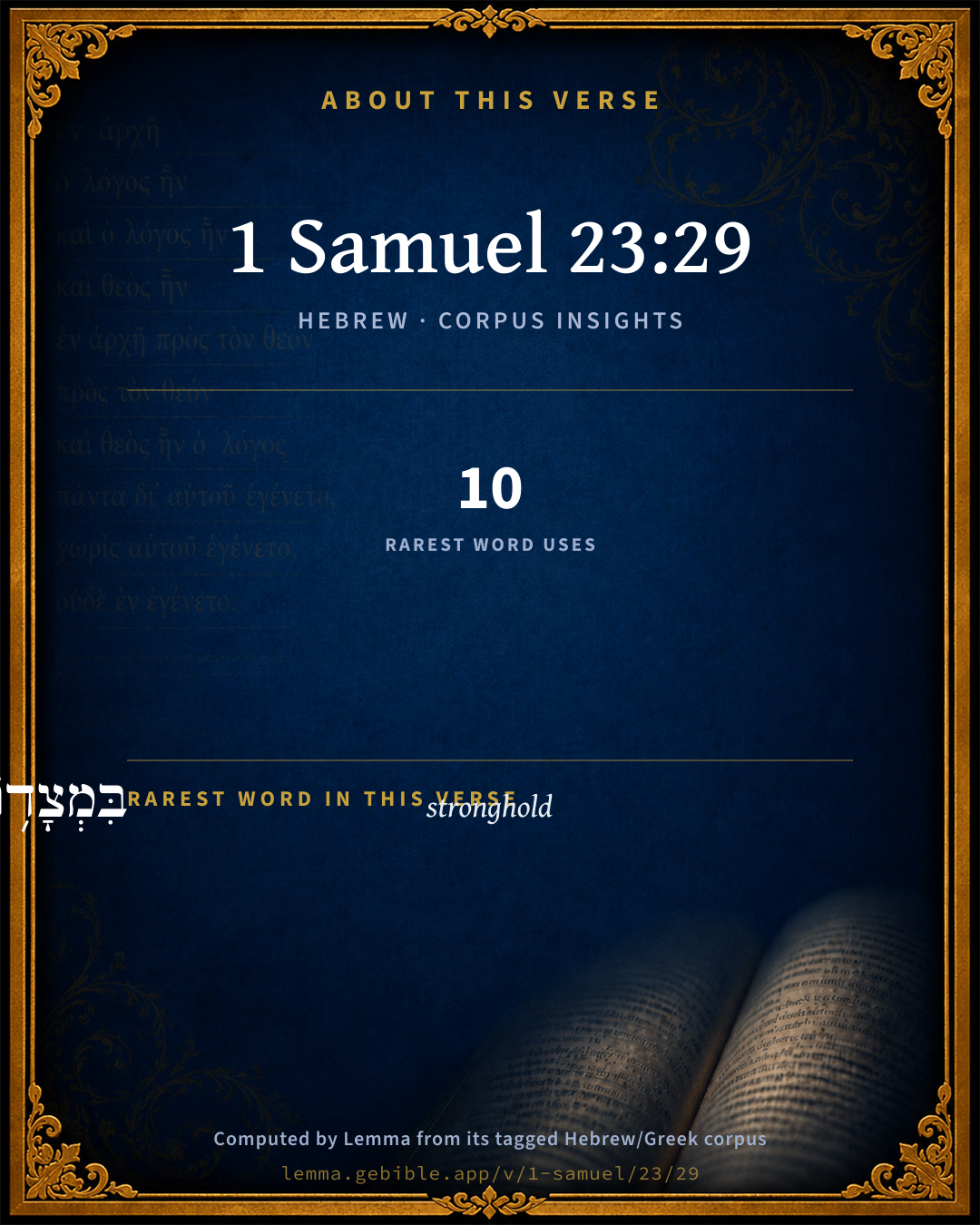
The rarest word here is בִּמְצָד֥וֹת stronghold H4679 — appearing just 10 times in the whole Hebrew Bible.

Shared distinctive vocabulary

בִּמְצָד֥וֹת stronghold H4679 occurs in 10 verses of the Hebrew Bible. Also found in:

Grammatical profile

  • 2 verbs
  • 4 nouns
  • 1 adverb

Verb forms

  • וַיַּ֥עַל Qal · Sequential Imperfect
  • וַיֵּ֖שֶׁב Qal · Sequential Imperfect

Repetition

A word recurs within this verse — often emphatic in Hebrew:

  • עֵֽין En-gedi H5872 ×2

Cross-references

6

Topical passages linked to 1 Samuel 23:29 in the Treasury of Scripture Knowledge — connected by theme and wording, ordered by reader-vote popularity; previews shown in the World English Bible.

  • 2 Chronicles 20:2 Then there came some who told Jehoshaphat, saying, There comes a great multitude against you from beyond the sea from Syria; and, behold, they are in Hazazon Tamar (the same is En Gedi).
  • Joshua 15:62 and Nibshan, and the City of Salt, and En Gedi; six cities with their villages.
  • Song of Solomon 1:14 My beloved is to me a cluster of henna blossoms From the vineyards of En Gedi. Lover
  • Ezekiel 47:10 It shall happen, that fishermen shall stand by it: from En Gedi even to En Eglaim shall be a place for the spreading of nets; their fish shall be after their kinds, as the fish of the great sea, exceeding many.
  • Genesis 14:7 They returned, and came to En-mishpat (the same is Kadesh), and struck all the country of the Amalekites, and also the Amorites, that lived in Hazazon Tamar.
  • 1 Samuel 24:1 It happened, when Saul was returned from following the Philistines, that it was told him, saying, Behold, David is in the wilderness of En Gedi.

Cross-references courtesy of OpenBible.info (CC BY 4.0).

Hebrew and Greek witnesses Masoretic Hebrew ↔ Greek Septuagint

The same verse in the two great witnesses to the Old Testament, shown verse-for-verse.

These are two independent witnesses, not word-aligned to each other, and the Septuagint is shown in lemma (dictionary) form.

Hebrew 1 Samuel 23:29 Masoretic · Westminster Leningrad Codex

וַיַּ֥עַל דָּוִ֖ד מִשָּׁ֑ם וַיֵּ֖שֶׁב בִּמְצָד֥וֹת עֵֽין גֶּֽדִי

David went up from there, and lived in the strongholds of En Gedi.

World English Bible · Public Domain

Hebrew: Westminster Leningrad Codex (CC BY 4.0). Greek: Septuagint (public domain); English from a public-domain English Septuagint. How the Septuagint differs from the Hebrew →

Commentary

Notes on 1 Samuel 23:29 from classic Christian and Jewish commentators (each source and its license shown beneath its notes). The classic Christian expositions comment on the surrounding passage and are grouped to its opening verse, so a note may address several verses; the Jewish commentaries on the Tanakh (Rashi and others) are per-verse, so they appear only where the commentator wrote on this verse.

Lemma curates 59 commentaries, every one of them public domain or Creative Commons licensed, each selected and text-cleaned for this edition rather than reprinted as found. About our sources →

Trapp's Complete Commentary

John Trapp

1Sa 23:29 And David went up from thence, and dwelt in strong holds at Engedi.

Ver. 29. Dwelt in strong holds at Engedi.] Which was the utmost border of the country, a very rocky and craggy place, And here it is thought he penned the fifty-seventh Psalm.

John Trapp, A Commentary or Exposition upon All the Books of the Old and New Testament (1647–1656) — public domain. Text from a community e-Sword module.

Tyndale Open Study Notes

Tyndale Open Resources

23:29 David traveled eastward from the area of Ziph (23:14) and took refuge in the strongholds of En-gedi. These rocky highlands were located on the western shore of the Dead Sea. There was an oasis in this region, making it an ideal place to find water and food.

Tyndale Open Study Notes — © Tyndale Open Resources, licensed CC BY-SA 4.0. Text via the HelloAO Bible API.

Jamieson, Fausset & Brown

Robert Jamieson, A. R. Fausset & David Brown

David went up from thence, and dwelt in strong holds at En-gedi--that is, "the spring of the wild goats or gazelles"--a name given to it from the vast number of ibexes or Syrian chamois which inhabit these cliffs on the western shore of the Dead Sea (Jos 15:62). It is now called Ain Jiddy. On all sides the country is full of caverns, which might then serve as lurking places for David and his men, as they do for outlaws at the present day [ROBINSON].

Next: 1 Samuel Chapter 24

Jamieson, Fausset & Brown — Commentary Critical and Explanatory on the Whole Bible (1871) — public domain (CC PDM 1.0). Text via the HelloAO Bible API.

Adam Clarke's Commentary

Verse 29. Strong holds at En-gedi.] En-gedi was situated near to the western coast of the Dead Sea, not far from Jeshimon: it literally signifies the kid's well, and was celebrated for its vineyards, Son 1:14. It was also celebrated for its balm. It is reported to be a mountainous territory, filled with caverns; and consequently proper for David in his present circumstances.

How threshing-floors were made among the ancients, we learn from CATO, De Re Rustica, chap. 91, and 129. And as I believe it would be an excellent method to make the most durable and efficient barn-floors, I will set it down: -

Aream sic facito. Locum ubi facies confodito; postea amurca conspergito bene, sinitoque combibat. Postea comminuito glebas bene. Deinde coaequato, et paviculis verberato. Postea denuo amurca conspergito, sinitoque arescat. Si ita feceris neque formicae nocebunt, neque herbae nascentur: et cum pluerit, lutum non erit. "Make a threshing-floor thus: dig the place thoroughly; afterwards sprinkle it well with the lees of oil, and give it time to soak in. Then beat the clods very fine, make it level, and beat it well down with a paver's rammer. When this is done, sprinkle it afresh with the oil lees, and let it dry. This being done, the mice cannot burrow in it, no grass can grow through it, nor will the rain dissolve the surface to raise mud."

The directions of COLUMELLA are nearly the same; but as there as some differences of importance, I will subjoin his account: -

Area quoque si terrena erit, ut sit ad trituram satis habilis, primum radatur, deinde confodiatur, permixtis paleis cum amurca, quae salem non accepit, extergatur; nam ea res a populatione murium formicarumque frumenta defendit. Tum aequate paviculis, vel molari lapide condensetur, et rursus subjectis paleis inculcetur, atque ita solibus siccanda relinquatur. De Re Rustica, lib. ii., c. 20. "If you would have a threshing-floor made on the open ground, that it may be proper for the purpose, first pare off the surface, then let it be well digged, and mixed with lees of oil, unsalted, with which chaff has been mingled, for this prevents the mice and ants from burrowing and injuring the corn. Then level it with a paver's rammer, or press it down with a millstone. Afterwards scatter chaff over it, tread it down, and leave it to be dried by the sun."

This may be profitably used within doors, as well as in the field; and a durable and solid floor is a matter of very great consequence to the husbandman, as it prevents the flour from being injured by sand or dust.

Adam Clarke's Commentary on the Bible (1810–1826) — public domain. Text from a community e-Sword/MySword module.

The Cambridge Bible for Schools and Colleges

gen. ed. J. J. S. Perowne

29. at En-gedi] En-gedi (= fountain of the kid), now Ain-Jidy, is situated about half way along the western shore of the Dead Sea. The precipitous cliffs recede from the water’s edge, and enclose a sloping plain watered by the stream which gushes copiously from the limestone rock. Here in the days of Abraham stood the Amorite city of Hazazon-tamar (= pruning of the palm). See Gen_14:7; 2Ch_20:2. It is still an oasis in the limestone desert, and though palm-trees and vineyards (Son_1:14) have vanished, the petrified leaves of the one and the terraces cut on the hills for the other attest its ancient fertility. On all sides the country is full of caverns which might serve as lurking places for David and his men, as they do for outlaws at the present day. See Robinson, Bibl. Res. 1. 508 ff.; Tristram, Land of Israel, p. 277 ff.; Stanley, Sin. and Pal. p. 295 ff., for descriptions of this remarkable spot.

29–24:8. David spares Saul’s life in the cave at En-gedi

This narrative and that in ch. 26 are regarded by some commentators as different accounts of the same event. See Note VII. p. 243, and the notes on ch. 26.

Psalms 57, 142 are referred by their titles to the time when David fled from Saul in the cave; but whether this occasion or his sojourn in the cave of Adullam is meant, must remain uncertain.

The Cambridge Bible for Schools and Colleges (gen. ed. J. J. S. Perowne; Cambridge University Press, 1878–1918) — public domain. Text from a community e-Sword module.

John Gill's Exposition

And David went up from thence,.... From the wilderness of Maon, having had a narrow escape for his life:

and dwelt in strong holds in Engedi; another place in the tribe of Judah, and which lay in the wilderness of Judah, and from whence that is called the wilderness of Engedi; and here Dr. Lightfoot (w) thinks he penned the sixty third psalm, Psa 63:1, the wilderness about Engedi being the most desert of all other places, that being upon the borders of the dead sea; of this place; see Gill on Jos 15:62.

(w) Works, vol. 1. p. 58.

Next: 1 Samuel Chapter 24

John Gill's Exposition of the Whole Bible (1746–1763) — public domain (CC PDM 1.0). Text via the HelloAO Bible API.

Albert Barnes' Notes on the Bible

En-gedi (the fountain of the kid), anciently called Hazezon-Tamar Gen 14:7 from the palm-trees which used to grow there, still preserves its name in Ain-Djedy. It is about 200 yards from the Dead Sea, about the center of its western shore. It is marked by great luxuriance of vegetation, though the approach to it is through most dangerous and precipitous passes. The country is full of caverns, which serve as lurking places for outlaws at the present day. One of these, a spacious one called Bir-el-Mauquouchieh, with a well in it suitable for watering sheep, close to the Wady Hasasa, may have been the identical cavern in which David cut off Saul’s skirt.

Albert Barnes' Notes on the Bible (1834–1885) — public domain. Text from a community e-Sword/MySword module.

Whedon's Commentary on the Bible

Daniel D. Whedon

29. En-gedi — See on Jos_15:62. and 1Sa_23:1 of the next chapter.

Daniel D. Whedon (gen. ed.), Commentary on the Old and New Testaments (1874–1909) — public domain. Text from a community e-Sword module.

Lesson kit

Teaching starters — assembled from the data on this page, not authored interpretation. Every prompt links to the verse data it draws on. Edit before teaching.

1 Samuel, in the Historical, opens this verse with 7 words (6 distinct Hebrew lemmas). Its most distinctive word is mᵉtsad (“stronghold”). A historical commentator’s framing appears above. Read the whole chapter for the surrounding context.

Discussion questions

  1. The word mᵉtsad carries the sense “stronghold.” How does it shape the verse?
  2. Judges 6:2 shares the word «stronghold» with this verse. How do the two illuminate each other?
  3. “En-gedi” occurs 2× in this one verse. What is the effect of the repetition?
  4. These translations render this verse differently. What is at stake in choosing one wording over another?
  5. The verb «וַיַּ֥עַל» is Qal Sequential Imperfect. How does its form color the action?
  6. Reading how Trapp's Complete Commentary and Tyndale Open Study Notes read this verse, where do the two commentators agree and where do they part?

Things to notice

Reading settings

Reading text

Shown beneath each verse's original-language words.

Old Testament
Old Testament edition

Read the OT as the Masoretic Hebrew (MT) or the Greek Septuagint (LXX).

English shown for the Greek Septuagint (in the Hebrew ↔ Greek comparison).

Comparing translations? Open the Compare panel on any verse page to stack up to four side by side.