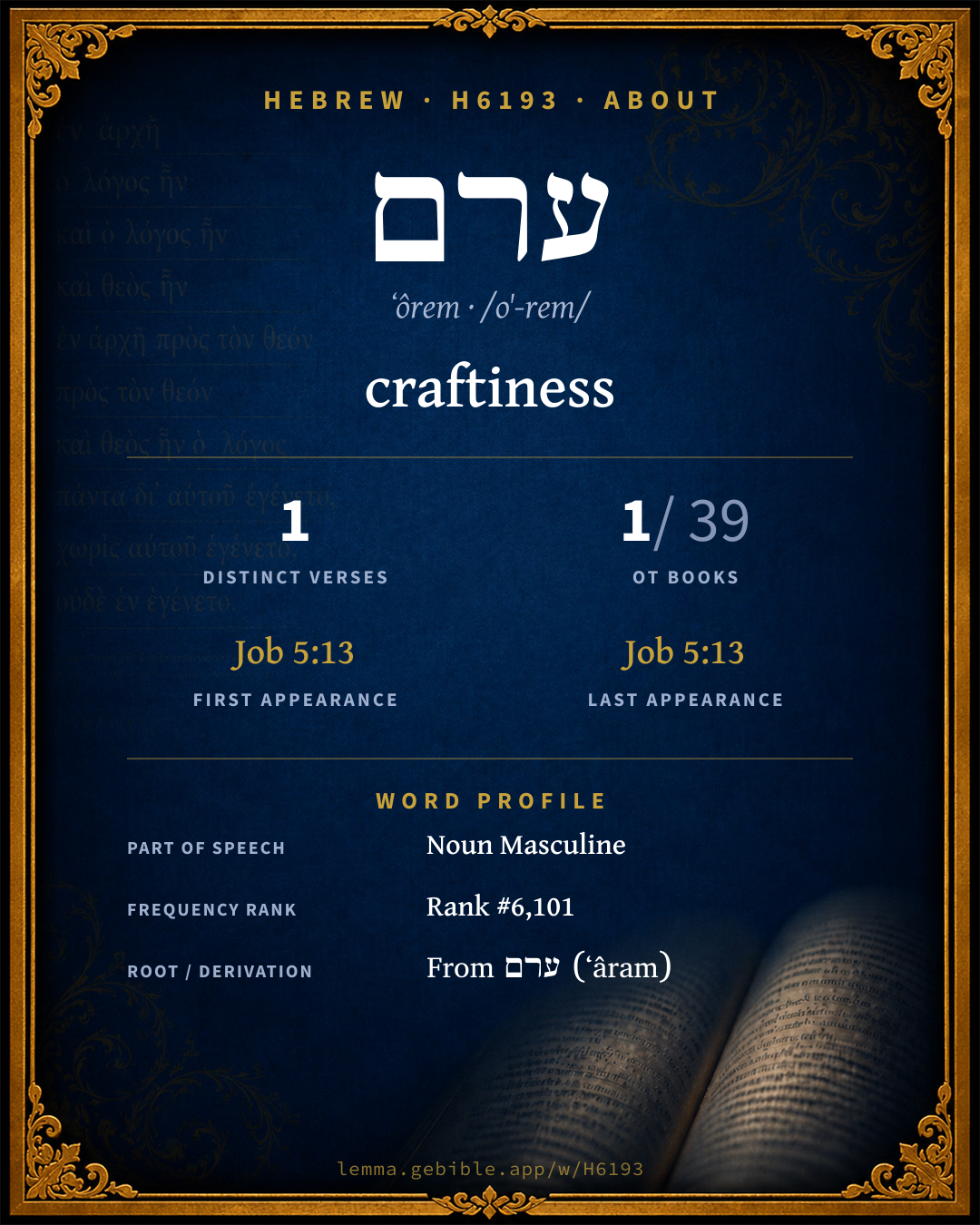
עֹ֫רֶם
craftiness
Full lexicon entry — Brown-Driver-Briggs (BDB)
From Brown-Driver-Briggs (BDB)
Where this word appears
Grammar key — what these labels mean
Stem
- Qal
- The basic, simple active stem — the plain form of the verb (“he wrote”).
Form
- Infinitive Construct
- A bound verbal noun, frequently with prepositions (“to write / in writing”).
Every verse where H6193 appears — 1 distinct verse across 1 book. Click any verse to open its interlinear word-by-word view. Verse text shown in the World English Bible for context — . Each verse’s Hebrew form is shown with its reference; the English is not keyword-highlighted, since the data carries no word-level English alignment. Use “Compare translations” on any verse to read it across multiple English versions. This concordance covers the Hebrew Bible; Septuagint (Greek Old Testament) occurrences are not indexed here.
Job 1 verse
About this entry
At a glance — auto-summarized from this page’s data, not written by a person. Every figure links to its source below. This summary describes the numbers; it doesn’t interpret them.
ערם — transliterated ʻôrem — is a Hebrew noun carrying the sense “craftiness.” A scarce word — 1 verse in all of the Hebrew Bible. More than three-quarters of its appearances fall in Job. Its lone occurrence is Job 5:13. Related forms include ערם, מערם and עירם. Each statement above links to its evidence; the full detail follows below.
Gloss history
Strong's 1890 vs modern scholarship
About this word
Strong's H6193 catalogs a Hebrew word from the Hebrew Old Testament.
These counts are not copied from any lexicon or concordance. They are computed here, from the morphology-tagged Hebrew Old Testament. What Lemma adds →
- 1
- distinct verses
- The word appears in 1 distinct verse.
- 1 / 39
- OT books
- The word appears in 1 of 39 Old Testament books.
- #6,101
- by frequency
- Rank #6,101 (rank 6,101 of 8,640 Hebrew words by occurrence).
View all 1 occurrence in the concordance →
Most concentrated in
- Job 1 verse 100%
By section of the Old Testament
By traditional corpus
Conventional, traditional groupings — biblical authorship is debated, so this is a traditional corpus grouping, not an authorship claim. Each share is this word’s portion of its verses in that division of the Hebrew canon. Each figure is a share of the word’s 1 distinct verse.
- Writings (Ketuvim) 1 verse · 100%
How translations render this word
Counts come from each version’s own published word-to-Strong’s tagging or interlinear alignment — an approximate guide to how each version renders this word, not a word-level alignment the data otherwise carries. Because each total is that version’s own tagged count, the per-version totals vary from one another and need not match the appearance or distinct-verse counts above. These counts may also differ from a printed concordance because Lemma counts each distinctly tagged rendering and does not collapse phrase taggings into a single head-word total. This is a fixed set of word-tagged versions (KJV, ASV, BSB, ULT) and does not change with the reading translation you choose elsewhere. Each version’s license is shown beside its name below (and on Sources).
- King James Version: Own craftiness 1×
- American Standard Version: Own craftiness 1×
- unfoldingWord Literal Text: Craftiness 1×
King James Version Public Domain
Renders H6193 across 1 tagged occurrence — most commonly:
American Standard Version Public Domain
Renders H6193 across 1 tagged occurrence — most commonly:
unfoldingWord Literal Text CC BY-SA 4.0
Renders H6193 across 1 tagged occurrence — most commonly:
Senses in BDB
The 1 sense BDB distinguishes for this word, in lexicon order (not ranked by frequency or importance). The full entry — with sub-senses — is in the Lexicon Entry tab.
- subtlety, shrewdness, craftiness
Word origin
[ עֹ֫רֶם ] n.[m.] craftiness;—sf. Jb 5:13
— Brown-Driver-Briggs (Oxford 1906, public domain), digitized via Sefaria, supplemented by the OpenScriptures HebrewLexicon (CC BY 4.0). See Sources.
Derived from ערם (ʻâram) (H6191) — to be crafty.
Jastrow Dictionary
A second Hebrew/Aramaic lexicon for comparison, covering Aramaic and post-biblical (Talmudic, Targumic, Midrashic) usage that the biblical-Hebrew BDB does not. Matched by lemma rather than by Strong’s number, so a lemma may carry more than one Jastrow headword (shown separately below), and the entries cover usage well beyond the Bible.
עָרַם I
- v. Ex. XV, to heap up, pile. Gen. R. s. 83, end (play on עירם, Gen. XXXVI, 43) שהוא עתיד לַעֲרוֹם וכ׳ he is destined to heap up treasures for the king Messiah; (‘Rashi’: לַעֲרוֹת, v. עָרָה I).—Denom. עֲרֵימָה. e.g. Genesis 36:43
עָרַם II
- to peel off, strip; to make white, bright; v. עָרוּם, עָרוֹם.
- 1. to enlighten, inform. Y. Snh. V, beg. 22ᶜ, sq. (ref. to בערמה, Ex. XXI, 14) שיַעֲרִימוּהוּ באיזו מיתה מת they (the forewarning witnesses) must keep him informed as to what kind of death penalty is expecting him; (Bab. ib. 80ᵇ שיודיעוהו). e.g. Exodus 21:14
- 2. to plan, act deliberately. Mekh. Mishp. s. 4 (ref. to בערמה, v. supra) להוציא … שאינן מַעֲרִימִין this is to exclude the deaf and dumb, the insane and the minor (who do not act with premeditation; להוציא מרפא … אינן מערימין to exclude the surgeon …, for although they acted with wilfulness (criminal negligence), they did not plan; Yalk. Ex. 325.
- 3. to act with subtlety, to get around a law by an artifice. Sabb. 65ᵇ מערימין בדליקה in case of a conflagration on the Sabbath (when the rabbinical law allows the rescue of a certain number of clothes by putting them on) we may use an artifice (by laying off the clothes saved and going in again to save others); (oth. opin.) אין מערימין בדליקה you dare not &c. Ib. מהו שתַּעֲרִים וכ׳ dare a woman use an artifice &c., v. פָּרַף. Tosef. Bets. III, 2. Gen. R. s. 49 מה אתה מַעֲרִים על השבועה מבול וכ׳ why wilt thou cunningly evade thy own oath? destruction by water thou wilt not bring, but destruction by fire thou wilt? Yalk. ib. 83; a. fr.
A Dictionary of the Targumim, the Talmud Babli and Yerushalmi, and the Midrashic Literature (Marcus Jastrow; London, Luzac, 1903) — Public Domain. Digitized via Sefaria. Digitized via Sefaria. Full attribution on Sources.
Same root — word family
Other BDB entries built from the same root as H6193, grouped by Strong’s listed origin. These share a root / origin per the lexicon — not necessarily a shared meaning. Each links to that word’s own entry.
Derives from
Shares the same root
- מערם maʻărôm H4636 nakedness
- עירם ʻêyrôm H5903 naked
- ערום ʻârôwm H6174 naked
- ערום ʻârûwm H6175 crafty
- ערמון ʻarmôwn H6196 plane tree
Derived from this word
Compare all same-root words → Showing 4 of 8 — not the complete family. They share a root, not necessarily a meaning.
Septuagint verse parallels
This word appears in 1 verse that also exists in the Greek Old Testament (Septuagint), out of the 1 Hebrew verse it occurs in. You can read those verses in Greek by switching the Old Testament edition to the Septuagint.
Read these verses in the Septuagint
This is a verse-level parallel only — the same verses exist in both the Hebrew and Greek Old Testaments. No word-level Hebrew↔Greek correspondence is claimed: the data carries no such alignment, so no Greek word is shown as this Hebrew word’s translation. Coverage is not total — the Septuagint omits the deuterocanon and renumbers the Psalms, so some Hebrew verses have no direct Greek parallel.