Philemon 1:23

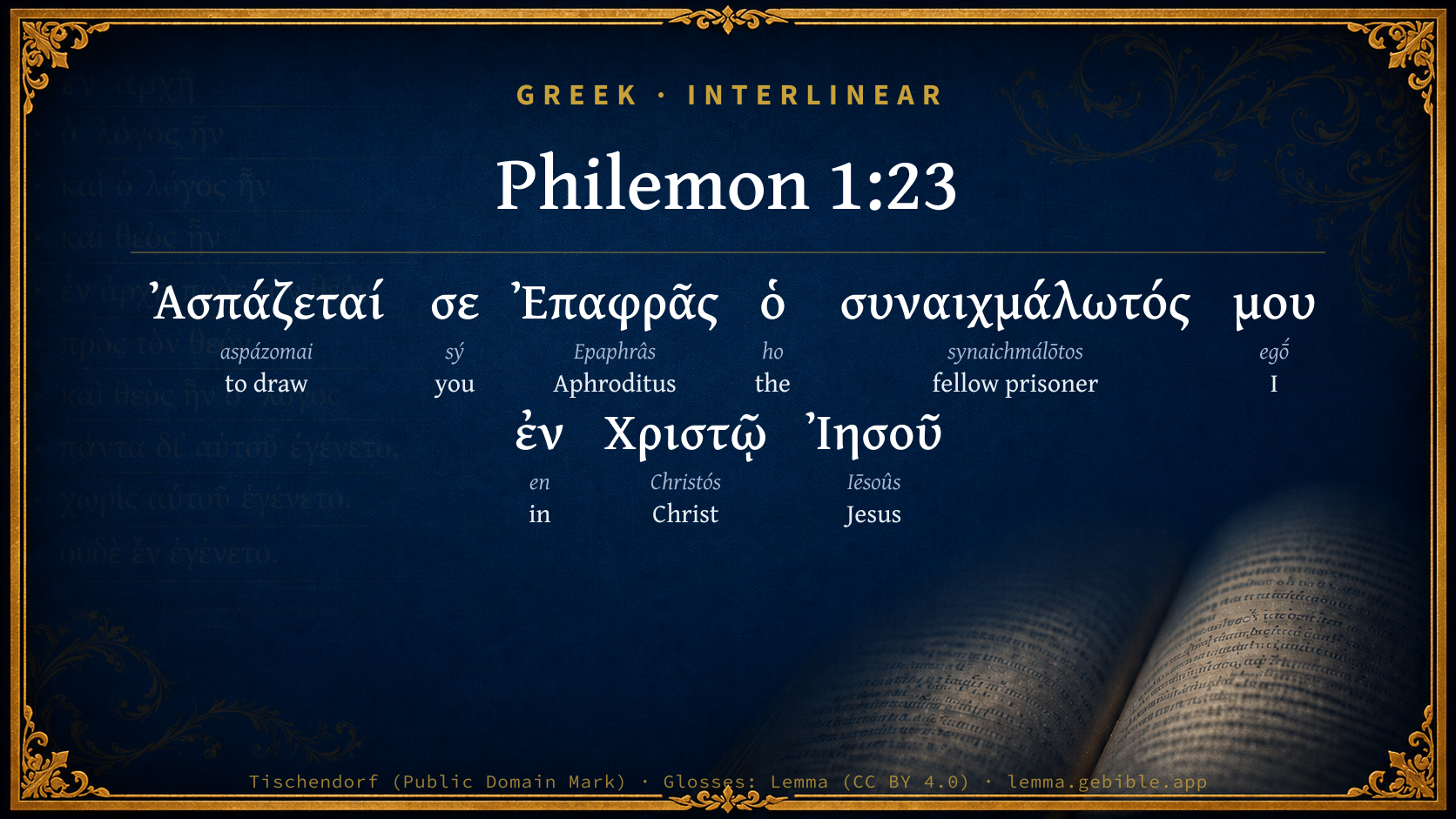
Greek (Tischendorf 8th ed.) Philemon 1:23 appears in the Greek New Testament. The text above is from the Tischendorf 8th edition. Each word links to its Strong’s number and a concise gloss. Click any word for its full Thayer’s Greek Lexicon entry.
Download image
Cite this verse

Philemon 1:23 (World English Bible). Public Domain. Lemma interlinear Bible study tool, https://lemma.gebible.app/v/philemon/1/23.

Show BibTeX & RIS
BibTeX
RIS
English Translation
Epaphras, my fellow prisoner in Christ Jesus, greets you,
World English Bible · Public Domain
Download a study sheet

One document with this verse’s original text, its word-by-word gloss line, the meaning frame, cross-references with their text, attributed commentary, and full source and license credits — printable, and it pastes into notes with its structure intact.

This verse Autodidact and up

Study sheet (.html) Plain text (.txt)

A passage Seminary Student

Up to 50 verses in one chapter. A passage sheet keeps up to 6 commentary sources and 12 cross-references per verse, in the order this page ranks them, and says so on the sheet whenever that leaves anything out. Ask for a single verse and you get the Autodidact verse sheet above.

Everything on this page stays free to read, with no account — the sheet is a download of what is already on screen, not access to it.

Want to remove ads? Support Godless Engineer
Compare translations 3

The same verse in 3 English versions, stacked beneath the original-language interlinear above. Click any original word for its lexicon entry.

Each is an independent rendering of the whole verse — the interlinear is not word-aligned to these translations.

Highlighted words mark where these versions differ — a whole-verse word diff, not a word-by-word alignment.

  • World English Bible Public Domain
    Epaphras, my fellow prisoner in Christ Jesus, greets you,
  • King James Version Public Domain
    There salute thee Epaphras, my fellowprisoner in Christ Jesus;
  • unfoldingWord Literal Text CC BY-SA 4.0
    Epaphras, my fellow prisoner in Christ Jesus, greets you,

unfoldingWord Literal Text — © unfoldingWord, licensed CC BY-SA 4.0. Word-aligned USFM3 via Door43 (git.door43.org/unfoldingWord/en_ult).

Versions to compare (up to 4)

3 of 4 selected

Show all 19 translations

Every available English version of this verse, each an independent rendering of the whole verse.

  • World English Bible Public Domain
    Epaphras, my fellow prisoner in Christ Jesus, greets you,
  • Berean Standard Bible Public Domain
    Epaphras, my fellow prisoner in Christ Jesus, sends you greetings,
  • Majority Standard Bible Public Domain
    Epaphras, my fellow prisoner in Christ Jesus, sends you greetings,
  • King James Version Public Domain
    There salute thee Epaphras, my fellowprisoner in Christ Jesus;
  • American Standard Version (1901) Public Domain
    Epaphras, my fellow-prisoner in Christ Jesus, saluteth thee;
  • Revised Version (1885) Public Domain
    Epaphras, my fellow-prisoner in Christ Jesus, saluteth thee;
  • Geneva Bible (1599) Public Domain
    There salute thee Epaphras my felowe prisoner in Christ Iesus,
  • Douay-Rheims (1899) Public Domain
    There salute thee Epaphras, my fellow prisoner in Christ Jesus;
  • Young's Literal Translation Public Domain
    Salute thee doth Epaphras, (my fellow-captive in Christ Jesus,)
  • Literal Standard Version CC BY-SA 4.0
    Epaphras greets you (my fellow-captive in Christ Jesus),
  • Unlocked Literal Bible CC BY-SA 4.0
    Epaphras, my fellow prisoner in Christ Jesus, greets you.
  • unfoldingWord Literal Text CC BY-SA 4.0
    Epaphras, my fellow prisoner in Christ Jesus, greets you,
  • Darby Bible Public Domain
    Epaphras salutes thee, my fellow-prisoner in Christ Jesus;
  • World Messianic Bible Public Domain
    Epaphras, my fellow prisoner in Messiah Yeshua, greets you,
  • Webster's Bible Public Domain
    There salute thee Epaphras, my fellow-prisoner in Christ Jesus;
  • Free Bible Version CC BY-SA 4.0
    Epaphras who is here in prison with me sends his greetings,
  • Bible in Basic English Public Domain
    Epaphras, my brother-prisoner in Christ Jesus, sends you his love;
  • Text-Critical English NT CC BY 4.0
    Epaphras, my fellow prisoner in Christ Jesus,
  • Tyndale New Testament (1534) Public Domain
    Ther salute ye Epaphras my felowe presoner in Christ Iesu

Literal Standard Version (2020), Covenant Press — licensed CC BY-SA 4.0. Text via the HelloAO Bible API (eBible.org). Unlocked Literal Bible (unfoldingWord) — licensed CC BY-SA 4.0. Text via the HelloAO Bible API (eBible.org). unfoldingWord Literal Text — © unfoldingWord, licensed CC BY-SA 4.0. Word-aligned USFM3 via Door43 (git.door43.org/unfoldingWord/en_ult). Free Bible Version, Dr. Jonathan Gallagher — licensed CC BY-SA 4.0. Text via the HelloAO Bible API (eBible.org).

Word by word

More ways to search: Search by grammar → Find every occurrence → Compare this word →

Practice this passage: Drill this verse → Learn its vocabulary →

About this verse

These counts appear in no published source. They are computed here, from the morphology-tagged text and Lemma’s own curated glosses. What Lemma adds →

9
words
9
distinct lemmas
Pauline Epistles
section

Notable vocabulary

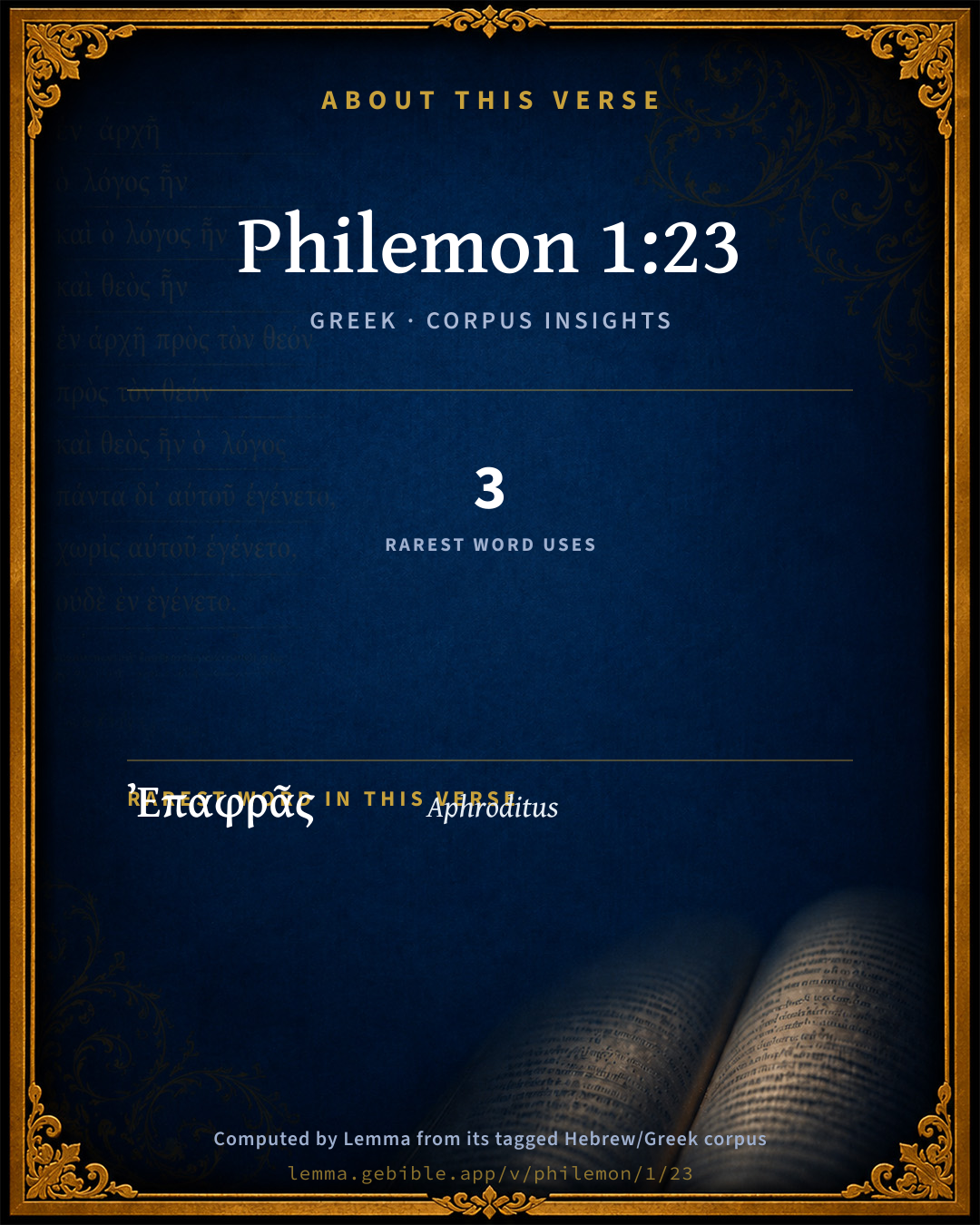
The rarest word here is Ἐπαφρᾶς Aphroditus G1889 — appearing just 3 times in the whole Greek New Testament.

Shared distinctive vocabulary

Ἐπαφρᾶς Aphroditus G1889 occurs in 3 verses of the Greek New Testament. Also found in:

Cross-references

4

Topical passages linked to Philemon 1:23 in the Treasury of Scripture Knowledge — connected by theme and wording, ordered by reader-vote popularity; previews shown in the World English Bible.

  • Colossians 1:7 even as you learned of Epaphras our beloved fellow servant, who is a faithful minister of Christ on our behalf,
  • Romans 16:7 Greet Andronicus and Junias, my relatives and my fellow prisoners, who are notable among the apostles, who also were in Christ before me.
  • Colossians 4:12 Epaphras, who is one of you, a servant of Christ, salutes you, always striving for you in his prayers, that you may stand perfect and complete in all the will of God.
  • Colossians 4:10 Aristarchus, my fellow prisoner greets you, and Mark, the cousin of Barnabas (concerning whom you received commandments, "if he comes to you, receive him"),

Cross-references courtesy of OpenBible.info (CC BY 4.0).

Where the printed editions differ

1 variant

Places in this verse where the major printed Greek editions disagree on the wording in a way that affects the translation — a comparison of editions, not a manuscript-by-manuscript collation. The editions are the modern critical texts (Nestlé-Aland 28/27, SBL, Westcott-Hort, Tregelles, Tyndale House) and the traditional texts behind the KJV (the Textus Receptus and the Byzantine/Majority text). It is not a claim about which reading is original.

  1. Different wording
    Ἀσπάζεταί

    “He greets”

    In NA28NA27TynSBLWHTreg Not in TRByz

    Ἀσπάζονταί (Aspazontai) 'They greet' occurs in traditional manuscripts (TR+Byz) instead of Ἀσπάζεταί (Aspazetai) 'He greets' in older manuscripts (NA28+NA27+Tyn+SBL+WH+Treg)

Textual data: Translators Amalgamated Greek New Testament (STEPBible TAGNT) · CC BY 4.0.

Commentary

Notes on Philemon 1:23 from classic Christian and Jewish commentators (each source and its license shown beneath its notes). The classic Christian expositions comment on the surrounding passage and are grouped to its opening verse, so a note may address several verses; the Jewish commentaries on the Tanakh (Rashi and others) are per-verse, so they appear only where the commentator wrote on this verse.

Lemma curates 59 commentaries, every one of them public domain or Creative Commons licensed, each selected and text-cleaned for this edition rather than reprinted as found. About our sources →

The Biblical Illustrator

Joseph S. Exell

Phm_1:23-24

There salute thee--

Apostolic salutations

The salutations which the apostle delivered in such numbers and so earnestly--

1.

Rest on faith and a confession of the one true Church of the Lord.

2. Are an expression of the feeling of our communion, of our higher, heavenly relationship in the family of God.

3. Furnish significant proofs of Christian love. (Nitzsch.)

Observations

I. We see the apostle setteth down A salutation proceeding from others which teacheth that salutations are an ordinary means ordained of God to nourish and cherish mutual love, and that union and conjunction which the members of Christs body have one with another.

II. Albeit the apostle were a prisoner for the faiths sake, yet God doth not leave him alone. Thus we see the endless mercy of God towards His afflicted and distressed servants, He raiseth them up some comfort, verifying the promise made to His Church, If I depart, I will send the Comforter unto you. He knoweth our infirmities, He seeth how ready we are to yield and slide back, and therefore as He strengtheneth us by others, so He maketh us means to strengthen others.

III. He calleth Epaphras a prisoner of Christ, as he also had called himself before in the beginning of this Epistle. The reason is, because he had preached Christ. There might haply be others in the same prison who might suffer as malefactors, and justly deserve the restraint of the prison, but such were none of Pauls fellow prisoners. Hereby we learn that persecutions often follow the sincere preaching of the gospel, not that it is the property of the gospel, but the cause is the malice of such as will not receive the gospel, and therefore they hate and persecute those that believe in Christ and give entertainment to the gospel. This is it our Savior teacheth (Mat_10:34-35). So, then, let us not think it a strange thing when we see such tumults arise, but arm ourselves with patience. Learn to be wise as serpents and innocent as doves, and condemn those that are the authors and beginners of those broils and contentions.

IV. Observe the titles that he giveth unto our Lord and Saviour--he describeth Him by two names, First he calleth Him Christ, then he calleth Him Jesus. Christ signifieth as much as anointed. Under the Law the priests were anointed (Exo_30:30); so were the kings (1Sa_10:1; 1Sa_16:13); and the prophets (1Ki_19:16). Christ is the true anointed Priest, King, and Prophet of His Church (Act_4:27; Act_10:38), and the only person that had all these offices, and therefore is said to be anointed with the oil of gladness above all His fellows (Psa_45:7; Heb_1:9; Joh_3:34). From this title it is that we are called Christians (Act_11:26; Psa_105:15). Jesus importeth as much as a Saviour, who was so called because He sayeth His people from their sins (Mat_1:21). From whence observe that Christ is the King, the Prophet, and the Priest of His Church, to govern us, to teach us, to redeem us, to save us. This is His office, for these ends and uses He was anointed of the Father with the Spirit of God itself. This serveth to our great good, and the benefit of it is communicated unto us; He maketh us kings and priests to God His Father (Rev_1:6). He armeth us with power and strength against sin, the flesh, the world, the devil, and maketh us able to overcome them. Through Him we have access to the Father, and may boldly appear in His sight, and offer up our prayers with assurance. Yea, He enableth us to offer up ourselves, our souls, and bodies, an holy, lively, and acceptable sacrifice unto Him, which is our reasonable serving of Him. He doth instruct us in the will of His Father, enlighten us in the knowledge of the truth, and maketh us, as it were, His household disciples and scholars to reveal unto us all things needful for our salvation. Let us therefore confess Him to be the only Son of God, perfect God and perfect Man, the sole Mediator between God and man.

V. Observe that speaking of Marcus, Aristarchus, Demas, and Luke, he calleth them his fellow helpers; whereby he putteth the ministers of the gospel and all the children of God in mind to be helpers to the truth, and to further the preaching and propagation of the gospel by all possible means that God hath enabled them. This reproveth those that employ their wits and bestow their strength to hinder the truth and the professors thereof. These have no part nor fellowship in the ministration, nor in the sound profession of the gospel, but are professed enemies to the faith of Christ. Moreover, this shall minister unspeakable comfort unto us to consider that we have been helpers to the truth and furtherers of the faith which is in Christ Jesus, we shall leave a good name behind us, and receive an incorruptible crown of eternal glory. (W. Attersoll.)

Courteous speeches are becoming to Christians

I. Our well wishing one to another is a fruit of our love, and a means to maintain and continue love among us. If we would maintain love, we must wisely and carefully entertain such helps as may further us in the performance of that duty, whereof this that now we speak of is one, so that we are to express our inward love by outward tokens, to the end that it may be seen and appear unto others.

II. Our salutations are remembrances of our care and good affections toward those whom we greet well. It is a sign that we are not forgetful of them, but do greatly regard and respect them.

III. To desire the good of others from the heart is both a fruit of the Spirit and a good sign and testimony to our own selves that we are chosen of God to eternal life.

1. We learn that courtesy with civil, gentle, friendly, and soft speeches are to be entertained of the servants of God. A fire is soonest quenched by water, and anger is soonest appeased by gentleness. Let us plant this in the garden of our hearts, and learn to give good speeches one to another, and show a friendly countenance, even to them that wrong us and abuse us, without any purpose or desire to revenge. This is a virtue hard to be found in these days among tile sons of men, they cannot speak well one of another. This gentleness that teacheth us to deal courteously toward each other is thinly sown in the furrows of our hearts. Wherefore, we must know that humanity and courteous dealing are not, as some imagine, excluded from Christians, as if nothing should be in them but rigour and austerity. Indeed they are to deal roughly and rigorously with wilful and wicked men that are offensive and unruly, but we must be gentle, meek, and lowly toward such as are willing to be instructed. Let us therefore accustom our tongues to civility, to blessing, and wishing all good one to another. This becometh our profession, and witnesseth to all the world that we are of pure conversation.

2. This doctrine serveth for reproof of divers and sundry abuses that are too rife and common among us. It seemeth a light and ridiculous thing to many to salute and to be saluted, but it is of great force, and availeth much to the obtaining and getting of good will. It is a point of courtesy and humanity to salute others and to pray for them. Let no man say these are very small matters to be spoken of and stood upon. We must acknowledge that our obedience is to be showed even in the least, and not in the greatest matters only. And a true Christian is to be seen and known when he will yield in the practise of lesser points and such as are not of greatest importance.

3. Seeing we are taught to use all gentle and courteous communication, and all loving salutations and well-wishing one toward another, this teacheth us that we must all diligently study and practise the government of the tongue, to order it aright and in due manner. This is a worthy study, it is a hard study, it is a profitable study (Psa_34:12-13; Psa_39:1). To this purpose the apostle teacheth us to be slow to speak and swift to hear. This virtue appeared notably in Elihu (Job_32:1-22), who waited till Job had spoken, for they were more ancient in years than he. In our speaking we must be careful that our words be gracious, and seasoned with wisdom, truth, reverence, modesty, meekness, and sobriety, as it were with salt, which are contrary to the foolish, rotten, and graceless talk that aboundeth in our days, wherein men are grown to be very beasts (Rom_3:13-14). (W. Attersoll.)

Courtesy

Courtesy is not confined to rank, or wealth, or station. Natures noblemen, without lineage, or heraldry, or fame, may be found sitting in the cottage, working in the fields, toiling with their hands. Though unlettered and untrained, their instincts are the instincts of gentlemen. They speak restrainedly, they would not wrong another for any gain; they would put themselves to any trouble for anothers sake. Courtesy is not mere manners; neither does it spring from mere amiable meekness. True courtesy is wedded to true pride and a fearless self-respect. The strong man is courteous because he is strong. The vacillating man is uncivil because he is weak. True courtesy shines most brightly in the sphere of home. The stripling, who is all grace to outside young ladies, and neglects his mother; the girl who is radiant as a butterfly at a ball, and surly as a wasp at home; the apprentice who addresses his employer as Sir, and talks of his father as the old boy, may possess the polish, but have not the principle, of courtesy. Courtesy shows itself not only upon great occasions, but also in little things. In a drawing room it will listen to playing or singing which may not be very brilliant, for the performers sake. True courtesy is kind to inferiors and servants. It knocks at the cottage door just as it rings at the mansions hall. It is chivalrous to woman, not because she is rich, or young, or handsome, or gifted, but because she is woman. It is kind to old age: the grey head is venerable in the eyes of courtesy. The same fine feeling which is called courtesy in secular conduct leads to reverence in sacred things. Irreverence is a coarse form of rudeness. Courtesy makes us bow to our fellows: reverence makes us kneel before God. What would be bad conduct in a drawing room is worse than bad conduct in church. Courtesy of heart overflows in courtesy of action. By imitating the gentleness of Christ, Christians become Christs gentlemen. (J. W. Diggle.)

The Biblical Illustrator, edited by Joseph S. Exell (c. 1880s–1900s) — public domain. Text from a community e-Sword module.

Joseph Benson's Commentary

Phm 1:23-25. There salute thee Epaphras, &c. — Respecting these persons, see on Col 4:10; Col 4:12; Col 4:14. In that chapter, Phm 1:10, Aristarchus is called the apostle’s fellow-prisoner; but as that particular is not mentioned here, it is not improbable that he had obtained his liberty about the time when this letter was written. Demas afterward forsook the apostle, namely, during his second imprisonment, from love to this present world, 2Ti 4:10. The grace of our Lord Jesus Christ — That is, his unmerited favour, and the influences of his Spirit; be with your spirit — Imparting that wisdom and power, that peace and comfort, which nothing but the communications of his grace can give. As the word υμων, your, is plural, it signifies that the apostle’s wish did not respect Philemon alone, but all the persons mentioned in the inscription of this letter.

Joseph Benson's Commentary on the Old and New Testaments (1811–1818) — public domain. Text from a community e-Sword module.

Tyndale Open Study Notes

Tyndale Open Resources

1:23-25 Paul usually closes his letters with greetings from others and a benediction. Cp. Col 4:7-18; Paul’s letters to the Colossians and to Philemon were probably carried to Colosse at the same time by Tychicus and Onesimus.

1:23 Epaphras was a native of Colosse who first brought the Good News to Philemon and his family (Col 1:7; 4:12).

Tyndale Open Study Notes — © Tyndale Open Resources, licensed CC BY-SA 4.0. Text via the HelloAO Bible API.

Bengel's Gnomon

Johann Albrecht Bengel

Phm 1:23. Συναιχμάλωτος, my fellow-prisoner) On this very account Epaphras is placed before the others.

Bengel's Gnomon of the New Testament — English translation (T&T Clark, Edinburgh, 1860) — public domain. Text from a community e-Sword module.

Meyer's Critical & Exegetical Commentary

Heinrich August Wilhelm Meyer

Phm_1:23 f. Salutations from the same persons, Col_4:10-14.

ὁ συναιχμάλωτός μου] See on Col_4:10. Here it further has expressly the specifically Christian character.[82] Comp. δέσμιος ἐν κυρίῳ, Eph_4:1.

The Jesus Justus mentioned at Col_4:11 does not here join in the greeting. The reason for this cannot be ascertained. It is possible that this man was absent just at the moment of Pauls writing the brief letter to Philemon. According to Wieseler, p. 417, he was not among those in the abode of the apostle under surveillance (in Rome).

[82] Yet ἐν Χριστῷ Ἰησοῦ might also be conceived as connected with ἀσπάζεται (Bleek). Comp. Php_4:21; Rom_16:22; 1Co_16:19. There is, however, no reason for separating it from the nearest word, with which even Chrysostom in his day expressly connected it.

Meyer — Critical and Exegetical Commentary on the New Testament — English translation by Peter Christie, edited by Frederick Crombie (T&T Clark, 1880) — public domain. Text from a community e-Sword module.

Expositor's Greek Testament

ed. W. Robertson Nicoll

Phm 1:23 . συναιχμάλωτος : lit. “a prisoner of war,” used metaphorically like συνστρατιώτης , see note on Phm 1:2 ; cf. Rom 16:7 , where the word is used in reference to Andronicus and Junius.

The Expositor's Greek Testament, edited by W. Robertson Nicoll (1897–1910) — public domain. Text from a community e-Sword module.

Jamieson, Fausset & Brown

Robert Jamieson, A. R. Fausset & David Brown

The same persons send salutations in the accompanying Epistle, except that "Jesus Justus" is not mentioned here.

Epaphras, my fellow prisoner--He had been sent by the Colossian Church to inquire after, and minister to, Paul, and possibly was cast into prison by the Roman authorities on suspicion. However, he is not mentioned as a prisoner in Col 4:12, so that "fellow prisoner" here may mean merely one who was a faithful companion to Paul in his imprisonment, and by his society put himself in the position of a prisoner. So also "Aristarchus, my fellow prisoner," Col 4:10, may mean. Benson conjectures the meaning to be that on some former occasion these two were Paul's "fellow prisoners," not at the time.

Jamieson, Fausset & Brown — Commentary Critical and Explanatory on the Whole Bible (1871) — public domain (CC PDM 1.0). Text via the HelloAO Bible API.

Adam Clarke's Commentary

Verse 23. Epaphras, my fellow prisoner] Epaphras was a Colossian, as we learn from Col 4:12: Epaphras, who is one of you. But there is no account there of his being in prison, though the not mentioning of it does not necessarily imply that he was not. Some time or other he had suffered imprisonment for the truth of the Gospel; and on that account St. Paul might, in a general way, call him his fellow prisoner.

Adam Clarke's Commentary on the Bible (1810–1826) — public domain. Text from a community e-Sword/MySword module.

The Cambridge Bible for Schools and Colleges

gen. ed. J. J. S. Perowne

23–25. Salutations

23. There salute thee] Cp. Col_4:10.

Epaphras] Cp. Col_1:7, and note.

my fellowprisoner] Cp. Col_4:10, and note. This passage is in favour of explaining the term there also to mean “a visitor who is so much with me as to be, as it were, in prison too.”

The Cambridge Bible for Schools and Colleges (gen. ed. J. J. S. Perowne; Cambridge University Press, 1878–1918) — public domain. Text from a community e-Sword module.

John Gill's Exposition

There salute thee Epaphras,.... Who was a Colossian, and minister of the church at Colosse, and so might be well known to Philemon, who seems to have been of the same place and church; see Col 1:7 his name is omitted in the Ethiopic version:

my fellow prisoner in Christ Jesus; this good man, and minister of Christ, might have been sent by the Colossians, as Epaphroditus was by the Philippians, to the apostle at Rome, to pay him a visit, and comfort and assist him under his afflictions; and staying and preaching the Gospel there, was committed to prison, or was laid in bonds, as the apostle was, and upon the same account; namely, for the sake of Christ, and his Gospel. For by this time Nero began to persecute the Christians, which he did in the better and more moderate part of his reign; for among several things for which he is commended by the historian (b), this is one,

""Afficti suppliciis Christiani, genus hominum superstitionis novae ac maleficae"; the Christians were punished, a sort of men of a new and bad religion:

and Epaphras being at Rome, when this persecution broke out, was taken up and put in prison, as were also Aristarchus, Col 4:10 and Timothy, Heb 13:23.

(b) Suetonius in Vita Neronis, c. 16.

John Gill's Exposition of the Whole Bible (1746–1763) — public domain (CC PDM 1.0). Text via the HelloAO Bible API.

Trapp's Complete Commentary

John Trapp

23 There salute thee Epaphras, my fellowprisoner in Christ Jesus;

Ver. 23. Epaphras my fellowprisoner] Clapped up, belike, for visiting and countenancing St Paul, to whom he was sent by the Colossians with relief, while he was prisoner at Rome. The ecclesiastical history telleth us of one Phileas a martyr, who going to execution, seemed as one deaf at the persuasions and blind at the tears of his friends, moving him to spare himself. And when one Philoramus defending him said, Quomode potest terrenis lachrymis flecti, cuius oculi caelestem gloriam contuentur? How can he be moved with earthly tears, who hath his eyes full fed with heavenly glory? he also was taken in, and both presently beheaded.

John Trapp, A Commentary or Exposition upon All the Books of the Old and New Testament (1647–1656) — public domain. Text from a community e-Sword module.

Albert Barnes' Notes on the Bible

There salute thee Epaphras - The same persons who are here mentioned as greeting Philemon, are mentioned in the close of the Epistle to the Colossians - furnishing a high degree of evidence that Philemon resided at Colosse. Epaphras was a member of the church there; the notes at Col 4:12.

My fellow-prisoner in Christ Jesus - In the cause of Christ; Notes, Phm 1:1. The circumstance of his being a prisoner is not mentioned in the parallel place in the Epistle to the Colossians, but nothing is more probable.

Albert Barnes' Notes on the Bible (1834–1885) — public domain. Text from a community e-Sword/MySword module.

Matthew Poole's English Annotations

We read of this Epaphras, Col 1:7, where he is called Paul’s fellow servant, and a faithful minister of Christ: he was with Paul at Rome, Col 4:12, but there is no mention of him as a prisoner; but now he was a fellow prisoner with Paul, either in the same place, or upon the same account.

Matthew Poole's English Annotations on the Holy Bible (1683–1685) — public domain. Text from a community e-Sword/MySword module.

Whedon's Commentary on the Bible

Daniel D. Whedon

23. Epaphras—Abbreviated form of Epaphroditus, as Luke of Lucanus. See our life of Luke, vol. ii, p. 11. Perhaps the same person as mentioned Php_2:25; Php_4:18. The fact of both being with Paul at Rome during his imprisonment indicates this; nor does it at all contradict this sameness, as Dr. Hackett seems to think, that he was part of the time, as it here appears, in prison there. It is also not here said that he belongs in Colosse, and so does not contradict the statement that he really belonged to Philippi. We are not to suppose two persons where one is amply sufficient to fulfil all the conditions of the two.

Daniel D. Whedon (gen. ed.), Commentary on the Old and New Testaments (1874–1909) — public domain. Text from a community e-Sword module.

The Pulpit Commentary

Vers. 23, 24. Salute. The salutations correspond generally to those with which the Epistle to the Colossians closes, but they are fuller, as is natural, in the longer Epistle. The order is in

Colossians:

Tychicus

Onesimus

Aristarchus

Marcus

Jesus Justus

Epaphras

Lucas

Demas

Philemon:

Epaphras

Marcus

Aristarchus

Demas

Lucas

My fellow-prisoner. The word occurs elsewhere only in Rom_16:7, besides the parallel passage in Col_4:10. As to Epaphras, see above. Marcus, having once forsaken the apostle, (Act_13:13 Act_15:37-39) had now returned, and was with him in Rome. Aristarchus was "a Macedonian of Thessalonica," and had accompanied St. Paul in his memorable voyage to Rome. (Act_27:2) Demas was now the "coworker" of the apostle at Rome, but at a later period he had departed unto Thessalonica, (2Ti_4:10) and we know nothing of his subsequent history. Tradition (Epiph., "Haer.," 41:6) relates that he also apostatized from Christianity; but the apostle"s phrase, though a strong one, does not necessarily mean this. Lucas. (see 2Co_8:18)

Vers. 23-25. Salutations and prayer.

I SALUTATIONS. These are the expressions of Christian sympathy and kindness.

1. They are the salutations of the apostles fellow-prisoner. "There salute thee Epaphras my fellow-prisoner in Christ Jesus.

(1) Epaphras was a Colossian evangelist. (Col_1:7 Col_4:12)

(2) He was imprisoned at Rome in the immediate society of the apostle.

(a) This was an alleviation to both prisoners, on account of their common faith, their common hopes, and their common interests. Epaphras, as probably the younger man, would be very helpful to the apostle.

(b) The cause of the imprisonment in both cases was "in Christ Jesus." They suffered for the preaching of his gospel.

2. They are the salutations of the apostle"s fellow-laborers. "Marcus", (Act_12:12) once temporarily estranged from the apostle, but now at his side; "Aristarchus"; (Act_19:29, 30 Col_4:10) "Demas," whose apostasy was yet future; (2Ti_4:10) "Luke," the beloved physician and evangelist. (Col_4:14) The apostle was happily circumstanced, even as a prisoner, through the constant or occasional society of these men.

II PRAYER. "The grace of our Lord Jesus Christ be with your spirit." It is curious to find no allusion to God the Father in this prayer. If Christ is not God, how can we account for such a prayer? It is a simple but beautiful prayer addressed to the whole Philemon household. T.C.

The Pulpit Commentary (1880–1919), ed. H.D.M. Spence-Jones & Joseph S. Exell — public domain. Text from a community e-Sword module.

Burkitt's Expository Notes on the New Testament

William Burkitt

Our apostle being now come to the conclusion of his epistle, he shuts it up with salutations and prayers: first he salutes Philemon from Epaphras, Marcus, Aristarchus, Demas, and Luke, some his fellow-prisoners, all his fellow labourers.

Here note, How graciously God provides for the comfort of his children in a prison; he sweetened St. Paul’s affliction with the saint’s communion: it was no joy to St. Paul that Epaphras was in prison, he had rather he had been preaching at Colosse; but seeing he was a prisoner, the apostle, no doubt, was very thankful that he was in the same prison with him, where they had opportunity (it is hoped) to pray together, to discourse, encourage, and comfort one another.

And note the cause of Epaphras’s imprisonment, in Christ Jesus, that is for the sake of Christ Jesus. No doubt there were others in prison besides Epaphras, but none were St. Paul’s fellow-prisoners but he, because though sufferers in the same prison, yet not for the same cause; Epaphras my fellow-prisoner saluteth thee.

Observe, 2. Our apostle’s concluding prayer, The grace of our Lord Jesus Christ be with your spirit.

Here note, 1. The person prayed to, the Lord Jesus Christ our Saviour, our anointed king; from Christ we are called Christians, because every one of us, in our measures, are partakers of a divine unction with and from him, Ye have an unction from the Holy One. 1Jn 2:20 This oil ran down from the head of our great High-priest, to the very skirts of his garment.

Note, 2. The blessing prayed for, The grace of our Lord Jesus Christ be with thy spirit; that is, "May the special favour of God, both in its effects and influences, in its graces and comforts, reside in thy soul and spirit; may the blessed spirit of our Lord Jesus Christ be with you, not thy but your spirit: all the saints of God in general, yea, the whole race of mankind universally, must be remembered by us in our prayers.

Amen, is a word that denotes our earnestness of desire to be heard, and our comfortable expectation of being answered: it teaches us, that whatever we pray for should be rightly understood, firmly expected, and earnestly desired. They sin in prayer, who either do not understand what they pray for, or do not earnestly desire what they pray for, or do not believe God’s readiness to grant what they pray for; therefore in testimony of our desire and assurance to be heard in prayer, we say Amen.

LAUS DEO.

William Burkitt's Expository Notes on the New Testament (1700–1703) — public domain. Text from a community e-Sword module.

The People's New Testament

B. W. Johnson

23. There salute thee Epaphras. See notes on Col. 1:7. He probably founded the Colossian church. See also Col. 4:12. My fellow-prisoner. Perhaps only in the sense that he shared Paul's imprisonment by becoming his companion.

B. W. Johnson's The People's New Testament with Notes (1889–1891) — public domain. Electronic text from the Christian Classics Ethereal Library (CCEL) ThML edition.

Cambridge Greek Testament for Schools and Colleges

23, 24. Salutations from friends

23. ʼΑσπάζεταί. Col 4:10, note.

σε. Philemon as head of the household. Perhaps he was known personally to most or some of those about to be mentioned. Probably only Epaphras knew others of those addressed in Phm 1:1-3.

Ἐπαφρᾶς. Col 1:7; Col 4:12†. He is mentioned first, as belonging to Colossae, and also perhaps as being now by St Paul’s side.

ὁ συναιχμάλωτός μου. Col 4:10; cf. Rom 16:7†. In Col. of Aristarchus, not Epaphras; see note there.

ἐν Χριστῷ Ἰησοῦ. Almost certainly not with ἀσπάζεται (e.g. 1Co 16:19) but with συναιχμάλωτος. Cf. Phm 1:1; Phm 1:9, and esp. Eph 4:1. It suggests that Epaphras had taken on the imprisonment with Paul for Christ’s sake; cf. Chrysostom ἐν Χ. Ἰ., ἀντὶ τοῦ, διὰ Χριστόν.

Cambridge Greek Testament for Schools and Colleges (Cambridge University Press, 1896; 21 vols, various authors incl. Carr, Maclear, Plummer, Farrar, Lumby, Moule, M. R. James, Simcox) — public domain. Text from a community e-Sword module.

Alford’s Greek Testament

Henry Alford

23-25.] Conclusion: See on Col 4:10, Col 4:12, Col 4:14, where the same persons send greeting. Ἰησοῦς ὁ λεγόμενος Ἰοῦστος (Col 4:11) does not appear here.

Henry Alford, The Greek Testament (1849–1861) — public domain. Text from a community e-Sword module.

International Critical Commentary

23. All the persons saluted are named in the salutations of Col. except Jesus Justus.

Ἐπαφρᾶς: Paul’s delegate to the Colossians (Col 1:7). A Colossian, and not to be identified with Epaphroditus of Php 2:25, on which see note.

Μάρκος: Probably John Mark, the son of Mary (Act 12:12, Act 12:25, Act 12:15:37). Called ὁ ἀνεψιὸς Βαρνάβα (Col 4:10). The first mention of him since the separation twelve years before (Act 15:39) occurs in Col. and Philem. (Comp. 2Ti 4:11 with the account of the separation.) He is commended to the church at Colossæ (Col 4:10). In 1Pe 5:13 he sends salutation to Asia, and appears to be there some years after the date of Col. and Philem. (2Ti 4:11).

Ἀρίσταρχος: A Thessalonian who started with Paul on his voyage to Rome (Act 27:2). On his leaving Paul at Myra, see Introd. V. In Col 4:10, Col 4:11, he is mentioned with Mark and Jesus Justus as being of the circumcision. He appears at Ephesus as Paul’s companion (Act 19:29), and as accompanying the apostle on his return from Greece through Macedonia to Troas (Act 20:4).

Δημᾶς: Contraction of Δημήτριος. Probably a Thessalonian (Col 4:14, comp. 2Ti 4:10.)

Λουκᾶς: The evangelist. His connection with Paul first appears Act 16:10, where he accompanies the apostle to Macedonia. He remained at Philippi after Paul’s departure, and was there seven years later, when Paul visited the city (Act 20:5, Act 20:6). He accompanied the apostle to Jerusalem (Act 21:15), after which we lose sight of him until he appears at Cæsarea (Act 27:2), whence he accompanies Paul to Rome.

Note on “The Church that is in Thy House” (vs. 2)

The basilica did not appear until the third century. The oldest witnesses for special church buildings are Clem. Alex. Strom. vii. c. 5, and Hippol. Fragm. ed. Lagarde, p. 149. Both witnesses represent the beginning of the third century, about 202 a.d., and are older than the commonly cited passages in Tert. Adv. Valent. c. 3 (205-8 a.d.).

The liberty of assembling was due to the fact that in the Roman Empire Christians at this time passed as a Jewish sect. The Jews were allowed to assemble under the special exemptions granted by Julius Cæsar and Augustus, which declared their communities legally authorised, and gave them the right to establish societies in all places (Joseph. Antiq. xiv. 10, 8). They thus availed themselves of the widely spread institution of collegia or sodalitates which had prevailed in the empire from a very early period. Numerous clubs or confraternities existed, composed either of the members of different trades, of the servants of a particular household, or of the worshippers of a particular deity. A special object of these clubs was to provide decent burial for their members. A fund was raised by contribution, from which burial expenses were defrayed, and also the expenses of the annual feasts held on the birthdays of the deceased. (See Antiochene Acts of Martyrdom of Ignatius, vii.; Pliny’s Letter to Trajan; Tert. Apol. 39.) For the celebration of these feasts special buildings were erected called scholae. Sometimes a columbarium was purchased by a club for its own use.

This right of forming collegia was at first freely granted to all parties under the republic, but began to be restricted before the close of the republican period. (See Cicero, Orat. in L. Calp. Pison. c. 4; and Livy’s account of the extirpation of the Bacchanalian rites, xxxix. 8.)

Julius Cæsar suppressed all but the most ancient collegia (Suet. Julius, 42), and his decrees were confirmed by Augustus (Suet. Augustus, 32). From the operation of these edicts, however, the Jews were exempted. They had only to refrain from meeting in a single general association. They were allowed the free exercise of their worship, and government by the chiefs of their synagogues. It was easy for the Christians to take advantage of the general misconception which confounded them with the Jews, and to hold their assemblies. At a later period, when they became more distinct, and their ordinary assemblies were forbidden, they availed themselves of those exceptions to the Julian and Augustan edicts which allowed the existence of benefit-clubs among the poor for funeral purposes, and permitted them to meet once a week. This exception became important under Hadrian (a.d. 117-138).

See Edwin Hatch, Organization of the Early Christian Churches; E. Loening, Gemeindeverfassung; W. M. Ramsay, The Church in the Roman Empire, etc.; J. S. Northcote and W. R. Brownlow, Roma Sotteranea, 2d ed.; R. Lanciani, Ancient Rome in the Light of Recent Excavations, p. 128; and Pagan and Christian Rome, p. 117; De Rossi, Roma Sotteranea, i. p. 209.

Comp. Compare.

Lightf. Lightfoot.

Theoph. Theophylact.

D Cod. Claromontanus: 6th century. Græco-Latin. National Library, Paris. Contains both epistles entire. Corrector: Db, close of 6th century.

K Cod. Mosquensis: 9th century. Moscow. Contains both epistles entire.

L Cod. Angelicus: 9th century. Angelican Library of Augustinian monks at Rome. Wanting from ἐξουσίαν (Heb 13:10) to the end of Philemon.

Syr. Schaaf’s ed. of Peshitto.

Syr. Harclean.

Beng. Bengel.

LXX Septuagint Version.

Ellic. Ellicott.

Calv. Calvin.

De W. De Wette.

A Cod. Alexandrinus: 5th century. British Museum. Contains both epistles entire.

C Cod. Ephraem: 5th century. Palimpsest. National Library, Paris. Very defective. Wanting from τοῦτο οὖν (Eph 4:17) to καὶ τί αἱρήσομαι (Php 1:22), and from μειν (Βενιαμειν) (Php 3:5) to the end. Correctors: C2, 6th century; C3, 9th century.

17 National Library, Paris: 9th or 10th century. Both epistles entire.

137 Paris: 13th or 14th century. Both epistles entire.

WH. Westcott and Hort: The New Testament in the Original Greek.

אԠCod. Sinaiticus: 4th century. Discovered by Tischendorf in the convent of St. Catherine on Mt. Sinai, in 1859. Now at St. Petersburg. Contains both epistles complete. Correctors: אa, nearly contemporary; אb, 6th century; אc, beginning of 7th century, treated by two correctors,—אca אcb.

F Cod. Augiensis: 9th century. Græco-Latin. Library of Trinity College, Cambridge. Philippians entire; Philemon wanting in the Greek from πεποιθὼς (vs. 21) to the end.

G

Cod. Boernerianus: 9th century. Græco-Latin. Dresden. Wanting Greek and Latin, Phm 1:21-25.

An asterisk added to the title of a MS., as D*, signifies a correction made by the original scribe.

P Cod. Porphyrianus: beginning of 9th century. Palimpsest. St. Petersburg. Both epistles entire, but many words illegible.

Tisch. Tischendorf: Novum Testamentum Graece. Editio Octava Critica Major.

B Cod. Vaticanus: 4th century. Vatican Library. Contains both epistles entire. Correctors: B2, nearly the same date; B3, 10th or 11th century.

Mey. Meyer.

Win. Winer: Grammar of N. T. Greek. 8th ed. of Eng. Transl. by Moulton. Grammatik des neutestamentlichen Sprachidioms, 8 Aufl., von P. W. Schmiedel. 1 Theil, 1894.

Bib. Gk. Biblical Greek.

Holtzn. Holtzmann.

Alf. Alford.

Hom. Homer.

Hdt. Herodotus.

Xen. Xenophon.

Vulg. Vulgate.

Weiss Der Philipperbrief ausgesetzt und die Geschichte seiner Auslegung kritisch dargestellt. 1859. A most thorough piece of work. It leaves no point untouched, and treats every point with ample learning, conscientious pains taking, independence, and positiveness. It is valuable in studying the history of the exegesis.

31 British Museum: 11th century. Both epistles entire.

37 Library of Town Council of Leicester: 15th century. Both epistles entire. See Miller’s Scrivener, vol. i. 202.

47 Bodleian Library: 11th century. Both epistles entire.

80 Vatican: 11th century. Philippians entire; Philemon mutilated.

Cop. Coptic, Memphitic, or Bohairic.

= Equivalent to.

Arm. Armenian.

Syr. Peshitto and Harclean versions.

v. Sod. von Soden.

Ign. Ignatius.

Dw. Dwight.

R.V. Revised Version of 1881.

Soph. Sophocles.

Luth. Luther.

Chr. Chrysostom.

Æth. Ethiopic.

Sap. Wisdom of Solomon.

67 Vienna: 11th century. Both epistles entire.

Pesh. Peshitto.

Wetst. Wetstein.

Ov. Ovid.

Q. Curt. Quintus Curtius.

Thdrt. Theodoret.

Œc. Œcumenius.

van Oos. van Oosterzee.

Aristoph. Aristophanes.

Suid. Suidas: Lexicon.

Hesych. Hesychius: Lexicon.

Pind. Pindar.

Dem. Demosthenes.

Hippol. Hippolytus.

Tert. Tertullian.

Suet. Suetonius.

International Critical Commentary — older volumes (1896–1929), various authors — public domain. Text from a community e-Sword module.

Vincent's Word Studies in the New Testament

Marvin R. Vincent

Epaphras my fellow prisoner [επαφρας ο συναιχμαλωτος μου] . Epaphras is mentioned Col 1:7; Col 4:12. Some identify him with Epaphroditus, but without sufficient reason. Epaphroditus appears to have been a native of Philippi (Phi 2:25), and Epaphras of Colossae (Col 4:12). Epaphroditus is always used of the Philippian, and Epaphras of the Colossian. The names, however, are the same, Epaphras being a contraction.

It is disputed whether fellow - prisoner is to be taken in a literal or in a spiritual sense. For the latter see Rom 7:23; 2Co 10:5; Eph 4:8. Compare fellow - soldier, ver. 2, and Phi 2:25. In Rom 16:7, the word used here is applied to Andronicus and Junia. Paul was not strictly an aijcmalwtov prisoner of war (see on Luk 4:18). The probabilities seem to favor the spiritual sense. Lightfoot suggests that Epaphras' relations with Paul at Rome may have excited suspicion and led to his temporally confinement; or that he may voluntarily have shared Paul 's imprisonment.

Marvin R. Vincent, Word Studies in the New Testament (1887–1900) — public domain. Text from a community e-Sword/MySword module.

Lightfoot's Colossians and Philemon

J. B. Lightfoot

23–25. ‘Epaphras my fellow-captive in Christ Jesus salutes you. As do also Mark, Aristarchus, Demas, and Luke, my fellow-labourers. The grace of our Lord Jesus Christ be with thee and thy household, and sanctify the spirit of you all.’

23 sq. For these salutations see the notes on Col. iv. 10 sq. Epaphras is mentioned first because he was a Colossian (Col. iv. 12) and, as the evangelist of Colossæ (see p. 29 sq.), doubtless well known to Philemon. Of the four others Aristarchus and Mark belonged to the Circumcision (Col. iv. 11), while Demas and Luke were Gentile Christians. All these were of Greek or Asiatic origin and would probably be well known to Philemon, at least by name. On the other hand Jesus Justus, who is honourably mentioned in the Colossian letter (iv. 11), but passed over here, may have been a Roman Christian.

ὁ συναιχμάλωτος] On the possible meanings of this title see Col. iv. 10, where it is given not to Epaphras but to Aristarchus.

J. B. Lightfoot, St Paul's Epistles to the Colossians and Philemon: a revised text with introductions, notes and dissertations (London: Macmillan, 1875) — public domain. Electronic text from Project Gutenberg (ebook #50857). Covers Colossians and Philemon only (the verse-by-verse notes; introductions and dissertations are omitted); Lightfoot's companion Galatians and Philippians volumes are not included, as the available public-domain scans carry garbled Greek that cannot be faithfully reproduced.

Lesson kit

Teaching starters — assembled from the data on this page, not authored interpretation. Every prompt links to the verse data it draws on. Edit before teaching.

Philemon, in the Pauline Epistles, opens this verse with 9 words (9 distinct Greek lemmas). Its most distinctive word is Epaphrâs (“Aphroditus”). A historical commentator’s framing appears above. Read the whole chapter for the surrounding context.

Discussion questions

  1. The word Epaphrâs carries the sense “Aphroditus.” How does it shape the verse?
  2. Colossians 1:7 shares the word «Aphroditus» with this verse. How do the two illuminate each other?
  3. These translations render this verse differently. What is at stake in choosing one wording over another?
  4. Reading how The Biblical Illustrator and Joseph Benson's Commentary read this verse, where do the two commentators agree and where do they part?

Things to notice

Reading settings

Reading text

Shown beneath each verse's original-language words.

Old Testament
Old Testament edition

Read the OT as the Masoretic Hebrew (MT) or the Greek Septuagint (LXX).

English shown for the Greek Septuagint (in the Hebrew ↔ Greek comparison).

Comparing translations? Open the Compare panel on any verse page to stack up to four side by side.