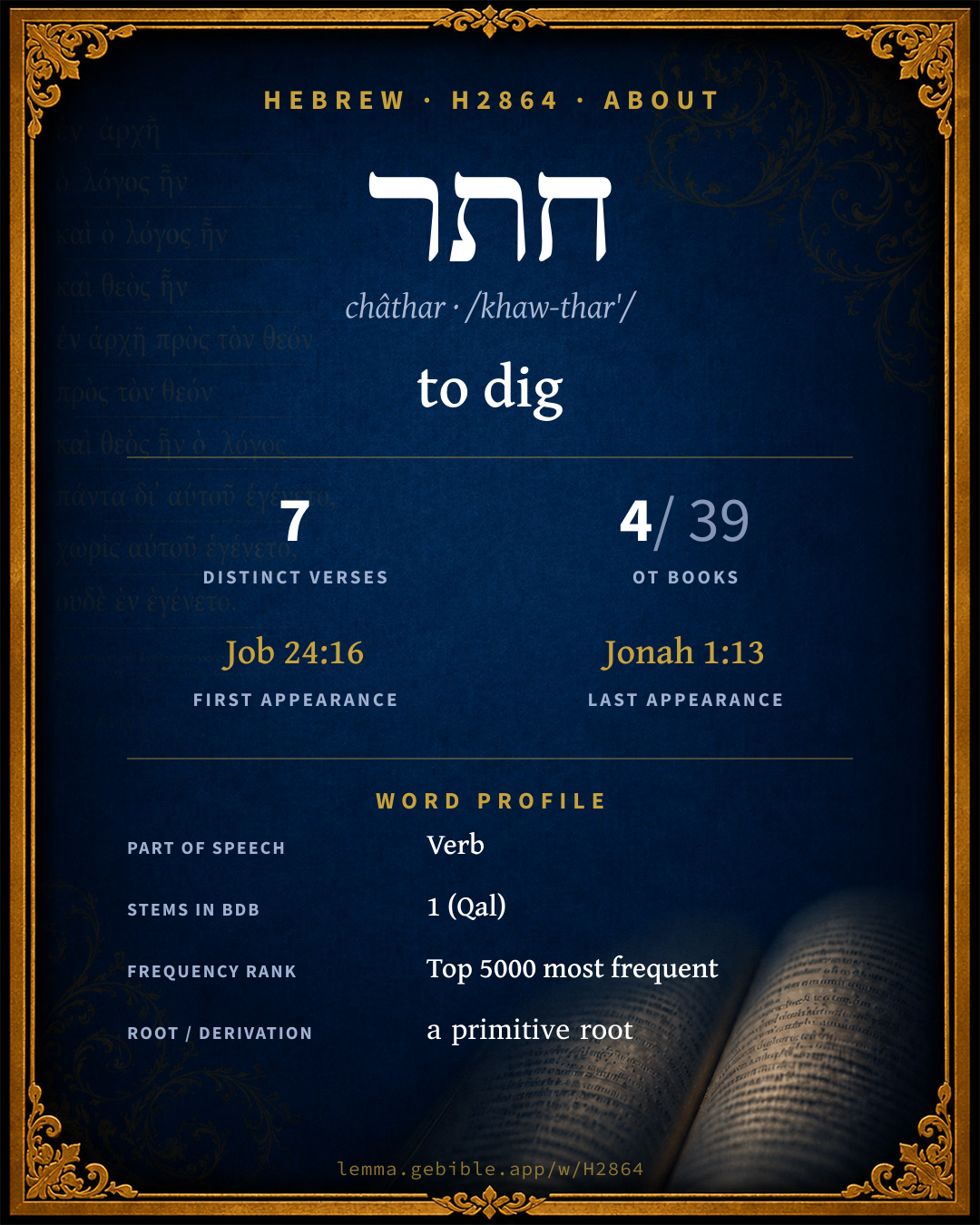
חָתַר
to dig
‘to dig’ is one of 3 main senses fuller range ↓
Full lexicon entry — Brown-Driver-Briggs (BDB)
From Brown-Driver-Briggs (BDB)
Where this word appears
Grammar key — what these labels mean
Part of speech
- Verb
- An action or state-of-being word.
Stem
- Qal
- The basic, simple active stem — the plain form of the verb (“he wrote”). Here: ‘dig into houses’
Form
- Imperfect
- An incomplete, ongoing, or future action (“he will / would write”).
- Imperative
- A direct command (“write!”).
- Sequential Imperfect
- An imperfect with prefixed waw — the standard past-narrative form (waw-consecutive imperfect).
- Perfect
- A completed action or state — Hebrew marks aspect (completeness) more than strict tense (“he wrote”).
Person
- 3rd Person
- The one spoken about (“he / she / it / they”).
- 2nd Person
- The one addressed (“you”).
- 1st Person
- The speaker (“I / we”).
Gender
- Masculine
- Grammatically masculine.
- Common
- Either gender — not distinguished for this form.
Number
- Plural
- More than one (in Hebrew, generally three or more).
- Singular
- One.
Grammatical forms
- Verb, Qal, Imperfect, 3rd Person, Masculine, Plural 2 times (25%)
- Verb, Qal, Imperative, 2nd Person, Masculine, Singular 2 times (25%)
- Verb, Qal, Sequential Imperfect, 1st Person, Common, Singular 1 time (13%)
- Verb, Qal, Sequential Imperfect, 3rd Person, Masculine, Plural 1 time (13%)
- Verb, Qal, Perfect, 1st Person, Common, Singular 1 time (13%)
- Verb, Qal, Perfect, 3rd Person, Masculine, Singular 1 time (13%)
Parsed forms decoded from the imported morphology (morphhb / Westminster Leningrad Codex — WLC text public domain, morphhb tagging CC BY 4.0), counted across 8 parsed occurrences — not distinct verses.
Every verse where H2864 appears — 7 distinct verses across 4 books. Click any verse to open its interlinear word-by-word view. Verse text shown in the World English Bible for context — . Each verse’s Hebrew form is shown with its reference; the English is not keyword-highlighted, since the data carries no word-level English alignment. Use “Compare translations” on any verse to read it across multiple English versions. This concordance covers the Hebrew Bible; Septuagint (Greek Old Testament) occurrences are not indexed here.
Job 1 verse
Ezekiel 4 verses
- Ezekiel 8:8 חֲתָר וָ/אֶחְתֹּ֣ר Qal impv 2ms conj + Qal wimpf 1cs Then said he to me, Son of man, dig now in the wall: and when I had dug in the wall, behold, a door.
- Ezekiel 12:5 חֲתָר Qal impv 2ms Dig you through the wall in their sight, and carry out thereby.
- Ezekiel 12:7 חָתַֽרְתִּי Qal pf 1cs I did so as I was commanded: I brought forth my stuff by day, as stuff for removing, and in the even I dug through the wall with my hand; I brought it forth in the dark, and bore it on my shoulder in their sight.
- Ezekiel 12:12 יַחְתְּר֖וּ Qal impf 3mp The prince who is among them shall bear on his shoulder in the dark, and shall go forth: they shall dig through the wall to carry out thereby: he shall cover his face, because he shall not see the land with his eyes.
Amos 1 verse
Jonah 1 verse
About this entry
At a glance — auto-summarized from this page’s data, not written by a person. Every figure links to its source below. This summary describes the numbers; it doesn’t interpret them.
The Hebrew verb חתר centers on the idea of “to dig.” Ezekiel dominates its distribution — 4 of 7 verses. The Hebrew Bible uses it across 7 verses — uncommon. First canonically at Job 24:16, it enters the text early. Its meaning spans more than one sense — see its full sense range. For the data behind this summary, explore the sense tree and the renderings breakdown below.
Gloss history
Strong's 1890 vs modern scholarship
About this word
Strong's H2864 catalogs a Hebrew word from the Hebrew Old Testament.
These counts are not copied from any lexicon or concordance. They are computed here, from the morphology-tagged Hebrew Old Testament. What Lemma adds →
- 7
- distinct verses
- The word appears in 7 distinct verses.
- 4 / 39
- OT books
- The word appears in 4 of 39 Old Testament books.
- #2,625
- by frequency
- Top 5000 most frequent Hebrew words (rank 2,625 of 8,640 Hebrew words by occurrence).
View all 7 occurrences in the concordance →
By section of the Old Testament
By traditional corpus
Conventional, traditional groupings — biblical authorship is debated, so this is a traditional corpus grouping, not an authorship claim. Each share is this word’s portion of its verses in that division of the Hebrew canon. Each figure is a share of the word’s 7 distinct verses.
- Prophets (Nevi'im) 6 verses · 86%
- Writings (Ketuvim) 1 verse · 14%
How translations render this word
Counts come from each version’s own published word-to-Strong’s tagging or interlinear alignment — an approximate guide to how each version renders this word, not a word-level alignment the data otherwise carries. Because each total is that version’s own tagged count, the per-version totals vary from one another and need not match the appearance or distinct-verse counts above. These counts may also differ from a printed concordance because Lemma counts each distinctly tagged rendering and does not collapse phrase taggings into a single head-word total. This is a fixed set of word-tagged versions (KJV, ASV, BSB, ULT) and does not change with the reading translation you choose elsewhere. Each version’s license is shown beside its name below (and on Sources).
- King James Version: Dig 2×
- American Standard Version: Dig 2×
- Berean Standard Bible: Dig 2×, I dug 2×
- unfoldingWord Literal Text: But 1×, Dig a hole 1×, Dig into 1×
King James Version Public Domain
Renders H2864 across 8 tagged occurrences — most commonly:
Plus 6 renderings that appear only once — usually multi-word phrases or single function words the recovered tagging swept in, not distinct renderings.
American Standard Version Public Domain
Renders H2864 across 8 tagged occurrences — most commonly:
Plus 6 renderings that appear only once — usually multi-word phrases or single function words the recovered tagging swept in, not distinct renderings.
Berean Standard Bible Public Domain
Renders H2864 across 8 tagged occurrences — most commonly:
Plus 4 renderings that appear only once — usually multi-word phrases or single function words the recovered tagging swept in, not distinct renderings.
unfoldingWord Literal Text CC BY-SA 4.0
Renders H2864 across 9 tagged occurrences — most commonly:
Senses in the full BDB
What do BDB’s symbols mean?
BDB uses these scholarly abbreviations:
| Symbol | Meaning |
|---|---|
| 𝔊 | the Septuagint (the ancient Greek translation, LXX) |
| 𝔙 | the Vulgate (the Latin translation) |
| 𝔖 | the Syriac version (the Peshitta) |
| 𝔗 | the Targum (the Aramaic translation) |
| ψ | the Psalms |
| √ | root (the underlying root or stem) |
| ‖ | parallel passage (a synonymous or contrasted parallel) |
| † | the dagger: every passage where the word occurs is cited |
The 3 senses and sub-senses the full Brown-Driver-Briggs lexicon distinguishes for this word, in lexicon order (not ranked by frequency), with BDB’s own verbatim wording and sub-sense lettering. Shown in Hebrew script with BDB’s own scholarly abbreviations. The condensed entry is in the Lexicon Entry tab. See also the Forms in the corpus table below.
Qal
- Pf. ח׳ Jb 24:16, חָתַרְתִּי Ez 12:7; Impf. וָאֶחְתֹּר Ez 8:8 יַחְתְּרוּ Ez 12:12 Am 9:2, וַיַּחְתְּרוּ Jon 1:13; Imv. חֲתָר־ Ez 8:8; 12:5;— e.g. Job 24:16
- 1. dig into houses, c. acc. בָּתִּים Jb 24:16 (of burglary); sq. בְּ into or through a wall Ez 8:8(×2) (Co del. on intern. grounds), 12:5, 7, 12; metaph. sq. בשׁאול Am 9:2 dig into Sheʾôl, i.e. as a refuge. e.g. Job 24:16
- 2. row (as digging into the water) Jon 1:13. e.g. Jonah 1:13
Senses from the full Brown-Driver-Briggs lexicon (Brown, Driver, Briggs; Oxford 1906 — public domain), digitized via Sefaria, supplemented by the OpenScriptures HebrewLexicon (CC BY 4.0). Full attribution on Sources.
Word origin
vb. dig, row (NH id., bore (through), so Aramaic חֲתַר 𝔗 (rare))—
— Brown-Driver-Briggs (Oxford 1906, public domain), digitized via Sefaria, supplemented by the OpenScriptures HebrewLexicon (CC BY 4.0). See Sources.
Origin: a primitive root
Jastrow Dictionary
A second Hebrew/Aramaic lexicon for comparison, covering Aramaic and post-biblical (Talmudic, Targumic, Midrashic) usage that the biblical-Hebrew BDB does not. Matched by lemma rather than by Strong’s number, so a lemma may carry more than one Jastrow headword (shown separately below), and the entries cover usage well beyond the Bible.
חָתַר
- to dig, break in, make an opening. Kidd. 24ᵇ חֲתוֹר לי שיני Ar. (ed. לַחְתּוֹר לו שינו) scrape my tooth (to clean it). Deut. R. s. 2 (ref. to וַיֵּעָתֶר, II Chr. XXXIII, 13) וַיֶּחְתַּר לו וכ׳ the Lord made an opening for his prayer; ח׳ את הרקיע He broke through the heavens; Y. Snh. X, 28ᶜ bot.; Ruth R. to II, 14 ח׳ לו חתירה וכ׳ (v. Snh. 103ᵃ).—Ex. R. s. 37 נטל את הצפורן לַחְתּוֹר וכ׳ (Ar. s. v. צפורן: לחפור) he took the digging tool to undermine his father’s house; Lev. R. s. 10 (לחתך, אחתוך, לחתוך את אביו) (corr. acc.). Gen. R. s. 63 (ref. to וַיֶּעְתַּר, Gen. XXV, 21, v. supra) like a prince שהיה חוֹתֵר על אביו ליטול וכ׳ who undertook a siege (for military practice) against his father for a litra of gold (for the winner) והיה זה ח׳ מבפנים וכ׳ and so the one did mine from within &c. (the father assisting his son’s efforts).—Snh. 109ᵃ וחוֹתְרִים שם and broke in there; Gen. R. s. 27; a. fr.—Part. pass. חָתוּר, f. חֲתוּרָה, pl. חֲתוּרִים, חֲתוּרוֹת. B. Kam. 114ᵇ היתה מחתרת ח׳ וכ׳ his house was broken into. Ib. 23ᵃ סתם דלתות ח׳ הן וכ׳ with reference to dogs, ordinary doors are subject to being broken in, i.e. the owner of a dog is responsible for damages done by breaking in. e.g. 2 Chronicles 33:13
חֲתַר
- Targ. Ez. VIII, 8; a. e.
- 1. to be broken into. M. Kat. 25ᵇ אִיתְחַתְּרוּ שבעין מחתרתא וכ׳ Ms. M. (ed. אִיחְתְּרוּ) seventy robberies were committed in Tiberias (ed. in N’hardea). Snh. 109ᵃ אִחְתְּרִין … מחתרתא וכ׳ (Ms. O. אִיחְתְּרוּ וכ׳) that night three hundred robberies were committed in S.
- 2. to break in for one’s self. Targ. Ez. XII, 7.
A Dictionary of the Targumim, the Talmud Babli and Yerushalmi, and the Midrashic Literature (Marcus Jastrow; London, Luzac, 1903) — Public Domain. Digitized via Sefaria. Digitized via Sefaria. Full attribution on Sources.
Forms in the corpus
The 7 distinct written forms H2864 takes in the Hebrew Bible, most frequent first — each parse links to that stem’s occurrences in the concordance. Hebrew forms include their vowel points and cantillation, so a single lemma takes many written forms.
| Form | Parsing | Example | Uses |
|---|---|---|---|
| חֲתָר | Verb, Qal, Imperative, 2nd Person, Masculine, Singular | Ezekiel 8:8 | 2 |
| וַ/יַּחְתְּר֣וּ | Verb, Qal, Sequential Imperfect, 3rd Person, Masculine, Plural | Jonah 1:13 | 1 |
| וָ/אֶחְתֹּ֣ר | Verb, Qal, Sequential Imperfect, 1st Person, Common, Singular | Ezekiel 8:8 | 1 |
| חָתַ֥ר | Verb, Qal, Perfect, 3rd Person, Masculine, Singular | Job 24:16 | 1 |
| חָתַֽרְתִּי | Verb, Qal, Perfect, 1st Person, Common, Singular | Ezekiel 12:7 | 1 |
| יַחְתְּר֖וּ | Verb, Qal, Imperfect, 3rd Person, Masculine, Plural | Ezekiel 12:12 | 1 |
| יַחְתְּר֣וּ | Verb, Qal, Imperfect, 3rd Person, Masculine, Plural | Amos 9:2 | 1 |
Same root — word family
Other BDB entries built from the same root as H2864, grouped by Strong’s listed origin. These share a root / origin per the lexicon — not necessarily a shared meaning. Each links to that word’s own entry.
Derived from this word
Compare all same-root words → They share a root, not necessarily a meaning.
Septuagint verse parallels
This word appears in 7 verses that also exist in the Greek Old Testament (Septuagint), out of the 7 Hebrew verses it occurs in. You can read those verses in Greek by switching the Old Testament edition to the Septuagint.
Read these verses in the Septuagint
This is a verse-level parallel only — the same verses exist in both the Hebrew and Greek Old Testaments. No word-level Hebrew↔Greek correspondence is claimed: the data carries no such alignment, so no Greek word is shown as this Hebrew word’s translation. Coverage is not total — the Septuagint omits the deuterocanon and renumbers the Psalms, so some Hebrew verses have no direct Greek parallel.