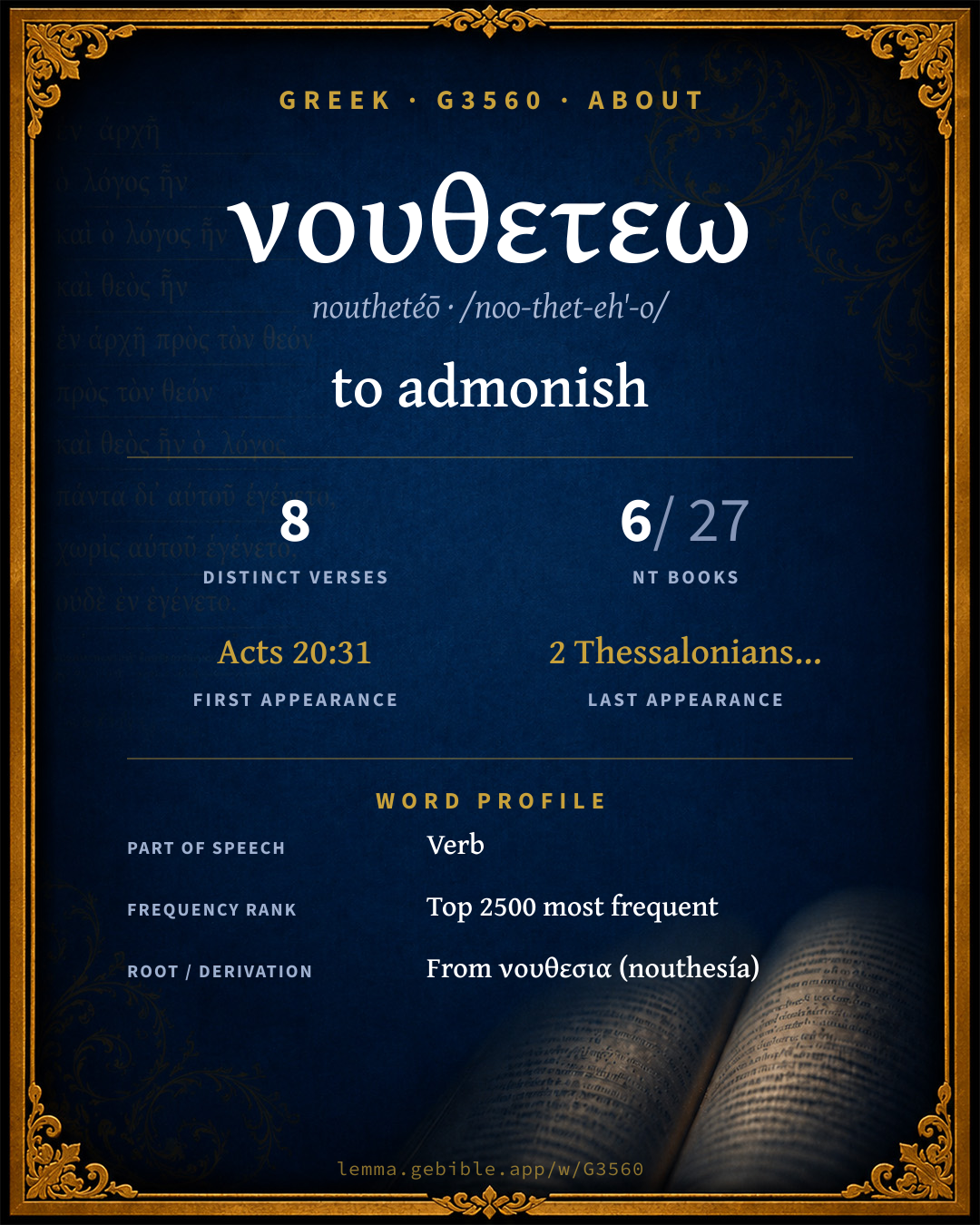
νουθετέω
to admonish
Full lexicon entry — Thayer's Greek Lexicon
From Thayer's Greek Lexicon
Where this word appears
Grammar key — what these labels mean
Part of speech
- Verb
- An action or state-of-being word.
Tense
- Present
- Ongoing or general action in present time (imperfective aspect).
Voice
- Active
- The subject performs the action.
Mood
- Imperative
- Expresses a command or request.
- Participle
- A verbal adjective (“writing,” “having written”).
- Infinitive
- A verbal noun (“to write”), unmarked for person or number.
Case
- Nominative
- The case of the subject (and the predicate nominative).
- Accusative
- The case of the direct object and of extent.
Person
- 2nd person
- The one addressed (“you”).
Gender
- Masculine
- Grammatically masculine.
Number
- Plural
- More than one.
- Singular
- One.
Grammatical forms
- Verb, Present, Active, Imperative, 2nd person, Plural 2 times (25%)
- Verb, Present, Active, Participle, Nominative, Plural, Masculine 2 times (25%)
- Verb, Present, Active, Participle, Nominative, Singular, Masculine 2 times (25%)
- Verb, Present, Active, Infinitive 1 time (13%)
- Verb, Present, Active, Participle, Accusative, Plural, Masculine 1 time (13%)
Parsed forms decoded from the imported morphology (Robinson–Tischendorf, public domain), counted across 8 parsed occurrences — not distinct verses.
Every verse where G3560 appears — 8 distinct verses across 6 books. Click any verse to open its interlinear word-by-word view. Verse text shown in the World English Bible for context — . Each verse’s Greek form is shown with its reference; the English is not keyword-highlighted, since the data carries no word-level English alignment. Use “Compare translations” on any verse to read it across multiple English versions. This concordance covers the Greek New Testament; Septuagint (Greek Old Testament) occurrences of this word are not indexed here.
Acts 1 verse
Romans 1 verse
1 Corinthians 1 verse
Colossians 2 verses
- Colossians 1:28 νουθετοῦντες pres act ptcp nom pl masc whom we proclaim, admonishing every man and teaching every man in all wisdom, that we may present every man perfect in Christ Jesus;
- Colossians 3:16 νουθετοῦντες pres act ptcp nom pl masc Let the word of Christ dwell in you richly; in all wisdom teaching and admonishing one another with psalms, hymns, and spiritual songs, singing with grace in your heart to the Lord.
1 Thessalonians 2 verses
- 1 Thessalonians 5:12 νουθετοῦντας pres act ptcp acc pl masc But we beg you, brothers, to know those who labor among you, and are over you in the Lord, and admonish you,
- 1 Thessalonians 5:14 νουθετεῖτε pres act impv 2pl We exhort you, brothers, admonish the disorderly, encourage the fainthearted, support the weak, be patient toward all.
2 Thessalonians 1 verse
About this entry
At a glance — auto-summarized from this page’s data, not written by a person. Every figure links to its source below. This summary describes the numbers; it doesn’t interpret them.
At its core, νουθετεω (nouthetéō) means “to admonish.” Scripture first uses it in Acts 20:31. It appears 8 verses across 6 books of the Greek New Testament, among its uncommon vocabulary. The word gravitates to Colossians (25%), then 1 Thessalonians and Acts. Dig into 8-verse concordance and the renderings breakdown below.
Gloss history
Strong's 1890 vs modern scholarship
About this word
Strong's G3560 catalogs a Greek word from the Greek New Testament.
These counts are not copied from any lexicon or concordance. They are computed here, from the morphology-tagged Greek New Testament. What Lemma adds →
- 8
- distinct verses
- The word appears in 8 distinct verses.
- 6 / 27
- NT books
- The word appears in 6 of 27 New Testament books.
- #1,240
- by frequency
- Top 2500 most frequent Greek words (rank 1,240 of 5,347 Greek words by occurrence).
View all 8 occurrences in the concordance →
Most concentrated in
- Colossians 2 verses 25%
- 1 Thessalonians 2 verses 25%
- Acts 1 verse 13%
By section of the New Testament
By traditional corpus
Conventional, traditional groupings — biblical authorship is debated, so this is a traditional corpus grouping, not an authorship claim. Some books belong to more than one corpus (Luke is in both the Gospels and the Lukan corpus, and so on), so these shares overlap and need not total 100%. Each figure is a share of the word’s 8 distinct verses.
- Pauline corpus 7 verses · 88%
- Lukan (Luke–Acts) 1 verse · 13%
How translations render this word
Counts come from each version’s own published word-to-Strong’s tagging or interlinear alignment — an approximate guide to how each version renders this word, not a word-level alignment the data otherwise carries. Because each total is that version’s own tagged count, the per-version totals vary from one another and need not match the appearance or distinct-verse counts above. These counts may also differ from a printed concordance because Lemma counts each distinctly tagged rendering and does not collapse phrase taggings into a single head-word total. This is a fixed set of word-tagged versions (KJV, ASV, BSB, ULT) and does not change with the reading translation you choose elsewhere. Each version’s license is shown beside its name below (and on Sources).
- King James Version: Admonish 3×, Warn 2×
- American Standard Version: Admonish 6×, Admonishing 2×
- Berean Standard Bible: Admonish 4×
- unfoldingWord Literal Text: Admonishing 4×
King James Version Public Domain
Renders G3560 across 8 tagged occurrences — most commonly:
Plus 3 renderings that appear only once — usually multi-word phrases or single function words the recovered tagging swept in, not distinct renderings.
American Standard Version Public Domain
Renders G3560 across 8 tagged occurrences — most commonly:
Berean Standard Bible Public Domain
Renders G3560 across 8 tagged occurrences — most commonly:
Plus 4 renderings that appear only once — usually multi-word phrases or single function words the recovered tagging swept in, not distinct renderings.
unfoldingWord Literal Text CC BY-SA 4.0
Renders G3560 across 9 tagged occurrences — most commonly:
Plus 5 renderings that appear only once — usually multi-word phrases or single function words the recovered tagging swept in, not distinct renderings.
Senses in Thayer's
The 1 sense Thayer's distinguishes for this word, in lexicon order (not ranked by frequency or importance). The full entry — with sub-senses — is in the Lexicon Entry tab.
- to admonish, warn, exhort
Word origin
Derived from νουθεσια (nouthesía) (G3559) — admonition.
From the same as G3559 ; to put in mind that is (by implication) to caution or reprove gently : - admonish warn.
— Strong’s Exhaustive Concordance (1890), public domain.
Forms in the corpus
The 5 distinct written forms G3560 takes in the Greek New Testament, most frequent first — each parse links to that tense’s occurrences in the concordance.
| Form | Parsing | Example | Uses |
|---|---|---|---|
| νουθετεῖτε noutheteîte | Verb, Present, Active, Imperative, 2nd person, Plural | 1 Thessalonians 5:14 | 2 |
| νουθετοῦντες nouthetoûntes | Verb, Present, Active, Participle, Nominative, Plural, Masculine | Colossians 1:28 | 2 |
| νουθετῶν nouthetō̂n | Verb, Present, Active, Participle, Nominative, Singular, Masculine | Acts 20:31 | 2 |
| νουθετεῖν noutheteîn | Verb, Present, Active, Infinitive | Romans 15:14 | 1 |
| νουθετοῦντας nouthetoûntas | Verb, Present, Active, Participle, Accusative, Plural, Masculine | 1 Thessalonians 5:12 | 1 |
Septuagint usage
The same Greek word νουθετεω appears 9 times in the Greek Old Testament (Septuagint), across 9 verses in 2 books.
- 9
- LXX occurrences
- Tagged occurrences of this Greek word in the Septuagint.
- 9
- verses
- Distinct Septuagint verses containing this word.
- 2 / 39
- OT books
- The word appears in 2 of the 39 Old Testament books.
Sample Septuagint occurrences
- 1 Samuel 3:13 νουθετέω
- Job 4:3 νουθετέω
Septuagint occurrences (same lexeme)
Every verse where the same Strong’s number (G3560) appears in the Greek Septuagint. Verse text shown in the World English Bible for context; the Greek form is the matched word — the English is not keyword-highlighted.
- 1 Samuel 3:13 νουθετέω For I have told him that I will judge his house forever, for the iniquity which he knew, because his sons did bring a curse on themselves, and he didn't restrain them.
- Job 4:3 νουθετέω Behold, you have instructed many, You have strengthened the weak hands.
- Job 23:15 νουθετέω Therefore I am terrified at his presence. When I consider, I am afraid of him.
- Job 30:1 νουθετέω "But now those who are younger than I, have me in derision, Whose fathers I would have disdained to put with my sheep dogs.
- Job 34:16 νουθετέω "If now you have understanding, hear this. Listen to the voice of my words.
- Job 36:12 νουθετέω But if they don't listen, they shall perish by the sword; They shall die without knowledge.
- Job 37:14 νουθετέω "Listen to this, Job: Stand still, and consider the wondrous works of God.
- Job 38:18 νουθετέω Have you comprehended the earth in its breadth? Declare, if you know it all.
- Job 40:4 νουθετέω "Behold, I am of small account. What shall I answer you? I lay my hand on my mouth.
These are occurrences of the same Greek lexeme (G3560) in the Septuagint — not a translation of any one Hebrew word. The store carries no word-level Hebrew↔Greek alignment, so no Hebrew original is asserted here. Counts come from the recovered LXX Strong's tagging — high-frequency vocabulary is well covered, while rare or late forms may be untagged — so they reflect tagged occurrences and may slightly undercount.