
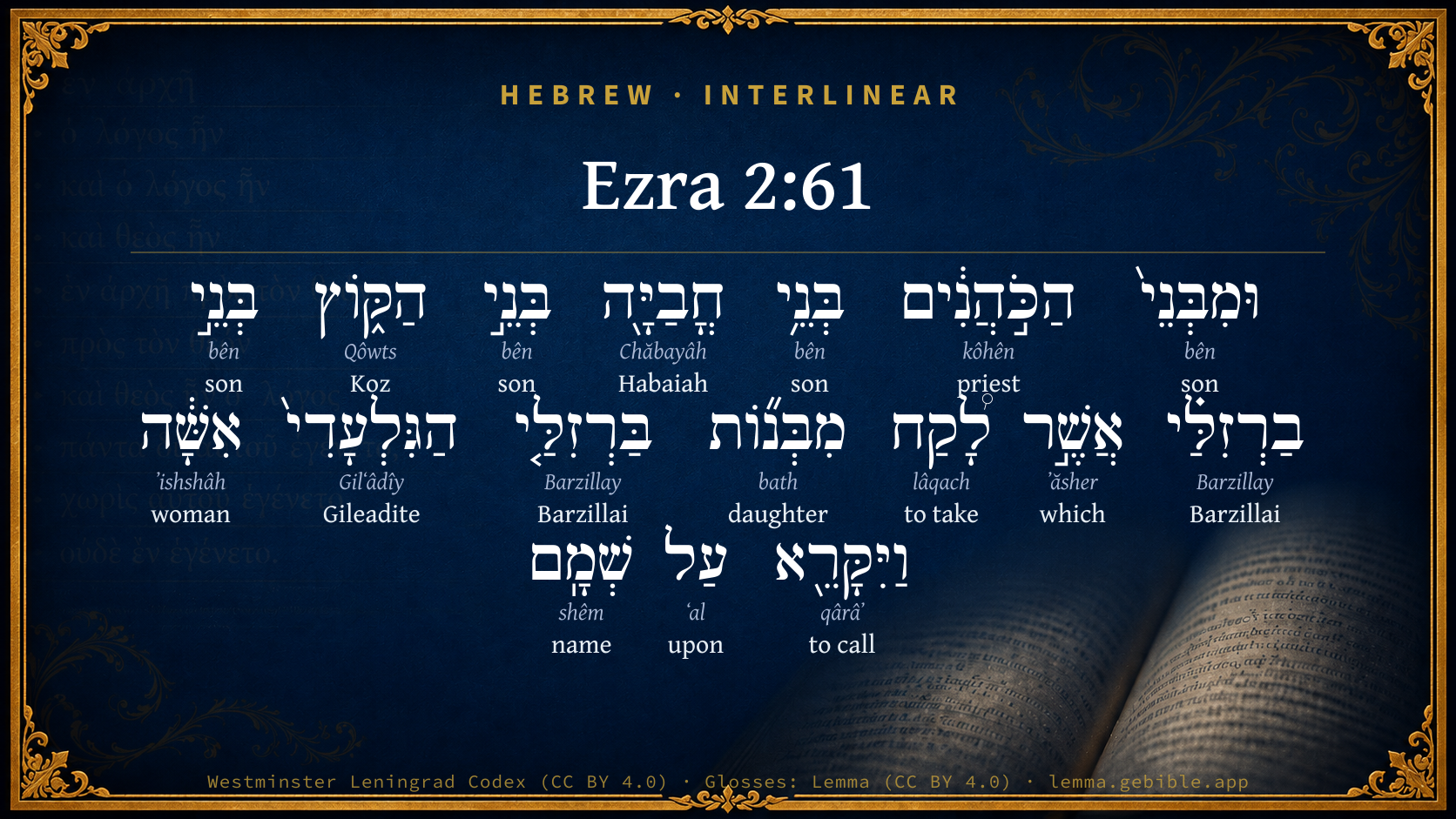
Ezra 2:61

Hebrew (Westminster Leningrad Codex) Ezra 2:61 appears in the Hebrew Old Testament. The text above is from the Westminster Leningrad Codex. Each word links to its Strong’s number, a concise gloss, and parsing drawn from the Open Scriptures Hebrew Bible morphology. Click any word for its full Brown-Driver-Briggs (BDB) entry.
Download image
Cite this verse

Ezra 2:61 (World English Bible). Public Domain. Lemma interlinear Bible study tool, https://lemma.gebible.app/v/ezra/2/61.

Show BibTeX & RIS
BibTeX
RIS
English Translation
Of the children of the priests: the children of Habaiah, the children of Hakkoz, the children of Barzillai, who took a wife of the daughters of Barzillai the Gileadite, and was called after their name.
World English Bible · Public Domain
Highlights
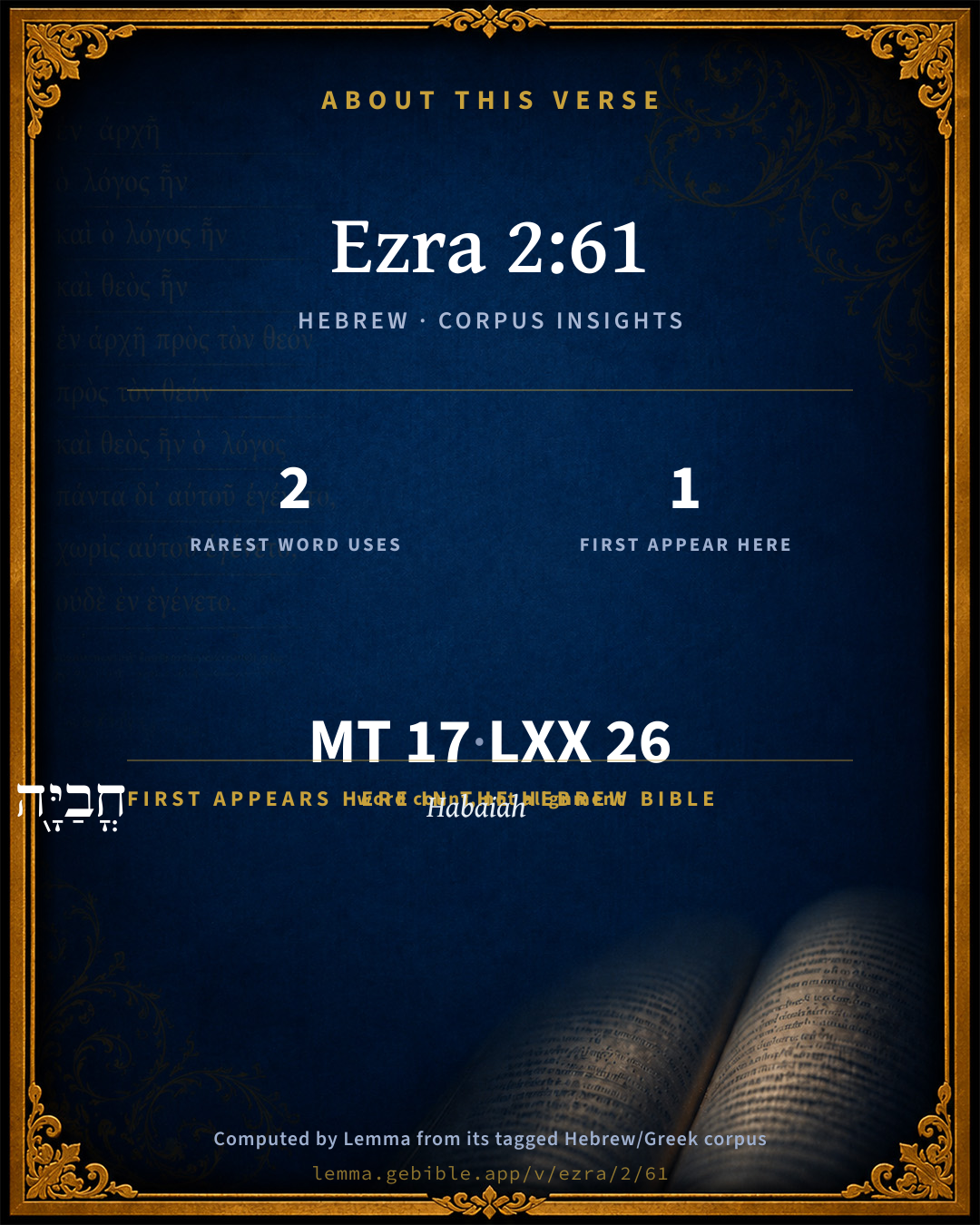
  • 1 first appearance in the Hebrew Bible
Full analysis ↓
Download a study sheet

One document with this verse’s original text, its word-by-word gloss line, the meaning frame, cross-references with their text, attributed commentary, and full source and license credits — printable, and it pastes into notes with its structure intact.

This verse Autodidact and up

Study sheet (.html) Plain text (.txt)

A passage Seminary Student

Up to 50 verses in one chapter. A passage sheet keeps up to 6 commentary sources and 12 cross-references per verse, in the order this page ranks them, and says so on the sheet whenever that leaves anything out. Ask for a single verse and you get the Autodidact verse sheet above.

Everything on this page stays free to read, with no account — the sheet is a download of what is already on screen, not access to it.

Want to remove ads? Support Godless Engineer
Compare translations 3

The same verse in 3 English versions, stacked beneath the original-language interlinear above. Click any original word for its lexicon entry.

Each is an independent rendering of the whole verse — the interlinear is not word-aligned to these translations.

Highlighted words mark where these versions differ — a whole-verse word diff, not a word-by-word alignment.

  • World English Bible Public Domain
    Of the children of the priests: the children of Habaiah, the children of Hakkoz, the children of Barzillai, who took a wife of the daughters of Barzillai the Gileadite, and was called after their name.
  • King James Version Public Domain
    And of the children of the priests: the children of Habaiah, the children of Koz, the children of Barzillai; which took a wife of the daughters of Barzillai the Gileadite, and was called after their name:
  • unfoldingWord Literal Text CC BY-SA 4.0
    And from the sons of the priests: the sons of Habaiah; the sons of Hakkoz; and the sons of Barzillai, who took a wife from the daughters of Barzillai the Gileadite, so he was called by their name.

unfoldingWord Literal Text — © unfoldingWord, licensed CC BY-SA 4.0. Word-aligned USFM3 via Door43 (git.door43.org/unfoldingWord/en_ult).

Versions to compare (up to 4)

3 of 4 selected

Show all 18 translations

Every available English version of this verse, each an independent rendering of the whole verse.

  • World English Bible Public Domain
    Of the children of the priests: the children of Habaiah, the children of Hakkoz, the children of Barzillai, who took a wife of the daughters of Barzillai the Gileadite, and was called after their name.
  • Berean Standard Bible Public Domain
    And from among the priests: the descendants of Hobaiah, the descendants of Hakkoz, and the descendants of Barzillai (who had married a daughter of Barzillai the Gileadite and was called by their name).
  • Majority Standard Bible Public Domain
    And from among the priests: the descendants of Hobaiah, the descendants of Hakkoz, and the descendants of Barzillai (who had married a daughter of Barzillai the Gileadite and was called by their name).
  • King James Version Public Domain
    And of the children of the priests: the children of Habaiah, the children of Koz, the children of Barzillai; which took a wife of the daughters of Barzillai the Gileadite, and was called after their name:
  • American Standard Version (1901) Public Domain
    And of the children of the priests: the children of Habaiah, the children of Hakkoz, the children of Barzillai, who took a wife of the daughters of Barzillai the Gileadite, and was called after their name.
  • Revised Version (1885) Public Domain
    And of the children of the priests: the children of Habaiah, the children of Hakkoz, the children of Barzillai, which took a wife of the daughters of Barzillai the Gileadite, and was called after their name.
  • Geneva Bible (1599) Public Domain
    And of the sonnes of the Priestes, the sonnes of Habaiah, the sonnes of Coz, the sonnes of Barzillai: which tooke of the daughters of Barzillai the Giliadite to wife, and was called after their name.
  • Douay-Rheims (1899) Public Domain
    And of the children of the priests: the children of Hobia, the children of Accos, the children of Berzellai, who took a wife of the daughters of Berzellai, the Galaadite, and was called by their name:
  • Young's Literal Translation Public Domain
    And of the sons of the priests: sons of Habaiah, sons of Koz, sons of Barzillai (who took from the daughters of Barzillai the Gileadite a wife, and is called by their name;)
  • Literal Standard Version CC BY-SA 4.0
    And of the sons of the priests: sons of Habaiah, sons of Koz, sons of Barzillai (who took a wife from the daughters of Barzillai the Gileadite, and is called by their name);
  • Unlocked Literal Bible CC BY-SA 4.0
    Also, from the priest's descendants: the descendants of Habaiah, Hakkoz, and Barzillai (who took his wife from the daughters of Barzillai of Gilead and was called by their name).
  • unfoldingWord Literal Text CC BY-SA 4.0
    And from the sons of the priests: the sons of Habaiah; the sons of Hakkoz; and the sons of Barzillai, who took a wife from the daughters of Barzillai the Gileadite, so he was called by their name.
  • Darby Bible Public Domain
    And of the children of the priests: the children of Habaiah, the children of Koz, the children of Barzillai; who took a wife of the daughters of Barzillai the Gileadite, and was called after their name.
  • World Messianic Bible Public Domain
    Of the children of the priests: the children of Habaiah, the children of Hakkoz, and the children of Barzillai, who took a wife of the daughters of Barzillai the Gileadite, and was called after their name.
  • Webster's Bible Public Domain
    And of the children of the priests: the children of Habaiah, the children of Koz, the children of Barzillai: who took a wife of the daughters of Barzillai the Gileadite, and was called after their name:
  • Free Bible Version CC BY-SA 4.0
    In addition there were three priestly families, sons of Hobaiah, Hakkoz, and Barzillai. (Barzillai had married a woman descended from Barzillai of Gilead, and he was called by that name.)
  • Bible in Basic English Public Domain
    And of the children of the priests: the children of Habaiah, the children of Hakkoz, the children of Barzillai, who was married to one of the daughters of Barzillai the Gileadite, and took their name.
  • JPS Tanakh (1917) Public Domain
    And of the children of the priests: the children of Habaiah, the children of Hakkoz, the children of Barzillai, who took a wife of the daughters of Barzillai the Gileadite, and was called after their name.

Literal Standard Version (2020), Covenant Press — licensed CC BY-SA 4.0. Text via the HelloAO Bible API (eBible.org). Unlocked Literal Bible (unfoldingWord) — licensed CC BY-SA 4.0. Text via the HelloAO Bible API (eBible.org). unfoldingWord Literal Text — © unfoldingWord, licensed CC BY-SA 4.0. Word-aligned USFM3 via Door43 (git.door43.org/unfoldingWord/en_ult). Free Bible Version, Dr. Jonathan Gallagher — licensed CC BY-SA 4.0. Text via the HelloAO Bible API (eBible.org).

Word by word

More ways to search: Search by grammar → Find every occurrence → Compare this word →

Practice this passage: Drill this verse → Learn its vocabulary →

חֳבַיָּ֖ה
Chăbayâh
H2252
“Habaiah”
Noun, Proper
Part of Speech
Noun
Type
Proper
Full BDB Definition

Origin: from H2247 and H3050

TWOT: None

Habaiah = "Jehovah has hidden" - head of a priestly family who returned from exile with Zerubbabel
  1. וּמִבְּנֵי֙ bên H1121 “and · from · sons of” Conjunction + Preposition + Noun, Common, Masculine, Plural, Construct
  2. הַכֹּ֣הֲנִ֔ים kôhên H3548 “the · priests” Particle, Definite Article + Noun, Common, Masculine, Plural, Absolute
  3. בְּנֵ֥י bên H1121 “sons of” Noun, Common, Masculine, Plural, Construct
  4. בְּנֵ֣י bên H1121 “sons of” Noun, Common, Masculine, Plural, Construct
  5. הַקּ֑וֹץ Qôwts H6976 “Koz” Noun, Proper
  6. בְּנֵ֣י bên H1121 “sons of” Noun, Common, Masculine, Plural, Construct
  7. בַרְזִלַּ֗י Barzillay H1271 “Barzillai” Noun, Proper
  8. אֲשֶׁ֣ר ʼăsher H834 “which” Particle, Relative
  9. לָ֠קַח lâqach H3947 “to take” Verb, Qal, Perfect, 3rd Person, Masculine, Singular
  10. מִבְּנ֞וֹת bath H1323 “from · daughters of” Preposition + Noun, Common, Feminine, Plural, Construct
  11. בַּרְזִלַּ֤י Barzillay H1271 “Barzillai” Noun, Proper
  12. הַגִּלְעָדִי֙ Gilʻâdîy H1569 “the · Gileadite” Particle, Definite Article + Noun, Gentilic, Masculine, Singular, Absolute
  13. אִשָּׁ֔ה ʼishshâh H802 “woman” Noun, Common, Feminine, Singular, Absolute
  14. וַיִּקָּרֵ֖א qârâʼ H7121 “and · to call” Conjunction + Verb, Niphal, Sequential Imperfect, 3rd Person, Masculine, Singular
  15. עַל ʻal H5921 “upon” Preposition
  16. שְׁמָֽם shêm H8034 “name · their” Noun, Common, Masculine, Singular, Construct + Suffix, Personal, 3rd Person, Masculine, Plural

About this verse

These counts appear in no published source. They are computed here, from the morphology-tagged text and Lemma’s own curated glosses. What Lemma adds →

17
words
13
distinct lemmas
Historical
section

Notable vocabulary

The rarest word here is חֳבַיָּ֖ה Habaiah H2252 — appearing just 2 times in the whole Hebrew Bible.

First appearance in Scripture

This word makes its first canonical appearance in the Hebrew Bible here:

  • חֳבַיָּ֖ה Habaiah H2252

Shared distinctive vocabulary

חֳבַיָּ֖ה Habaiah H2252 occurs in 2 verses of the Hebrew Bible. Also found in:

Grammatical profile

  • 2 verbs
  • 13 nouns
  • 1 preposition
  • 1 particle

Verb forms

  • לָ֠קַח Qal · Perfect
  • וַיִּקָּרֵ֖א Niphal · Sequential Imperfect

Repetition

Words recur within this verse — often emphatic in Hebrew:

  • וּמִבְּנֵי֙ son H1121 ×4
  • בַרְזִלַּ֗י Barzillai H1271 ×2

Hebrew & Septuagint length

In English translation the verse runs 35 words from the Hebrew and 36 from the Septuagint (LXX English) — closely comparable.

A rough comparison of the two English renderings, which tokenize alike — not a word-level alignment.

Word counts can differ between the Hebrew and the Greek without any difference in meaning — e.g. the Hebrew direct-object marker אֵת has no separate Greek word, and Greek often adds the article ὁ.

In the original languages it is 17 Hebrew tokens and 26 Greek tokens — but the two are counted differently (Hebrew bundles its prefixes and suffixes into one token; the Greek is in lemma form), so that isn’t a like-for-like length.

Cross-references

4

Topical passages linked to Ezra 2:61 in the Treasury of Scripture Knowledge — connected by theme and wording, ordered by reader-vote popularity; previews shown in the World English Bible.

  • 2 Samuel 17:27 It happened, when David was come to Mahanaim, that Shobi the son of Nahash of Rabbah of the children of Ammon, and Machir the son of Ammiel of Lodebar, and Barzillai the Gileadite of Rogelim,
  • 1 Kings 2:7 But show kindness to the sons of Barzillai the Gileadite, and let them be of those who eat at your table; for so they came to me when I fled from Absalom your brother.
  • 2 Samuel 19:31–39 Barzillai the Gileadite came down from Rogelim; and he went over the Jordan with the king, to conduct him over the Jordan.
  • Nehemiah 7:63–64 Of the priests: the children of Hobaiah, the children of Hakkoz, the children of Barzillai, who took a wife of the daughters of Barzillai the Gileadite, and was called after their name.

Cross-references courtesy of OpenBible.info (CC BY 4.0).

Hebrew and Greek witnesses Masoretic Hebrew ↔ Greek Septuagint

The same verse in the two great witnesses to the Old Testament, shown verse-for-verse.

These are two independent witnesses, not word-aligned to each other, and the Septuagint is shown in lemma (dictionary) form.

Hebrew Ezra 2:61 Masoretic · Westminster Leningrad Codex

וּמִבְּנֵי֙ הַכֹּ֣הֲנִ֔ים בְּנֵ֥י חֳבַיָּ֖ה בְּנֵ֣י הַקּ֑וֹץ בְּנֵ֣י בַרְזִלַּ֗י אֲשֶׁ֣ר לָ֠קַח מִבְּנ֞וֹת בַּרְזִלַּ֤י הַגִּלְעָדִי֙ אִשָּׁ֔ה וַיִּקָּרֵ֖א עַל שְׁמָֽם

Of the children of the priests: the children of Habaiah, the children of Hakkoz, the children of Barzillai, who took a wife of the daughters of Barzillai the Gileadite, and was called after their name.

World English Bible · Public Domain

Greek LXX Ezra 2:61 Septuagint · lemma form

καί ἀπό ὁ υἱός ὁ ἱερεύς υἱός χαβια υἱός ακους υἱός βερζελλαι ὅς λαμβάνω ἀπό θυγάτηρ βερζελλαι ὁ γαλααδίτης γυνή καί καλέω ἐπί ὁ ὄνομα αὐτός

And of the children of the priests, the children of Labeia, the children of Akkus, the children of Berzellai, who took a wife of the daughter of Berzellai the Galaadite, and was called by their name.

LXX2012 (modern English Septuagint) · Public Domain

In the Septuagint this is one book — Esdras B (2 Esdras): Ezra is chapters 1–10, Nehemiah 11–23.

Hebrew: Westminster Leningrad Codex (CC BY 4.0). Greek: Septuagint (public domain); English from LXX2012 (modern English Septuagint) (Public Domain). How the Septuagint differs from the Hebrew →

Commentary

Notes on Ezra 2:61 from classic Christian and Jewish commentators (each source and its license shown beneath its notes). The classic Christian expositions comment on the surrounding passage and are grouped to its opening verse, so a note may address several verses; the Jewish commentaries on the Tanakh (Rashi and others) are per-verse, so they appear only where the commentator wrote on this verse.

Lemma curates 59 commentaries, every one of them public domain or Creative Commons licensed, each selected and text-cleaned for this edition rather than reprinted as found. About our sources →

Trapp's Complete Commentary

John Trapp

Ezr 2:61 And of the children of the priests: the children of Habaiah, the children of Koz, the children of Barzillai; which took a wife of the daughters of Barzillai the Gileadite, and was called after their name:

Ver. 61. And was called after their name] After the name of his wife’s father, that noble Gileadite; as holding it a greater honour to be allied to Barzillai than to be looked upon as a priest. It was therefore just upon such proud and insolent people, that as they had once scorned the priesthood, so the priesthood should now scorn them.

John Trapp, A Commentary or Exposition upon All the Books of the Old and New Testament (1647–1656) — public domain. Text from a community e-Sword module.

Joseph Benson's Commentary

Ezr 2:61-62. And was called after their name — Namely, Barzillai; a name which he preferred before that of his own family, accounting it, as appears, a greater honour to be allied to so noble a family than to be a priest of the Lord. But by this vain ambition he deprived himself of the honour and advantage of the priesthood, as is here noted. They sought their register — The Jews were generally very exact in their genealogies, from their own choice and interest, that they might preserve the distinctions of the several tribes and families, which was necessary both to make out their titles to offices or inheritances, and to govern themselves thereby in the matter of marriages, and from the special providence of God, that so it might be certainly known of what tribe and family the Messiah was born.

Joseph Benson's Commentary on the Old and New Testaments (1811–1818) — public domain. Text from a community e-Sword module.

Tyndale Open Study Notes

Tyndale Open Resources

2:61-63 were not found: The lack of a genealogy was problematic for three families (2:61-62). They were excluded from priestly privileges or responsibilities until the high priest received divine direction through the use of the Urim and Thummim to determine the will of God (see Exod 28:30; Num 27:21). Although using the Urim and Thummim resembled throwing dice or drawing straws, when done by the priest, the result was a divine decision rather than blind chance.

Tyndale Open Study Notes — © Tyndale Open Resources, licensed CC BY-SA 4.0. Text via the HelloAO Bible API.

Geneva Bible (1599)

Geneva Bible translators

Of him is made mention, 2 Sam. 17:27 and 19:31, and because the Priest’s office was had in contempt, these would have changed their estate by their name, and so by God’s just judgment lost both the estimation of the world and the dignity of their office.

Geneva Bible (1599) marginal notes — public domain. Text via Bolls.life.

Jamieson, Fausset & Brown

Robert Jamieson, A. R. Fausset & David Brown

the children of Barzillai--He preferred that name to that of his own family, deeming it a greater distinction to be connected with so noble a family, than to be of the house of Levi. But by this worldly ambition he forfeited the dignity and advantages of the priesthood.

Jamieson, Fausset & Brown — Commentary Critical and Explanatory on the Whole Bible (1871) — public domain (CC PDM 1.0). Text via the HelloAO Bible API.

Ellicott's Commentary for English Readers

(61) Barzillai the Gileadite.—See the well-known history in 2Sa_17:27.

After their name.—Rather, after her name, she having been probably an heiress.

A Bible Commentary for English Readers, edited by Charles John Ellicott (1878–1897) — public domain. Text from a community e-Sword module.

The Cambridge Bible for Schools and Colleges

gen. ed. J. J. S. Perowne

61. Habaiah] This name appears in Neh_7:63 as ‘Hobaiah’. R.V.

Koz] R.V. ‘Hakkoz’. This name appears as that of the seventh priestly course in 1Ch_24:10.

of the daughters of Barzillai the Gileadite] Barzillai, the rich and noble Gileadite who assisted David during his flight from his son Absalom. Barzillai’s son Chimham accompanied David to Jerusalem on his return (2Sa_17:27; 2Sa_19:32 ff.; 1Ki_2:7). Chimham probably founded a family called after his own name, which resided at Bethlehem (Jer_41:17). Barzillai’s position and estates in Gilead were inherited by his daughters, through whom their father’s name was preserved. One of them was married to a priest, who thereupon received the family name. His descendants however were unable to make out their claim to belong to the priesthood; possibly on account of the confusion resulting from the altered name.

The R.V. places a full stop at the close of this verse.

The Cambridge Bible for Schools and Colleges (gen. ed. J. J. S. Perowne; Cambridge University Press, 1878–1918) — public domain. Text from a community e-Sword module.

John Gill's Exposition

The whole congregation together was forty and two thousand three hundred and threescore. But the sums before given make no more, with Zerubbabel, and the ten principal men, than 29,829, so that there are more than 12,000 wanting; wherefore, in answer to the question, where are the 12,000? the Jews say in their chronology (a) these are they of the other tribes, who set up the altar on its bases, and gave money to the masons, &c. Ezr 3:1, this was a much larger number than were carried captive; see Kg2 24:14, but not to be compared with the number that came out of Egypt, Exo 12:37. An Arabic writer (b) makes them 50,000, but wrongly.

(a) Seder Olam Rabba, c. 29. p. 86. (b) Abulpharag. Hist. Dynast. Dyn. 5. p. 82.

John Gill's Exposition of the Whole Bible (1746–1763) — public domain (CC PDM 1.0). Text via the HelloAO Bible API.

Haydock's Catholic Bible Commentary

Their name. The priest, Berzellai, assumed the name of the family, from which he had chosen a wife. (Haydock) --- It was that of the famous old man, who was so hospitable to David, 2 Kings xix. 31. (Calmet)

George Leo Haydock (1774–1849), Haydock's Catholic Family Bible and Commentary, 1859 edition — public domain. Excludes Psalms (Douay-Rheims chapter numbering differs from Protestant) and Deuterocanonical books (Catholic canon only).

Matthew Poole's English Annotations

To wit, Barzillai; which name he preferred before that of his own family, accounting it, as it seems, a greater honour to be allied to so noble a family, than to be a priest of the Lord. But by this ambition he deprived himself of the honour and advantage of the priesthood, as it is here noted, Ezr 2:62.

Matthew Poole's English Annotations on the Holy Bible (1683–1685) — public domain. Text from a community e-Sword/MySword module.

Whedon's Commentary on the Bible

Daniel D. Whedon

61. The children of Barzillai — So called, as is immediately explained, because their ancestor, a priest, had married a daughter of the distinguished Gileadite, who showed great kindness to David. 2Sa_17:27; 2Sa_19:32-39; 1Ki_2:7.

Their name — The name of the daughters. Hence the confusion in their genealogy.

Daniel D. Whedon (gen. ed.), Commentary on the Old and New Testaments (1874–1909) — public domain. Text from a community e-Sword module.

The Pulpit Commentary

Of the children of the priests. Some of those who claimed to be descendants of Aaron, and therefore priests, had also lost the evidence of their descent. This loss was held to disqualify them from the exercise of the priestly office (ver. 62).

HOMILIES BY J.A. MACDONALD Vers. 61-63.

The privileges of the priesthood.

We are here forcibly reminded

I THAT THE PRIESTHOOD HAD ITS PRIVILEGES. These were

1. They were sanctified to the service of God.

(1) Distinguished from the tribes whose inheritance was in the soil. (see Num_18:20)

(2) Distinguished among the Levites. They were sons of Aaron. Were served by the Levites. While they served in the holy places, at the altar, within the veil. (see Num_18:7)

2. They ate of the most holy things.

(1) As Levites, they had tithes from the nation.

(2) As priests, they had tithes from the Levites. (Num_18:20, Num_18:21, Num_18:26-28)

(3) They partook of the altar. (see Lev_6:16, 26 7:6, etc.)

(4) They ate the shew-bread of the Presence, viz., of the Shekinah, the visible glory of God. All this symbolically expressed near fellowship with God.

II THE LAW PRIESTS WERE TYPES OF TRUE CHRISTIANS.

1. In their birth, as sons of Aaron.

(1) Aaron was a type of Christ. See arguments in Epistle to the Hebrews.

(2) Christians are of the family of Christ. (see Eph_3:14, Eph_3:15; Gal_4:4-7) Have we the spiritual birth?

2. In their office, as priests of God.

(1) Christians are a spiritual priesthood. (see Isa_61:6; 1Pe_2:5, 1Pe_2:9; Rev_1:6)

(2) They have a spiritual consecration. (see 2Co_1:21; 1Jn_2:20, 1Jn_2:27)

(3) They offer spiritual sacrifices. Themselves. (Rom_12:1) Sacrifices of prayer, of praise, of service. (see Hos_14:2; Heb_13:15)

3. In the privileges of their office.

(1) They draw nigh to God. The law priest entered the holy place. We enter the most holy. (see Heb_10:19-22)

(2) They feast with God. This glorious fellowship is now expressed in the Lord"s Supper.

III THOSE WHO ASPIRE TO THESE PRIVILEGES MUST BE ABLE TO SHOW A VALID TITLE,

1. As to the priesthood under the law.

(1) Case of the children of Habai and Koz. These not elsewhere otherwise mentioned. Here acknowledged as sons of Aaron. Their reputed descendants could not show their genealogy from them.

(2) Case of the children of Barzillai"s daughter. Honourable mention made of Barzillai. (see 2Sa_17:27-29 2Sa_19:31-39) This accounts for descendants of his daughter assuming his name rather than that of their father.

(3) They were therefore excluded (Hebrews, polluted) from the priesthood. Lost the sanctity; also the privileges.

2. As to the priesthood under the gospel.

(1) As with the aspirants through Habai and Koz, the reputation of being of the family of Jesus will not avail. Have you evidence of spiritual birth?

(2) As with the aspirants bearing the honourable name of Barzillai, respectability will not avail in place of a spiritual title. We must be real.

(3) The Tirshatha will scrutinize our claims. We must all pass the scrutiny of the judgment.

3. But is it possible for us to make up a valid title?

(1) What does the Tirshatha say (see ver. 68)?

(2) The Urim and Thummim were wanting then. These were used in the breastplate of the high priest for obtaining responses from the Shekinah of God in the temple. Neither these "lights and perfections" nor the Shekinah to illuminate them were found in the second temple.

(3) We have a High Priest who stands up with these, even Jesus, who ministers in the grander temple. Through his glorious Spirit, the true Shekinah, we have in our breasts the most perfect illuminations. By these we ascertain our spiritual birth with its titles. Have we this most sacred, this most indubitable assurance? J.A.M.

The Pulpit Commentary (1880–1919), ed. H.D.M. Spence-Jones & Joseph S. Exell — public domain. Text from a community e-Sword module.

Keil & Delitzsch

C. F. Keil & F. Delitzsch

Priests who could not prove themselves members of the priesthood. Comp. Neh 7:63-65. - Three such families are named: the sons of Habaiah, the sons of Hakkoz, the sons of Barzillai. These could not discover their family registers, and were excluded from the exercise of priestly functions. Of these three names, that of Hakkoz occurs as the seventh order of priests; but the names alone did not suffice to prove their priesthood, this being also borne by other persons. Comp. Neh 3:4. The sons of Barzillai were the descendants of a priest who had married a daughter, probably an heiress (Num), of Barzillai the Gileadite, so well known in the history of David (Sa2 17:27; Sa2 19:32-39; Kg1 2:7), and had taken her name for the sake of taking possession of her inheritance (the suffix שׁמם refers to בּנות; see on Num 27:1-11). That by contracting this marriage he had not renounced for himself and his descendants his priestly privileges, is evident from the fact, that when his posterity returned from captivity, they laid claim to these privileges. The assumption, however, of the name of Barzillai might have cast such a doubt upon their priestly origin as to make it necessary that this should be proved from the genealogical registers, and a search in these did not lead to the desired discovery. כּתבם is their ספר יחשׂ, Neh 7:5, the book or record in which their genealogy was registered. The title of this record was המּתיחשׁים, the Enregistered: the word is in apposition to כּתבם, and the plural נמצאוּ agrees with it, while in Neh 7:64 the singular נמצא agrees with כתבם. They were declared to be polluted from the priesthood, i.e., they were excluded from the priesthood as polluted or unclean. The construction of the Pual יגאלוּ with מן is significant.

Keil & Delitzsch — Biblical Commentary on the Old Testament (1861–1891) — public domain (CC PDM 1.0). Text via the HelloAO Bible API. (Old Testament only.)

unfoldingWord translationNotes

Door43 World Missions Community

Habaiah ... Hakkoz ... Barzillai

These are men's names. (See: How to Translate Names)

their genealogical records

the records that told who their ancestors were

could not find them

"could not find their names in the records of the priests"

they were excluded from the priesthood as unclean

This can be translated in active form. The abstract noun "priesthood" can be translated as the verb "work as priests." AT: "the other priests treated them as if they were unclean and did not allow them to work as priests" (See: Active or Passive and Abstract Nouns)

unclean

not fit to be priests

Urim and Thummim

two items like dice that the priests used to decide what God wanted them to do

translationWords

priest

descend

Gilead

name

defile

govern

holy

sacrifice

unfoldingWord translationNotes — © Distant Shores Media and the Door43 World Missions Community, licensed CC BY-SA 4.0. Source: git.door43.org/Door43/en_tn.

Rashi

Rabbi Shlomo Yitzchaki (Rashi)

who took Each one of the sons of Barzillai the Gileadite took a wife.

and was called by their name And the name of Barzillai was called on their name because they took of his daughters.

Rashi on the Tanakh — English translations: “The Judaica Press complete Tanach with Rashi, translated by A. J. Rosenberg” (CC BY 4.0); “Pentateuch with Rashi's commentary by M. Rosenbaum and A.M. Silbermann, 1929-1934” (public domain); “The Metsudah Tanach series, Lakewood, N.J” (CC BY 4.0); and “The Book of Joshua, Metsudah Publications, 1997” (CC BY 4.0). Text via Sefaria.

Lesson kit

Teaching starters — assembled from the data on this page, not authored interpretation. Every prompt links to the verse data it draws on. Edit before teaching.

Ezra, in the Historical, opens this verse with 17 words (13 distinct Hebrew lemmas). Its most distinctive word is Chăbayâh (“Habaiah”). A historical commentator’s framing appears above. Read the whole chapter for the surrounding context.

Discussion questions

  1. The word Chăbayâh carries the sense “Habaiah.” How does it shape the verse?
  2. This is the first place “Habaiah” appears in Scripture (first appears here). What does its debut here establish?
  3. How does Nehemiah 7:63, which shares the word «Habaiah», read alongside this verse?
  4. What does the repetition of “son” (4× in this one verse) do in this verse?
  5. These translations render this verse differently. What is at stake in choosing one wording over another?
  6. «לָ֠קַח» is a Qal Perfect verb. How does that grammatical form shape the action described?
  7. Compare how Trapp's Complete Commentary and Joseph Benson's Commentary read this verse. Where do they agree or differ?

Things to notice

Reading settings

Reading text

Shown beneath each verse's original-language words.

Old Testament
Old Testament edition

Read the OT as the Masoretic Hebrew (MT) or the Greek Septuagint (LXX).

English shown for the Greek Septuagint (in the Hebrew ↔ Greek comparison).

Comparing translations? Open the Compare panel on any verse page to stack up to four side by side.