
1 Chronicles 6:20

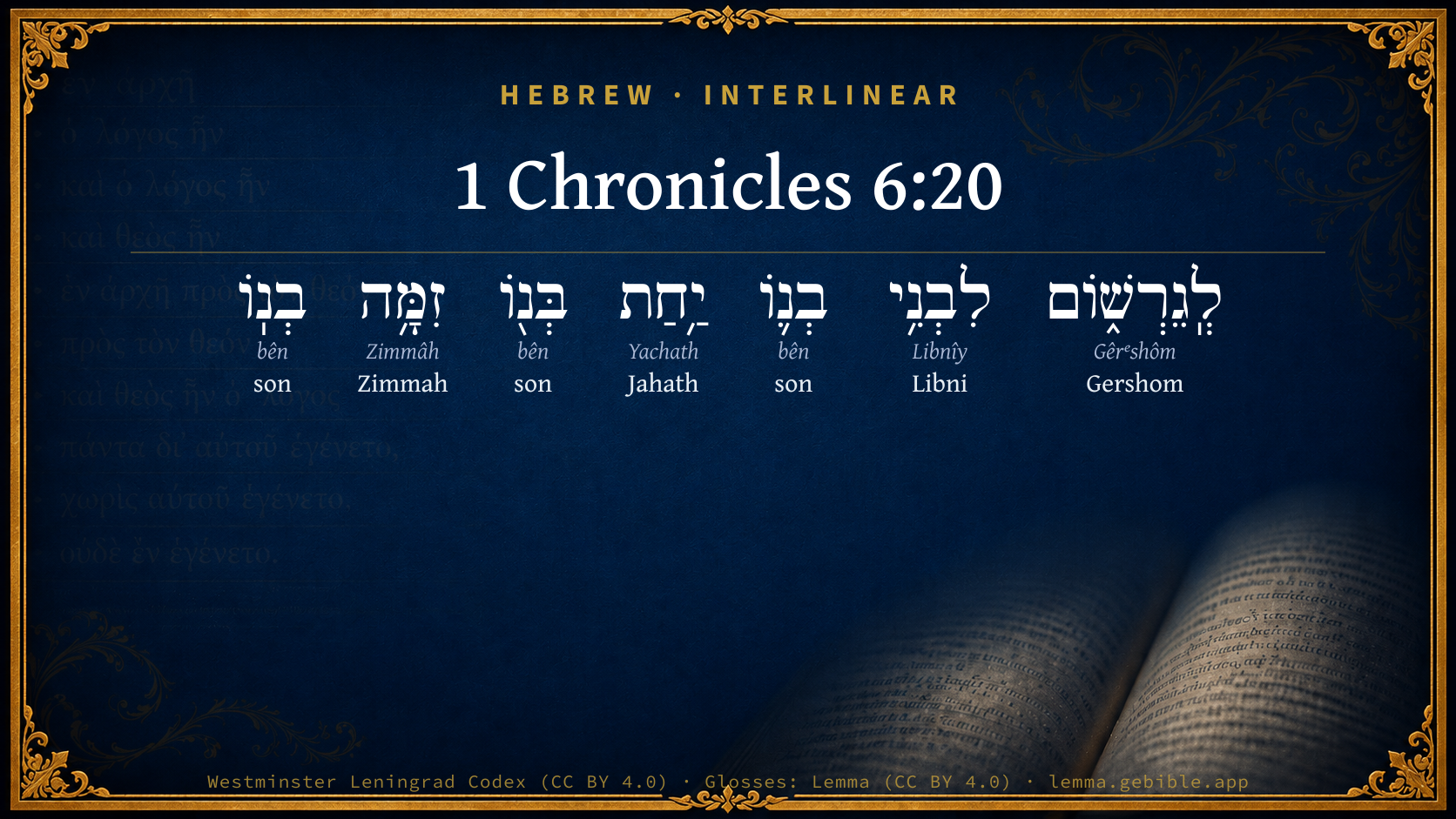
Hebrew (Westminster Leningrad Codex) 1 Chronicles 6:20 appears in the Hebrew Old Testament. The text above is from the Westminster Leningrad Codex. Each word links to its Strong’s number, a concise gloss, and parsing drawn from the Open Scriptures Hebrew Bible morphology. Click any word for its full Brown-Driver-Briggs (BDB) entry.
Download image
Cite this verse

1 Chronicles 6:20 (World English Bible). Public Domain. Lemma interlinear Bible study tool, https://lemma.gebible.app/v/1-chronicles/6/20.

Show BibTeX & RIS
BibTeX
RIS
English Translation
Of Gershom: Libni his son, Jahath his son, Zimmah his son,
World English Bible · Public Domain
Highlights
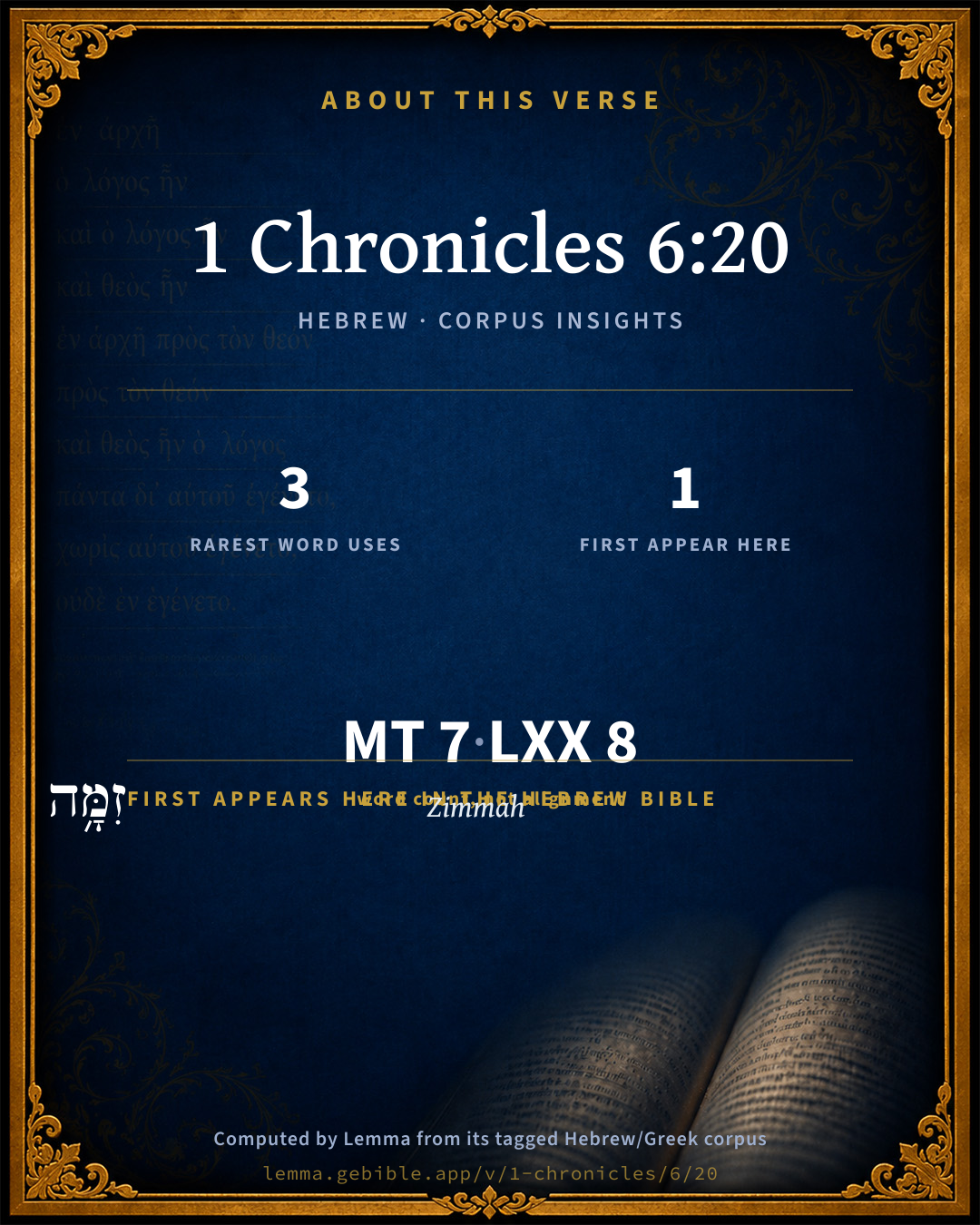
  • 1 first appearance in the Hebrew Bible
Full analysis ↓
Download a study sheet

One document with this verse’s original text, its word-by-word gloss line, the meaning frame, cross-references with their text, attributed commentary, and full source and license credits — printable, and it pastes into notes with its structure intact.

This verse Autodidact and up

Study sheet (.html) Plain text (.txt)

A passage Seminary Student

Up to 50 verses in one chapter. A passage sheet keeps up to 6 commentary sources and 12 cross-references per verse, in the order this page ranks them, and says so on the sheet whenever that leaves anything out. Ask for a single verse and you get the Autodidact verse sheet above.

Everything on this page stays free to read, with no account — the sheet is a download of what is already on screen, not access to it.

Want to remove ads? Support Godless Engineer
Compare translations 3

The same verse in 3 English versions, stacked beneath the original-language interlinear above. Click any original word for its lexicon entry.

Each is an independent rendering of the whole verse — the interlinear is not word-aligned to these translations.

Highlighted words mark where these versions differ — a whole-verse word diff, not a word-by-word alignment.

  • World English Bible Public Domain
    Of Gershom: Libni his son, Jahath his son, Zimmah his son,
  • King James Version Public Domain
    Of Gershom; Libni his son, Jahath his son, Zimmah his son,
  • unfoldingWord Literal Text CC BY-SA 4.0
    Of Gershom: Libni his son, Jahath his son, Zimmah his son,

unfoldingWord Literal Text — © unfoldingWord, licensed CC BY-SA 4.0. Word-aligned USFM3 via Door43 (git.door43.org/unfoldingWord/en_ult).

Versions to compare (up to 4)

3 of 4 selected

Show all 18 translations

Every available English version of this verse, each an independent rendering of the whole verse.

  • World English Bible Public Domain
    Of Gershom: Libni his son, Jahath his son, Zimmah his son,
  • Berean Standard Bible Public Domain
    Of Gershom: Libni his son, Jahath his son, Zimmah his son,
  • Majority Standard Bible Public Domain
    Of Gershom: Libni his son, Jahath his son, Zimmah his son,
  • King James Version Public Domain
    Of Gershom; Libni his son, Jahath his son, Zimmah his son,
  • American Standard Version (1901) Public Domain
    Of Gershom: Libni his son, Jahath his son, Zimmah his son,
  • Revised Version (1885) Public Domain
    Of Gershom; Libni his son, Jahath his son, Zimmah his son;
  • Geneva Bible (1599) Public Domain
    Of Gershom, Libni his sonne, Iahath his sonne, Zimmah his sonne,
  • Douay-Rheims (1899) Public Domain
    Of Gerson: Lobni his son, Jahath his son, Zamma his son,
  • Young's Literal Translation Public Domain
    of Gershom: Libni his son, Jahath his son, Zimmah his son,
  • Literal Standard Version CC BY-SA 4.0
    of Gershom: Libni his son, Jahath his son, Zimmah his son,
  • Unlocked Literal Bible CC BY-SA 4.0
    The descendants of Gershon: His son was Libni. Libni's son was Jahath. His son was Zimmah.
  • unfoldingWord Literal Text CC BY-SA 4.0
    Of Gershom: Libni his son, Jahath his son, Zimmah his son,
  • Darby Bible Public Domain
    Of Gershom: Libni his son, Jahath his son, Zimmah his son,
  • World Messianic Bible Public Domain
    Of Gershom: Libni his son, Jahath his son, Zimmah his son,
  • Webster's Bible Public Domain
    Of Gershom; Libni his son, Jahath his son, Zimmah his son,
  • Free Bible Version CC BY-SA 4.0
    The descendants of Gershon: Libni his son, Jehath his son, Zimmah his son,
  • Bible in Basic English Public Domain
    Of Gershom: Libni his son, Jahath his son, Zimmah his son,
  • JPS Tanakh (1917) Public Domain
    (6-5) Of Gershom: Libni his son, Jahath his son, Zimmah his son;

Literal Standard Version (2020), Covenant Press — licensed CC BY-SA 4.0. Text via the HelloAO Bible API (eBible.org). Unlocked Literal Bible (unfoldingWord) — licensed CC BY-SA 4.0. Text via the HelloAO Bible API (eBible.org). unfoldingWord Literal Text — © unfoldingWord, licensed CC BY-SA 4.0. Word-aligned USFM3 via Door43 (git.door43.org/unfoldingWord/en_ult). Free Bible Version, Dr. Jonathan Gallagher — licensed CC BY-SA 4.0. Text via the HelloAO Bible API (eBible.org).

Word by word

More ways to search: Search by grammar → Find every occurrence → Compare this word →

Practice this passage: Drill this verse → Learn its vocabulary →

About this verse

These counts appear in no published source. They are computed here, from the morphology-tagged text and Lemma’s own curated glosses. What Lemma adds →

7
words
5
distinct lemmas
Historical
section

Notable vocabulary

The rarest word here is זִמָּ֥ה Zimmah H2155 — appearing just 3 times in the whole Hebrew Bible.

First appearance in Scripture

This word makes its first canonical appearance in the Hebrew Bible here:

  • זִמָּ֥ה Zimmah H2155

Shared distinctive vocabulary

זִמָּ֥ה Zimmah H2155 occurs in 3 verses of the Hebrew Bible. Also found in:

Grammatical profile

  • 7 nouns

Repetition

A word recurs within this verse — often emphatic in Hebrew:

  • בְנ֛וֹ son H1121 ×3

Hebrew & Septuagint length

In English translation the verse runs 11 words from the Hebrew and 12 from the Septuagint (LXX English) — closely comparable.

A rough comparison of the two English renderings, which tokenize alike — not a word-level alignment.

Word counts can differ between the Hebrew and the Greek without any difference in meaning — e.g. the Hebrew direct-object marker אֵת has no separate Greek word, and Greek often adds the article ὁ.

In the original languages it is 7 Hebrew tokens and 8 Greek tokens — but the two are counted differently (Hebrew bundles its prefixes and suffixes into one token; the Greek is in lemma form), so that isn’t a like-for-like length.

Cross-references

1

Topical passages linked to 1 Chronicles 6:20 in the Treasury of Scripture Knowledge — connected by theme and wording, ordered by reader-vote popularity; previews shown in the World English Bible.

Cross-references courtesy of OpenBible.info (CC BY 4.0).

Hebrew and Greek witnesses Masoretic Hebrew ↔ Greek Septuagint

The same verse in the two great witnesses to the Old Testament, shown verse-for-verse.

These are two independent witnesses, not word-aligned to each other, and the Septuagint is shown in lemma (dictionary) form.

Hebrew 1 Chronicles 6:20 Masoretic · Westminster Leningrad Codex

לְֽגֵרְשׁ֑וֹם לִבְנִ֥י בְנ֛וֹ יַ֥חַת בְּנ֖וֹ זִמָּ֥ה בְנֽוֹ

Of Gershom: Libni his son, Jahath his son, Zimmah his son,

World English Bible · Public Domain

Greek LXX 1 Chronicles 6:20 Septuagint · lemma form

υἱός σουφ υἱός ελκανα υἱός μεθ υἱός αμασιας

To Gedson—to Lobeni his son—were born Jeth his son, Zammath his son,

LXX2012 (modern English Septuagint) · Public Domain

Hebrew: Westminster Leningrad Codex (CC BY 4.0). Greek: Septuagint (public domain); English from LXX2012 (modern English Septuagint) (Public Domain). How the Septuagint differs from the Hebrew →

Commentary

Notes on 1 Chronicles 6:20 from classic Christian and Jewish commentators (each source and its license shown beneath its notes). The classic Christian expositions comment on the surrounding passage and are grouped to its opening verse, so a note may address several verses; the Jewish commentaries on the Tanakh (Rashi and others) are per-verse, so they appear only where the commentator wrote on this verse.

Lemma curates 59 commentaries, every one of them public domain or Creative Commons licensed, each selected and text-cleaned for this edition rather than reprinted as found. About our sources →

Jamieson, Fausset & Brown

Robert Jamieson, A. R. Fausset & David Brown

Zimmah his son--his grandson (Ch1 6:42).

Jamieson, Fausset & Brown — Commentary Critical and Explanatory on the Whole Bible (1871) — public domain (CC PDM 1.0). Text via the HelloAO Bible API.

Ellicott's Commentary for English Readers

(20) Of Gershom.—Literally, to—i.e., belonging to Gershom.

Libni his son.—See Num_3:21, “To Gershon, the clan of the Libnite, and the clan of the Shimeite; these are the clans of the Gershonite.”

The names Jahath, Zimmah, and Zerah recur in the line of Asaph, 1Ch_6:41-43 below (see the Note there). Jeaterai, in whom the present series culminates, is wholly unknown. At the time when the list was first drawn up, the name may have represented a famous chieftain or family. It has the ending of a patronymic or gentilic term, and perhaps should be read with different vowels, we ‘Ithrai, or ‘Ithri, “and the Ithrite” (comp. ‘Ishai for Yishai), a clan of which came two of David’s heroes (1Ch_11:40).

(20, 21) The genealogy of the Gershonites in seven successive generations. It does not occur in the Pentateuch. This and the two following lists of Kohathites and Merarites are symmetrical in plan, but not in the number of names included.

A Bible Commentary for English Readers, edited by Charles John Ellicott (1878–1897) — public domain. Text from a community e-Sword module.

John Gill's Exposition

The sons of Merari; Mahli,.... The posterity of his brother Mushi are omitted; his genealogy is drawn thus, Libni, Shimei, Uzza, Shimea, Haggiah, Asaiah.

The sons of Merari; Mahli,.... The posterity of his brother Mushi are omitted; his genealogy is drawn thus, Libni, Shimei, Uzza, Shimea, Haggiah, Asaiah.

1 Chronicles 6:31

ch1 6:31

ch1 6:31

ch1 6:31And these are they,.... Who follow; the account of whom begins Ch1 6:33,

whom David set over the service of the song in the house of the Lord: whom he appointed chief musicians, and masters of the chorus, to manage and conduct that part of divine service in the sanctuary, singing the praises of God, both with vocal and instrumental music:

after the ark had rest; which was when it was brought from the house of Obededom to the city of David, and was placed in a tabernacle he provided for it, Sa2 6:12, where it remained until the temple was built, when and which was the only time it was removed, whereas before it had been removed from place to place, and so till now had no rest; though some understand this of the ceasing or silence of the oracle over the ark, which was neither consulted by Solomon and his successors, nor any of the high priests afterwards (g).

(g) Vid. Marsham. Canon. Chron. Setul. 14. p. 365.

John Gill's Exposition of the Whole Bible (1746–1763) — public domain (CC PDM 1.0). Text via the HelloAO Bible API.

Albert Barnes' Notes on the Bible

Of Gershom - The names in this list are curiously different from those in 1Ch 6:41-43, which yet appear to represent the same line reversed. Probably both lists are more or less corrupted, and, as in many genealogies, omission is made, to reduce the number of the names to seven. Compare e. g. 1Ch 6:22-28 with 1Ch 6:33-38. Compare the other genealogy ties of this chapter; and see also Matt. 1:1-17.

Albert Barnes' Notes on the Bible (1834–1885) — public domain. Text from a community e-Sword/MySword module.

Haydock's Catholic Bible Commentary

Jahath. See ver. 42, 43. --- Zamma springs from Semei, Jeth, Gerson, and has a son named Ethan, who has Adaia; as Zara begot Athanai, ver. 41. Almost all the names are rather different

George Leo Haydock (1774–1849), Haydock's Catholic Family Bible and Commentary, 1859 edition — public domain. Excludes Psalms (Douay-Rheims chapter numbering differs from Protestant) and Deuterocanonical books (Catholic canon only).

Matthew Poole's English Annotations

i.e. His grandson, by his son Shimei, as appears from 1Ch 6:42,43, the names of father and son being oft used in scripture of more remote progenitors or successors.

Matthew Poole's English Annotations on the Holy Bible (1683–1685) — public domain. Text from a community e-Sword/MySword module.

The Pulpit Commentary

Vers. 20, 21. (A) These verses apparently give seven lineal descendants of Gershom, through his eldest son Libni. The question is whether this list of seven is part of the longer list of thirteen from Gershom (vers. 39-43). terminating with Asaph; and it seems impossible to decide the question satisfactorily. From the occurrence of the name Shimei in this latter, though in the wrong place, viz. after Jahath in the descending order, instead of before him, some think, Keil and Zockler among them, that it is a line from Shimei, the brother of Libni, and second son of Gershom. If this be so, the occurrence of three names, the same and in the same order, is a thing to be remarked, though possible enough in itself. But if not, then either the names Joah, Iddo, Jeaterai, in the former list, must be interchangeable with Ethan, Adaiah, Ethni, respectively in the latter (a thing which the similarity of the Hebrew letters might render credible), while the Shimei of ver. 42 is omitted from ver. 20, and the Libni of ver. 20 from ver. 43; or the one list must pick up some links and leave others, and the other do likewise, whilst those taken the same by both are in the minority. This last supposition may be the more probable, though not free from difficulty. Zimmah. Beside the uncertainty of the identity of this Zimmah with the same name in ver. 42, it is very remarkable that we find a Zimmah, also father of a Joah, in 2Ch_29:12; also in this same passage we find three other reproductions of a similar kind father and son of what have first been found in this sixth chapter, viz. "Mahath, son of Amasai" (ver. 35); "Joel, son of Azariah" (ver. 36); "Kish, son of Abdi" (ver. 44). It seems as though the individual descendant was quoted in these instances by the name of the ancestor at a certain point.

The Pulpit Commentary (1880–1919), ed. H.D.M. Spence-Jones & Joseph S. Exell — public domain. Text from a community e-Sword module.

Keil & Delitzsch

C. F. Keil & F. Delitzsch

The sons of Merari; Mahli,.... The posterity of his brother Mushi are omitted; his genealogy is drawn thus, Libni, Shimei, Uzza, Shimea, Haggiah, Asaiah.

The sons of Merari; Mahli,.... The posterity of his brother Mushi are omitted; his genealogy is drawn thus, Libni, Shimei, Uzza, Shimea, Haggiah, Asaiah.

1 Chronicles 6:31

ch1 6:31

ch1 6:31

ch1 6:31And these are they,.... Who follow; the account of whom begins Ch1 6:33,

whom David set over the service of the song in the house of the Lord: whom he appointed chief musicians, and masters of the chorus, to manage and conduct that part of divine service in the sanctuary, singing the praises of God, both with vocal and instrumental music:

after the ark had rest; which was when it was brought from the house of Obededom to the city of David, and was placed in a tabernacle he provided for it, Sa2 6:12, where it remained until the temple was built, when and which was the only time it was removed, whereas before it had been removed from place to place, and so till now had no rest; though some understand this of the ceasing or silence of the oracle over the ark, which was neither consulted by Solomon and his successors, nor any of the high priests afterwards (g).

(g) Vid. Marsham. Canon. Chron. Setul. 14. p. 365.

Keil & Delitzsch — Biblical Commentary on the Old Testament (1861–1891) — public domain (CC PDM 1.0). Text via the HelloAO Bible API. (Old Testament only.)

Lesson kit

Teaching starters — assembled from the data on this page, not authored interpretation. Every prompt links to the verse data it draws on. Edit before teaching.

1 Chronicles, in the Historical, opens this verse with 7 words (5 distinct Hebrew lemmas). Its most distinctive word is Zimmâh (“Zimmah”). A historical commentator’s framing appears above. Read the whole chapter for the surrounding context.

Discussion questions

  1. What does “Zimmah” (Zimmâh) contribute to the verse as a whole?
  2. This is the first place “Zimmah” appears in Scripture (first appears here). What does its debut here establish?
  3. How does 1 Chronicles 6:42, which shares the word «Zimmah», read alongside this verse?
  4. What does the repetition of “son” (3× in this one verse) do in this verse?
  5. Compare how Jamieson, Fausset & Brown and Ellicott's Commentary for English Readers read this verse. Where do they agree or differ?

Things to notice

Reading settings

Reading text

Shown beneath each verse's original-language words.

Old Testament
Old Testament edition

Read the OT as the Masoretic Hebrew (MT) or the Greek Septuagint (LXX).

English shown for the Greek Septuagint (in the Hebrew ↔ Greek comparison).

Comparing translations? Open the Compare panel on any verse page to stack up to four side by side.