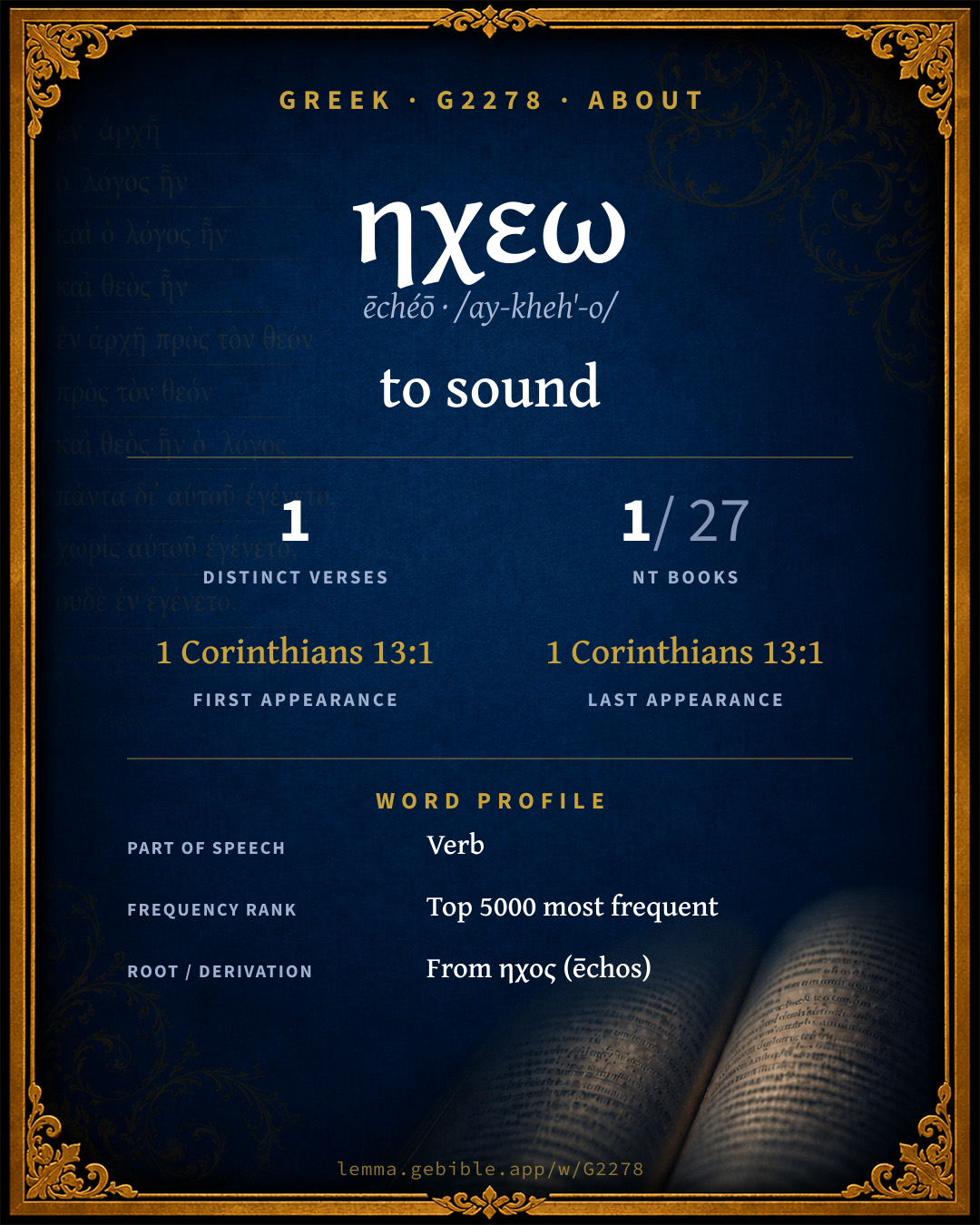
ἠχέω
to sound
Full lexicon entry — Thayer's Greek Lexicon
From Thayer's Greek Lexicon
Where this word appears
Grammar key — what these labels mean
Part of speech
- Verb
- An action or state-of-being word.
Tense
- Present
- Ongoing or general action in present time (imperfective aspect).
Voice
- Active
- The subject performs the action.
Mood
- Participle
- A verbal adjective (“writing,” “having written”).
Case
- Nominative
- The case of the subject (and the predicate nominative).
Gender
- Masculine
- Grammatically masculine.
Number
- Singular
- One.
Every verse where G2278 appears — 1 distinct verse across 1 book. Click any verse to open its interlinear word-by-word view. Verse text shown in the World English Bible for context — . Each verse’s Greek form is shown with its reference; the English is not keyword-highlighted, since the data carries no word-level English alignment. Use “Compare translations” on any verse to read it across multiple English versions. This concordance covers the Greek New Testament; Septuagint (Greek Old Testament) occurrences of this word are not indexed here.
1 Corinthians 1 verse
About this entry
At a glance — auto-summarized from this page’s data, not written by a person. Every figure links to its source below. This summary describes the numbers; it doesn’t interpret them.
At its core, ηχεω (ēchéō) means “to sound.” It is rare — just 1 verse in the entire Greek New Testament. Its uses cluster heavily in 1 Corinthians (100% of all occurrences). Scripture uses it exactly once, at 1 Corinthians 13:1. Dig into 1-verse concordance and the renderings breakdown below.
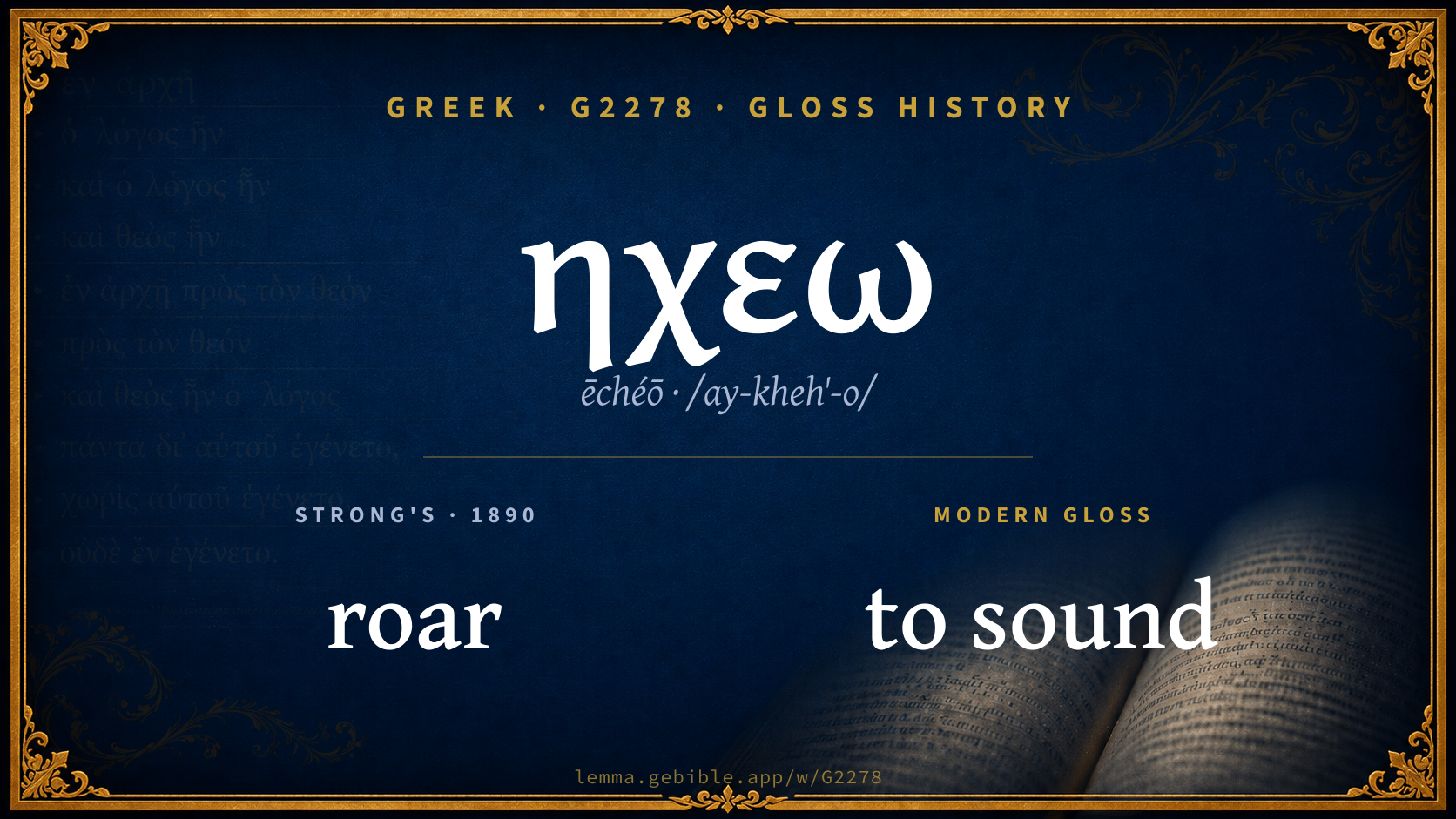
Gloss history
Strong's 1890 vs modern scholarship
About this word
Strong's G2278 catalogs a Greek word from the Greek New Testament.
These counts are not copied from any lexicon or concordance. They are computed here, from the morphology-tagged Greek New Testament. What Lemma adds →
- 1
- distinct verses
- The word appears in 1 distinct verse.
- 1 / 27
- NT books
- The word appears in 1 of 27 New Testament books.
- #3,503
- by frequency
- Top 5000 most frequent Greek words (rank 3,503 of 5,347 Greek words by occurrence).
View all 1 occurrence in the concordance →
Most concentrated in
- 1 Corinthians 1 verse 100%
By section of the New Testament
By traditional corpus
Conventional, traditional groupings — biblical authorship is debated, so this is a traditional corpus grouping, not an authorship claim. Some books belong to more than one corpus (Luke is in both the Gospels and the Lukan corpus, and so on), so these shares overlap and need not total 100%. Each figure is a share of the word’s 1 distinct verse.
- Pauline corpus 1 verse · 100%
How translations render this word
Counts come from each version’s own published word-to-Strong’s tagging or interlinear alignment — an approximate guide to how each version renders this word, not a word-level alignment the data otherwise carries. Because each total is that version’s own tagged count, the per-version totals vary from one another and need not match the appearance or distinct-verse counts above. These counts may also differ from a printed concordance because Lemma counts each distinctly tagged rendering and does not collapse phrase taggings into a single head-word total. This is a fixed set of word-tagged versions (KJV, ASV, BSB, ULT) and does not change with the reading translation you choose elsewhere. Each version’s license is shown beside its name below (and on Sources).
- King James Version: Roaring 1×, Sounding 1×
- American Standard Version: Roaring 1×, Sounding 1×
- Berean Standard Bible: Ringing 1×
- unfoldingWord Literal Text: Noisy 1×
King James Version Public Domain
Renders G2278 across 2 tagged occurrences — most commonly:
American Standard Version Public Domain
Renders G2278 across 2 tagged occurrences — most commonly:
Berean Standard Bible Public Domain
Renders G2278 across 1 tagged occurrence — most commonly:
unfoldingWord Literal Text CC BY-SA 4.0
Renders G2278 across 1 tagged occurrence — most commonly:
Senses in Thayer's
The 1 sense Thayer's distinguishes for this word, in lexicon order (not ranked by frequency or importance). The full entry — with sub-senses — is in the Lexicon Entry tab.
- used of the roaring of the sea
Word origin
Derived from ηχος (ēchos) (G2279) — sound.
From G2279 ; to make a loud noise that is reverberate : - roar sound.
— Strong’s Exhaustive Concordance (1890), public domain.
Septuagint usage
The same Greek word ηχεω appears 17 times in the Greek Old Testament (Septuagint), across 17 verses in 9 books.
- 17
- LXX occurrences
- Tagged occurrences of this Greek word in the Septuagint.
- 17
- verses
- Distinct Septuagint verses containing this word.
- 9 / 39
- OT books
- The word appears in 9 of the 39 Old Testament books.
Sample Septuagint occurrences
- Exodus 19:16 ἠχέω
- Ruth 1:19 ἠχέω
- 1 Samuel 3:11 ἠχέω
- 1 Kings 1:41 ἠχέω
- 2 Kings 21:12 ἠχέω
- Psalms 45:4 ἠχέω
- Isaiah 16:11 ἠχέω
- Jeremiah 5:22 ἠχέω
- Hosea 5:8 ἠχέω
Septuagint occurrences (same lexeme)
Every verse where the same Strong’s number (G2278) appears in the Greek Septuagint. Verse text shown in the World English Bible for context; the Greek form is the matched word — the English is not keyword-highlighted.
- Exodus 19:16 ἠχέω It happened on the third day, when it was morning, that there were thunders and lightnings, and a thick cloud on the mountain, and the sound of an exceedingly loud trumpet; and all the people who were in the camp trembled.
- Ruth 1:19 ἠχέω So they two went until they came to Bethlehem. It happened, when they were come to Bethlehem, that all the city was moved about them, and [the women] said, Is this Naomi?
- 1 Samuel 3:11 ἠχέω Yahweh said to Samuel, Behold, I will do a thing in Israel, at which both the ears of everyone who hears it shall tingle.
- 1 Samuel 4:5 ἠχέω When the ark of the covenant of Yahweh came into the camp, all Israel shouted with a great shout, so that the earth rang again.
- 1 Kings 1:41 ἠχέω Adonijah and all the guests who were with him heard it as they had made an end of eating. When Joab heard the sound of the trumpet, he said, Why is this noise of the city being in an uproar?
- 1 Kings 1:45 ἤχέω and Zadok the priest and Nathan the prophet have anointed him king in Gihon; and they are come up from there rejoicing, so that the city rang again. This is the noise that you have heard.
- 2 Kings 21:12 ἠχέω therefore thus says Yahweh, the God of Israel, Behold, I bring such evil on Jerusalem and Judah, that whoever hears of it, both his ears shall tingle.
- Psalms 45:4 ἠχέω In your majesty ride on victoriously on behalf of truth, humility, and righteousness. Let your right hand display awesome deeds.
- Psalms 82:3 ἠχέω "Defend the weak, the poor, and the fatherless. Maintain the rights of the poor and oppressed.
- Isaiah 16:11 ἠχέω Why my heart sounds like a harp for Moab, and my inward parts for Kir Heres.
- Isaiah 17:12 ἠχέω Ah, the uproar of many peoples, who roar like the roaring of the seas; and the rushing of nations, that rush like the rushing of mighty waters!
- Isaiah 51:15 ἠχέω For I am Yahweh your God, who stirs up the sea, so that the waves of it roar: Yahweh of Hosts is his name.
- Jeremiah 5:22 ἠχέω Don't you fear me? says Yahweh: won't you tremble at my presence, who have placed the sand for the bound of the sea, by a perpetual decree, that it can't pass it? and though the waves of it toss themselves, yet they can't prevail; though they roar, yet they can't pass over it.
- Jeremiah 19:3 ἠχέω and say, Hear you the word of Yahweh, kings of Judah, and inhabitants of Jerusalem: thus says Yahweh of Hosts, the God of Israel, Behold, I will bring evil on this place, which whoever hears, his ears shall tingle.
- Jeremiah 27:42 ἠχέω
- Jeremiah 28:55 ἠχέω
- Hosea 5:8 ἠχέω "Blow the cornet in Gibeah, And the trumpet in Ramah! Sound a battle cry at Beth Aven, behind you, Benjamin!
These are occurrences of the same Greek lexeme (G2278) in the Septuagint — not a translation of any one Hebrew word. The store carries no word-level Hebrew↔Greek alignment, so no Hebrew original is asserted here. Counts come from the recovered LXX Strong's tagging — high-frequency vocabulary is well covered, while rare or late forms may be untagged — so they reflect tagged occurrences and may slightly undercount.