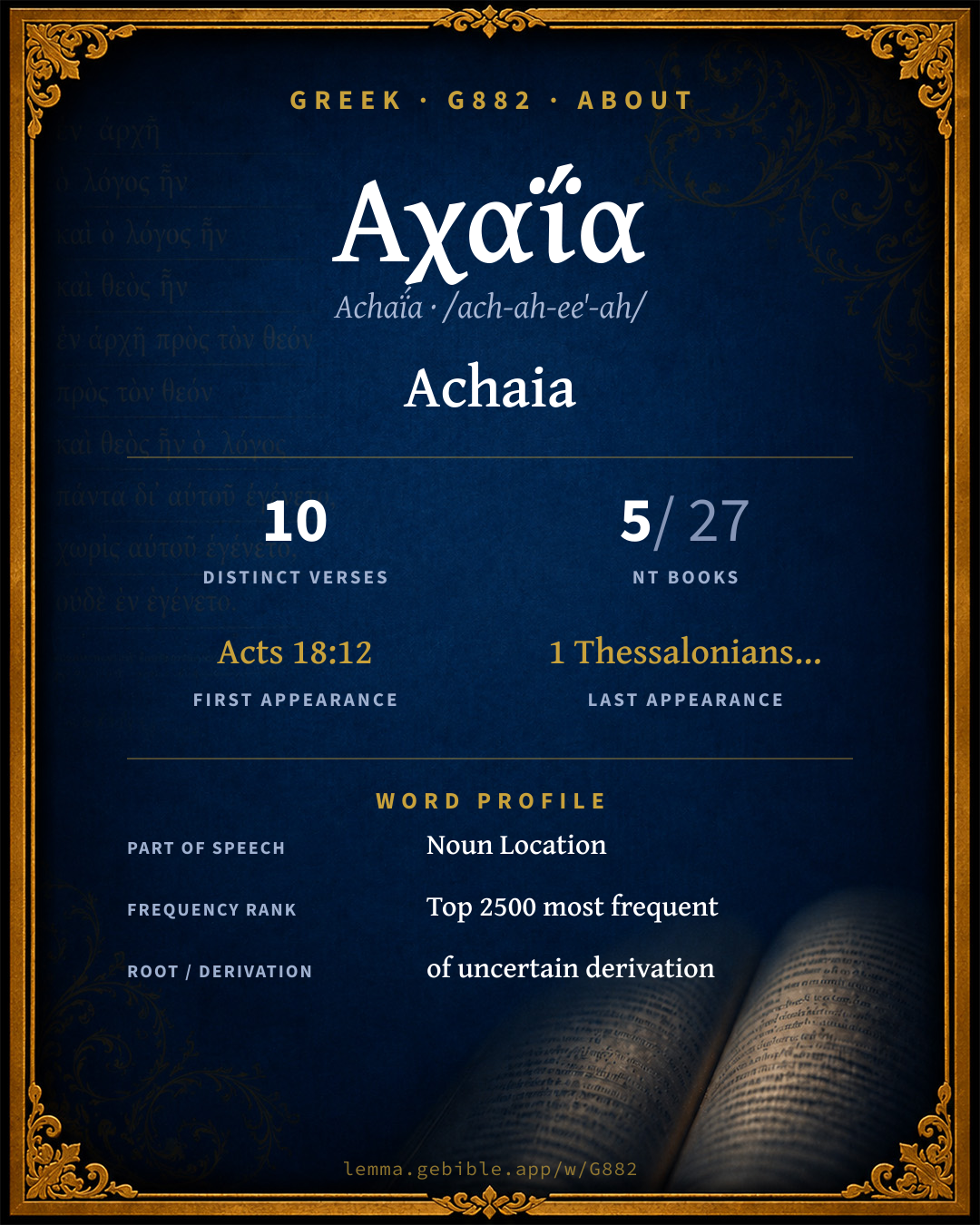
Ἀχαΐ́α
Achaia
Thayer's lists 3 entries for ‘Achaia’ fuller range ↓
Full lexicon entry — Thayer's Greek Lexicon
From Thayer's Greek Lexicon
Where this word appears
See every Dative-case word in the Greek New Testament →
Grammar key — what these labels mean
Part of speech
- Noun
- A naming word — a person, place, thing, or idea.
Case
- Dative
- The case of the indirect object, means, or location — “to / for / with / in.”
- Genitive
- The case of source, possession, or “of” — answers “whose / from what.”
- Accusative
- The case of the direct object and of extent.
- Nominative
- The case of the subject (and the predicate nominative).
Gender
- Feminine
- Grammatically feminine.
Number
- Singular
- One.
Grammatical forms
- Noun, Dative, Singular, Feminine 3 times (30%)
- Noun, Genitive, Singular, Feminine 3 times (30%)
- Noun, Accusative, Singular, Feminine 2 times (20%)
- Noun, Nominative, Singular, Feminine 2 times (20%)
Parsed forms decoded from the imported morphology (Robinson–Tischendorf, public domain), counted across 10 parsed occurrences — not distinct verses.
Every verse where G882 appears — 10 distinct verses across 5 books. Click any verse to open its interlinear word-by-word view. Verse text shown in the World English Bible for context — . Each verse’s Greek form is shown with its reference; the English is not keyword-highlighted, since the data carries no word-level English alignment. Use “Compare translations” on any verse to read it across multiple English versions. This concordance covers the Greek New Testament; Septuagint (Greek Old Testament) occurrences of this word are not indexed here.
Acts 3 verses
- Acts 18:12 Ἀχαΐας n gen sg fem But when Gallio was proconsul of Achaia, the Jews with one accord rose up against Paul and brought him before the judgment seat,
- Acts 18:27 Ἀχαΐαν n acc sg fem When he had determined to pass over into Achaia, the brothers encouraged him, and wrote to the disciples to receive him. When he had come, he greatly helped those who had believed through grace;
- Acts 19:21 Ἀχαΐαν n acc sg fem Now after these things had ended, Paul determined in the spirit, when he had passed through Macedonia and Achaia, to go to Jerusalem, saying, "After I have been there, I must also see Rome."
Romans 1 verse
1 Corinthians 1 verse
2 Corinthians 3 verses
- 2 Corinthians 1:1 Ἀχαΐᾳ n dat sg fem Paul, an apostle of Christ Jesus through the will of God, and Timothy our brother, to the assembly of God which is at Corinth, with all the saints who are in the whole of Achaia:
- 2 Corinthians 9:2 Ἀχαΐα n nom sg fem for I know your readiness, of which I boast on your behalf to them of Macedonia, that Achaia has been prepared for a year past. Your zeal has stirred up very many of them.
- 2 Corinthians 11:10 Ἀχαΐας n gen sg fem As the truth of Christ is in me, no one will stop me from this boasting in the regions of Achaia.
1 Thessalonians 2 verses
- 1 Thessalonians 1:7 Ἀχαΐᾳ n dat sg fem so that you became an example to all who believe in Macedonia and in Achaia.
- 1 Thessalonians 1:8 Ἀχαΐᾳ n dat sg fem For from you has sounded forth the word of the Lord, not only in Macedonia and Achaia, but also in every place your faith toward God has gone forth; so that we need not to say anything.
About this entry
At a glance — auto-summarized from this page’s data, not written by a person. Every figure links to its source below. This summary describes the numbers; it doesn’t interpret them.
The Greek name Αχαΐα centers on the idea of “Achaia.” Debuting at Acts 18:12, it then recurs through the corpus. Spanning 10 verses in 5 books, it ranks among the uncommon words of the Greek New Testament. Acts dominates its distribution — 3 of 10 verses. For the data behind this summary, explore 10-verse concordance and the renderings breakdown below.
Gloss history
Strong's 1890 vs modern scholarship
About this word
Strong's G882 catalogs a Greek word from the Greek New Testament.
These counts are not copied from any lexicon or concordance. They are computed here, from the morphology-tagged Greek New Testament. What Lemma adds →
- 10
- distinct verses
- The word appears in 10 distinct verses.
- 5 / 27
- NT books
- The word appears in 5 of 27 New Testament books.
- #1,056
- by frequency
- Top 2500 most frequent Greek words (rank 1,056 of 5,347 Greek words by occurrence).
View all 10 occurrences in the concordance →
Most concentrated in
- Acts 3 verses 30%
- 2 Corinthians 3 verses 30%
- 1 Thessalonians 2 verses 20%
By section of the New Testament
By traditional corpus
Conventional, traditional groupings — biblical authorship is debated, so this is a traditional corpus grouping, not an authorship claim. Some books belong to more than one corpus (Luke is in both the Gospels and the Lukan corpus, and so on), so these shares overlap and need not total 100%. Each figure is a share of the word’s 10 distinct verses.
- Pauline corpus 7 verses · 70%
- Lukan (Luke–Acts) 3 verses · 30%
How translations render this word
Counts come from each version’s own published word-to-Strong’s tagging or interlinear alignment — an approximate guide to how each version renders this word, not a word-level alignment the data otherwise carries. Because each total is that version’s own tagged count, the per-version totals vary from one another and need not match the appearance or distinct-verse counts above. These counts may also differ from a printed concordance because Lemma counts each distinctly tagged rendering and does not collapse phrase taggings into a single head-word total. This is a fixed set of word-tagged versions (KJV, ASV, BSB, ULT) and does not change with the reading translation you choose elsewhere. Each version’s license is shown beside its name below (and on Sources).
- King James Version: Achaia 11×
- American Standard Version: Achaia 9×
- Berean Standard Bible: Achaia 10×
- unfoldingWord Literal Text: Achaia 10×
King James Version Public Domain
Renders G882 across 11 tagged occurrences — most commonly:
American Standard Version Public Domain
Renders G882 across 10 tagged occurrences — most commonly:
Plus 1 rendering that appears only once — usually multi-word phrases or single function words the recovered tagging swept in, not distinct renderings.
Berean Standard Bible Public Domain
Renders G882 across 10 tagged occurrences — most commonly:
unfoldingWord Literal Text CC BY-SA 4.0
Renders G882 across 10 tagged occurrences — most commonly:
Senses in Thayer's
The 3 senses Thayer's distinguishes for this word, in lexicon order (not ranked by frequency or importance). The full entry — with sub-senses — is in the Lexicon Entry tab.
- Achaia = "trouble"
- in a restricted sense, the maritime region of northern Peloponnesus
- in a broader sense, a Roman province embracing all Greece except Thessaly
Word origin
Origin: of uncertain derivation
Of uncertain derivation; Achaia (that is Greece ) a country of Europe : - Achaia.
— Strong’s Exhaustive Concordance (1890), public domain.
Forms in the corpus
The 4 distinct written forms G882 takes in the Greek New Testament, most frequent first — each parse links to that case’s occurrences in the concordance.
| Form | Parsing | Example | Uses |
|---|---|---|---|
| Ἀχαΐας Achaí̈as | Noun, Genitive, Singular, Feminine | Acts 18:12 | 3 |
| Ἀχαΐᾳ Achaí̈a | Noun, Dative, Singular, Feminine | 2 Corinthians 1:1 | 3 |
| Ἀχαΐα Achaí̈a | Noun, Nominative, Singular, Feminine | Romans 15:26 | 2 |
| Ἀχαΐαν Achaí̈an | Noun, Accusative, Singular, Feminine | Acts 18:27 | 2 |
Same root — word family
Other Thayer's entries built from the same root as G882, grouped by Strong’s listed origin. These share a root / origin per the lexicon — not necessarily a shared meaning. Each links to that word’s own entry.
Proper names from this root
People and places named from this root — a name, not an additional meaning of the word.
Compare all same-root words → 1 of the same-root words is a proper name (a person or place). They share a root, not necessarily a meaning.
Bible dictionary
Public-domain dictionary articles matched to this entry by name (Achaia). A biblical name can be shared by more than one person or place, so an article may treat several.
Easton's Bible Dictionary · M. G. Easton, 1897
The name originally of a narrow strip of territory in Greece, on the north-west of the Peloponnesus. Subsequently it was applied by the Romans to the whole Peloponnesus, now called the Morea, and the south of Greece. It was then one of the two provinces (Macedonia being the other) into which they divided the country when it fell under their dominion. It is in this latter enlarged meaning that the name is always used in the New Testament (Acts 18:12, 27; 19:21; Rom. 15: 26; 16:5, etc.). It was at the time when Luke wrote the Acts of the Apostles under the proconsular form of government; hence the appropriate title given to Gallio as the "deputy," i.e., proconsul, of Achaia (Acts 18:12).
Smith's Bible Dictionary · William Smith, 1863
(trouble) signifies in the New Testament a Roman province which included the whole of the Peloponnesus and the greater part of Hellas proper, with the adjacent islands. This province, with that of Macedonia, comprehended the while of Greece; hence Achaia and Macedonia are frequently mentioned together in the New Testament to indicate all Greece. (Acts 18:12; 19:21; Romans 15:26; 16:5; 1 Corinthians 16:15; 2 Corinthians 7:5; 9:2; 11:10; 1 Thessalonians 1:7,8) In the time of the emperor Claudius it was governed by a proconsul, translated in the Authorized Version "deputy," of Achaia. (Acts 18:12)
Hitchcock's Bible Names Dictionary · Roswell D. Hitchcock, 1869
grief; trouble
Classic public-domain reference works; full attribution on Sources.