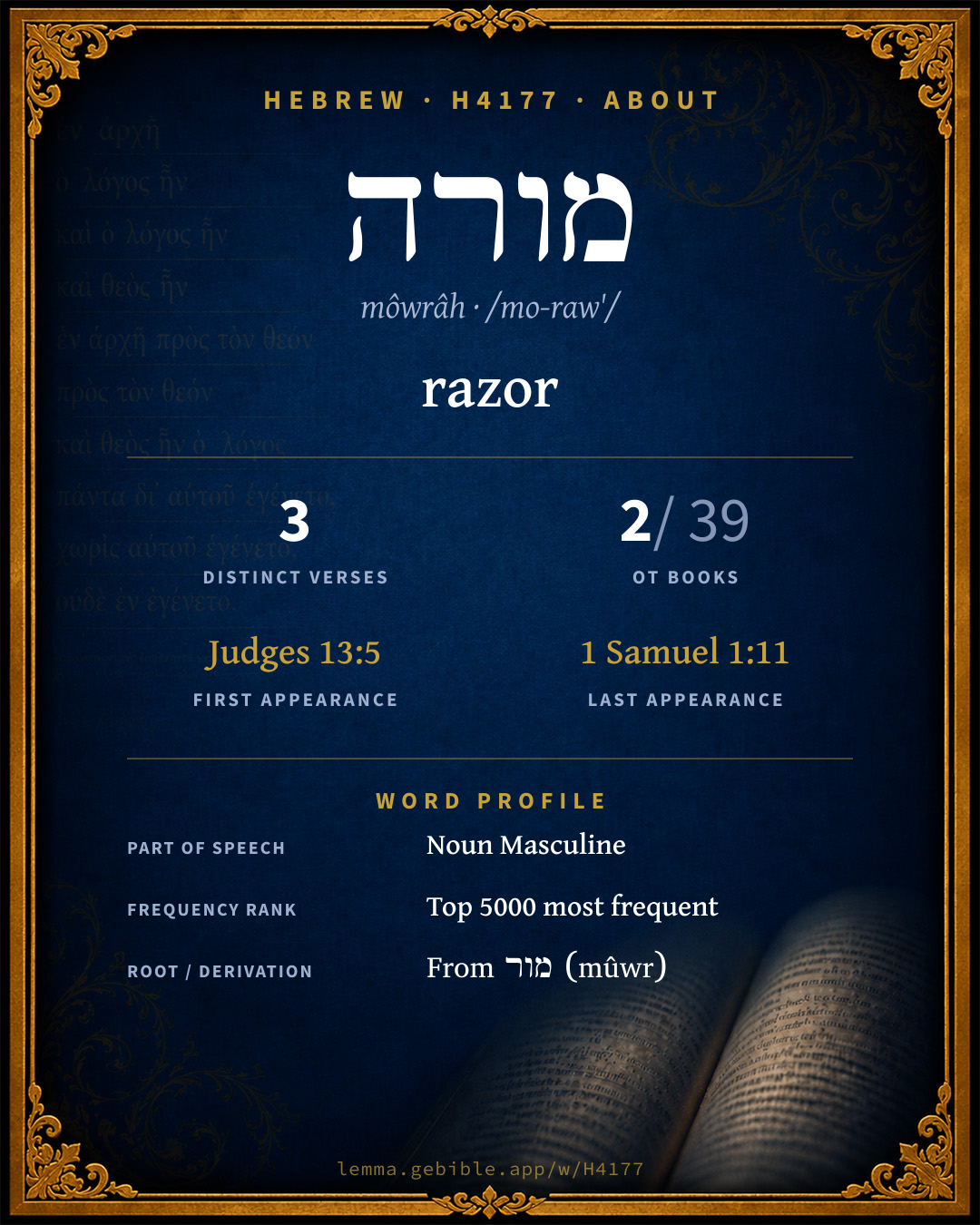
מוֹרָה
razor
Full lexicon entry — Brown-Driver-Briggs (BDB)
From Brown-Driver-Briggs (BDB)
Where this word appears
Grammar key — what these labels mean
Part of speech
- Noun
- A naming word — a person, place, thing, or idea.
Noun type
- Common
- A common noun — a general class of person, place, or thing (“king,” “city,” “water”), not a specific name.
State
- Absolute
- The independent form of a noun, not bound to a following word.
Gender
- Masculine
- Grammatically masculine.
Number
- Singular
- One.
Every verse where H4177 appears — 3 distinct verses across 2 books. Click any verse to open its interlinear word-by-word view. Verse text shown in the World English Bible for context — . Each verse’s Hebrew form is shown with its reference; the English is not keyword-highlighted, since the data carries no word-level English alignment. Use “Compare translations” on any verse to read it across multiple English versions. This concordance covers the Hebrew Bible; Septuagint (Greek Old Testament) occurrences are not indexed here.
Judges 2 verses
- Judges 13:5 וּ/מוֹרָה֙ conj + n c ms for, behold, you shall conceive, and bear a son; and no razor shall come on his head; for the child shall be a Nazirite to God from the womb: and he shall begin to save Israel out of the hand of the Philistines.
- Judges 16:17 מוֹרָה֙ n c ms He told her all his heart, and said to her, "No razor has ever come on my head; for I have been a Nazirite to God from my mother's womb. If I am shaved, then my strength will go from me, and I will become weak, and be like any other man."
1 Samuel 1 verse
About this entry
At a glance — auto-summarized from this page’s data, not written by a person. Every figure links to its source below. This summary describes the numbers; it doesn’t interpret them.
The Hebrew noun מורה centers on the idea of “razor.” With only 3 verses it sits in the long tail of Hebrew Bible vocabulary. The word gravitates to Judges (67%), then 1 Samuel. Its earliest occurrence is Judges 13:5. It clusters with מור and תמורה under a shared root. Dig into 3-verse concordance and the renderings breakdown below.
Gloss history
Strong's 1890 vs modern scholarship
About this word
Strong's H4177 catalogs a Hebrew word from the Hebrew Old Testament.
These counts are not copied from any lexicon or concordance. They are computed here, from the morphology-tagged Hebrew Old Testament. What Lemma adds →
- 3
- distinct verses
- The word appears in 3 distinct verses.
- 2 / 39
- OT books
- The word appears in 2 of 39 Old Testament books.
- #4,179
- by frequency
- Top 5000 most frequent Hebrew words (rank 4,179 of 8,640 Hebrew words by occurrence).
View all 3 occurrences in the concordance →
By traditional corpus
Conventional, traditional groupings — biblical authorship is debated, so this is a traditional corpus grouping, not an authorship claim. Each share is this word’s portion of its verses in that division of the Hebrew canon. Each figure is a share of the word’s 3 distinct verses.
- Prophets (Nevi'im) 3 verses · 100%
How translations render this word
Counts come from each version’s own published word-to-Strong’s tagging or interlinear alignment — an approximate guide to how each version renders this word, not a word-level alignment the data otherwise carries. Because each total is that version’s own tagged count, the per-version totals vary from one another and need not match the appearance or distinct-verse counts above. These counts may also differ from a printed concordance because Lemma counts each distinctly tagged rendering and does not collapse phrase taggings into a single head-word total. This is a fixed set of word-tagged versions (KJV, ASV, BSB, ULT) and does not change with the reading translation you choose elsewhere. Each version’s license is shown beside its name below (and on Sources).
BDB lists this Strong’s number as 2 distinct words (homographs). Each count above pools all of them and is not split by sense — see the Senses section below. A low-frequency rendering may belong to a different one of those words, not the primary meaning.
- King James Version†: Razor 2×
- American Standard Version†: Hath not come a razor 1×, Razor 1×, Shall no razor 1×
- Berean Standard Bible†: Razor 2×
- unfoldingWord Literal Text†: Razor 3×
King James Version Public Domain
Renders H4177 across 3† tagged occurrences — most commonly:
Plus 1 rendering that appears only once — usually multi-word phrases or single function words the recovered tagging swept in, not distinct renderings.
American Standard Version Public Domain
Renders H4177 across 3† tagged occurrences — most commonly:
Berean Standard Bible Public Domain
Renders H4177 across 3† tagged occurrences — most commonly:
Plus 1 rendering that appears only once — usually multi-word phrases or single function words the recovered tagging swept in, not distinct renderings.
unfoldingWord Literal Text CC BY-SA 4.0
Renders H4177 across 3† tagged occurrences — most commonly:
Senses in BDB
The 1 sense BDB distinguishes for this word, in lexicon order (not ranked by frequency or importance). The full entry — with sub-senses — is in the Lexicon Entry tab.
- razor
Word origin
I. n.[m.] שִׁיתָה מוֹרָה לָהֶם ψ 9:21, prob. appoint (Hos 6:11) terror (i.e. some awe-inspiring exhibition of power) for them Thes SS RV Ew De Hu Pe Che after Mas 𝔗 Aq Jer (מוֹרָה a variation of or prob. error for מוֹרָא); poss. set them a teacher, master Bae after 𝔊 𝔙 𝔖 מוֹרֶה, νομοθέτην; neither altogether satisfactory.
III. n.m. razor (√ dub.; WeSm p. 146 thinks = מַעֲרָה);—razor, always in phr. מ׳ לֹא יַעֲלֶה (עָלָה) עַל־רֹאשׁ Ju 13:5; 16:17 1 S 1:11.
— Brown-Driver-Briggs (Oxford 1906, public domain), digitized via Sefaria, supplemented by the OpenScriptures HebrewLexicon (CC BY 4.0). See Sources.
Derived from מור (mûwr) (H4171) — to change.
Jastrow Dictionary
A second Hebrew/Aramaic lexicon for comparison, covering Aramaic and post-biblical (Talmudic, Targumic, Midrashic) usage that the biblical-Hebrew BDB does not. Matched by lemma rather than by Strong’s number, so a lemma may carry more than one Jastrow headword (shown separately below), and the entries cover usage well beyond the Bible.
מוֹרָא II
- (μωρά) stupid, foolish. Lam. R. introd. (R. Simeon) (play on מוראה, Zeph. III, 1) [read:] ל"י הוא שכן בל"י קורין לשוטיתא מ׳ it is a Greek expression, for in Greek they call a foolish woman mora; Yalk. Zeph. 567 מירה (corr. acc.). Midr. Till. to Ps. IX, 21 (play on מורה, ib.) הכנס בהן … שכן בל"י … מ׳ let folly enter into their hearts, for in Greek they call a fool mora (= מוֹרוֹס). e.g. Zephaniah 3:1
מוּרָה
- myrrh, v. מוּרָא.
מוֹרָה I
- (b. h.; = מערה, of Phoenician origin, v. Wellh. Text d. B. Sam., p. 146, sq.) razor. Naz. IX, 5; Midr. Sam. ch. II מה מ׳ האמור(ה) וכ׳ as the word morah which is used in connection with Samson (Jud. XIII, 5) intimates that he shall be a nazarite, so also &c. (I Sam. I, 11); v. next w.—Num. R. s. 10 why is the razor (תער) called morah? שאין השער מתיירא וכ׳ for the hair is afraid of nothing but the razor (v. מוֹרָא); v. Midr. Sam. l. c. e.g. Judges 13:5
מוֹרָה II
- (cmp. מָרוּת) authority. Naz. IX, 5 והלא אין מ׳ אלא של בו"ד does not this morah (I Sam. I, 11, v. Targ.) mean, ‘the authority of man (shall not come upon his head)’? שכבר היה עליו מ׳ של בו"ד (Var. מורא) the authority of man was obviously upon him (I Sam. XVI, 2); Midr. Sam. ch. II (corr. acc.). e.g. 1 Samuel 1:11
מוֹרָה III
- stupid, v. מוֹרָא II.
מוֹרֶה I
- , part. Hif. of יָרָה; v. next w.
מוֹרֶה II
- rebellious.—Pl. מוֹרִים. Tanḥ. Ḥuck. 9 (ref. to המרים, Num. XX, 10) מהו המ׳ … המ׳ סרבנים what does this hammorim mean? There are several explanations of it: hamm. means ‘trouble-some’; המ׳ שוטין וכ׳ hammorim means ‘fools’, for in the sea towns they call fools morim (v. מוֹרוֹס); ויש אומרים המ׳ שמורים את מלמדיהן and some say, hamm. means those who presume to teach their teachers; (or) המורים חצים וכ׳ those who shoot arrows (with ref. to I Sam. XXXI, 3); v. יָרָה; Num. R. s. 19. e.g. Numbers 20:10
מוֹרֶה III
- (μωρέ, vocat. of μωρός, v. next art.) fool! Pesik. Shimʿu. p. 118ᵇ למלך … אל תהי קורא לבני מ׳ like to a king who gave his son in charge of a pedagogue and said, never call my son fool; מה הדין לישנא מ׳ כהדין … מורוס what does this moré mean?—As in Greek they call a fool moros; Yalk. Jer. 265; Yalk. Num. 764 לִּבְנִי מורים … (corr. acc.).
A Dictionary of the Targumim, the Talmud Babli and Yerushalmi, and the Midrashic Literature (Marcus Jastrow; London, Luzac, 1903) — Public Domain. Digitized via Sefaria. Digitized via Sefaria. Full attribution on Sources.
Forms in the corpus
The 3 distinct written forms H4177 takes in the Hebrew Bible, most frequent first — each parse links to that state’s occurrences in the concordance. Hebrew forms include their vowel points and cantillation, so a single lemma takes many written forms.
| Form | Parsing | Example | Uses |
|---|---|---|---|
| וּ/מוֹרָ֖ה | Noun, Common, Masculine, Singular, Absolute | 1 Samuel 1:11 | 1 |
| וּ/מוֹרָה֙ | Noun, Common, Masculine, Singular, Absolute | Judges 13:5 | 1 |
| מוֹרָה֙ | Noun, Common, Masculine, Singular, Absolute | Judges 16:17 | 1 |
Same root — word family
Other BDB entries built from the same root as H4177, grouped by Strong’s listed origin. These share a root / origin per the lexicon — not necessarily a shared meaning. Each links to that word’s own entry.
Derives from
Shares the same root
Compare all same-root words → They share a root, not necessarily a meaning.
Septuagint verse parallels
This word appears in 3 verses that also exist in the Greek Old Testament (Septuagint), out of the 3 Hebrew verses it occurs in. You can read those verses in Greek by switching the Old Testament edition to the Septuagint.
Read these verses in the Septuagint
This is a verse-level parallel only — the same verses exist in both the Hebrew and Greek Old Testaments. No word-level Hebrew↔Greek correspondence is claimed: the data carries no such alignment, so no Greek word is shown as this Hebrew word’s translation. Coverage is not total — the Septuagint omits the deuterocanon and renumbers the Psalms, so some Hebrew verses have no direct Greek parallel.